


And so, we come at last to the end of the road for MIGHTY COMICS, Archie’s attempt to replicate and cash in on the popularity of the Marvel titles of the day. By late 1967, the super hero fad that had driven sales to enormous numbers across the past few years had cooled off considerably, and all publishers were beginning to dump their costumed characters in favor of other fare (or, in many cases, in favor of getting out of the business entirely.) This was only a small loss, as the assorted MIGHTY COMICS that had been released can’t actually be considered good by any reasonable yardstick. But they are so obliviously wrong-headed in their approach that I find them absolutely entertaining, at least if viewed through the correct lens. In particular, as followers of this page can attest, I really loved the intermittent appearances of The Web. The final Web story of this era appeared in this last issue, MIGHTY COMICS #50.
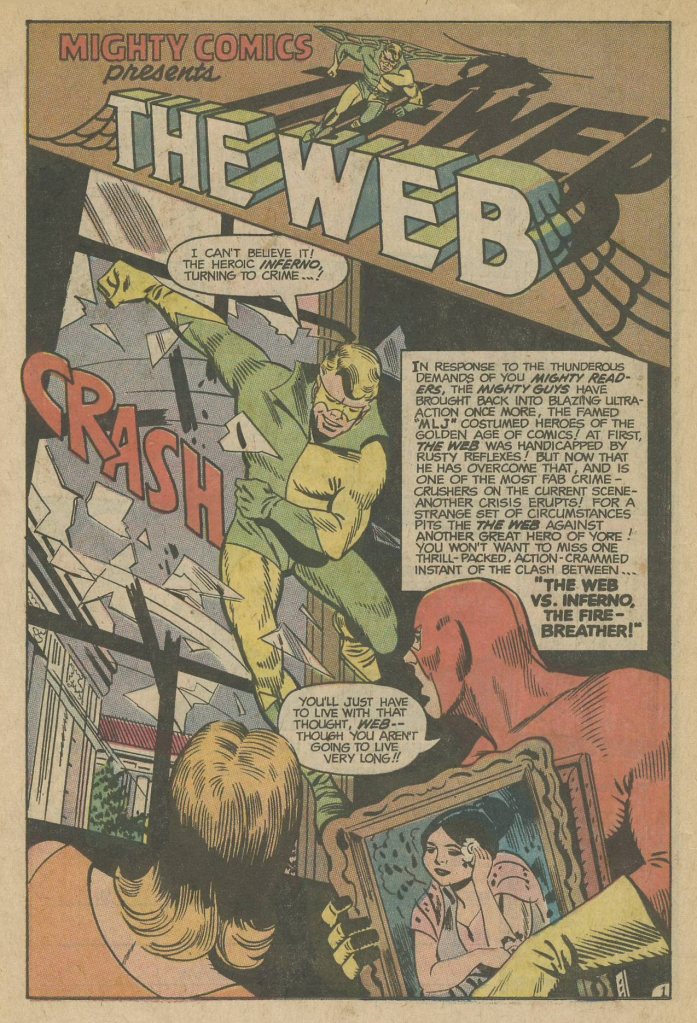
The basic concept of the Web was that he was a middle aged super hero who had been active in the 1940s, but who retired to marry his love interest, Rosie. This was all true, as the Web had been a genuine Golden Age hero, as were most of the characters MIGHTY COMICS featured. But now past his prime, the Web is compelled to resume his career as a costumed crime-fighter, even though his now-wife Rosie hates the idea of him risking his life and gives him no end of complaining about it. It’s like a gimmick 1960s sitcom in which Dick Van Dyke is a super hero rather than a comedy writer. And it’s wonderful in its awfulness.

By this point, MIGHTY COMICS had stopped running credits–or I guess I should say “credits” as, inspired by the example of Stan Lee nee Stanley Leiber, they would routinely credit their writers, artists and editors by their first name and first initial stretched out into a word. So Jerry Siegel, who wrote all of the Web stories, became Jerry Ess, and Paul Reinman, who drew most of them, including this one, was listed as Paul Arr. If their intent was to needle Stan Lee, then this is pretty funny. But I suspect that the decision to do this was as clueless about the appeal of Marvel as every other choice that they made along the way.
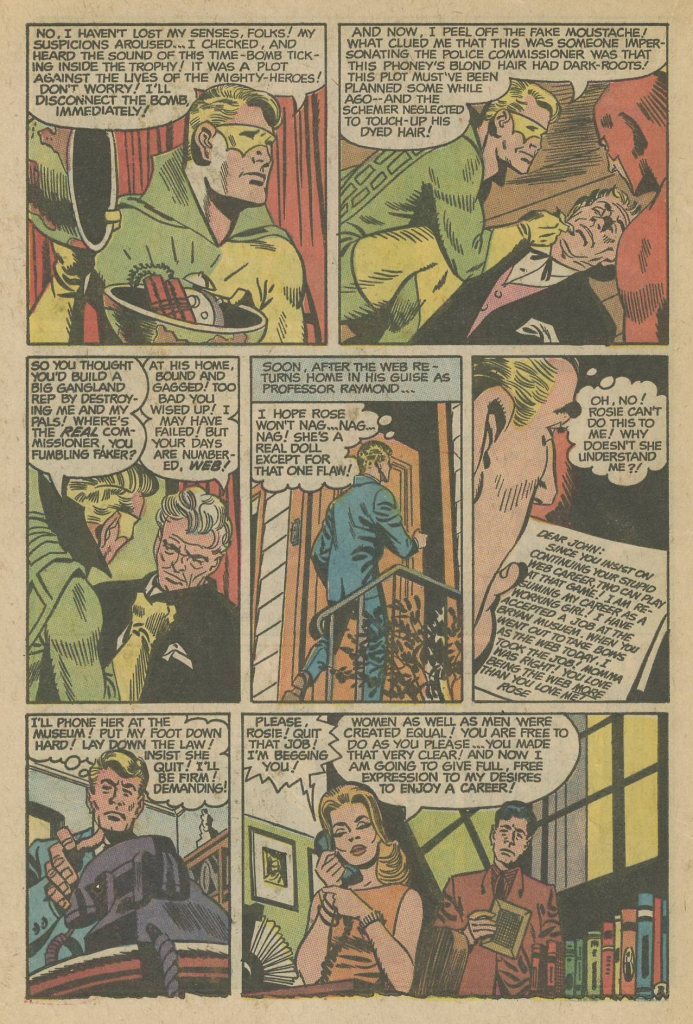
Part of what MIGHTY COMICS was attempting to tap into, apart from the growing interst in Marvel, was the rise of comic book collectors who wrote about the 1940s as the “Golden Age of Comics” in fanzines. Accordingly, MIGHTY COMICS made it something of a sales point to bring back obscure characters from their back-catalog, characters who often were only hardly remembered at all. In this story, while he’d appeared previously, the big return was Inferno, the Fire-Breather. But in emulation of what Marvel did with the Sub-Mariner, they brought him back in this story as a villain, somebody that the Web would need to combat.

Closer to home, and in true sitcom conservative American values, the Web is flummoxed by the fact that ,in retaliation for him having resumed his crime-fighting career, his wife Rosie has also decided to go back to work. What’s more, she’s working for Tom Alexander, a notable playboy. This, of course, cannot be allowed to stand–a woman’s place is in the home, bitching about her husband’s super heroic occupation! But arrivng at the scene, the Web comes upon his fellow hero Inferno burning up objects d’art and holding Tom and Rosie at gunpoint while he does so. What’s gong on here?
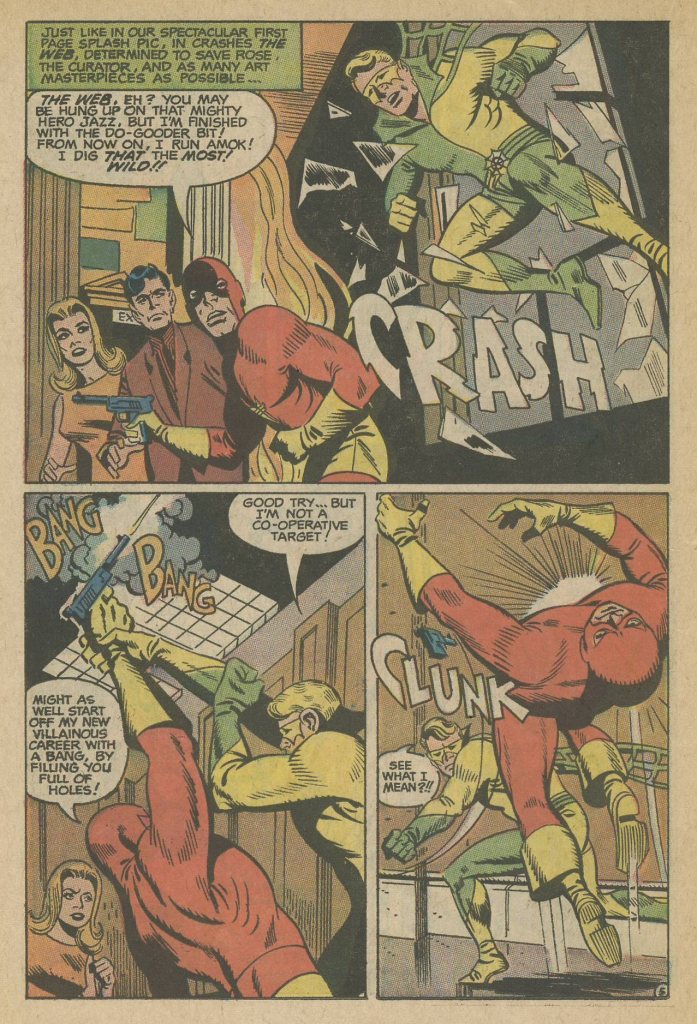
I dig that the most! Wild! Clearly, author Siegel was in touch with how the kids were jiving in 1967. Groovy!
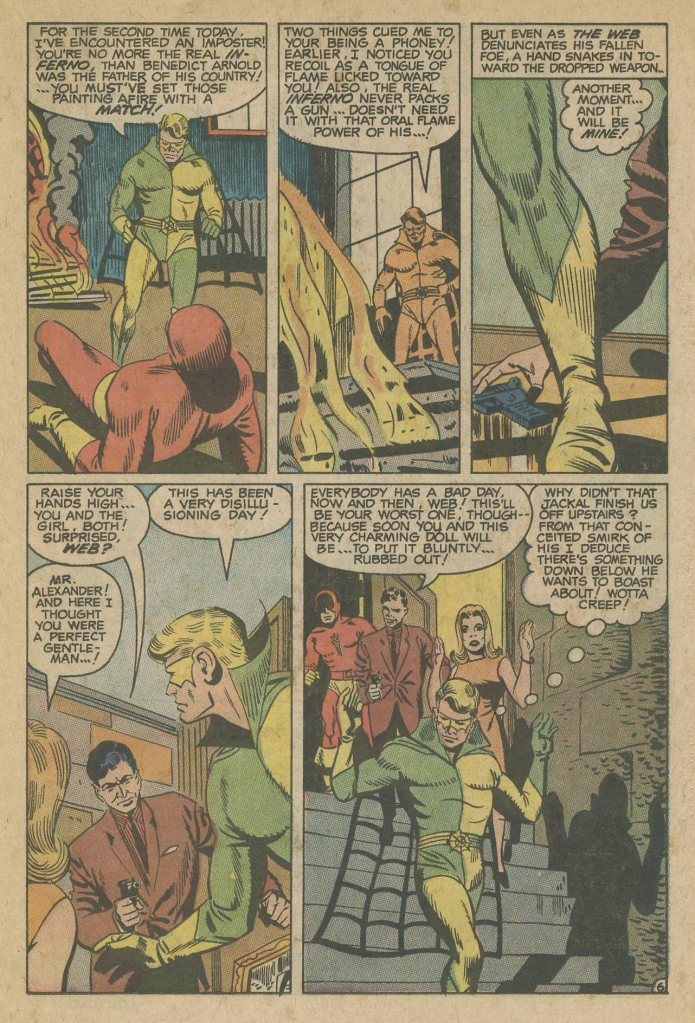
Inferno, it turns out, is swiftly unmasked as a lousy impostor. But it turns out that Tom Alexander is a bad guy too, and he turns Inferno’s gun on the Web and Rosie unexpectedly. Well, somewhat unexpectedly, he is the Web’s rival for his wife’s affections, after all. He was always going to turn out to be a cad.
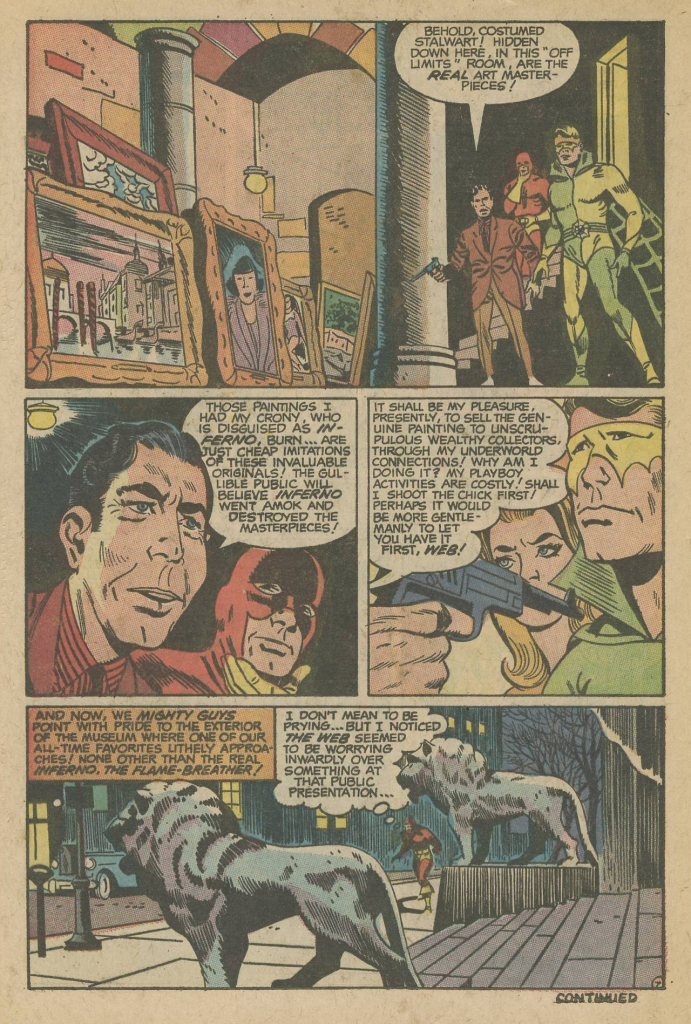
Behold, costumed stalwart! I’d imagine that Siegel was trying to channel the more flowery prose style that Stan Lee often used in his books, but he simply doesn’t have an ear for it.

Of course, it’s at this point that the real Inferno shows up. He’s been trailing the Web for reasons that don’t really make a whole lot of sense (to say nothing of the fact that he would have followed the Web back home to John Raymond’s house, exposing his secret identity. Yipe!) and so he leaps into the fray.
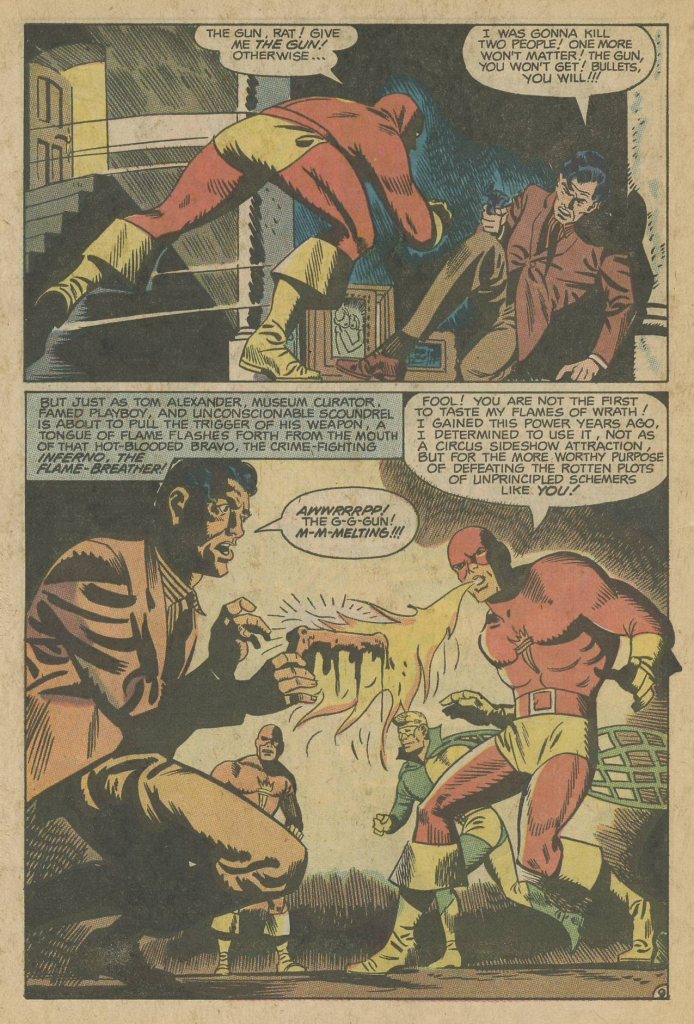
Fool! You are not the first to taste my flames of wrath! Admit it, any strip that can put forward a ridiculous line like that absolutely straight-facedly definitely has its appeal.
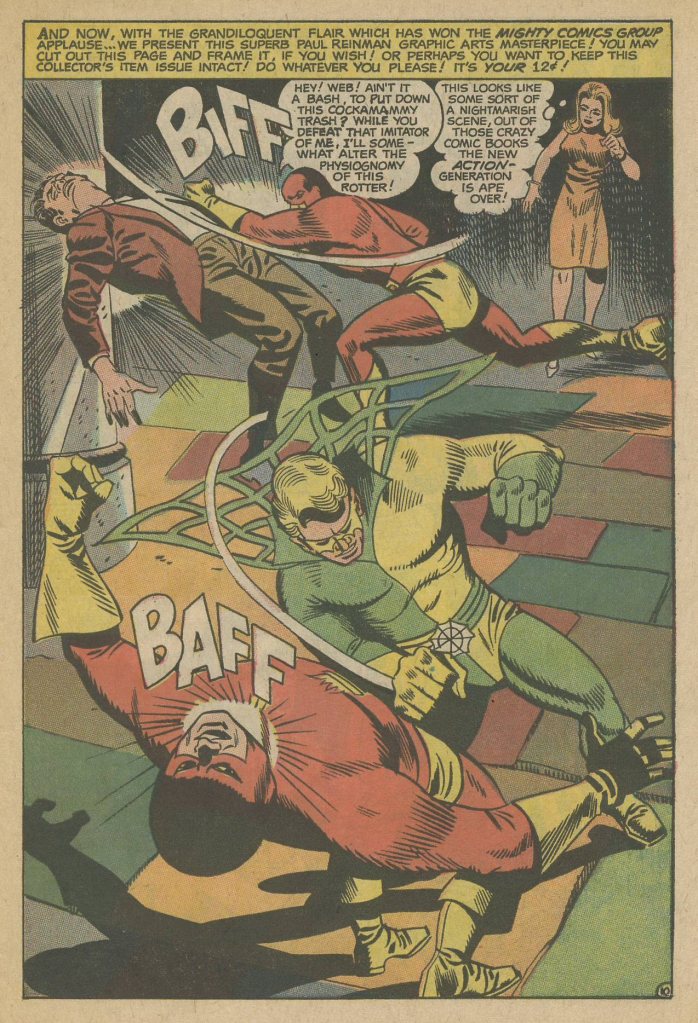
Every bit of copy on this page is a riff on something stan Lee had done in the Marvel books. And somehow, it’s all a lot clunkier than Stan’s prose. In particular, the text does give Paul Reinman’s full name, equating him with a Jack Kirby or a Steve Ditko when Lee would do the same elsewhere. And Rosie’s comment is also straight from the Lee dialogue playbook, albeit filtered to make it come across more awkwardly.
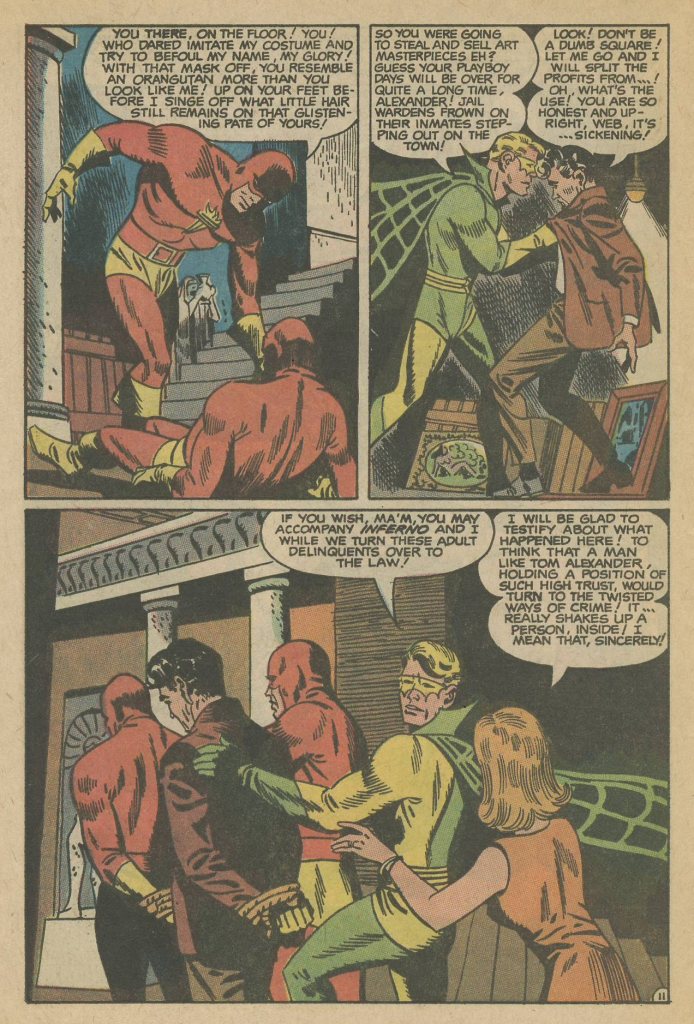
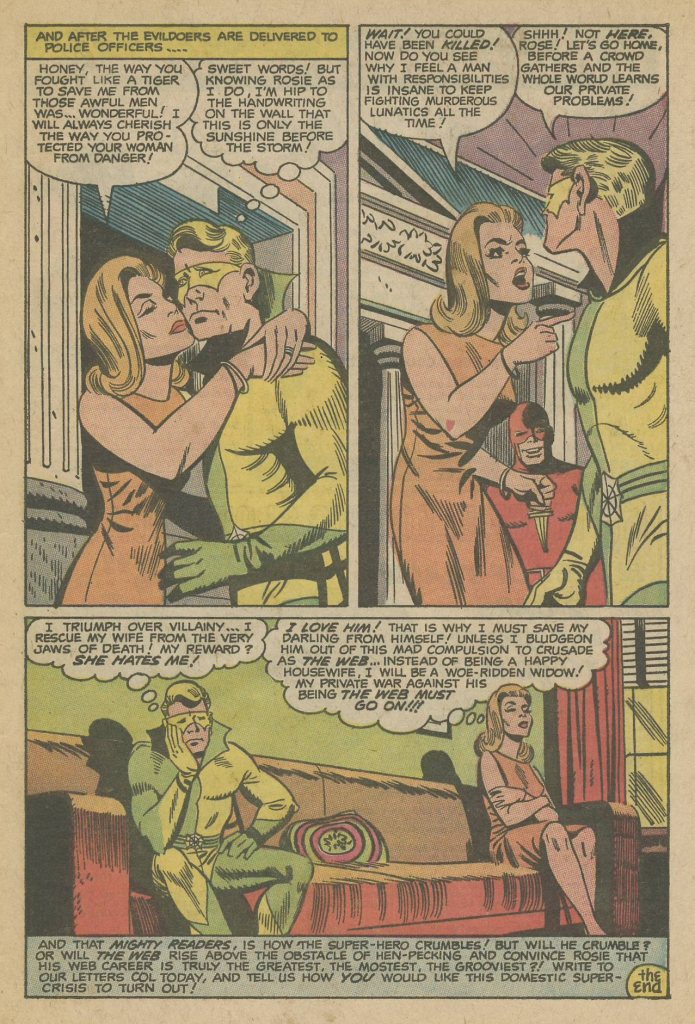
And that’s a wrap on The Web, whose final installment doesn’t change the basic set-up one iota. These stories are pretty dumb, but they’re dumb in a fun way.

They also had their supporters at the time. On the letters page to this issue, Duffy Vohland, who’d go on to work at Marvel, as a long letter printed in which he responds to recent developments in the Mighty Comics Group’s titles.
 The Tom Brevoort Experience
I picked a number of these up in the early 80’s (including this one) for the same reasons. I agree… they’re an appealingly awkward artifact of their time.
The visual storytelling, characters, ideas and concepts from the Marvel artists were way better than what Reinman is pulling off here with MLJ retreads… but I could almost see this art working in a Marvel comic with a few tweaks. He’s not great here, but he’s not the weakest link imo. There’s no saving Jerry’s repetitious writing… which is oddly confident, and at the same time terrible.
60’s Marvel was a ragtag outfit compared to DC, but I think Archie comics thinking they could replicate the success of Stan, Kirby, Heck, Ditko, etc with Jerry Siegel and Paul Reinman sort of parallels DC not understanding what the kids saw in Marvel Comics. Siegel was still capable of doing good work during this period, and It makes some sense that the co-creator of Superman would get the shot to oversee a line of comics, but some higher-up had to have major second thoughts before anything went to print.
Also.. the Web looks like William H. Macy in a few panels when he’s flummoxed… which is quite few panels.
LikeLike
I always felt a lot of the people who were claiming (& almost certainly thought) they were paying “homage to Stan & Jack’s Marvel Comics” in their comics work in the ’70s, ’80s & ’90s – it was quite a fad for quite a while there – were mostly, albeit almost certainly unwittingly, really paying homage to Jerry & Paul’s Mighty Comics…
LikeLiked by 1 person
I am pretty impressed, tho’, that Inferno can spew an entire lengthy speech at the same time he’s spewing a torrent of flame. THAT’S talent!
LikeLiked by 1 person
Probably a half dozen other writers of the time mangled “youth slang” this way. But who, save Siegel, would come up with a phrase like “oral flame power?”
I confess that phrase might hail from the Golden Age stories of Inferno, though I tend to doubt that possibility. I did read Inferno’s debut in the pages of Steel Sterling, and that dialogue wasn’t nearly as wonky as Siegel’s. If this is the last time Inferno appeared in a new story in any era, it’s sort of appropriate that he starts and ends with a crossover– though this one had no potential to spawn new stories.
I agree with Tom that the WEB series is the only Mighty Comics effort that sustains some interest these days, and that’s exactly because it’s a superhero sitcom before anyone did one literally. It might have been interesting to end the series with the story where Rose forms her own costumed identity so that she can monitor (control) what her husband does while fighting crime. OTOH, had that been the final story, we wouldn’t have had this story’s interesting word choices as “oral flame power” or Rose thinking about how she’s going to “bludgeon” her husband into staying with her in their happy home.
Wonder if it was Reinman’s decision on the last page to stick in a shot of Inferno grinning at how whipped the Web is?
LikeLiked by 1 person
“You resemble an orangutan more than you look like me!” Ain’t it a bash, to put out this trash… I thought “Rotter” was a British insult.
LikeLiked by 1 person
“I’ll somewhat alter the physiognomy of this rotter!” sounds like he’s really trying to sound British. It follows on really strangely from “put down this cockamamie trash”. Maybe he had a book of cool lines, swiped from different international heroes? 🙂
LikeLiked by 1 person
I think slang for people coming of age in the 30’s & 40’s was very different. And Jerry had that Canadian “northern exposure” (I know, that TV show was set in Alaska).
People in the US’s Northeast had multiple vernaculars. This was before the mass homogenization from TV that’d start a few decades later.
My grandparents were of that generation. They still said a few things that had been handed down from their parents & grandparents.
Jerry was at the very beginnings of the comic book business. Was one of the most successful early on. And was still working when Marvel changed everything all over again. Interesting to think about.
LikeLike