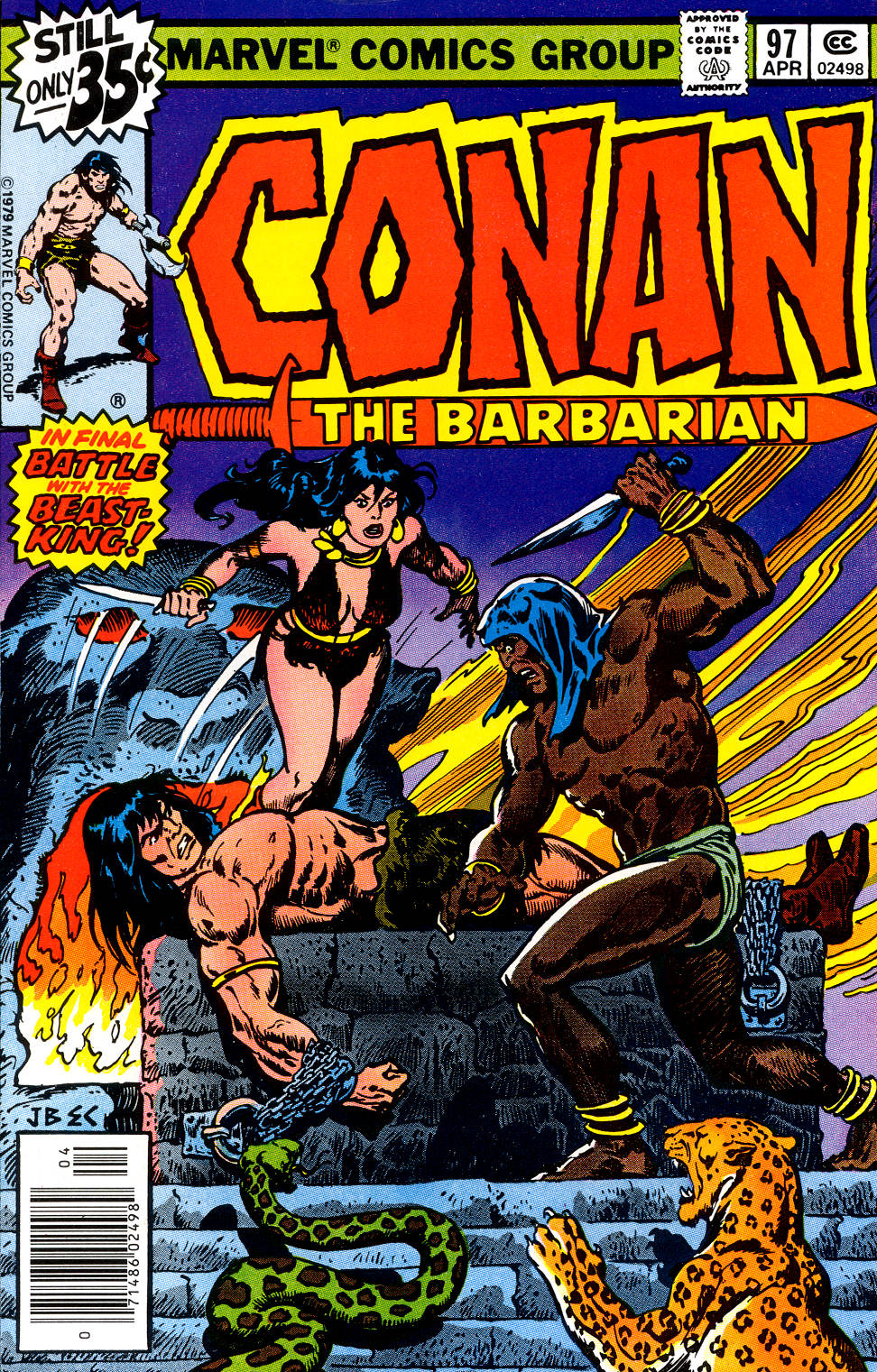


From time to time, my younger brother Ken would become interested in one comic book title or genre or another, and for a brief period of a few months read and collect it. I’m not entirely sure what caused his attraction to CONAN THE BARBARIAN at this particular moment, but for the next couple of months, he’d buy that book with regularity, as well as the black and white magazine SAVAGE SWORD OF CONAN. And of course, in the years to follow, all of those books would eventually wind up with me after his momentary interest lapsed. This issue, CONAN #97, was the first one that he bought new off of the spinner rack at the 7-11 from which we got our comic books.
Now, I know that Conan is a popular and well-beloved character and series, but it’s also a book that I’ve never entirely been able to really get into. Some of it is simply that my tastes in fantasy don’t run in that direction. I’ve never felt as though I wanted to run around the world bare-chested, fighting monsters and dangerous animals and wizards and stuff with my sword and my wits. I had enough problems with the other kids of my relative age and size. Reading CONAN often felt to me like homework. I didn’t understand the geography or the set-up of the Hyborean Age, and so trying to decipher the whys and wherefores felt like being in history class. I was all about colorful super-powers and battles with similarly colorful super-villains in a quasi-real world setting. So CONAN really wasn’t for me. I can appreciate how well done the series often was, but it consistently left me cold emotionally.
By this point, writer/editor Roy Thomas had been writing the series for close to a hundred issues. He was the person most responsible for it having been licensed by Marvel and he clicked with it immediately–so much so that he often adapted the genuine Robert E. Howard pulp stories into comic book form (albeit often sanitized for the comics Code’s protection) as well as transforming other Howard stories starring other characters into Conan tales along the way. Thomas fell in love with Howard’s prose style and drew from it directly as much as he could. Consequently, CONAN was one of the more caption and narration-heavy titles of the era, another thing that put me off from it. I was much more interested in what the characters were saying and doing than any florid play-by-play. Again, that often felt like homework to me.
The artwork for this issue was penciled (or at least broken down) by John Buscema, who had succeeded Barry Windsor-Smith on the title some years before. CONAN was a favorite assignment of Buscema’s, who consistently talked about his dislike for super heroes and how he hated drawing cars and buildings and the trappings of modern life. In CONAN, though, almost everything was organic, and this played to Buscema’s natural storytelling preferences. The inking/finishing was being done at this time by Ernie Chan, who added a lot of texture to the finish of the pages. This textured finish had become something of a hallmark of the series, and gave the book something of the flavor of antiquity. It was good-looking stuff, even if I wasn’t all that engaged by the story it was in service to a lot of the time.

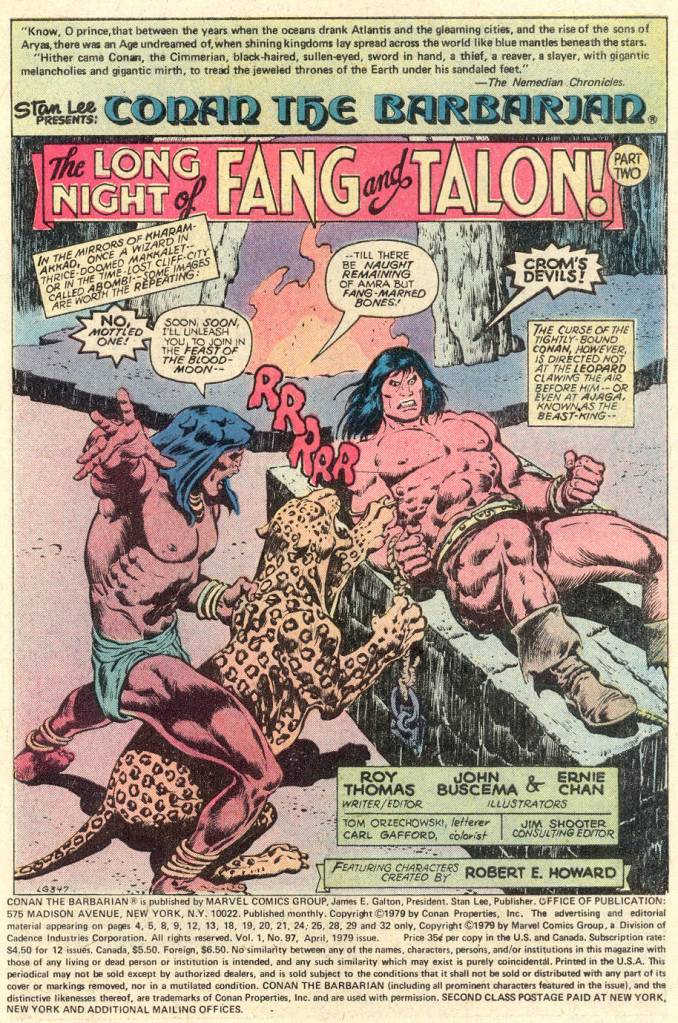
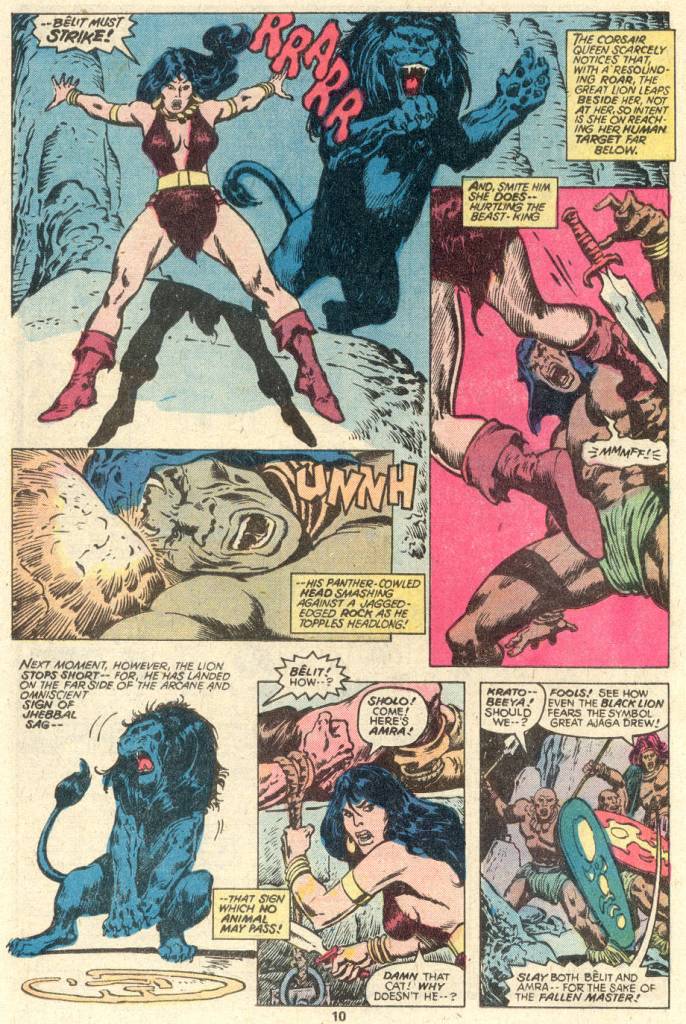
This issue opens with Conan having been captured and prepared for sacrifice by Ajaga, the Beast-King, who through sorcery controls a horde of wild animals. The Beast-King intends to offer Conan up as supper for his many carnivorous followers. But Conan’s lover Belit, the Pirate Queen, is on the trail for him, accompanied by a massive black lion, Sholo. Sholo had been in service to the now-long-dead first Amra–Amra, or lion, being what Conan was himself called in the language of the Kush. Anyway, before the ritual can begin, Belit and Sholo find Ajaga, leaping down into his chambers from above and starting a fitful battle with the Beast-King,
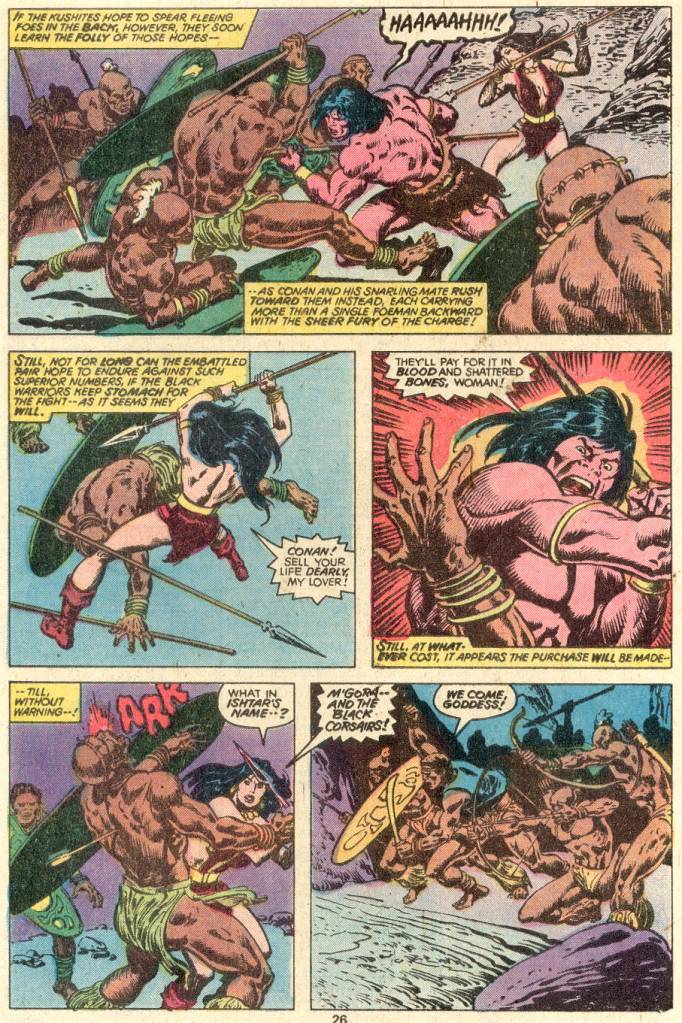
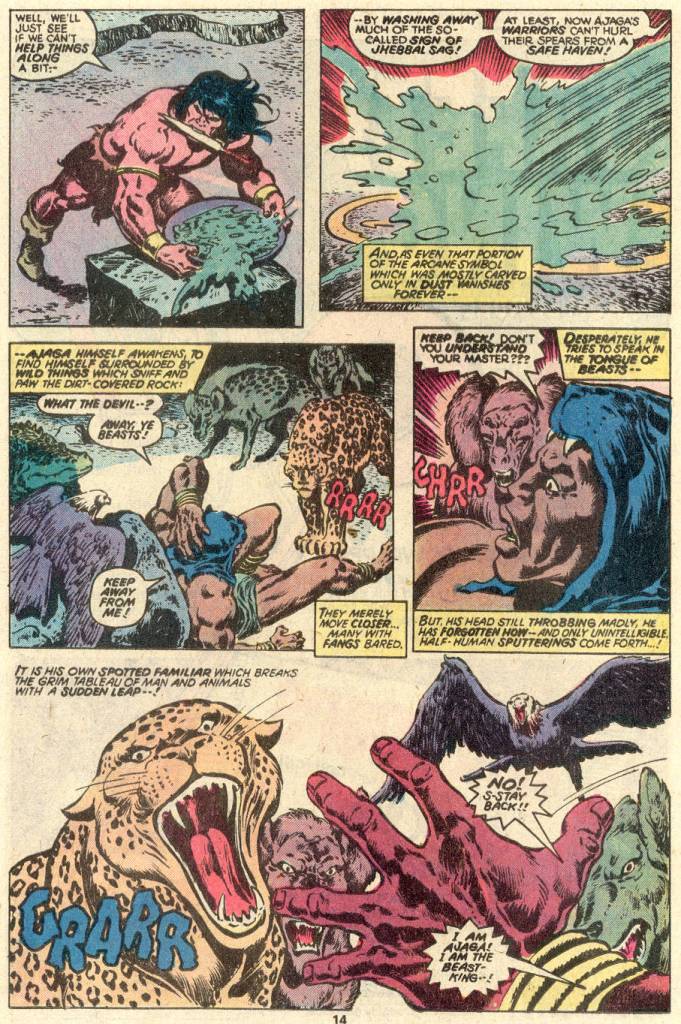
Belit swiftly frees Conan so that the big guy can get into the action and doesn’t spend the entire issue tethered to a stone altar. Having disrupted Ajaga’s spell of renewal, the Beast-King’s beastly minions begin to turn on him, and he is consumed by his own animal horde. Tough break. But the issue is only half-over, so at that moment, Ajaga’s human minions show up, giving Conan and Belit something else to battle with. At a certain point, Belit is almost pounced upon by a leopard now freed from Ajaga’s ensorcellment, but her back is protected by Sholo, the Black Lion. Moments later, it’s Conan’s turn, as the Black Lion leaps at one of Ajaga’s men who is about to spear the Barbarian, and is run through himself while biting the guy’s face off.

At this point, Belit’s pirates show up, and the rest of the battle is a rout. Sadly, Sholo perishes, having fulfilled his beastly duty to both the Amra of the past and the present. And that’s about the end of things. Conan and Belit free Ajara’s captives, content that they will return to their homes and villages and speak of the prowess of the Black Queen and her consort, Amra. Then it’s back on the sea and off to new adventures. It’s a perfectly nice tale, but I never quite understood or felt why I should care about any of it, and so its appeal was entirely lost upon me. But I’d wind up reading a few of these stories across the next couple of months, as my brother pursued his passing fancy.


For many old school, longtime Conan-heads, Ernie Chan’s textured inks over John Buscema’s brawny, bold drawings were definitive to John’s version of the character. Personally I prefer John inking his own Conan work, and there were a handful of issues that he did ink his drawing. They look fantastic. I don’t remember Al Williamson inking John’s Conan. But their “Wolverine” together was a fine collaboration. I also really liked Bob Camp’s inks over John’s drawing on just a few issues, sadly. I’d’ve loved to have seen Camp ink J.Buscema many more issues that John drew.
All that said, my fave issue of Marvel’s CtB was likely #71; drawn by John & inked by Ernie.
LikeLike
Bog standard barbarian comics always left me cold. I needed a hook besides half naked man kills his enemies.
LikeLike
On page 10, Roy brings in (or brings back in) Krato and Beeya, named for the mythological Titans Kratos (strength) and his sister Bia (force). Names Roy used multiple times over his career, though I don’t think he ever wrote a “Bia” that was a woman…
LikeLiked by 2 people
I do like Greek myth references!
LikeLike
CONAN ( Pulp Hero Trivia I learned a couple of months ago https://en.wikipedia.org/wiki/Conan_the_Barbarian under Influences ): Howard frequently corresponded with H. P. Lovecraft, and the two would sometimes insert references or elements of each other’s settings in their works. Later editors reworked many of the original Conan stories by Howard, thus diluting this connection. Nevertheless, many of Howard’s unedited Conan stories are arguably part of the CTHULHU MYTHOS. Additionally, many of the Conan stories by Howard, de Camp, and Carter used geographical place names from Clark Ashton Smith’s Hyperborean Cycle.
LikeLiked by 1 person
I think Roy Thomas’ first fifty or so issues of Conan mined tropes from both Howard and from Lovecraft, after which the Conan world became a little more mannered, with more of that “play by play” feel, except when Thomas directly adapted Howard. Lovecraft himself borrowed from a Clark Ashton Smith tale a giant toad-deity named Tsatthogua for the story “Whisperer in Darkness.” I always wondered if Thomas had Tsatthogua in mind for an early Barry Smith tale pitting the barbarian against a giant batrachian. (Hey, the b&w boom of the eighties missed a bet when no one did “Conan the Batrachian, the Fighting Frog.” It might’ve done better than Zatoichi Walrus…)
LikeLiked by 1 person
“There is a real “Zogar Sag” vibe to this bad guy. Beyond the Black River was one of Howard’s best stories and part of that was an antagonist who was even more of a natural man” than Conan himself.
LikeLiked by 1 person