

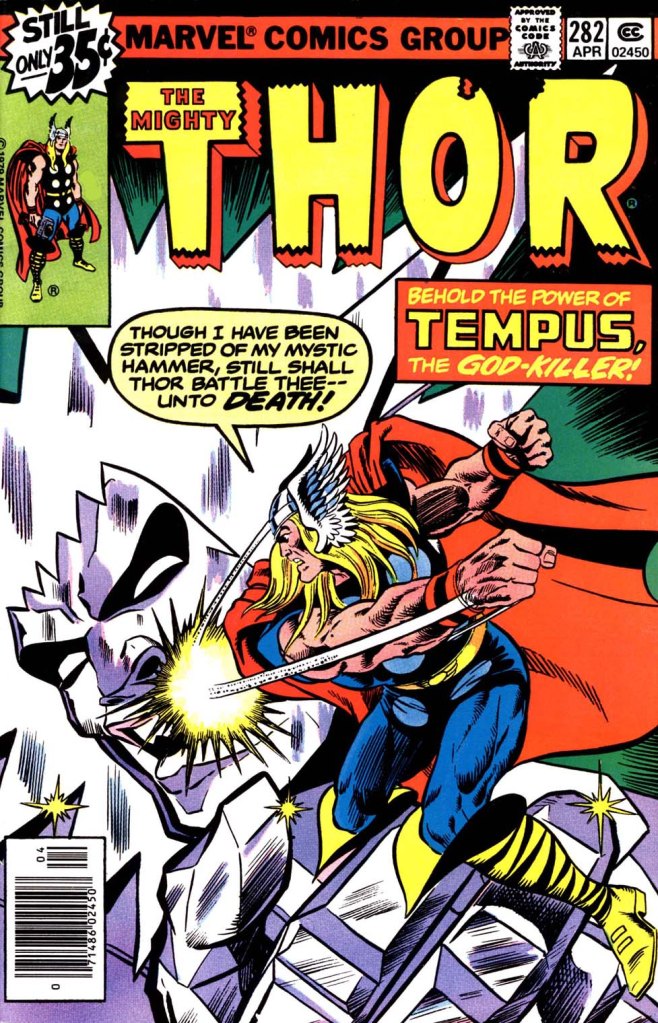
This next issue of THOR was the second part of a two-part story designed to help get the book back on schedule as writer/editor Roy Thomas prepared to get into his long Celestials storyline. This was the fourth issue in a row that felt like a bit of a throwaway, so the series was going nowhere fast. And it never sat towards the top of my buying or reading pile. But still, I was on the train, so I dutifully continued to buy the book every month. I stopped for about a month during that long Celestial storyline, but came back during a light week when I was able to pick up two issues at once, and thus not have missed anything.
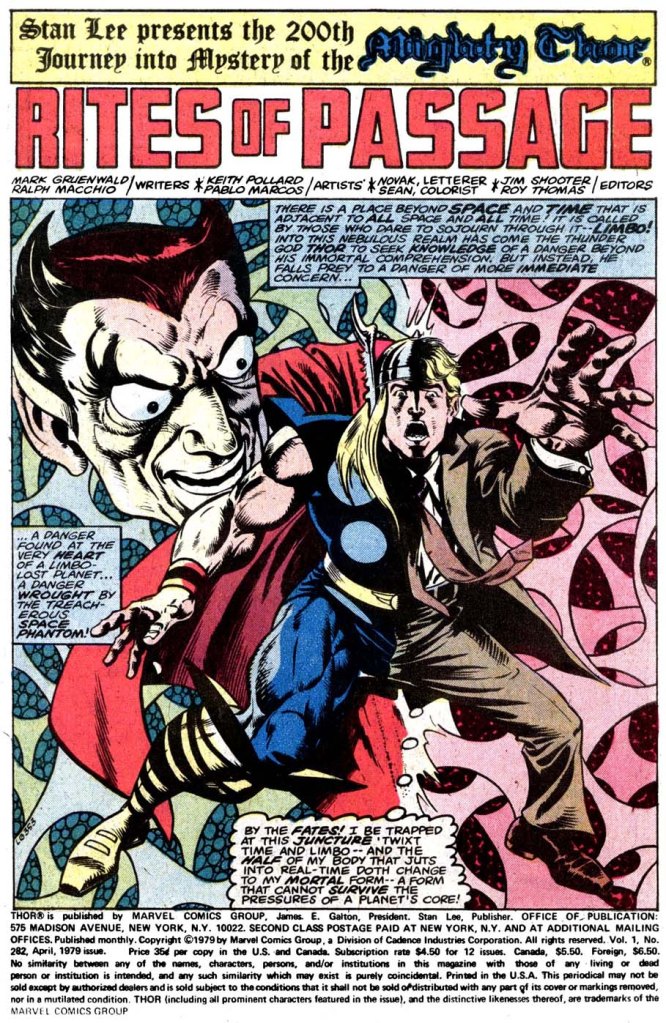
As the blurb on this first page indicates, this was the 200th appearance of Thor in the series that had started life years earlier as JOURNEY INTO MYSTERY. The Thunder God didn’t show up until issue #83, though he swiftly made the title his own. As an anniversary celebration goes, the second half of a two-part fill-in isn’t exactly prime material, but needs must, I suppose. This entire two-parter seems to have been created specifically to “fix” a power of Thor’s that bothered Mark Gruenwald. In a few early stories, Thor’s hammer Mjolnir was shown able to allow time travel. This was the sort of thing probably best ignored in the present, but at this point Marvel, especially continuity-hounds such as Gruenwald, considered everything to be canonical. And yet, he hated the idea of Thor having this power, that made it too easy for him to get out of jams, and so he and co-author Ralph Macchio set about taking that power away from him.
Last time, the Space Phantom had appealed to Thor for help, but betrayed the Thunder God, sticking him into a temporal rift like a cork. The only problem is, half of that rift was set beyond the confines of timeless limbo, and so, separated from his hammer, half of Thor transformed back into the mortal Don Blake. How being split in half didn’t kill Thor instantly is beyond understanding, but this circumstance prevents the Thunderer from being the cork that the Space Phantom needs, and so he’s convinced to rescue Thor from the very trap he’d lured him into. Thor is, understandably, irate at the Space Phantom’s treachery, but he renews his vow to help the Phantom’s people nevertheless.
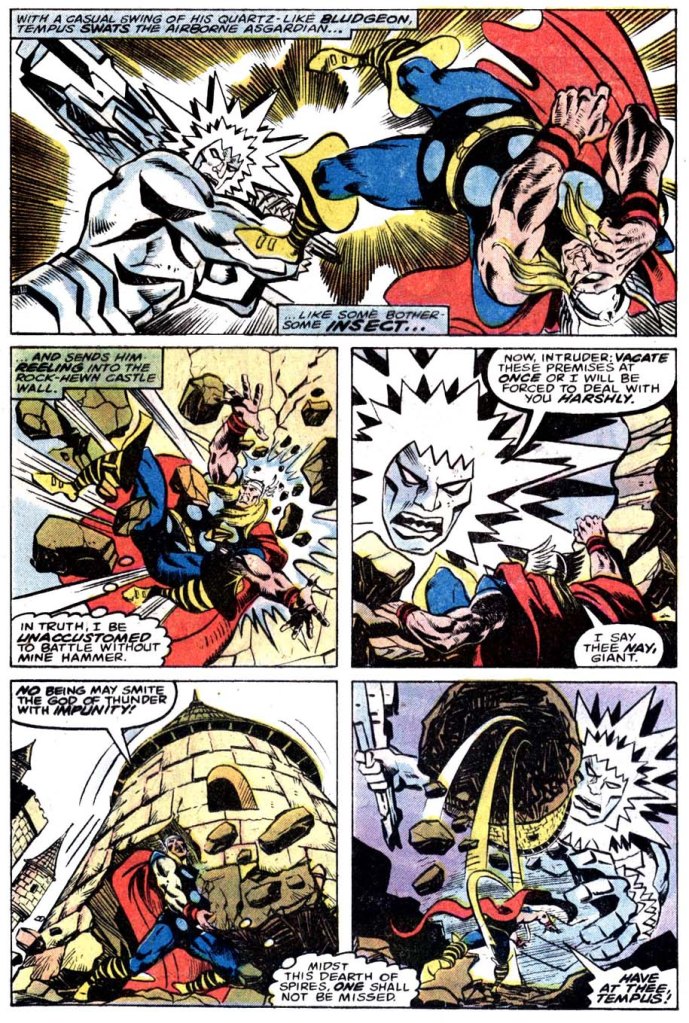
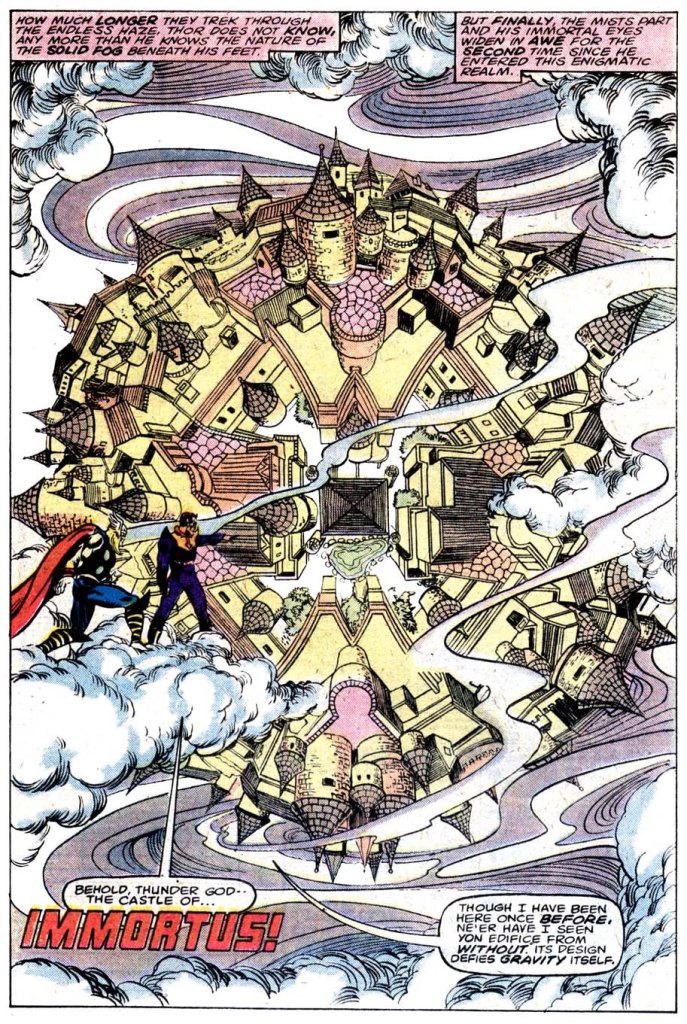
Needing to recover his missing hammer so that he’ll be able to help the Space Phantom’s planet, Thor and the Phantom journey to the center of limbo where Immortus, recently thought dead, resides. But the Lord of Time’s citadel is guarded by Tempus, a big crystal being from an old FANTASTIC FOUR story, and this leads to a fight since it’s been a couple of pages without one. Thor, of course, is at a disadvantage without his hammer, but he’s still strong enough of limb to hold his own.
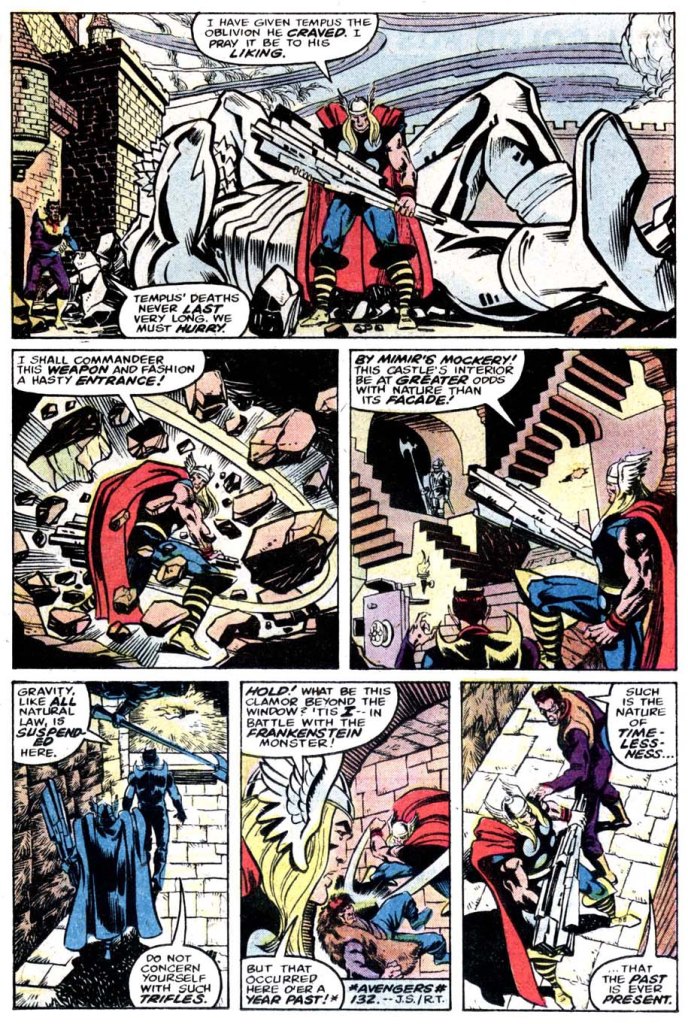
And so, after the prerequisite number of pages, Thor is able to smite his enemy with his own war club, and he and the Space Phantom enter the halls of Immortus’ castle. Thor is at one point surprised to come upon himself in battle with the Frankenstein Monster from an earlier AVENGERS tale, but the Space Phantom tells him that limbo is a timeless place, and so all events herein are happening simultaneously. Which is a fun concept if you don’t think about it too much. Anyway, the pair eventually reaches Immortus’ throne room, and sure enough, the Time Master has Thor’s hammer, which he’s only too willing to trade back for Tempus’ war club. So that bit of business is handled. What follows I can only desribe as a three-page long Marvel Handbook entry in which Gruenwald and Macchio recap all of Immortus’ past appearances, giving them some new context to fit Mark’s decisions about how time travel ought to work within the Marvel Universe. It’s a very talky, very static sequence, but as a young reader, I loved this sort of historical deep dive, so it didn’t bother me then.
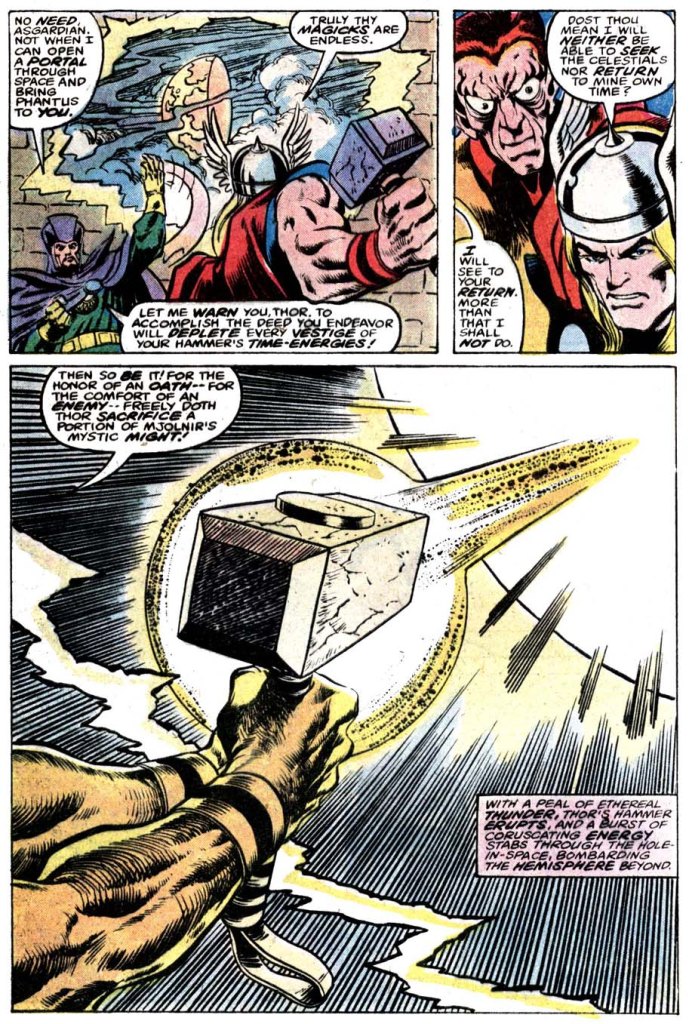
But there’s still the matter of the Space Phantom’s home planet of Phantus, which is partially stuck within limbo. Now that he’s got his hammer back, Thor can actually do something about this situation, but Immortus warns him that it will take all of the remaining temporal power the hammer possesses to accomplish this feat. If Thor rescues Phantus, he will no longer be able to use Mjolnir to traverse the timestream. But the Thunder God has given his word, and so, in an underwhelming sequence, he unleashes his full might towards Phantus, pushing it entirely through the rift and back into normal space.
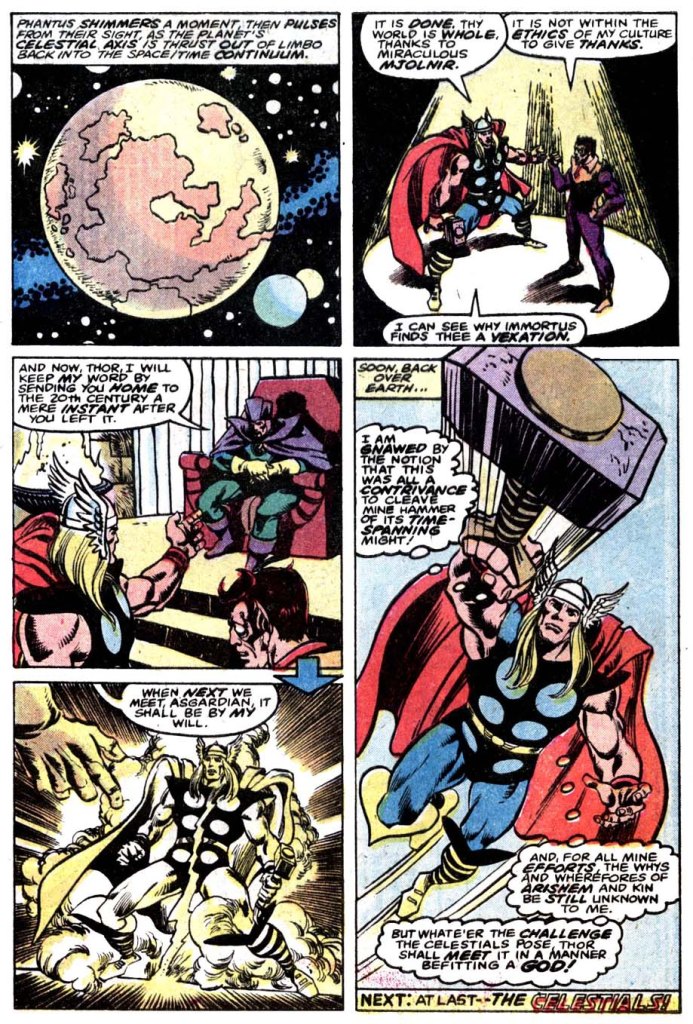
And that’s it! The deed done, Immortus returns Thor to his rightful place and time, and everything’s fine. But Thor can’t help but wonder if this entire story was merely a contrivance to strip his hammer of its temporal properties–which it very much was. Mark and Ralph hang a big ol’ lantern on that fact in this final panel, in a manner that’s just a little bit cheeky. And once again here, we’re promised that next issue we’ll finally be getting to the Celestials–and this time, that prediction is accurate! But that was still a month away for me.
 The Tom Brevoort Experience
Just another case of Gruenwald having no story to tell but just another “problem” to fix. So tiresome.
LikeLiked by 1 person
But can’t Thor still do that by going to Asgard ( see Official Handbook map ) and use either the Cave of Ages ( in Nornheim ) or Cavern of Time ( in the Asgard Mountains )? Mark was alive when Doctor Strange cast a spell to do what he didn’t want Thor doing with his hammer’s Time Travel abilities [ The Uncanny X-Men#191 ( March 1985 ) ] which was undoing everything Kulan Gath did in The Uncanny X-Men#190-191. Was that a double standard on Mark Gruenwald’s part or was the X-Men outside his control?
LikeLiked by 1 person
I’ve never seen this I’d’ve been 7, close to 8 years old then. But if I’d seen it 5, 6 years later when I had my own spending money, I’d’ve bought this just for the art alone. Some of these panels look fantastic. That opening splash made me think of Gil Kane. Thor highly detailed right thigh, and Space Phantom’s poppin’ eyes. I think of the SP as a small, thinner character. He looks powerful here.
Thor himself looks great. Next to John Buscema, Keith Pollard might’ve done the best straight up superhero version. Excluding more ethereal, fantasy, or even naturalistic styles that I also love very much. Sometimes limbs can get wonky, short-cut w/ that deadline looming. Everything here is balanced, and dynamic. The action moves. Thor’s right arm swung back, the anatomy’s spot on w/o being over rendered. Then just below it, most of the page shows that amazing blast from Mjolnir. The stone-like Uru hammer, all that lighting and shading o the arms and hands. Epic.
Gotta also cite that ariel layout of Immortus’s castle. Damn. Pollard & Marcos poured a tremendous amount of care into this issue. Great stuff. And that last panel of the issue, Thor flying, about perfect. I’d call this issue a win. Just now thought; 6 or 7 years on, Roger Stern brought the Avengers to Limbo looking for Kang, and they came across the Space Phantom. Had he been there ever since this issue??
I noticed both Roy Thomas and Jim Shooter were credit as editors. I’ve seen Jim called the “consulting editor” in Roy’s other Thor issues around then (Roy as “Writer/Editor”). And the *footnote is credited to both sets of initials (“JS/RT”). If I didn’t know that there was some eventual tension between them, I wouldn’t have thought too much of it. But now I’m embellishing it a bit, think both may have insisted on taking credit, or just not wanting to be left out of a footnote. Like it mattered that much. A power/pride thing. Or it was all good, and including both initials was just a courtesy. Nobody “pulling rank”.
LikeLiked by 1 person
Totally Agree about page 1. Eye-catching well crafted imagery by 2 total pro’s. To my eye’s Marco’s inks were a perfect fit for Pollards pencils. I’ve seem some of the Original Art from these issues on the web and it’s is outstanding; Google “Thor 282 Original Art 1979 fans”
LikeLiked by 1 person
“Avengers” Annual #16, 1987. Several artists each drew & inked different chapters. A contest between the Grandmaster & Death. Avengers vs. dead heroes & villains. Keith Pollard is credited for drawing “breakdowns” for 6 pages, inked by the great Al Williamson. Great storytelling & panel/page layouts. Dynamic, expressive figures. Elegant finishes, Some of my very favorite ever stuff in superhero comics.
LikeLike
When Roy had stepped down as Editor in 1974, he’d been given a contract where he could be writer/editor on his books. The same deal was given to Len and Marv when they stepped down (until they went to DC at least.) Once Jim Shooter became EiC, he decided nobody was going to get to edit their own work any more, so when Roy’s contract came up for renewal, he also moved to DC. I’d imagine this was written during the tense period when they both decided they were editing Roy’s work.
LikeLiked by 1 person
Roy Thomas has never complained about editorial interference from Jim Shooter. His problem with Shooter was that he felt Shooter was trying to undermine, or more specifically, usurp his status at the company. It was an ego thing; Thomas resented Shooter’s ambition. I believe he also resented Shooter’s outspokenly disdainful upending of the overall editorial structure that Thomas had put in place at Marvel earlier that decade. Shooter moved away from the laissez-faire structure Thomas established in favor of the group-editor set-up that DC had long used. But the evidence is that Shooter respected the prerogatives of the writer-editor status while those contracts were in force. He was opposed to continuing it when those contracts came up for renewal. James Galton, Marvel’s president at the time, was on his side with this. Galton came from the book-publishing world, where allowing people to edit their own work was verboten. Marvel never reinstituted the writer-editor status after Shooter did away with it. DC experimented with it in the 1980s. They regretted that, as the writer-editors treated it as a license for public insubordination, and got themselves fired.
The credits on the writer-editor books at Marvel generally listed the editor-in-chief as a “consulting editor.” Since this issue had the “consulting editor” being the de facto one, the “consulting” was dropped. I suspect Thomas’s name is only on this as a courtesy given that he was the series editor at the time.
LikeLike
I doubt Roy or Jim cared about a footnote. Despite having the editor “sign” them, those were almost all written by the writer, not the editor, and what happened here was that Mark & Ralph knew that Roy and Jim were both credited editors of the issue (since they also wrote the credits), and decided to credit them both in the footnote.
In all likelihood, neither Roy not Jim looked at the script before it was lettered. Jim, as EIC, might have read the finished comic before it went off to the printer, but he might not have looked at it until it the make-ready was delivered, depending on his workload. And Roy may not have had much to do with the issue at all, beyond approving the story concept. He had plenty of other things to occupy his time, and was of the era of Marvel editors largely letting the writer of the book do the bulk of the editorial work. And with Mark and Ralph both in the office and working as editors, that’d be easy for them to do.
LikeLiked by 1 person
Speaking of the Gru-Mac team, I have never read anything about the two men’s relationship with each other or how it worked them writing as partners. I honestly should have been curious by now considering how much I loved their stuff. It was brief but 2 In 1 was a sub par book before and after that exceptional run.
LikeLike
Their post Roger Stern Avengers was a hard slog for me. Each issue I hoped wouldn’t be as bad as the previous. Even Simonson couldn’t save it. I finally dropped the book.
LikeLike
I may be in minority here, but I love Thor 281-282. I was a child then and it was a FUN read plain and simple. Whereas most of the Celestial Saga for me at my young age then was unintelligible. Still I dropped other books when funds were tight, but Thor was my fave back then and he stayed regardless.
I also love the Pollard/Marcos artwork then in the mid-late 280’s Pollard/Stone.
BTW: To me it seem the Immortus Castle idea from #282 was loosely adapted for use in the Disney+ Loki Series.
P.S. Very Cool 1/2 page of Mjolnir!
LikeLiked by 2 people
Space Phantom looks like a creepy version of Star Fox.
LikeLiked by 1 person
I thought Starfox was a creepy version of Starfox. 😉
LikeLiked by 5 people
“Midst this dearth of spires” … ? Someone needed a dictionary. I suppose “wealth” would do as a substitute.
LikeLike