

A few years ago, I ran a piece on the first book-length comic book story ever produced. You can take a look at that page here:
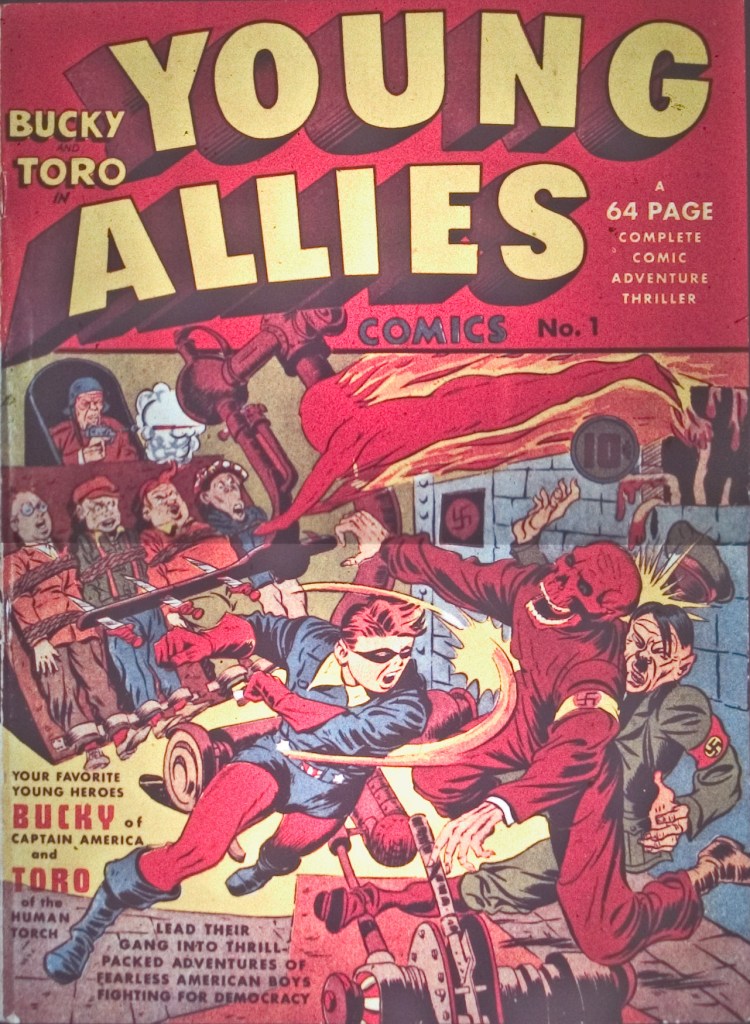
But as it turns out, I had overlooked something. Prior to ALL-FLASH COMICS #2, there had been at least one earlier book-length story produced. And it saw print in the first issue of YOUNG ALLIES COMICS #1 in July of 1941.
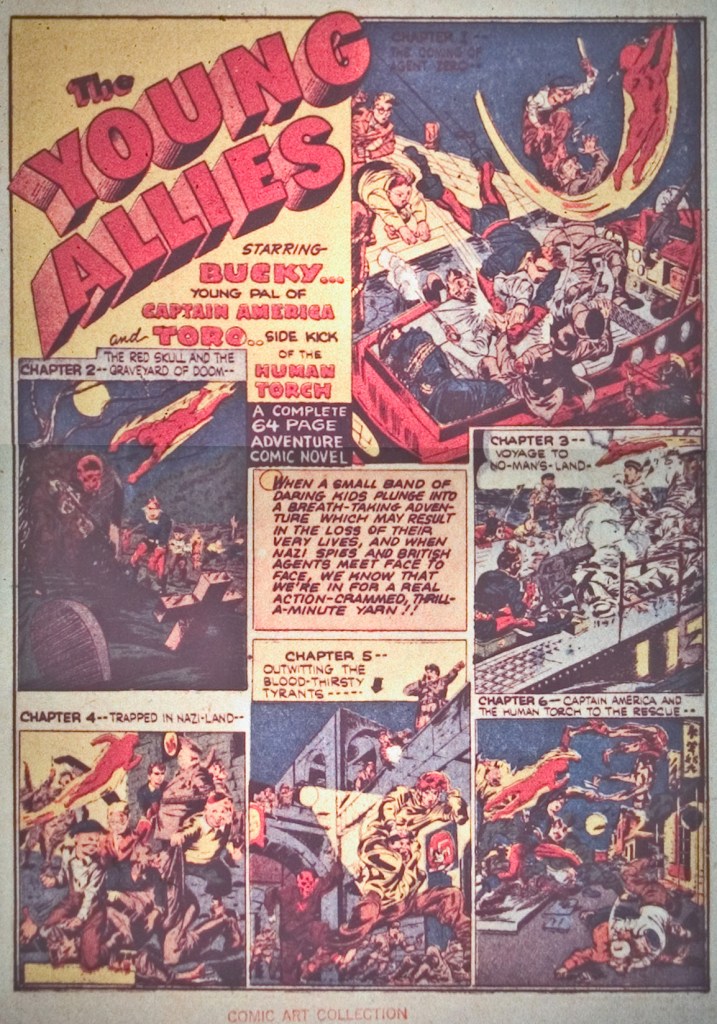
YOUNG ALLIES was the creation of Joe Simon and Jack Kirby, who were then tearing up the sales charts with their CAPTAIN AMERICA COMICS. At the time, Simon was also functioning as Timely Comics’ editor, so he was looking for other projects that the team could do to bring in some additional revenue. Inspired by their own years growing up, Simon and Kirby invented an entire genre of comic books here, which came to be known as “kid gang” comics. And there were dozens of them throughout the golden age and into the 1950s, many produced by the Simon and Kirby team, but several put out by others intent on grabbing some portion of the audience for such titles.
As the name implies, Kid Gang comics focused on a small group of ordinary teens banding together to take on criminals or fight in the war effort or just to unite in whatever their common cause was. And the breakdown of character “types” here was often emulated in later such strips, whether by Simon & Kirby or by others. The Young Allies included Knuckles, the tough kid from Brooklyn, Tubby, the jovial fat kid, Jefferson Worthington Sandervelt, the bookish smart kid, and Whitewash Jones, the unfortunate and terrifically racist African-American kid.
What made YOUNG ALLIES stand out from future kid gang comics was the inclusion of two characters from other series. The leader of the group is Bucky from the Captain America series. And in fact, the Young Allies are initially simply members of Captain America’s Sentinels of Liberty club, membership to which was offered in CAPTAIN AMERICA COMICS. The other headliner in the book was Toro, the junior sidekick of the Human Torch. He would have a continuing rivalry with Bucky throughout the series as to which one was better suited to lead, and by extension which hero, Captain America or the Human Torch, was the best.
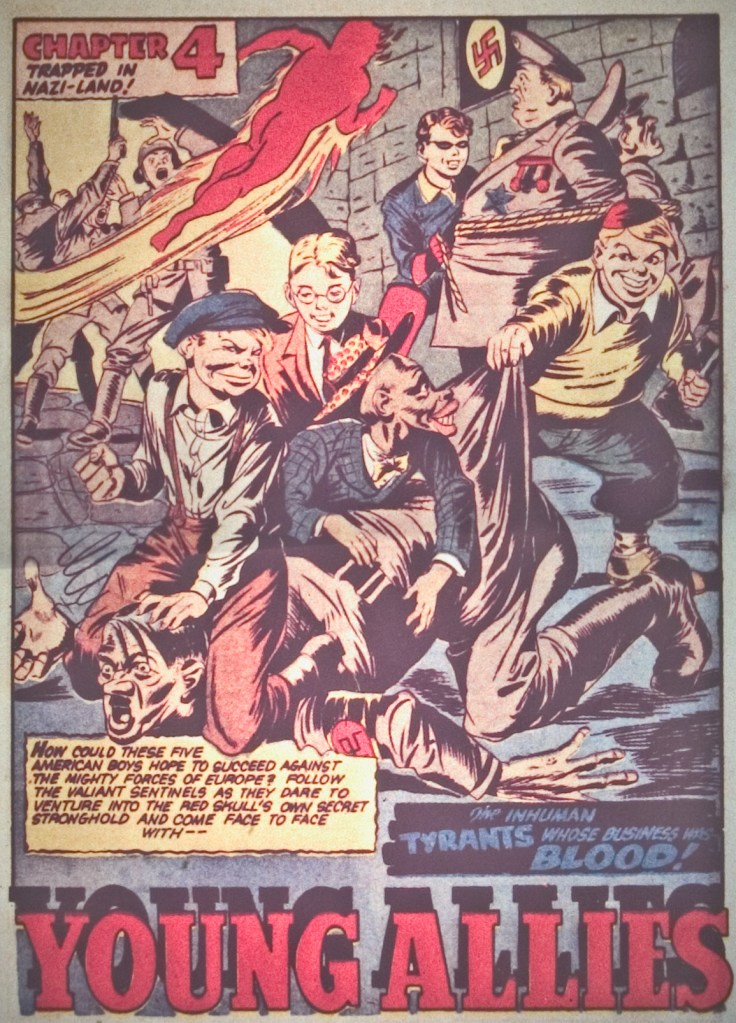
As an additional grabber in this first issue, Simon and Kirby threw their new group up against Captain America’s greatest enemy, the Red Skull. The Skull had proven to be extremely popular, so much so that he was brought back after dying in his first appearance (without even much of an explanation as to how) and he was a regular reoccurring figure in the Captain America stories of the wartime period and beyond. In essence, Simon and Kirby were using the popularity of super heroes to bring in readers and expose them to their new concept, giving it the best practical change for success. And succeed it did. The YOUNG ALLIES COMICS title ran for 20 issues and the group was also showcased in other books such as KID COMICS over the years.
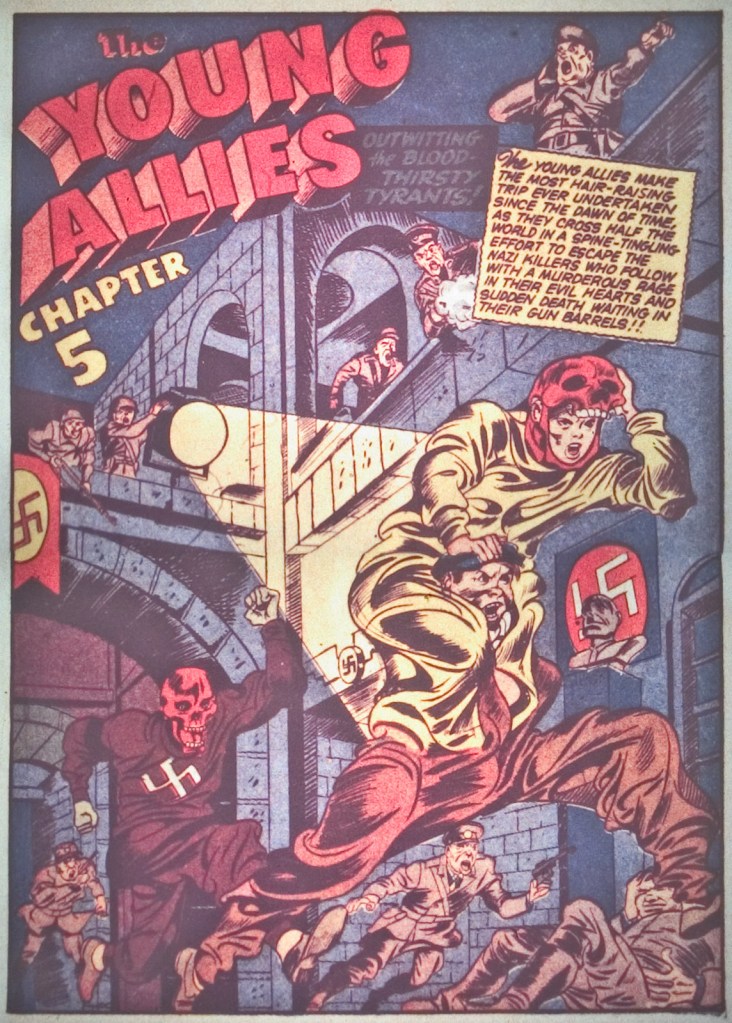
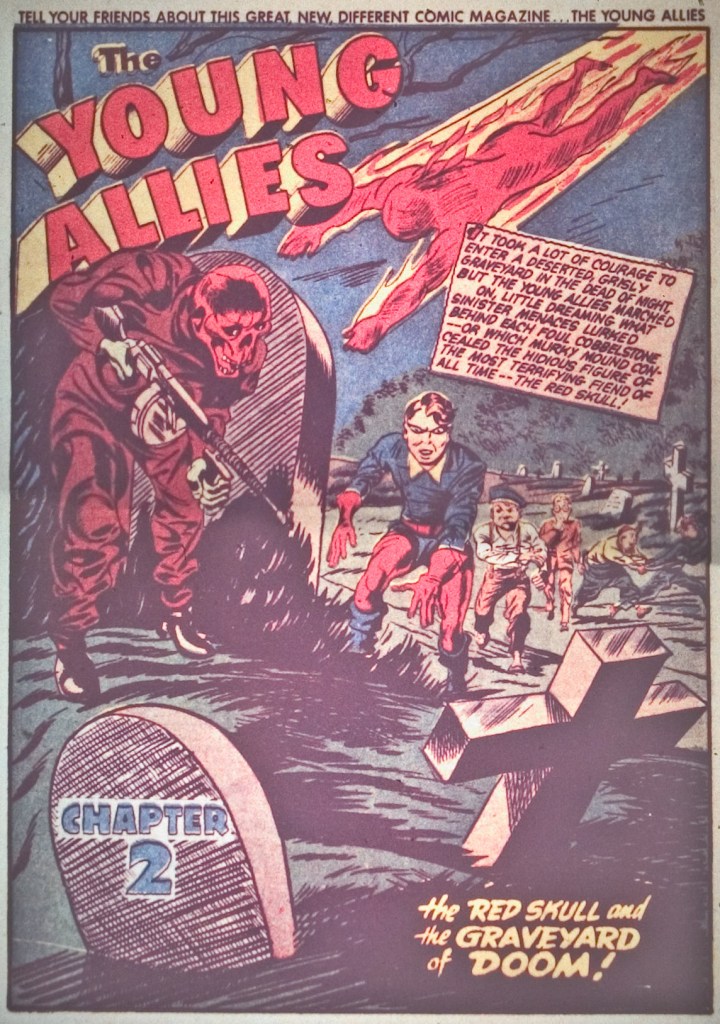
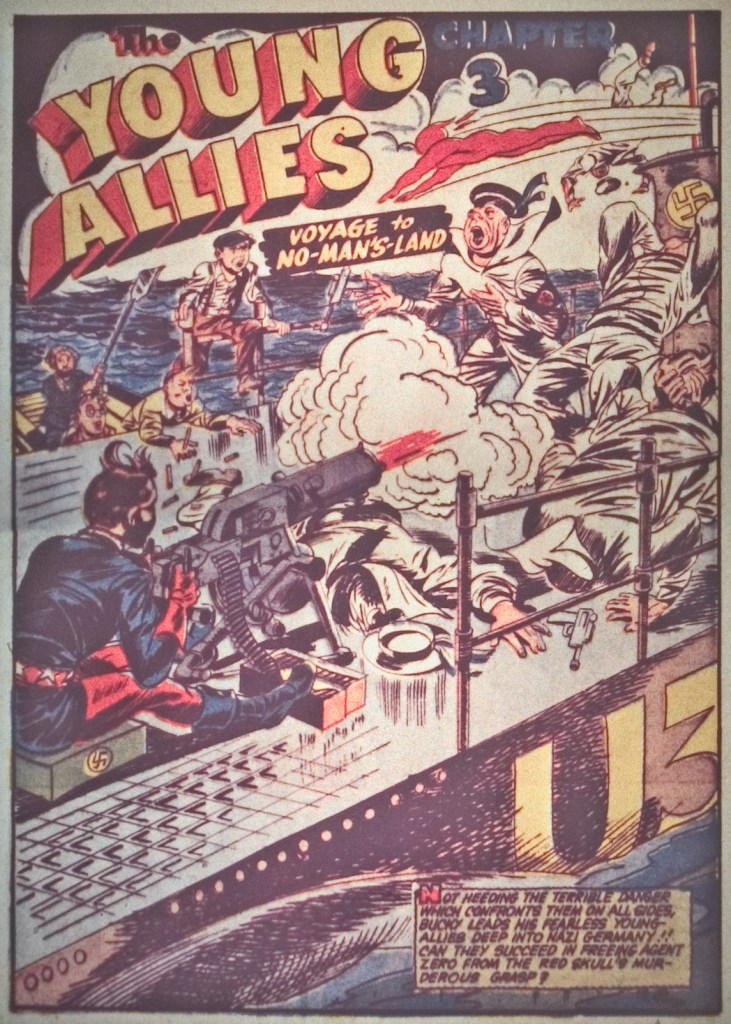
This first Young Allies story wasn’t produced by Simon and Kirby alone. While they may have done some of the broad-form plotting, and Kirby contributed the chapter break splash pages to each chapter, the issue was actually scripted by Otto Binder and was mostly illustrated by Charles Nicholas. Syd shores, who would take over the CAPTAIN AMERICA strip following Simon & Kirby’s departure, inked at least the Kirby pages. The plot is a banger, which sees the newly-formed Young Allies assisting British Agent Zero, who has a secret code that’s of interest to the Nazis and the Red Skull in particular. The adventure carries them all the way to Germany, where they’re imprisoned in a Concentration Camp, which they are able to escape from when Bucky paints a human skull red and somehow fits it over his own head to impersonate the Red Skull. Comics, right?
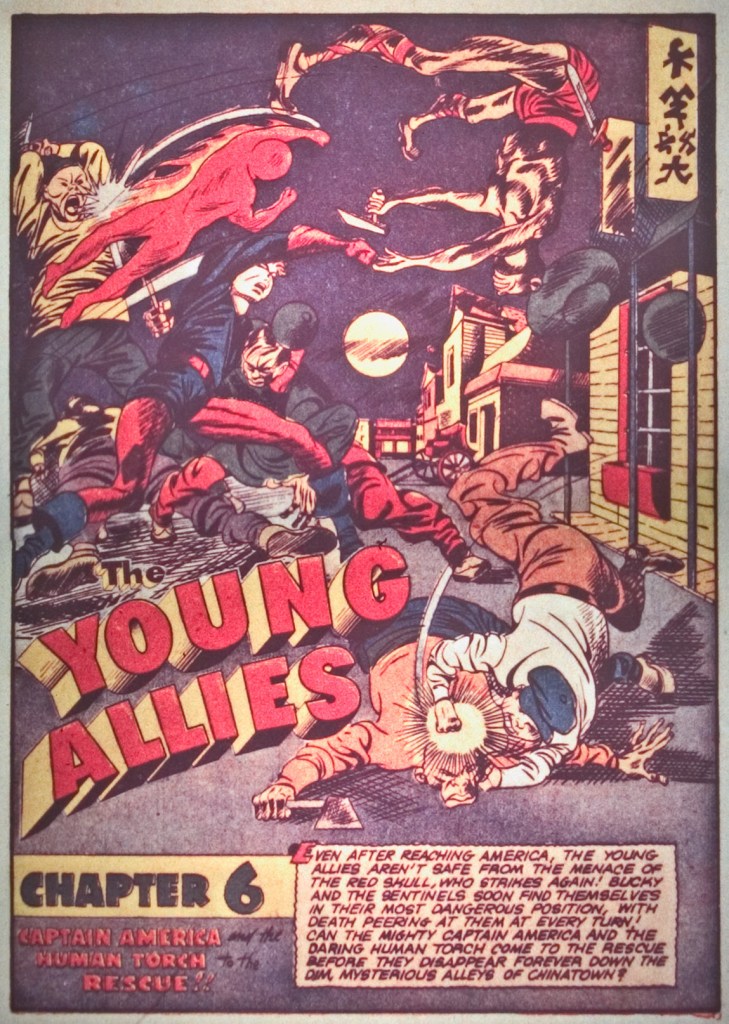
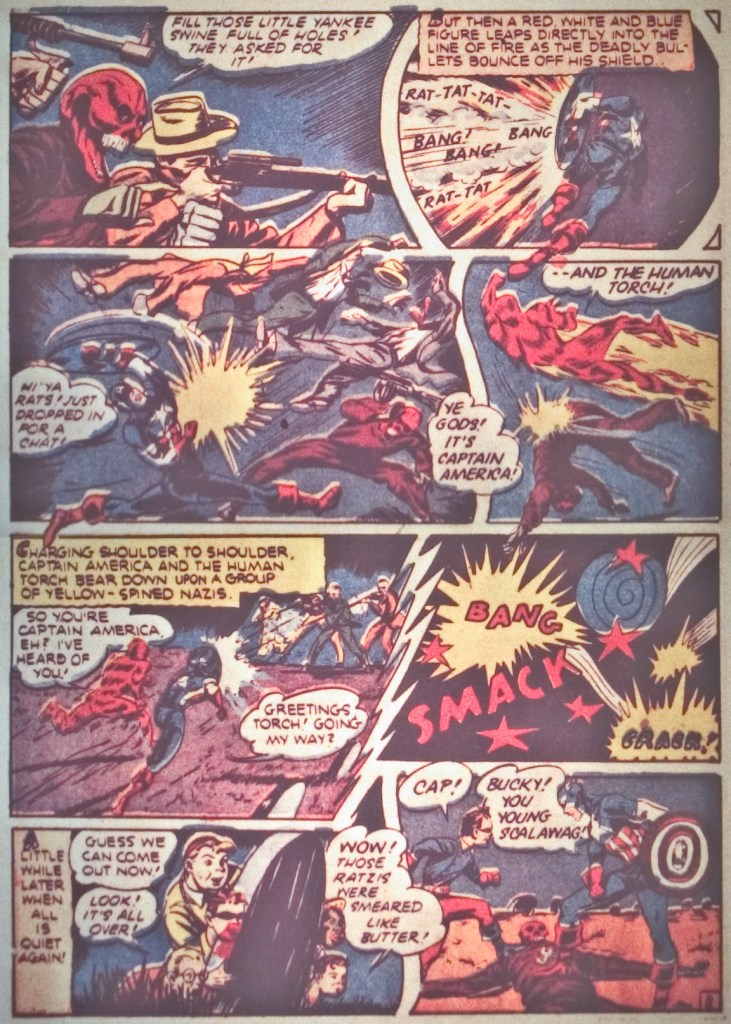
In the final chapter, having made it home after several adventures in several nations, the Young Allies and Agent Zero are still under attack by the Red Skull, and so there’s only one thing to do: call in Captain America and the Human Torch to deal with the situation once and for all. This story represents the first meeting between Cap and the Torch, and is another example of a rare crossover between characters and strips during the Golden Age. In the end, of course, Agent Zero is revealed to have been a woman the whole time, much to the astonishment of the two-fisted red-blooded Young Allies.
Many of the follow-up issues of YOUNG ALLIES COMICS also featured book-length epics, though none quite as extraordinary as this first one. Eventually, though, the series settled into a pattern of featuring two shorter Young Allies stories in each issue.

While it was rare at this time to credit the creators working on any given series, on the inside front cover of YOUNG ALLIES COMICS #1, both Joe Simon and Jack Kirby are credited as editor and art director, respectively. And Carl Burgos is also called out as the creator of the Human Torch and Toro.
 The Tom Brevoort Experience
When TBG publisher Alan Light was publishing his b&w facsimile reprints of classic comics in his FLASHBACK series back in the ’70s, YOUNG ALLIES # 1 was the first issue I ever bought! As I grew to be able to afford other issues of the original YOUNG ALLIES series, it became a real favorite!
LikeLike
really enjoyed the Young Allies one shot/Anniversary special by Roger Stern – very cool and poignant story that tied into Brubaker’s run. Would be fun to see more from that creative team re-imaging some of these golden age tales.
John
LikeLike
“While it was rare at this time to credit the creators working on any given series”
No, upon examination, it seems that was a very common practice at this time
LikeLike
“The Young Allies included Knuckles, the tough kid from Brooklyn” As film historian Jeanine Basinger has pointed out, a tough guy from Brooklyn was an essential in every multiethnic WW II platoon. Being from Brooklyn was an ethnicity in itself.
LikeLike
I understand that the JSA story in All Star #3, might not be considered one story, but why doesn’t the story in All Star #4 (Mar-Apr 1941) beat this one out?
LikeLike
As I said in that earlier piece: Here’s the thing, though: while there was a framing sequence that carried throughout the issue, the individual chapters of ALL-STAR COMICS #3 had been created as individual stories. So while the issue had a Book-Length element to it, it wasn’t truly what I’d consider a Book-Length tale. The same is true of subsequent issue of ALL-STAR COMICS–they’re closer, in that the Justice Society are all contending with aspects of the same situation. But the events in each of the sub-chapters are their own thing, and created by different creators much of the time. So, again, these feel more like an anthology of connected stories rather than a true Book-Length adventure. The same is true of the few other contenders for the title such as DAREDEVIL BATTLES HITLER #1 in which the boomerang-wielding hero pairs up with the assorted leads of SILVER STREAK COMICS to sock it to the dictator and his Axis powers.
LikeLike
Correction Tom: Page 3 panel 5 “You are a British agent known as Agent Zero. We have tracked you half-way across the world! Where is the code?” Page 9 panel 2 she says she works for the British government. Chapter 2 page 3 panel 5 “Suddenly, the two British agents find themselves overpowered by thugs.” — Agent Zero & Agent X.
LikeLike
You are correct. Fixed.
LikeLike
The reason I remembered that Agent Zero & Agent X were British ( and checked ) was I wanted to suggest them as the Timely Comics appearance for Blind Al ( Althea ) [ Deadpool vol.3#1 ( November 1996 ) – the Deadpool Corps: Rank And Foul ( handbook ) says she was involved with British Intelligence & knew Captain America during WW2 ] and Jack Smithers [ Plasmer#1 ( November 1993 ) ]. I know Agent X was shot by the Red Skull, but Timely Comics Ferret wore a bulletproof vest, so perhaps Agent X did too ( one with a blood pack ). Plus in the last Chapter of this issue there is a Nazi officer who resembles General Skul ( Dieter Skul ) [ Marvel Fanfare#16 ( September 1984 ) ].
LikeLike
The OTHER 5 SENTINELS OF LIBERTY: Pete Keller ( Sergeant-at-arms ), Joey, Larry [ Captain America Comics#4 ( June 1941 ) “Captain America and the Bomb Sight Thieves” -Stan Lee text story ( some art ) — Professor Colby vs. One-Eye & Monk — ( First appearance of The Sentinels of Liberty ) ], Jerry Briggs, Harry, Petey( Pete Keller from CAC#4 ) [ Captain America Comics#5 ( August 1941 ) “Captain America and the Ruby Robbers” – by Stan Lee, Joe Simon & Jack Kirby text story — Mr. Briggs vs. Muggsy & partner ] & Larry David ( Larry from CAC#4 ) [ Captain America Comics#6 ( September 1941 ) “Trap for a Traitor” – by Stan Lee, Jack Kirby ( pencils ) & Joe Simon ( inks ) — vs. Bill Haynes ].
LikeLike
I suppose this all depends on how long you consider “full length” and “comic” to be. Young Allies is 64 pages, but if you consider a continuous story in a 36 page book to be full length, then you can go back as far as Detective Dan from 1933 which had a single story that ran 25 pages and a 5 page text story. The comic was sold on the newsstands but it was a much bigger size at 10 x 13.
In 1934 you have Tim McCoy Police Car 17 that was a movie adaptation. 36 page comic, at 11 x 14.75 and 32 continuous pages of 1 story, no ads or text stories. Both are black and white, but do use word balloons.
If being sold on the newsstands and word balloons aren’t that important in your definition of comic, then you can go back to Obadiah Oldbuck, if you insist on it’s origin being American, then Journey To The Gold Diggins by Jeremiah SaddleBags.
LikeLiked by 1 person
The non-powered/street clothes Young Allies, and the Newsboy Legion, could almost be analogues for each other… and Doc Savage’s Fabulous Five could be grown up versions of both kid groups. Many similarities…. it would be fun to see some kind of crossover, but… too late for any interest.
LikeLike
Of the many classic kid gangs, I’ve really enjoyed reading the Commando Cubs from Standard/Nedor/Better/Whatevertheywerecalled. They just copied the Young Allies setup without Toro (leader, tough kid, fat kid, smart kid, black kid), but their adventures are a lot of fun, with the added gimmick of going on commando missions without their grown-up finding out they’re doing it. And the black kid, one Pokey Jones, after the first couple of comics starts being drawn much more like a human being than was usual in comics of the forties! Check out Thrilling Comics and America’s Best for their adventures!
LikeLiked by 1 person
Thrilling Comics also sported one of the longest stories for the debut of Doc Strange, though said debut did not take up the whole issue. I gave it a quick check on Comiic Book Plus. The story ended on Page 39 of 68, though I think CBP counts the front and inside front cover as pages 1 and 2. But I don’t even remember an ad page interrupting Strange’s rock-em sock ’em initial outing.
LikeLike
Ah, the Golden Age. When it was perfectly fine to have a kid hero machine-gunning at point-blank range a horde of generic enemies (no blood though, I guess that would be going too far).
Interestingly, when Cap and the Torch first meet here, they do NOT have a fight over a misunderstanding.
If a guard is confronted with someone wearing a real human skull painted red, I’ll accept them deciding that going along with the pretense might be the better course of action, even if they aren’t actually fooled. On the one hand, the real Red Skull might kill them later. But on the other hand, there is also a very scary person who might try to upgrade the disguise with the guard’s own skull if there’s a fight. Staying alive right at the moment seems to favor discretion over valor.
LikeLike
These initial panels to the chapters are probably Jack Kirby’s only Human Torch related art before 1961!
Otto Binder was also credited later as one of the authors of the two Golden Age All-Winers Squad stories, oddly enough. (Bill Finger being thought to be the other.)
LikeLike