

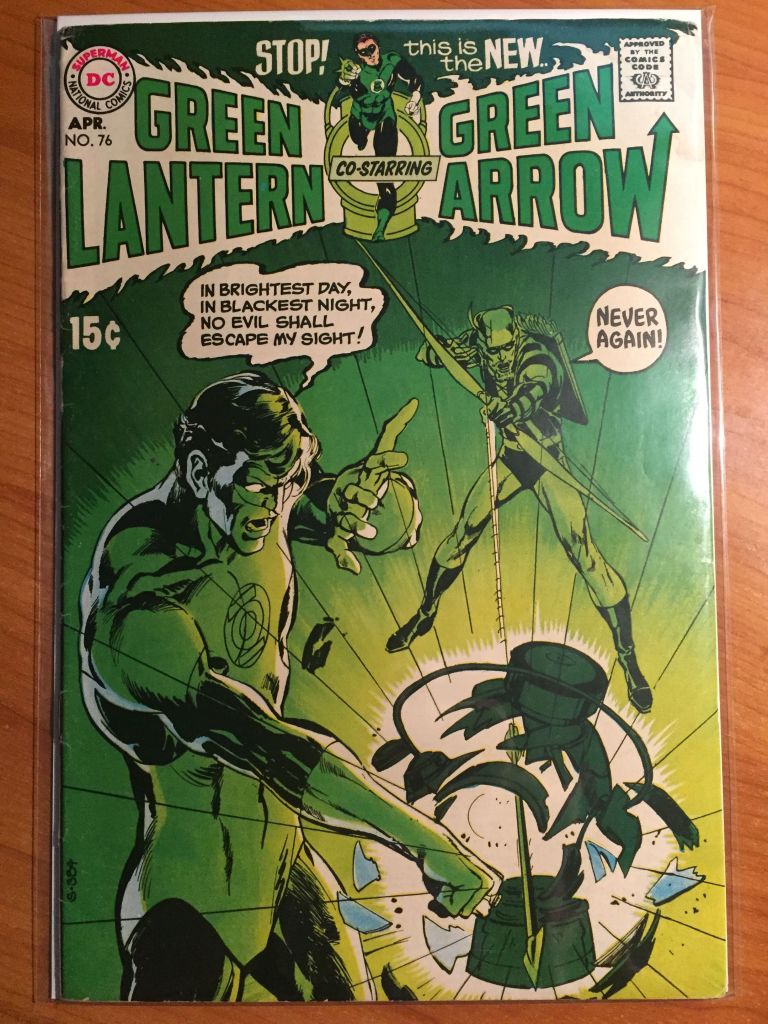
Super heroes as a genre were on their way out as the 1960s turned into the 1970s and the super hero fad that had driven success throughout the silver age fell away. But this meant that publishers were more encouraged to experiment than they had been previously in an attempt to stave off cancellation–and every once in a while, they hit on something that revolutionized the industry. GREEN LANTERN #76 was such a title. Editor Julie Schwartz had brought in writer Denny O’Neil and artist Neal Adams in a last-ditch attempt to save the title. O’Neil and Adams decided to ground their run in gritty real-world realism and to have the Emerald Crusader and his new agitator co-star Green Arrow grapple with the social issues that were plaguing the day. Adams’ artwork in particular was a revelation–he crafted super hero images that simply felt more like photographs than anybody else in this period. The book was a sensation, albeit one whose own zeitgeist would last only for about two years, but the relevance movement spawned by it would spread throughout the DC line and even touch other publishers.

As super heroes weakened as a category, publishers were also on the lookout for the next breakout genre in comic books. Having noticed that Marvel was getting a lot of mail from its older readers asking it to adapt Robert E. Howard’s pulp hero Conan the Barbarian, Roy Thomas convinced Marvel publisher Martin Goodman to take a flier on it, and so kicked off the sword-and-sorcery book of the 1970s. CONAN THE BARBARIAN #1 was like no other Marvel title before it. It featured an amoral hero whose actions had to be finely crafted to get past the strictures of the restrictive Comics Code. Thomas incorporated as much of Howard’s original prose as he could, making the book surprisingly literate. But the real breakout star here was artist Barry Smith, whose work grew by leaps and bounds issue after issue, developing an entirely new template for what a Marvel comic could look like.

But super hero comics weren’t entirely done, and would hang on throughout the 1970s to once again become the dominant genre of the 1980s. Over at Marvel, editor Stan Lee combined forces with artist Gil Kane to produce a milestone moment in the life of the firm’s flagship character, Spider-Man, one that has since been overshadowed by the death of the web-slinger’s longtime girlfriend Gwen Stacy. In AMAZING SPIDER-MAN #90, it is Gwen’s father Captain George Stacy who unexpectedly loses his life as collateral damage in a fight between Spider-Man and his foe Doctor Octopus. It’s a tragic and touching finale that’s utterly unexpected despite the cover imagery–supporting players simply did not get wiped out in this manner in comic books in the 1960s. Gil Kane channels a sense of Spidey co-creator Steve Ditko into the artwork, infusing it with an energy and a verve that hadn’t been felt since Ditko departed the strip. A brilliant issue.
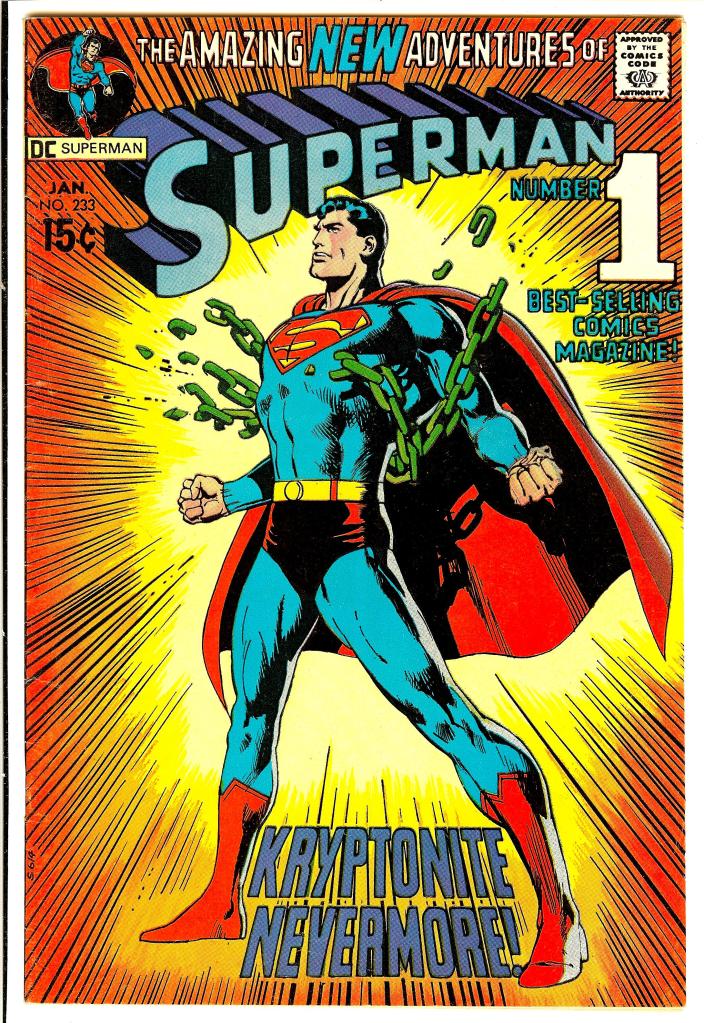
The retirement of longtime SUPERMAN editor Mort Weisinger kicked off a small renaissance around the granddaddy super hero of them all. As he’d done on GREEN LANTERN, editor Julie Schwartz brough Denny O’Neil on board as his new writer, and the Man of Steel’s adventures suddenly became a whole lot more realistic and real-world oriented. Feeling that the character was too overpowered to make any drama possible, O’Neil began a storyline intended to half the man of Tomorrow’s infinite power. He also eliminated all of the Kryptonite on Earth, putting an end to the overabundance of Superman’s overused Achilles heel. Artist Curt Swan’s artwork was given a polish after being paired with inker Murphy Anderson, who made Swan’s pages shine. Neal Adams’ historic cover kicks things off–and Schwartz incorporates a giant #1 onto it to signify the beginning of a new era. SUPERMAN #233 represented a new beginning for the Man of Steel, and while not all of its changes would be permanent ones, it primed the pump for the character to move into the new decade successfully.
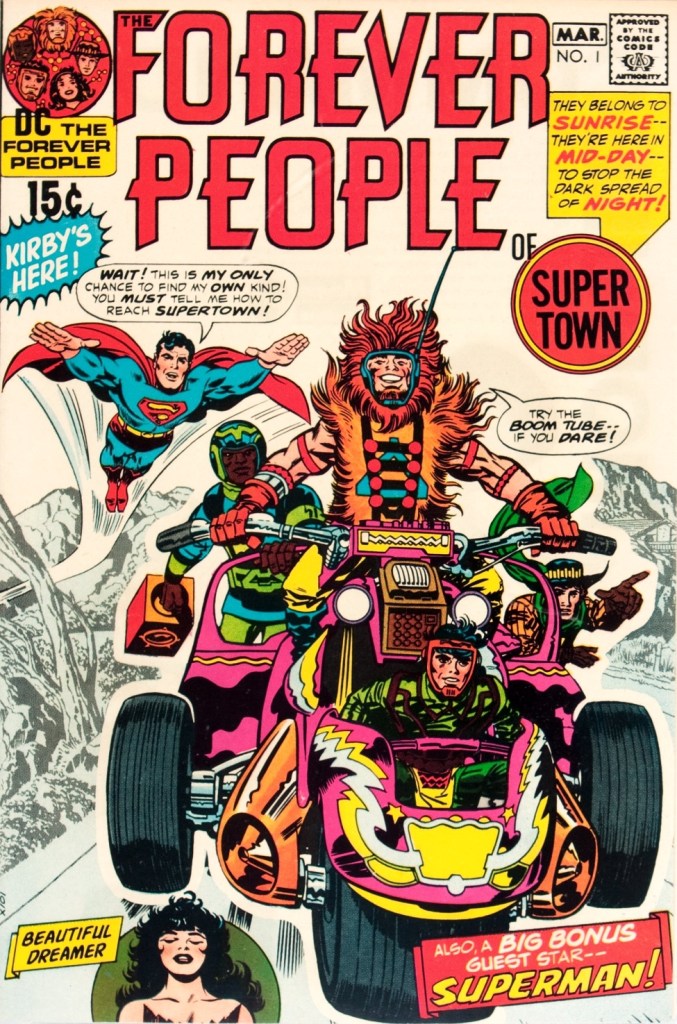
There was no bigger news in 1970 than the fact that Marvel architect Jack Kirby had left the House of Ideas to go work for its longtime rival DC. Fans were a bit stunned and confused when Kirby’s work turned up in, of all places, SUPERMAN’S PAL JIMMY OLSEN, and despite reactions being somewhat mixed, Kirby infused the series with his own brand of big sci-fi ideas and oddball humor. But his stint at DC really began with the launching of his three interconnected “Fourth World” series: NEW GODS, MISTER MIRACLE and FOREVER PEOPLE #1. Of the three, I think FOREVER PEOPLE #1 is the best and most inviting, as Kirby introduces a quintet of new super-powered young people reflective of the kids of the early 1970s and pits them instantly against his ultimate new villain, Darkseid. The issue also includes a treatment of Superman that is at once insightful and revolutionary, revealing his isolated and alone the Man of Steel is among the regular human beings of Earth. It’s a hell of a good debut, but for whatever reason, FOREVER PEOPLE was the least successful of the Fourth World titles.
 The Tom Brevoort Experience
A fine selection from the year I was born! (Yeah, I’m old.)
LikeLiked by 1 person
You’re old? Ha! I bought all these off the spinner racks back in the day 🙂
LikeLiked by 2 people
Ooops, my bad. I didn’t get Conan #1. Because of distribution problems, I rarely saw first (sometimes second, third, etc) issues of new Marvel series. Conan was actually the worst, the first issue I got was #22.
LikeLike
I’d have to crawl to the spinner rack at the time! 😀
LikeLiked by 1 person
Six alternates:
–CREEPY #32, featuring “Rock God,” by Harlan Ellison & Neal Adams. Cover by Frank Frazetta.
–FANTAGOR #1, Richard Corben.
–THE NEW GODS #1, Jack Kirby, with Vince Colletta.
–OUR LOVE STORY #5, featuring “My Heart Broke in Hollywood,” by Stan Lee & Jim Steranko.
–SUBVERT COMICS #1, Spain Rodriguez.
–YOUNG LUST #1, Bill Griffith, Jay Kinney, and Art Spiegelman.
LikeLike
These are somewhat similar to the list Mr. Brevoort provided, but worth mentioning: Detective Comics #404 (“Ghost of the Killer Skies”); Our Fighting Forces #128 (“How Many Fathoms?); Our Army at War # 226 (“Death Stop”); Aquaman 50-52 (the Deadman Cross-over); Green Lantern #75 (“The Golden Obelisk of Qward”) the last new John Broome Green Lantern story with very interesting insights into Hal Jordan, the development of society in Qward and the ultimate significance of Olivia Reynolds; and Strange Adventures # 226 (“The Magic Maker of Rann”) the last new Gardner Fox story at DC.
LikeLiked by 3 people
Oh yea, I vaguely recall seeing Detective 404. Hope that gets reprinted some day. Nice call!
LikeLike
A fine list. I might pick NEW GODS 1 over FOREVER PEOPLE 1, since it’s got a ton of majesty and sets up the Fourth World conflict well. But FP 1 is a lot of fun, and has a surprisingly bittersweet take on Superman, which maybe overcomes the fact that Superman gets redrawn the whole issue. It’s certainly a good choice.
I think the reason FP never really caught on like the others is that it doesn’t seem to have as clear a purpose. NEW GODS is about Orion fighting the war. MISTER MIRACLE is about Scott Free trying to live free (and building a life and career). The FOREVER PEOPLE, though, seem to just wander around from crisis to crisis, not having much of a direction, not meeting people who’ll be important over time. They’re just…footloose. Which suits Kirby’s concept of them as young flower children, but doesn’t really give the book a sense of what-happens-next momentum.
[I think FP is the concept that has caught on least in revivals, later, because for all that they’re young, they’re “of the moment” in 1970, and feel dated whenever they come back, a throwback to those days rather than characters who feel young in the present.]
I think I’d pick CONAN 3 over CONAN 1 — while issue 1 is historically important, issue 3 is a better story, with better art, to boot. And I might go for GL/GL 80 or 81 over 76, but 76 makes its case pretty damn well.
The issue that stands out to me as a “best of the year” candidate aside from these would most likely be HOT WHEELS 5, with the all-Toth “Case of the Curious Classic.” Not an industry-changer, but still a masterwork.
1970 favorites that wouldn’t make the list include AVENGERS 75 and 76 (Thomas, Buscema and Palmer at their peak on the book), CAPTAIN MARVEL 20 (the debut of the Rat Pack, nobody’s favorite but mine), and WONDER WOMAN 189 (“Red for Death,” the best of the straight-adventure Sekowsky stories). SUB-MARINER was also really strong in 1970.
And best cover of 1970: Either AQUAMAN 52 or THE WITCHING HOUR 10.
LikeLiked by 1 person
Reading through your comment suddenly gave me an idea. What if Kirby had mixed one DC hero into each of the Fourth World books? You had Superman in Forever People. But what about Batman in Mister Miracle. I’d love to have seen some Kirby drawn Batman at that time, or even more interesting Ditko Batman if he handed off the title like he wanted to. I’m not sure who else for the other titles. Green Lantern in New Gods, or maybe Wonder Woman would be a better fit. I was too young to read them as they came out, but I found it difficult to digest the Fourth World without any real ties to the DC Heroes. So it might have made things better. Though I guess it would also be easier for DC to drop the titles and ignore them if they didn’t succeed too.
LikeLiked by 1 person
I think the problem with that idea, mostly, is that Kirby didn’t want to write and draw other series’ heroes. I don’t think he even wanted to do CHALLENGERS OF THE UNKNOWN again. He wanted to do his own stuff without having to coordinate it with other people.
So if DC thought it was worth it to show connections between the DCU and the Fourth World, it think the best place to do it would have been other books. Have Aquaman tangle with one or two of the Deep Six, have Green Lantern cross paths with Metron, or Big Bear and Serifan guest star in TEEN TITANS. I don’t know whether Kirby would have liked that or not (I’m guessing not), but he could at least ignore it.
I don’t think I’d want to see Wonder Woman as a recurring character in NEW GODS, though. While from our vantage point, I think the Old Gods who died, giving rise to the New ones, are some previously unexplored pantheon, I think in Kirby’s original intent, those Old Gods were the classic mythic pantheons — there was some great Ragnarok-esque calamity and everyone went down, the Norse god, the Greco-Roman crowd, the Hindu, Japanese, African, everyone. And the New Gods arose as gods for the modern day.
So having WW show up in NEW GODS would feel like, if it were a Marvel book, having Thor turn up. It’s a reminder that the Old Gods are up and about and doing just fine. Doing that afterward, once Kirby’s gone, seems inescapable, but doing it while he’s actively creating the books seems like a thumb in his eye.
[If I were writing WONDER WOMAN back then, though, I’d want to have Victor Volcanum show up as a villain. But he’s not Fourthworldian.]
kdb
LikeLiked by 2 people
That’s a very interesting comment about Kirby and the way he worked, that I hadn’t even thought about. As a creator of so many characters, he didn’t really need to work on anyone else’s stuff.
I guess I was originally looking at it from the perspective that integration would be inevitable, but maybe that wasn’t the case in Kirby’s eyes? It’s hard to imagine that DC would want to keep two separate lines of comics going forever though.
LikeLiked by 1 person
The more THE FOURTH WORLD was distinct from the other DC titles, the better. Dilution did it no favors.
LikeLiked by 1 person
TBH, costume design, dialog, and the names of the characters did it no favors either.
LikeLiked by 1 person
I think some people were successful at bringing the two together later on. The Great Darkness saga in Legion for one.
LikeLiked by 2 people
My “dream scenario” from that era involves Kirby and Mike Sekowsky switching assignments: Sekowsky takes over Jimmy Olsen, turning him into a globe-trotting adventurer, and Kirby reboots Wonder Woman. But Kurt is correct, of course, that reconciling Diana’s pantheon with the New Genesis crew would require a lot of hand-waving (cf. the awkward attempts to connect the Eternals to the Marvel Universe). But man, a Kirby Wonder Woman would’ve been so cool…
LikeLiked by 2 people
I kind of feel like we got the “Kirby Wonder Woman” with Big Barda.
LikeLiked by 2 people
“I guess I was originally looking at it from the perspective that integration would be inevitable, but maybe that wasn’t the case in Kirby’s eyes? It’s hard to imagine that DC would want to keep two separate lines of comics going forever though.”
I don’t think Kirby cared much whether his work was integrated with continuity or not. He just didn’t want to mess with it himself. He didn’t want to keep up on the other books so he’d know what the current status quo was, or confer with other editors about getting stories approved. He just wanted to make the comics he made without the hassle. Indeed, when he was asked to use other DC characters, like Superman, he wound up getting his work revised, out of his control. So he wouldn’t have wanted to do more of it.
So if Orion had showed up in an issue of GREEN LANTERN, the fact that he was showing up there might not bother him, but the fact that he’d be expected to read over the script and/or look at the art to see if it was okay was work he didn’t want to do and might not have been getting paid for.
Over at Marvel, I don’t think he was the one deciding to have guest-stars and crossovers. That was probably coming from Stan, and left to his own devices, Kirby wouldn’t have bothered. You can see, for instance, that most of the Human-Torch-and-Spidey-are-frenemies stuff happens in SPIDER-MAN, not in FF. I also think it’s why neither Spider-Man or Dr, Strange were Avengers — why put someone on the team that Kirby would have to do research on to plot the book? Kirby also left AVENGERS pretty early, which was partly due to his workload, I’m sure, but might have been partly due to him not being the regular artist/plotter of Giant-Man and Iron Man.
He just wanted to tell his stories, not to have meetings and do extra work to make things fit together.
LikeLiked by 2 people
Thanks for the background! I’ll be looking at Kirby’s work in a whole new light next time. Not a bad one, but watching more closely for things I didn’t know.
This reminds me that when I was younger I always thought the group membership of the Avengers was planned out. I thought that was why Spider-Man wasn’t allowed in. Also that there must have been some secret criteria to become an Avenger, and that is why Dr. Strange and others were not part of the group. Dr. Strange made sense though, because he was too busy in his own comic defending the Earth from mystical attacks that no one knew about.
Maybe I got the impression from some of Stan’s comments that things were a lot more organized and planned out. I was pretty surprised when I learned that my favorite team comic came about just because they had to get something out the door!
LikeLike
I think another thing holding FOREVER PEOPLE back is that the characters don’t have very distinctive personalities. Compared to the likes of Orion, Lightray, Metron, Scott Free, Big Barda, Oberon…heck, even the Newsboy Legion have more individuality and nuance than the FP kids.
LikeLike
Also the dialogue (“We leave you things that never die — truth! Love!”) was the weakest of the three. However they do spell out the nature of the Life vs. Anti-Life conflict most clearly of the three books.
While I respect how startling the GL/GA run was, and how admirable Adams’s art, I’ve never found it enjoyable.
We moved to the US in late ’69 and I didn’t start buying comics regularly until ’72. While I’ve caught up on a lot, I don’t have the perspective of “comics of 1970” that I do of say, “comics of 1967” so this is interesting.
LikeLike
My start in comics is Sand Superman and the debut of the Defenders so I missed these too. Forever People always left me cold, more than any other 4th World. Current Kirby was a big miss to me back then in general (except for Eternals and Kamandi) and it took eventual readings of F4 reprints to get me even a little past that. Hard Traveling Heroes I hated when I finally read it. World and universe saving being denigrated right from the get go was a bad move and O’Neil’s writing always seemed very ham fisted when trying to be current. It didn’t help that his revamp of Green Arrow created the DC hero that I actively loathe to this day. On top of that while I admire Adams storytelling chops and the layouts, I find his actual art ugly. Honestly I prefer more stylized art (think Alan Davis or Paul Smith) to likes of Adams Hitch. The combo of writing that eschewed subtlety completely, the art, and DC’s biggest asshole hero doomed classic HTH and its excruciating revival years later.
LikeLike
I hear you on Kirby. I didn’t read much Marvel in the 1960s so my introduction to Kirby was the late Fourth World followed by his various subsequent DC works. I was baffled why so many people thought he was a genius.
Much more appreciative of him now. Still don’t think much of Denny O’Neil’s work.
LikeLike
That’s probably fair. I tend to look at characters from a “How would I write them?” standpoint, so they’ve got personalities in my head that may not have been so clear on paper.
LikeLiked by 1 person
To this day, I still get Serifan and Mark Moonrider mixed up. Maybe because “Moon-Rider” sounds more like a name for a cosmic cowboy to me…
LikeLike
For me, the problem with Forever People was that there were so many unanswered questions. Why did these five share a Mother Box? What was the link between them and the Infinity Man, or was Infinity Man linked to this special Mother Box? Who or what was the Infinity Man? Why was Serifan the only one without special powers? What were his cosmic cartridges and why did he have them? Could any of the others use them?
LikeLike
My problem with Forever People is that there was so much unexplained. Why did they sahare a Mother Box? What was their link to the Infinity Man, or was he linked to this special Mother Box? What was the Infinity Man? Where did he go between being summoned? What about Serifan? He didn’t seem to have any special powers but he had the cosmic cartridges. What were they and why did he have them? Could any of the others use them? Lots of mysteries with no hints for answers.
LikeLiked by 1 person
My problem with Forever People is that there was so much unexplained. Why did these five share a Mother Box? What was there link to the Infinity Man, or was he linked to this special Mother Box? Who or what was he? Where did he go when he wasn’t summoned? What about Serifan? He didn’t seem to have special powers like the others but he had the cosmic cartridges. What were they and why did he have them? Could the others use them? So many mysteries without any clues.
LikeLike
I think Forever People #1 was an inspired choice..
New Gods #1 or the first Jack Kirby Jimmy Olsen are more important historically, but the first issue of the Forever People sets up the conflict which was the subject of the first phase of the Fourth World. (I think the intimidating thing about Fourth World was that the conflict with Darkseid, which some of the most talented people in the industry have been contending with for half a century now, was only the first part of the story Kirby set out to tell
The conflict with the “Bugs” (that was set up in New Gods #9 and a central conflict in The Eternals for Marvel and CPT Victory and the Galactic Rangers for Pacific) was only the next movement of that symphony.
Forever People seems like the weakest leg of the Fourth World. Other than this issue and arguably the Sonny Sumo story, little in the Forever People advances the Fourth World narrative in general.
Had the idea existed or had Kirby been able to suggest trying it to DC, this might have been an ideal miniseries/limited series (or even periodic DC Specials to tell stories like the one in Forever People #1 and the Sonny Sumo stories.
Since Marvel reprinted some of the early CPT America stories and some of the secondary materials from that book in the late 1990s, it has been possible to see that Kirby was starting to play with the early outlines of the story 30 years before the Fourth World, The Hurricane story in CPT America Comics #1 [(“Murder, Ltd.”) had elements of the Fourth World (Pluto breaches a treaty among the gods by becoming active on Earth).
LikeLiked by 1 person
Odd detail: Forever People #1 was one of three covers inked by Frank Giacoia during this Kirby stint at DC (the others being Sandman #1 and In the Days of the Mob #1).
I wonder why Giacoia was no used more, given his 1960s work with Kirby at Marvel and his work at DC going back to All-Star Comics and The Flash going back to the 1940s . . . .
LikeLike
Giacoia was, by the 70s, not terribly dependable, alas. I don’t know if someone told me he was an alcoholic, or just suggested it, or what, but I was definitely told that if he was given a job, there was no real assurance it’d get done in time. Otherwise, I’m sure he’d have been in demand; he was an excellent inker.
There are a fair number of issues that are inked by Giacoia & Esposito, and that was either because if Giacoia was late on a job, Esposito would step in to finish it up — or in some cases, he’d ask an editor to give Frank the work because he needed money, with the promise that he’d backstop Frank if needed.
I’ve never been fond of Esposito’s inks, but he seems to have been a very nice guy, loyal to his friends.
kdb
LikeLiked by 1 person
From what Joe Giella wrote about his friend Frank after his passing in (I think) 1989, it seemed like depression, not that I know for sure.
Apparently, the problem began early in his career, possibly why he did not have a career as a penciller (as nice as his All-Star work was for example0.
LikeLike
I was also told that Carmine Infantino and Frank Giacoia were told by an editor early on that they were both capable of doing professional work but they should go back to art school for another year or two. Carmine did and Frank didn’t, and the end result was that Frank had the technical chops to be an inker but not the confidence or training to be an effective penciler, which is why almost every time he’s credited as a penciler he’s farmed the work out to a friend.
I don’t know if that story’s true or not (I’ve never checked whether Giacoia started working steadily a year before Carmine), but it’s definitely true that he used ghost pencilers a ton. His JOHNNY REB AND BILLY YANK strip is about half drawn by Kirby and half by Sekowsky (so it looks fantastic), and his SHERLOCK HOLMES strip was largely ghosted, but I forget by who.
LikeLike
Julie Schwartz had a habit of beginning his editorship of a new superhero comic with a related series of stories that continued intermittently; with The Flash it was Gorillas Grodd; with Green Lantern, it was Qward & Sinestro; with Detective and Batman, it was the death of Alfred and The Outsider (not originally seen as connected by the creators); and, later, it was Wonder Woman’s 12 Labors to rejoin the JLA.
While getting rid of Green Kryptonite, limiting Superman’s powers and the Sand Superman were not quite successful (none of the changes stayed) it made for a great miniseries within the bigger story.
Possibly. Schwartz’s least successful run was on Shazam,. That book also did not have that kind of an organizing principle to its early run.
LikeLiked by 1 person
Interesting thought. You can include Hal slowly learning about the Guardians and the Green Lantern Corps as a running element in the early GL.
It took E. Nelson Bridwell to put some life and fun into Shazam.
LikeLiked by 1 person
Very true.
E. Nelson Bridwell loved the characters and it did not seem like the primary writers did as much or in the same way for the first year and a half or so.
The guy who also would have done well at this was John Broome, who had written for Fawcett and had a good light, whimsical touch in addition to the kind of sad or clever stories he also did really well
LikeLiked by 1 person
“The guy who also would have done well at this was John Broome…”
Hey, if we’re going to keep Broome in comics, let’s keep Otto Binder, too.
Binder, Broome and Bridwell — and heck, let’s throw in Leo Dorfman, who knew his way around a lighthearted script — could write a multi-book line of Shazam comics.
[And yes, I know Binder and Dorfman died young, but if we change the circumstances of their professional life, maybe it’ll change their personal lives too.]
LikeLiked by 2 people
Well, both Dorfman and Binder died after Shazam was launched in 1972 (Dorfman in 1974, while still working on Jimmy Olson & Ghosts and Binder, also in 1974, after being invited to comment on Shazam #1).
Another interesting old CPT Marvel writer (also asked to comment on Shazam #1) was Manley Wade Wellman (who died in 1986).
Between 1979 and the time of his death, Wellman wrote a series of Novels and a Novella his old Weird Tales protagonist, Silver John the Balladeer.
That might have been the basis for an interesting take on the Marvel Family, play their optimism and integrity straight and unironically and their enemies as utterly corrupt.
LikeLike
Let Boltinoff and Bridwell edit it.
LikeLiked by 1 person
Yes, Otto Binder would have been great, for obvious reasons. I’d never thought of Broome but that might have been interesting.
LikeLiked by 1 person
“Well, both Dorfman and Binder died after Shazam was launched in 1972 (Dorfman in 1974, while still working on Jimmy Olson & Ghosts and Binder, also in 1974, after being invited to comment on Shazam #1).”
I know. But it’d be nice to have them around for a while.
“Another interesting old CPT Marvel writer (also asked to comment on Shazam #1) was Manley Wade Wellman (who died in 1986).”
Yeah, but by 1972, Wellman had been out of comics a very long time, much longer than Broome and Binder. And while his experience on THE SPIRIT might have served him well, he didn’t do much of the Fawcett Marvels, and what he did is from the formative years, and, sadly, isn’t all that great. By the time they’d settled into a groove, he was gone.
LikeLike
ASM 90 was a life-changing event for 8-year old me. It was one for the first Marvel comics I bought off the stand (and about the last time I read a Superman comic) and the beginning of a long, (and expensive) Marvel obsession. After all the years, Kane/Romita are still my favorite art team for Spidey. But what really knocked me out was the writing in those last few pages on the rooftop with Captain Stacy. Lee gets a lot of flak for stealing writing credit from artists, but does that mean Kane plotted this story? He must have gotten at least a synopsis from Lee. Unless it was Romita?
LikeLiked by 1 person
But am I wrong or is the one on the cover of FP. n.1 the only face of Superman drawn by Kirby that went to print? In any case, a nice Superman well integrated into his drawing without distorting it.
LikeLiked by 1 person
Kirby drew Superman’s face on the covers (and perhaps interiors) of the Super Powers mini series.
LikeLike