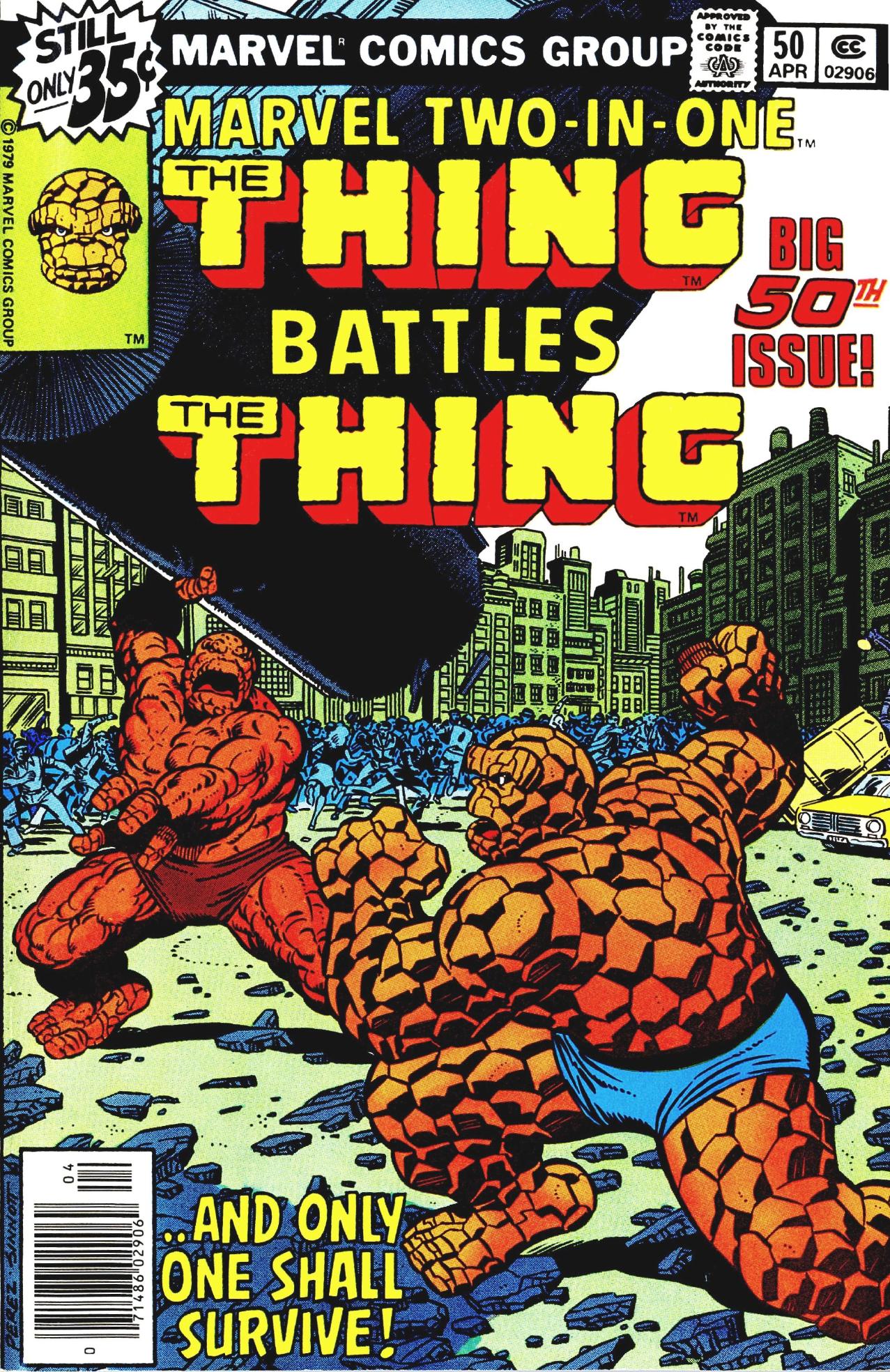


Now this was a comic book that I really liked. So much so that I sent a letter of comment in to the letters page asking that creator John Byrne be allowed to both write and pencil FANTASTIC FOUR. A real case of “be careful what you wish for”, as I stopped buying FF under Byrne’s eventual tenure. But this issue, steeped in classic lore that I was familiar with, was something that really connected with me in a fannish way. And I still think it’s a pretty great one-off.
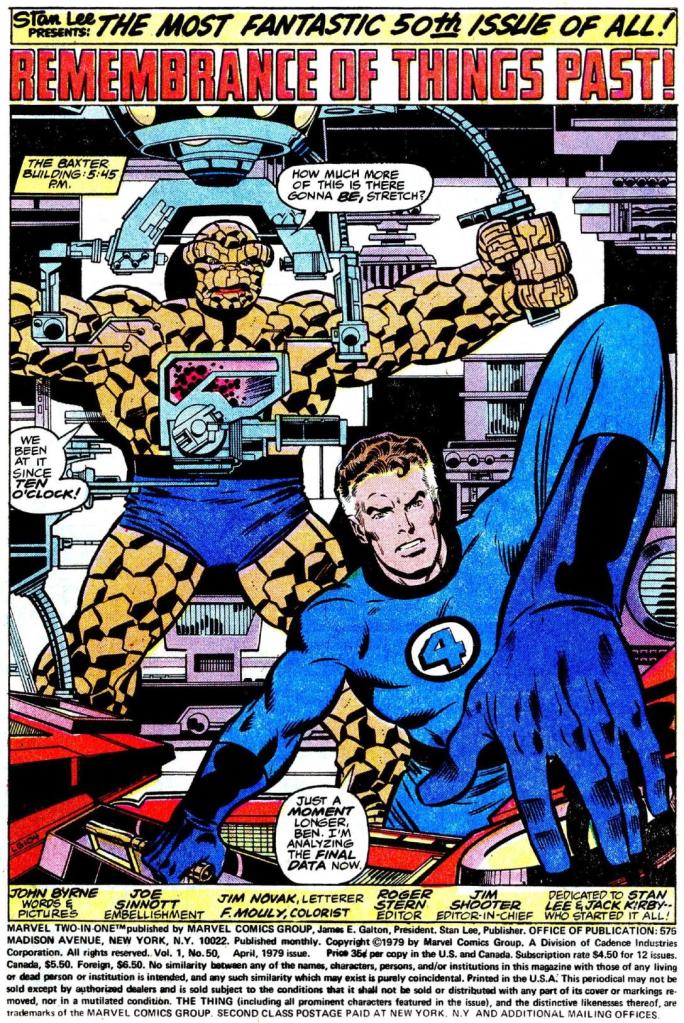
As I mentioned previously, this was one of the first stories, if not the very first, that John Byrne both wrote and illustrated for Marvel. He had been growing increasingly dissatisfied with doing the lion’s share of the plotting on UNCANNY X-MEN only for scripter Chris Claremont to frequently change Byrne’s intent in his copy. That synthesis between the two produced the best comics of their careers, but I can understand how Byrne might have felt ill-used. In any case, Byrne was beginning to explore the idea that he might be able to do the entire job on his own, without the need for a Claremont. And this story certainly lent some credence to that idea.
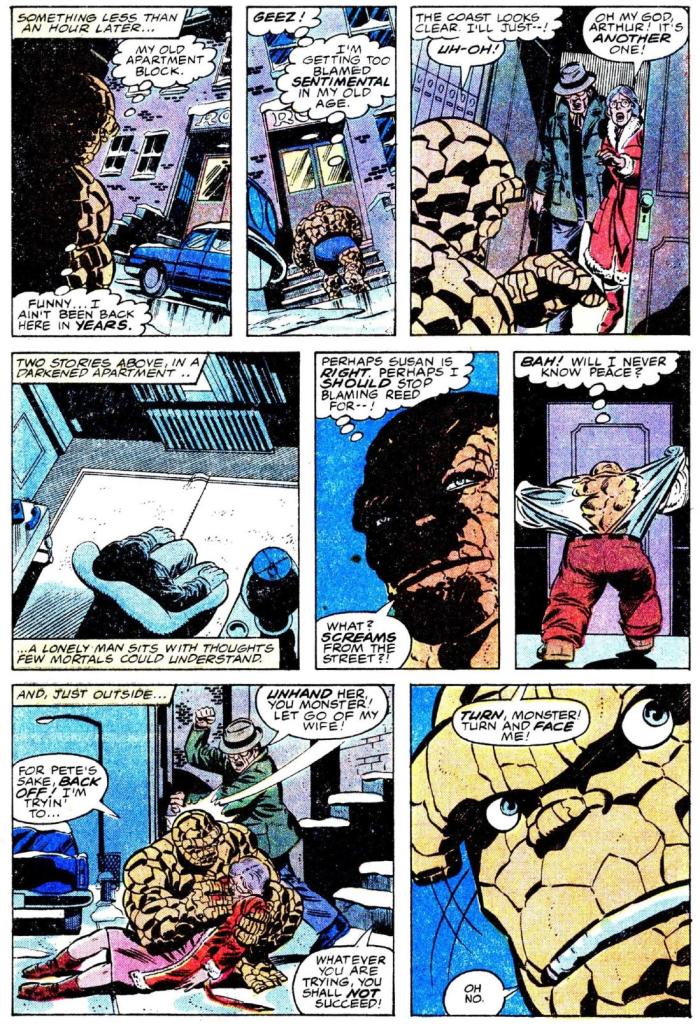
The premise of this issue is very simple but appealing in that kid-cool manner. It opens with Reed Richards having developed a new cure for the Thing, but it won’t work on his current form. Undaunted, Ben figures that the obvious solution is to use Doctor Doom’s time machine to go back into teh past to when he first became teh Thing and give the cure to his earlier self. It’s interesting, in that Bryne writes the early Thing much as Stan Lee scripted him in the first few issues, before his personality and speech pattern had completely solidified. But here, these two are supposed to be the same person, so it’s a bit strange to see the early Ben speaking so formally.
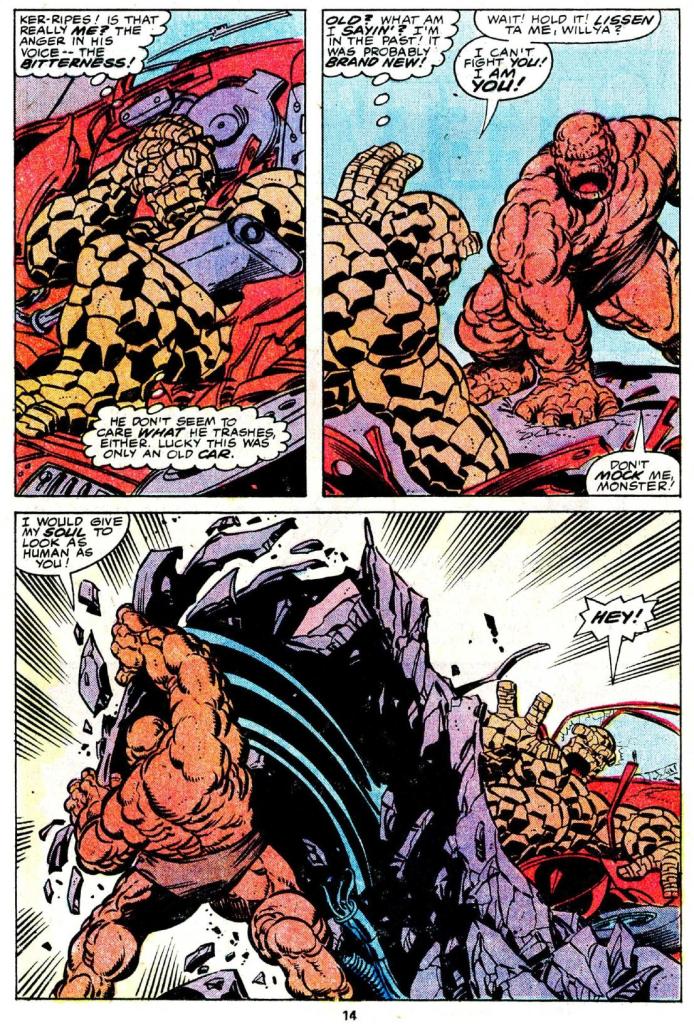
The problem with Ben’s plan, of course, is that his younger self doesn’t recognize him, and takes him for another rampaging monster. That early Thing is sitting atop a powderkeg of anger and bitterness, so he’s only too happy to have an opponent to vent his rage on. So what we get next is an extended Thing vs Thing battle. As usual, Byrne’s fight choreography is terrific, and like Jack Kirby before him, he makes good use of the environment as the two Things battle it out, having them use items in the area as weapons against one another,
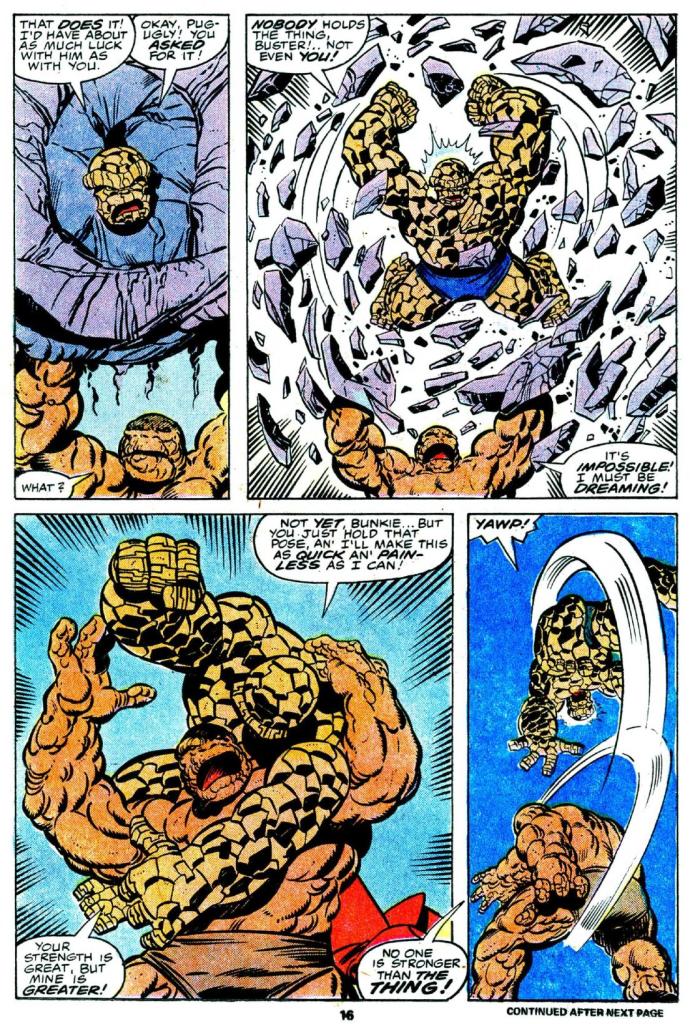
There really isn’t anything much more to the story from here apart from the last couple of pages. This is primarily a fight comic, perhaps the reason why Bryne felt confident that he’d be able to script it as well as anybody else. It’s a really good battle, colorful and inventive and contrasting the personalities of the two incarnations of the Thing. But a big fight is really all that it is.
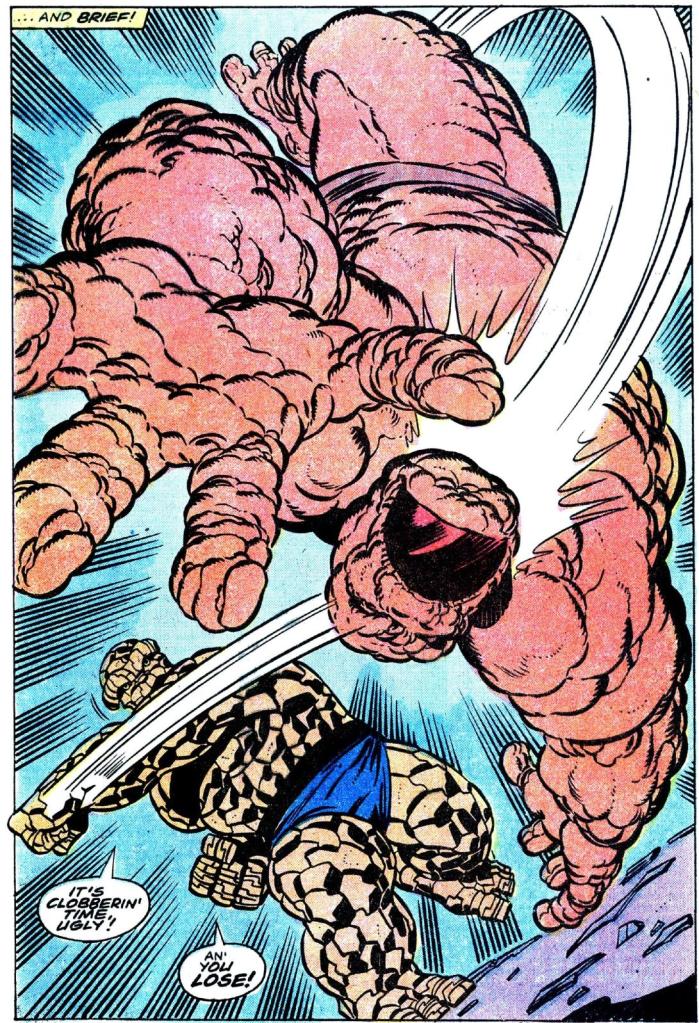
And finally, teh battle ends in the only way that it could: with the modern day Thing, who is stronger and more evolved in his cosmic ray-altered form, laying the smackdown on his younger self and triumphing. The future Ben approaches his earlier incarnation and feeds him Reed’s cure, expecting that he too will revert to his human state at the same time as his counterpart. When this doesn’t happen–the 1961 Thing is cured, but the later Ben remains the Thing–Ben is confused. But he figures that the change will happen once he returns to his proper moment in time.
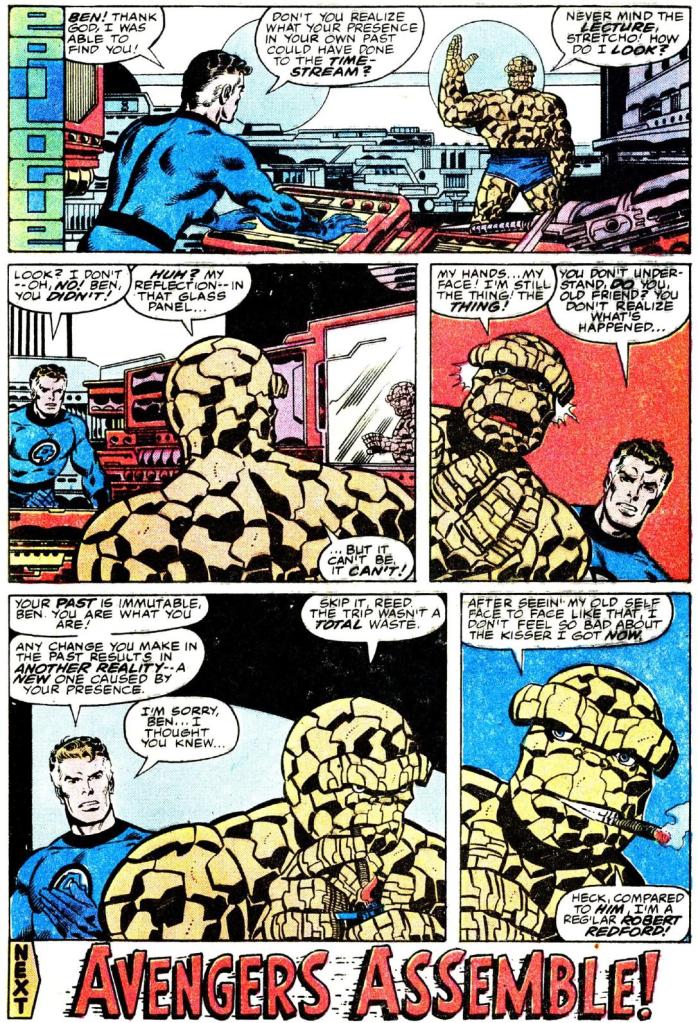
Alas, this is not to be, and it falls to Reed Richards to lay out the new rules for time travel that were beginning to be implemented in the Marvel line at this point, concepts that Mark Gruenwald had a big hand in shaping. According to Reed, any alteration to the past results in teh creation of an alternate timeline which runs parallel to the world that we know. So Ben’s quest was impossible–he couldn’t cure himself via time travel. However, he could cure some other Ben Grimm somewhere else, and for the moment, that was going to have to be good enough.
 The Tom Brevoort Experience
Is this the first time anyone at Marvel acknowledged that the characters looked different “in universe” when they debuted, and have evolved since? Previous to this, didn’t flashbacks show them looking and dressing like their modern selves, with even some reprints altering the art to make the characters more on-model? I feel like things such as Tyler Hoechlin wearing a Max Fleischer Superman suit during his Year One flashbacks evolves out of this.
LikeLike
In FF #126, Roy Thomas’ first as regular writer upon taking over from Lee, as Ben Grimm reminisced about the FF’s origin, with one of Reed’s lastest gizmos that reflected images of one’s thoughts onto a screen, John Buscema drew the Thing as he appeared in FF #1 and Ben reflected on how much uglier he was then. As far as I know, that was the first time anyone in story made reference to the Thing’s gradual change in appearance over the first 40 or so issues of the FF.
LikeLiked by 1 person
“You can’t change the past, only split the time stream” is a reasonable premise. When Gruenwald took it to “any major event in the MU creates a split” he lost me. What’s the point in reading if every time Cap beats the Red Skull he loses as well? Which Larry Niven pointed out in a short story years earlier.
LikeLiked by 1 person
I’ve always loved this one, mainly just because of the early Thing speech patterns! It’s something that makes no sense in the context of the story, but is somehow a lot of fun to read in a meta kind of way. Probably the first time I’d seen that kind of thing in a comic, I think.
John Byrne then in #100 for some reason felt it necessary to rewrite the ending and assert that it isn’t possible to create alternate universes by time travel…
LikeLiked by 2 people
MARVEL TWO-IN-ONE#50 ( April 1979 ): the THING’s strength level was upgraded to 70 tons thanks to Galactus [ Fantastic Four#175 ( October 1976 ) Ben says he feels a little strong and Reed says bigger too ( must mean muscles cause no mention of height change in the handbooks ) ] and then Ben, Reed and Sue got upgrades when they were made younger [ Fantastic Four#214 ( January 1980 )]. Ben fought to a standstill Blackbolt ( lift 60 tons ) [ Fantastic Four#46 ( January 1966 )], Ronan the Accuser ( lift 60 tons ) [ Fantastic Four#65 ( August 1967 )] and Thundra ( lift 60 tons ) [ Fantastic Four#129 ( December 1972 ) ] and was stronger than Blastaar ( lift 50 tons ) [ Fantastic Four#63 ( June 1967 )] and Annihilus ( lift 50 tons ) [ Fantastic Four Annual#6 ( November 1968 )]. But was weaker than the Over-Mind ( lift 70 tons ) [ Fantastic Four#113-116 ( August-November 1971 )] and weaker after Galactus upgraded his strength than the Sphinx ( lift 85 tons ) [ Fantastic Four Annual#12 ( 1977 ) — yet some how Blackbolt was able to hurt the Sphinx — his electron powered body? Is he the Ka Stone’s kryptonite? ]. I liked this issue and the ones not to far after it.
LikeLiked by 1 person
And John Byrne would bring back the early version of the Thing in Fantastic Four#238 ( January 1982 ) second story — “The More Things Change….”. Unless I’m wrong the only other time a Marvel hero travelled back in time only to get in a fight with their younger self was Captain America vs. Captain America in the Avengers: Endgame 2019 movie.
LikeLiked by 1 person
Mark’s rules for time-travel always bugged me a little, because he seemed to want one set of rules for all time travel, no matter what.
I figured that we don’t have one set of rules for physical travel — I can drive a car from Boston to New York, but I can’t drive it from Boston to London without adding some specialty travel device like a cargo ship. Airplanes can do things cars can’t, and space shuttles can do things airplanes can’t, but are spectacularly bad at getting you to the local 7-11.
I think it makes perfect sense that, say, using Dr. Doom’s time machine has consistent rules, but if Dr. Strange whammies you into the past, the same set of rules don’t necessarily apply. And so on.
That’s one of the reasons I set up the Forever Crystal in AVENGERS FOREVER — however it did it, it overrode Mark’s rules, even in a Kang-Immortus-based time-travel system (which was based on Doom’s technology in the first place).
It’s a big universe. Room for variation.
LikeLiked by 6 people
To bad we can’t ask him why, but my best guess is Marvel Universe continuity. He probably wanted to avoid the continuity chaos of multiple writers over time changing time. I got Avengers Forever but I don’t remember the Forever Crystal being used to change the past ( Captain America had the opportunity to save Bucky by moving him forward in time without altering the past ( cause it would be no different than Bucky going into suspended animation, after all the Winter Soldiers wasn’t even a glimmer in a writer’s eye yet. Plus like Cap, history recorded Bucky as dead ) but didn’t ).
LikeLiked by 1 person
But, in physical travel, once you’ve reached the destination, the rules about what you can affect from it are the same no matter how you arrived. It’s not like a package you mail from New York will get back to Boston any differently if you got there by plane versus driving. That’s more analogous to a consistence among all methods of the past being unable to be changed.
The time-travel process itself could be significantly different, maybe a Legion time-bubble is a like an airplane, it’s a sealed container where you can’t interact with anything until it stops and you leave it. It’s believable to have some methods much more prone than others to time-barriers, time-storms, getting thrown into alternate time-lines, etc (like hitchhiking is a much different experience than first-class air travel). But allowing changing the past by any means sort of pushes on a similar genre problem of people with world-changing technology using it to rob banks.
LikeLiked by 1 person
I like the variety.
I like a world where in one story you can’t affect the past and in another you can, and in yet another you can’t travel outside of your own lifetime, and in another you can’t be material in the same timeframe as your younger self, and so on.
If you can’t change the past, some stories don’t work as well. If you can, other stories don’t work as well. I like the idea that it depends on how you do the time-traveling.
But I’d rather have options than lock it down into one choice only.
And heck, the firearm was world-changing technology, and people robbed banks with it a lot!
[Yes, not the point you were making, but anyway.]
kdb
LikeLiked by 4 people
There are Marvel stories where the past is changed just not in the way Ben was trying to change it in this Marvel Two-In-One issue: see the Enchantress’s spell in The Avengers#10 ( November 1964 ) and Doctor Strange’s spell in Uncanny X-Men#191 ( March 1985 ).
LikeLike
Man, Sinnott did some pretty heavy inking. Normally I can look at a Byrne panel and instantly recognize the style, but not here.
LikeLiked by 1 person
Joe kept the cart consistent. No jarring difference over en extended period, with different artists drawing issues. “On model”. When Byrne took over the FF series, he changed the model. Notice much thicker Reed is here, vs. after Byrne settles in on the team’s monthly book.
LikeLiked by 1 person
If you take a look at Jack Kirby’s early FF work you will see that is who Writer-Artist on Fantastic Four John Byrne is imitating ( Early Jack Kirby Reed Richard’s body type as opposed to later Jack Kirby Reed Richard’s body type ). In FF#250 ( during the Gladiator vs. Skrulls ) when Spider-Man shows up he has a Steve Ditko body type and not the Marvel Team-Up Spider-Man body type John Byrne drew.
LikeLiked by 1 person
As fun as the story is, the time-travel is one of those premises which don’t bear thinking about too closely.
If you have a time machine, going back to bring a cure to your earlier self seems rather roundabout. I’d think the obviously action is to go back to the meeting about the original flight, and show up, saying “Hi, I’m Ben Grimm from the future, look at me – I was right about the cosmic rays and the shielding wasn’t strong enough. Don’t do it, or for everyone’s sake, put in heavier shielding!”
Then there’s the standard time-paradox problem. If the cure did work, and he was no longer The Thing from that point on – who brought back his cure from the future?
If there’s isn’t some sort of no-changing-the-past rule, the plot holes become really big really fast.
LikeLiked by 3 people
Plus Ben forgot about the impact he had on history ( See the last issue of Marvel Two-In-One for the end result of his time-travel self cure mission ) — butterflies.
LikeLiked by 3 people
Byrne muddied the waters on Gruenwald’s “divergence” theory in #100 when he established that divergent timelines always existed and that noone ever actually time travels on their own timeline.
I’ve always had a gut feeling (and I may be way off on this), that Byrne did this because he had a moral objection to the notion of “creating” a new universe. He’s always had a social conservative streak in his work, which this kind of fits in with. And he used a similar rationale to retcon out Vision and Wanda’s children (Agatha Harkness’ remark that Wanda couldn’t create life, “only one” could do that.)
I guess he convinced Gruenwald though, because the rule stuck around for a while. I think after he died, nobody cared as much about maintaining an Omniverse-approved playbook.
LikeLiked by 3 people
“any alteration to the past results in teh creation of an alternate timeline”
I disliked this concept the moment I read it in this issue. Why does changing the past result in “creating” a new universe/time line. What energy is released simply by changing one little thing. That’s why I never liked the Watcher’s explanation in What If? or Doc Brown’s explanation in Back to the Future. I have always loved time travel stories in general. Change the past, okay; Butterfly effect okay; silver age Superman being unable to change the past, okay; but “create” new universes? No thank you.
LikeLiked by 1 person
The majority of those changes would be miniscule and as a whole be temporary timelines that fold back into the original soon because they would all still lead to the same future.
LikeLiked by 1 person
I saw George Perez with that cover on his table at a convention in NYC and said “Huh, I thought John Byrne pencilled that cover.” He replied with mock shock, “Look at the buildings!” Ha!
LikeLiked by 1 person