

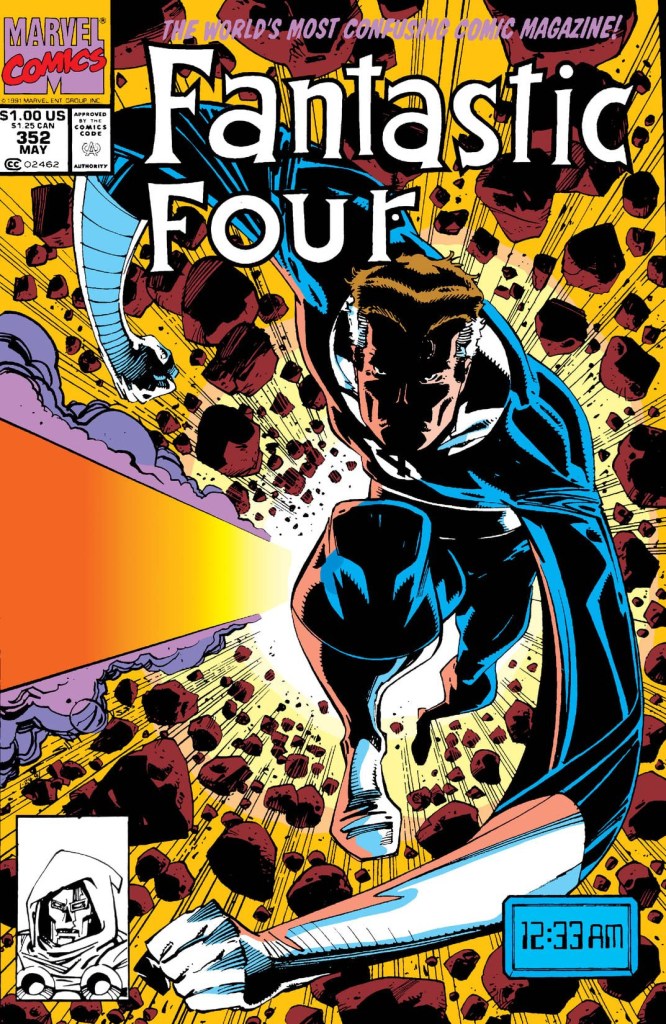
Walt Simonson had taken over the reins of FANTASTIC FOUR and propelled it into the stratosphere with a series of expansive stories that drew upon the best of Jack Kirby’s era on the title and turned the concepts up to eleven. Graphically, the book looked sweet as well, as Walter was able to channel Kirby’s graphics through his own style, producing a wonderful hybridization. Perhaps Walt’s best and certainly his most ambitious issue was this one, #352. In it, Reed Richards and Doctor Doom engage in a time-duel across twenty minutes, moving backwards and forwards through time while the rest of the cast moves through the book linearly. It’s a great concept, executed flawlessly and with several clever flourishes. Walter would only stay on the title for another two issues, but his run is a highlight of FANTASTIC FOUR’s sixth-plus year history.
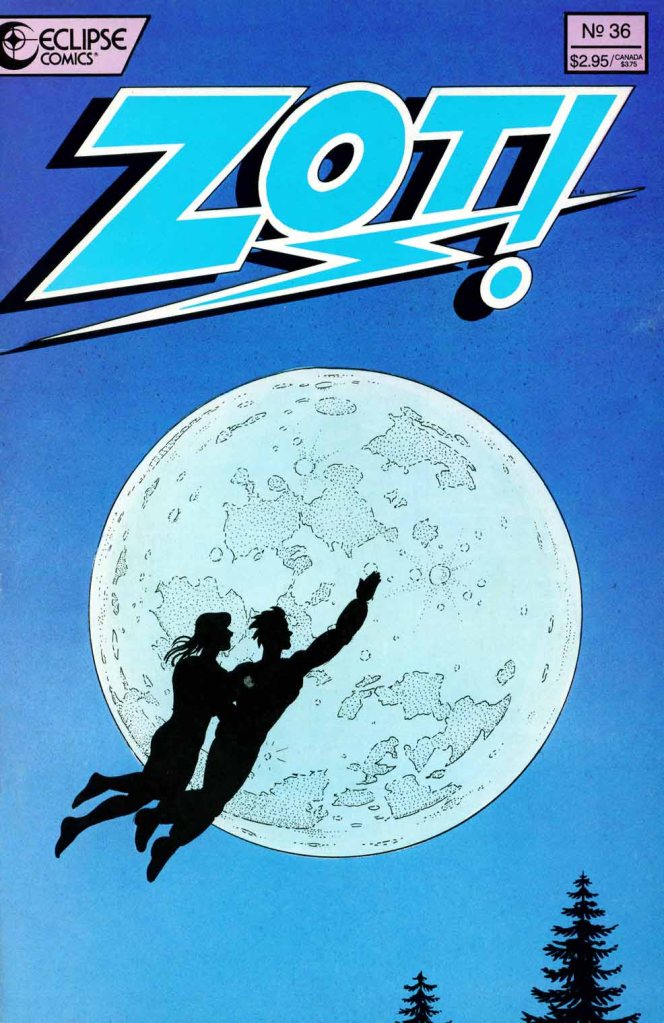
ZOT! ended its run in issue #36 with an emotionally-fulfilling climax that left the door open for future adventures. Having turned his back on the fantasy of Zot’s alternate retro-future Earth, creator Scott McCloud had spent the last half-dozen issues with Zot stranded in Jenny Weaver’s world–our world. In doing so, he gave greater attention and depth to the supporting characters all situated around Jenny and showcased Zot’s essential optimism and positivity against a much colder and crueler world than the one he’d grown up in. This all reaches a head in this issue, in which Zot is shot to pieces after having attempted to go into a crack house, and he lies near death. Fortunately, Uncle Max has finally found the means to locate his nephew, and so a dimensional portal opens once more. Jenny cannot wait to leave her difficult world behind and return to the seeming fantasy of Zot’s, but our hero issues her with an ultimatum: if she relocates to his home dimension, he will never set foot in it again. He’s got too much hope for the future of our world, and he needs Jenny to accept her place in the universe. It’s a great wrap-up to a great series, one that rewards frequent rereading.

I’ve chosen to focus on MARVEL COMICS PRESENTS #84, the finale of Barry Windsor-Smith’s WEAPON X storyline–but I’m really speaking about the entirety of that story. Largely on his own, Smith reveals the traumatic origin of the mysterious Wolverine and how he acquired his adamantium skeleton and claws. Far from being merely a continuity implant, WEAPON X is an enthralling saga all its own, with Smith creating drama among the people working at the Weapon X project even though we already know what the outcome is going to be. The story was rightly acclaimed at the time and continues to be a perennial best-seller in collected form. And Smith’s artwork and stylized coloring makes the entire epic a singular affair.

All throughout his time on FLASH, writer Bill Messner-Loebs specialized in crafting distinct and memorable single-issue stories that examined assorted aspects of his main character and his world. This one, #54, is perhaps the most memorable of his efforts. In this issue, the Flash leaps from a stricken plane that’s been attacked by hijackers in order to rescue a stewardess who had been thrust out of the craft a moment earlier. The bulk of the issue is spend on Wally West desperately trying to find a way to get to the Stewardess and then halt their fatal fall, told virtually in real time. It’s a real master class in tight, economic storytelling. Greg LaRocque provides clean, classic pages that keep the focus on the drama of the story. An excellent tale.

Valiant, the comic book company formed by former Marvel EIC Jim Shooter after his ousting had been getting notices ever since they began releasing super hero material, but HARBINGER #1 was the first completely original title they produced–prior to this, everything they’d done had been a revival of a vintage Gold Key character, or a spin-off of one. HARBINGER was an alternate take on the sort of concept that drove popular series like X-MEN, concerning a team of young heroes who all discover that they have superhuman abilities and who band together for self-preservation in a hostile world. The artwork by newcomer David Lapham was clean and attractive, far removed from the more expressive line that he’s used for the past twenty years or so. HARBINGER also established a wide-sweeping mythology, one that would form one of the essential underpinnings of the growing Valiant universe.
 The Tom Brevoort Experience
I enjoyed Bill Messner-Loeb’s work on The Flash.. It is a bit overshadowed by Mark Waid’s efforts but he made the cast (and even the rogues) a sort of an extended family, After Mike Barron’s less accessible run, it seemed like a return to form.
LikeLike
Barron is why I’m still not a Sally fan.
LikeLike
Barron was going somewhere I just did not follow. He clearly had something to say, but I did not quite responded to it.
LikeLike
I think his spotlight on Wally’s mom is very much taking a host at Barron’s portrayal of her as a nag who does nothing but clean up her son’s house. Turns out she’s so much more …
And yes, WML did some fun work on that book.
LikeLike
Something from the “Big 2” I much enjoyed was in 1991 (which I think of as “When I returned from the Gulf War,,” was Ostrader;s Hawkworld.
It did not sell, but was unfailingly worth reading.
LikeLike
It was one of the few Grim, Serious books that I admired the quality of the work on, even though I didn’t buy it.
LikeLike
There is probably a great business book to be written about Jim Shooter, his emergence as Marvel EIC, his attempt to do an LBO of Marvel and his launch of Valiant.
Sean Howe’s book Marvel Comics” the Untold Story tells the first part brilliantly ,
Valiant , even more than Image, nearly made it the “Big 3.”
LikeLike
The problem is that Howe’s book is grossly biased to the point of libel against Jim Shooter. I got called in to correct one of the more egregious passages for the paperback edition. I was listed in the paperback’s acknowledgements, but Howe took ruthless advantage of my good will. I received no payment for my work. I didn’t even get a complimentary copy of the edition that was published. Sean Howe told nothing “brilliantly.” The book is a rubbish piece of misrepresented research. For Sean Howe to be considered as a voice of morality or ethics–or even journalistic or historiographical competence–is a sad joke. People should not take that book seriously.
LikeLiked by 1 person
Shooter has an interesting story, that has important points to make about investment banking in the late 1980s and early 1990s, corporate control in established companies and start-ups, how to deal with independent contractor workforces and popular culture.
I would hope Shooter sits down and turns the stuff from his blog into a book or sits down with someone and tells his story
Jack Welch wrote an autobiography, but other people are still writing Welch’s story (The Man Who Broke Capitalism, etc.).
It might be good to get it out in his words in a more formal way.
LikeLiked by 1 person
I liked the book but I noticed when writing about the comics themselves, Howe is often wrong — the Sons of the Serpent are not the Serpent Society for instance.
LikeLike
Well, the only one of these I’ve read is ZOT!, which is certainly a worthy pick. Marvel and DC were largely off my radar during this period, and I was reading a lot of Fantagraphics books — HATE, EIGHTBALL, LOVE AND ROCKETS, NAUGHTY BITS, etc.
LikeLike
Zot was the only one I wasn’t reading. I was mostly Big Two but Valiant was like them enough to follow.
LikeLike
Walt Simonson Fantastic Four issues I have but no plot detail memories ( only dinosaurs, Gladiator & Galactus ). Have more plot detail memories from John Byrne Fantastic Four issues, George Perez and whatever number of Jack Kirby drawn FF reprints I have. My memory of Walt’s Thor is better.
LikeLiked by 1 person
Some very good choices, of the ones I’ve read.
I had some other favorites in 1991 — SIN CITY and BACCHUS in DHP, HOLLYWOOD SUPERSTARS, SANDMAN and DOOM PATROL — but I’m not sure I could pick a single issue of them.
A nice variety of stuff out there, though.
LikeLiked by 1 person
Mostly stuff I don’t know (cash crunch meant I wasn’t reading much) but I read the Zot TPB and yes, a wonderful series.
LikeLike
On a more pleasant note, here are my alternates for 1991:
–MAUS II, Art Spiegelman
–RAW, Vol. 2, No. 3, Art Spiegelman & Francoise Mouly, editors.
–HATE #6, Peter Bagge
–EIGHTBALL #6, Daniel Clowes
–XENOZOIC TALES #11, Mark Schultz, with Steve Stiles
–HELLBLAZER #41, Garth Ennis, Will Simpson, and Mark Pennington
–MIRACLEMAN #21, Neil Gaiman & Mark Buckingham
–THE SANDMAN #32, Neil Gaiman & Shawn McManus
Honorable mentions:
–FROM HELL #1, Alan Moore & Eddie Campbell (collects the prologue and the first two chapters that were originally published in TABOO #2 and 3).
–VIOLENT CASES, Neil Gaiman & Dave McKean (first North American edition, and unlike the 1987 British one, it presents McKean’s story pages in their color form, not grayscale).
LikeLiked by 1 person
One more to add:
–BONE #1, Jeff Smith.
LikeLike
I remember buying that Harbinger #1 at a comic book store near the Maryland and Delaware border on a trip to see my grandmother. I read that issue over and over again, and it began my obsession (one shared by many at the time) with Valiant Comics. I really felt I was reading the start of something big that would go decades.
There are some great creators working on current Valiant books but I wish they had kept the same continuity and timeline set by Rai #0 all those decades ago.
LikeLiked by 1 person
@kryptonsite, do you remember where about on that border? Northern? Off I-95? First Stare Comics? Captain Blue Ben?
LikeLike
Weapon X was amazing, still one of my favorite BWS bits ever. His Storyteller for Dark Horse was also beautifully done, but the stories needed more work. I wasn’t crazy about Harbinger, I much preferred the initial Valiant series (Solar, Rai, Shadowman, Archer & Armstrong, Eternal Warrior, and X-O). About a year or two after BWS left is when I started to lose interest.
LikeLiked by 1 person
I also really loved FF 352. I enjoyed Simonson’s entire run, and this issue was particularly creative. I read it again every few years. I should re-read the rest of his run sometime.
LikeLiked by 1 person
I’m not going to judge what someone thinks was the best. Looking back now I can’t believe how I missed out on Harbinger. When I read it later as a TPB I would agree, very good. When I spoke to Shooter about that series at a comic con he told me how it was really designed to be a tv series. I’d still put Infinity Gauntlet and GI Joe 109-115 in my favorite list.
LikeLike