

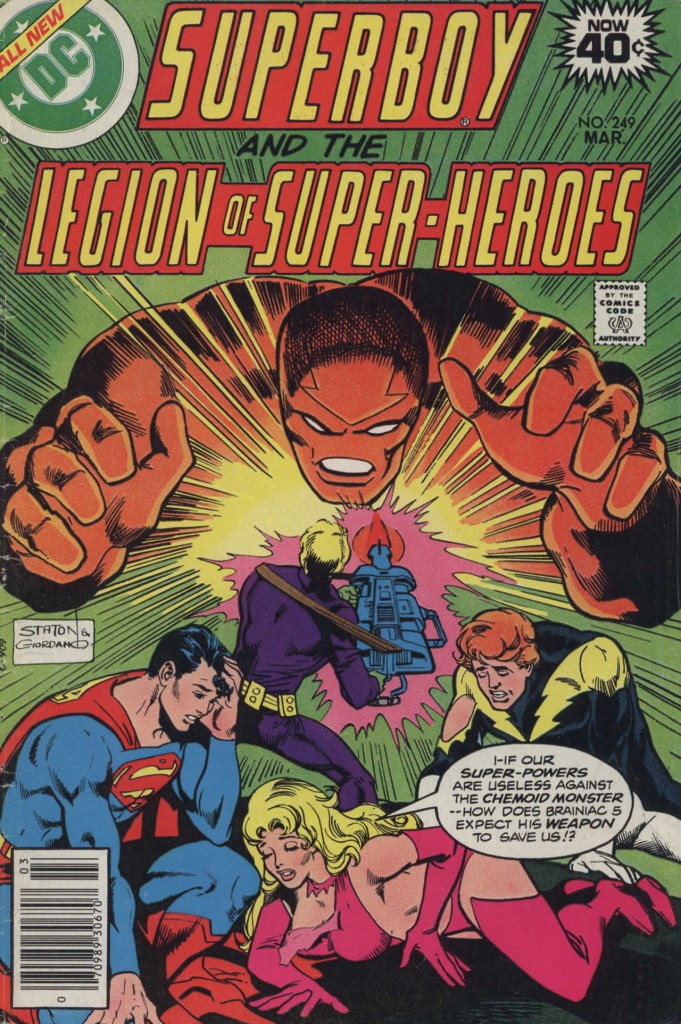
I had sort of fallen into the habit of buying SUPERBOY AND THE LEGION OF SUPER-HEROES after having sampled the previous issues. It was a series that I always wanted to like–it seemed right up my alley, with a large and diverse cast of cool super heroes. But the stories often felt “off” to my younger self–an indication that they were being edited to the tastes of some editor other that Julie Schwartz. I’d dropped in on S&LSH a bunch of times over the years, but never stuck around for the long haul. And even this brief period wouldn’t last for long, as I’d drop the book again in a couple more issues.
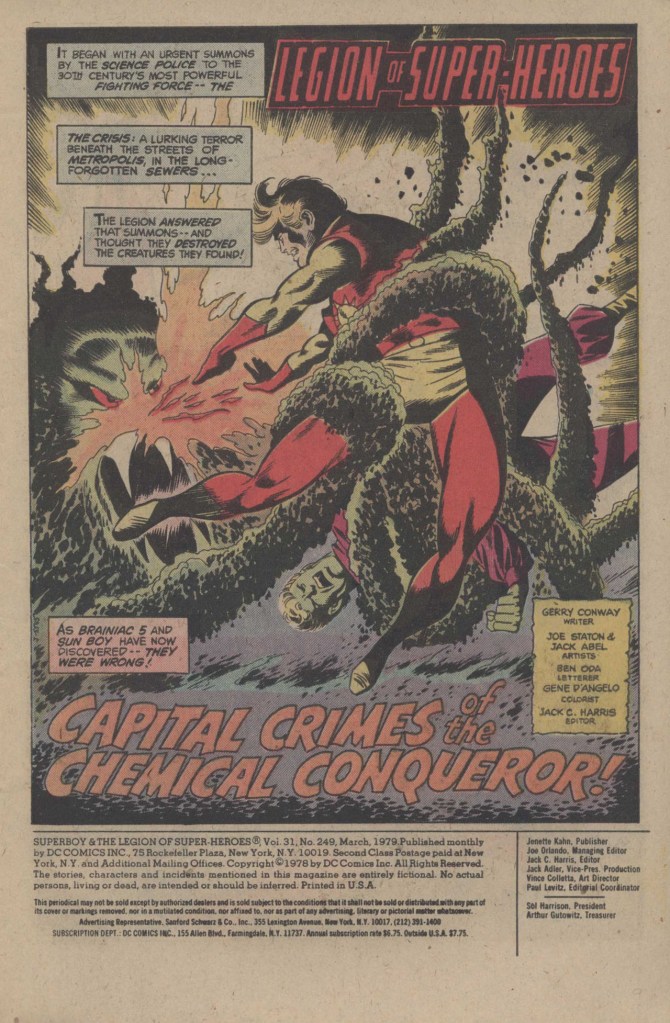
In fairness, this wasn’t a great period for the series. Following the DC Implosion, which saw the line cut in half and a couple of editors laid off, there was a need to fulfill contractual commitments that the firm had made to assorted creators. One such creator was Gerry Conway, who had come over from Marvel, signing a contract that guaranteed him a certain amount of writing work each month. With the line scaled back, places where Gerry might be employed were not so prevalent, and so he wound up writing S&LSH for a while, even though he had no real interest in doing so. Consequently, while his run is decently crafted, it’s a bit lifeless, lacking the spark that a truly invested creator might bring to the table.

More appealing to me was the artwork of Joe Staton. I don’t know that inker Jack Abel did him any favors here, but Staton’s lively cartooning shone through regardless. He had a lighter touch than many of his contemporaries, one that was put to good use on somewhat more comedic fare such as Plastic Man or Charlton’s E-Man, which he co-created. But he could pull off more straight-ahead fare as well, as he was called upon to do in S&LSH. At a time when a lot of DC’s artists were still attempting to draw the way they had done a decade earlier, ignoring the changes the field had gone through, Staton instead attempted to incorporate those changes into his artwork. He’d never quite have the power of a Jack Kirby, but he worked to make his page and panel compositions dramatic and exciting and modern. At DC in this period, that was a godsend.
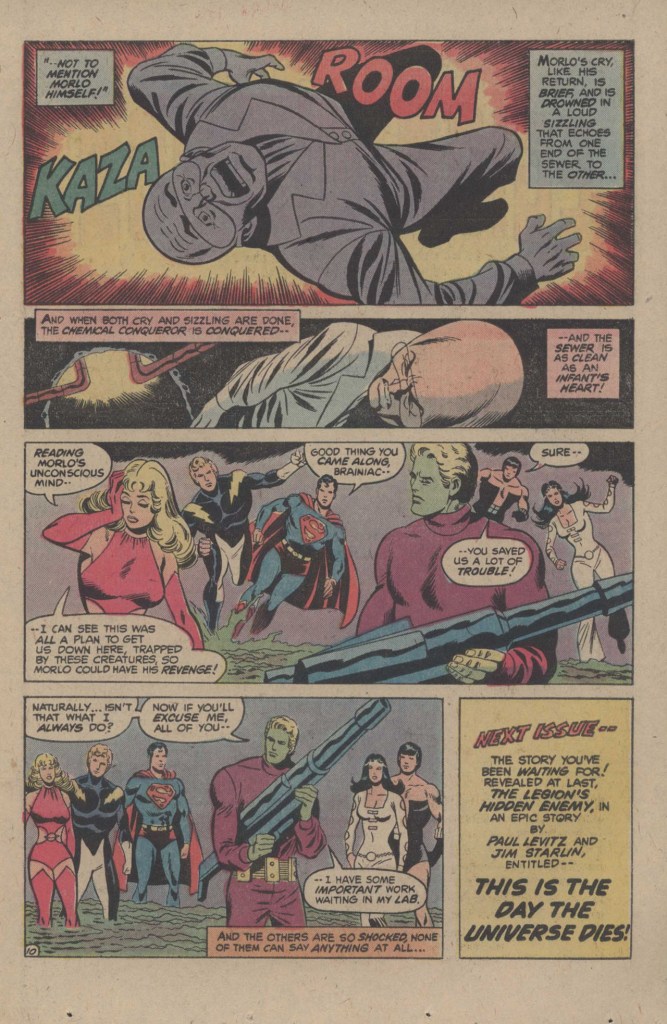
Another after-effect of the DC Implosion was the reduction in size of the books, which meant that a bunch of material that had already been commissioned had to be jigsawed in order to fit the new space. Accordingly, this issue of S&LSH has two stories, a short lead feature starring the whole of the Legion and a back-up focused on Chameleon Bok that was likely intended to be a back-up in the larger format that S&LSH had occupied until recently. The opening tale is a forgettable yarn concerning the Legionnaires having to journey into the sewers of 30th Century Metropolis in order to seek out a plant-based menace created by their old sparring partner, Mantis Morlo, the Chemical Conqueror. There isn’t a whole lot more to this adventure than that, for a DC story of this period, it’s relatively plotless, focusing more heavily on soap opera and characterization. Conway had learned this during his time at Marvel.

The back-up story was written by newcomer Paul Kupperberg, and artist Joe Staton got to ink his own work for it, providing a more sensitive and appropriate finish than the lead story got. In this tale, Chameleon Boy is brought in on a blackmailing case by the Science Police. The SP are being plagued by blackouts caused by the power being siphoned from their headquarters, a situation that they determine is being caused by the blackmailier, Giy Delor, though they have no idea how he’s doing it.
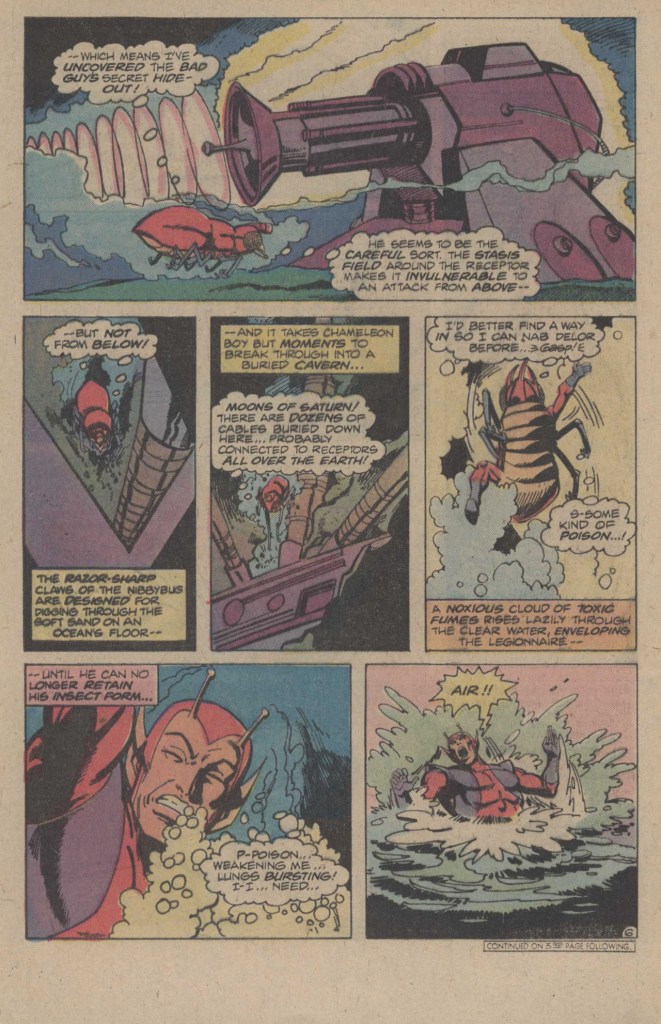
This leads Chameleon Boy to check out the entirety of the Science Police’s power set-up, following a submerged power cable for 300 kilometers underwater in an aquatic form. He’s able to find the power tap, and this leads him to an underwater base that protects itself with a microwave weapon that bombards anything that gets too close to it. Chameleon Boy is able to get into the facility in the form of a bug that is largely immune to radiation, but before he can find out much, he’s sprayed with a toxic chemical designed to repel insects and is forced to withdraw and assume his regular form. Reporting back to the Chief, Chameleon Boy tells him that the base is also protected by a Stasis Field that would prevent conventional Science Police officers from breaking in. So he’s only got one idea left.

And that is for the blackmailed Ambassador Jeryl to pay the ransom, a rare jewel from her homeworld. It’s brought to the agreed-upon coordinates and then teleported into Delor’s base. But Delor sees through the obvious trick, that Chameleon Boy has disguised himself as the gem to penetrate his security, and so he whips out a weapon and preparers to fire on the gem. Alas, Chameleon Boy was smarter than that, and instead has arrived disguised as the case the jewel was transported in. Getting the drop on Delor, he swiftly disarms him, and the case is solved. A perfectly fine little story, but nothing that was going t keep me coming back on a regular basis.
 The Tom Brevoort Experience
I wonder sometimes, if the non-specific credits here mean Joe Staton was doing layouts or breakdowns, and Jack did finishes rather than inks.
There are later issues by Joe and Dave Hunt where I really get the impression that Joe was doing breakdowns and Hunt was inking them without realizing he was supposed to tighten them up…
LikeLiked by 2 people
And I love Staton’s own finishes, and wish he’d gotten to do it more often.
LikeLiked by 2 people
Jack Abel’s heavy shadowed inks remind me of some Golden Age comics styles. But I also associate them with drawings by Dick Dillin, Dick Ayers, Irv Novick, and Bob Brown. Though I don’t know for sure that Abel inked all of those artists’ work. His inks might have helped shore up Don Heck’s Bronze Age work.
Staton inking his own drawings was best. I liked his inks over Sal Buscema’s drawings, too.
LikeLiked by 1 person
Joe Staton is the only person I ever asked for an autograph. A real professional.
LikeLiked by 2 people
The mix of Superhero and Science fiction elements really reached out to some people (Shooter, Bates, Cockrum, Levitz,, Giffen, and, it seemed, Waid) and not to others.
The book was always a bit better when people who were into it were working on it.
Especially for an artist, it seems like a LOT of work.
LikeLiked by 2 people
Liking the Legion between Levitz’s two runs was a near impossible task. I am actually surprised the Legion survived this period.
LikeLiked by 1 person
I kept up with it because the platonic Legion (i.e., the concept and the characters apart from any specific incarnation or run) are dear to my heart. I’m sure others did too. But yeah, like Justice League there were some long, painfully bad stretches in there.
LikeLiked by 3 people
I don’t hate Jack Abel’s inking, but I definitely prefer Joe Staton’s own inks over his pencils.
Reading LOSH via back issues over the past 25 years, I agree that the Gerry Conway period is unfortunately underwhelming. Unlike Paul Levitz, who had a clear passion for writing the Legion, for Conway it was obviously just another assignment, one he did not appear to have all that much enthusiasm for. I feel that Staton’s work during this period is what often saved the book from being a total loss.
LikeLiked by 1 person