

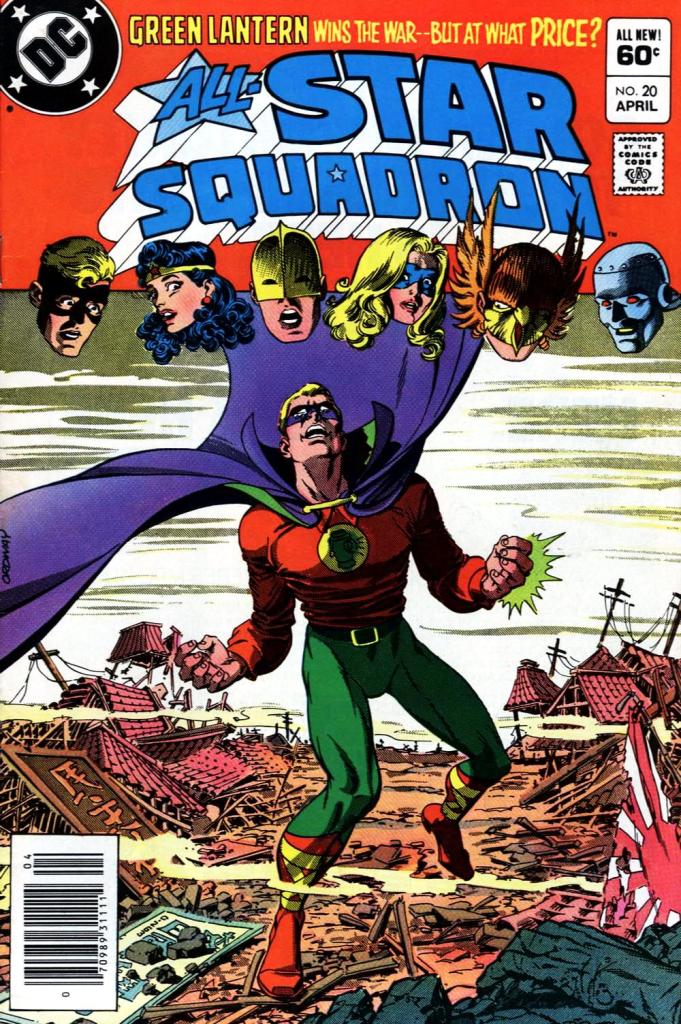
This was actually a really good issue of ALL-STAR SQUADRON, yet it became my last, at least for a short while. Why? I can’t really say. I maintained my pull list for other titles, but somehow this one didn’t make the cut. Which seems strange to me today, as the book was just about in its prime period–there would be another couple of years in which it would trend downward, similar to the trajectory of the INVADERS series that preceded it. I did come back to the title in relatively short order, though, so there may have been some non-buyer’s remorse at my choice after the fact. Regardless, though, this was where I capped my initial time with the series.


I first encountered ALL-STAR SQUADRON at its debut, which was a “Bonus Book” contained within JUSTICE LEAGUE OF AMERICA #193. DC had seen great success with launching NEW TEEN TITANS in this fashion, and so for a year or two afterwards, they did the same with most of their new roll-outs. I loved ALL-STAR SQUADRON right from the start, as it was a mixture of a couple of things that I already enjoyed: the defunct WWII-era Marvel series INVADERS and the Justice Society of America of Earth-2. And in particular, SQUADRON was heavily historically oriented, both in real world events and comic book ones. And that sort of continuity was my meat. I honestly would rather have had a new Justice Society title set during this period, but I was happy to go along with writer Roy Thomas’ contrivance that all of the super heroes on Earth-2 (including several who originated at other publishing houses such as Plastic Man) were all grouped together in a single massive (and ill-named) organization to aid in the war effort.
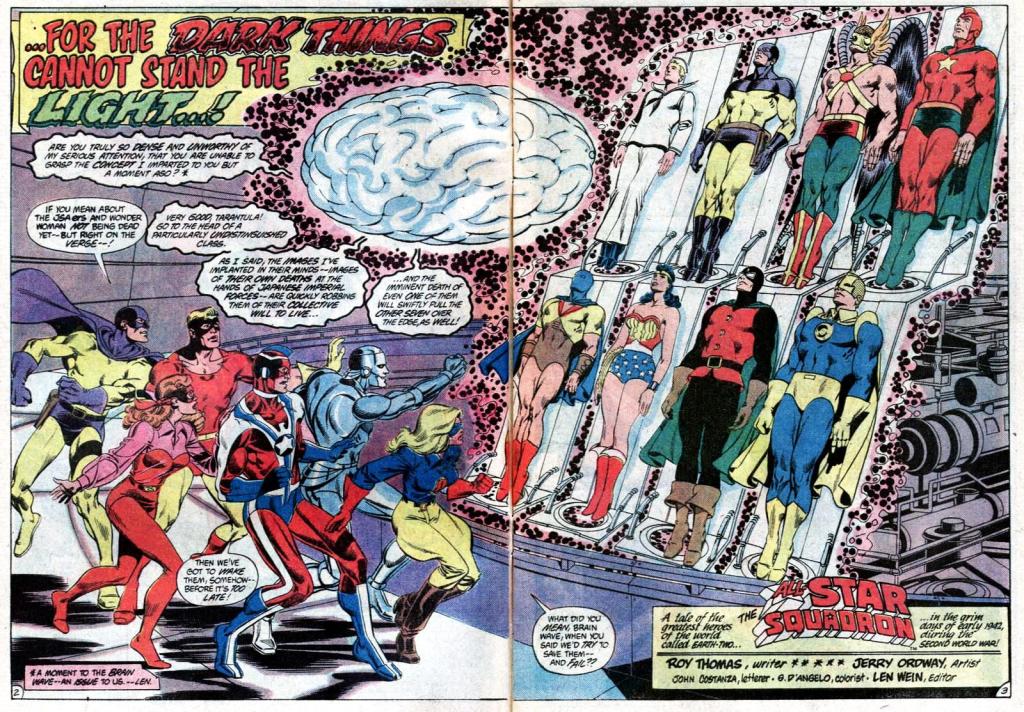
Even more so than INVADERS, ALL-STAR SQUADRON was Roy Thomas’ perfect nostalgic comic book. He had grown up in this era and held huge affection for both the characters and stories of the time and the events of the era. Almost every team concept that he had worked on since entering the field had been an attempt for him to mirror his beloved Justice Society from ALL-STAR COMICS. And for its first year or two, the book had strong art provided by Rich Buckler and Adrian Gonzales, often working under the slick finishes of Jerry Ordway. By issue #20, Ordway was doing the entire job, and he was excellent at mirroring the historic looks of the assorted Golden Age characters and giving everything a Wally Wood-style sheen.
Of course, Roy wasn’t above making odd choices when it came to the application of continuity towards the tales he was reflecting. This whole two-parter was a way for him to legitimize/explain the first Justice Society story produced after Pearl Harbor, in which the JSA members all enter the armed forces, kick the crap out of the Axis forces in all corners of the globe in ways that don’t reflect the real world history, and then were reunited for the duration of the conflict as the Justice Battalion. Roy thought this was all completely implausible (and he was right–but it was a Golden Age comic book, plausibility wasn’t really all that important in that era) so he had the whole thing be a fantasy force-fed to the JSA members by Brain Wave, an enemy they hadn’t yet encountered. Roy also connected Brain Wave to two earlier JSA adventures so as to justify his enmity towards the group here. The Squadron members come to the rescue and enter the dream-world as well, but just like the JSA members, they all meet defeat and lie near death. And should one perish, all of the others would follow.

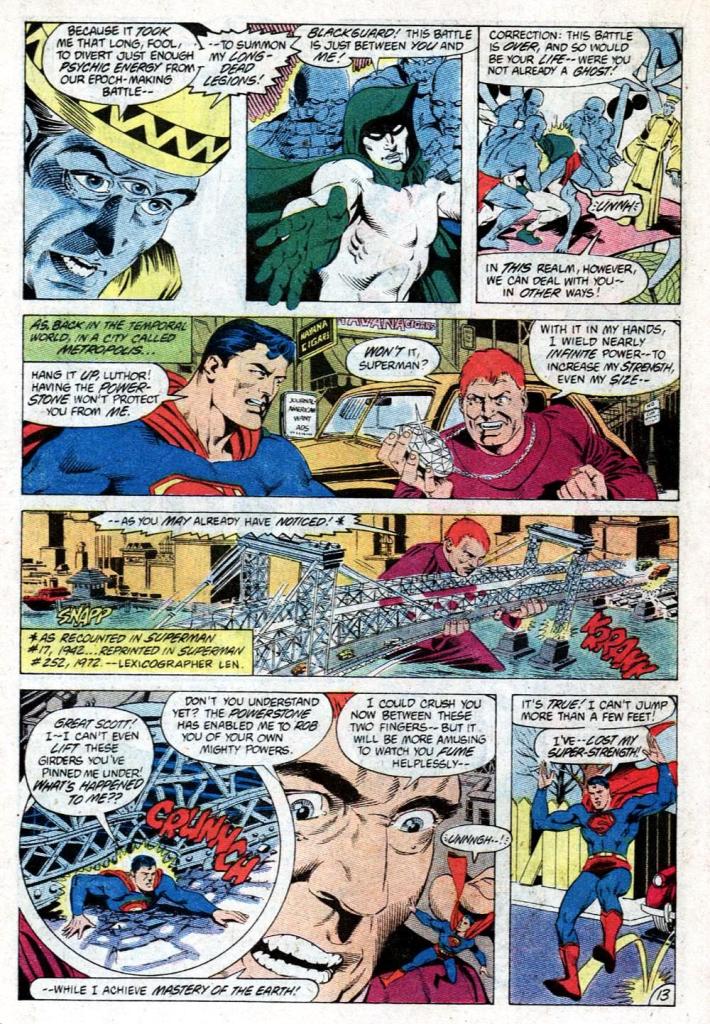
Unfortunately for Brain Wave, while we check in on the Spectre, Superman, Batman and Robin and the Flash and find them all occupied with other adventures culled from genuine 1941 stories (and immaculately represented by Ordway), Green Lantern is not. He overhears the broadcast challenging the All-Star Squadron and, having nothing more urgent going on, flies to give assistance. Brain Wave is able to pull him into the dreamscape as well, but the Lantern’s will power is simply too strong for Brain Wave to conquer, no matter how much he throws at the hero. Ultimately, events build toa fever pitch in which Green Lantern uses his power ring to annihilate the entire island nation of Japan (not the real one, fortunately, the dream one.) This is enough to feedback Brain Wave’s device and destroy it.
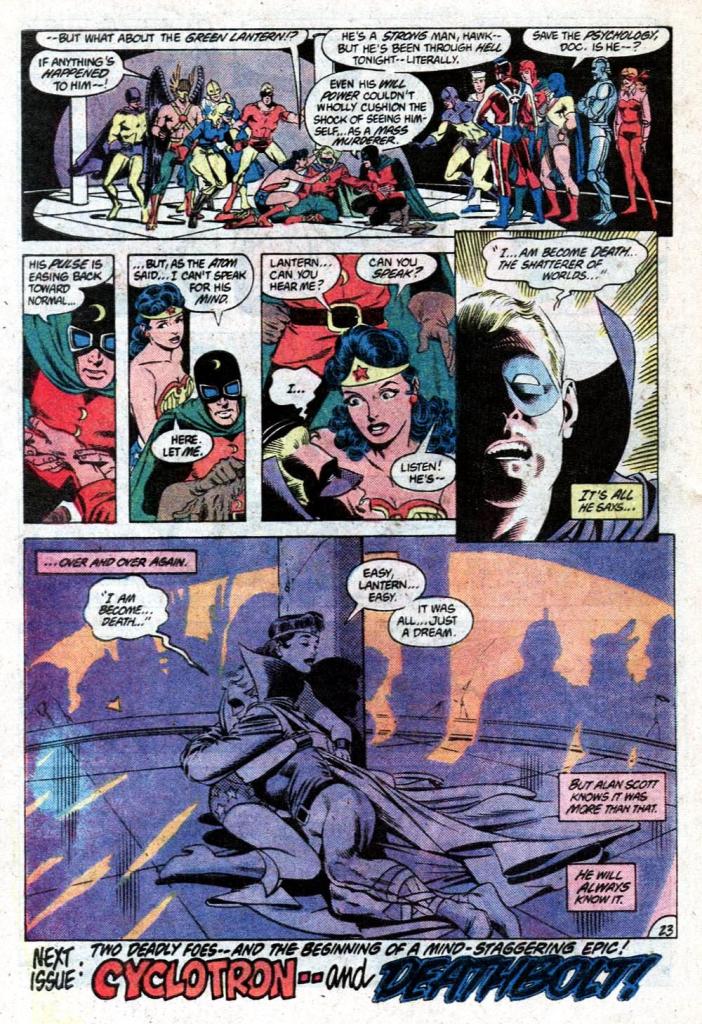
Brain Wave, of course, escapes in the confusion–he still has to face the Justice Society for the “first” time in ALL-STAR COMICS #15 after all. But all of the mesmerized heroes come back to life, finding Green Lantern curled up into a ball. Alan Scott is horrified by his own actions, and he retreats into an almost catatonic state due to the horror if it all. It’s an affecting ending, and one that adds a bit of necessary gravitas to what had often been up until then a gleeful story about super heroes killing Japanese soldiers–war and all, but still. And maybe that’s why I leapt off of ALL-STAR SQUADRON at this point. Over the years, as I learned more and more about the actual historic conflict, I grew more and more uneasy about the treatment of the Axis leaders in comic books, particularly Adolf Hitler. He’d been reduced so often to a fumbling caricature villain that his actual monstrous crimes had been largely overlooked. I felt, and feel, like that does a disservice to those lost during those events, and so I became increasingly uncomfortable with stories such as this one.

For all that, though, I was back on board in just seven months–I really did like the Justice Society of America. I also suspect that I was prompted to dip my toe back in by the launch and early issues of INFINITY INC, a new team series set in the present day, albeit on Earth-2, also produced by Roy Thomas and Jerry Ordway which featured a team made up of the sons and daughters of the Justice Society of America. Like ALL-STAR SQUADRON, INFINITY INC. started off very strong–though like SQUADRON, it also settled into a slow but steady decline over the years. In particular, the quality of the artwork tended to wither. I’ve been told by people who worked on these books that Roy’s primary concern was for artists who could get the details of the period correct, both in terms of the period and the heroes and villains he was using. This led him to settle for less exciting artists who were happy to make sure everybody’s costume lines were where they were supposed to be. This wasn’t an excellent trade-off for me (not that I wanted the costume lines out of whack–that stuff bugged me, too.) Nevertheless, I stayed with ALL-STAR SQUADRON until its post-CRISIS demise in #67, and then also was on board for its replacement series, YOUNG ALL-STARS.
 The Tom Brevoort Experience
I had always wondered why Roy always seemed to be stuck with lesser lights for artists. This explanation seems to makes sense.
LikeLiked by 1 person
As his associate editor, I can tell you that it was less being “stuck” than, as Tom posited, prioritizing artists who would get the belt buckles right over more exciting artists who were better at dynamic storytelling
LikeLiked by 2 people
I did say “seemed.” 😉
LikeLike
From conversations with artists who worked on those books, there may have been another reason Roy wasn’t able to attract more-commercial artists. Aside from it being a book with lots of characters and lots of reference, artists were often drawing the book in a tearing hurry, because the plots were late.
One of the issues around this time was drawn by an artist who’d expected to be attending the San Diego Con that week, but instead was up in his hotel room, drawing the issue to save the schedule.
So, post-Jerry, Roy had to get the artists who were available at short notice to do a rush job that involved a lot of extra work. No surprise that artists who could easily get other jobs would rather draw a book like BATMAN, with one hero, usually one villain, and set in the present day, to boot.
LikeLiked by 3 people
This is also true. Which, in a lot of cases of plots being late, was extra-unacceptable because–certainly in the case of Secret Origins–they often consisted of photocopies of old comics.
LikeLiked by 2 people
If you read a lot of interviews with Roy Thomas over the last 40 years or so, he often talks about a preference for “Story-telling artists” over more gifted draftsman .
I wonder if that is part of it as well, But, he did work with some giants: John Buscema; Neal Adams; Barry Windsor-Smith; and, here, helping to launch Jerry Ordway (not to mention some people whose merits are now being realized, like, Heck, Sal Buscema and Dick Giordano)..
Roy Thomas had an interesting, not just career, but life and he has lived long enough to influence how many things will be remembered.
LikeLiked by 2 people
@ John Minehan, Roy was my 1st fave comicbook writer.
LikeLiked by 1 person
The problem with writer/editors IMHO. 😉
LikeLiked by 1 person
Maybe keeping Len Wein on as the series editor would’ve helped. But Len, Roy, Marv, Gerry Conway went back together, what, 10, 20 years by that point? Len & Marv from high school? And Roy & Gerry were also screen-writing partners
LikeLiked by 1 person
I always felt this one did a real disservice to the poor Atom. The original All-Star Comics had him join the army and work his way up the ranks by hard work and dedication. Then All-Star Squadron wipes that out of history and turns him into FDR’s little sidekick instead…
LikeLiked by 1 person
An interesting conversation, but much I do appreciate. I do recall Todd McFarlane’s run on Infinity, Inc. As someone who first discovered his art through his runs on Hulk and Amazing Spider-Man, it was fun to see his earlier work on the children of the JSA.
LikeLiked by 2 people
He didn’t impress me (& not that much) until his taking over “Batman: Year 2”, & even then I thought Alcala was the wrong inker for him.
LikeLike
Loved All-Star Comics, including the idea of focusing on the lesser lights (by modern standards) such as Liberty Belle, Johnny Quick, etc. I didn’t have a problem with this first clash with Brain Wave though working him into the backstory of All Star Comics 8 seemed pointless.
LikeLiked by 1 person
“All-Star Squadron”? As Tom’s said elsewhere, “America’s A.S.S.”
“All-Star Comics” was the Golden Age title, right? Then revived in the 1970’s by “peerless” Paul Levitz, “joltin'” Joe Staton, & “boyish” Bob Layton.
My fave All-Stars were Libby, Brandi, Quick, Steel, Robbie, & Will Everett (named for Sub-Mariner & original Amazing Man creator Bill Everett).
Hawkman came as as quite capable, too, & A.S.S. (!) I think helped keep him in readers’ minds while books like “Shadow War” (Earth 1, I know)may have failed to keep him on the “A-list” for long.
LikeLiked by 1 person
Yes, A-SS rather than A-SC
LikeLiked by 1 person
There was a recent book (last year?) published by Marvel that featured the Original Human Torch at the time of his creation in ’39. The art did such a poor job of evoking the period and its details that it made the story very confusing. Was the African American police detective with the lanyard badge and tight t-shirt a time traveller in 1939 New York? He must have been but I don’t think he was.
Evoking the period with pain-saking accuracy isn’t as important as the art being dynamic, but the art has to at least convincingly convey the period broadly I think. Heck, Robbins, and Ordway are good to great in this regard.
LikeLiked by 2 people
Heck and Robbins, at least, were alive during WWII.
Jerry’s a good researcher.
LikeLiked by 2 people
He can also flat-out draw his “A.S.S.’ off. His statuesque, idealized, figures & faces. He knows how to depict naturalistic anatomy. And I much preferred his softer, “Wally Wood” (Tom’s reference) echoing inks to the style he’s used the last 20+ years.
LikeLike
Is Jerry Ordway retired or does he just not get regular work from the Big Two, because if that’s the case, it’s a shame.
LikeLiked by 2 people
That second thing.
LikeLike
I got that Justice League of America with the All-Star Squadron’s first appearance and while I can’t remember which issue of All-Star Squadron I jumped in on but I do know I had to go get the back issues. As an Invaders fan I felt so cheated as I was reading All-Star Squadron ( especially just before the Crisis on Infinite Earths Roy used almost all DC Comics golden Age heroes ). I don’t know why Stan Lee didn’t realize the only thing wrong with the Timely Comics heroes was that they weren’t created in the 1960s, had the 1960s heroes been created during the 1940s with 1940s knowledge they would have suffered the same fate as the Timely heroes. Demon ( embodiment of mankind’s evil ). I WISH ROY HAD KNOWN ABOUT THESE GUYS [ Mystic Comics#7 (December 1941 ) Davey & the Demon story ], Satan ( Mephisto? ) [ Mystic Comics#4 ( August 1940 ) Black Widow first appearance — Mephisto empowered the Bounty Hunter, Flying Dutchman Ghost & Ghost Rider — so the Black Widow fits his M.O. ], Grinner ( Dr. Weems – Mr. Hyde type who I would upgrade to Marvel Mister Hyde level and built like John Byrne’s drawing of Mister Hyde ) [ Mystic Comics#7 ( December 1941 ) Black Marvel story ], Dr. Fear( scare citizens to death ) [ Mystic Comics#8 ( March 1942 ) Blazing Skull story ], The Scar ( Baron Zemo class )[ Mystic Comics#6 ( October 1941 ) Destroyer story ], League of Crime ( Remu the Great ( hypnotist ), Crusher Collins ( Ox type ), Pierre La Verne ( swordsman ) & Nails Swigland ( gunman ) — Timely’s Enforcers ) [ Mystic Comics#8 ( March 1942 ) Challenger story ], Dr. Vortex & Trustees of Hate ( Weasel, Lara & others — had Hate Ray )[ Mystic Comics#4 ( August 1940 ) Blue Blaze story — he was suppose to battle the Vampire of Doom in the next issue but this was his last appearance. I would have VARNAE be that vampire since he has power to be a threat unlike normal vampires ], Dr. Gair ( head of the Crime Syndicate ( see the Torch’s Atlas Age return for them ), Star Gazer ( astronomer – starlight absorbing & projecting lenses ) & Star Monster ( a SOLAM -Captain Marvel#6 ( October 1968 ) ) [ Mystic Comics#3 ( June 1940 ) Blue Blaze story ], Green Terror ( A Ra’s Al Ghul type with his own form of immortality using blood of women ) & Gang ( Hydra like outfits minus the yellow H ) [ Mystic Comics#1 ( 1940 ) The 3X’s story ] — to name a few.
LikeLiked by 1 person
“I WISH ROY HAD KNOWN ABOUT THESE GUYS”
Trust me, he did.
LikeLiked by 2 people
This just came to me this morning, if Roy knew then why did he use the Hyena [ Human Torch Comics#30 ] & Shark [ Sub-Mariner Comics#23 ( Summer 1947 ) ] in Invaders Annual#1 instead of Daka ( Namor’s uncle who was in bed with the Nazis )[ Marvel Mystery Comics#24( October 1941 ) — Lonu-Ne ( Chancellor of the Seal People ) ] & the Parrot ( who in his second/last appearance got in bed with the Nazis – Herr Hesslous )[ Marvel Mystery Comics#26 ( December 1941 ) ] ? He could have even used Queen Jarna ( of Venus — who is can breathe in air & water ) [ Marvel Mystery Comics#25-26 ( November-December 1941 ) Sub-Mariner story — in bed with the Nazis in MMC#26 ]. I get why he used non-Timely character Agent Axis ( who Jack Kirby clearly forgot he created or co-created for DC Comics — I got to see her stories ), but Timely Comics has a counterpart to her — The Leader ( N-4 ) [ Marvel Mystery Comics#23 ( September 1941 ) Human Torch story — Sigmund & Rudolph named henchmen — see Atlastales.com for what she looks like — or think Crime-Master ]. BATTLE AXIS ( These Timely Villains could have taken the place of the Vision, Golem, Skyshark ) — Grosso of the War-Dust World [ Marvel Mystery Comics#24 ( October 1941 ) Vision story ], Stone Man [ All-Winners Comics#6 ( Fall 1942 ) Destroyer story — Professor Schultz ( Nazi scientist ) & Lubitch ( Nazi sculptor ) — ( Stone Man was blown up in an explosion — but teleportation by someone else could save it, plus a strength upgrade ] & Black Ace [ Daring Mystery Comics#6 ( September 1940 ) Flying Flame story — he could be saved from death too — There is a Nazi Death Ray in this story. Plus Timely was suppose to have a hero named the Black Ace ( see ad in Captain America Comics#1, maybe the Black Ace could be like DC Comics WW1 German pilot Enemy Ace but either under the effects of a Hate-Ray or brainwashed ]. YEAH, I have had a lot of time imagining what I would do & upgrades I would make — like my Golden Age Vision would be as strong & as powerful as his DC Comics successor Etrigan the Demon.
LikeLike
“This just came to me this morning, if Roy knew then why did he use the Hyena [ Human Torch Comics#30 ] & Shark [ Sub-Mariner Comics#23 ( Summer 1947 ) ] in Invaders Annual#1 instead of…”
Because he liked them.
Also, likely, because he was 6-7 years old when he read those stories and thought they were very cool, and stories from 1940-41 are stories he didn’t buy off the stands because he wasn’t yet old enough. So he found those later as back issues, and they didn’t have the same impact as the stuff he first read as a kid.
LikeLiked by 2 people
@Kurt Busiek I always thought The Hyena was probably used because that story had been (somewhat recently) been reprinted in The Human Torch (#2) in 1974, I thought Agent Axis was used because the Tales of Suspense story where Agent Axis was (mistaken)y) reintroduced had been reprinted around that same time.
Timely (and, in the 1950s, Atlas) just did not have many recurring villains (other than The Red Skull and Prince Byrrah. who I remember as a 1950s Submariner antagonist who was used in Tales to Astonish).
Also, do I remember right, but Marvel didn’t have as many copies (as a complete a collection) of their old comics as DC had, which made Golden Age reprints and Golden Age references harder?
They did some of it with Fantasy Masterpieces in the late 1960s but it did not matter as much there as it did with DC in that period.
LikeLike
” I always thought The Hyena was probably used because that story had been (somewhat recently) been reprinted in The Human Torch (#2) in 1974, I thought Agent Axis was used because the Tales of Suspense story where Agent Axis was (mistaken)y) reintroduced had been reprinted around that same time.”
I think it’s quite likely the case that the Hyena story was reprinted in HUMAN TORCH 2 because Roy, the editor of that series, liked it. I think it’s no coincidence that all of the pre-Marvel Torch stories reprinted in that series are from when Roy was old enough to read the books new. He liked the stuff he read while young.
As for Agent Axis, I expect he was aware that Marvel’s version was created by mistake, but given that it’s a good name and that there were no trademark issues, it was an opportunity to insert a character into INVADERS with a good name and a striking look.
LikeLiked by 1 person
I can’t imagine Roy didn’t know them all! IMHO After seeing the folks that turned up in The Twelve, I think Roy featured the best of the best of the Timely heroes in Invaders and Liberty Legion.
LikeLike
You saw butchered versions of Timely Heroes in The Twelve, I see great potential in Timely Heroes & villains. Even unnamed & named Timely Comics characters that could be turned into counterparts to Rival Golden Companies whose heroes culturally appropriation other countries powers ( American heroes that got their powers in India or China or Africa ) – example the Ghost ( sorcerer – powers in India ) [ Thrilling Comics#3 ( April 1940 ) Standard ( company ) ] a member of the “tribe” in India in Monako’s origin [ Daring Mystery Comics#5 ( June 1940 ] could be turned into his counterpart. That “tribe” never raised Monako to be evil so it is very unlikely they killed his parents unless they were a threat to Monako and considering how powerful Monako is it is unlikely British troops killed them ( more like either Illusion spell for their deaths ). Dynamic Man ( Super-Intelligence, Super-Strength, X-Ray Vision, Project Electricity ( & create an Electric Feld around a building ), Manipulate Magnetic Fields, Can Alter his Appearance and make is clothes Invisible ( which should mean he can make himself invisible ) — plus in his first appearance the writer says he has MUSCLES THAT CAN FREEZE making him a biological being ( sure artificial — Android ) but not a piece of crap Robot like the in The Twelve. DYNAMIC MAN is said to have SUPER-HERCULEAN STRENGTH — he is TIMELY’S SUPERMAN. Electro the Marvel of the Age ( not seen in The Twelve ): my version would be given Golden Age Technology ( seen in Comics & Newspaper strips — project electric blasts, project multiple images of itself ( Buck Rogers comics strip ) ) — that tiny propellor on its back would be an anti-gravity generator ( think the Wizard’s anti-gravity discs ). Marvex the Super-Robot not seen in The Twelve would live up to his Super-Robot name be able to give an golden age Kryptonian a fair fight.
LikeLiked by 1 person
Cool Perez JLA cover. But the out-of-control “Tornado Tyrant” kind’a conjures up the evil Stay-Pufft Marshmallow Man from “Ghostbusters”. 😉
LikeLike
@Tim Pervious Although the cover was published about 3 years prior to Ghost Busters, it does remind me of the Stay-Pufft Marshmallow Man!
LikeLiked by 1 person
@John Minehan 😅🙏
LikeLike
@Kurt Busiek Excellent point; I had not considered that, to some degree, in the 1970s at Marvel, Roy Thomas was his own E. Nelson Bridwell.
LikeLiked by 1 person
“America’s A.S.S.” (sorry & thanks, Tom) was a top 5 book for me in the early 80’s. Maybe briefly higher. My fave characters were Libby, Brandi, Steel, Robie, Quick, & Will Everett (Amazing Man, named for the original character’s creator, & Sub-Mariner’s, Bill Everett). If that bit of trivia is annoying like I’m showing off how little I know, I started to feel that way by the middle of the series’ run. Roy crammed too much explanation & exposition in the dialog, or monolog.
But for the 1st 40 issues, I loved the book. I loved seeing Dr. Fate, the Spectre, Alan’s ‘Lantern, Jay’s Flash, Hawkman, and Jerry’s Superman. I much preferred Jerry’s Superman here to his later version by the early 90’s. The “Super Shnozz”. 😉
Some AMAZING covers, by Buckler, JOE KUBERT, & Jerry Ordway. Jerry’s covers in the 20’s & 30’s were often poster-worthy. And Buckler & Ordway’s # 36 (?) Captain Marvel defeating Superman, w/ most of DC’s headliner namesakes placed around them, was more fun to me than the JLA at the time. Richard Howell’s inks over Buckler’s drawing that issue helped the final art mesmerize me. Naturalistic, w/ a bit of period noir.
And despite my earlier gripes, Roy’s love & enthusiasm for the book came shining through. Sorry to hear about the late plots. And the burden it placed on the artists. Rick Hoberg was another stand-out. I remember him drawing the Detroit issues. Hourman telling a racist, “You still have 32 teeth Pal; how’d you like to try for NONE?” Hahaha. And the tragic Red Bee story.
I was 11 or 12 when I 1st read the series. When the white supremacist Real American showed up in similar garb as Steel, I was worried Hank would be revealed as the villain (I was young). I preferred it being the robot, despite that feeling like a cop-out as I read it, instead of it being an actual human white supremacist. I knew the problem existed, & figured why not personify it.
The series did get bogged down over time (actually & figuratively), & CoIE (“Crisis”) didn’t help.
Just now thought, I don’t recall Captain Nazi making the trip from Earth-S to Earth 2 during the book. I’d’ve liked to have seen that.
And Baron Blitzkrieg (from a 70’sWonder Woman issue, correct?), was my fave Nazi villain. I liked seeing a contemporized version in the 90’s “Damage” series. He also looked formidable drawn by Jose Luis Garcia-Lopez in that 70’s “Superman v. Wonder Woman” one-shot. The panels where Superman wrecks him still warm my heart. DC should bring him back. We could use seeing superheroes punching out Nazis again.
I also liked Roy’s retroactive villains Cyclotron & Deathbolt. They looked Golden Age. Did “A.S.S.” sort of define the term “retconning”? Retroactive continuity? Deathbolt would show up in James Robinson’s “Starman”, I didn’t even care how, it just looked cool, & fit, since his costume was like a darker version of Ted Knight’s famous suit. And Cyclotron’s totally recalled the Silver Age Atom’s suit Al Pratt wore.
Hey, Tom- “keep ’em flyin’.” 😉
LikeLike
Arvell Jones (with a good inker), Mike Clark, & Mike Harris drew some good issues, too.
LikeLike
“Retroactive Continuity” was brought up in the letter column to ALL-STAR SQUADRON 18. It got shortened to “retcon” later.
But back then, what Roy and others used it to mean was adding stuff to past continuity — new stories set in the past. In later years, it came to mean stories that alter past continuity and overwrite it with new stuff.
So by the original meaning, UNTOLD TALES OF SPIDER-MAN is retroactive continuity, because it adds to the early Spidey canon without changing what was already there. And by the new meaning, Byrne’s MAN OF STEEL is retroactive continuity, because it replaces earlier stories with new information.
Somewhere in between are stories like the return of Bucky as the Winter Soldier or the (first) resurrection of Jean Grey, because they don’t actually say what was shown in earlier stories is incorrect, just that it wasn’t the whole story, and there was something else happening behind the scenes.
LikeLiked by 1 person
Thanks, Kurt! 🙏
LikeLike
What I liked about Cyclotron was that Dr. Terry Curtis was a real golden age character [ Action Comics#21 ( February 1940 ) Superman story ] and I wished other characters ( Deathbolt, Amazing Man, Firebrand II, etc. ) were created in a similar manner either using named or unnamed golden age characters ( So that they could at least have one foot in the time period they are suppose to be from and the other in the time period they got their second creation from: That goes for Timely, Atlas Age & 1940s & 1950s DC characters too ). Terry Curtis to Cyclotron is like Bill Foster to Black Goliath, Carol Danvers to Ms. Marvel, Patsy Walker to Hellcat. The other way of doing it is Tessa to Sage, Amanda Sefton to a sorceress, Frankie Raye to a Human Torch ( Where a character is revealed to have always been super-powered ). Otherwise in order to do it backwards, you take a page from Chris Clairmont who in Marvel Team-Up#64 ( December 1977 ) moved Misty Knight’s first appearance to Marvel Team-Up#1 ( March 1972 ). I know it will impossible when Golden Age artist never drew female Africans or teenaged Japanese American girls ( Golden Girl ).
LikeLiked by 1 person
Roy’s obsession with belt buckles was a well know fact by this point. It became common knowledge afte rhis short lived series for Marvel, ‘Tales of Suspenders” Featuring The Undroppable Iron Pant and the back-up feature starring Cap and his sidekick, Buckled Barnes. (Drawn by Rich Buckler natch!)
LikeLike
This was my first issue of All-Star Squadron. I think I was 10 when it came out. Although I had no idea who he was at the time, this was when I first fell in love with Jerry Ordway’s artwork. That cover is amazing. I think Ordway is probably the most underrated artist of his generation.
LikeLiked by 2 people
I’m glad Tom did All-Star Squadron, because before the Crisis in the letter pages of a couple of All-Star Squadron issues letter writers asked Roy to have Superman use his face-changing ability, but I found out that the Golden Age Superman doesn’t have face-changing ability — but Full Body Changing ability [ Superman#45 ( March-April 1947 ) — altered his size, colour ( white –Joker/Solomon Grundy white ) and shape to look like the much bigger Collectors; his costume changed too ]. Plus dc.fandom.com/wiki/Kal_L_(Earth-Two) list other forgotten powers: Sound Manipulation – Superman can emit a supersonic whistle so high in pitch that humans can’t hear it, but strong enough to destroy a tower. He also can project his voice over Metropolis and everyone there can hear him. Hypnosis — Kal-L can control the thoughts of others with great concentration ( Telepathic Will Control he took control of one of the alien Collectors — Superman#45 ). In World’s Best Comics#1 ( Spring 1941 ) Superman fought the Rainmaker ( a criminal scientist ) with a weather control machine & paralysis gas and in Mystic Comics#1 ( March 1940 ) Dynamic Man fought King Bascom ( millionaire banker ) whose scientists created a weather control machine and used Lantholum to paralize Dynamic Man.
LikeLike
When Roy had Jerry Ordway redo Leading Comics#3 ( Seven Soldiers of Victory vs. Doctor Doome story ) in All-Star Squadron#29 ( January 1984 ) I noticed the Robotman class robots in the story, but it was only a couple of years ago that it occurred to me that Roy could have made them part of Project M ( for Monster ) and those Robots as the real Earth-2 G.I. Robots. He had Mike Machlan & Richard Howell redo All-Star Comics#12 ( Justice Society of America vs. the Black Dragon Society ) in All-Star Comics#30 ( February 1984 ) and when I got to see All-Star Comics#12 in the Johnny Thunder part of the story there was a samurai on 3 pages that disappeared after that no one fought that could be identified as the Earth-2 real golden age Sumo the Samurai.
LikeLiked by 1 person
1or 2 years ago I Googled DC Comics Zyklon and from CBR.Com I discovered that Zyklon appeared in Wonder Woman#240 ( February 1978 ) under the name Seigfried the Speedster. Johnny Quick foe Dr. Clever used a ray to give his henchman Breezy super-speed [ More Fun Comics#76 ( February 1942 ) ] — if it was me I would either reveal that Breezy became Zyklon ( That Hitler sent Nazi spies to the U.S. to infiltrate the enemies of America’s Mystery Men ( I like that name better than Super-Heroes because not all super-heroes are super ) to gain knowledge of Mystery Men’s weaknesses or steal scientific knowledge/technology from criminal scientists ) or another henchman could have secretly used the ray on himself.
LikeLiked by 1 person
You’re a regular Peter Sanderson. 😉 I think Roy did use “Mystery Men” in “All-Star Squadron”. I don’t know if Bob Burden’s “Mystery Men” would interfere with using the name inside a DC comicbook. But maybe it couldn’t be used on a comicbook cover.
I thought Alan Moore’s use of “Science Hero” was cool. Didn’t have to be “super”, either. Although magical heroes got lumped in, too.
LikeLike
Just discovered that the original Zyklon a.k.a. Seigfried the Speedster was the golden age Flash in disguise ( Thanks to the Duke of Deception, Wonder Woman was on trial for treason and the Flash created a fake Nazi foe to help restore citizens faith in her — real threats turning up helped too ).
LikeLike
I loved Jerry’s cover to a Black Dragon story in “A.S.S.”. Most of the JSA bursting through a wall to rescue an All-Star about to be stabbed. Hawkman? Inside, ‘Hawk was strapped to a rocket. A Black Dragon member tells him (and I’m likely misspelling here), “Sayanora, Hawkman”. To which Carter replies, “Go to Hell, snake head.”
LikeLike
Oh, I do love Ordway’s “Ira Yarbrough” Superman – possibly my favourite (before the wide stomach, low forehead Wayne Boring version, which I really dislike…)
LikeLiked by 1 person
Yeah, loved Jerry Ordway’s work on the series. Rich Buckler too ( I knew his work from the few Fantastic Four I have he did and the one Deathlok with the first appearance of the Doomsday-Mech ). Rick Hoberg inked by Mike Machlan was good enough but I missed Jerry Ordway on the series. I loved Infinity, Inc. and Amazing Man ( Will Everett — unless Bill Everett did work for DC, I wish Roy had created him for Marvel. Granted Timely Comics has 2 heroes with the last name Everett ( Excello & Microman ) and there is a text story character with the last name Everett owner of a aircraft/plane company with his last name ).
LikeLiked by 1 person
[ Human Torch#9 ( fall 1942 ) The Invalid ( text story – by Irv Werstein/Pvt. Irving Werstein ) ] Characters – Tom Grant, Jack Everett ( Everett Aircraft Plant ), Manfred Richter ( Nazi spy-ring leader, death ).
LikeLike
While I understand some of the reasons that the ASS feature didn’t attract the more creative artists, who would have been impatient with the requirements, I think RT can be faulted for not having built up a good ensemble of main characters. That was the great strength of his sixties AVENGERS run, that he could take about five or six characters and play them off one another really well. But in ASS he was more concerned to see how many characters, famous and obscure, he could revive for his mini-cosmos, so there wasn’t so much concentration on character interplay. I suppose it was a trade-off, especially if one really liked some of the obscure characters he revived. I myself would have liked to have seen a revival of Jim Mooney’s WILDFIRE.
LikeLiked by 1 person
I have to agree that some characterizations & interactions were less than they might have been if so much other emphasis hadn’t been placed elsewhere. To Roy’s credit, it was an incredible juggling act. A huge cast. Comics & world history. In some cases, Johnny & Belle, it was a little ham-fisted. And the trivia-laden dialog that sometimes just seemed too implausible. I did like several of the “humanistic points” Roy raised. Especially about the Detroit race (mostly white) riot.
I carved out my own “core” group. Libby, Brandi, Quick, Robbie, Steel, & Will. Just going by cover appearances would back up the first five I mentioned. I think it’s well balanced smaller roster. I did like how Hawkman was handled. I appreciated Roy giving more than his due, recalling his more prominent part he played than he was by the late Bronze Age.
LikeLiked by 1 person
All-Star Squadron#36-37 ( August-September 1984 ) When I saw Superman ( Kal-L )’s reaction to the newsreel of Super-Nazi ( Captain Marvel/Billy Batson ) fighting the Shining Knight and Superman taking off for England so he can fight Super-Nazi, I thought of The Invaders#3-4 ( November-January 1975-1976 ) when Namor saw the newsreel of U-Man and took off after him ( with Bucky in Namor’s flagship to keep an eye on him ) & also The Invaders#32-33 ( September-October 1978 ) since Captain Marvel was brought to Earth-2 in a similar manner to Thor. All-Star Squadron#10-12 ( June-August 1982 ) Roy’s The Day the Earth Stood Still ( 1951 Film based on the 1940 science fiction short story “Farewell to the Master” by Harry Bates ) made me think of The Invaders#29-30 ( June-July 1978 ) only because of the flying saucer shape of the Flying Death in the Invaders story[ Had it been me, I would have used the Nazi Floating Fortress ( it has a similar appearance & more guns ) on the cover of Marvel Mystery Comics#21 ( July 1941 )/The Story Behind The Cover ( Text story ) and given it the ability to fly [ It also appears or another one does underwater in Marvel Mystery Comics#22 ( August 1941 ) Human Torch story ].
LikeLiked by 1 person