

It was right before this issue of FANTASTIC FOUR came out that SUPERMAN THE MOVIE finally opened on December 15, 1978. And strangely, for a film that sits so highly in my personal lexicon, I don’t really have a strong recollection of going to see if for the first time. I don’t think we got to it until the second week, and I can recall that my family saw it in some distant theater rather than our regular local one, possibly my parents anticipating crowds. And I enjoyed the heck out of it, though it wasn’t as life-changing as you might have imagined that it would be. But Superman would be at the forefront of popular culture for the next couple of years in a way he hadn’t been in a while, so that was a definite plus. For those interested in my take on the film, I wrote all about it at the link below

But life went on, and that included the publication of another issue of what had become my favorite comic book, FANTASTIC FOUR. At around this time, though means that I completely forget so many years later, I had wound up winning a year’s subscription to the Marvel title of my choice. Naturally, I selected FF, and so beginning with the next issue, I spent a year once again at the mercy of the United States Post Office. I didn’t enjoy this process one bit as an older kid, especially since I could see each issue as it arrived on the spinner rack at the 7-11 and feared somehow missing one if my delivery got somehow waylaid. This paranoia was all driven by the fact that I had earlier missed issue #200, a book that I still didn’t have a copy of. But it made following the series a bit more stressful than it ought to have been.

So this issue was the beginning of the other half of what writer Marv Wolfman had intended to be a sci-fi epic that would play out between his two titles, FANTASTIC FOUR and NOVA over the course of a couple of months. Best laid plans. NOVA wound up getting cancelled after one more issue, and so like it or not, Marv needed to at least park his plot threads from the NOVA side of the storyline in FF, resulting in an epic that went on way longer than was wise. I know that, by the time events wrapped up, I was more than ready to move on to something else.

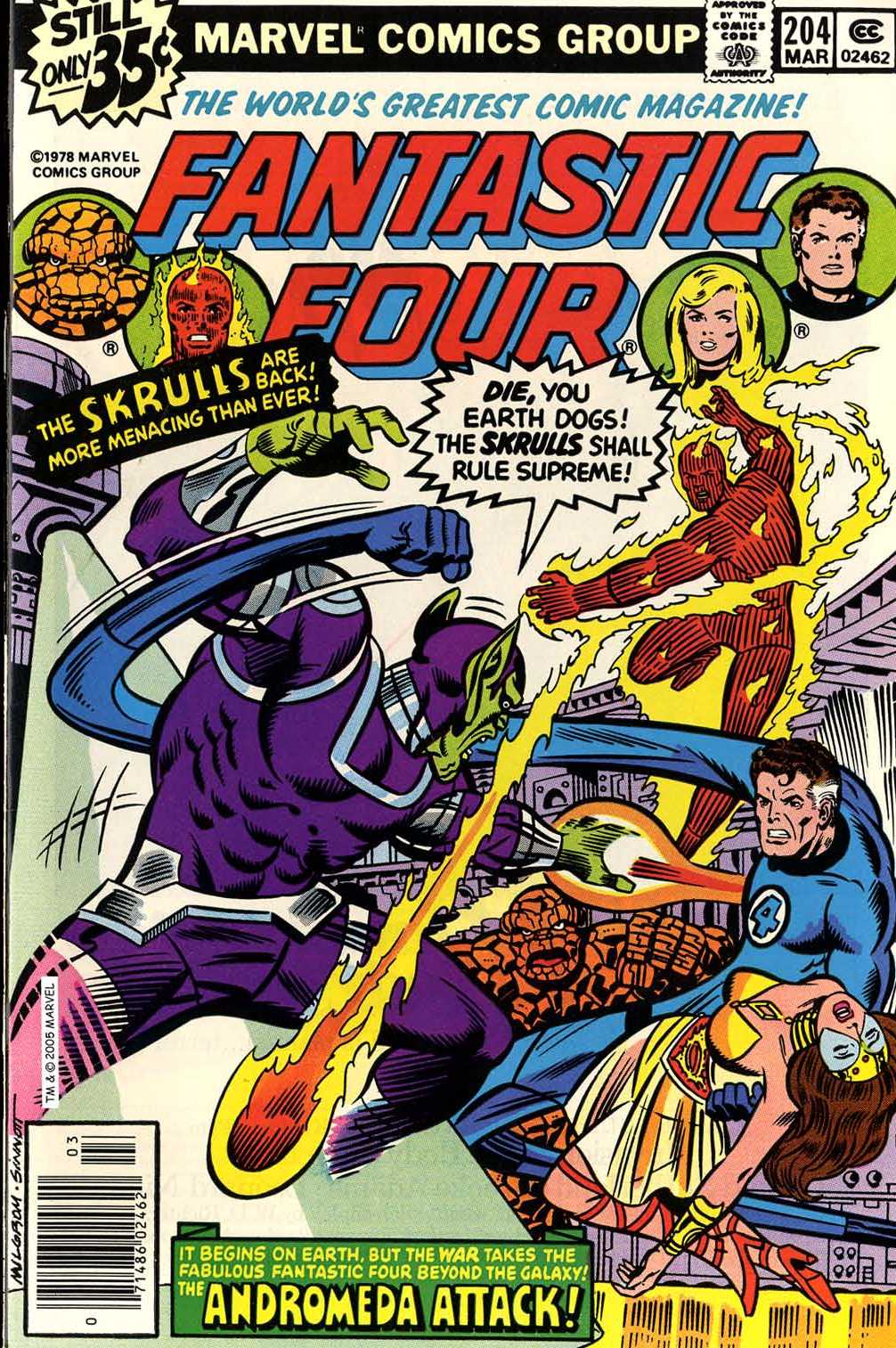
A bunch of this issue is dedicated to the history of Xandar, the planet from which Nova’s powers and spaceship originate. The issue opens as Reed is trying to figure out why the FF’s computing power is being diverted into outer space. But that gets put aside when a frantic female figure appears in his midst. This is Queen Adora, the Suzerain of the Xandarians, and she’s being pursued by a powerful Skrull warrior. But not so powerful that the Thing and Mister Fantastic aren’t enough to put him down. Adora’s been wounded, and as she receives medical attention, she begins to tell Reed Richards why she’s come. Xandar, which is now a hivelike world following a planetary collapse, is under attack by the Skrulls, and she’s come to petition the Fantastic Four’s help against this dread foe.

Reed immediately says that they need to get involved. But to do so, they’re going to want to have their full team on hand, and so a summons is sent to the Human Torch. Johnny Storm, though, is sort of drifting through life, hanging around on the Empire State University campus and playing pinball. But when he’s insulted by a girl he’s trying to pick up who admonishes Johnny for not making the most of the opportunities he’s been given and instead acting like a child, this galvanizes Johnny’s resolve to go back to college and complete his degree.
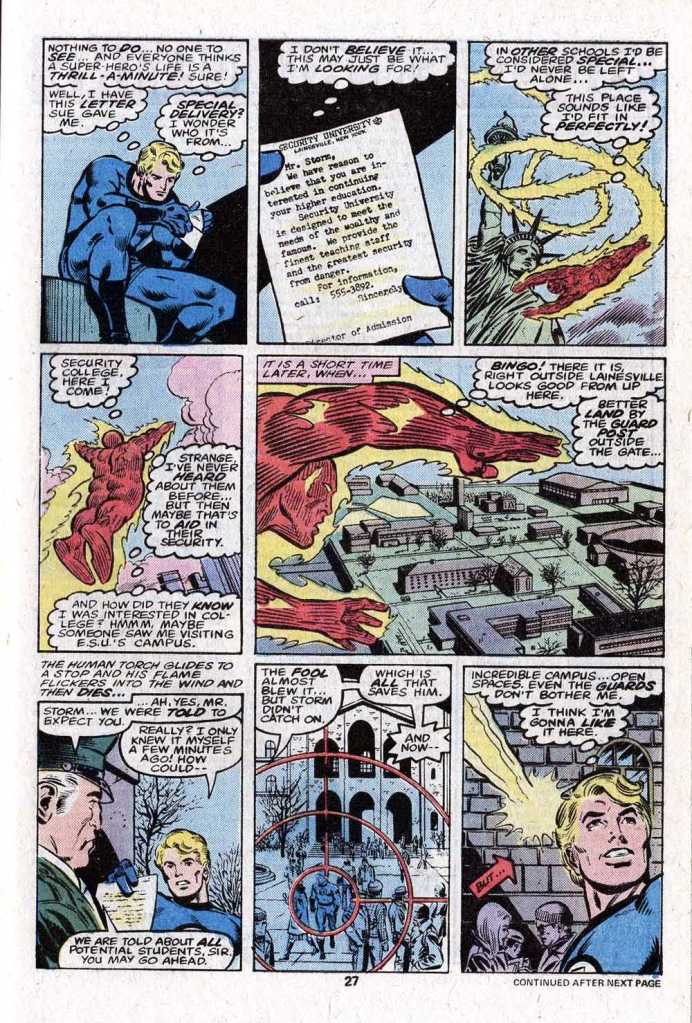
But to do so, he can’t be heading back off into space for who-knows-how-long with Reed and the gang. His fellow team members understand, and they take off for Xandar, leaving the Human Torch behind. Now once again at loose ends, Johnny seeks out somebody to talk to about his situation. But the Avengers are all occupied and Spider-Man is fighting the Man-Wolf in his own comic and is therefore unavailable to him. Johnny has received a special delivery telegram from the oddly-named Security University asking him to join its student body and promising an environment where the wealthy and famous can study unmolested by the outside world. Despite this seeming like an obvious trap, Johnny zooms off to the college to see about enrolling. Dope.
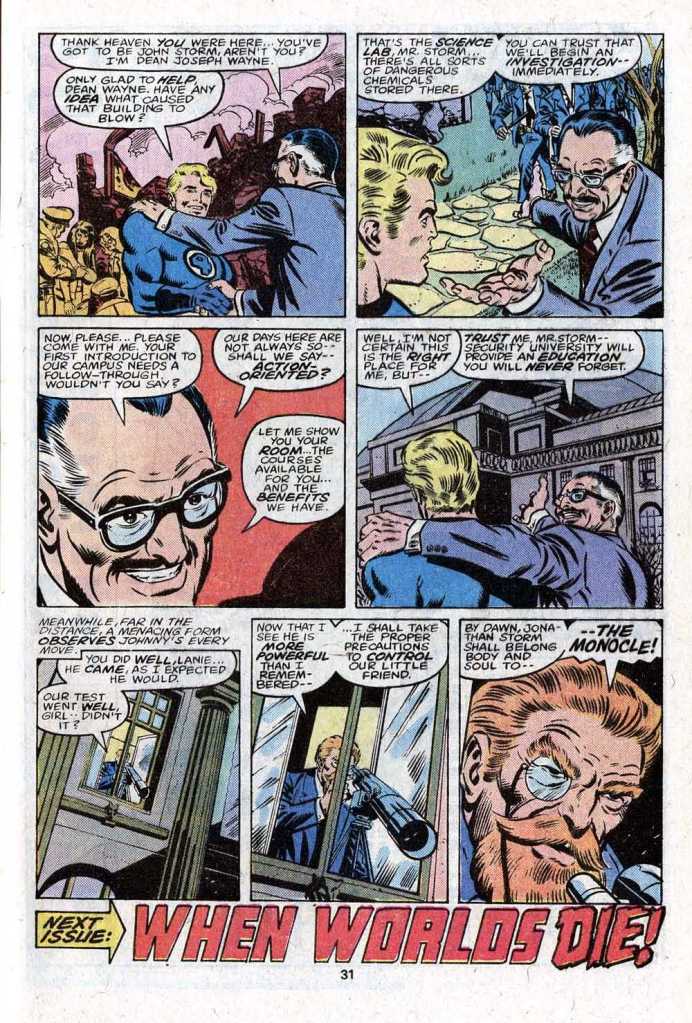
As the issue wraps up, the string-puller behind Johnny’s invitation causes an explosion in the science lab that requires the Human Torch to take action to save imperiled students. This earns him praise from the school’s headmaster Dean Joseph Wayne, and it seems inevitable now that the Torch is going to sign on for the learning experience, little realizing that everything has been a set-up. And we pull back to reveal the mastermind behind this whole deception. It’s the Monocle, one of the last and weakest villains created by Stan Lee and Jack Kirby in their final days as a team on the series. So while this was a callback to the past, it wasn’t an especially exciting one–the Monocle was a bit of a piker, and never intended as anything more than a one-off. But the pieces were now in place, and Marv would be splitting his time between the trio in space and the Torch on Earth across subsequent issues.

This issue also has a heck of an eventful letters page. Not only is there a long missive from Peter Sanderson, Marvel’s future historian and researcher, but there’s also a mea culpa from Marv about having fouled up a plot point in an earlier issue–complete with a replacement version of the panel in question that you could clip and paste into the book in question. I hope nobody actually did this, shades of the Marvel Value Stamps! Finally, we get this year’s Statement of Ownership, which tells us how well the title was performing at this moment. As it indicates, FANTASTIC FOUR was selling 160,757 copies on a print run of 390,661, giving it an efficiency of 41`%. Which was about average, but which meant that literally more than half the print run was being shipped, displayed, returned and destroyed every issue, which is crazy.
 The Tom Brevoort Experience
I barely remember this plotline, and did not know it was originally supposed to be a big crossover between FF and NOVA. I might revisit the issues in an attempt to figure out what aspects of the plot were originally intended to be more “Nova-centric”– though I must admit I don’t have a real strong motivation to do so, since I’ve yet to read a good story starring Wolfman’s hero, either as a solo star or in an ensemble.
LikeLiked by 1 person
I have this issue and I wouldn’t figure this out until a number of episodes of Star Trek: The Next Generation or Star Trek: Deep Space Nine or Star Trek: Voyager but there is no way either the Luphomoids ( Zorr’s race ) or Nebula using Sanctuary II could have destroyed the planet Xander or what was left of the planet Xander, not when the Xandarian Syfon Warriors ( and later when Nova’s full abilities were revealed to include Syfon Warrior powers — absorb energy ) can easily pass through shields around ships ( and if it was me, their Skimmers [ Rom#24 ] would be able to absorb energy too like one of the Raiders that Iron Man fights tech ) and head for the engine room to take out any ship. As for that Skrull whose name I would find out years later is Skrull-X, to bad no one thought to give that name to a 1960s era original X-Men powered “super-skrull”. Fun fact, Xander ( this issue ), Galador & the Kree are the 3 alien races that have members that could pass on Earth for Africans/African-Canadian/African-american,etc. ( a.k.a. Black — a term I hate since my colour is clearly Brown ). Galador also has an Asian Race ( Japanese/Chinese/Korean,etc. looking race ).
LikeLike
As for the Monocle, he should have been created for Captain America or Daredevil and Modok should have been created for the Fantastic Four.
LikeLiked by 1 person
I don’t think Daredevil needed anymore lame villains, haha! MODOK as a Fantastic Four villain would have been very interesting though! I don’t think they ever fought each other even? Reed would probably figure out how to deactivate him in minutes.
LikeLike
Keith Pollard and Arv Jones are not as well remembered as they should be. Pollard had a nice run on the FF and worked better with Sinnott than most, (Great inker, but one who did not especially work as well with John Buscema or Byrnes as he did Buckler, Kirby, Kane or Pollard in my opinion,).
i never noticed this before, but the ur-Nova was created for a fanzine in the 1960s. Does “Xandar” (home to a force of Marvel Cosmic Policemen) remind any one of “Xudar” (home to a famous member of a DC force of cosmic Policemen)? Did the “Cease & Desist” letters ever go out?
Also, am I the only one who confused the Monocle and Dr. Faustus from CPT America?
LikeLiked by 2 people
I myself thought that was Faustus.
LikeLiked by 3 people
Keith Pollard got to draw the butt of every single Marvel character as part of the ‘Master Edition’ handbooks. That achievement has to count for something! ;-)
LikeLiked by 2 people
Keith Pollard is an unsung great, compared to his contemporaries. To me, he stayed closer to the spirit of Kirby’s versions, especially on Reed, than subsequent artists. The biggest visual break coming with Byrne. Reed went from being drawn like Burt Lancaster to looking more like Dean Jones.
An inker also had a big impact on Keith’s drawings. His pages in Avengers Annual #16 were inked by the great Al Williamson, & I’d rank them pretty highly against almost any other artist’s.
LikeLiked by 2 people
I also liked Pollard’s FF very much. I agree that his Reed was from the model (as was J. Buscema, Perez, and Buckler) that was established by Kirby plus Sinnott. It could be argued that Byrne’s version was on model as well, but it’s Reed from the earliest issues of the FF.
LikeLiked by 3 people
Thanks, David. It might just be my ignorance . I might be stuck in the later, thicker Kirby images of Reed. I’ve also read where Kirby’s Read has a build described as an “action hero’s”. Alex Ross stuck to that design, too.
LikeLiked by 1 person
Tim, I do agree with your point that Byrne’s FF (plus the lack of Sinnott) was a big visual break from previous runs. Had Sinnott stayed on board I think it would have been somewhat less so despite Byrne slimming down Reed, Sue, and Johnny’s physiques and sending them to the hair dressers for the first time in 12 years.
LikeLiked by 2 people
😅😉🙏
LikeLiked by 1 person
Alex Ross draws near everyone as if he’s using aging bodybuilders as models so he might not to be aping Kirby on purpose.
LikeLiked by 2 people
Ouch! Harsh, Steve. 😉
LikeLiked by 1 person
Agreed. Pollard deserves more respect for his more than Solid FF and ASM!
LikeLiked by 1 person
Faustus came before Monocle, and though both were Kirby’s visual takes on European villainy, Faustus is a little more memorable.
LikeLiked by 1 person
Long before Monocle’s raising & teaching the members of the Umbrella Academy.
LikeLiked by 1 person
I always appreciated Peter Sanderson’s opinions & insights, going back to his days as one of DC’s most prominent letter writers in the mid-1960s!
LikeLiked by 2 people
“Finally, we get this year’s Statement of Ownership, which tells us how well the title was performing at this moment. As it indicates, FANTASTIC FOUR was selling 160,757 copies on a print run of 390,661, giving it an efficiency of 41`%. Which was about average, but which meant that literally more than half the print run was being shipped, displayed, returned and destroyed every issue, which is crazy.”
Let’s get the easy rebuttal out of the way. This document did not reflect sales “at the moment.” It reflected the numbers of a sales year in which the last issue considered was published at least eight months earlier. I’ve pointed this out elsewhere, but the sales year that included the last issues of the John Byrne run on X-Men saw the series become the top-selling color-comics title in North America. Claims by Byrne–with his determination to belittle the success of his X-Men run, perhaps because of the bitter circumstances of his departure–that sales of his run were nothing special ARE FALSE. The sales in this particular document are not about the sales of FF #204. They’re about the sales of the series around issue #190 or so.
Healthy sell-through in what’s called the newsstand market is 50%. With publications such as the Marvel titles, which are dependent on continuing readership, and which risk losing readers if an issue is missed, 50% is what’s optimal. Sell-throughs over 60% mean sell-outs are happening at the vendor level, and sell-outs risk alienating continuing readers because an issue is missed. If a publication is hitting 60% or greater sell-throughs, the publisher underprinted the publication. Sales managers don’t want to echo Ed Shukin about the sales of Howard the Duck #1. Acknowledgements such as “I underestimated that duck.” are what’s to be avoided.
I talk up Jim Shooter a lot. But he understood the business as well as anyone before him, and more than anyone since. When he took over editorial at Marvel in 1978, the company had two, maybe three continuing titles that averaged sales over 200K per issue. When he left the company in 1987, it had at least a dozen continuing titles–not limited series, debuts, or one-shots–averaging sales over 200K per issue, and two of the three titles selling better than 400K saw most of their sales in that “crazy” wasteful newsstand market. (DC, in contrast, had no continuing titles selling better than 200K per issue.) Shooter understood the value of the “crazy” wasteful newsstand market in getting new readers.
Here’s something for our host to consider. The beginning of his tenure at Marvel (sort of) coincides with Shooter’s departure. Sales of the ongoing series in general went in decline when he left. The big boost afterward was the influx of readers into the comics stores with the 1989 Batman movie. That’s when Todd McFarlane and those in his wake took off. But those readers had cycled out of the market by 1993. What was the status of the newsstand market by 1993? How successful have efforts been to bring in new readers since 1993? The X-Men, Spider-Man, and MCU franchises have been lures, but how successful have they been in bringing in new readers? Could part of the problem perhaps be that disdain for the “crazy” waste–i. e., the overhead considerations that had been a matter of course for periodical publishing for over a century–of the newsstand market made it impossible for those in charge to consider it as the avenue for a new (and renewable) readership? And isn’t that short-term thinking that defines stupid? How often has our host seen a first-month sale over 200K that was an ongoing thing, rather than a debut or a gimmick? Maybe the newsstand model wasn’t as crazy or as wasteful as he thinks. It requires savvy, but that’s the challenge.
LikeLiked by 1 person
It could be argued that Marvel and DC were a little too quick to give up on the newsstand market once the non-returnable Direct Market became viable. But the newsstand market was starting to dry up even then, and it’s only gotten worse since. Print media of all kinds are struggling. Magazine racks are getting hard to find, and are small, sad affairs when they exist at all. Even the ubiquitous Archie digests have disappeared from the checkout lanes around here. I think the notion that if we just produce and distribute comics the way we did in the ’80s, they’ll sell like they did in the ’80s is wishful thinking. The media landscape has gone through a seismic shift, and kids have a million more options competing for their attention and money these days. Movies, video games, and streaming shows are doing all the crazy fantasy, sci-fi, and superhero stuff that used to be the exclusive purview of comics.
The good news is that kids still read comics, just not the same titles and formats as we did back in the day. They’re reading manga. They’re reading books by Dav Pilkey and Raina Telgemeier. They’re reading strips on Webtoons and Tapastic. That’s the future, as much as it might irk those of us with a deep nostalgia for spinner racks and the smell of newsprint.
LikeLiked by 1 person
I didn’t say the newsstand model was applicable now. It’s not applicable to much of anyone these days. But to sneer at it in the context of a late-1970s publication, as our host does, is seriously off-base. No one knew about the Internet back then. DC began treating the newsstand market with disregard around 1982-1983. I get that, as they couldn’t successfully market much of anything in it at that point. But that wasn’t a universal situation. Marvel was still quite viable in the newsstand market, and with projects such as G. I. Joe and Transformers–projects that fanboy “historians” such as Sean Howe have sought to erase from comics history–they were seeing successes that this market maybe saw once a decade. Success in the newsstand market brings new readers. The comics-store market relies on old readers.
Our host is reflecting a decades-old fallacy that new readers shouldn’t matter, because pursuing those readers is wasteful, and it’s not congenial to producing material that appeals to him as a fan. Therefore, pursuing old readers (with similar tastes) should be the be-all end-all, as they are more predictable, despite their numbers being in continual decline. For his sake, I hope he reaches retirement before the market strategy he’s beholden to runs out of runway.
LikeLike
I apologize for misinterpreting you. But if you’re not advocating for a return to the newsstand model, I’m not sure what you ARE advocating for. And I think you’re inferring an awful lot from Tom’s use of the word “crazy”. Those margins might have worked out for Marvel for a long time, but you gotta admit, any business plan that involves more than half your product getting pulped sounds pretty crazy!
LikeLiked by 2 people
Also, not just for their money. There are tons of free games,
apps, stuff to read online.
I often see kids opt for something they don’t have to pay for, because there is tons out there.
LikeLike
I don’t think I ever read this issue, or the Nova tie-in. Sounds interesting in premise. I really like that cover, nice Milgrom/Sinnot collaboration. I like hoe 3d the characters are, shifting back and forth dimensionally.
LikeLike
You missed absolutely nothing. Doctor Sun outside of Tomb of Dracula was a misfire, Sphinx was treated with the gravitas of Doctor Doom without any of the build up it took to get Doom to that level, it felt interminable, Xandar was better off gone (proven by future writers couldn’t think of anything to do with it other than re-blow it up), and subjectively I felt the most interesting Nova character (Powerhouse) was just dumped to make room for the D list characters that dragged down the whole thing.
LikeLiked by 2 people
Now the continuity-hound in me has an additional motive to seek out this story-line, because as I was rummaging through old MARVEL TEAM-UPS to see what if anything I remembered from them, I found a 1983 tale in which Spidey and the FF are preyed upon by Doctor Fre– er, Faustus. There’s only a short face-off between Faustus and Mister Fantastic, and while Reed doesn’t say anything like, “The last time we met, you…,” he also doesn’t seem to need any laborious introductions either. Faustus doesn’t say anything about a previous encounter either, just the usual “this will help my plans to RULE THE WORLD.”
LikeLike
Could I get a No-Prize for suggesting Reed keeps tabs on the whole super-villain community as an intellectual diversion?
LikeLiked by 1 person
D’oh, got my wires crossed and somehow thought Dr Faustus was the Villain of Johnny’s Collegiate Experience, not Monocle, which is why I went on the MTU tangent. So maybe Reed really did know Faustus in the latter story just because he researches all eleventy-thousand active supervillains.
The whole “Johnny goes back to college” subplot was a big nothing, too. I can’t think why Wolfman stuck a one-off crossover with Spider-Man into the midst of this big long space opera. I guess that gambit ensures that that the Torch is the only FF member not exposed to the Skrull’s aging weapon, so he’s at full strength the whole time. Still a dull Spidey-Torch crossover and nothing that improved the Monocle’s reputation.
LikeLike