

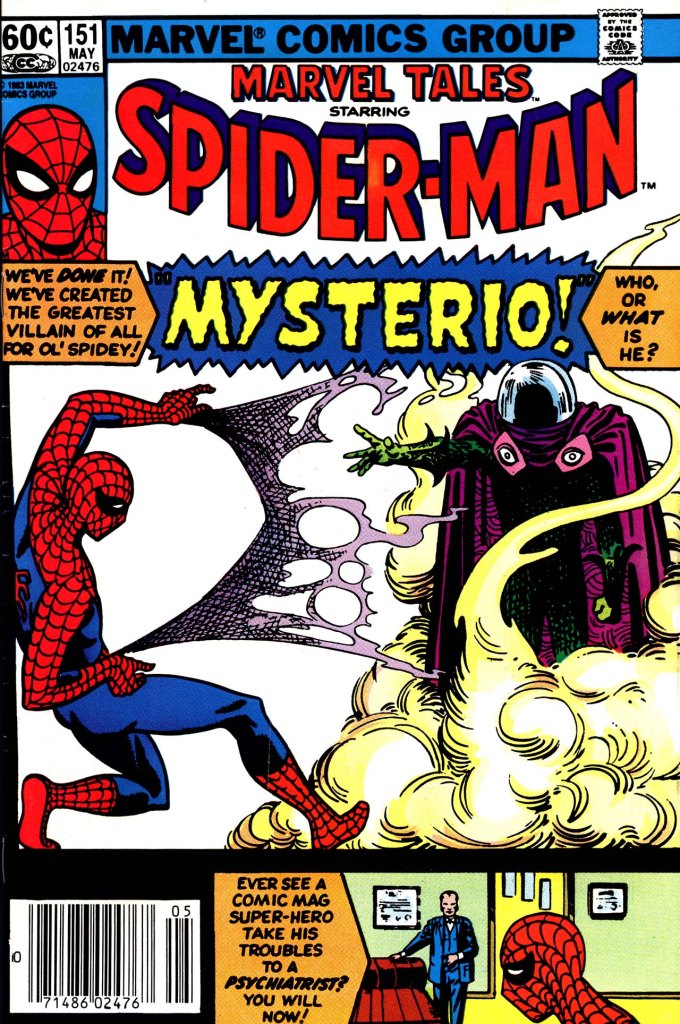
As I’ve spoken about in the past, it proved to be relatively easy to get me to start buying a given series every month. A book just needed to make me picking it up a habit for an issue or two, and away I would go. In the case of MARVEL TALES, the long-running reprint series that re-presented earlier AMAZING SPIDER-MAN stories, this pattern was put to the test in 1982. At that time, new Spidey editor Tom DeFalco along with assistant editor Mark Gruenwald, not really liking the mid-1970s Spidey stories that they were stuck reprinting, decided to simply start the process over and begin again at the jump. Now, I had read the first 20 issues of AMAZING SPIDER-MAN prior to this, plus AMAZING FANTASY #15, in a series of three paperback books. So there wasn’t a whole lot of reason for me to keep on reading here. Yet, I did anyway–in part because these early Spider-Man stories are just so good, and it was nice to see them at full size rather than reduced to paperback proportions. But eventually, during my 1983 purge, the book wound up on the chopping block.

As I’ve spoken about in the past, the first issue of MARVEL TALES that I ever read was the one above, #53. It was a gift from my Uncle Jerry, a house painter who had come across it and two other comic books at some job site where he was working, and thought to pick them up for me. This was another of the Marvel books that I read in my early “only DC” period that failed to make me a Marvel convert. It was memorable, and well-executed, but the story also felt a little bit dark and dangerous to me. I didn’t like that the police were trying to capture Spider-Man, and that they outright shot at him. That wasn’t what I wanted from my super heroes at the age of seven, and so while I kept the comic, MARVEL TALES wasn’t a book that I paid any attention to.
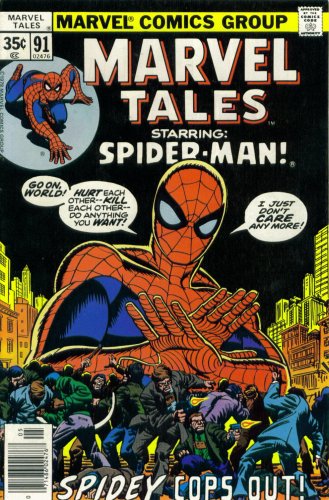
But once I got a few years older, and began to expand my reading interests out into the Marvel Universe, MARVEL TALES was a series i came back to. My first issue was #91, seen above, which was right at the transition point of the AMAZING SPIDER-MAN series. Spidey co-creator Stan Lee had handed over the reins of the book to young newcomer Gerry Conway, who worked arm-in-arm with artist John Romita to keep Marvel’s best-selling series on top of the heap. I bought and read the book every month, even when I’d occasionally come across an issue reprinting a story I had already read (my grade school friend Don Sims had a small stack of AMAZING SPIDER-MAN issues, and I’d read through most of them at various points)
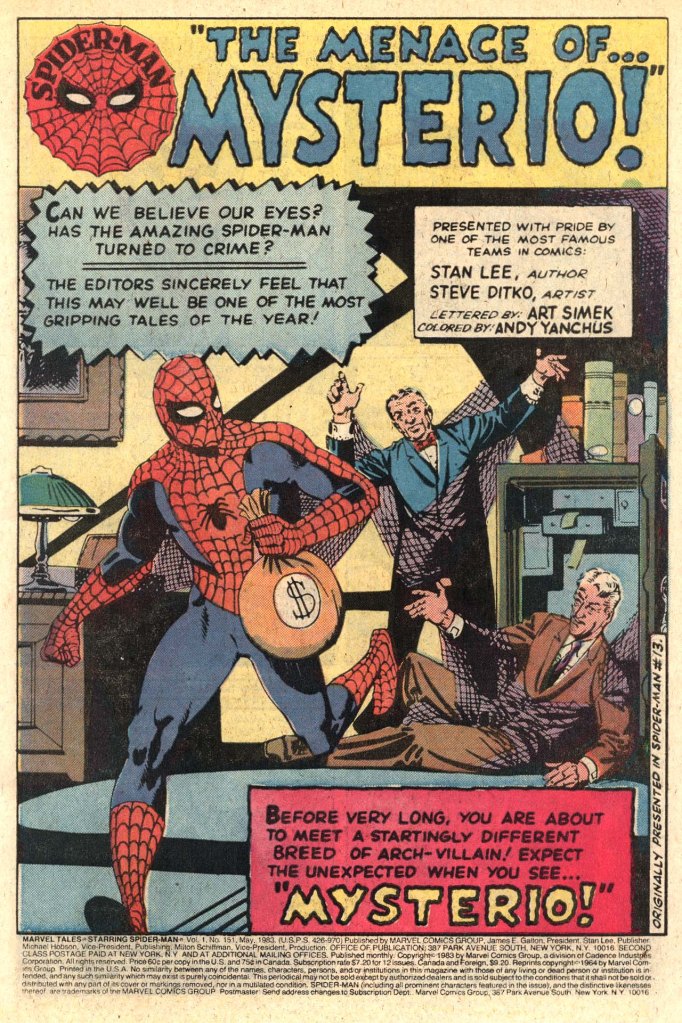
Back in the present of 1983, by the time this issue came out, reprinting AMAZING SPIDER-MAN #13, creators Stan Lee and Steve Ditko had more or less figured out what they were doing with the character, after some early-on teething pains as they worked out the strip. Spider-Man was designed as something of an anti-Super Hero, a character comically plagued by ordinary problems and difficulties in a soap opera style. This human element was a new thing in comics at the time, and it separated AMAZING SPIDER-MAN from everything else in the field, even the other Marvel books of the day. Ditko’s art was quirky and strange and singular, and as he grew more adept and began to plot the series more and more, it became ever more exciting.
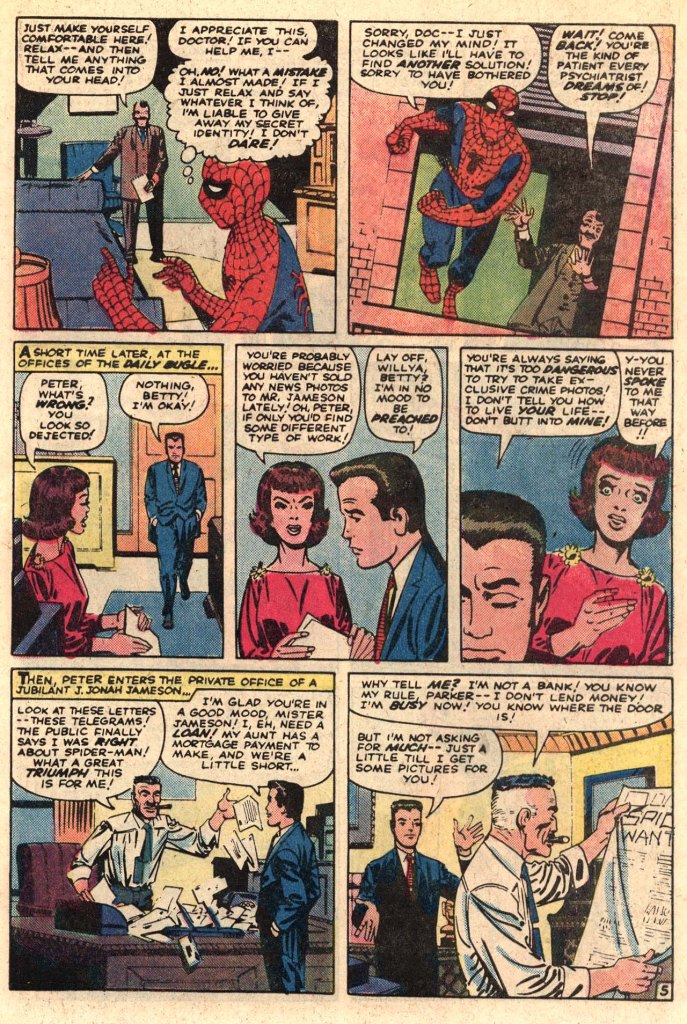
This issue, for example, includes a brief interlude in which Spider-Man goes to see a psychiatrist, fearing that he’s cracking up. You see, somebody else has been impersonating the wall-crawler and committing crimes, and Peter Parker can’t be sure that it isn’t he himself sleepwalking. But he’ got no explanation for how somebody else might be able to copy his unique spider-powers. The scene with the shrink is a short interlude in this story, but Ditko and Lee would come back to it again later in the next Mysterio adventure.
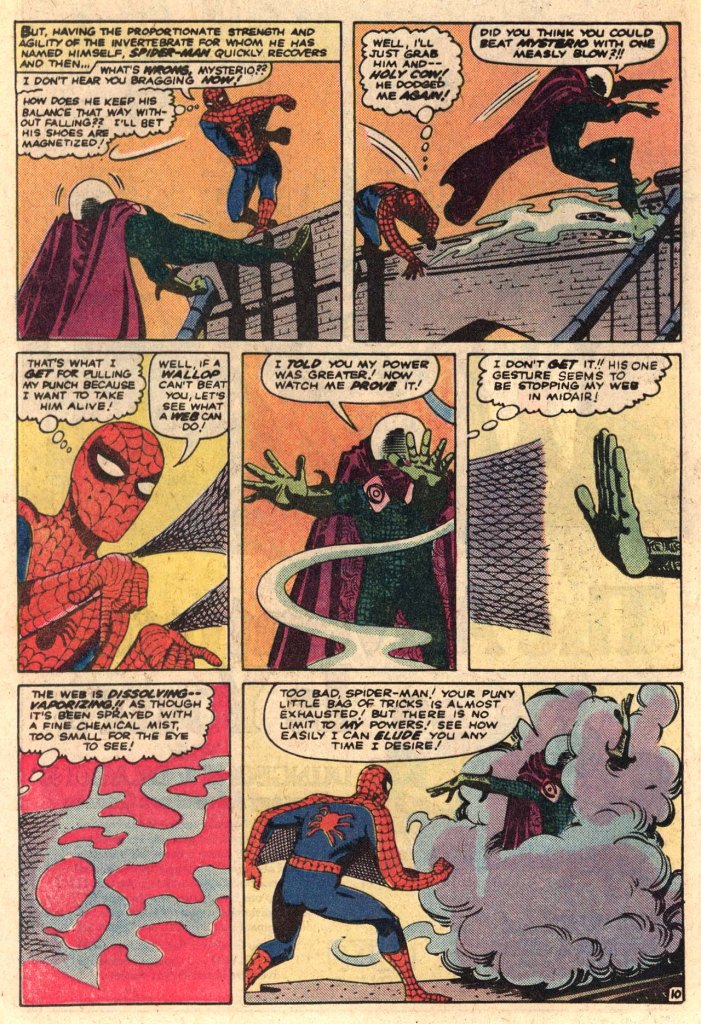
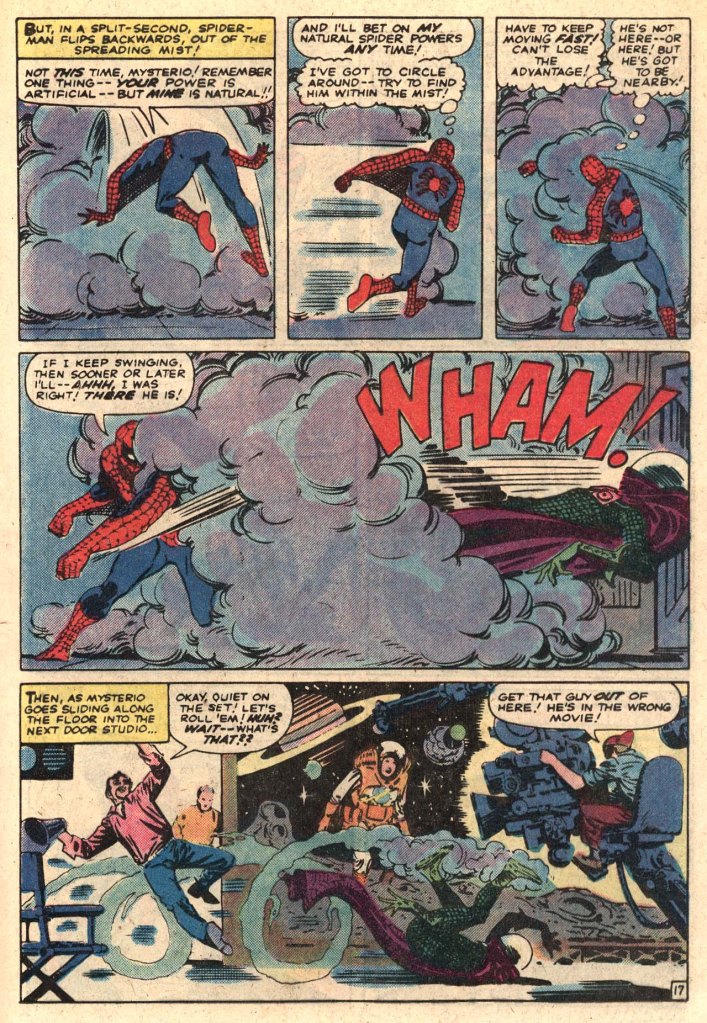
Speaking of Mysterio, he’s another of the wonderfully colorful villains that Ditko and Lee came up with for the wall-crawler to battle with. Spider-Man has just about the best collection of villains in the field, most of which were originated in these early days. In the story, Mysterio presents himself as a kind of sorcerer, a Doctor Strange type with weird, unexplained powers. In actuality, he’s a special effects wizard who is trying to cash in on his talents by using them for crime and framing Spider-Man. (He, of course, was the fake Spider-Man who framed Spidey at the beginning.) And especially in these early sequences where the reader doesn’t quite know what Mysterio’s deal is, he makes a strong impression.
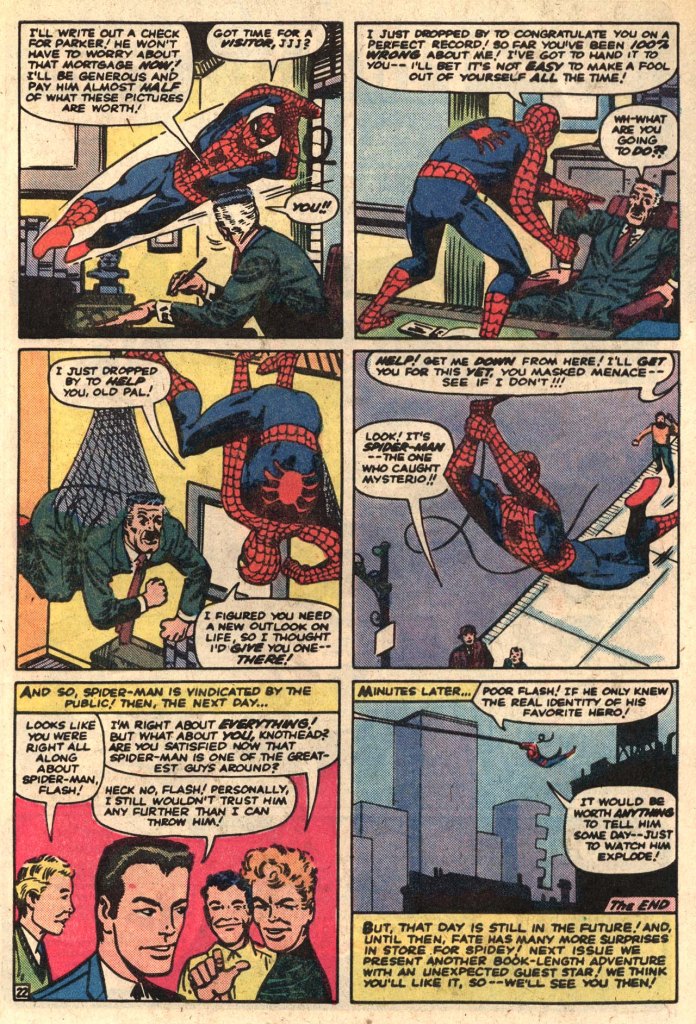
The other thing that was unique about Spider-Man in the early days is how much emphasis was placed upon his life as High School student Peter Parker. There’d be pages and pages in every issue spotlighting Pete and his cast of characters, whether school kids like Liz Allan and Flash Thompson or the reporters of the Daily Bugle such as publisher J. Jonah Jameson and Betty Brant. Pete also had to take care of his doting Aunt May. It was a rich cast, and nobody else dedicates as much real estate to making the supporting players feel like an important part of the story. Legend has it that the DC editors of the era were mystified by this approach. They were certain that kids would lose interest in these Peter-heavy sequences. But far from it–it was his troubles that endeared Peter Parker to the audience.
The Lee/Ditko run of AMAZING SPIDER-MAN is pound-for-pound the very best material generated by Marvel in that early period, outdoing even Jack Kirby’s FANTASTIC FOUR during that same time. And while they clearly looked a bit dated by 1983 standards, these stories were still a lot more entertaining than much of what MARVEL TALES had been reprinting beforehand. So on that end, DeFalco and Gruenwald were absolutely right.
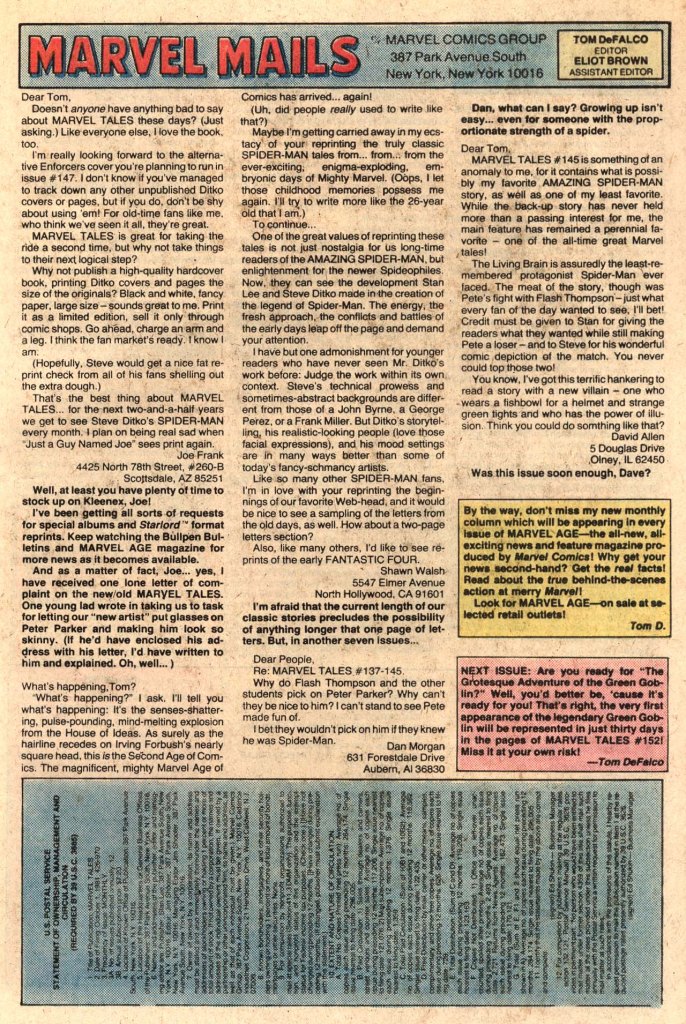
This issue even includes a Statement of Ownership, so we can get a better picture of just how well the series was performing at the point where I dropped it. As we can see, MARVEL TALES had been selling 122,435 copies an issue on a print run of 296,005, giving it an efficiency rating of 41%. While pretty much all of the other reprint books in the Marvel line had fallen by the wayside, the tremendous popularity of Spider-Man kept MARVEL TALES chugging along for years and years yet.
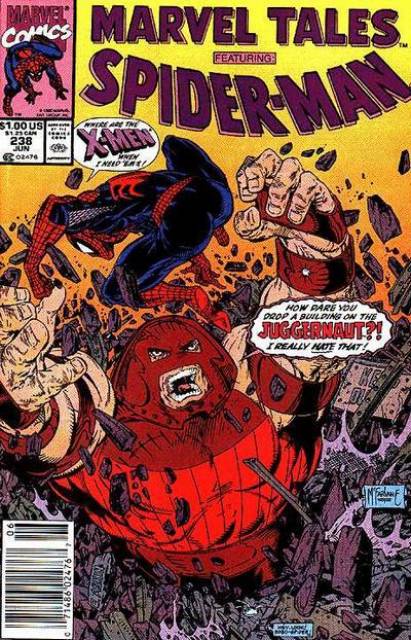
After dropping MARVEL TALES, I would drop in occasionally every time the book reprinted an issue that I hadn’t previously read. But I didn’t start reading it regularly again until I came on staff at Marvel and began to get a weekly bundle of the company’s entire publishing output. So my first issue back was this one, #228, reprinting a Juggernaut adventure that I had read when it was published new.
 The Tom Brevoort Experience
The supporting cast really was a huge asset to Spidey’s success (https://atomicjunkshop.com/art-webs-and-more-somewhat-random-thoughts-connected-to-spider-man/)
I’m often irked at the people who argue Mysterio shouldn’t have had to turn to crime if he’s so talented, OMG Silver Age, amiright? Like incredibly talented people don’t lose their careers in Hollywood for all kinds of reasons (hit on the wrong person, not a team player, mouthed off to the wrong person, etc.).
LikeLiked by 1 person
I suspect the reason for shifting to an issue-by-issue reprint of the Ditko-Lee run was more than just “new Spidey editor Tom DeFalco along with assistant editor Mark Gruenwald, not really liking the mid-1970s Spidey stories that they were stuck reprinting, decided to simply start the process over and begin again at the jump.”
Reprint responsibilities are an easy job, particularly if all titles are equal–the situation frees up time for more attention to non-reprint work, or just screwing off on company time. It would surprise me if DeFalco and Gruenwald much cared what run was being reprinted. I believe editor-in-chief Jim Shooter might have had some say in the decision to go back to the Ditko run, particularly since there was an opportunity to direct income Steve Ditko’s way. For a number of reasons, I’m sure he thought Ditko was more worthy of that income than Gerry Conway or Ross Andru.
If questioning our host’s biases, I might ask if this was an instance where we shift from characterizing Shooter as Mr. Control Freak to one where everything good that happened at Marvel during his tenure was someone else’s doing.
Whatever. I was grateful back in the day for the shift, despite some hiccups, to chronologically reprinting the entirety of the Ditko-Lee run. That run was one of the high points of comic book history, and I’m glad Gen-X readers like myself got to see it in a month-to-month fashion.
LikeLike
Wasn’t it this round of Lee/Ditko reprints that, at least in the early issues, included some changes to the text to make it more up-to-date in terms of historical references? I’ve a vague recollection of complaints about a reference to the “Ayatollah” being added.
I read these along with the other Spider-Man books at the time and they were by far my favourite.
LikeLike
Yes, on occasion during this run topographical references were modernized. Never liked that.
LikeLiked by 1 person
Yes, those changes started under Tom DeFalco, and ended under subsequent editor Danny Fingeroth, when his new assistant, Bob DeNatale, was put in charge of the book and stopped making changes. So far from not caring what was being reprinted, Tom cared enough to do extra work–perhaps misguidedly, but it definitely shows a concern for the content.
LikeLiked by 1 person
There were dumb revisions, such as changing the name of a TV show being referenced to something more contemporary. That’s what I was referring to with “hiccups.”
LikeLike
“…such as changing the name of a TV show being referenced to something more contemporary.”
Specifically, a reference Aunt May made to THE BEVERLY HILLBILLIES was changed to THE DUKES OF HAZZARD. There was a large number of complaints.
LikeLiked by 1 person
By a fortuitous coincidence, the issue where they stopped “updating” the stories (#159, reprinting Spidey #21) was the exact point where the old Pocket Books reprints had left off. So I was able to finish out the Lee/Ditko run more-or-less unadulterated.
(#159 also came out during the notorious “Assistant Editors’ Month”, and included an extra gag page where they went hog-wild on making updates, including putting Aunt May in a track suit and giving Flash Thompson a mohawk.)
LikeLiked by 1 person
It’s possible that Jim was involved in that decision, RS. But from speaking with DeFalco about it, he credited himself and Gruenwald.
LikeLiked by 3 people
I feel pretty comfortable saying that if Shooter didn’t approve the direction shift with Marvel Tales, it wouldn’t have happened. He was the editor-in-chief, and an engaged one.
LikeLike
“…if Shooter didn’t approve the direction shift with Marvel Tales, it wouldn’t have happened.”
Sure, but there’s a difference between “This happened because Jim wanted to send money to Ditko and Tom’s biased to suggest that it was someone else’s idea” and “It might have been Tom and Mark’s idea but Jim would have had to approve it.”
Nobody’s been suggesting that it was done against Jim’s will.
LikeLiked by 1 person
If Jim had chosen to steer money Ditko’s way by telling Tom what to reprint, he’d have been diverting the money from Len Wein, not Gerry, since the book was into his run on the series by then.
LikeLiked by 2 people
The Ditko/Lee era of Spidey, is still my all time favorite. They setup the template for the young hero model that been used over the years. It’s one that works well!
LikeLiked by 2 people
My impression as a fan at thetime was that the Lee/Ditko issues had not (yet) been widely reprinted and there was interest.
Ditko was still doing work for Marvel at the time (for example, Rom Space Knight and Avengers and FF Annuals) so Shooter might have wanted to improve returns on the book and stay in Ditko’s good graces, as well.
Shooter was (for a long time) a very successful Editor in Chief for Marvel (and, later, Valient).
He is somewhat symbolic of the the lare 1970s to late 1980s period in publishing (and venture capita;l). He came fairly close to an LBO of Marvel and got VCs to back major comics start-ups twice.
There is a good business book there.
LikeLiked by 1 person