

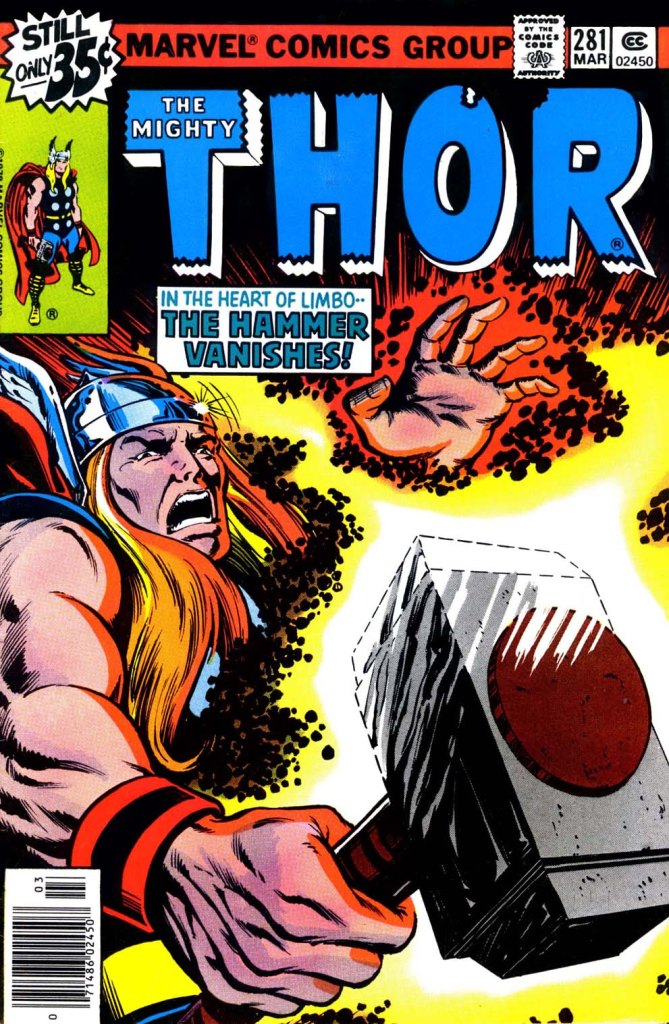
This particular issue of THOR was another comic book that my household wound up with two copies of. As he would do from time to time, by younger brother Ken purchased his own copy of this issue for whatever reason. The series was drifting a bit at this particular moment, with this being another in a string of fill-in stories designed to buy time before writer/editor Roy Thomas could begin his Celestials Saga and attempt to reconcile the Marvel Universe with Jack Kirby’s ETERNALS series. Spoiler alert: it was an ill fit, but over the years, the roughest edges have been sanded away, and today that history is accepted at face value.
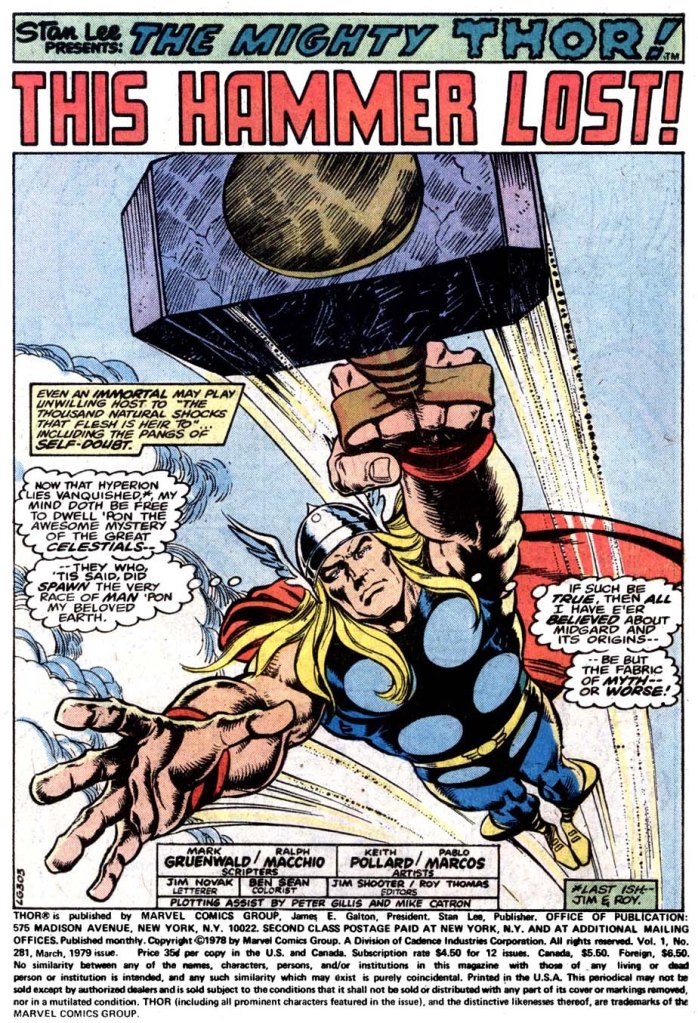
This issue, the first of a two-part storyline, was the work of co-writers Mark Gruenwald and Ralph Macchio. Both on staff at Marvel during this time as assistant editors, the pair had joined forces as a writing combo to better improve their chances of landing writing work and making a good effort at it when they did. Shortly after this, they would begin a well-regarded run on MARVEL TWO-IN-ONE, saving that series from its doldrums. But here, the pair was motivated by more mundane matters. Even in this era before the Official Marvel Handbook, Gruenwald in particular was keen on categorizing and organizing the continuity and mythology of the Marvel Universe. There were aspects of things that had been established that bugged Mark, and so he’d occasionally take it upon himself to write a story like this one, where the goal was to get rid of some inconvenient fact that he didn’t care for. In this instance, it was the early-established idea that Thor’s hammer could allow him to travel through time.

Consequently, the story this time out opens up with Thor needing more information about the Celestials’ Fifty-Year judgment of Earth, and to get it, he decides to travel backwards in time through the use of his hammer to witness firsthand the Celestials’ first Host, when they came to our planet initially. But entering into the timestream, Thor finds his hammer disappearing from his hands and himself deposited into a timeless void. There, he meets an old foe, the Space Phantom, who in the past had bedeviled the Avengers on a few occasions. But the Phantom isn’t here to fight, rather, he’s come to petition the Thunder God for help.
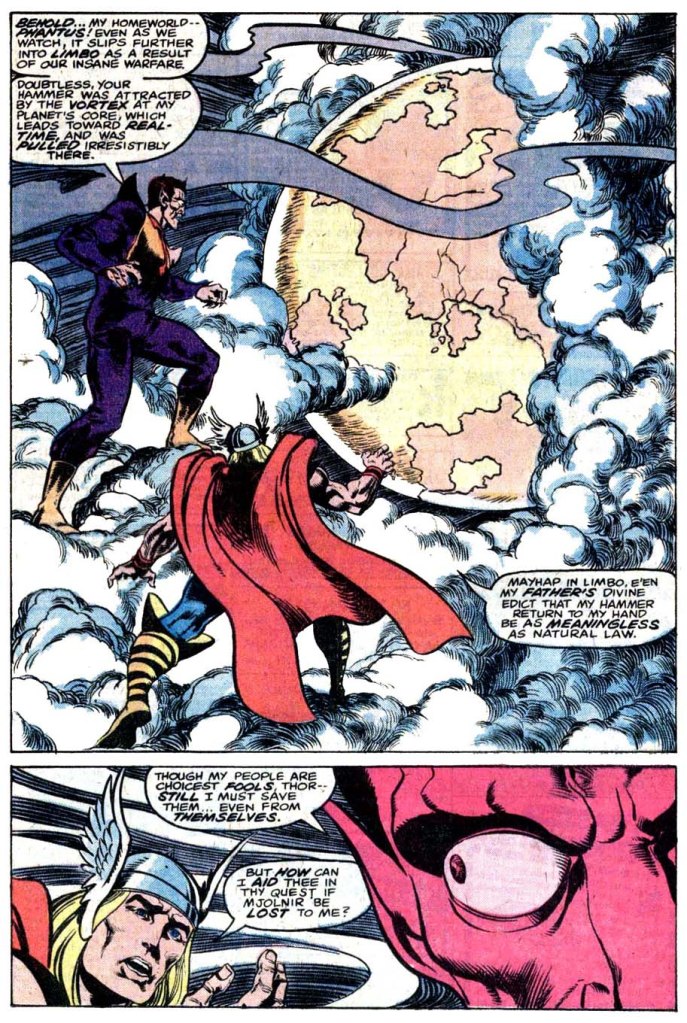
The Space Phantom explains his history and unrevealed backstory as he and Thor walk and talk, and Gruenwald and Macchio take the opportunity to try to turn a couple of random appearances by an ill-motivated foe into some sort of deliberate pattern. The Phantom reveals that he’s a native of the planet Phantus, a world that is itself slipping into the Limbo that has trapped Thor due to its inhabitants having used time travel to wage warfare among its people. The space Phantom is determined to save his planet, and he asks for the Son of Odin’s help in doing it. Thor doesn’t know how much help he’ll be without his hammer, but he agrees to go along with the Phantom for the time being.
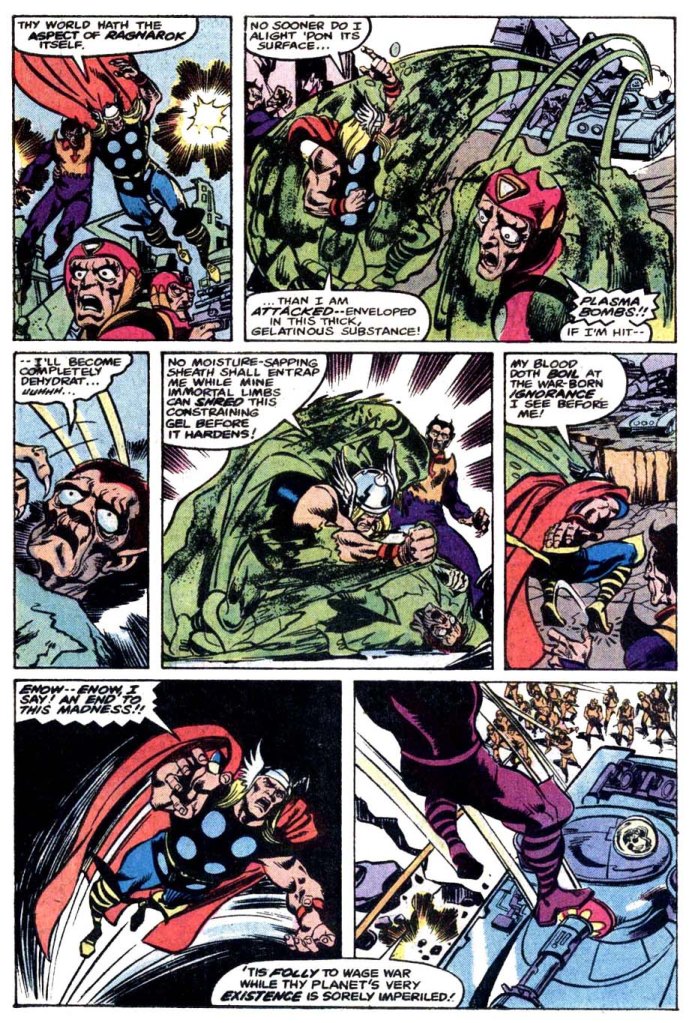
The Phantom tells Thor that he figures Mjolnir was pulled to Phantus, and so that’s where they must go if they are to retrieve it. But as the pair make planetfall, they find themselves in the middle of an all-out conflict, waged with frightening super-weaponry. It seems the Phantans are still in the middle of their never-ending time war. Thor throws himself directly into the battle, of course, but without his weapon, he’s at a bit of a disadvantage, and is forced to improvise in order to knock out his assorted attackers.
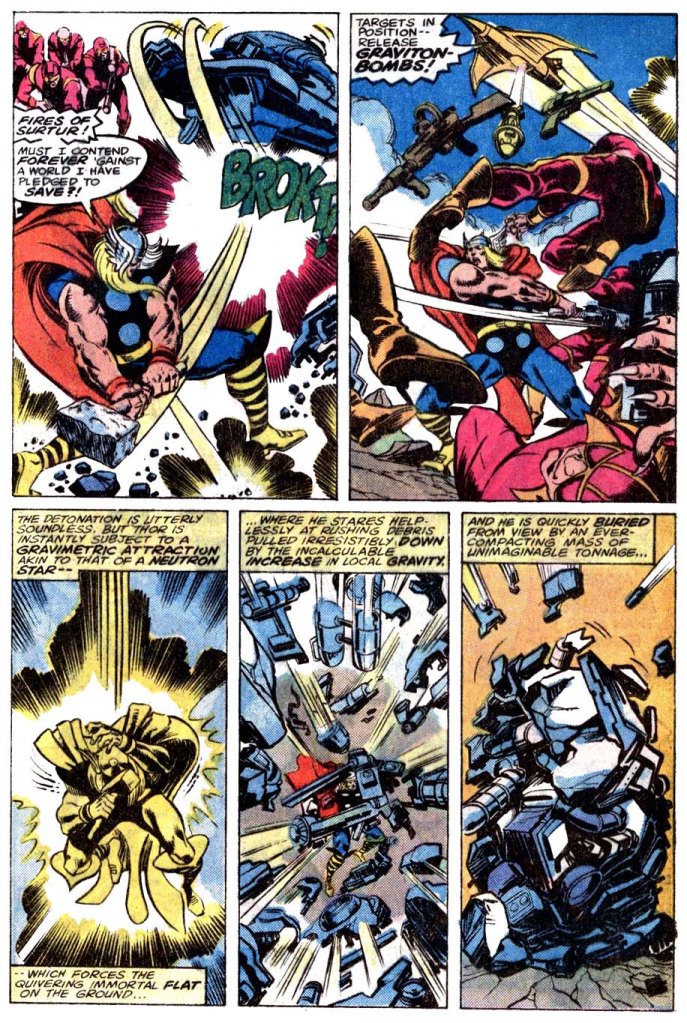
What follows is the issue’s action-quotient, a spectacular multi-page sequence adeptly illustrated by Keith Pollard and Pablo Marcos. Taking a page from another early Marvel Thor story, the Thunder God smashes an alien tank, compressing it down and forming it into a crude substitute for his missing hammer. It’s not as strong, of course, and it won’t return to him when he hurls it, but it feels good in his hand and gives him something to hit with. Eventually, Thor and the Space Phantom are able to fight their way to their objective: a Terminal Complex that contains a shaft that runs down into the planet’s core, to the juncture point where it is being pulled into Limbo.
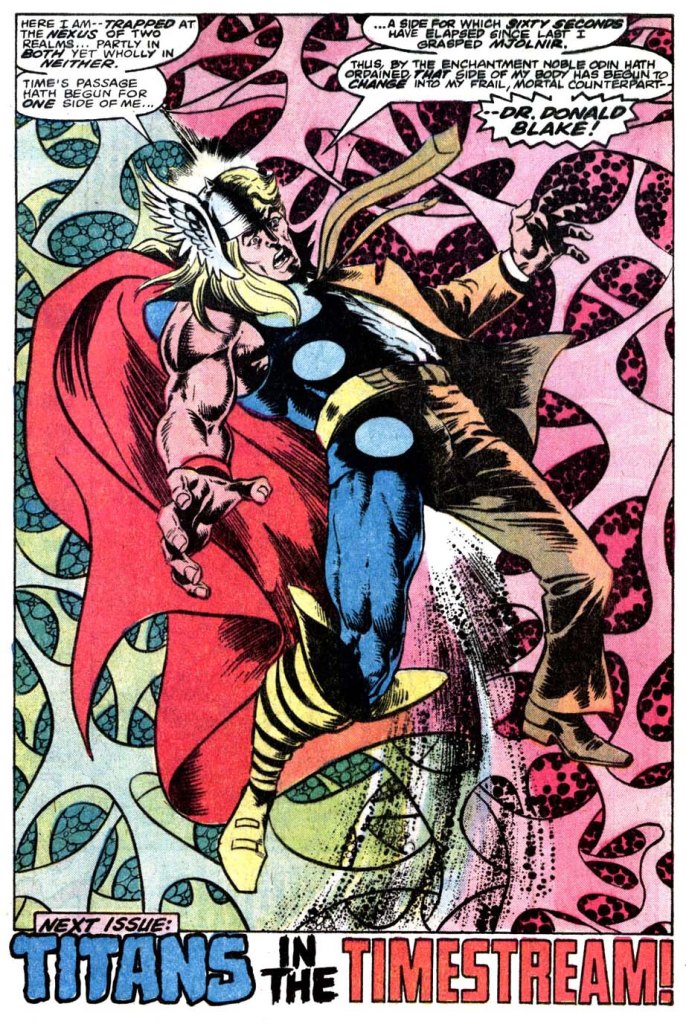
The Phantom tells Thor that all he needs to do in order to recover his hammer is to leap into the shaft, which will carry him to the juncture point where it certainly must be. The big dope goes along with the Space Phantom’s plan, little realizing that the alien is lying through his teeth. In fact, the Space Phantom intends to use Thor’s immortal body like a cork, to plug up the aperture that’s drawing Phantus into Limbo. But things don’t work out quite the way the Phantom had planned, for as Thor is trapped between Limbo and the outside universe, time begins to pass for the side of him that’s within the real world. And that means that the enchantment that says he must transform back into the mortal Doctor Donald Blake if deprived of his hammer is triggered, and half of Thor is so transmogrified! To Be Continued!
 The Tom Brevoort Experience
I am still bugged by that bit in Avengers Forever where the Space Phantoms pose as dead western heroes. That’s not how it works, for the SP need to replace the hero who takes their place in Limbo, and if they were dead, cannot be replaced. They are not “skrulls”. ;-P
LikeLiked by 1 person
I have the reverse issue with the Legion of the Unliving. It started as “dead people plucked out of time from before they died” and became “people who will be dead some time in the future so they totally count as unliving, um, kind of.”
LikeLike
Our thinking there was that everyone the Phantoms duplicated — including the synchro-staff — was duplicated at a point when they were living (or whatever life-status the staff had) and then the Phantom-version was sent by Immortus to the time they were needed in.
There are some characters — Moonraker, for one — who we’ve seen duplicated by a Phantom but have never (as far as I know) seen their actual selves. Whatever world or timeline Moonraker’s from has yet to be established.
LikeLiked by 1 person
I’ve no clue either way. If Kurt Busiek sees this, he might be able (& willing) to explain.
LikeLike
Gruenwald’s issues of Thor in this period were fun. Later they were an awful mess.
LikeLiked by 1 person
The credited letterer is Jim Novak, but I’m pretty sure that opening splash page and story title was done by Gaspar Saladino — Todd Klein has written about how lots of Marvels of this era had Saladino, uncredited, on page 1 only.
LikeLike
That R in the title isn’t how Saladin’s did R’s, and it’s a very plain title treatment.
It looks like straight-up Novak to me.
LikeLike
Wait, let me correct that.
I wouldn’t be surprised if someone else lettered the splash, or even if Roy, rather than Mark and Ralph, scripted it, since it’s all about referencing the previous issue. The fill-in would have been drawn and scripted before anyone knew when it’d be used, so that first page would have been left blank so it could be customized when needed. So that page would have been lettered, most likely, by a Bullpen letterer (which could still have been Novak, but might not have been). But that’s still not a Saladino R. And if Gaspar had been brought in to do a compelling smash, he wouldn’t have done such a plain title, I’d think.
Now, the R in the next-issue blurb, that’s a Saladino-style R. And it’s a more-imaginative blurb than that title is. But I think it’s still Novak, who admired Saladino and did that sort of thing from time to time; it’s unlikely they’d have farmed out a next-issue blurb to Gaspar.
LikeLike
Ugh. Gruenwald writing a bad story to fix an nonexistent problem is the worst Gruenwald of all.
LikeLike
Very nice opening & closing splash pages by Keith Pollard. Pablo Marcos’s inks seemed a good fit. I could see these 2 paring up for Conan. Pollard in general seems underrated. He drew a few pages of an all-star jam Avengers annual (# 16, I think). The combined East & West Coast teams face off against Death’s “champions”. Sienkiewicz inks JR,Jr. on a chapter. And Keith gets inked by the great Al Williamson, the result is beautiful. Keith & Al produce maybe my favorite rendition of Mar-Vell I’ve ever seen.
LikeLike
Pollard was highly-regarded enough in the offices, at least, that at one point he was drawing FANTASTIC FOUR, AMAZING SPIDER-MAN and THOR, all at the same time.
LikeLiked by 1 person
“Spoiler alert: it was an ill fit, but over the years, the roughest edges have been sanded away, and today that history is accepted at face value.”
Not by all, Brevoort. Not by all!
LikeLiked by 3 people
I had this issue but had forgotten about it until seeing that cover jogged my memory. I rarely bought Thor during this period but I probably got this issue because I thought Thor making a hammer from a space ship was cool and I was likely intrigued by the Space Phantom plot due to his connection to the early Avengers. As mentioned above….Pollard sure had some chops.
LikeLiked by 1 person
This story was never published in Brazil, but Pollard´s lovely splash page was used as a cover to the comic that started the Marvel period in Editora Abril, a license that lasted from 1979 to 2001
LikeLiked by 1 person
One of my favorite early childhood comics. The Pollard/Marcos art IMHO is outstanding!
The second page pictured in this post; does it count as Spider-man, Iron Man and fantastic Four appearance?
LikeLiked by 1 person
Kurt Busiek: “Now, the R in the next-issue blurb, that’s a Saladino-style R.”
I gotta say… the R in the title and the R in the next issue blurb look pretty much the same to me style-wise… and look drawn by the same hand. Both have a rectangular counter and a vertical leg. The only difference I see is the height where the leg meets the bowl. For what its worth….the letter-spacing is inconsistent on the title and optically more even on the next issue blurb.
LikeLike
That difference where the leg meets the bowl is what makes the one in the blurb a Saladino-style R and the one in the title not, yes.
And they may very well be by the same hand, in that both may be Novak, who admired Saladino and learned a lot from his work, including using Saladino R’s at times. Todd Klein could probably tell offhand; I can only point to the indicators Todd’s pointed out often in his blog posts about letterers.
LikeLike