


Well, there’s a cover that you probably wouldn’t see today, as we’re all just a little bit more sensitive to this stuff. This issue of CAPTAIN AMERICA, purchased on one of my weekly trips to the 7-11 for new comics, was the start of a six-part epic that I’d wind up really enjoying–even if I didn’t realize it quite yet. I’m going to try not to spoil the storyline ahead of time, as we’ll get to those issues in due course. But there was little to no evidence in this first chapter of the specific bit that would get me excited.

After a rocky year or so following the departure of writer/artist Jack Kirby, at this point Roger McKenzie finally gets the series back on track. And by back on track, what I largely mean is spiritually connected to the material that was going on before Kirby’s arrival, in the waning days of Steve Englehart and John Warner’s tenures. Kirby, being Kirby, ignored all of that stuff and just did his own thing, and since his departure, CAPTAIN AMERICA had lurched from one stopgap writer to another, not really holding any particular identity for very long. McKenzie starts off here by ratifying within the story a change that had been made to the covers for several issues now: The Falcon, the co-star of the book for many years, was moving on, and the focus would be shifting back over to Steve Rogers as a solo super hero once more. This wound up being bad news for the Falcon in teh long run, as he largely drifted into teh background not having a regular title to appear in.

This issue picks up with the aftermath of the defeat of the Corporation last month, and Cap helping out with the mop-up detail. However, of late, the Star-Spangled Avenger’s relationship with the clandestine organization has been strained, and when he sees a SHIELD agent verbally harassing the clearly-traumatized Vamp, Cap steps in and puts an end to it–even though it means staring down several gun-wielding SHIELD operatives. It’s a fine Captain America moment, illustrating that Cap’s principles are his guiding light. He’s in no way a “my country right or wrong” sort of guy. On the flight back to New York, McKenzie includes a two-page summation of the events of the prior issues, which is great for getting new readers up to speed but which just feels like padding to anybody who read those books, especially with Marvel’s page count still only being 17 pages.

The artwork this issue is provided once again by Sal Buscema, here finished by Don Perlin. Buscema was a semi-regular fixture on CAPTAIN AMERICA throughout the 1970s, at least when Kirby wasn’t drawing it, and his version of the character is strongly imprinted on my mind. Sal’s artwork was always direct, dynamic and clear, and while he was never quite a super-popular flavor-of-the-day like more illustrative artists, he was a reliable workhorse who always turned in entertaining and imaginative story pages. And Don Perlin’s finishes over Sal’s layouts provide the best of both worlds. If Perlin had a weakness as a penciler, it was that his pages were often a bit drab, lacking in explosive vitality. His finish, though, was always very attractive, so having him work over Buscema’s construction allowed both me to do what they did best.
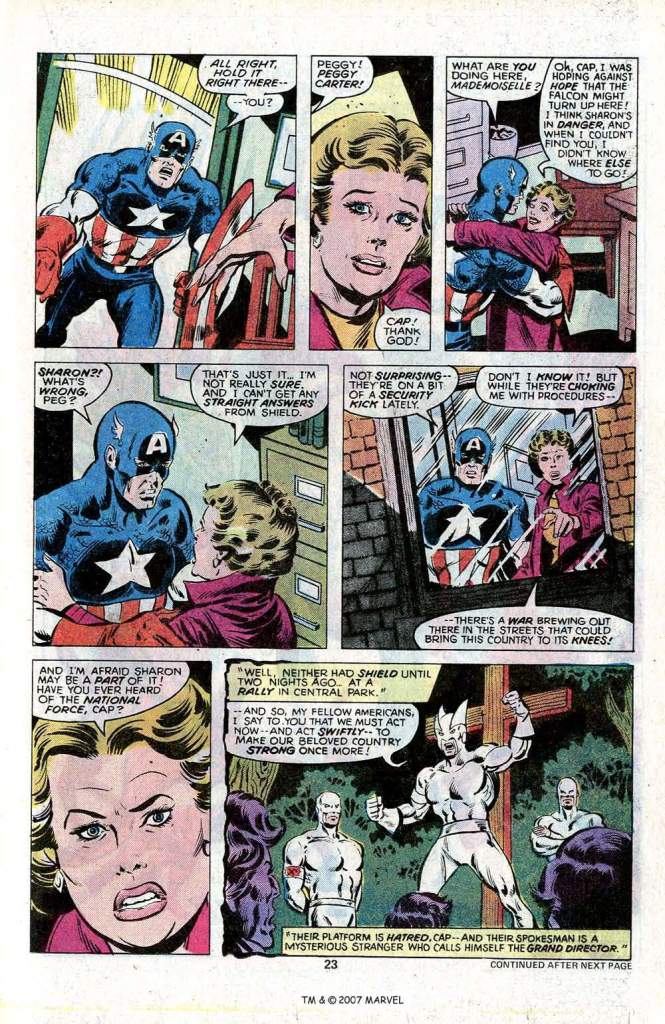
Cap winds up back at his destroyed apartment which was totaled by a flying Volkswagen Bug something like eight issues before and which still hasn’t been cleaned up. So that’s what he attends to, at least in part. Then, unable to sleep, he heads out to stop by the Falcon’s social worker office–where he finds Peggy Carter waiting for him. This version of Peggy Carter is a far cry from the incarnation seen in the assorted MCU films. This Peggy, like Cap, was a veteran of World War II, but she hadn’t gone into suspended animation, and so she was a good twenty to thirty years older than her wartime boyfriend, Cap. Peggy tells Cap that her sister, Cap’s current girlfriend Sharon Carter (yeah, it’s complicated) has gone missing. And she proceeds to fill the patriotic Avenger in on the activities of the National Force, a Ku Klux Klan-styled organization led by the mysterious Grand Director.

This National Force sequence feels completely relevant today. The Grand Director has filed the proper paperwork and gotten permits so that he can hold a rally in Central Park–a rally at which he burns crosses and speaks of the need to restore ethnic purity to the country. There are also dozens of protestors on site who are not down with the Director’s message of bigotry and intolerance, and the situation threatens to boil over into a full scale riot. That is, until the Grand Director hits the crowd with what is clearly some hypnotic whamma-jamma, and all of the light-skinned people, including Sharon Carter and fellow SHIELD agent Janacek, start beating on all of the dark-skinned people. Since then, Sharon has been missing (as has Janacek, presumably, but our guys don’t seem to really care about him) and so Peggy has come seeking help.

But as Cap races off to investigate the National Force, the camera stays on Peggy as she returns to her car. It turns out that a couple of the National Force goons have followed her and heard her speaking to Captain America. Under orders from teh Grand Director, they open fire with their weapons, and as the issue ends, Peggy’s car explodes in a ball of flame. To Be Continued!

This issue’s Letters to a Living Legend letters page also includes our old friend, the yearly Statement of Ownership. So it allows us to determine that CAPTAIN AMERICA was currently selling 107,196 copies on a print run of 294,903,giving the title an efficiency rating of 36%. So just under two copies of every issue had to be printed, distributed and ultimately pulped for every copy being sold. It was this ration of waste that made the Newsstand distribution market a doomed beast, and why the emerging Direct Sales market was so attractive to publishers. This is a hair down from last year’s performance of 37%, so things were slowly getting worse rather than better.


The sales improved. The numbers you quote are for the 1977-1978 sales year. They weren’t reported for Captain America for the 1978-1979 sales year, but the 1979-1980 sales year has them at an average per issue level of 165,498 out of a print run of 325,888, for a sell-through of 50.8%. 1980-1981 saw api sales of 159,647 from a 318,939 print run, for a similar sell-through of 50.1%.
My understanding is that with newsstand distribution, a 50% sell-through is considered optimal. Beginning in 1978, Marvel’s newsstand sales began recovering from the doldrums of the 1970s. (The sales of titles from DC and other publishers continued to decline.)
Newsstand sales at Marvel were pretty healthy during most of the 1980s. By mid-decade, Marvel had three ongoing titles with average sales of over 400K per issue, and two of those–Transformers and G. I. Joe–saw most of their sales in the newsstand market. It seems there was thinking at or near the top at Marvel that recognized a healthy newsstand presence was a good thing–it’s where the new readers largely come from–and was able to make it happen. But by the late 1980s, that thinking was gone. Marvel’s output turned incestuous–aging fans making comics for other aging fans–and everything ultimately became about gimmicks and reboots. The readership, of course, withered away in every market, not just the newsstand one.
LikeLike
Waiting impatiently for the run between Kirby and DeMatteis to be collected.
And let’s be honest here, unsold newsstand comics weren’t being pulped at this point, as long ago the distributors only required the front cover logo to be return and many stores had a thriving coverless back issue side business.
LikeLike
Agreed on Don’s inks being complimentary to Sal’s drawings. There’s a depth Don adds I don’t always see in Sal’s work. The word “rustic” comes to mind. But it’s a strong combo. I wasn’t crazy about Don’s own drawing, but sometimes it pleasantly surprised me.
Disappointed by the state of Cap’s shirt on Page 31 (I 4got how many more pages the issues had back then), Panel 2. I know Cap worked up a sweat, but he either needs to wash his uniform more frequently, or get a better detergent. I’s not “the” flag, but it’s based on it. He outta know better. ;-)
LikeLike
I think the cover holds up well — like Cap’s attended the Unite the Right rally to punch out some more fascists.
LikeLiked by 1 person
I suspect the objection today would be a kind of use/mention complaint, that it’s too glamorizing or something of that sort. There’s also a school of thought that these types of images are regarded as so upsetting and profane that they shouldn’t ever be displayed in public where someone might come across them unwittingly. Anyway, that scene actually has some close real-life echoes. Take a look at the real KKK here digitalcollections.library.gsu.edu/digital/collection/ajc/id/117/
You can easily imagine Cap in the background there watching it.
LikeLiked by 1 person
I’m Big, Big Fan of the 238-241 era of Cap.
Love Sal’s and Don’s art on 231.
Great Dialog; “I’ve Pulled Out Shield’s Butt Out Of The Fire More Times Than I Can Count” !!!
Odd you left out commenting on the page where Steve/Cap is vacuuming. You just don’t see that type page in comics anymore 🙂
LikeLike