

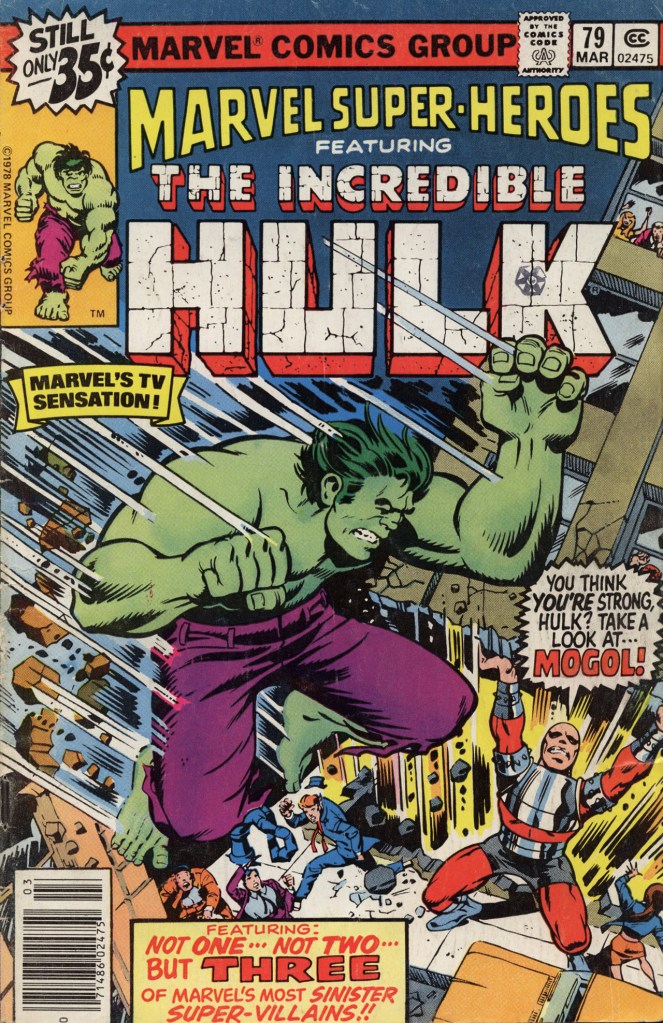
Now here was an issue of MARVEL SUPER-HEROES that I quite liked. The story was reprinted, of course, from an INCREDIBLE HULK that had gone on sale seven or so years earlier, back when Roy Thomas had taken over the series. And it was a good example of the simple pathos that worked best with this iteration of the character, coupled with some very nice artwork from Herb Trimpe, who visually defined the Hulk for much of this period. I tended to find the Green Goliath a bit of a limited concept, but stories such as this one kept me reading and gave me a wider appreciation for what you might be able to do with him.
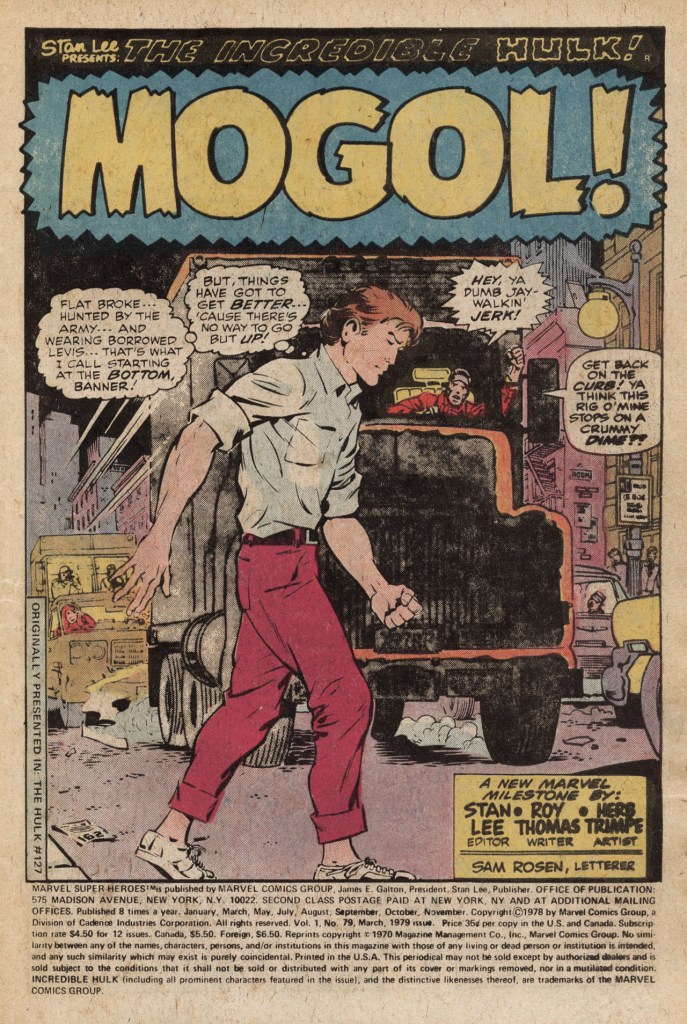
In an almost reverse of the manner of action-spectacle splash pages Marvel preferred in this period, this issue opens with Bruce Banner stepping off a curbside. That said, it’s a very lovely image, and one that’s stuck with me all these years more than a number of the other shots in this book. Unfortunately for dopey old Bruce, he’s so caught up in recapping his situation for the readership that he hasn’t looked both ways. And so he winds up getting hit by a truck that can’t stop in time. This isn’t really the driver’s fault, Banner stepped out into traffic–but that really doesn’t matter, as Banner begins to transform into his emerald alter ego in the aftermath. He tries to warn the rapidly-gathering crowd away from him before the change is complete, but to no avail.
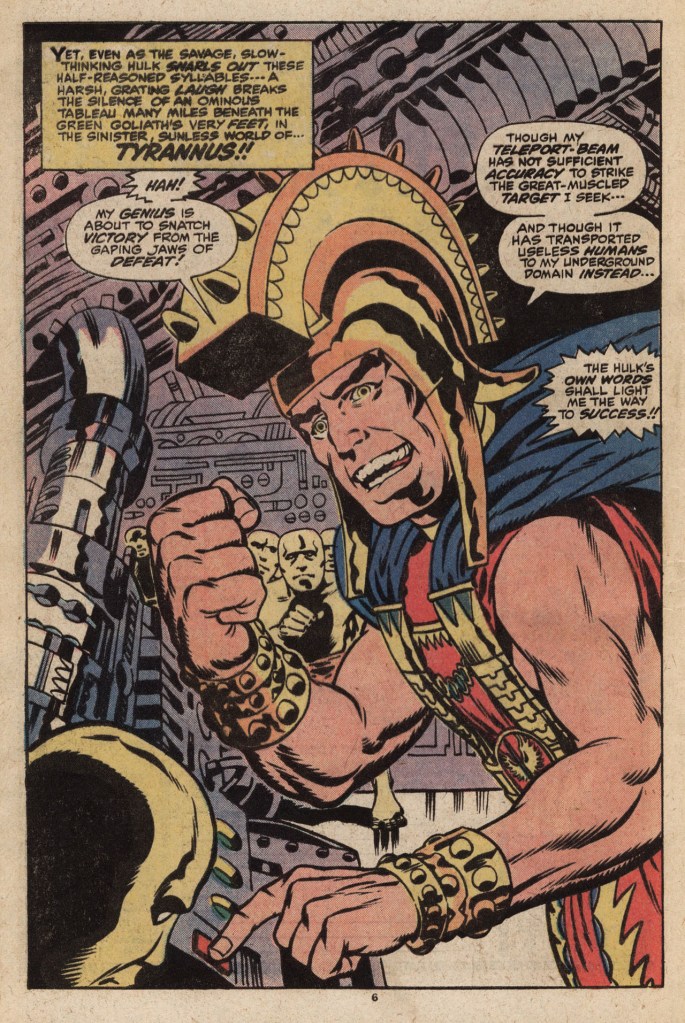
But as the Hulk prepares to rampage, the targets of his ire all fade away–teleported elsewhere by some unseen hand. We learn shortly that the one behind these vanishing pedestrians is the Hulk’s old foe Tyrannus, one of the would-be kings of the underground realm of Subterranea. He was trying to capture the Hulk, but it seems the precision of his teleportation process is lacking. So, changing tactics, he proposes to instead teleport one of his own warriors to the surface. Having witnessed the Hulk’s reaction to the mob and realized that his green-hued enemy has never known true friendship, Tyrannus plans for his emissary to befriend the Hulk, and then betray him into Tyrannus’ hands.
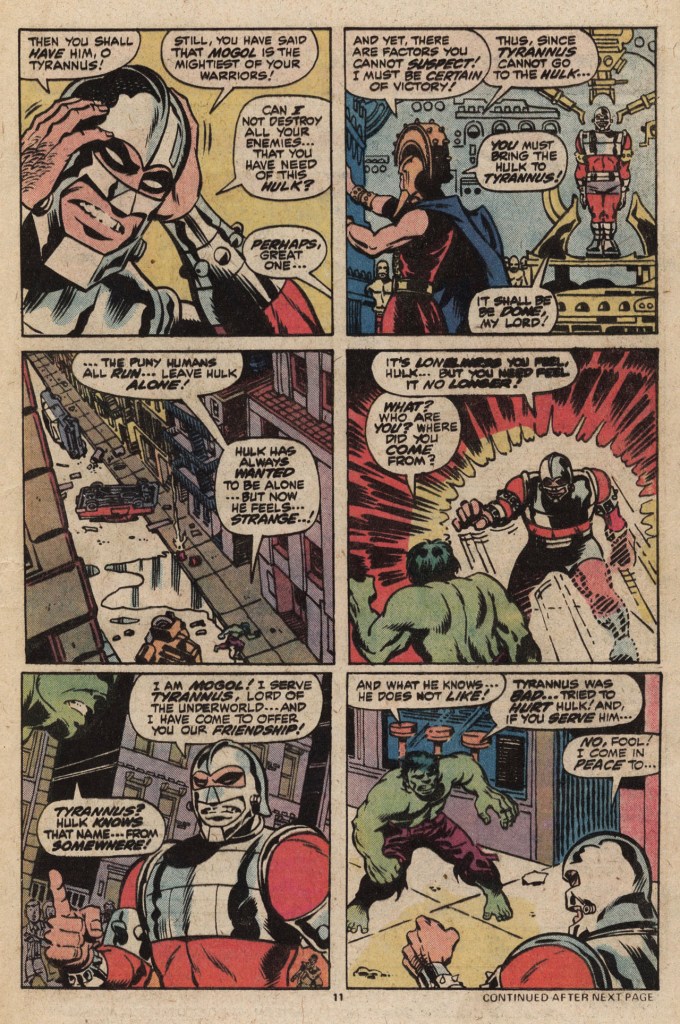
Tyrannus needs the power of the Hulk in order to recapture the Fountain of Youth which has kept him young and vibrant since the days of the Roman Empire, and which in a previous story fell into the hands of his rival Subterranean warlord, the Mole Man. As his agent, Tyrannus dispatches his mightiest warrior, a new character, Mogol. Far larger and more powerful than the average Subterranean, Mogol wonders why his power isn’t enough to serve Tyrannus’ ends–he’s a proud warrior. But Tyrannus cites vague circumstances for this, and Mogol has no option but to obey his Emperor. Teleported to the vicinity of the Hulk, Mogol makes his sales pitch in friendship for Tyrannus’ cause. The Hulk, though, has history with Tyrannus, and remembers him as a dangerous enemy.
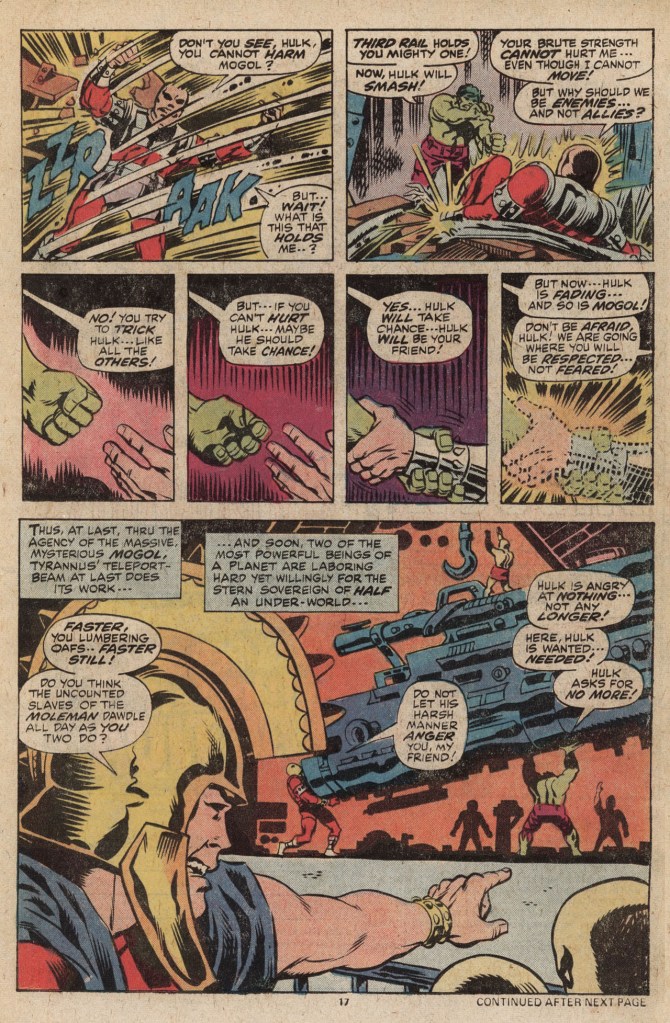
This leads, of course, to a throwdown between the Hulk and a reluctant Mogol, who matches blows with the Hulk, but only in self-defense and the protection of innocents. The Hulk, though, is able to get the upper hand after the pair careens through the ground and winds up on the subway tracks, where Mogol is held motionless by the electrified third rail. The Hulk has his opportunity to finish Mogol off here, but something about his opponent’s kindly words finally sinks in, and he instead holds out his hand in friendship. Mogol returns to Tyrannus with the Hulk, and the two friends begin to prepare Tyrannus’ war machines for an attack against the territory of the Mole Man.
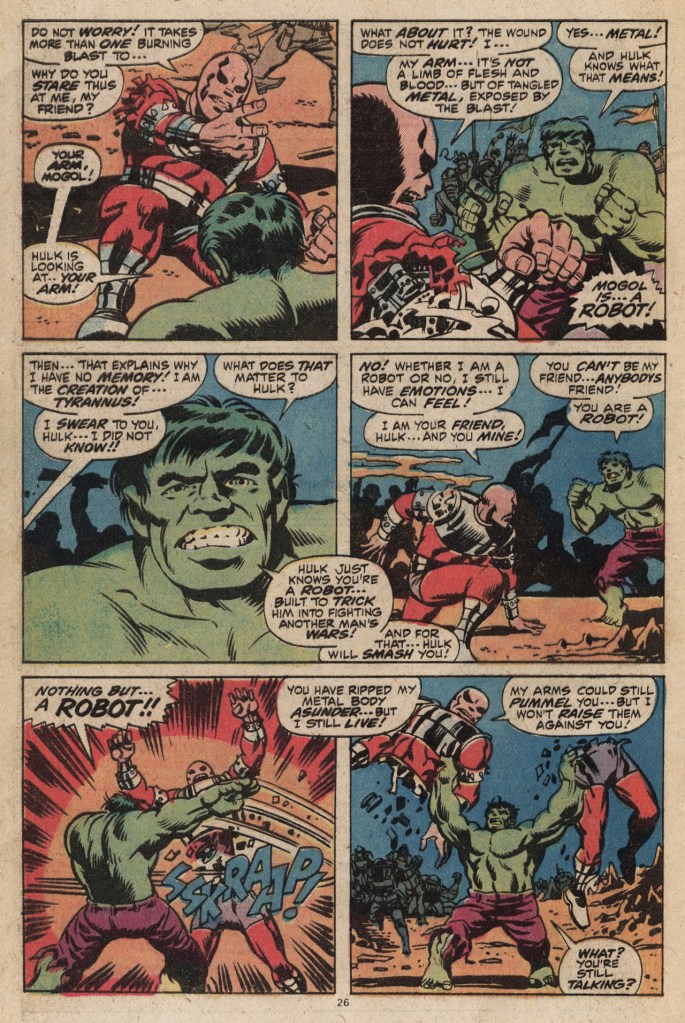
The attack goes off perfectly, and the Mole Man’s forces are soon in disarray and being pushed back by the army led by Mogol and the Hulk. But at a critical moment, Mogol is struck by blast fire, and his wound exposes his shoulder, which is filled with mechanisms The Hulk recognizes Mogol for what he truly is: a robot, a creatin of Tyrannus’ super-science, and he’s outraged at having been tricked in such a fashion. But Mogol insists that there was no trickery, that he was and remains the Hulk’s friend. But green-skin isn’t hearing it, and as Mogol pleads for understanding, the Hulk tears his body to pieces, eventually silencing his pleading voice. So it’s a tragic turn for the Hulk, as Tyrannus confirms that Mogol was simply an automaton created to make the Hulk a pawn in his war.
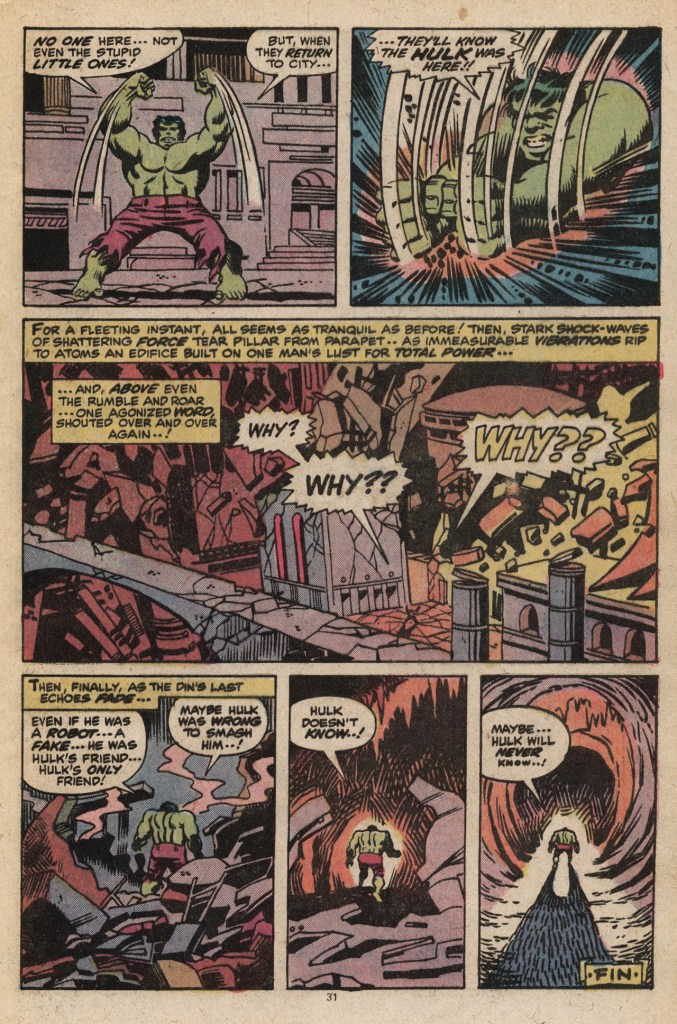
Which is a contender for the dumbest things that Tyrannus could have said to the Hulk, as his foe is now angered like never before. He first annihilates the city belonging to the Mole Man, then leaps back behind the lines and destroys all of Tyrannus’ empty empire as well. So everybody winds up a loser. As the Hulk makes his way back to the surface and the story wraps up, he muses to himself that he maybe shouldn’t have smashed Mogol, as he was a friend despite being a robot. But the subtleties of that question are too great for the Hulk’s limited intellect, and so he puts the thought out of his head, and the story ends. This was a pretty good tale, one that often zigged where the usual story would have zagged, and I appreciated that change-up of the formula.
 The Tom Brevoort Experience
This was reprinted in a U.K. Marvel annual in… 1982? Along with a story where the Hulk fought the Man-thing, I think, and was the first Hulk story I read. It stayed with me. The Man-thing one, not so much.
LikeLiked by 1 person
Tragic. “Is Hulk meant to suffer forever??” 😉 Not a quote but thematically speaking… This story was another example why Roy Thomas my 1st fave comics writer.
LikeLiked by 1 person
This is toward the end of a stretch of issues that Trimpe inked himself (started maybe 10 or 12 issues previous, with an odd issue or two with someone else finishing over him, Buscema maybe?), and they look beautiful. The absorbing man issue (125?), this one and another in the 120s with a page that is a 12-ish panel grid, textless at that, really show off how great of a storyteller, draftsman and character actor Trimpe could be. Others inking him also looked and read excellent, but man, there’s something about him inking his own pencils that works so well. I love re-reading and poring over those issues. As you said, his work defined this era of Hulk books, and in my estimation for what its worth, it never looked better than when Herb handled pencils and inks.
LikeLiked by 2 people
To paraphrase Blazing Saddles, Mogol only pawn in game of life.
LikeLiked by 1 person