


In 1979, DAREDVIL was a series that had been limping along for years. Perhaps its only saving grace, the thing that kept it from being cancelled, was the fact that it was one of the original Marvel titles that had been launched at the start of the 1960s at the dawn of the Marvel Age. But the book was bimonthly, and its fortunes didn’t look all that great. Mind you, all of that was about to change, although that change wouldn’t be completely apparent for another year or so. But that’s a tale for the future. Right now, let’s take a look at the final issue of DAREDEVIL before Frank Miller came along and changed the game completely.

DAREDEVIL was then being penciled by Gene Colan, an artist who had made his Marvel bones on the series, and who had done (and would later do) long stints on it. Colan was utterly unique as a comic book artist. Despite the limitations of the medium, Colan’s pencil work was loaded with subtle graytones and shading–painting with a pencil, he called it. Accordingly, he was a difficult artist to ink properly, as the inker wound up having to make decisions that radically altered the look of the final pages. Few were really up to the job. One who was was Klaus Janson, who had come to DAREDEVIL a few years earlier when Bob Brown had been penciling it, and whose lush, expressive inks became something of a signature look for the series and the character.

Colan also had two bad habits that developed over his time at Marvel. The first was that he had a tendency not to read the entirety of the plot for an issue he was drawing, which inevitably meant he had to cram a lot of plot advancement into his final few pages. Stan Lee was so angry about this on an issue of CAPTAIN AMERICA that he mockingly called Colan out on it in the printed book. The second quirk of Colan’s work is that straightforward storytelling wasn’t what he did. He preferred chaotic page layouts like the one above, a page that requires the dread “arrow of shame” to guide the reader to the next panel in the sequence. Colan’s work was always fluid and dynamic, but new Marvel EIC was a stickler for straightforward, grid-oriented clear storytelling, and as you might expect, he and Colan began to clash over the work Gene was turning in. I can’t prove it, but there are one or two pages in this issue that look to me as though Colan may have been asked to redraw them to better conform to Shooter’s approach. Or, if not, he was trying to accommodate where he felt he could.

So what’s going on in this story? Well, two issues ago, Daredevil got a concussion that caused him to act crazy and attack the Avengers due to his old love interest the Black Widow having joined the team. This went as well as trying to knock down a brick wall with a water balloon, and in the aftermath of the battle, the Avengers got DD to medical attention. But while the Avengers waited in the lobby for news of the Man Without Fear’s condition, one of DD’s recurring foes, the enigmatic Death-Stalker, had used his power to become immaterial to enter Daredevil’s hospital room. And as this issue opens, he’s about to slay his foe with his lethal touch. But the Avengers show up just in time to save Daredevil, who enters the battle himself to save the Beast. Death-Stalker didn’t count on this level of opposition, and so he escapes by passing through the wall. But Daredevil, at least, has seemingly recovered.

And he and the Black Widow spend some time getting reacquainted, performing acrobatics in the Avengers Mansion gym. Clearly there’s a spark there–but Matt races off to reconnect with his actual girlfriend Heather Glenn, who hasn’t heard from him since Daredevil got concussed and went into the hospital. Heather is happy to see Matt–that is, until Natasha shows up at Nelson and Murdock’s law offices for an arranged date, which dopey Matt forgot setting up. Off in the corner, the wheelchair-bound Becky also pines for the attentions of the blind Mister Murdock, but he hasn’t noticed her at all. This is one of the pages that I suspect Colan had to redo, its structure is so relentlessly rectilinear, with a ton of panels condensed into it.

Fortunately for Matt’s love life, though not for his prospects of survival, it’s at this moment that the Ani-Men burst into the law offices. The prosaically named Ape-Man, Bird-Man and Cat-Man were longtime punching back jobber foes of the Man Without Fear, and they show up here just in time to bring some action to an otherwise relatively quiet issue. They announce that they’ve come for Matt Murdock–and the supposedly blind Matt can’t defend himself without potentially revealing his secret identity. It’s a classic super hero trope!
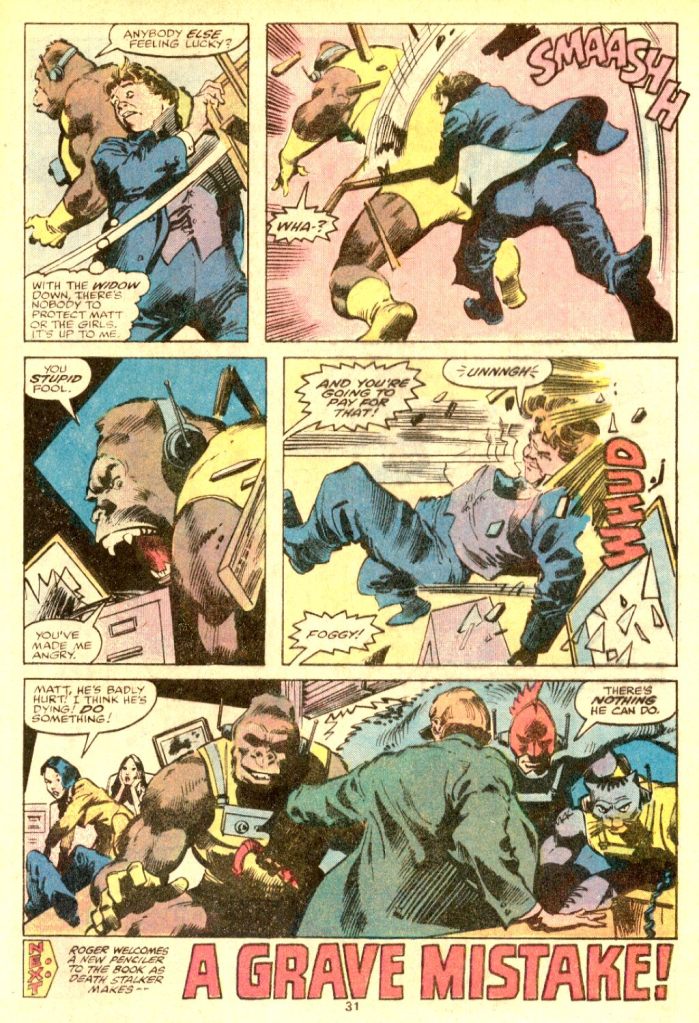
On the other hand, the Black Widow has no secret identity to protect, and so Natasha launches herself against the Ani-Men. But she’s not carrying her weapons and is outnumbered three to one, and so it isn’t long before Bird-Man puts the kibosh on her. Even Foggy Nelson tries to get into the act, figuring that he’s the only one who might be able to protect Matt and Heather, but he sadly fares about as well as you’d expect. Good heroic try, though, Foggy. And so the issue closes out with Matt facing his three angry enemies, unable to act. To Be Continued!
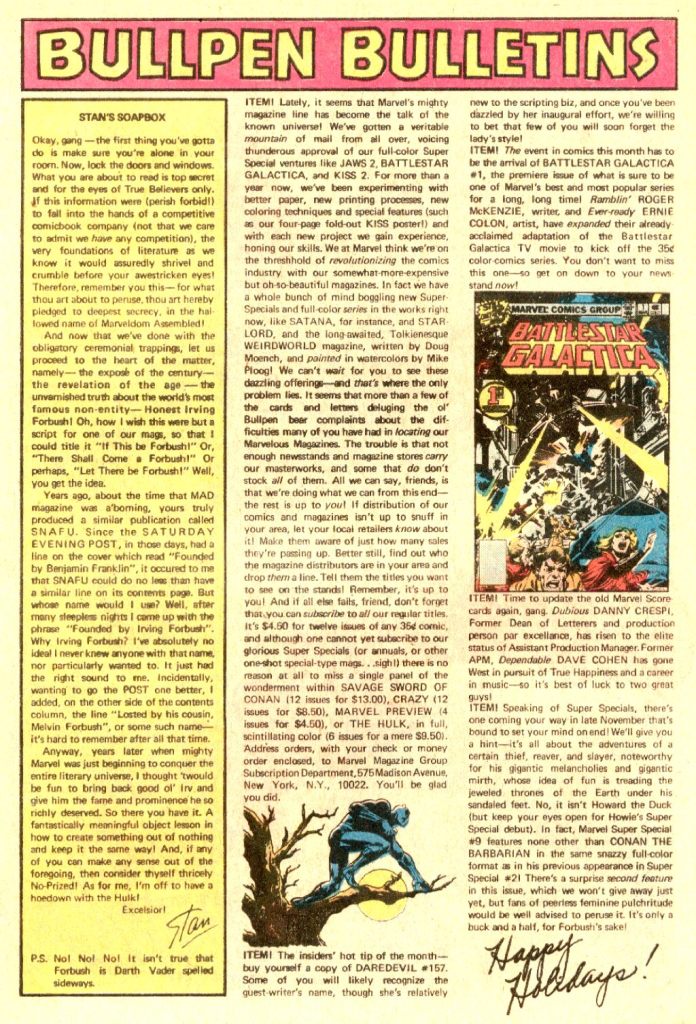
The change of the month also brought a fresh Marvel Bullpen Bulletins page, and with it Stan explaining in his soapbox the origins of Irving Forbush, Marvel’s oft-referenced mascot. There’s also a blurb touting Jo Duffy scripting this very issue of DAREDEVIL, though it neglects to mention her by name. Oops. And there’s a big push for BATTLESTAR: GALACTICA, both as a Treasury Edition and as a regular color comic book. Clearly, Marvel was hoping that it would prove to be another cash cow like STAR WARS proved to be.
 The Tom Brevoort Experience
Was that arrow of shame really necessary though in this case? It’s pretty obvious how the action flows. I never noticed Milgrom edited DD until the splash page here. Could any Shooter problems with this issue be as much the infamous bad blood between he and Milgrom in its early stages?
LikeLiked by 1 person
I’ve never thought of it as an “arrow of shame” as much as “oh, they’re doing something interesting with the layout.”
LikeLiked by 3 people
I always thought Shooter was too harsh with Colan. Better to let Gene be Gene regarding the flair of his layouts. They more than made up for the minimal confusion – if any – about which panel followed which. To reduce Gene’s art to a boring grid was a crime.
LikeLiked by 2 people
Shooter’s overriding concern was about sales, not Gene Colan fans, who were an insignificant part of the readership. No artist at this time justified concern about offending said artist’s fans.
LikeLike
By this point, Gene had drawn countless Marvel issues, and sales didn’t seem to be a problem. This included pre-#100 DAREDEVIL when it was monthly. Additionally, his TOMB OF DRACULA ran for a whopping 72 monthly issues! No other horror series came close. Really, Shooter wanted to bring Gene to heel because he wanted more simplistic story-telling generally. He was, as I said, too harsh with Gene and should have respected him much more than he did.
LikeLiked by 3 people
Remember the color-comic Tomb of Dracula went from monthly to bimonthly–a clear sign of declining sales in the 1970s–and then was cancelled. It was revived, briefly–as a black-and-white magazine–where the production cost relative to price point allowed for significantly lower sales. TOD didn’t last long in that context, either. And let us not forget that when Colan went to DC, the sales of his Batman material were the lowest the feature had seen up to that point, and led to Colan’s firing being the first decision editor Denny O’Neil made upon taking over the character in 1986. By the end of the 1980s, Gene Colan was all but unemployable in the comics industry and had to do other things to make a living. Shooter may have been the harbinger of Colan’s misfortune, but Colan’s insufferable conceit about his approach to his work was always the cause.
LikeLike
I don’t see Paul’s point being that Shooter shouldn’t offend Colan’s fans as much as Shooter shouldn’t be so uptight about good art, even if it was unconventional. As a Colan fan, I’m in agreement (but obviously YMMV).
LikeLiked by 3 people
And my point in part is that Shooter had a professional reason to be uptight about Colan. As the situation with Bill Sienkiewicz a few years later demonstrated, Shooter was tolerant of potentially incomprehensible art if there wasn’t a sales problem.
LikeLike
IIRC we have very different views on Colan and his value to Marvel, which is fair enough.
But now you’ve made me think of Sienkewicz’ art, which I try to forget exists. Shame on you!
LikeLike
Sure thing, RSM, the fact that Gene Colan only managed to work steadily in the comics industry for a measly 4 decades shows what a no-talent slacker he was (insert massive eye-roll here). “Became unemployable in the comics industry due to his insufferable conceit” sounds more like a description of your boy Shooter’s career arc.
LikeLike
Say what you want about Colan’s layouts/storytelling — that opening splash page is amazing!
LikeLiked by 5 people
His one-panel pages in Silver Age DD likewise. I suspect it was a way to reduce the amount of plotting he had to do, but I can forgive him.
LikeLiked by 1 person
Agreed. As is Page 27’s, the Ani-Men’s crashing entrance.
LikeLiked by 2 people
Supposedly the gist of Shooter’s problems with Colan were writers complaining about Gene not following the story. Were artists at Marvel working from scripts in 79?
LikeLike
Didn’t Shooter’s tenure end the Marvel Method being institutionalized at the company?
LikeLike
I enjoyed Roger Mckenzie’s runs of Daredevil and Captain America. I thought he was a solid writer. I can see why editor Denny O’Neil wanted to promote the career of the then young up-and-coming superstar Miller, but I always felt Marvel could have found other outlets for McKenzie after that. He seemed to be offered less work in the next few years.
LikeLiked by 2 people
I’ve loved every panel I’ve seen illustrated by the art team of Gene Colan and Klaus Janson. Whether it was featuring Daredevil, Batman, Jemm, Silverblade, or any other characters. Klaus mixes in his wet chocolate syrup into Gene’s granular brown sugar.
The esteemed Mr. RS Martin seems intent on Colan-bashing (not an official medical term). In previous posts he’s made Trumpian statements (after the infamous, fraudulent real estate mogul, bankrupt casino owner, and twice impeached former PotUS, who often begins unsubstantiated comments with, “A lot of people say…”), like “many inkers had problems with Colan’s drawings”, and “By the end of the 1980s, Gene Colan was all but unemployable in the comics industry”. This, despite Gene’s credits continuing beyond the 1980’s (by DC, Darkhorse, & Marvel), eventually into his 80’s (the 2000’s), including a 2010 Best Single Issue Eisner Award 2010 with Ed Brubaker for “Captain America” # 601 (2009). RS has argued that all of Gene’s late 1980’s output was drawn before DC “fired” him in 1886. But the output was so large, even Kurt Busiek wrote that it couldn’t all have been finished by 1986.
But I am intrigued by RS’s “No artist at this time justified concern about offending said artist’s fans.” I think he could be correct. The industry was quire different in 1978, than it would become in about 1/2 a decade. The Direct Market, for one example. And Byrne, Perez, Miller, Simonson, & others hadn’t had the success and clout they’d achieve between 1983-86. But I gotta wonder about 2 other artists who I’d believe it if they were the possible exceptions. John Buscema, specifically on the Conan titles. And Neal Adams.
LikeLike
Folks, we’re going to cap this right here, as it’s turning into name-calling and personal attacks, and we don’t do that in these parts. Let us all just agree that some people like Gene Colan’s work more than others and leave it at that.
LikeLiked by 4 people
Neal Adams was never much of a boon to sales. More often than not, his presence on a title coincided with sales going down. The one exception was the Green Lantern/Green Arrow series, where, during its first year, average sales went up by about 14,000 copies an issue. His appeal was to older fans, and they were not most comics readers in the late ’60s and early ’70s.
LikeLiked by 2 people
Death Stalker was one of my favorite DD villains and I’m still a bit salty over his inauspicious demise as engineered by (I believe) Roger Mackenzie and Frank Miller.
LikeLike
Marc Burkhardt, one of the few deaths in comics that has remained to the present day. The demise of Death Stalker was well-constructed and satisfying…a great ending to a great story! While it was a bummer to see a great villain’s demise, it’s still “meaningful” 45 years later. I quit collecting Marvel when they resurrected Norman Osborn in 1996…to me, that was the ultimate affront to comics fans, as it ruined the greatest comic story, IMHO, in my lifetime (Amazing Spiderman #121-122). Let’s keep Death Stalker deceased!
LikeLiked by 1 person