


This issue of PETER PARKER, THE SPECTACULAR SPIDER-MAN is probably the most noteworthy and sought-after one in the whole of the run, for reasons that were not apparent to me when I first read it. And that’s because it represents the first time that artist Frank Miller works on the character of Daredevil–a series that he would transform into one of Marvel’s hottest just a couple of years later. Frank’s work in this issue is good, but I’ll admit that when I first read it, I didn’t pay the artist any attention. The work didn’t stand out to me in any meaningful way. That all said, I was growing increasingly interested in the mystery of Carrion (a mystery, as we’ve pointed out when talking about earlier issues, whose solution would change by the time the final chapter was released.)

The hook going into this story was pretty compelling: after an encounter with Daredevil’s old foe the Masked Marauder, in which the web-slinger was on the receiving end of the villain’s opti-blasts, Spider-Man has been left sightless. Daredevil shows up to lend him a hand here and to keep him from spiraling into despair–there’s no sense as to whether Spideys blindness is merely temporary or permanent. Having been blinded himself, Daredevil can empathize with Spidey’s plight directly. As the issue opens, the pair is rather foolishly making their way across the rooftops. But then, I suppose DD isn’t known as the Man Without Fear for nothing.

It has to be said, Spider-Man isn’t handling his situation all that well. He’s on the verge of cracking up, and this made total sense to me as a reader. He almost kills himself trying to prove that he can still navigate the city streets while sightless, and he lashes out at Daredevil in frustration as the other hero has to save and guide him. Miller does some nice work here with multiple strobing figures of Daredevil in motion as he stays ahead of Spidey’s blows–Miller is still young and formative, but you can see a bit of the graphic sensibility he’d bring to the character later on. With nowhere else to go, Daredevil takes Spidey to his apartment, hoping that nothing there will give away his true identity as Matt Murdock to even the blinded wall-crawler. There, he calls an ophthalmologist friend of his to give Spider-Man a clandestine examination.

Meanwhile, back in Chelsea, Betty Brant and Mary Jane Watson leave Peter’s apartment, having cleared the air between them due to their romantic entanglements regarding Peter. Landlord and old bat Mrs Muggins hears something going on in Parker’s apartment–and when she takes a look, she finds the place having been trashed by Carrion, who has scrawled the message THE DEAD WALK PARKER on a wall, another clue as to his ultimate identity. While this is all going on, Daredevil and Spider-Man have made their way to Dr. Orlock’s office, traveling under cover of night just to be safe. Examining the stricken wall-crawler, Orlock indicates that Spidey’s optic nerve is healing itself with surprising speed, thanks to his enhanced physiology. He can’t say for certain that there’ll be a full recovery, but he is optimistic.
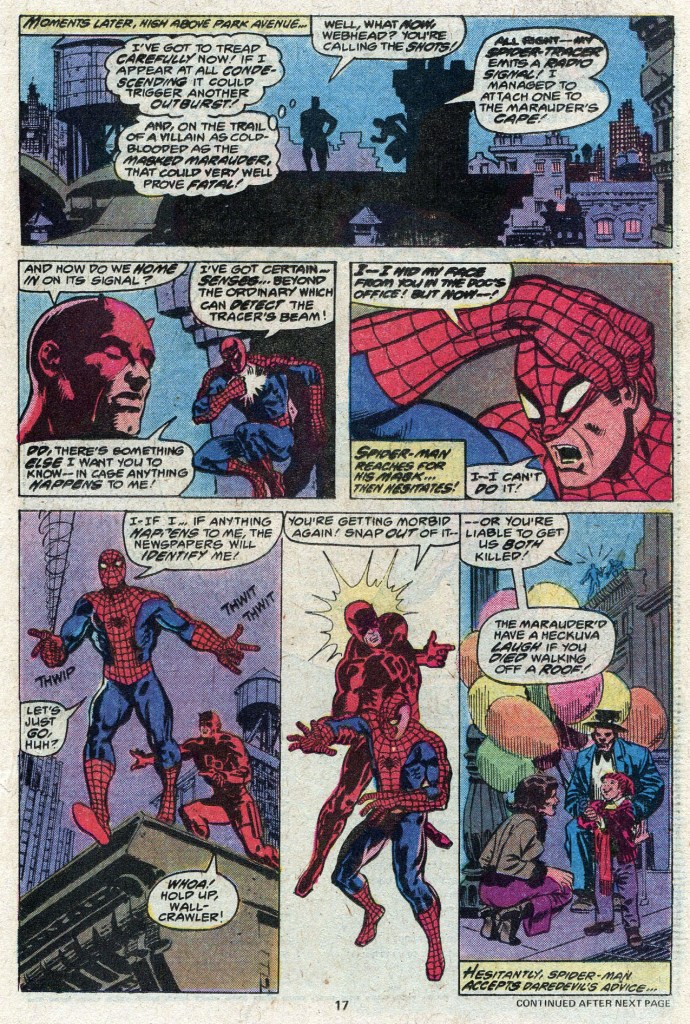
Buoyed somewhat by this news but still agitated by the thought that the Masked Marauder and his Maggia goons are up to something big, Spidey indicates that he’s the only one who can track them down, thanks to the spider-tracer he hit the Marauder with. Spidey’s still not right, but Daredevil decides to buoy his fellow hero’s confidence by racing around the city with him until they can locate the Marauder. At a key point, Spidey decides that he needs to reveal his true identity to Daredevil in case anything happens to him. But he just can’t bring himself to take off his mask (not that it would have meant much to the sightless Daredevil anyway.) It turns out that Daredevil’s own heightened senses are capable of picking up the signal from the spider-tracer, but he keeps that information to himself to give Spidey a sense of purpose and need, and keep him from spiraling into self-pity.
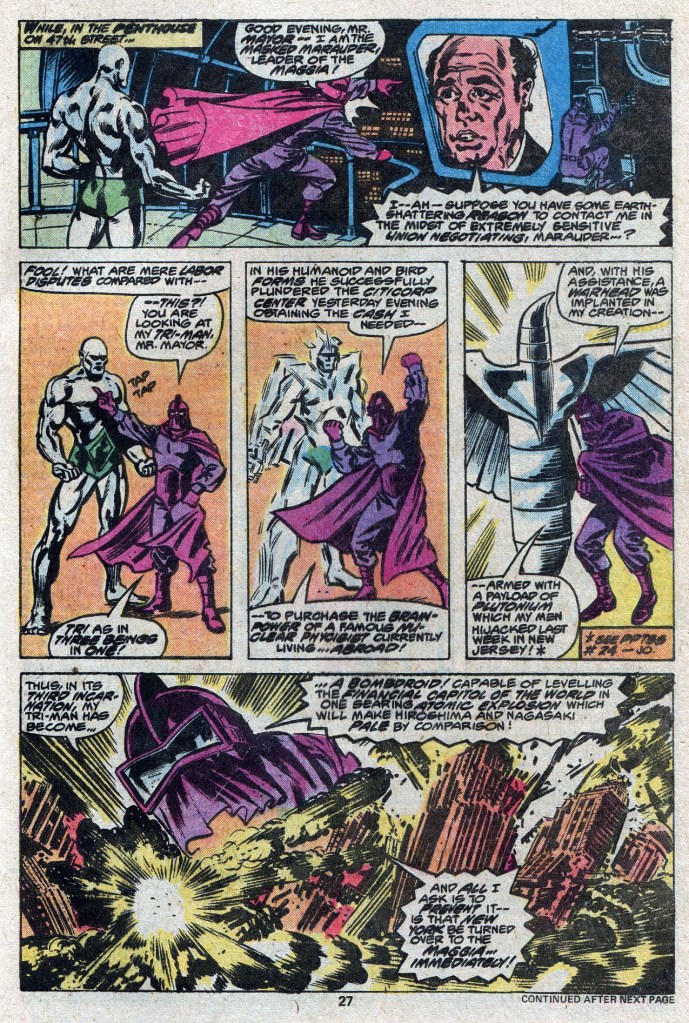
As Spidey and Daredevil criss-cross the city, the Marauder puts his master plan into motion. He installs the plutonium stolen by his men a few issues ago into his android Tri-Man, transforming the creature into a bombdroid. He then contacts the Mayor of New York, insisting that control of the city be turned over to the Maggia or else he’ll launch the Bombdroid at the financial district, destroying it and the millions of people who live there. By this point, though, Daredevil and Spider-Man have located the Marauder’s hidey-hole. Leaving Spidey behind clinging to a wall, Daredevil launches himself into the room and into combat with the Marauder and his Maggia stooges.
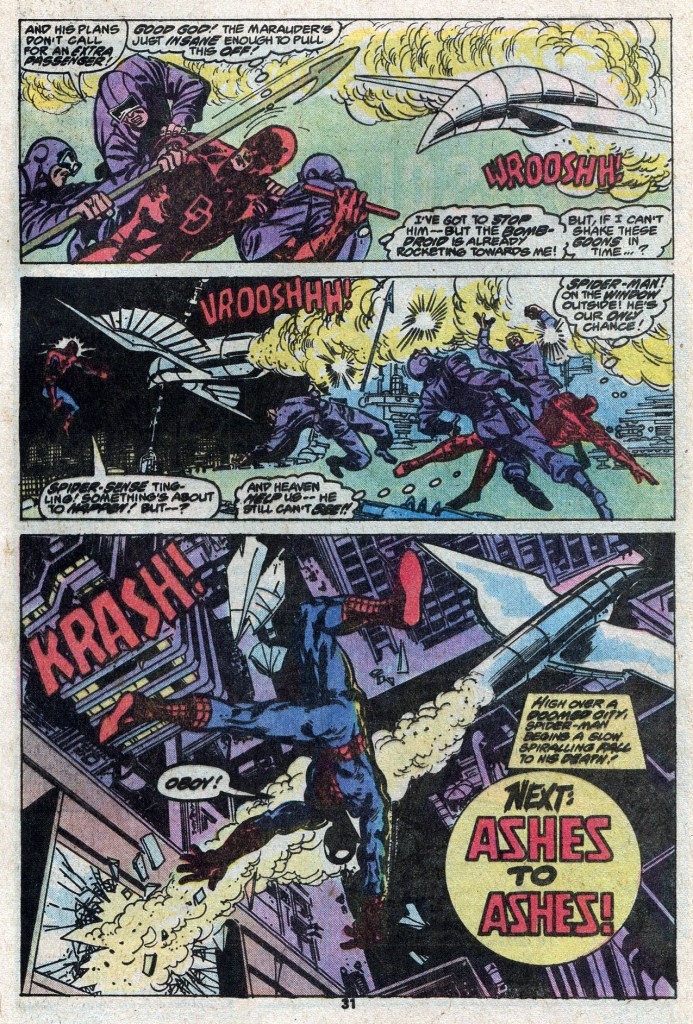
As the melee carries on, the Marauder primes and launches the Bombdroid, intending to teleport himself (and possibly his Maggia minions–they certainly think he’s going to, whether that’s his actual intent or not) away from the blast zone. The Bombdroid comes smashing through the wall where Spider-Man is clinging, dislodging him from his perch and sending him groundward. And that’s where our story is To Be Continued–with Spider-Man blindly falling to his death and the destructive Bombdroid cruising towards the Financial District and a catastrophe that will annihilate New York!
 The Tom Brevoort Experience
I was into this run. The artwork didn’t stand out to me overall either at the time….though I recall digging some of the panel action like Spidey punching through the ladder steps and smashing the desk. Springer is burying young Frank a bit. I would think that Springer’s moody brushwork would be a pretty good fit for Miller’s pencils style-wise. The result here isn’t bad looking and looks more typical of a MU comic from those days.
LikeLiked by 1 person
One of Bill Mantlo’s better stories, I thought at the time. The art looked a bit stilted at times, but as we all know, Miller got better–much better–very quickly!
LikeLiked by 1 person
Around this time Miller did a John Carter fill in where he came up with a four arm sword fighting technique just one scene. I prefer his early style and while it did improve, Miller was damn good right out of the box.
LikeLiked by 2 people
It took me a long time to get ahold of this issue due to Millers popularity. I always loved that strobing action effect. I thought he came up with it, but you can find examples of other artists doing it earlier. I think Kane might’ve been one of them.
LikeLike
I really liked this storyline back in the day. Still do, in fact. If only young me realized this would one day be a collectible I would have treated it with much greater care! 🙂
LikeLiked by 1 person
At one point Cap was my favorite Marvel character, thanks to the strength of the Englehart run. I even loved Jack Kirby’s issues (especially the Madbomb arc), unlike many of my fellow 70s fans. The quality of the book waxed and waned after Kirby left and I have to admit Gruenwald’s run left me cold. Cap eventually lost his #1 status to Spidey but I still return to his title if the creative team (such as Waid and Brubaker) is interesting. So far the JMS issues have been entertaining…
LikeLiked by 1 person
This made me wonder when Daredevil and Spider-Man learned each other’s identities and I was going to ask here, but Googled it and then went to comics.org since the guy who gave me the answer never gave the issue: Peter Parker The Spectacular Spider-Man#110 ( January 1986 ) the end of the Sin-Eater storyline in case anyone else was wondering.
LikeLike
Coincidentally, it’s also covered in one of Brian Conin’s most recent posts on CBR right now.
LikeLike
It’s interesting, like Romita early on with Spider-Man (Daredevil 16 and 17), Miller seemed to struggle with the eyes on the Spider-Man costume.
As good an artist as Miller was, you get no more an idea of how iconic Miller would be on Daredevil than you did of Romita’s influence on Spider-Man from those two 1966 DD issues. Great oaks from tiny accorns . . . .
LikeLiked by 1 person