


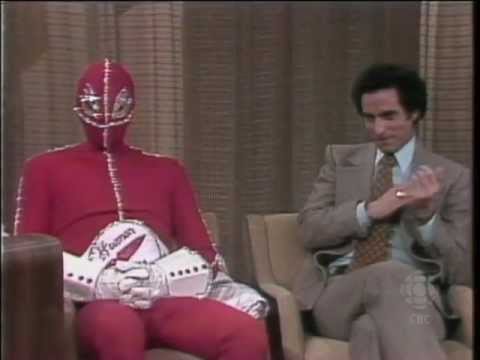
I was still sampling different Marvel titles that caught my eye, which is no doubt why I picked up this issue of THE HUMAN FLY under forgotten circumstances. I didn’t quite understand from this one issue the tagline on the front cover, about him being a real life super hero. So you aren’t similarly confused, let me explain that HUMAN FLY was inspired by the life and exploits of Canadian daredevil Rick Rojatt, another in a line of Evel Knievel wanna-bes who apparently did perform at least on occasion in a costume similar to the one found on his comic book counterpart and using that name. Apparently, the comic was the result of a licensing deal done with Marvel, and Editorial was a bit leery about the entire thing, in fear that Rojatt would either kill himself in one of his attempted stunts or be caught in some compromising scandal that would then be pulled into. Neither one happened, but the HUMAN FLY comic book ran its course an issue after this one.

Interestingly, writer Bill Mantlo set himself an especially difficult task in writing this series. Not wanting to use Rojatt’s real name, Mantlo keeps the Fly’s name entirely unrevealed. And like a Mexican Luchador, he wears his mask and costume constantly. On the occasions when he’s out of it, he’s hidden in shadow. That makes it really difficult to connect with the character as anything other than an action figure, despite his backstory of having rebuilt his body following an almost-fatal car crash when he was a child. One also has to question Mantlo and artist Lee Elias’s decision to open up this issue with a splash page of hands on a typewriter in an otherwise-empty room.

The set-up for the series felt more like a prospective television series than a super hero comic. The Fly and his entourage would travel from place to place, putting on performances and staging daredevil stunts for the crowds, and also getting involved in local problems along the way. I can remember in particular being a bit creeped out by the Fly’s paraplegic engineer Ted Locke, who built and orchestrated the Fly’s stunts and whose amputated hands had been replaced with hooks. This was all a far cry from the sort of colorful daring do that I preferred in my super hero comic books.

This particular story takes the Fly and his crew out west to Las Cruces, New Mexico where the Fly is slated to perform for the Hopi Indian reservation. Both Ted and the Fly are individually worried about the stunt, but each man reassures the other that their concerns are groundless. As they enter the area, the Stunt-Van comes across a young boy vainly attempting to stir the body of his grandfather, who lies dead at his feet. Disembarking, the Fly and company learn that the old man had been run down by a car that diverted its direction specifically to do so. The boy’s grandfather had saved his life by pushing him into a nearby ditch, but he was struck head on and killed.

Bringing the old man’s body back to the Reservation, the Fly learns that he was one of the Tribal Elders and that he opposed bringing the Fly in to perform, which will bring in a lot of business for the white businessmen who own most of the establishments around the reservation. After a conversation with the boy’s cousin Cha’tima, the Fly heads into town to seek out the Tribal Council. He does, at a bar owned by local entrepreneur Frank Sturgis, who points out that the Elders are all stinking drunk and leave all of their business to Sturgis himself. It’s a very dated representation of Native American culture, about as stereotypical as it gets. Sturgis is the one who contracted the Fly to perform for the Reservation.
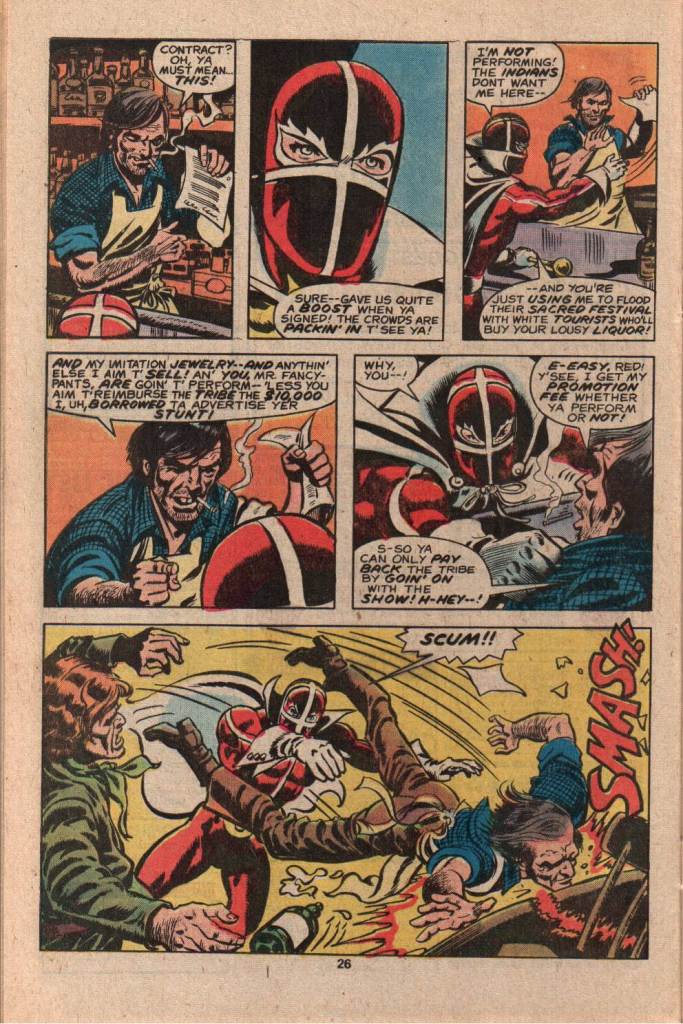
Having learned all of this, the Human Fly tells Sturgis that he’s not going to go on with the show. But Sturgis doesn’t care–he’ll get his Promotion Fee just for having signed the Fly, whether he goes on or not. The only way to pay back the money taken from the Tribe’s accounts to pay for the promotion of the Event is to go through with it. A disgusted Fly angrily hurls Sturgis across his bar–but he realizes that he has little choice but to comply. Once the Fly departs, a furious Sturgis instructs his men to take care of the Fly just as they did the old Elder earlier–by killing him.
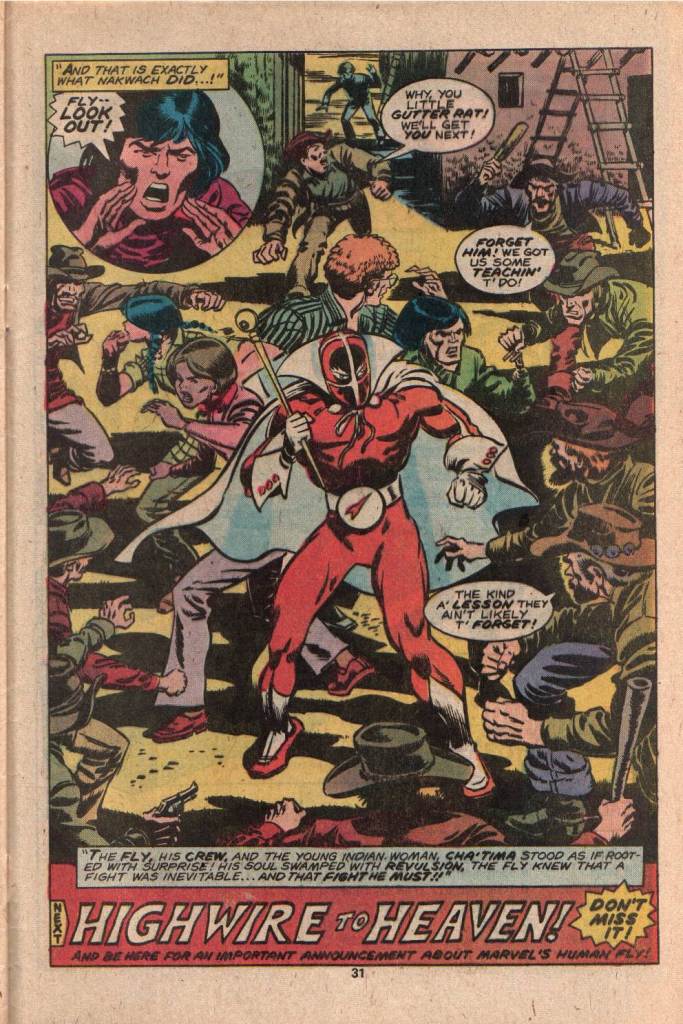
Meanwhile, Nakwach, the boy whom the Fly had rescued earlier, is poking around the bar looking to try to connect Sturgis to the killing of his grandfather. He sees Sturgis’ men head out to trash the Fly and follows them, shouting a warning to the stunt performer just before the bad guys descend upon him. Still, the Fly, his small crew and Cha’tima are all outnumbered and surrounded, so the odds are stacked against them. And that’s where this issue is To Be Continued. Mantlo really tries to build up a mystique around the Human Fly through the narration provided by the news story that narrator Harmony Whyte is writing about these events. But even still, it’s a pretty dull comic book. And the last line of copy under the Next Issue blurb seems to indicate that Marvel already knew that HUMAN FLY had reached the end of the line, even if it was the next issue that would be the book’s last.
 The Tom Brevoort Experience
Agreed that this feels very much like the set-up for a tv show. The “wandering the country, righting wrongs” reminds me of the live-action Shazam! I can respect Mantlo’s decision to try and maintain some sense of real life, but he might’ve been better off to go full-on superhero and have him taking on Doctor Doom or whatever.
LikeLike
I was pretty neutral on this series but I was buying everything but westerns, war comics, and a select few horror comics, so I bought every issue. i wondered who the real life Human Fly was but never enough to extend any effort in finding out.
LikeLike
I was confused by the “Because He’s Real!” tagline, too. Then I noticed him as a blip in the opening sequence of the weekly TV show, “That’s Incredible”. The comic did follow the TV travelling do-gooder” pattern. A lot of shows like that, “Kung-Fu”, “Incredible Hulk”, “The Fugitive”. “The A-Team”, “Knight Rider”, & a lot more. But in shows which the protagonist didn’t travel, the people who needed help paraded in each week. Patients, crim victims, etc. instead of a “freak of the week” like in “X-Files”, it was like the “weak of the week”, who needed help.
The risks you listed about series based on a real person seem to great to take. Seems pretty lucky they didn’t happen & blow back in Marvel’s face. And was wise not to show the Human Fly’s face unmasked. I also didn’t get the connection of the name with the suit. No wings, no bulbous eyes. I guess the rocket on his belt represents something that would “fly”. Was the name ever explained, either the actual origin, or even a fictionalized story? “Human Fly” is a cool song by the Cramps, but it’s like a call back to the 50’s horror movie.
LikeLike
“Human fly” was a pre-existing term for people who climbed up building walls to great heights, and did acrobatic things like leaping from window-ledge to window-ledge.
So it fit the idea of a daring stuntman, at least to a degree.
LikeLiked by 2 people
Wow. Times change. And words & their references. Thanks, Kurt. “Encyclopedia Busiek”. “Brainiek” ( that’d could be your Anti-Matter doppelganger).. 😉 Wasn’t there a guy in France, in the last 10, 15 years, who climbed up a building to save someone? They called him “Spider Man”, b/c, of course of the the web head wall crawler from Queens, NY.
LikeLike
Richard Thompson has an album called Henry the Human Fly, possibly predating Rojatt’s career and definitely the comic book.
LikeLike
Bill didn’t use Rojatt’s real name not only because it was part of the Fly’s gimmick that no one knew who was under the mask, but also because Bill didn’t know his real name. I don’t think anyone at Marvel did. The deal was made with the corporation that owned the Human Fly rights (and employed Rojatt), so the officers of the company were the names on the contract, and Rojatt was a mystery.
LikeLiked by 1 person
And incidentally, when papers had to be delivered or checks picked up, the person who came over to the Marvel offices to do so was a pre-fame Cyndi Lauper. In the 1980s, Jim Salicrup pitched Marvel a Cyndi Lauper comics & more magazine, since he knew her from the HUMAN FLY days and thought he could put together the deal, but Marvel wasn’t interested. I’d like to have seen that book.
LikeLiked by 2 people
Crazy. Cyndi Lauper? What a voice. And by many accounts a cool lady, nice person. Thanks for that background.
LikeLike
Well, if nothing else, “She’s so unusual. . . .?:
The Human Fly was known for one spectacular stunt in particular: riding on the outside of a jet aircraft. https://www.youtube.com/watch?v=5dejuGeDpEU Obviously, as long as the acceleration is not excessive it is possible with enough prep. (But I still would not want to do it,
Odd that the Human Fly had two of the late Golden Age Flash artists (Infantino and Elias).
LikeLiked by 1 person