


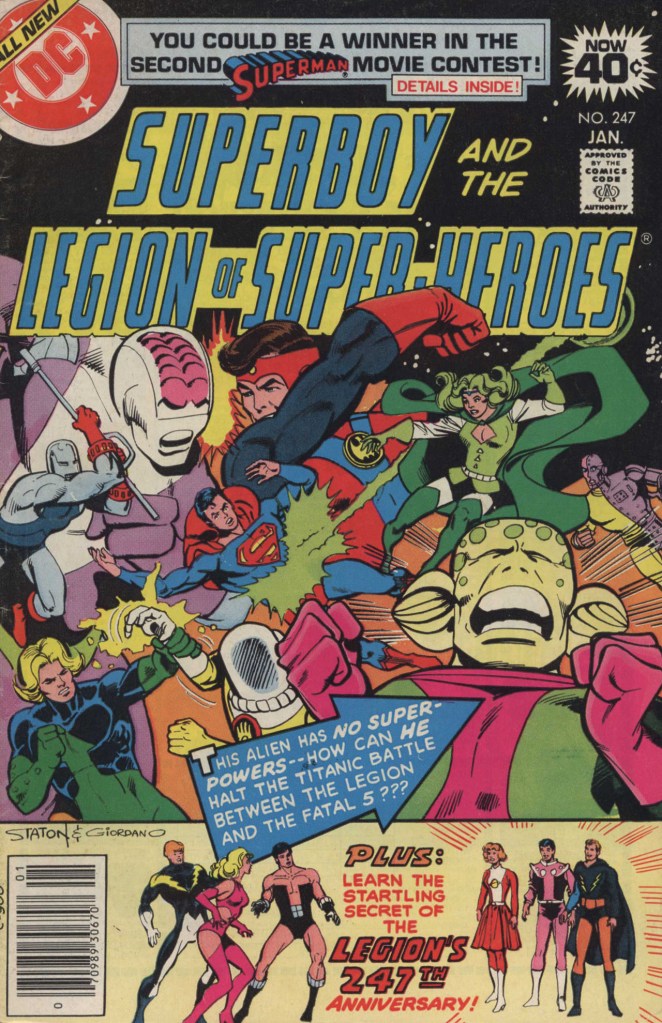
SUPERBOY AND THE LEGION OF SUPER-HEROES was one of those titles that consistently failed to hook me for the long term. It always felt like a series i should really enjoy, with an awesome variety of futuristic heroes. But I found most of the individual issues no better than okay. Every so often, something would compel me to dip my toe back into the water–in this case, I’m sure it was that bottom blurb about the founding Legionnaires being somehow relevant to this issue. I always liked comic book history, and the Legion of the 1960s (as penciled by Curt Swan) held more appeal for me. And I bought the book for a couple of months here before falling off of it again.

In a bit of a novelty for this time, the issue contained two stories, the first of which was the second part to a tale begun in the previous issue, which I’d shortly pick up at a 7-11 in another part of my area. I quite liked the look of Joe Staton’s work during this time, although here I don’t know that inker Jack Abel does him a whole lot of favors. The female faces in particular look to owe more to Abel than to Staton. Len Wein was the writer, and I always enjoyed Len’s output, even though I hadn’t really taken any particular notice of it. He seemed to have similar fan sensibilities to my own, which meant that he hit with regularity as far as I was concerned.
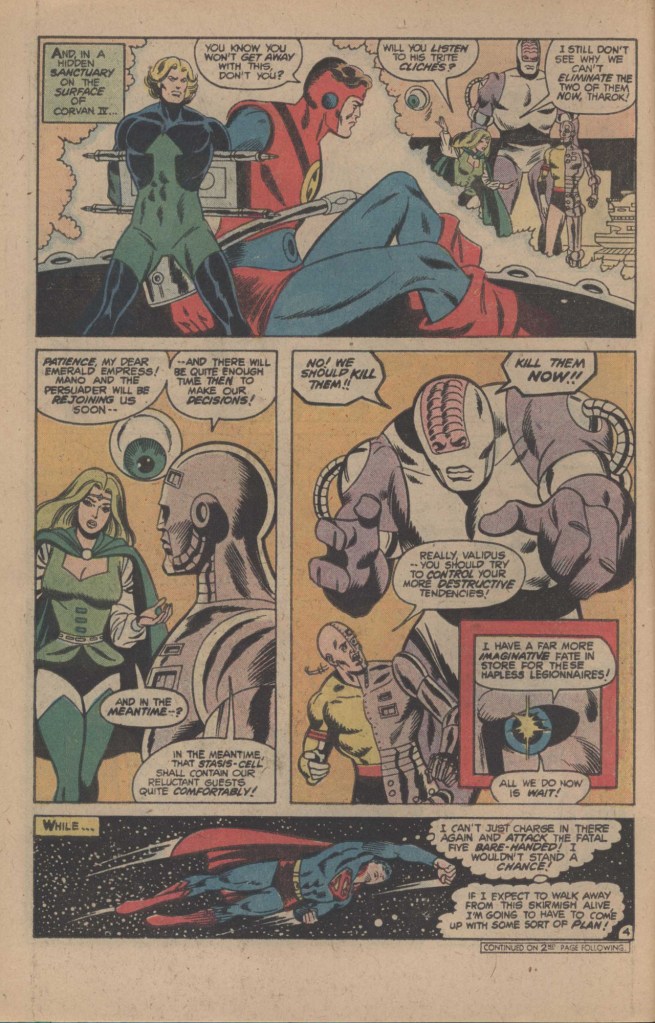
Last time, a squadron of Legionnaires had been ambushed by their perennial foes the Fatal Five on the planet Corvan IV. The Five had taken control of Corvan and attempted to get it admitted into the United Planets, and the Legion team was sent to judge its worthiness for inclusion. When the Legionnaires rejected the planet’s admission due to how the Five’s efforts had disrupted the local culture, the Fatal Five clobbered them–all except Superboy, who uncharacteristically ran from the battle. The Boy of Steel has actually gone in search of reinforcements. But he’s gotten no response from the other Legionnaires, whom he assumes are all off on a vital mission of their own. With no other choice left to him, Superboy realizes that he’s going to have to liberate his friends all by himself.
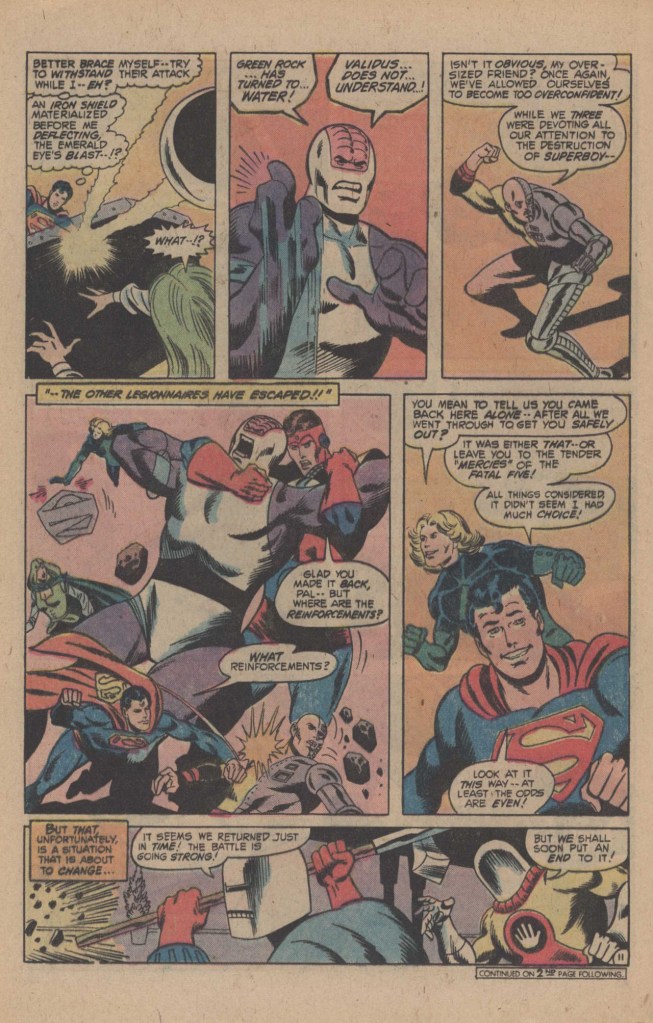
The Fiver who is the most dangerous to Superboy is the Emerald Empress, to whose mystic eye he is vulnerable. Previously, Superboy had learned that, like him, the Eye is susceptible to Kryptonite, so finding a nearby chunk in an asteroid field, he’s able to pool-shot it with other asteroids so that it falls towards the surface of Corvan IV and smacks into the Eye. With the Empress now momentarily out of action, the Boy of Steel descends to the planet and takes on Validus, Mano, the Persuader and Tharok on his own, attempting to liberate Element Lad and Colossal Boy. But while he has the upper hand at first, as the Five begin to attack him en masse, the table start to turn. And when the Empress’ Eye is recovered from being struck, it looks like game over for Superboy.
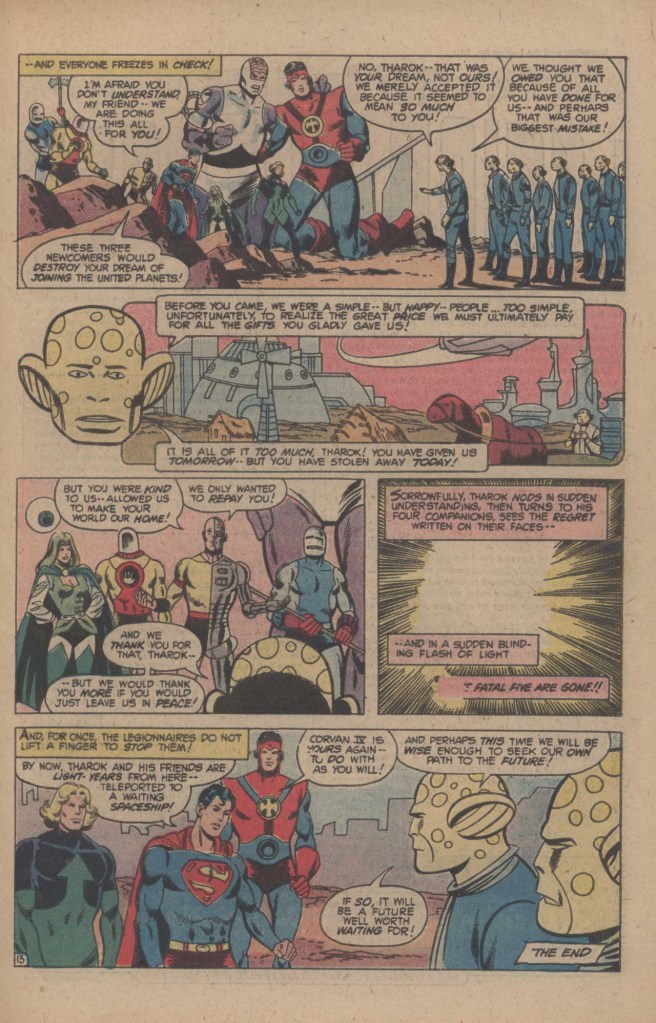
Fortunately, the battle has disrupted the restraints holding the other Legionnaires, and so Element Lad and Colossal Boy come to Superboy’s assistance. The fight turns into a donnybrook that rages wildly until one of the Corvan people cries for an end to the fight. The Fatal Five’s efforts to get the planet inducted into the U.P. were genuine and altruistic, but the Corvans have had enough and no longer want any part of this, at least for the time being. They were happy as a less technologically advanced species in the first place. So the Fatal Five stop fighting and teleport away–and the Legionnaires stand around acting like they did something heroic, rather than having been a part of the problem. And that’s where this story ends.

A quick stop-off at this point for the Legion Outpost letters page, which carries a letter from future Eclipse editor Cat Yronwode, as well as longtime comic book letterhack Beppe Sabbatini. All throughout the 1970s, you’d see the same names crop up on the letters pages time and again, to the point where you’d begin to recognize them.

The back-up tale is written by Paul Levitz, whose connection with the Legion had already been established though his long run as the writer of the series had yet to begin. The story was commissioned as an anniversary piece of a sort–the Legion had first appeared in the Superboy story in ADVENTURE COMICS #247 in 1958, so to modern editor Jack C Harris’ way of thinking, SUPERBOY AND THE LEGION OF SUPER-HEROES #247 represented an anniversary moment for the strip. Harris had also brought back an old Legion tradition for the occasion, in which the leadership of the team was decided upon by a fan vote rather than any story need. And so this story was all about selecting the new leader.

Except that mishaps keep interfering with the election process. To try to get away from them, Chameleon Boy suggests completing the election in space aboard one of the Legion Cruisers. But this is all set-up for a surprise, as it turns out that the mishaps are all the doing of Superboy, and all of them parallel the initiation pranks the Legion pulled on him in that first story before he was permitted to join the team. This was a fun story, in part because it was all about characterization and color, even though there was no genuine threat to speak of. And as revealed on that Legion Outpost letters page, Lightning Lad was the readers’ choice, and so he became the next Legion leader.


Not really news to you–you know this–but for the benefit of those reading, a little more on the “247” gimmick: The number 47 turned up, purely by coincidence, several times during the Silver Age. Adventure 247, of course, but Superman 147 was the first appearance of the Adult Legion, and Superboy 147 (or, under the Giant series numbering, G-47) was an 80-Page Giant devoted to the Legion. So the number 47 became a little running joke among Legion fans for decades. (When I was working at DC in the ’80s, it amused me that Legion editor Karen Berger’s phone extension was 47.)
The provenance of the stories in issues 246-247 is a little wonky. DC had to do some fancy footwork in the immediate aftermath of the Implosion. Book-length stories produced at 25 pages had to be edited down back closer to the original 17-page format, but there was a couple months’ grace given–to my recollection, nothing was cut immediately from 25 to 17 but, rather, shaved down a couple or three pages until new 17-pagers could be produced. (This is most evident in the first few issues of DC Comics Presents.) The back-up in Superboy 246 and its concluding half, the lead in this issue (247), were written as one 25 page story. Rather than shave it down, it was just broken in half and padded out/edited a little to form a two-part tale. That’s how the “247th Anniversary” story came to be; as Paul Levitz later explained, there were pages to fill, and depending on how you were counting the number of past Legion stories (with some admitted fudging), you could get to 247 of them, which was the inspiration for this filler short.
All that said, I can’t account for the 14-page lead story in 246 that filled out the front part of that issue. How that was supposed to jibe with a 25-page-per-issue format is a mystery to me. It may have just been whipped up quickly as a filler, same at the “247” story–artist Staton was always fast, and the writing chores were broken up between Len Wein and Paul Levitz, so it conceivably could have been banged out more quickly than an average 14-pager.
LikeLiked by 3 people
Good information. I hadn’t realized that about the #246/#247 story although it seems obvious in hindsight. No doubt this is partly due to the order in which I bought and read them, which was well before I learned any of the particulars of the Implosion.
LikeLiked by 1 person
It may be that the 14-page lead was designed to work with the broken-up story — but it wasn’t filler so much as JCH wanting to tie up the loose ends from the recently-canceled KARATE KID series as quickly as possible. Al had been editing KK, and JCH had co-written the final issue, which had been part of a crossover with the JCH-written KAMANDI.
So maybe they either had that in the works, planning to pair it with a backup story, or took advantage of the need to break up Len’s story to slip it in.
LikeLiked by 2 people
Mark & Kurt. The Matt Damon & Ben Affleck. of Tom’s website. 🙂
LikeLike
Page 13, top panel, it looks like Validus and Colossal Boy are posing for a photograph. It almost looks like all the brightly costumed characters could be allies. In a fantasy match-up, I see the Fatal Five being given a real challenge by the early Defenders 5-hero roster. Hulk, Dr. Strange, Namor, Silver Surfer, Valkyrie.
LikeLiked by 1 person
Oh this was mean! Now I can’t die until I see a showdown between the Fatal Five and the Classic Defenders!
LikeLiked by 1 person
Ha! You may become immortal, sir. It would be something to see. I’d give to the Defenders, but it wouldn’t be easy.
LikeLiked by 1 person
I will go to my grave insisting that while Silver Surfer was one of the Titans Three, he was not a founding Defender. He was a recurring guest member and on a level with all the others including Luke Cage, Professor X, and Hawkeye.
LikeLiked by 1 person
OK. Valid point. Mr. Grandpachet said “Classic Defenders”, I said “early Defenders 5-hero roster”, so I don’t see any conflict w/ any of our statements. *whew* 😉 Surfer could definitely count as both part of the “Classic” and the “early” roster. Surfer wasn’t a founding member, like Cap wasn’t, in the Avengers, but he seemed to “complete” the team. But Surfer’s presence soon after, maybe especially b/c of the “Titans 3”, only solidified the team as a powerhouse alliance of people who didn’t seem to fit in with many others.
LikeLike
I’d give the victory definitively to the Defenders, on the basis of these comparisons:
Silver Surfer is at the same general power level as Validus, and much smarter.
Strange vs Empress, both have distance attacks. Strange is more skilled and used to fighting very strong opponents.
Valkyrie vs Persuader, both weapons brawlers. Valkyrie is much stronger (and I think more agile).
Hulk vs Tharok, Tharok is similar to The Leader, so Hulk should prevail.
Namor vs Mano, not a close contest, aside from Mano’s disintegration power, he’s baseline human, and will go down with one kick or punch from a superhuman (or simply break his helmet). Namor can fly above him and keep out of reach before dive-bombing (or just keep dropping things or throwing things).
In the first few minutes, Surfer/Validus, Strange/Empress, Valkyrie/Persuader, and Hulk/Tharok just need to keep the other occupied. Then Namor takes out Mano, proceed to help Valkyrie take out Persuader (again, flying and strength beats human with weapon), Namor/Valkyrie/Hulk take out Tharok, and if Strange hasn’t already defeated Empress by this time (comedy moment), him with Namor/Valkyrie/Hulk should be able to do it. Then everyone can figure out how to deal with Validus.
LikeLiked by 1 person
Seth —
I note that you’ve had the Defenders make all the choices in how to fight and the Fatal Five just go along with it. But that’s not really how comic book fights work.
It could just as easily start with Validus roaring out mental lightning and scattering everyone, and while they’re reacting to him, the Empress, intrigued by the Hulk, drains the “green energy” out of him with the Eye, and he reverts to Banner. Meanwhile, the Persuader has cut through the power cosmic (he did shit like that all the time), grounding the Surfer, while Mano disintegrates Dragonfang.
Doctor Strange is trying to wrap Validus up with the Crimson Bands of Cyttorak, but Tharok shoots him from behind with tranq darts while the Persuader and the Empress are knocking Val and Namor around, and…
…it’s pretty easy to make it go either way, but that’s the nature of superhero fights. We rig ’em to get the outcome that’ll suit the story.
LikeLiked by 1 person
Man, that was cool. What a treat. I can see all that in my imagination. Kurt, I wish you were writing/published more. I know you have a history w/ the Defenders. Actually, w/ most of DC & Marvel’s characters. That was a great laid out scenario, a sequence of unfortunate events. I felt bad for the Defenders. Great individual match-ups. I feel a little guilty for not paying anything for it- it’s what you do for a living. And came off pretty darn expertly. It seemed like it’d happen so fast, starting w/ Validus’s lightning. Jeez. I was a little over-confident in the D’s. But I also agree w/ Seth, & you’ll likely agree, as you can write any outcome that’ll suit the overall story, that the Defenders would pull out a win after an initial loss. And I definitely would have read your version of that result, too. Thanks for taking the time! Now who would I want to draw it… 🙂 Pascal Ferry…
LikeLike
Of course a writer can write anything, as shown in the limit by Wolverine beating Lobo in DC vs Marvel. But making reasonable power assumptions, the Defenders have a intelligent story-logic path to victory, since they can pair off on the Fatal Five in an equal or dominant way. It’s not so much that the Fivers go along with it, rather keeping them off-balance in a way they don’t have time to do anything aside from trying to defend against their specific opponent. It’s a pretty common battle scenario where rival teams do one-on-one fights with comparable members.
That does require knowing the Fatal Five’s strengths and weaknesses, so it works better as a story climax. An initial fight where the Defenders lose could set that up, with fun stuff like the Persuader’s Axe cutting those Crimson Bands of Cyttorak, or Mano disintegrating the Bands.
LikeLiked by 1 person
Awesome. Well thought out.
LikeLike
As I noted above, Validus can squash Superboy. In his first appearance they’re discussing that maybe possibly anti-matter bombardment will kill him. I think he could take the Surfer (ignoring, as Kurt says, that events on the ground are not about raw power levels alone).
And I’d count Tharok as smarter than the Leader. His whole hook was supposed to be “Brainiac? Luthor? Doom? Morons!” as witness outthinking Brainiac Five in the second Fatal Five two-parter. Why the reboot Legion turned him into a mindless cyborg killer I’ve never understood.
LikeLike
Your point about teamwork is a good factor to consider. The early Defenders didn’t do a lot of team fighting IIRC but way more than the Five.
LikeLiked by 1 person
“…you’ll likely agree, as you can write any outcome that’ll suit the overall story, that the Defenders would pull out a win after an initial loss.”Depends entirely on what the story needs. The Defenders could also lose after an initial win.This is my point. We rig the fights. Seth is rigging it — unconsciously, I expect — by giving the Defenders agency and having the Five react to it, and when responding to that note, he brings up the Defenders keeping the five off-balance, which is another way of giving the Defenders agency and not letting the Five seize it.My description simply assumed the Five get “first move” (which is often the case with villains), and their first move is to get the Defenders off-balance. thus giving them strategic agency.There isn’t an answer to “who would win.” The answer is always “what does the story need at this point.”
LikeLiked by 2 people
Wow! Who’d have thought this topic would have had such continued interest? Especially when MY personal favorite of all “superheroes meet and must fight” tropes waa Captain America and Batman confronting each other, quickly realizing they’re each perfectly matched, but decided it would be a waste of time. BRILLIANT. My memories are clouded, but it was either in Batman vs Captain America or one of the Avengers vs JLA titles. Meaning it would have been Byrne or Kurt who cut through the nonsense.
As for Defenders vs Fatal Five, my take is that Galactus accidentally sits on all of them.
LikeLiked by 1 person
Given Validus could swat Superboy and Mano disintegrated his home planet I think the odds are in the Five’s favor. Seeing if Tharok’s tech wizardry could beat Stephen’s magical wizardry would be interesting though.
LikeLiked by 1 person
Kurt could write a convincing Defenders win. I don’t have to even read it to know. He’s written wins against longer odds before.
LikeLike
Absolutely. A good writer can do that, sometimes by how they map out the fight, sometimes by choosing the ground rules (how effective is the Emerald Eye against magic?).
LikeLiked by 1 person
Aw, the Legion did too do something heroic — they freed Corvan IV from the Fatal Five, who had essentially “violated the Prime Directive” by forcing technology on them they weren’t ready for. The Corvanians didn’t want what the Fatal Five had pushed on them, but didn’t assert themselves until the Legion arrived to say (and back up) what they were already thinking.
We never actually see evidence that the Corvanians are in “future shock” — it’s all expository — but that may be an artifact of the tightness of the story.
LikeLiked by 1 person
Giordano on this LSH issue? I’m surprised Len would’ve thought he could’ve written Batman while remaining an editor, a writer/editor for Marvel. I’d think that’d be a non-starter for Marvel. It’d different than freelancing. I’d think so, anyway.
Looking back @ Len’s editorship of the Bat-books, I still really enjoy that stuff. He maintained much of what Dick was doing as editor. Don Newton, Gene Colan. The occasional great treat of Klaus Janson on inks. They did change the letters column title from “The Batcave” to “Detective Comments”, which I did prefer. And Len added Doug Moench.
All respect to Denny’s long and storied tenure as Bat-Ed. Maybe we wouldn’t have had “Batman: Year One” without Denny’s involvement. But I wonder what else Len would’ve come up with, had he stayed on.
LikeLike
“I’m surprised Len would’ve thought he could’ve written Batman while remaining an editor, a writer/editor for Marvel.”
I think the writer/editor contracts were freelance, and apparently didn’t mention exclusivity.
In any case, Marvel was willing to let Len write Batman, as long as he used a pseudonym — they didn’t want DC to get the promo benefit of having one of Marvel’s top writers on one of DC’s core characters. DC didn’t like that — Jenette Kahn absolutely wanted the promo benefit of Len’s name.
And there was much wrangling, and in the end either Len got sick of it or DC offered enough money or something, and he decided he’d go write for DC full-time. Which, within two years turned into an editorial job, and a lot of Len’s Marvel co-workers traveling over to DC, and DC being transformed by CRISIS.
Not, perhaps, foreseeable back in 1978, but a major turning point in DC’s fortunes.
LikeLiked by 3 people
“I think the writer/editor contracts were freelance, and apparently didn’t mention exclusivity.
“In any case, Marvel was willing to let Len write Batman, as long as he used a pseudonym — they didn’t want DC to get the promo benefit of having one of Marvel’s top writers on one of DC’s core characters. DC didn’t like that — Jenette Kahn absolutely wanted the promo benefit of Len’s name.
“And there was much wrangling, and in the end either Len got sick of it or DC offered enough money or something, and he decided he’d go write for DC full-time. Which, within two years turned into an editorial job, and a lot of Len’s Marvel co-workers traveling over to DC, and DC being transformed by CRISIS.”
Fascinating. I agree w/ Kahn. A turning point for both companies. Much appreciated background. Thanks very much.
LikeLike
I suppose. But I feel like that’s a tough position to substantiate when the moment the Corvanians speak up and say they don’t want it, the Fatal Five immediately respond, “Oh. Sorry then” and vamoose.
LikeLiked by 1 person
The Corvanians are apparently a bunch of wusses. They didn’t have the gumption to say they didn’t want it until the Legion showed up and the Fatal Five demonstrated that they were willing to murder people to achieve their goal.
The story would probably have been better if the Fatal Five had a deeper game going on — maybe they were introducing this technology to get the Corvanians to mine some element Tharok wanted, or something. A plan that made them villains instead of well-meaning-but wrong.
But, well, single-issue story (as originally intended, at least) and not much room. But Corvan IV could have been brought back later to develop further…
LikeLiked by 2 people
I’ll also add that I figure Len’s brief Legion run was due to his abrupt and not-wholly-planned switch from Marvel to DC — he’d originally planned just to be writing BATMAN, while writer-editing for Marvel for the rest of his workload. But Marvel didn’t like that, and when the dust settled, his Marvel books were all frantically preparing for new writers, and DC must have been scrambling to find work for him until more regular assignments were available.
I’d have been happy to see a longer stay, though. Especially if Dick Giordano had been able to stick around as inker. That story looked great.
LikeLiked by 1 person
Len Wein’s account of leaving Marvel for DC in 1977, from a 2000 interview with Chris Knowles in Comic Book Artist:
At the time, I was writing Fantastic Four, Amazing Spider-Man, Mighty Thor, and Incredible Hulk, all at the same time, and I was getting too obsessed about the little day-to-day details of the job, and going crazy. At that point, DC was wooing me like crazy to come back and work for them, and Jenette Kahn made me incredible offers of all kinds of things that I could have if I came back. I was sort of resistant for a while, and then they finally offered me Batman–Detective Comics–right after Steve Englehart left, Marshall Rogers was continuing with the book, but they needed a new writer, and they offered me Batman, my all-time favorite character. I thought about it, and said, “Yeah, I’d like to do that,” and so I gave them a tentative yes on the gig, and went to tell Stan [Marvel publisher Stan Lee] that I was taking over a book at DC as well. Stan didn’t think it was right or fair, but I kind of explained that I just needed to do a little distancing if I was going to keep myself sane, and finally, with great reluctance, he said, “All right, fine. If you have to write Batman, then write Batman, but we don’t want you to use your name on the book, because you’re top writer on our four top titles. Use a pseudonym, and do what you’ve got to do, and we’ll live with it.” But he was clearly not happy. I called DC back, and said, “Okay, here’s the deal: I can do the book, but Stan doesn’t want me to use my name on the title. I have to use a pseudonym.” Of course, DC was not happy, because what they wanted to do was promote me writing the Batman book. So, now I had pretty much what I wanted–the four top books at Marvel, and Batman at DC–and nobody was very happy.”
“Rather than have everybody unhappy with me, [I thought] that maybe it was simply time to take a clean break, take the deal DC was offering, and use my own name, and give myself a chance to sort of refresh my batteries and take on the other projects! So, I finally said that was the thing to do, I had gotten too obsessively involved in my Marvel books, and I came back that Monday and basically sat there with Stan and said, “Look, I want to use my own name on the Batman books, and if that means I’ve got to go, then I will leave.” It took Stan so many years to understand my feelings, it was like, “I gave you what you wanted, I said you could write Batman! Why are you leaving?” I just felt I needed it for my own mental sanity at the time.”
According to the late Kim Thompson, Wein told him at the time that Stan Lee blackballed him at Marvel for making the switch.
LikeLiked by 3 people
I never thought Len Wein as a good a fit at Marvel as at DC, so I didn’t mind seeing him leave Marvel back then, aside from being mildly curious about the character Wein seemed poised to introduce as the Torch’s new girlfriend. I looked over a list of his eighties works and his accomplishments as editor seemed to be his highest accomplishments, not least with respect to his role (as I understand it) in the “British invasion.”
LikeLiked by 1 person
I don’t know about all the other stuff–I just know I was still buying LSH at this time when this issue came out–maybe not every issue but every other issue or something–because I remember getting this one. Nothing too spectacular, but still enjoyable, especially that second story with Superboy pulling that trick.
LikeLike