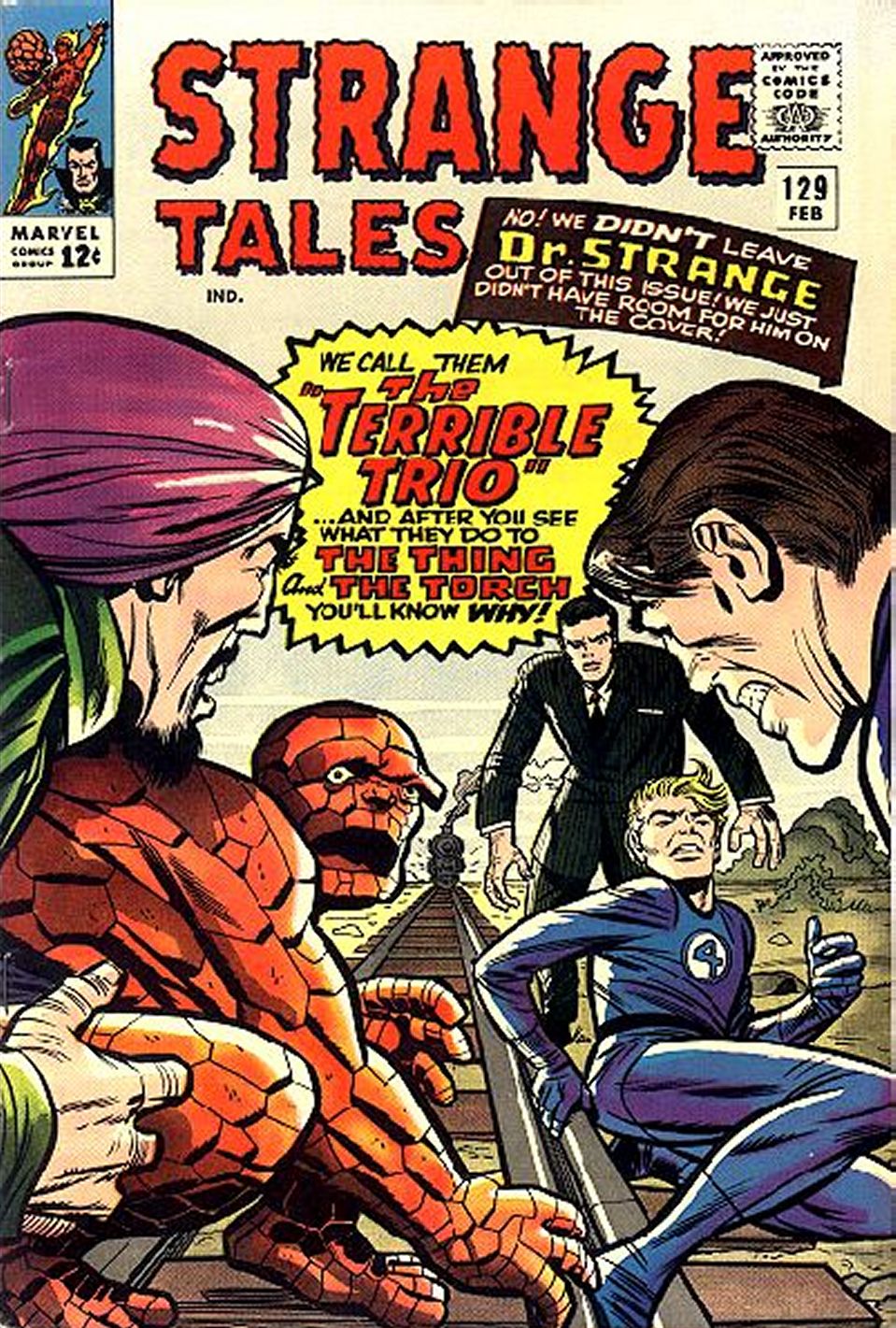


This was the last issue of STRANGE TALES that I had gotten in the box of Silver Age comics that made up my Windfall purchase in 1988. As we’ve spoken about before, the series felt more and more like an afterthought, one that simply wasn’t as important to the line as books like FANTASTIC FOUR, AVENGERS or X-MEN. In only a couple more issues, editor Stan Lee would overhaul the title by sunsetting the Human Torch and Thing series in favor of a new contemporary concept; NICK FURY, AGENT OF S.H.I.E.L.D. But for now, the title limped forward in an unimpressive manner.

But this doesn’t mean that Lee wasn’t taking some steps to try to improve the series’ fortunes. In this issue, the pedestrian work of artist Dick Ayers was inked by Frank Giacoia, one of the best in the business, who provided it with a much nicer polish and snap. Ayers’ strength was always in understanding how to break down a story in the way that Lee liked, and Giacoia added a strong finish to the work. Giacoia was still doing work for rival DC, so he used the pseudonym Frankie Ray on his Marvel work for a time. The letters page also indicates that, starting in the next issue, Bob Powell would be taking over the strip. Powell had been working in comics going back to the 1940s and was often associated with his friend Wally Wood. this change wouldn’t quite yield the results Lee was hoping for, but it is an indication that an attempt was being made to improve on what was being offered.

One other thing that had been happening with STRANGE TALES was that it was becoming better integrated with the rest of the Marvel line. this meant that it had begun running house ads for the other titles and also pieces like this full-pager touting the wonders of Marvel’s new in-house fan club, the Merry Marvel Marching Society. A buck was a lot of money for a membership kit at a time when a new comic book cost just twelve cents, but Lee makes it look like an absolute necessity chock-full of wonderment without which one’s life couldn’t be considered complete.
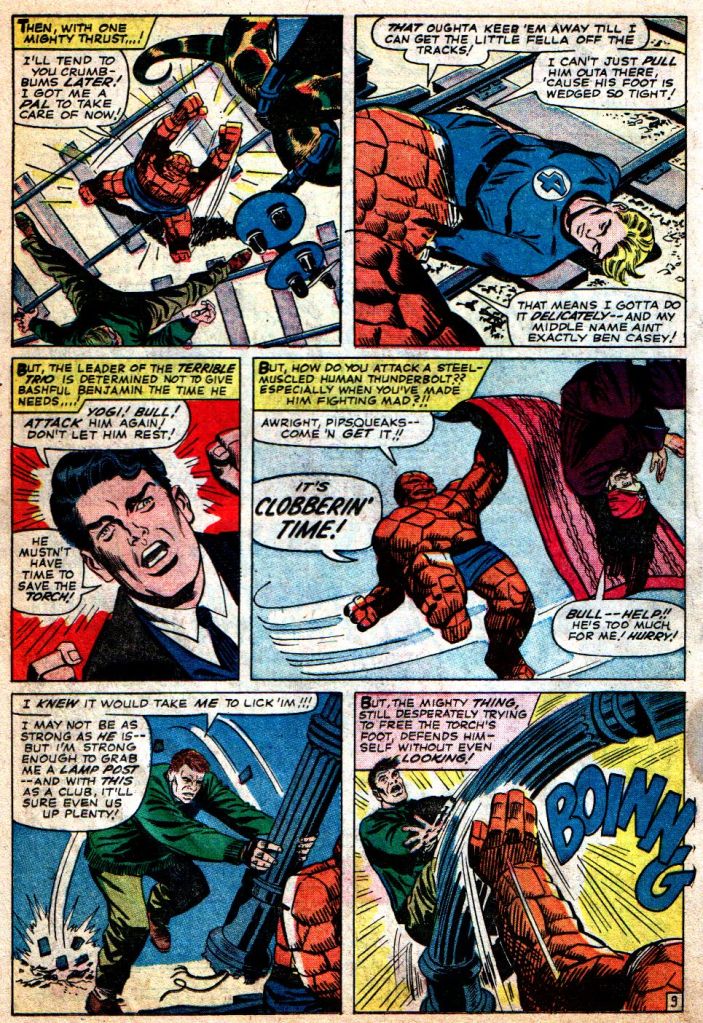
Anyway, the story this issue concerns the return of the Terrible Trio, three never-was super-villains who had been created by Doctor Doom in a FANTASTIC FOUR story some months earlier and whom Lee was attempting to turn into a regular thing. It didn’t help that they weren’t all that colorful or interesting. The Torch had beaten the three of them by his lonesome only a couple of issues earlier, so putting them up against Johnny and the Thing as well felt a little bit like they were trying to commit suicide-by-super-hero. Despite the earnestness of the text, there’s never any real feeling that the two FF stalwarts are in any real jeopardy here.

The centerpiece of the story revolves around the Thing needing to save Johnny from being run over by a train in the manner of an old serial chapter. It isn’t much of a challenge, really. And while the story runs its bases perfectly well, the imagination and compositional skill of Jack Kirby, who might have been able to make this idea interesting, simply wasn’t present. So it’s another by-the-numbers episode that isn’t ever quite as fun as it wants to be. No, this was a strip that was operating on fumes, and the impending arrival of Bob Powell wasn’t going to be enough to save it.
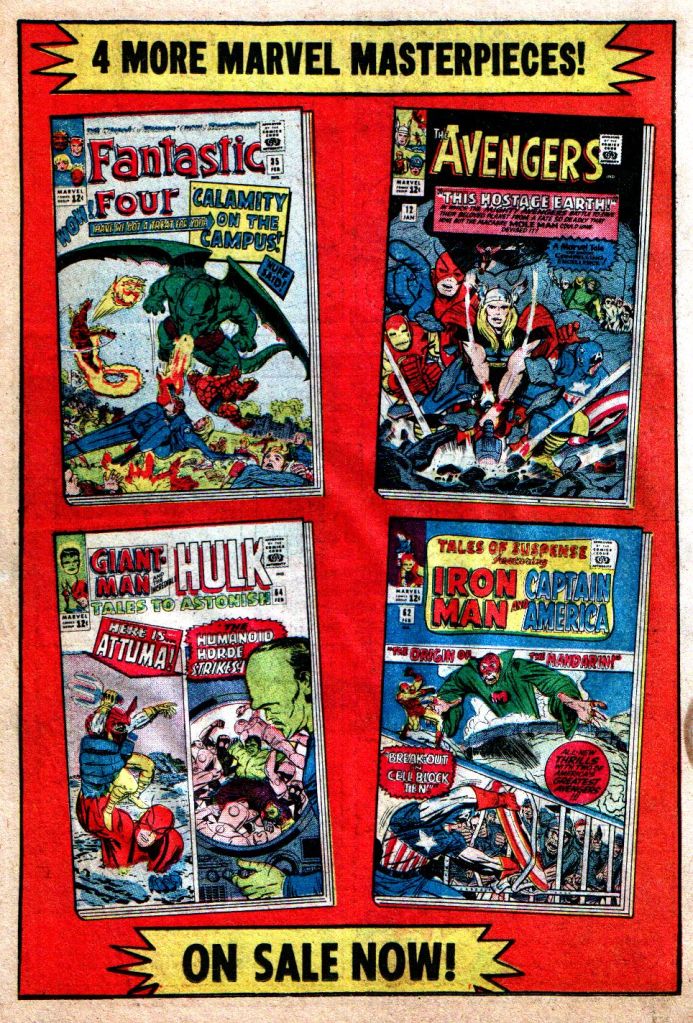
And as if to prove that point, here’s a House Ad for four series that were all far better executed than this Torch and Thing story. In a line-up such as this one., STRANGE TALES was something of a weak sister, though its back-up series helped to justify it as a going concern.

It isn’t a big secret that Stan Lee wasn’t all that enamored of Doctor Strange during its initial run. I suspect some of that is due to the fact that he had a different perspective on this sort of material than artist and often plotter Steve Ditko did. So it was easier to hand the assignment off to somebody else, and that’s just what Lee does here. Don Rico had been a writer and an artist during the Golden Age, and he’d done a couple of stories for Marvel before this under the pseudonym N. Korok. So Lee set him to work dialoguing this issue’s Doctor Strange story, and the results are pretty solid. if anything, it’s probably closer to the manner in which Ditko would have liked strange to be handled, more serious-minded and less bombastic.

The story is a wrinkle on an earlier Dr. Strange adventure. A trio of scientists attempt to convince Strange to come onto a television program with them to discuss whether black magic is real or just a fantasy. Strange has no intention of going along with their foolishness, and so declines. But on the day of the broadcast, one of the trio has brought an effigy unearthed in Peru that is meant to be a representation of the mighty Tiboro, a mystic entity who once ruled that region. Suddenly, the lights in the broadcast room go out, and when they come back up, the three scientists are missing and only the idol is left. Strange is contacted in the hope that he might be able to get to the bottom of what’s going on, and after consulting with his master the Ancient One, who fills him in on Tiboro’s backstory, the Master of the Mystic Arts himself crosses the veil into Tiboro’s realm.
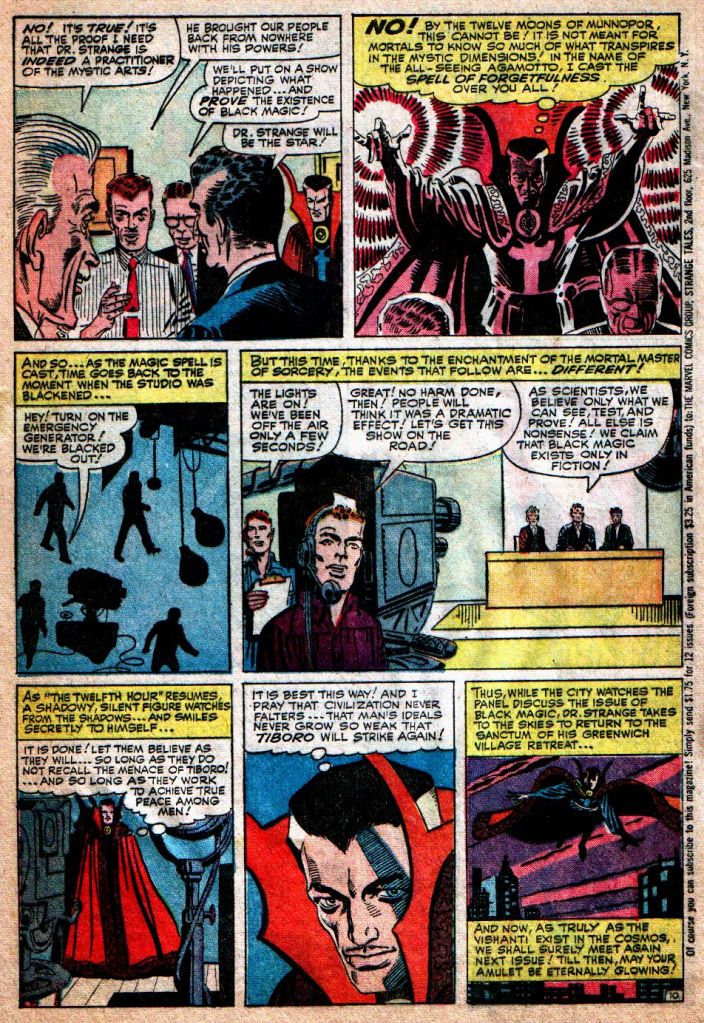
There, Strange fights a duel with Tiboro for the fate of the trio of scientists, and after an extended mystic battle, he defeats his foe, securing their release. They all return to Earth and the broadcast studio, where they enthusiastically talk about all they have witnessed and their desire to make a new broadcast to reveal it all to the world. This Dr. Strange cannot allow, and so he erases their memories of these recent events, leaving them to scoff at his belief in magic once more. The real sell here, as always, was the artwork of Steve Ditko, who made Strange’s world both moody and eerie, and who devised a unique manner for depicting his spells and sorcery. This story, as derivative of an earlier yarn as it was, was just as satisfying as the Torch & Thing story was disappointing.
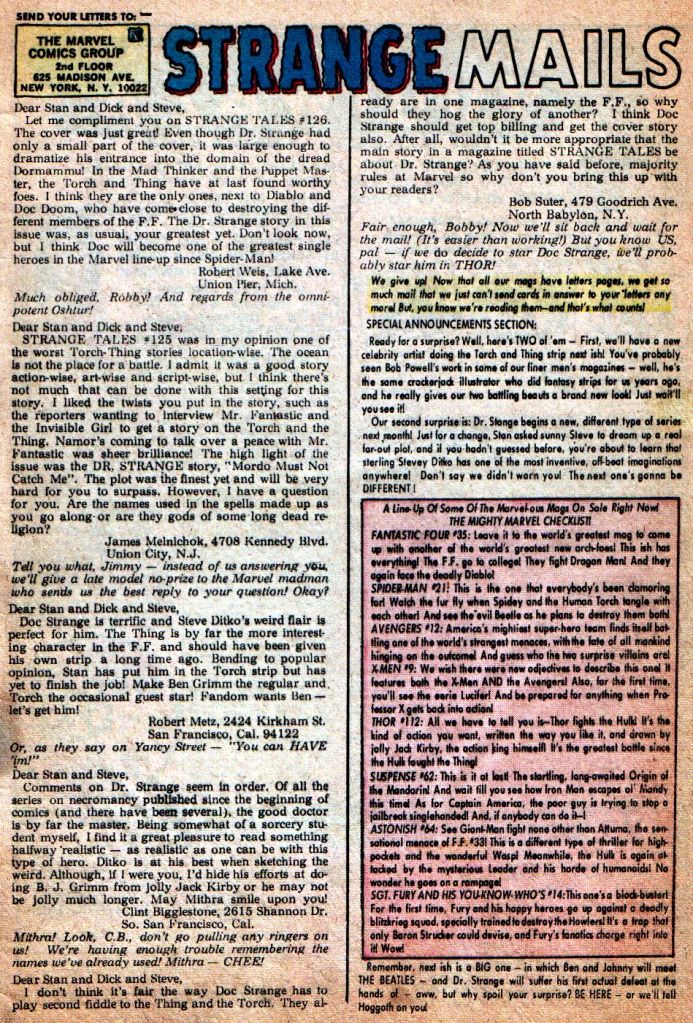
And the issue wrapped up with a single page STRANGE MAILS letters page, which also included a Special Announcements Section and the Mighty Marvel Checklist. Lee had moved to add letters pages to all of the titles in the line of late in response to demands from the audience, and doing so meant that there was a lot more editorial work to be done to fill them all. Dedicating a portion of them to the checklist lightened that load a little bit, at least in the short term.


I’ve always loved that Silver Age Strange was well known as an expert in matters occult even if not everybody believed in him.
LikeLiked by 2 people
What a shame the Torch-Thing strip didn’t end with the very next one. with their almost meeting the Beatles. It’s not exactly a high note, but it’s more memorable than the four issues after it.
LikeLiked by 1 person
When Frank Giacoia used the pseudonym of Frankie Ray, is it known how he was paid? Was a check issued to Frank Giacoia or Frankie Ray? I don’t know how pseudonyms work, so I’m just wondering.
LikeLike
The check would have been made out to Frank Giacoia, otherwise he wouldn’t have been able to cash it. The Frank Ray name was just for the credits in the book.
LikeLiked by 1 person
Roy Thomas once pondered in the pages of his magazine Alter Ego if perhaps the name Tiboro was Don Rico coming up with a play on the Triborough Bridge in NYC.
As I’ve said before, it boggles the mind that it took sop very long to give Doctor Strange the full cover treatment on Strange Tales. Even if Le was not enamored or personally invested in Doctor Strange, surely he must have been able to perceive that Steve Ditko was creating stories that far surpassed either the underwhelming Human Torch feature or the middling S.H.I.E.L.D. stories that fell in-between the initial Kirby installments and Steranko’s arrival.
LikeLike