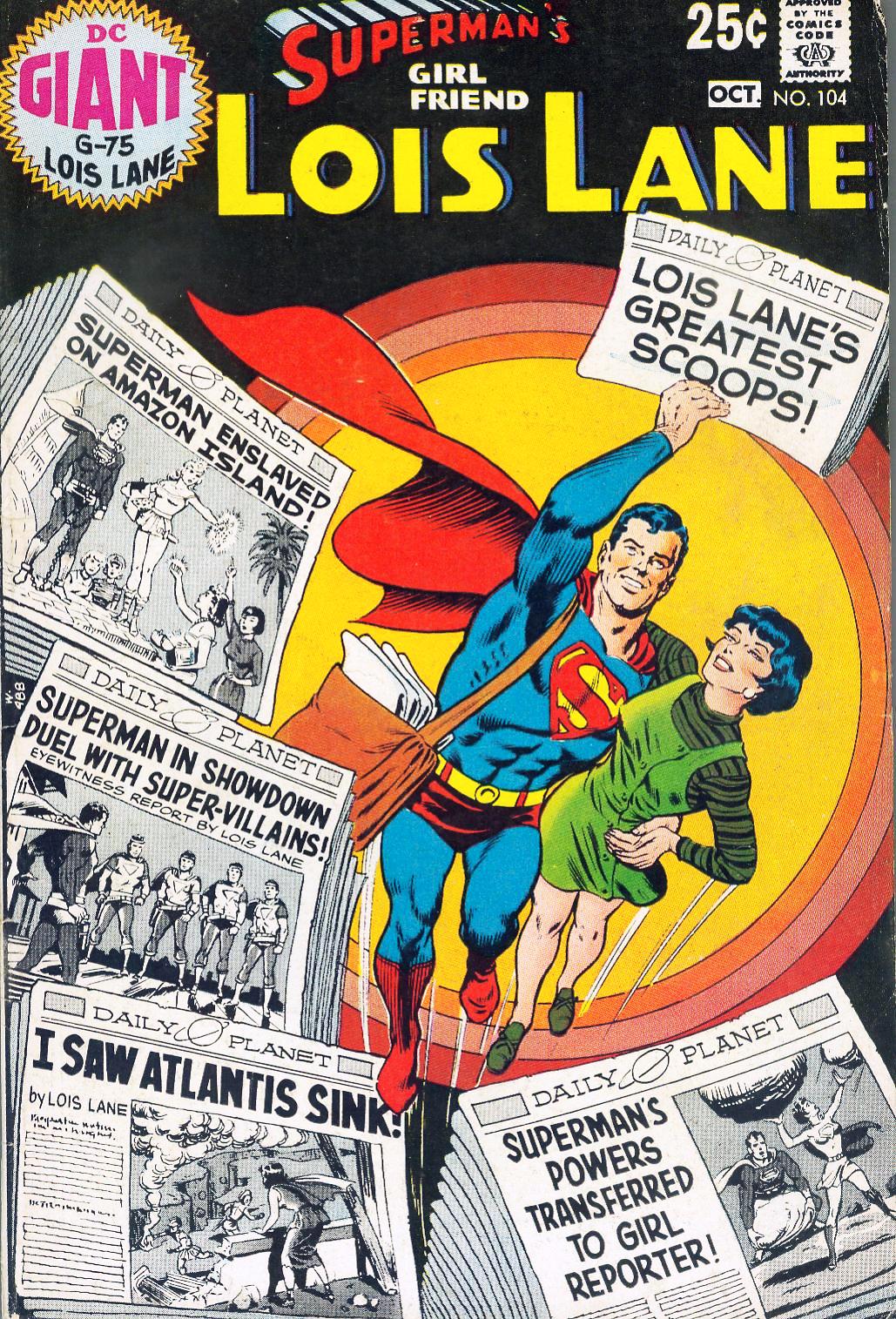


Now this comic book I know was given to me by my friend David Steckel. As I’ve mentioned before, David was a thorough Marvel Zombie (before that term came into widespread use) and he found all DC comics to be juvenile kiddy stuff–which, in al honesty, they largely were. So he had less than no interest in LOIS LANE, which contained reprints of Mort Weisinger-edited stories from early in the Silver Age of Comics, stories that were aimed at Mort’s youthful audience. I seem to recall that he even mocked me a bit for taking it. But I had no problem with DC books, I still loved them as much as my Marvels, and it was a Superman title, and free. So why not?

The issue contained six reprinted stories, and my recollection is that none of them stuck with me especially strongly. It opened with this Superman tale from 1957 in which Lois Lane and a group of other female Superman admirers wind up stranded among a lost colony of Amazons. Superman goes to rescue them, but the Amazons of course have Kryptonite and are able to subdue the Man of Steel. Thereafter, Superman is forced to perform challenges for the freedom of himself and his friends. Should any woman present him with a challenge he cannot meet, that woman will become his bride. Of course, Superman is able to come up with clever ways to achieve each needed goal, sometimes with the aid of Lois. There’s also a subplot about a Kryptonite Cure, but it’s a pretty basic story beyond that. It was written by Otto Binder and illustrated by the Superman artist of the day, Wayne Boring, whose work seemed of a different era in 1978.
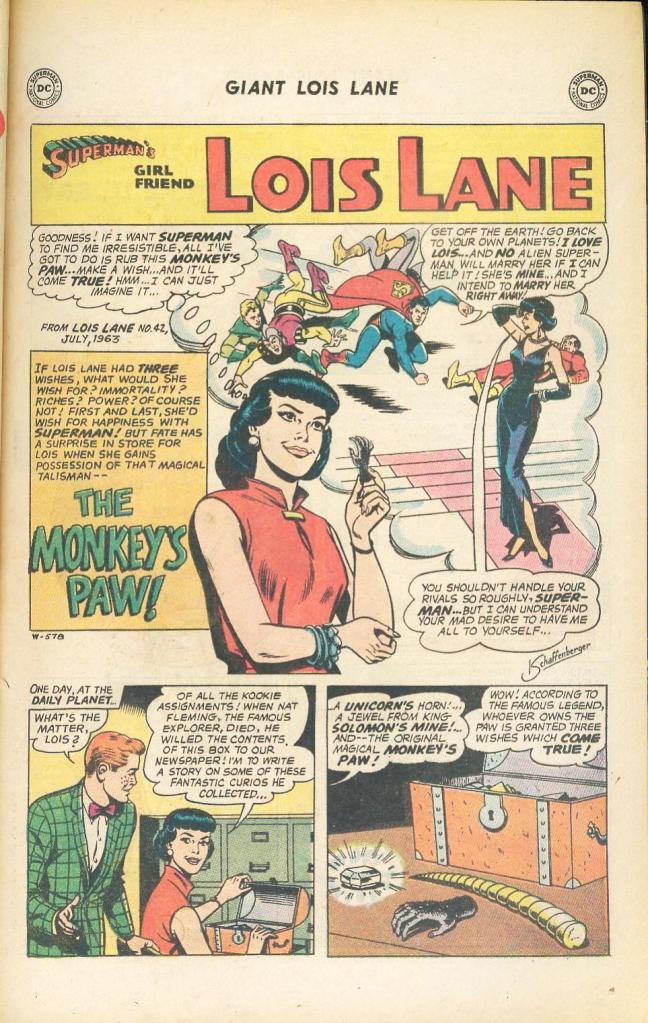
This second story includes a sly Easter egg on the part of artist Kurt Schaffenberger and the colorist. If you look at the splash panel above, you’ll see that that’a Fawcett’s Captain Marvel lying on the ground behind Lois. Schaffenberger had worked on the Big Red Cheese before his line was discontinued by agreement with DC, so this was him playfully thumbing his nose, I expect. The story is a Jerry Siegel-scribed pot-boiler about Lois gaining possession of a Monkey’s Paw that grants three wishes. But Lois is convinced by circumstances that the thing is a hoax and she throws it away, never realizing that it could have made all of her dreams come true.
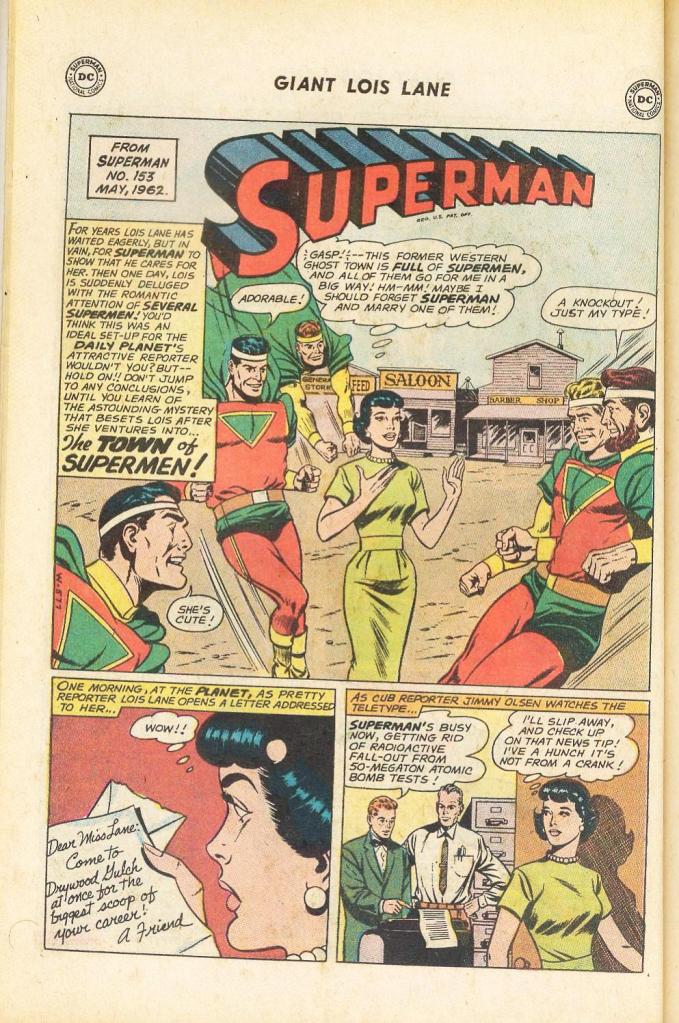
The next story is also written by Siegel but illustrated by John Forte, one of the stiffer and more lifeless artists in the Weisinger stable. In it, Lois Lane discovers a western town populated entirely by refugees from Krypton–but when she tries to show it to her friends and co-workers, it appears to be simply another ordinary western town. This is because the citizens are all secretly criminal escapees from the Phantom Zone, and this is all part of a needlessly-complicated plot to destroy Superman. Of course, the Man of Steel is able to survive a duel with all eight outlaws at once, projecting them back into their ethereal Phantom Zone prison. And Lois was able to convince Superman and her friends that the threat was real by showing them the town’s barber shop, which was disused since Kryptonian hair doesn’t grow under a yellow sun.
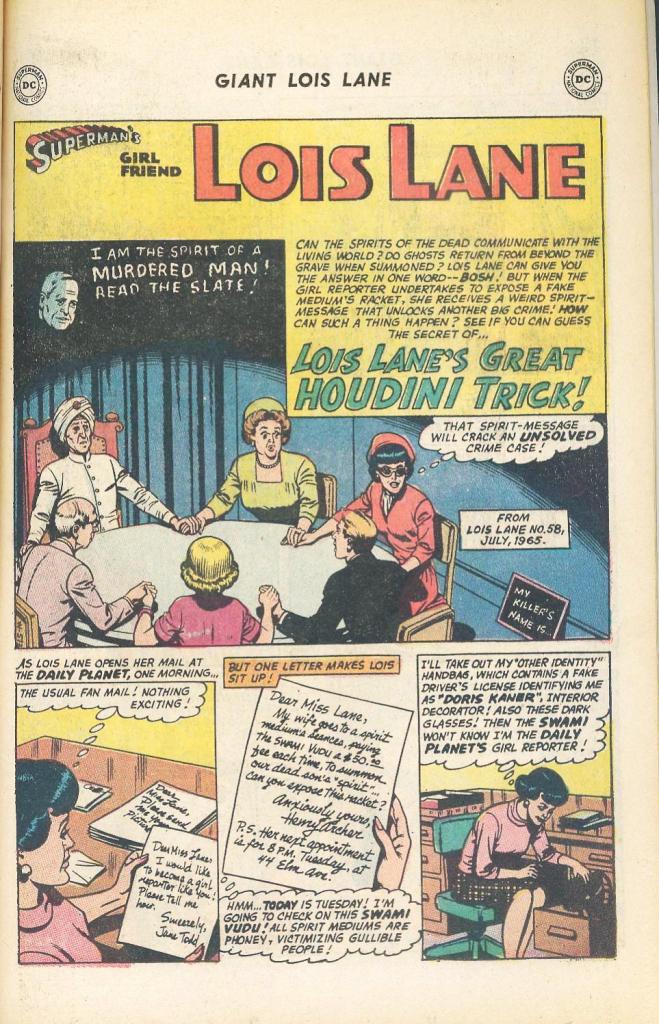
The next story was by Binder and Schaffenberger and involved Lois’ efforts to expose a crooked Swami. Lois uses a trick taken from the repertoire of the famous illusionist Houdini to do so, creating what seems to be an actual supernatural event during a seance with the Swami, one that makes him believe that the location of the body of the gangster he had murdered was about to be discovered, leading him to attempt to dig it up and move it. Superman shows up for a couple panels here just to grab up the guy–otherwise, this is entirely Lois’s show, and she’s pretty clever in it, particularly for the dingbat Lois of this era.

Like a creative mix-and-match, the following story is written by Jerry Siegel and drawn by Kurt Schaffenberger. Schaffenberger was the defacto lead artist for Lois Lane stories in this era, so his presence isn’t all that much of a surprise. In it, an accident while he’s trying to develop an antidote to Kryptonite transfers Superman’s powers to Lois Lane. Cattily, Lois refuses to wed the now-powerless Superman, and instead puts him through the wringer a bit now that the shoe is on the other foot. But this has all been a ruse by one of Superman’s Robots, who has suspected that Lois only loves Superman for his dazzling super-powers and not for himself. And this story pretty much proves exactly that–Lois comes off terribly here. In the end, the real Superman tells her not to worry about it, but there really isn’t any sort of resolution to this problem–only the fact that the status quo goes back to normal in the next story.

The final story in the issue is another Schaffenberger job, but is written by Leo Dorfman. In it, Lois is sent back in time to the days when Atlantis still resides above the waves. There, she discovers that the Dictator Roh-Tul (Luthor spelled backwards and hyphenated, of course) isn’t the benevolent figure he appears to be, and she aids Clark Kent look-alike Klar-Kan in bringing about his fall from power. But Lois herself seems to be responsible for the sinking of Atlantis when Roh-Tul sets off a massive bomb after she refuses to stay with him. But back in the present, Lois learns that the bomb was a harmless bluff and wasn’t responsible for the catastrophe after all. Whew! I can certainly see why David Steckel found these stories to be dopey and childish–because they absolutely were. Still, they’ve also got a unique charm to them if you can approach them on their own level.


Re: the “easter egg” in the Lois Lane story: artist Kurt Schaffenberger was also a mainstay at Fawcett, mostly on The Marvel Family & Captain Marvel Jr, but he also occasionally drew Captain Marvel solo adventures in Whiz Comics & other titles. It wasn’t just Dorfman’s gag.
LikeLike
It wasn’t Dorfman’s gag at all — that one’s a Jerry Siegel script.
LikeLike
“This second story includes a sly Easter egg on the part of artist Kurt Schaffenberger and the colorist.”
…and the associate editor, I expect.
When this story originally appeared in 1963, that “Captain Marvel” figure was colored orange and a greenish-yellow; a nod to his original coloring, but not quite right. In this reprint, overseen by E. Nelson Bridwell, he’s red and gold. So that’d at the very least be a change Nelson allowed through, but I expect it’d be more likely that he asked for it to be made.
LikeLiked by 1 person
Agreed, that sounds like exactly the sort of thing that would tickle Bridwell’s fannish funny bone.
LikeLike
I didn’t think much of Kurt Schaffenberger’s art when I was growing up during the 70s era of the Superman Family – didn’t look “cool enough” to me. I’m happy to say I saw the error of my ways as I grew older.
LikeLike
As Brian Cronin has said, he made Lois’s stories way more charming than the scripts were.
LikeLike