

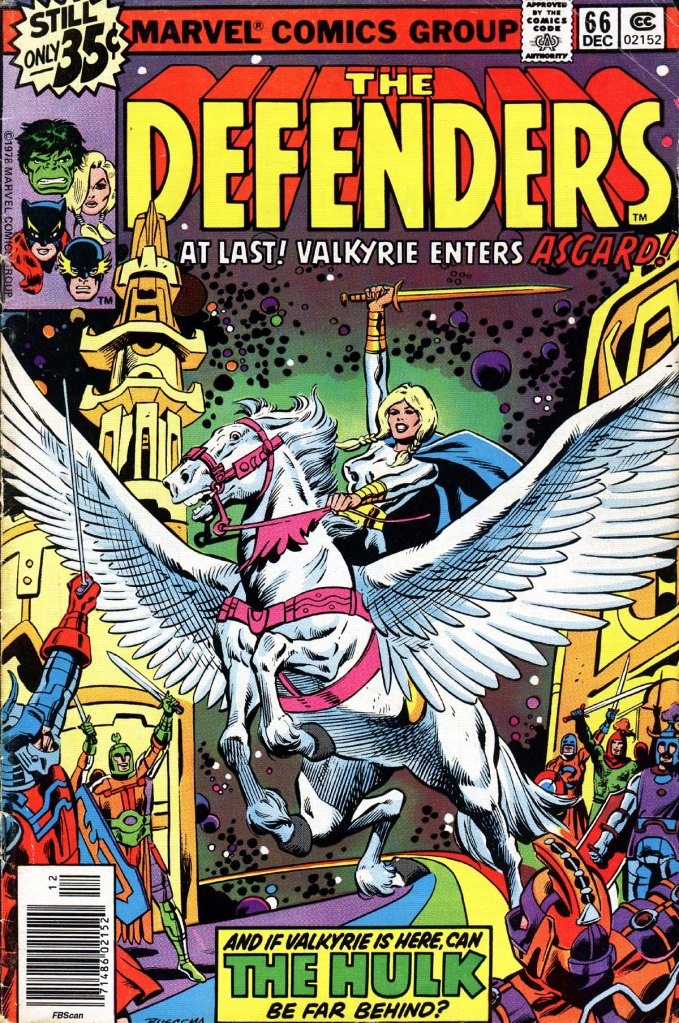
As in the case of FANTASTIC FOUR #200 and UNCANNY X-MEN #115, I had also missed DEFENDERS #65 during that same period–all of them were released during the same month and so it’s obvious to think that they must have all been part of the same waylaid shipment. But as opposed to the other two, I really wasn’t bothered by the absence of that issue of DEFENDERS. I’d been buying the series for a few months now, and while I really enjoyed the daffy absurdity of the recently-concluded Defender For A Day storyline, I couldn’t say that I was a big fan of the series. And indeed, from this pint on, DEFENDERS continues to plummet in my estimation–though I dutifully bought it for years. It wasn’t until the title was nearing issue #100 and J.M. DeMatteis took over as writer that I truly became interested in it again.

The Hulk was the big commercial draw of DEFENDERS, especially during this time when his live action CBS series was airing first run. And so, even though these next three issues would focus primarily on Valkyrie and attempt to sort out some questions concerning her origins and identity (which would never entirely be sorted out satisfactorily) this issue carries a huge cover blurb assuring readers that the Hulk is still in this comic book, even if he isn’t a part of the cover image. Which is a complete lie, the Green Goliath doesn’t put in so much as a single-panel appearance. The writer here was still David Anthony Kraft, whose efforts I had mostly been enjoying on previous issues, with artwork provided by Ed Hannigan and Bruce Patterson. The artwork on this issue was quite good, with Patterson providing a strong finish to Hannigan’s interesting compositions.

Anyway, our story opens with Valkyrie having returned to Asgard for what I believe is the first time since she had been reconstituted within the body of mortal Barbara Norriss. She’s come in response to some prophetic visions that she’d received, and so her first stop after entering the shining city through the Rainbow Bridge is to seek out the Three Norn Fates in the hope that they can give her visions some proper context. With their aid, Valkyrie peers into the spring of Mimir, which can reveal future events. There, she gets some terrible portents about a coming destruction, the deaths of her Defenders teammates, and herself struck down by an unseen foe. And ultimately, she witnesses herself banished to Niffelheim by Hela, the Goddess of Death. According to the Norns, these future glimpses cannot be changed, they will come to pass–and so Valkyrie decides to present herself to Hela and surrender to her judgment.

After a pair of short cut-aways back to Earth in which we learn that Hellcat is sitting around doing nothing remotely interesting and that the Justice Department is building a legal case against Kyle Richmond, Nighthawk, for stock manipulation and tax evasion, we return to Asgard, where Valykrie approaches Valhalla. As she enters, she’s greeted by Harokin, a character from an earlier Tales of Asgard story who here is the leader of the Legions of Valhalla. Val tells her circumstance to Harokin and her sister Valkyrie and they can scarcely give it credence. But then, the crowds begin to part and Hela steps forward. Val prepares herself to face her commander’s deadly touch.

Hela, though, tells Val to put the Norns’ nonsense out of her head, because the fates delight in twisting up others with their deceptive words. Instead, she commands Val to lead the assembled Valkyrior and Harokin’s troops against an impending attack by Ollerus the Unmerciful, who fancies himself the new God of Death and seeks to unseat Hela. Ollerus has a pair of sorcerers as lieutenants in his efforts, minor characters from earlier stories: Poppo the Cunning and Casiolena. What’s more, they see Val and her forces coming with the Crystal of Eternal View, another item introduced in Tales of Asgard, and so they are prepared to set a trap for the enemy army–ambushing them in the on-the-nose valley named the Path of Peril. Perhaps not the best route to take if you’re on the attack.

As Val’s forces approach the Path of Peril, one of the rank-and-file valkyrie, Svava, expressed a degree of distaste to Brunnhilde, our Valkyrie, over the manner in which Hela has been running things. Hela, she indicates, is an outsider, and under her rule, Valhalla has become a barren and desolate place. Val doesn’t want to deal with conflicting loyalties, so she rides ahead rather than heeding Svava’s words. And that’s when the trap is sprung. Ollerus’ arms descends upon Harokin and the Valhalla forces, and the battle is joined in spectacular if clinical fashion. Kraft reverts to narration for most of this battle, putting the reader a bit at a distance from the conflict, in a way that I don’t think serves the experience especially well. Val’s army is on a bit of a time limit as this fight is happening within the confines of Valhalla, which means that when the sun sets, those struck down in battle will rise up to fight again. So the only hope is to vanquish the enemy while it’s still daylight.
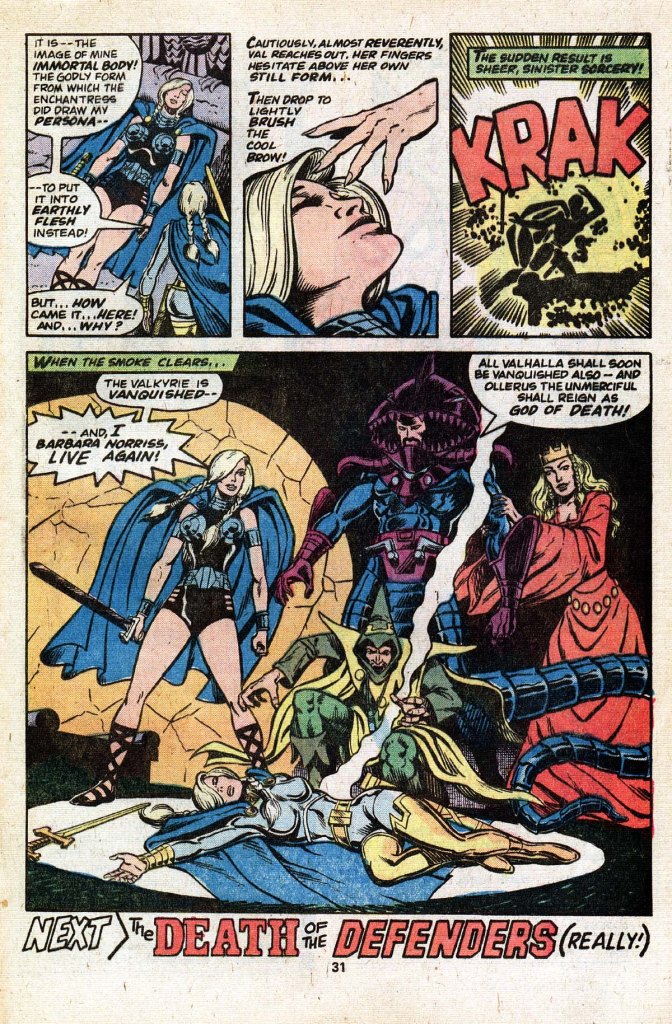
It’s at this point that Ollerus detonates sections of the pass, causing an avalanche that threatens both armies, but especially Val’s. Soaring on Aragorn in search of the cause of the explosions, Val spies a mountain that appears to move under its own power–Occulus’ stronghold. Val swiftly finds entrance into the structure, and its interior strikes her as being unnervingly familiar. And it’s no wonder, for as she enters an antechamber, she finds herself in the presence of her own immortal body. The Enchantress had previously stolen her essence and implanted it in the form of Barbara Norriss, but here is Val’s true body. Unfortunately, this is all a trap, and when Val touches her body, there’s a burst of energy–and when all is done, Val has been zapped into unconscious, and her immortal form has risen–inhabited by the spirit of Barbara Norriss. To be continued!
 The Tom Brevoort Experience
I think I’d given up on the book by this point. The long period ahead soured me unfairly on JM DeMatteis’ run, but now that I have the Marvel app I shall have to revisit it.
LikeLike
Never understood why Val left Asgard without reclaiming her body! BTW I was in the midst of a Defenders reread when Covid struck. Perhaps the most uneven series Marvel ever published. Pretty much all over the map from Day One. My usual comment about Defenders is “Marvel published it because they always published it.” I picture numerous editorial meeting where the question “should we keep doing Defenders?” was raised and met by many indifferent shrugs.
LikeLike
My main problem with this has always been that Ollerus, Poppo and Casiolena don’t look or feel like Asgardians, so the whole story just doesn’t seem to work. Although that gigantic helmet is sort of cool…
LikeLike
I don’t know about the others but Casiolena wasn’t an Asgardian. She was queen of a sub-dimension Amora and Skurge found themselves trapped in. Her being killed at the end of that issue was my problem with her appearance. BTW, wasn’t Sal Buscema the king back then of beautiful but evil women?
LikeLike
Re: “minor characters from earlier stories: Poppo the Cunning and Casiolena.”
According to one of those handy dandy online databases, Poppo first popped up here courtesy of Kraft, whom *I* think was trying to do one of the various jester/cheerleader figures that used to appear in a lot of Lee/Kirby stories. Casiolena was Steve Englehart’s creation in DEFENDERS #4. I’m fairly sure she was originally intended to be just your garden-variety queen of some vague dimension, and I think this is her second appearance ever, with Kraft retconning her into an exiled Asgardian.
I’ve been thinking about a Defenders re-read, so I might start with this. I think it’s also the first time we ever heard that Valkyrie even had an Asgardian body. At least one Defenders Annual, maybe by Steve Gerber, had previously implied that Valkyrie’s true nature was still just a random concoction of Enchantress’ making. Kraft may have been thinking that since Val had been going around making all these arcane references to trolls and rainbow bridges for years, it didn’t really make sense for her to be just some persona the sorceress magicked up. I think De Matteis eventually weaves a very long backstory for both Valkyrie and Enchantress, but Kraft was there first.
LikeLike
Also, though Enchantress zaps Casiolena at the end of DEFENDERS #4, no one actually says that the latter is dead and gone. Amora does make the interesting comment that the two of them are equals in power, though if Casiolena had really started out in Asgard one would not think Amora would be so utterly unacquainted with her when she first sees her in AVENGERS #83, (Just correcting my earlier flub: Roy Thomas created the unnamed sorceress, but Englehart gave her both “a local habitation and a name.”)
LikeLike
I know Thomas used Valkyrie when he did that four color sleeping pill adapting some opera in Thor. Which came first?
LikeLike
The opera came first. And the valkyrie Brünnhilde is in it, in the role Roy used Marvel’s Valkyrie design to fill.
Or if you mean which came first, this DEFENDERS story or Roy’s muddled Ring of the Nibelungs adaptation, the Defenders story did, but just by a year or two. Roy’s version takes place in the past, though, in a previous Asgard that existed before the current — ahh, forget about it.
LikeLike
That run killed what little I liked Thor except for Simonson’s run.
LikeLike
I always thought it was a huge mistake to keep moving Valkyrie more and more toward being the actual Valkyrie Brunnhilde and not part-human, because it detached her from Earth concerns, and unlike Thor, she had an actual job she should be attending to.
This is why, when Erik and I did DEFENDERS, we brought her back as the second Val, from the Hulk story, to bring back some human connections.
[I also think it’s been a mistake to make Aquaman less and less human — he started out as a human with science-based changes, then got retconned into a human/Atlantean hybrid like Namor, then we found out that he was an Atlantean demi-god…at some point you start to wonder why he bothers to surface at all, if his whole life is tied to the undersea world and he has no strong connection to the surface world. Readers respond to that connection, so the more to cut it away, the less engaged they get. Or so I think. It’s not like my Valkyrie or. Aquaman lasted very long.]
LikeLiked by 3 people
I agree… Valkyrie in a human body trying to fit in to everyday life was more compelling,.. and it made more sense why she would hang out with likes of the Defenders. NIghthawk, Hellcat, and Val had good chemistry for a run of issues and it hinged on things like their power levels, experience, and relative awkwardness as the B team within a B team that the Defenders morphed into when the original 4 stopped being reliable members.
LikeLiked by 1 person
That run of THOR written by Roy had three stories to it, (and a couple of fill-ins). The Red Norvell Thor story, which was good stuff, the “Eternals are part of the Marvel Universe” story, which was middling, and the “Let’s adapt Wagner’s Ring Cycle as a weird continuity reset, but figure out how as we go along!” which was awful.
And the Eternals story didn’t so much end as blend in with the Ring Cycle story to make it even more tangled, and then Roy left Marvel and Gruenwald and Macchio had to figure out how to end it in, like two issues — and did not stick the landing.
I prefer to just remember the Red Norvell story and leave it at that.
Although the Eternals stuff did have my single favorite Eternals bit, as Ransack the Reject is so grumpy that he’s complaining that his clothes don’t fit, and someone points out that they’re an illusion projected by his own mind…
LikeLiked by 3 people
I had similar problems with the New 52 Wonder Woman: as a daughter of Zeus she was all about the gods, not about the mortals.
Oceam Master was interesting as a human obsessed with somehow competing with his more powerful brother. As an Atlantean he’s just Byrrah or Krang, recycled.
LikeLike
I wonder if part of Aquaman’s problem is that the utility of “Atlantis” as a place has taken a big hit from modern globalization and communication. There’s not much room for mysterious exotic kingdoms anymore. Asgard is an exception because it’s quasi-mythical. But these days, the Atlantians would immediately want an Internet connection (unless they’re extreme xenophobes like the DC Amazons). Maybe Aquaman would work as a main player of part of Atlantian society which wants ties with the surface world (electronics! entertainment! coffee! etc), against another faction which wants war (over climate change, ocean garbage, killing sealife, etc). Ecological conflicts have been touched on with Aquaman, but he can’t be too radical and still be a (conventional) hero. Maybe it makes for better stories if he takes the perspective of “I sympathize with your objections but not your tactics, so I have to stop you” to Atlantian radicals.
LikeLiked by 1 person
Sticking the Eternals in the Marvels Universe turns them from “the secret truth behind the myths” to “a bunch of guys who look like the 100 percent true figures of myth.” Not comparable.
LikeLiked by 2 people
Absolutely.
I remember writing a letter at the time (don’t remember whether they used it), saying that putting the Eternals in the Marvel Universe made as much sense as revealing that Mary Jane Watson was a robot, and always had been.
LikeLiked by 3 people
Not to give away any details Tom may wish to discuss about the other two parts of this story, but wow, this is a rushed story. Maybe Kraft or someone said something earlier about Brunnhilde’s real body still being in Asgard but here Kraft just claims that Ollerus got of said body somehow or other– I think it was to enlist the services of the Defenders? Since Kraft took the heroes back to Earth in his next script I bet he didn’t come back to that point at all, or explain where Barbara Norris’ spirit was all this time. I presume without re-reading that DeMatteis will provide the link to the activities of Amora in the disposition of Brunhilde’s original delicious corpus.
I can see now why some readers would think that Casiolena had been killed at the end of DEFENDERS #4, since one database claims that’s why she’s in Valhalla at the start of #66. But Kraft doesn’t explicitly say she’s dead, or that she’s an Asgardian. I’m sure that if I thought about the matter when I first read the story, I assumed that Casiolena and Poppo, (who hadn’t appeared before under that name) had both appeared on Ollerus’ door in answer to his ad for mystical henchpeople. If Cassie was supposed to be in Valhalla because she had died, then she would have to be an Asgardian who had been exiled to that “most barren of nether worlds” by Odin, same way as he exiled Skurge and Amora there. But I get the sense that no one called Cassie an Asgardian until that 2015 series PATSY WALKER.
And that was a fun way to waste half an hour.
LikeLiked by 1 person
I read Defenders 4 back in the day and never assumed Casiolena was dead. Like you, I assumed Ollerus was running a Forgotten Magical Villains franchise, not recruiting Asgardians.
LikeLiked by 1 person