


This next issue of DAREDEVIL featured the return of a hallmark of the series. Not DD’s original yellow costume–something that I was excited to see, having read the first DAREDEVIL issue in SON OF ORIGINS OF MARVEL COMICS–but rather artist Gene Colan returning to the book that he’d labored on for many years throughout the Silver Age of Comics. Gene had earlier done #153 and #154 before skipping the prior issue. I believe that Colan’s tenure on the title had been intended to be a permanent thing, but it was around this time that Gene began to have conflicts with new Editor in Chief Jim Shooter concerning the way he’d compose his pages and his panels. I don’t know that this specifically led to him coming off of DAREDEVIL, but it may have been a contributing factor. Still, it paved the way for Frank Miller to step in as Colan’s replacement.
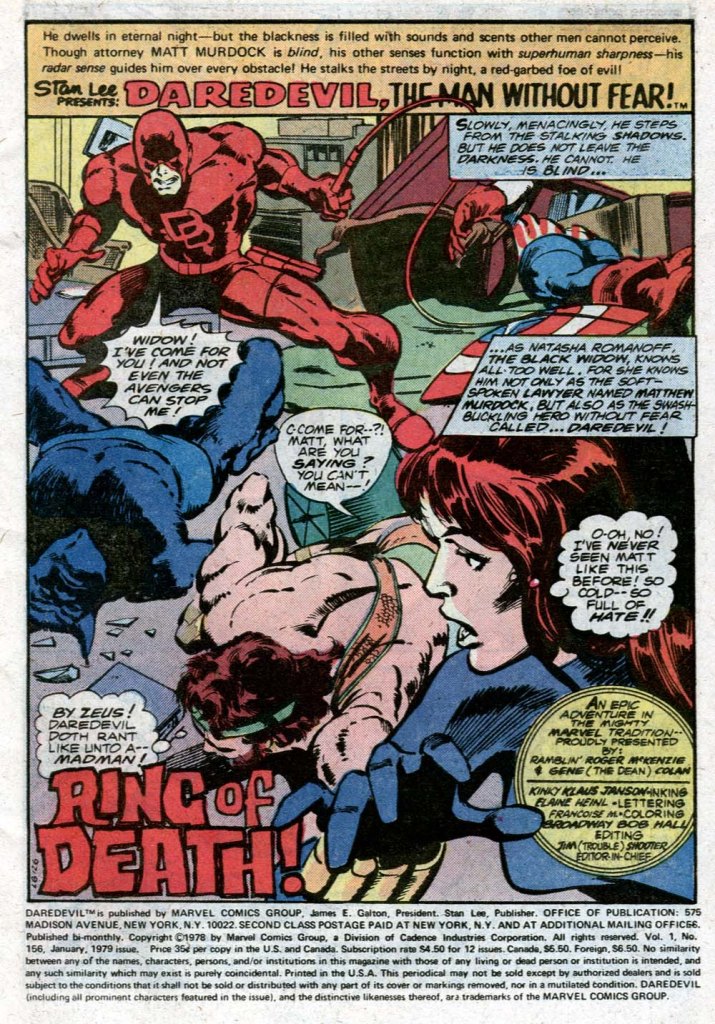
Colan could be a tough penciler for people to ink, as his work employed a lot of subtle shades of gray that couldn’t easily be reproduced in black and white. Colan’s best inkers were able to interpret those shades into hatch-tones and cross-hatching that emulated what he had done. Here, Klaus Janson does a strong job of finishing Colan’s work. Klaus could occasionally be a heavy sauce over pencilers, but with Gene he kept the essential flavor of what Colan had done while organizing the elements of each panel and page a bit more clearly. It’s a pretty good combination.
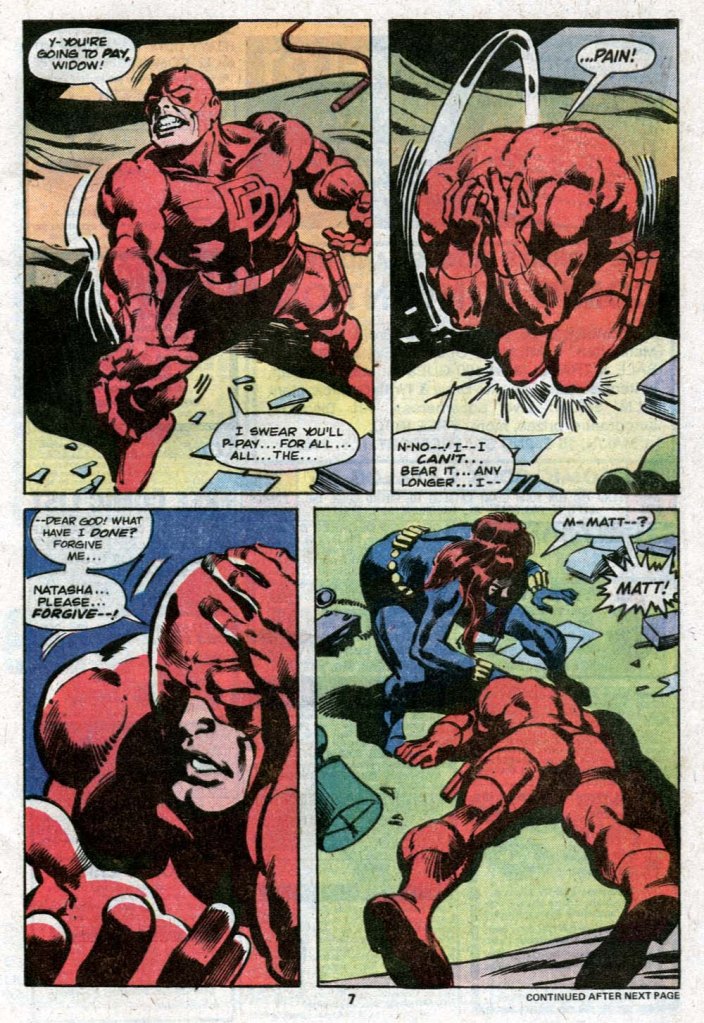
Driven a bit coo-coo by a concussion that he’d suffered, last issue Matt Murdock’s swashbuckling alter ego had heard news reports indicating that the Black Widow was back in New York with the Avengers. As he and the Widow had been romantically involved but whose relationship had hit the rocks, the messed-up Daredevil chooses to swing over to Avengers Mansion and attack the Avengers in order to force Natasha to feel his pain. This is a crazy thing for Matt to do on his best day, in the shape he’s in, he shouldn’t be able to give any of these guys a halfway decent fight. But it is his book, so fortunately for him, most of the overpowered Avengers are absent, leaving him to contend with the Black Widow, Captain America, the Beast and Hercules–three of whom are more his speed. Held back by the Widow’s words, the Avengers don’t really want to hurt Daredevil, which puts them at a serious disadvantage in this opening fight.
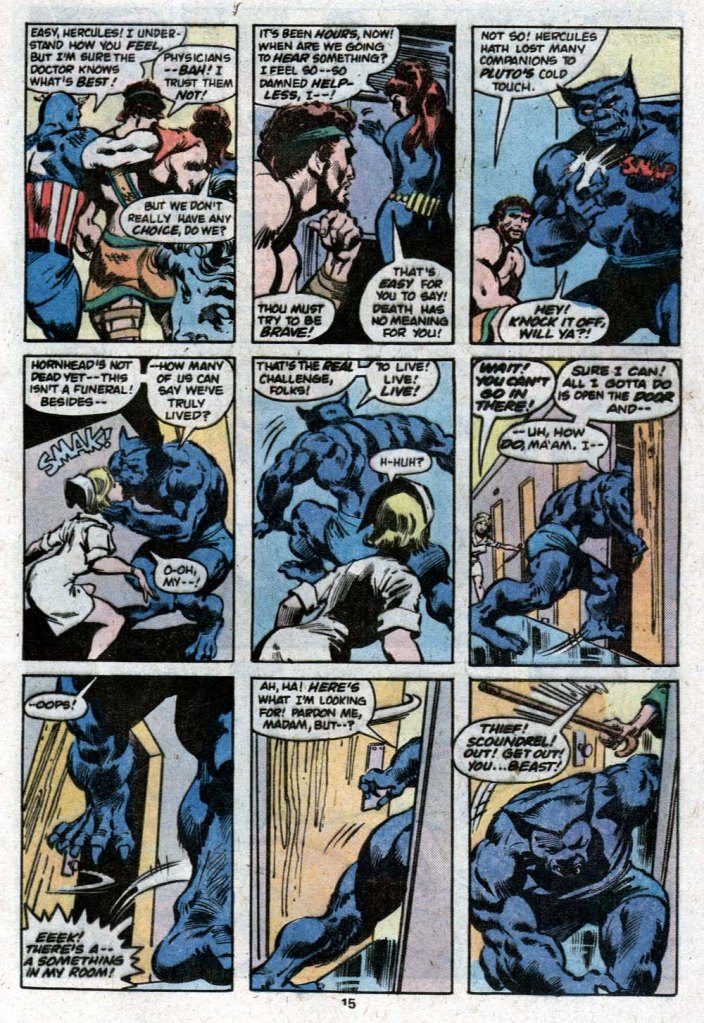
Eventually, though, like a wind-up toy unwinding, Daredevil hits the limits of what his punished body can take and he collapses on the floor, drifting into a coma. The sympathetic Avengers rush him to a nearby hospital, but the situation is immediately touch-and-go, since the sightless crusader didn’t have his concussion treated when it first happened. The Black Widow is perhaps uncharacteristically concerned about the possibility of Matt’s impending death–so the Beast attempts to buoy her spirits by sneaking into one of the patient rooms and swiping a flower that he can present to Natasha.
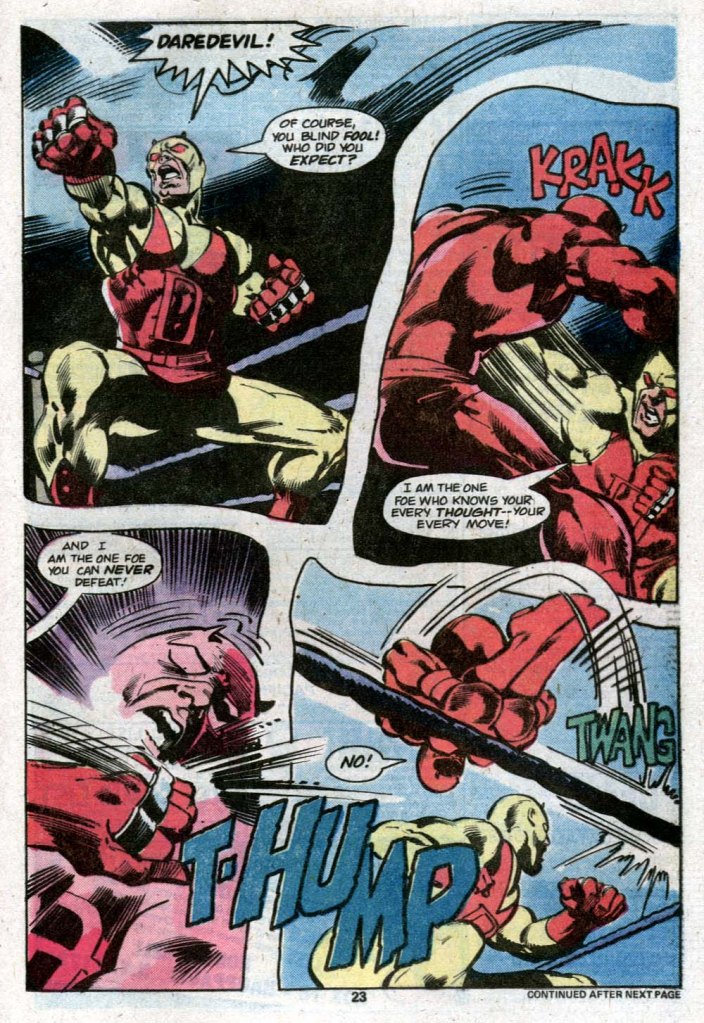
Lying in his hospital bed in a delirium, Daredevil begins to hallucinate a vivid dream. He’s in a boxing ring waiting for a match with an unseen opponent to begin. In his corner are his dead father “Battlin'” Jack Murdock as well as his own alter ego Matt Murdock. As the bell rings signaling the start of the bout, Mat’s father urges him that he must never give up, no matter what. As Daredevil steps forward to face his foe, his opponent is revealed as a malevolent version of himself clad in his earliest super hero costume and wielding brass knuckles rather than boxing gloves.
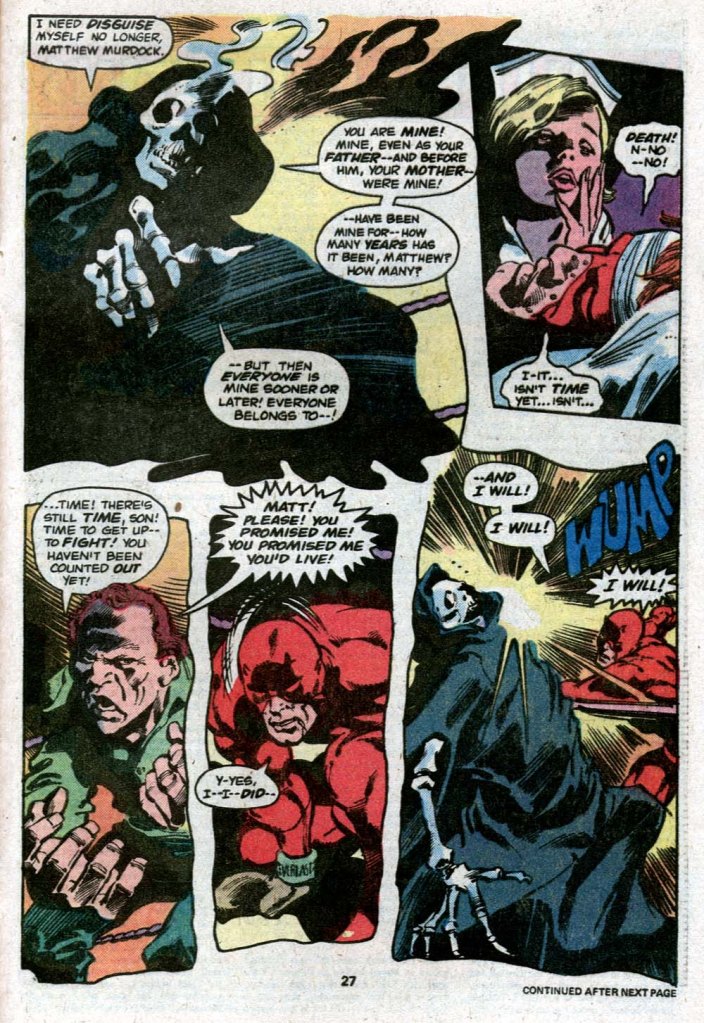
The real Daredevil begins to take a furious pounding from his aggressive alter ego, who simultaneously tells him what a failure he’s been, and that he should lay down and quit and die. But Battlin’ Jack will hear none of this, and he presses DD to fight on harder. Eventually, as the bout reaches its climax, the vintage Daredevil drops his disguise, revealing himself to be the personification of death itself. Matt is literally fighting for his life as he lays in that hospital bed. And like he learned from his Dad, he refuses to give up and kayos death in his vision. The adrenaline released from this action causes Daredevil’s real body to respond, and he awakens momentarily, having broken out of his comatose state.
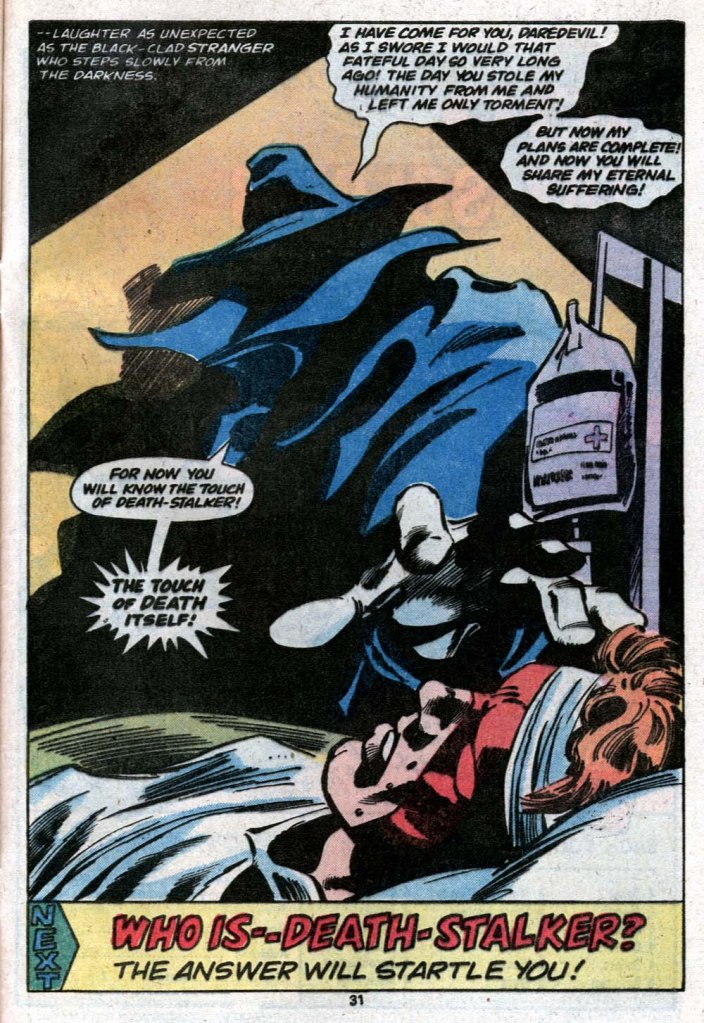
The attending nurse goes rushing off to inform Daredevil’s doctor and the Avengers about his sudden outburst–but as she leaves the room, we see that there’s another figure present, hiding in the shadows. This is Death-Stalker, a recurring and mysterious foe of Matt’s about whom we know relatively little still, apart from the fact that he harbors some grudge against the Man Without Fear. Death-Stalker also possesses a lethal touch, and so, with his victim alone and unguarded and helpless, he reaches forward to use it and end Daredevil’s life. To Be Continued! The Next Issue blurb indicates that next issue we’ll learn more about who and what Death-Stalker is–though I had been burned often enough by such blurbs already by thsi point that I retained some skepticism.
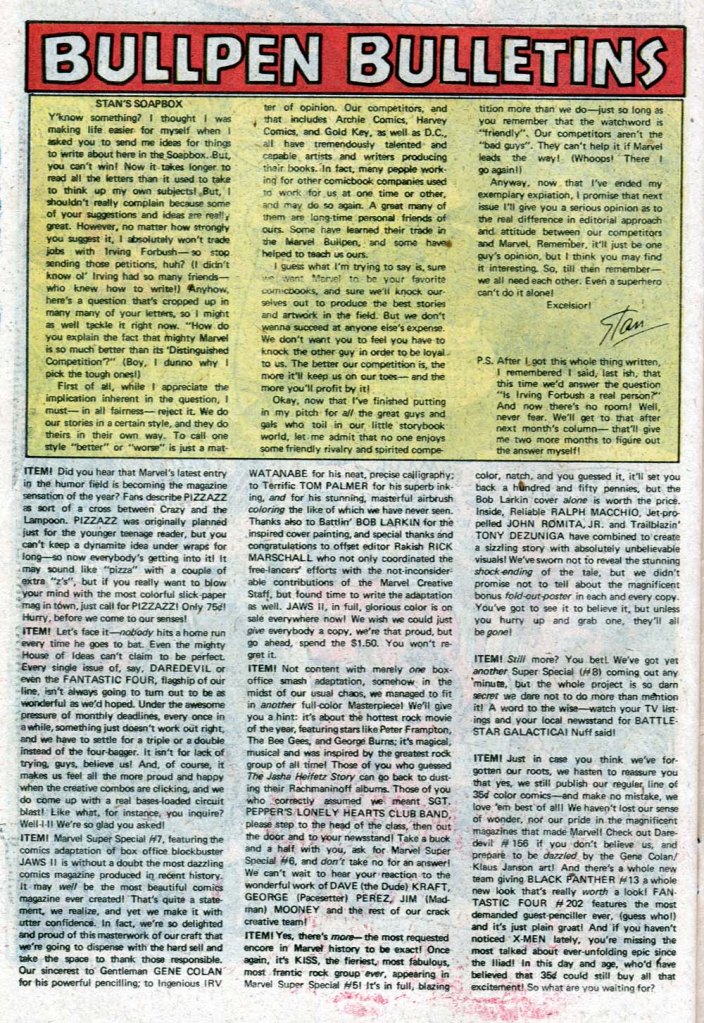
This issue is also where I would have first seen this month’s new Bullpen Bulletins. The page had been steadily growing a bit more corporate and less free-wheeling for some time now, and it wasn’t all that long before it was done away with entirely, at least in its current format. Publisher Stan Lee talks about the difference between Marvel’s approach and that of the competition in his Soapbox this time, and promises to continue this line of thought next month. And the rest of the page is pretty much a plug-fest, with one item talking about how it’s impossible to make every issue of every title a home run–which is a situation that I can relate to today.
 The Tom Brevoort Experience
It struck me as weird that Matt would hallucinate his father telling him to fight — fight — FIGHT! — when his origin story hinges on the fact that Jack Murdock consistently told young Matt to stick to his studies and _not_ become a fighter like his old man. Matt came up with the DD identity as a cheat, so that he could fight for justice without doing so as Matt, and thus satisfying his promise to his father.
Naturally, dream Jack wouldn’t want Matt to die, but this approach is a 100% reversal from Matt’s memories of the guy…
LikeLike
I like characters to be consustent. From my own experience, though, in dreams (cue up Roy Orbison), I’ve reacted differently to situations than I would when awake. Out of character, maybe by base instincts. Or even a desire to handle something differentlyvthan I actually had done. It gives a writer more flexibility. But it also doesn’t seem psychologically impossible for Matt’s dream state behavior to deviate from his waking actions.
LikeLike
If memory serves, Marv Wolfman at the time said that Colan wanted to get away from working on the standard comic-book line. He was more interested in working on the magazine-size titles, such as the Hulk magazine, and the replacement Dracula and Howard the Duck series.
I don’t believe Shooter was confronting Colan until after he started fielding complaints from scriptwriters and inkers. This was in 1980, when the magazine work was winding down, and Colan began working again on the regular comics. Colan’s page output was higher under Shooter than it had been with Archie Goodwin and the other editors-in-chief. Colan really began cranking it out, and wasn’t taking much care with things. The complaints were that Colan wasn’t following the page-to-page breakdowns in the scripts, the artwork was illegible without the benefit of copy, and the pictures were so lacking in structure underneath the rendering that the inkers didn’t know what to make of them. As one inker of the time put it, “I’d rather see a well-drawn figure with no rendering at all rather than a badly drawn figure that’s been rendered to death… It just kills your time to ink something like that, and you have to think up the drawing after it’s been rendered out.” Colan was by all accounts a very nice guy in most instances, but he was not receptive to pushback about what he was doing.
He went over to DC, and they had the same problems with him. His initial three-year contract was not renewed, and assignments began dwindling away. When Denny O’Neil took over as the Batman editor, his first decision was to remove Colan from the Batbooks. (Doug Moench, who was paired with Colan on those, was happy about this. Of course, Moench then found out that O’Neil’s second decision was to fire him, too.)
Colan was all but unemployable as an artist by the end of the 1980s, and was teaching for a living. It’s sad.
LikeLike
RS, what sources are you referencing? Which inkers complained? I agree Gene was tricky to ink. But I’ve read interviews with Janson & Giordano who loved Colan’s work, and enjoyed creating unique visuals with him. There were several Bronze Age inkers who’s work I didn’t care for, and seemed to take away from from the drawings of my favorite artists. So when you cite, “the inkers didn’t know what to make of them”, I know it wasn’t all inkers.
He came back to DC, on “Batman”, in, what, 1981? He finished his long run on “Detective Comics” in ’86. He also worked on “Jenn, Son of Saturn” in the mid-80’s (sometimes with Klaus Janson, great stuff). The critically acclaimed “Nathanial Dusk” was in ’84, & again from ’85-’86. “Silverblade” was ’87-’88 (Janson inked 1 or 2 issues, I think). Maybe he didn’t need that initial 3-year contract renewed, as he stayed pretty busy without it. Are Don McGregor, a longtime Colan collaborator, or Cary Bates on record complaining about Gene’s storytelling, or his break down of scripts? Did Doug Moench work with Gene on the first 6 issues of the ’87 Spectre series against his will? Did Denny O’Neil explicitly or specifically trash Gene’s work in some interview or article that we can read?
Did Gene have any health considerations that would’ve impacted his ability. later in his career? Don’t forget he was age sixty by ’86. His work “dwindled” in the 90’s, but he was approaching 70. He was over 70 when he drew some very cool Predator stuff for Dark House in ’97. His work was sporadic in the early 2000’s, but he was pushing 80! He was still being published by Marvel, DC, & others in the 21st Century. He won an Eisner for Captain America # 601, 2009! At age 82??
Your comments seemed one-sided, and didn’t offer any evidence. Would you please clarify a bit?
LikeLike
A place you can start is with the Secrets in the Shadows biography from TwoMorrows. The tone is extremely fannish and celebratory, but it gets into Gene Colan’s problems with management at Marvel and DC. Among other things, Colan relates that Dick Giordano pointedly told him to change his art style. He also notes that he began teaching in the ’80s because comics were no longer a reliable source of income.
I believe Colan’s health problems surfaced in the 1990s. If you reread my comment, you should see the timeline of what I describe is in the ’80s and late ’70s.
LikeLike
Thanks, RS. I don’t know Dick’s account of his comments to Gene, Gene may have taken them more pointedly than Dick intended them to be. I’m sorry Gene felt slighted.
I’ve read Dick’s commentlts praising Gene’s work in letter columns from when Dick was Bat-editor. And later in his “Meanwhile” columns whenever Gene had a new DC project out.
I remember finding discrepancies in the published accounts by Dick, Jim Shooter, & George Perez, on the cancelled 1983 JLA/Avengers project, People see & remember things differently.
Makes me think of Julie Schwartz reportedly saying something like “Its ‘behind the scenes’ for a reason.”
Reading your initial comments on Gene made me think that you thought he was all washed up in the 80s. I dont see his career that way. I don’t know about his initial 3 year contract not getting renewed. But I do know he did work for DC beyond those 3 years.
I also dont know who those inkers were that you mentioned. Most of your comments seem to add up to a one-sided story. And didn’t really represent Gene’s career. Which was aruably one of the most celebrated of his generation, & even including other generations. I’d be surprised if there arent other artists who’d like the same level of acclaim & reverance from fans that Gene still gets.
LikeLike
Death Stalker was one of my favorite villains as a kid. His aura of mystery and touch of death made the character stand out from the likes of other DD antagonists like The Owl and Stilt-Man. When the character’s origin was finally revealed I was inevitably disappointed.
LikeLiked by 2 people
Colan & Janson together make one of my very favorite art collaborations in comicbooks. There was a wispy, spectral, ethereal element to a lot of his work, especially when the story involved the supernatural. He also had a very earthy naturalism to his faces when he wanted. And his streets, brownstone row homes, urban settings, or even elaborate, Victorian homes and spooky countrysides all felt genuine. His anatomy was exaggerated, expressionistic, or impressionistic. But also very kinetic I liked his stream of consciousness storytelling. His style captured the essence of characters as widely different as the Spectre and Captain America. There was inherent power in his figures, and an ambience, an atmosphere few other artists could match.
Depending on the characters, Klaus was my favorite inker for Gene. Definitely so for Batman. It’s like dark chocolate and brown sugar. The mood, the mystery, the energy was all there for me in those pages. Texture, lighting. Klaus added a solid edge to Gene’s fluid figures. I’d have used these 2 guys together on the Creeper, the Demon, the Phantom Stranger, the Spectre, Batman, and Daredevil. Even Aquaman. And Captain America and Dr. Strange, too. Thanks for covering this issue. It was a real treat to see those pages.
LikeLike
“Colanatomy”. 😉 But I liked it!
LikeLike
A combination of Hero fights Hero and pretentious surreal hallucinations? By the time this came out they were among my least favorite tropes.
LikeLike
Replying to Tim Pervious’ 08-14 comment:
I wasn’t looking to provide an overview of Colan’s career. I was describing Colan’s relationships with Marvel and DC and their staff in the 1980s. As for his reputation overall, it lies with his work on the Daredevil and Iron Man features in the 1960s, and on Tomb of Dracula and Howard the Duck in the 1970s. I wasn’t putting down any of that. I wouldn’t.
Yes, Colan continued to work for DC for a couple of years after his contract ended. That was between 1984 and 1986. In between the run-up to Crisis on Infinite Earths and the post-Crisis feature reboots, DC was in a “marking time” mode where they weren’t replacing the talent on poor-performing titles. It also appears there was a publishing quota to fill, and DC was meeting it with material that otherwise
wouldn’t have seen print. Colan benefited from these situations. But per him and his biographer, DC was finished with him after his Batman assignments were taken away in 1986. While there was material by Colan published by DC after that, it all but certainly was stuff that had been sitting on a shelf waiting for room on the schedule.
Dick Giordano’s comments in DC letter columns and his “Meanwhile” editorials were invariably PR copy intended to promote the comics. Those were not forums for his personal opinions. This isn’t a situation particular to Giordano, either. It would be true of any editorial staffer doing these.
As for inkers at Marvel circa 1980, there were some who didn’t mind the challenge of working on Colan’s pencils. Janson, Tom Palmer, and Dave Simons were examples. Dan Green, too. I never said “all inkers.” But I gather pretty much everyone else made it known they didn’t want to work on Colan’s pages. You can fill in the names yourself. It wasn’t unusual for his jobs to be inked by in-office production staffers such as John Tartaglione because everyone else was busy or unwilling.
My opinion of Colan? I think at this stage of his career, he’d become sloppy and arrogant. Just look at that splash panel. Any conscientious artist with decent compositional skills knows to begin a deep-space picture like that by putting down a horizon line and a vanishing point or two. Not Colan. He obviously just blocked out the figure placement and started drawing. The figure work on all the pages looks cramped and shoehorned into the panels. Based on his earlier work, Colan knew better than this. He just didn’t care. Klaus Janson’s inks and Francoise Mouly’s coloring make this job look a lot better than it deserves.
LikeLike
RS,
“I wasn’t looking to provide an overview of Colan’s career. I was describing Colan’s relationships with Marvel and DC and their staff in the 1980s. As for his reputation overall, it lies with his work on the Daredevil and Iron Man features in the 1960s, and on Tomb of Dracula and Howard the Duck in the 1970s. I wasn’t putting down any of that. I wouldn’t.”
I was buying his stuff after 1980, and was really into it. We just have different tastes. Palmer was great, but I lean more towards Janson & Williamson’s inks over Gene’s drawing.
“Yes, Colan continued to work for DC for a couple of years after his contract ended. That was between 1984 and 1986. In between the run-up to Crisis on Infinite Earths and the post-Crisis feature reboots, DC was in a ‘marking time’ mode where they weren’t replacing the talent on poor-performing titles. It also appears there was a publishing quota to fill, and DC was meeting it with material that otherwise
wouldn’t have seen print. Colan benefited from these situations. But per him and his biographer, DC was finished with him after his Batman assignments were taken away in 1986. While there was material by Colan published by DC after that, it all but certainly was stuff that had been sitting on a shelf waiting for room on the schedule.”
That was a LOT of work, and you say he did it all by ’86? He drew “Jemm” (12 issues?), “Silverblade” (12 issues), “Nathaniel Dusk”, A “Nightwings” DC “Science Fiction GN”, those 1st six issues of “The Spectre”, fill-in/annuals (“Firestorm”, “DC Comics Presents”, “LSH”, the “Little Shop of Horrors” adaptation), all published after his contract, while he was alternately drawing “Batman”, “Detective”, and “Wonder Woman” in the early 80’s? He must’ve been more amazing than I realized…
“Dick Giordano’s comments in DC letter columns and his ‘Meanwhile’ editorials were invariably PR copy intended to promote the comics. Those were not forums for his personal opinions. This isn’t a situation particular to Giordano, either. It would be true of any editorial staffer doing these.”
That crossed my mind as I wrote earlier that Dick had praised Gene publicly in those spaces. But again, I don’t, and maybe you don’t, know what Dick actually said to Gene. You say Gene gave an account. Like I said, people remember things differently. And I still love Gene’s work. That’s really the bottom line for me. But wait, there’s more… 😉
“As for inkers at Marvel circa 1980, there were some who didn’t mind the challenge of working on Colan’s pencils. Janson, Tom Palmer, and Dave Simons were examples. Dan Green, too. I never said ‘all inkers.’ But I gather pretty much everyone else made it known they didn’t want to work on Colan’s pages. You can fill in the names yourself. It wasn’t unusual for his jobs to be inked by in-office production staffers such as John Tartaglione because everyone else was busy or unwilling.”
I’m not fillin’ anybody’s name in, and neither should you. You “gather pretty much everyone else”, but I’m not relying on that. Unless somebody came out and said it, on the record, I can’t say what their thoughts or feelings were. Here’s what you said…
“I don’t believe Shooter was confronting Colan until after he started fielding complaints from scriptwriters and inkers… The complaints were that Colan wasn’t following the page-to-page breakdowns in the scripts, the artwork was illegible without the benefit of copy, and the pictures were so lacking in structure underneath the rendering that the inkers didn’t know what to make of them. ”
No, you didn’t specifically say “all inkers”, but you left it wide open. Then seemed to reinforce it with, “I gather pretty much everyone else”. It seemed you went out of your way to bash Gene and his work.
“My opinion of Colan? I think at this stage of his career, he’d become sloppy and arrogant. ”
OK. Well, I read his 80’s DC stuff as it came out. I had maybe a handful of his 70’s work. But I really got into his his work as I entered my teens. And that was the in the ’80’s. I’ve since gone back and marveled at his stuff in “Captain America”. A lot of fluid, kinetic energy on those static pages. Did I love everything he did? Probably not. But most of it, yes. He was so unique, his style wasn’t great for every character. But for certain others, it was very satisfying to me. The mood, the tone, the expressiveness. And no matter who’s inks I saw over his work, I could tell it was Gene’s. He wasn’t overpowered, though some inkers were far more complimentary to his work than others. Janson’s touch added an enhancement no other inker could. So the 2 together were one of my favorite collaborations in all of comicbooks.
Gene really was a true artist to me. Idiosyncratic. And I thank you, and appreciate you offering up what you know (and think you know, via what you may have heard or read from others), and what you think about his work and relationships in the industry. But for me, his work transcended the industry. And the only authority I need to influence what I like, is me. 😉
Take care, RS.
LikeLike
Got no opinion on what everyone really thought of Colan but I agree with you Tim, I still enjoyed the allegedly “sloppy and arrogant” work.
LikeLiked by 1 person
I forgot “Night Force”. Gene excelled at the spooky, supernatural, even the “normally” mysterious. Like I said earlier, from Cap to Dr. Strange & the Spectre. If I dropped a book he was on, like “Nightforce”, it wasn’t because of the art. It was the stories (or the lack of superheroes when I was a kid), and I had a very limited budget to buy comics. I did love “Nathaniel Dusk”, despite no superheroes. 😉 Though I read it a few years after it was published. I didn’t “need” superheroes in every comicbook by then. But Gene could make the mundane look arcane. 😉
LikeLike
How the hell did I forget Night Force? Couldn’t get into Nathaniel Dusk but I didn’t have a problem with the art.
LikeLiked by 1 person
This is a test post, since WordPress hasn’t let me post a longish response…
LikeLike
Still won’t let me post the longer response, even in short chunks. Maybe there’s a taboo word in it somewhere? Anyway, to try to boil it down…
I know Gene had editorial conflicts — I heard about them through the grapevine even before I broke in, though I heard about writers (one in particular) who didn’t like Gene’s pacing choices, and of course about the clash with Shooter.
But it’s virtually impossible for the stuff he drew for DC post-Batman to have been material sitting on the shelf. Some of it spins out of stories that hadn’t been written or drawn until afterward, one was a movie adaptation that couldn’t have been drawn earlier, and the one major possible exception — SILVERBLADE — was edited by Denny and written by Cary Bates after he’d finished FLASH, so it doesn’t fit either.
[more to come if this works]
LikeLiked by 1 person
[more summary of a longer post; imagine that it’s better written and full of delightfully convincing argument…]
It’s also incorrect to say that it wasn’t unusual for Colan to be inked at Marvel by production staffers such as John Tartaglione. Colan was inked on four stories by Tartag during that period, and by no other production staffers.
Those four stories were all edited by Lynn Graeme, who was also having Alcala and Simons ink Colan’s work. And they look good — Tartag had a gift for not trying to “correct” Gene’s gestural figure work, but to make it work as exaggeration, so the motion flowed the way it seems Gene wanted it to. He also handled Colan’s tonal work well with a mixture of linework (sometimes very striking) and wash. To my eye, he was a better choice than Simons and in some (but not all) ways better than Green, who could be uneven over Gene.
…
LikeLiked by 1 person
Colan’s last Batman story was in Detective Comics #472, the last before Denny O’Neil took over as editor. It was published in July of 1986. The work DC published afterward was The Little Shop of Horrors film adaptation, Silverblade, and The Spectre. That’s it.
The Detective #472 letter column mentions Colan was working on the Little Shop adaptation at that time.
I know Colan was working on a new Spectre series with Steve Gerber no later than March of that year. Gerber was removed because of a deadline problem and replaced by Doug Moench. I don’t know how much of a time gap there was between Gerber and Moench’s involvement, but I doubt it was very long.
That leaves Silverblade. I don’t know what the schedule on that was. But O’Neil began working at DC again that January. He isn’t credited as the editor on Batman or Detective until July. But his first issues with both were Legends tie-ins, and that makes me wonder if his credit was strictly nominal, like it was on The Dark Knight Returns. Allowing a four-month lead time with issues of continuing series, it doesn’t sound like he was actually working on the Bat-titles until April. Could he have been working on other things in the interim? Like Silverblade?
Colan’s preferred output at this time was 12-14 pages a week. While I think it’s a reasonable guess that Detective #472 was not his last job for DC, I don’t think he started new projects for them afterward. Little Shop was underway at that point, and The Spectre and Silverblade probably were, too. I think he and his biographer got his departure from DC pretty much right.
LikeLike
There’s a lame “boxers or briefs” joke floating out there, somewhere.
LikeLike
…nope.
I have no idea what’s hanging WordPress up. Bad connection? It doesn’t like the word “Tartag”? Who knows?
LikeLiked by 1 person
[wait, maybe…?]
In any case, Graeme could have been hiring Tartag for reasons other than that other inkers were refusing — maybe she liked how it looked, as I do. Maybe Tartag needed money and she was nice enough to feed him some freelance work. Maybe there was a schedule advantage to having a guy in the Bullpen ink the last story of the month to come in (Colan did multiple stories in most issues).
But the closest Marvel came to having a production staffer ink Colan other than Tartag was Al Milgrom inking a few jobs and Dave Cockrum and Jack Abel inking one cover each, and none of them were production staff. In Abel’s case I expect someone simply wanted to reunite the old team one last time, and I’d bet Cockrum assigned a cover to himself for the fun of it.
[more coming, I hope]
…
LikeLiked by 1 person
Was Jack aslso willing, besides being Abel? (Word Press had no prblem with that!) 😉
LikeLike
“Was Jack also willing, besides being Abel?”
He may even have been ready.
LikeLiked by 1 person
[more]
You note that Janson, Palmer, Simons and Green didn’t object to working on Colan’s pencils, and they, plus Alcala and Leialoha, were the inkers most often inking him during that stretch. But that doesn’t mean everyone else was refusing, it may simply mean that six inkers who can handle an artist like Colan is a deep enough pool.
Colan got inked during that time by a bunch of other inkers, including names like Joe Rubinstein (who I know likes inking Gene), Walt Simonson, Alan Weiss and Wendy Pini — it looks to me like when they needed someone to pitch in, they had choices.
I’m sure there were inkers who didn’t like to ink Colan. It doesn’t look like it was a widespread issue.
[…]
LikeLiked by 1 person
[…]
I think Colan’s editorial resistance may well have lost him his DC gig, though he wasn’t “all but unemployable” — post-Shooter Marvel gave him work for about a decade after that (though he wasn’t drawing multiple series a month any more). So I think in some cases you’re taking some of the evidence and extrapolating it to something broader than it really was.
And for whatever it’s worth, I think DD 156 looks pretty damn good. I liked it when I bought it off the stands and I like it today. I’d love to write a series as well-drawn and well-told as that issue, and Colan’s other work of the era. Just more likely at Marvel than at DC, because Marvel had the better inker pool.
[…]
LikeLiked by 1 person
[…]
Also for whatever it’s worth, I think the touchpoint for Colan’s blowup with Jim was that he got assigned to AVENGERS, which was never a good fit for him. Jim wanted more conventional storytelling on that book than he was open to on DOCTOR STRANGE, and Gene didn’t want to do that. I heard at one point (and this may well be completely untrue) that Jim returned to AVENGERS as writer in part to teach Gene how he should draw a Marvel comic by taking a direct hand, rejecting pages and showing Gene what he wanted. Whatever the case, one issue of working with Jim directly and Colan quit.
kdb
LikeLiked by 1 person
[…]
Also for whatever it’s worth, I think the touchpoint for Colan’s blowup with Jim was that he got assigned to AVENGERS, which was never a good fit for him. Jim wanted more conventional storytelling on that book than he was open to on DOCTOR STRANGE, and Gene didn’t want to do that. I heard at one point (and this may well be completely untrue, or a “grapevine” distortion) that Jim returned to AVENGERS as writer in part to teach Gene how he should draw a Marvel comic by taking a direct hand, rejecting pages and showing Gene what he wanted. Whatever the case, one issue of working with Jim directly and Colan quit.
kdb
LikeLike
RSM —
“Colan’s last Batman story was in Detective Comics #472, the last before Denny O’Neil took over as editor. It was published in July of 1986.”
DETECTIVE 567, but otherwise, yeah.
“The work DC published afterward was The Little Shop of Horrors film adaptation, Silverblade, and The Spectre. That’s it.”
There was also an ELVIRA story, which was the only one that could reasonably have been “on the shelf,” but whether it was, I don’t know. I would also suspect he did either the Legion issue or the Firestorm sequence afterward, though they were published earlier.
[more…?]
LikeLiked by 1 person
[more]
“The Detective #472 letter column mentions Colan was working on the Little Shop adaptation at that time.”
Then it wasn’t on the shelf.
“I know Colan was working on a new Spectre series with Steve Gerber no later than March of that year. Gerber was removed because of a deadline problem and replaced by Doug Moench. I don’t know how much of a time gap there was between Gerber and Moench’s involvement, but I doubt it was very long.”
Then it wasn’t on the shelf.
“That leaves Silverblade. I don’t know what the schedule on that was. But O’Neil began working at DC again that January. He isn’t credited as the editor on Batman or Detective until July.”
It wouldn’t be terribly unusual for an editor to start work and not have stuff on the stands for six months, particularly during a big company upheaval.
[…]
LikeLiked by 1 person
[more]
“But his first issues with both were Legends tie-ins, and that makes me wonder if his credit was strictly nominal, like it was on The Dark Knight Returns. …. Could he have been working on other things in the interim? Like Silverblade?”
Cary Bates said Denny edited SILVERBLADE, so I doubt Denny’s credit was nominal. Cary also said that he wrote SILVERBLADE after he was done with FLASH and the Super-books. And it’s 12 issues long. Even if we imagine Gene drawing 12 issues in the space between January and when he finished the last BATMAN story, Cary didn’t work that way. It’s just not reasonable to assume that series was on the shelf waiting for a slot.
LikeLiked by 1 person
[more]
“While I think it’s a reasonable guess that Detective #472 was not his last job for DC, I don’t think he started new projects for them afterward. Little Shop was underway at that point…”
LITTLE SHOP was underway at the time the lettercol was written. That doesn’t mean Colan started on it before finishing Batman work. Had he started after finishing his Batman work, that lettercol statement would still be true.
“I think he and his biographer got his departure from DC pretty much right.”
I haven’t seen what they say, just your summation of it. But a claim that all of the post-Batman work “all but certainly was stuff that had been sitting on a shelf waiting for room on the schedule” is simply incorrect. It all but certainly wasn’t, given what we know.
kdb
LikeLiked by 1 person
Mr. Busiek–
I find it more than a little ironic that you’re faulting me for making too much of John Tartaglione inking Colan, while touting Rubinstein, Simonson, Weiss, and Pini. I looked up these collaborations up on GCD, and this is what I found.
Rubinstein has inked all of one story by Colan–in 1993. Before that? He inked three covers, two single illustrations, and participated in the gang-inking of two stories. He did four pages on one of them, and an undetermined amount of work on the other.
Simonson’s inking of Colan was restricted to the gang-inking of two stories mentioned above. He did one page on one, and an undetermined amount of work on the other.
Weiss inked three covers.
Pini inked one page as part of the gang-inking of one of the stories mentioned above.
Moving on, this was Colan’s view of the situation with inkers and his work.
https://www.nerdteam30.com/creator-conversations-retro/an-interview-with-gene-colan-drawing-the-horrors-of-dracula-and-howard-the-duck
“[W]ith my work there’s a lot of guess work involved. Is there something in the shadows or not? That kind of thing. It’s very difficult for many inkers to figure out what I had in mind. Also, I put a lot of half tones in. And I know full well they’re never going to use those half tones, because that means cross hatch work and line work and the artists can’t make money that way and I don’t blame them because it takes a lot of time to do that, but I put it in anyway. If they don’t want it, they can leave it out. But I’ve satisfied myself.”
If I was an editor at Marvel or DC, I would not want a penciler with such an arrogant, self-indulgent attitude working for me. People in collaborative situations need to be considerate of their co-workers. Colan understood all the problems an inker might have with his pages, and he didn’t care. Fortunately for Shooter and the DC people, Colan’s presence on a book at that time was a drag on sales. His Batman issues, for example, are the worst-selling in the history of the feature up to that point. I would think his departure was a relief.
Finally, I’m sure Jim Shooter continued to write The Avengers for a year after Colan left because he wanted to put Gene Colan in his place.
LikeLike
Oh, and to add to this bit, since I just thought to look it up…
“It wouldn’t be terribly unusual for an editor to start work and not have stuff on the stands for six months, particularly during a big company upheaval.”
But in this case, Denny had editorial credits on FIRESTORM, WARLORD and HAWKMAN in the interim, in addition to whatever projects he may have been developing.
How much work he was doing, I don’t know, but he was writing lettercolumn essays, at least…
kdb
LikeLiked by 1 person
fingers crossed —
“I find it more than a little ironic that you’re faulting me for making too much of John Tartaglione inking Colan, while touting Rubinstein, Simonson, Weiss, and Pini.”
I wasn’t doing either. I was arguing that giving the impression so few inkers were willing to ink Gene that the editors were assigning work to production staffers because they had few choices wasn’t accurate.
Beyond the main inkers, I listed everyone who inked Gene at all during that period. The point wasn’t that there are dozens of Colan/Simonson pages around, it was that this was a longish list of people who weren’t saying no, including some people who were only going to say yes if they thought it was fun.
The impression you gave was that Marvel was having trouble finding inkers to ink Gene. The reality was different — they had six inkers who inked Gene a fair amount (several of them among the top talent they had), and a bunch of others who seem to have been happy to volunteer, here and there.
[…]
LikeLiked by 1 person
[Whoops — I listed every inker who inked Gene during that stretch in the long version I cut down a lot. For the short version I just picked the coolest names that hadn’t come up before.]
LikeLiked by 1 person
Hey, WordPress, more? —
“If I was an editor at Marvel or DC, I would not want a penciler with such an arrogant, self-indulgent attitude working for me.”
I’m very glad you weren’t one. I wouldn’t characterize that quote like that, for one — I think it indicates that he was aware that inking his stuff was hard, and didn’t blame inkers who didn’t tackle the tonal stuff. That’s way, way, waaaaaay milder than I’ve heard from plenty of other comics pros over the decades.
And since Colan was tough to ink going back to the 1960s or earlier, and since inkers who did handle Colan well resulted in great-looking comics, I think that was a better approach than making his work more standardized.
…
LikeLiked by 1 person
“Finally, I’m sure Jim Shooter continued to write The Avengers for a year after Colan left because he wanted to put Gene Colan in his place.”
The sarcasm would work better if I’d said any such thing. I was told other reasons Jim took on the book, as well — but I was definitely told he intended to work hands-on with Gene, to teach him how to draw a Marvel comic in what Jim thought was an acceptable way.
Is this true? I can’t know for sure — I heard it through the same channels that told me other stuff, like that a particular writer didn’t like how Gene paced their collaborations, or that Phoenix was going to die and why. But I’m aware that means it was filtered through at least two people, which is why I added the caveats.
kdb
LikeLiked by 1 person
Sorry, re-reading some of these again, long after they’ve been dormant. I really liked Gene & Klaus’s work on this issue!
Colan: “[W]ith my work there’s a lot of guess work involved. Is there something in the shadows or not? That kind of thing. It’s very difficult for many inkers to figure out what I had in mind. Also, I put a lot of half tones in. And I know full well they’re never going to use those half tones, because that means cross hatch work and line work and the artists can’t make money that way and I don’t blame them because it takes a lot of time to do that, but I put it in anyway. If they don’t want it, they can leave it out. But I’ve satisfied myself.”
I don’t see those comments as arrogant, either. Gene’s giving the inkers a choice. And he’s satisfying himself w/o hurting anyone else (assuming his meeting the deadlines, which seemed more inflexible back then). Why’s it arrogant for someone to enjoy and take satisfaction from their work? “Self-indulgent” but at what cost to others? Gene leaves it up to the inkers to ink what they choose. Is it arrogant for Gene to say it’s very difficult for many inkers to figure out, when RS notes following “complaints” (RS’s word choice):
“..[T]he artwork was illegible without the benefit of copy, and the pictures were so lacking in structure underneath the rendering that the inkers didn’t know what to make of them. As one inker of the time put it, ‘I’d rather see a well-drawn figure with no rendering at all rather than a badly drawn figure that’s been rendered to death… It just kills your time to ink something like that, and you have to think up the drawing after it’s been rendered out’.”
Gene’s statement seems to recognize that some inkers wouldn’t want to ink everything he’s put on the page. It’s time-consuming and likely not cost-effective for them. That doesn’t seem like arrogance to me. I don’t know why (and it really doesn’t matter if I ever know, I’m just observing “out loud”) RS seemed to go out of his way to show Gene as unlikeable person whose work was inferior. I only know I really enjoyed the vast majority of what I saw of Colan’s work. Especially when inked by Klaus Janson.
LikeLike
Gene was great to work with on DD and Tomb of Dracula. If anybody had anything negative to say about Gene they never said it to me.
LikeLiked by 1 person
I name I have good memories of & associations for. One of the 3 writing Rogers of my younger reading days. Stern, McKenzie, and Slifer. Also a very professional sounding name for a law firm. I hope you’re well, man. Thanks for all those good stories.
LikeLiked by 1 person