


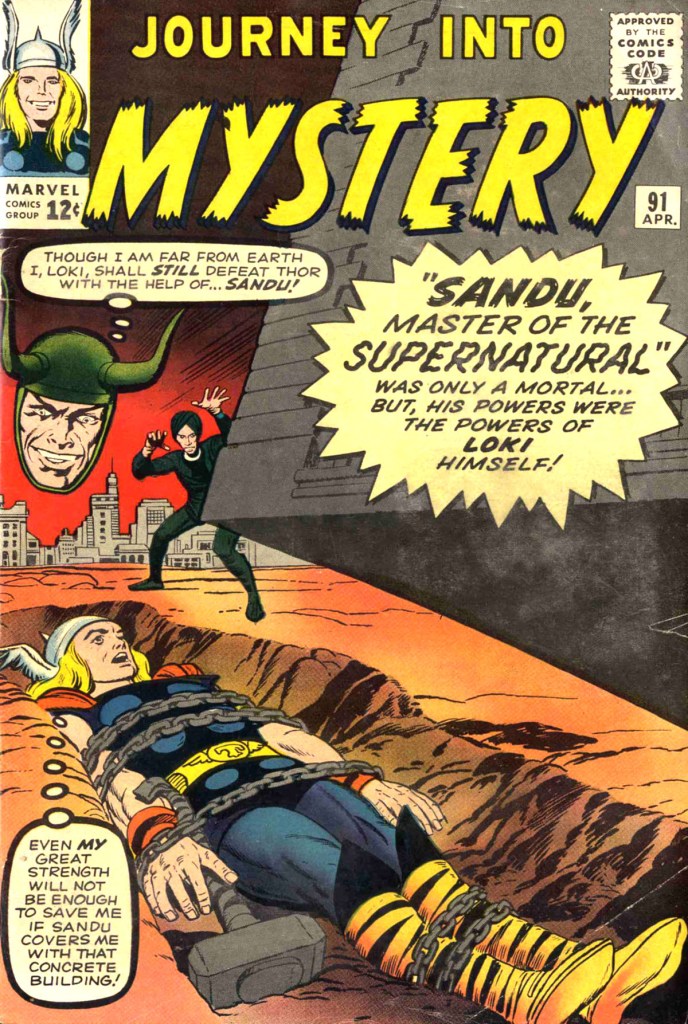
So after last week’s piece on STRANGE TALES #103 where we tried to work out who might have been behind the story therein, Larry Lieber or Jack Kirby, I received, as you’d expect, a lot of pushback from the “Everything Kirby” contingent, who believe that Jack did at least 100% of all of the stories and storytelling for every job he did for Marvel in the 1960s, if not more. I don’t really disagree with 90% of how these folks think–but it’s that final 10% that’s such a contentious area. And understandably, given how much credit was stolen from Kirby by Lee over the years as to the origination and the authorship of the work they did together.
One commenter in particular, a fellow named Chuck, suggested in the comments that all that would be necessary for us to see clearly that Larry Lieber had nothing to do with the stories that he was credited on along with Kirby was to look at his efforts on JOURNEY INTO MYSTERY #90 and #91, which he called amateurish and laughable. So okay, that seems like a fair approach to me. Let’s take a look at JIM #89, which is credited as plot by Lee, script by Lieber and art by Kirby and then #90, which is credited as plot by Lee, script by Lieber and art by Al Hartley, and #91, which is credited as plot by Lee, script by Lieber and art by Joe Sinnott, and see what we can see–if, apart from the art styles, there’s a material different in the language of the copy or the manner in which the story is told.

So let’s begin with JIM #89. First off, it has to be said, all three of these stories are dumb as rocks. There isn’t a whole lot here that anybody would be thinking about sixty years later had Kirby with Lee not stepped up their game in a big way when Jack came back onto the strip on the regular after handing it off to others. Anyway, this story opens with Thor returning to Don Blake’s medical office, and having to use a makeshift Thor dummy to distract gawkers to keep them from seeing him enter Blake’s office and put two-and-two together–standard Superman-style protect-the-secret-identity stuff.

I have scans of only three pages from JIM #89, and this splash page is the best and most useful of the lot. Looking at it up close, there’s some copy penciled in on the board, but it mostly doesn’t appear to be in Kirby’s hand. In particular, you can see remnants of the story title, the blurb-box and an indication of the credits (including an indication that the lettering credit should be YOUR NAME). So there is immediately a difference from STRANGE TALES #103 where the lettered-on-the-board copy was easier to detect and identify as Jack’s.


So looking at the actual story copy, in my opinion it’s not by Lee–it showcases none of his typical wisecracking humor nor his phantasmagoric turns of phrase. Neither does it appear to be by Kirby, lacking any semblance of his operatic sense of language and expression. Along those same lines, while I could certainly see Kirby coming up with the concept of pitting the immortal Thunder God against a regular human gang boss–that’s a plot concept that feels very Kirby to me, somehow–the actual events of the story and the manner in which it breaks down leads me to believe that it wasn’t of Kirby’s devising either. So my take-away is that, as credited, Larry Lieber wrote the script for this story and it was likely produced from a full script.

This is perhaps just a matter of opinion, but while Kirby was always ready to be funny in his stories, I can’t see him originating that sequence at the top of this page, where Jane pines for a domestic life with Thor. Again this feels like a contemporaneous Superman story more than anything, and points to Lieber as being the prime driver of the narrator here.

I will say that, whether he was plotting this story or not, Kirby adds a lot of visual panache to what could have been a very staid outing. This last panel, with the crook sent flipping for example. On the other hand, if Kirby was the one plotting this story, then I would wonder about panels 4 & 5 above. Given that there’s a beat at the end where Thor has Odin take away Thug Thatcher’s girlfriend’s memory of the mobster, I wonder if the intent here wasn’t for Blake to reveal himself as Thor here and then have Odin wipe all of the mortals’ memories of that event. If it was, that’s really pretty weak sauce–why worry about revealing this secret at all if Dad can snap his fingers and erase that knowledge as needed?

The other factor that leads me away from thinking that this might be a Kirby-driven narrative is that Jane Foster is an absolute doormat in it, giving her most Lois Lane performance in any of thee early stories. She’s an ineffectual hostage for much of the tale, and before that a doe-eyed ingénue dreaming about a domestic life with the hero. These don’t feel like the sort of traits exhibited by Kirby women. (Also Thor using Super-Ventriloquism is another Weisingerism and doesn’t read like a Kirby idea to me.)

In terms of structure and scripting approach, the story is relatively caption-heavy and most panels have anywhere between seven and nine panels on them, with the exception of the opening page with has a large panel and then two smaller ones to immediately get into the tale. So these are all hallmarks that we can look for across the next two issues.

Moving on to JOURNEY INTO MYSTERY #90, we find the first Thor story to not be illustrated by Jack Kirby. Rather, it’s by Al Hartley, typically a teen humor cartoonist who worked on PATSY WALKER among other things and who did this one and only super hero story in the early days of Marvel. I’ve seen it opined that Kirby quit Thor and all of his other assignments save FANTASTIC FOUR at this point after a blow-out fight with Lee over INCREDIBLE HULK, but that analysis of events has always struck me as being almost all conjecture, connecting some dots that in all likelihood are unrelated. Kirby in this period did tend to be used to start series and then hand them off to other creators to carry on with, so his absence here at this moment feels like business as usual to me more than anything else.
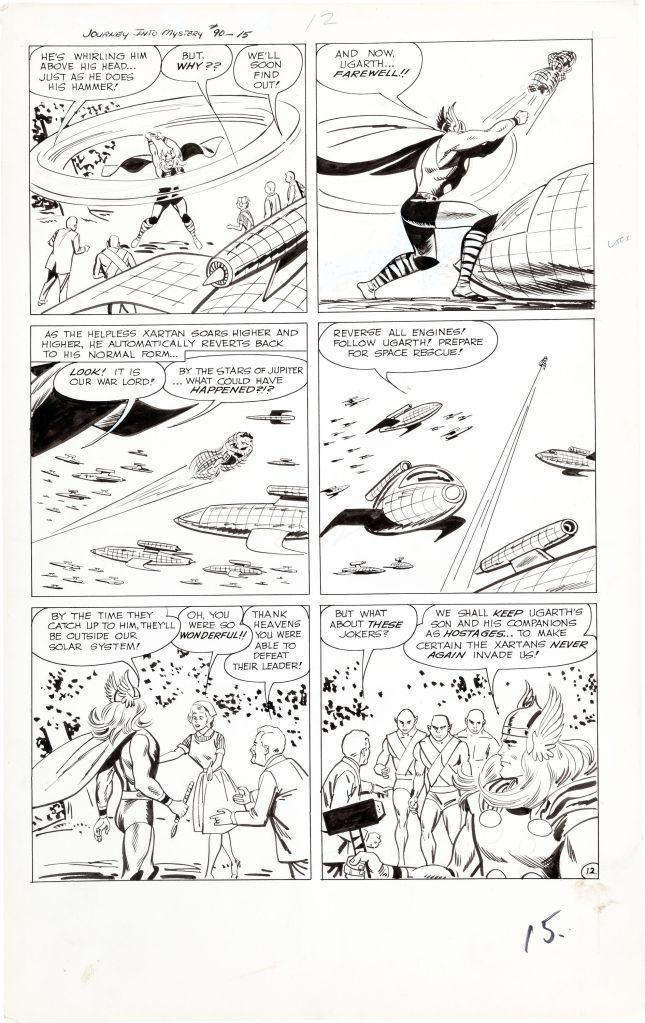
I have scans of two or three pages from JIM #90, the most useful of which is probably this one of story page 12. As you can see, it’s a very clean board, there aren’t really any stray pencil marks on it. Hartley definitely wasn’t writing in the copy on the board as a compositional tool as Kirby learned to do from Will Eisner. It’s also relatively clear how ill-suited to the job of doing Marvel super heroes Hartley really was. His Thor is bloated and cartoonishly built, and his action, while clear, is almost exclusive showcased in wide shots that keep the camera stationary. There isn’t any of the dynamism that Kirby brought to the preceding issue in evidence here.

The copy isn’t quite so caption-heavy as the previous issue, but its manner strikes me as very similar. This also isn’t Lee’s voice, and of course it isn’t Kirby’s. I don’t know that anybody would dispute that the scripting here was done by Larry Lieber–though I suppose that there might be somebody somewhere who might suggest that it was the work of Hartley, who was certainly capable of doing it. I will say that Jane’s personality and characterization in the middle tier on this page strikes me as consistent with what we saw of her in the early pages of JIM #89.

The story’s plot is another variation on a situation that Lee’s line of comics had been doing wrinkles on for years, beginning before super heroes made a comeback. It’s about an alien race, the Xartan, colloquially known as the Carbon Copy Men, who attempt to conquer the Earth by using their power to change their forms so as to resemble anyone to replace human beings in key positions. They’re sort of a cut-rate version of the Skrulls from FANTASTIC FOUR #2. Thor gets involved after the people around him, including Jane Foster, begin acting weird, but he’s separated from his hammer for too long and reverts to his vulnerable Don Blake identity and is captured before he can rout the invaders.
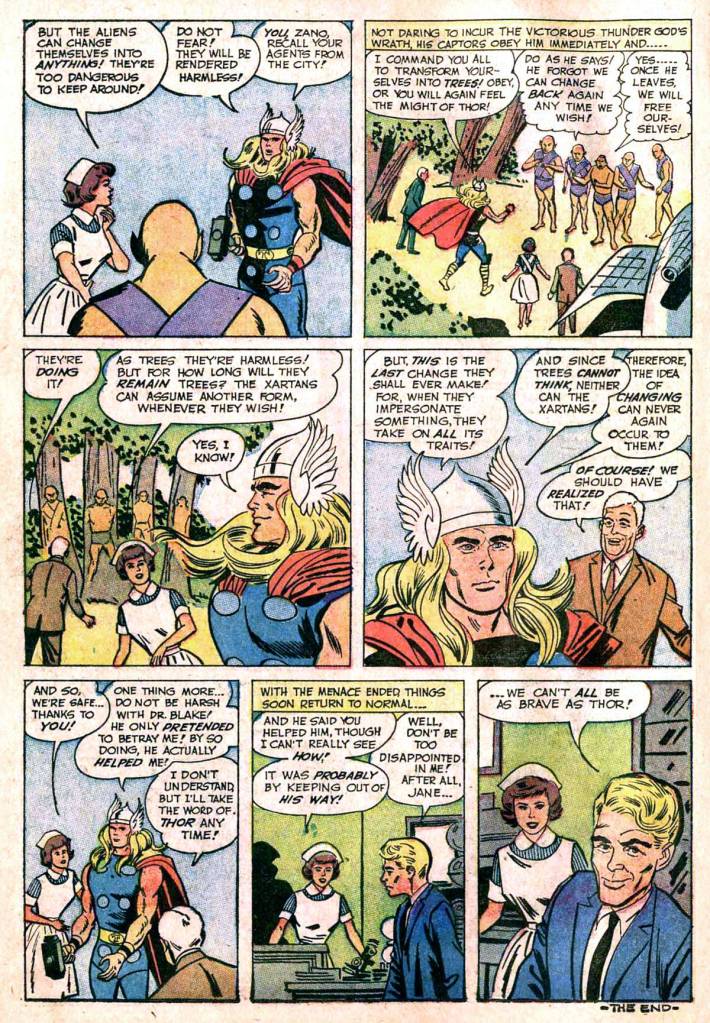
In the end, Thor regains his hammer and his powers, goes one-on-one against the Carbon Copy champion, emerges victorious, and then straight out of FANTASTIC FOUR #2, orders the Xartan soldiers to transform themselves into trees (rather than cows.) As I said at the beginning, it’s a dumb story, and bereft of Kirby’s narrative power to imbue it with anything, it’s perhaps the worst super hero adventure of the early Marvel era–and that’s saying something. That all said, it reads to my eye like the same person who worked on JIM #89. There are more six-panel pages in this job, but still mostly seven-panels-and-up. And the opening page is again a big shot with two follow-up panels to begin the tale.

And lastly, let’s look at JOURNEY INTO MYSTERY #91. For this issue, I don’t have any scans of any of the original art pages, so we’re going to need to rely solely on the printed book for insight. It’s a bit more caption-heavy than #90 was, more in line with the work in #89, where the captions drive elements of the plot. And the splash page by Joe Sinnott, as you can see above, is the inverse of the previous two, beginning with three smaller panels before going to a large title shot. It also seems as though penciler Sinnott didn’t leave a whole lot of space for the story intro and title, it’s a bit crammed in there as opposed to previously.

As with JIM #90, I suspect that few would argue that the scripting here is Lieber’s work–though again, I’m sure that somebody somewhere will make a case that it was done by Joe Sinnott. It definitely doesn’t show any of the hallmarks of Lee’s scripting style. It’s another pretty dopey story, the third in a row, in which the imprisoned Loki magically increases the powers of the sinister mortal illusionist Sandu, turning him into an actual wizard and pitting him against the Thunder God. Sinnott isn’t Kirby in terms of his dynamics, but he’s got a good dramatic approach. That last panel on this page is really very effective and creepy.

This page in particular convinces me that this story was drawn from a full script by Lieber. Look at this page, take away all of the copy that’s on it and then ask yourself: can you see any reasonable person who is working from just a broad plot idea select and draw these seven images to depict teh actions of the story? They don’t really make visual sense on their own, relying on the final copy to contextualize what’s happening with the bullets in Panel 4 and the disappearance and reappearance in Panels 6 & 7. There isn’t any such similar page in either #89 or #90, but that may simply be down to both Kirby and Hartley being better visual storytellers than Sinnott was at this time. Kirby in particular, I believe, had the leeway to change the storytelling on any story he was given and the expectation that he would do so in order to make everything as clear and dramatic as it could be.

The set-up and punch line of this story are pretty amateurish as well. At the top of the very first page, we find Odin studying Thor’s legendary Belt of Strength, which can increase his power greatly in a time of need. And despite not having needed it for some time, this winds up being the story where it is called upon, so Lieber and Sinnott establish it right up front. Thor’s Belt of Strength is an item out of the original Norse myths of Thor, so if nothing else, this proves that somebody else besides Kirby could pull in aspects from the myths–regardless of whether that person was Lee, Lieber, Sinnott or whomever.
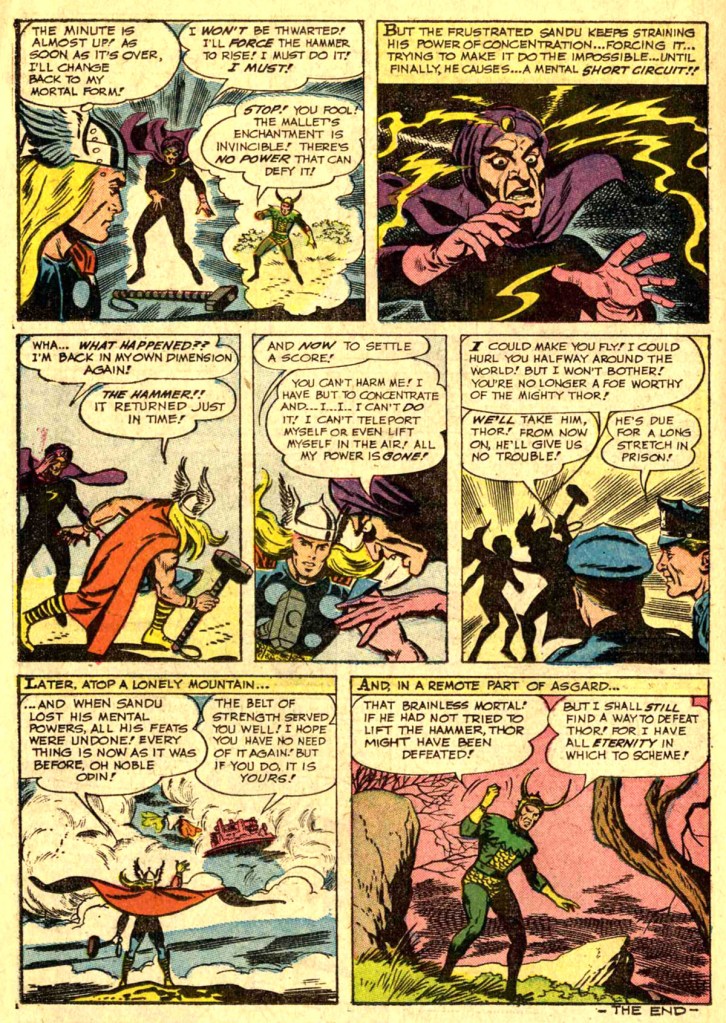
At the story’s end, Sandu short-circuits his newly-gained mental powers when he attempts to use them to lift Thor’s hammer–bad move. So the villain is caught and brought to justice, ad far away in Asgard, Loki steams and plots anew. It’s another relatively brainless story, very much of a piece with what DC or Archie or Dell were publishing in their hero books. Without Kirby, there really isn’t any spark of anything interesting.
So what is my take-away? Well, I don’t know that we’ve proven anything through this exercise. And your mileage may vary, of course. But looking across these three stories, far from being convinced that Lieber didn’t have anything to do with any of the Kirby outings, I’m more convinced than ever that at least JIM #89 was written by him in a full script fashion and then penciled and altered along the way by Kirby. The voice in all three of these issues sounds consistent to me–in a way that the next couple, which were scripted by Robert Bernstein, are not.

And I just wanted to share this Steve Ditko splash page from one of the back-up stories in JOURNEY INTO MYSTERY #90 with you all as well because it’s simply so good.
 The Tom Brevoort Experience
Commenting just so other comments will crop up in my email. This is outside my ability to judge.
For some reason I’ve always liked Sandu as a foe. Regardless of his merits, it’s surprising nobody’s ever revived him — Lord knows both companies have brought back worse Silver Age characters.
LikeLike
Sandu’s got the start of a nice design, with the purple turban and shortie-cape over the all-black body suit. The S on his chest, maybe not so much.
The name Sandu always makes me remember Simon & Kirby creations Sando and Omar and their mentalist act — they did come back, in a Kirby/Lee Cap story. But that just makes me think that if Sandu came back, he should team up with Dormammu’s sister Umar.
All right, all right, I’ll get my coat.
LikeLike
Then if we shipped them would it be Sand/Umar or Sandu/Mar?
LikeLike
THANK. YOU.
LikeLike
Ha ha ha… Did Thor ever use Super-Ventriloquism or get his hair cut short again?!
I prefer Hartley’s Thor to solo Sinnott’s, and both of them seem to draw Thor’s locks as even longer and more ‘alive’ than Kirby did.
LikeLike
That hair in the Hartley issue is just gorgeous! You can tell this is a man who’s drawn page after page of fan-designed hairdos for Patsy Walker!
LikeLike
Thanks for the dissertation and reminder that if, as a young lad, any of these issues had been the first Marvel comic book I’d bought instead of #136, I doubt I would’ve bought another Marvel comic book again. Talk about a run-of-the-mill slog.
Page three of #136 with its warriors on horseback and the captured troll was magnificent and it has stayed with me.
LikeLiked by 1 person
It has been a great week for comic book conspiracy theories from guys named Chuck! Somewhere in the distance, Chuck Austen schemes.
LikeLike
I don’t recall anyone thinking that Kirby was the writer of any tales of Thor that he didn’t draw. The one that many think he think he did come up with was the first issue since it relied on tropes that Kirby had used many times in the past combining rock creatures, invading space armadas, Easter island and Thor myths.
LikeLiked by 1 person
Yup–that Ditko splash is the best part of these three issues, hands down!
The DC touches in all the Thor stories are unmistakable. You could photoshop Superman and Lois Lane into all three tales, and no one would guess that they were actually Silver Age Marvel.
LikeLike
The early stories are heavy on the Superman/Lois cliches. Even more dated is #87 where he fights the communists.
LikeLike
I’m commenting on this very late, but I’m struck by a few things you didn’t consider. First, the comparison should be between the first seven Thor stories Kirby drew (JIM 83-89) and JIM 90/91. Larry Lieber supposedly wrote the scripts for ALL these issues. If you want to only go by the printed credits, at least compare JIM 86-89 to 90 and 91. There’s a lot more data that way, and the deficiencies of the stories and storytelling in JIM 90 and 91 are more dramatic.
The plots, themes, and storytelling of issues 83-89 scream out ‘Jack Kirby!’, and are absolutely nothing like the work Larry Lieber did elsewhere. See, for example, Lieber’s ‘Tales of the Wasp’ that he both wrote and drew to see his ideas, themes, and storytelling chops. When Kirby is drawing, somehow the stories involve hi-tech sci-fi, hi-tech aliens, elaborations of Asgard that aren’t straight out of Bulfinch’s, contemporary anti-communist politics, Blake as a humanitarian surgeon, elemental monsters, and chapter breaks. When Lieber is writing but Kirby is gone, that all goes out the window.
Second, Larry Lieber made clear that his scripts were not just outlines with captions and dialogue, but contained panel-by-panel layout directions, complete with virtual camera positions and framing. If Jack Kirby worked from Lieber’s scripts, both his page layouts and panel compositions should be indistinguishable from Hartley’s and Sinnott’s. There’s no way to substantially deviate from that kind of script without throwing the script out.
The Kirby drawn stories have strong narrative drive from start to finish, and can be followed even when barely reading the captions and dialogue, because he uses a ‘cinematic’ camera to keep from confusing the reader. His panels work like animation storyboards, with setup->action->payoff. Ignore the captions and dialogue in the Hartley/Sinnott drawn stories and the result is utter confusion. Both those stories start with expositional non sequiturs, and progress with barely connected events that skip all over the place and keep the reader from from being engaged. You highlighted the horrible storytelling of page 6 of issue 91, but that page hardly stands out from a dozen other similarly bad pages in issues 90 and 91.
You mentioned the humorous panels of page 4 of #89, while saying it must be Lieber who did this because it’s too “Lois Lane-like” and Jane Foster is a “doormat” here. Reading the other Kirby Thor issues, I see multiple places where Kirby’s wit and humor shine through, and where Jane playfully daydreams in a rather charming way about her heartthrob Thor. Remember Kirby pioneered romance comics, and was not at all averse to portraying unrequited love. Note that in all the cases where Kirby shows Jane Foster, he actually makes her a character, with actual thoughts and desires, while Dr. Blake isn’t an object of contempt, but a staid and held-in contrast to the larger-than-life Thor. She may at this stage be the Lois Lane character, but she’s a character.
In issues 90 and 91, Jane could be replaced by a mannequin and the story would be exactly the same. There’s not a whit of humor in either issue, and the relationship between Jane Foster and Don Blake is rigid and cringy.
LikeLike