

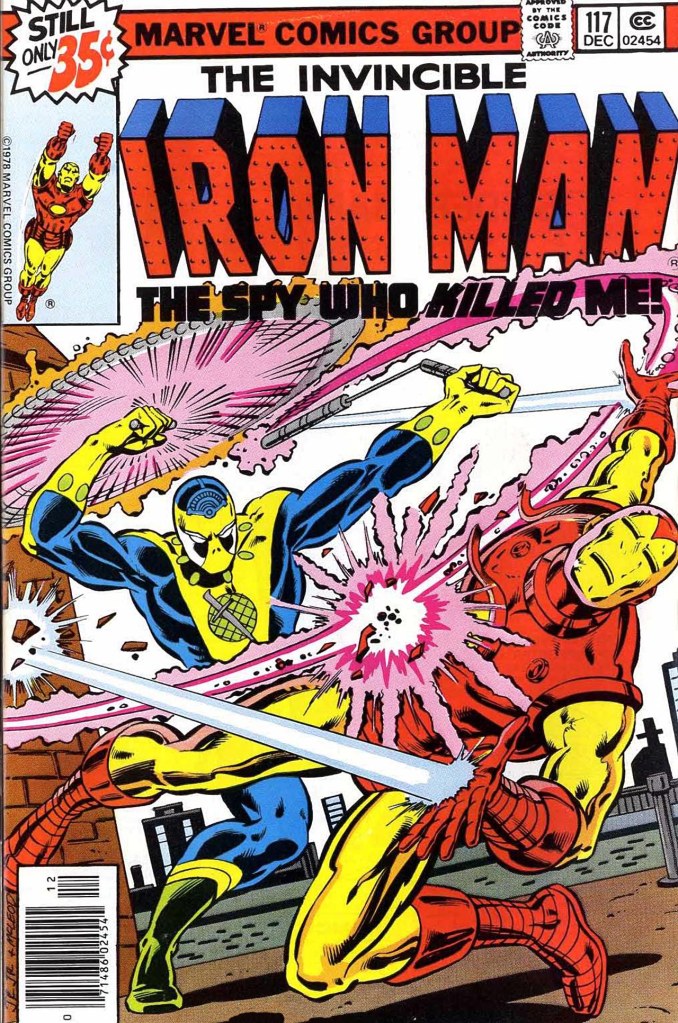
It was immediately apparent once the trio of writer David Micheline, penciler John Romita Jr. and inker/co-plotter Bob Layton came on board the series over the course of two months that something good was beginning to happen in IRON MAN. The series had, for a long while, been a bit out of step with the real world, still fighting Cold War-style battles in the metrics of the 1960s, or having its main character go full-on Dove in the early 1970s as a way of attempting to keep him connected with the audience. There was just a subtle sense that the book was a touch out of step and behind the times that permeated the past couple of years, despite some good work done during that time, particularly by outgoing writer Bill Mantlo. But the IRON MAN produced by this trio of creators definitely felt as though it belonged to the modern Jim Shooter era of Marvel, perhaps the first title to do so.

This early into their run, the team was still busy cleaning up plot threads that had been started by their predecessors, such as the mysterious assassin who was stalking Tony Stark. Here on this splash page, that plotline reaches a climax of a sort, as Tony is suddenly gunned down by an unseen assailant. A really dramatic way to open an issue. This was actually the creators’ way of getting rid of the Tony Stark Life-Model Decoy that had become a fixture in the series under Mantlo and which perhaps made Tony Stark’s double life a bit too easy for him to navigate. The victim here is the L.M.D., placed so as to draw out the killer and give Iron Man a chance at identifying and capturing him.
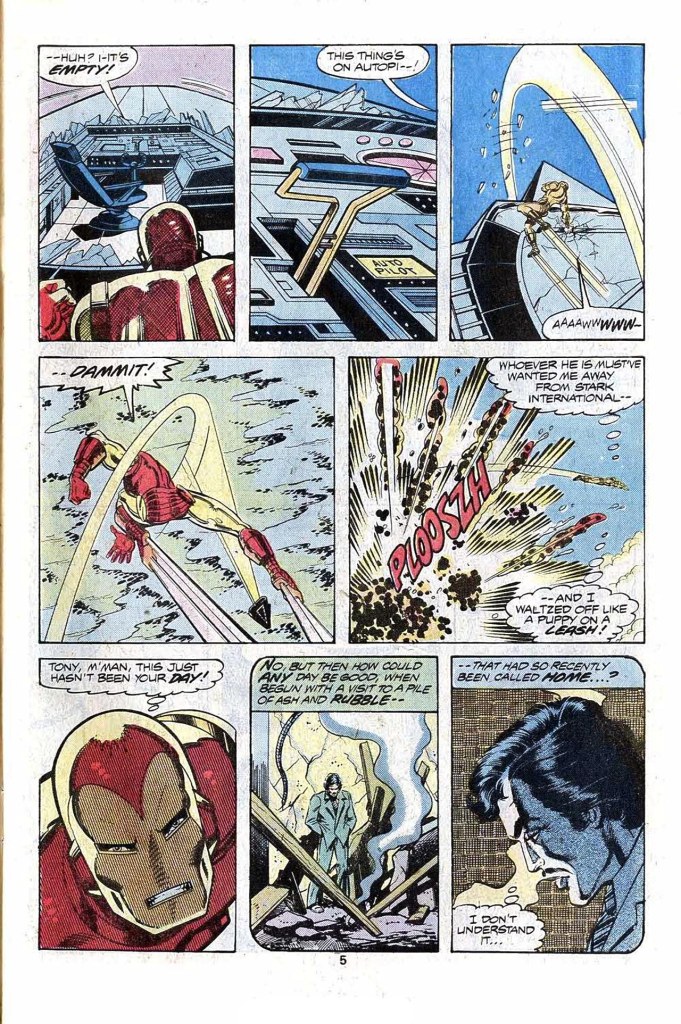
As has already been given away by the cover, the would-be killer is Iron Man’s old foe Spymaster. The espionage master seems to be making is getaway in a flying craft, one that Iron Man is swift to pursue and catch up to. But once he forces his way into the ship, he finds it operating under remote control–Spymaster has given him the slip. One of the hallmarks of the Michelinie/Romita/Layton Iron Man was the manner in which he’d often lash out in rage and frustration, and that pattern begins here, as he takes his stress out on the flying ship. These little moments helped to make Tony Stark feel more like a real person, which was good. Also, Romita’s sense of dramatics, even though he was still new at this, were already extremely strong, and with Layton providing a slick polish, this was about the best the series had looked in a very long time.

From here, we flash back to earlier in the day, which begins with Tony being evicted from his residence due to complaints from the building’s other tenants about it constantly being attacked. (The petition that the landlord shows is chock-full of the names of fans and pros as well as a few inside jokes such as Alec Rois. I’d bet that Roger Stern was responsible for that one.) That evening, Tony decides to present a public target to draw his assassin out by attending a reception in honor of the Carnelian Ambassador, a figure who will prove to be important in the months ahead. Even more important is Bethany Cabe, whom Tony meets for the first time in this issue and who will quickly become his new romantic interest. There really isn’t a hint of Cabe’s profession as a bodyguard in this story–she just seems like an extremely attractive woman. So I don’t know if that’s something the creators already had in their back pocket, or whether it was a development they added as they figured Bethany out.

Back in the present, Iron man doubles back to the Stark plant and quickly ascertains that Spymaster is still on the grounds. He’s attempting to raid the computer complex, stealing every secret that Stark International has. Regardless, this gives Iron Man an opportunity to kick some ass, and that’s what he proceeds to do in a big, colorful running fight. From a modern vantage point, this hardly seems like a fair contest–for all of his many gadgets and gizmos, Spymaster can’t bench-press a car, after all. But in these days, Iron Man’s power level was typically a lot lower, more on the level of Spider-Man. It was during this run that it got goosed up, to the point where he started to be seen as one of the company’s heavy hitters. But at this point, Spymaster was still capable of giving him a good run for his money.
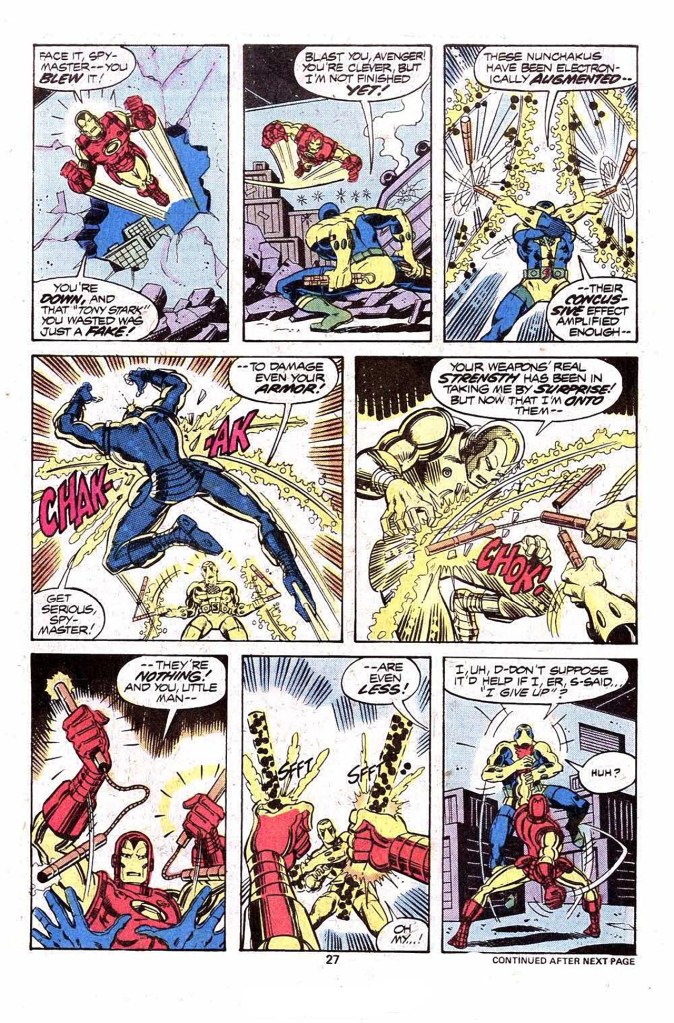
Still, it gives JRJR a chance to cut loose with some formidable action graphics, and for Layton to provide a wide range of chrome textures to the hero’s armor and the technological surroundings. Eventually, though, spymaster runs out of both tricks and space and Iron Man sends him flying literally through a wall and for a football field’s worth of distance. How he’s not dead after this is something of a mystery, but it’s a really visceral moment either way. Examining Spymaster’s fallen form, Iron Man learns that the specific information that Spymaster was after has to do with the identifies of all of the stark International stockholders. Tony can’t figure out why anybody would want that information.
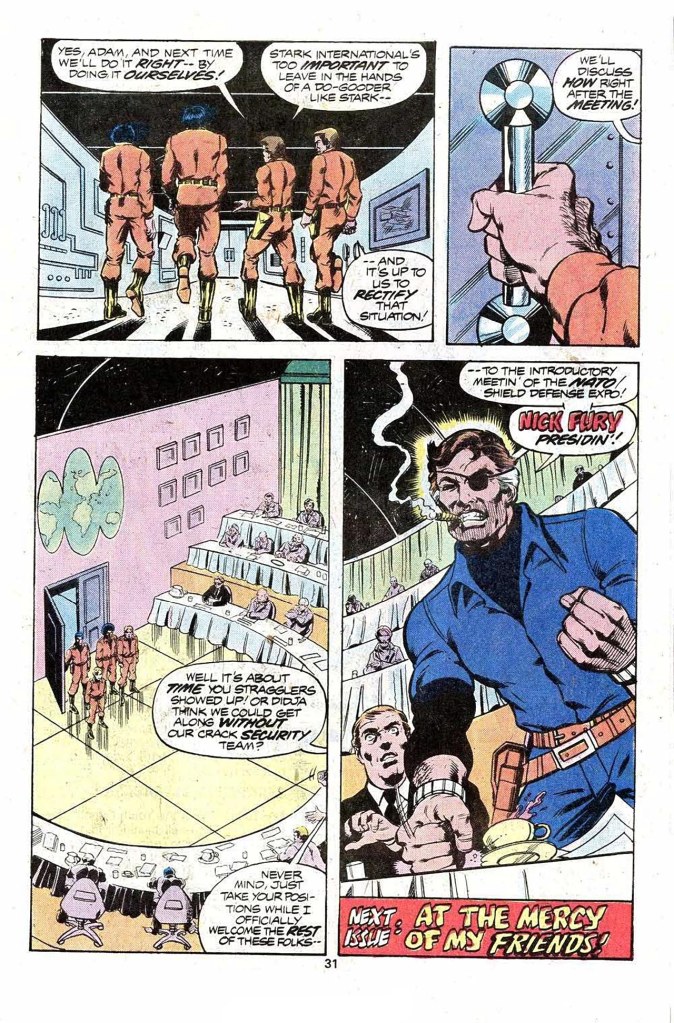
And from here, the camera pulls back to a quartet of SHIELD agents who’ve been clandestinely observing the whole affair. It becomes clear that they hired Spymaster in the first place, though to what end remains a mystery. Two of them are named Buck Richlen and Val Adair, and they represent a cancer within SHIELD that will be followed up on in subsequent months. They also represent some payback from writer David Micheline, as both names and the characters behind them were meant to be references to artist Rich Buckler. Prior to this, Buckler had been working with Michelinie on DC’s series STAR HUNTERS where he swiped the design for a spaceship from the animated series SPACE SENTINELS. The animation company became aware of this and there was some legal back-and-forth–the crux of the matter came down to Michelinie wanting Buckler taken off the book, but his DC editor refusing, and so it was Michelinie who took a powder from it, seeking out new opportunities at Marvel that had landed him the IRON MAN assignment. Michelinie would use Richlen to take a couple of veiled shots at Buckler throughout this storyline.
 The Tom Brevoort Experience
I love how shading is achieved in those bottom panels on page 5, especially Iron Man’s face.
LikeLike
Ironman was still referred to throughout the 70’s as the “2nd strongest Avenger” more than once on a team that featured Thor and Vision….even if it was inconsistently shown. While it’s true he did struggle with low level opponents more than once I think the higher end of his classic rogues gallery (Titanium man, Mandarin, Sub-mariner, Ultimo, etc) suggests that he’s always been a bit above Spider-man when something needs smashing. Mantlo showed Ironman as consistently powerful during his run, but Michelinie and Layton got rid of an Ironman that would get clobbered by Whiplash pulling over a computer bank. Jim Shooter also wrote IM as pretty powerful.
I very much liked this new direction of Ironman when it came out, but #117’s cover is a pretty awkward piece leg-wise and lack of leg-wise.
LikeLike
“Two of them are named Buck Richlen and Val Adair, and they represent a cancer within SHIELD that will be followed up on in subsequent months. They also represent some payback from writer David Micheline, as both names and the characters behind them were meant to be references to artist Rich Buckler.”
I had never noticed that!
Obvious once you point it out, but it’s slipped by me all these years.
LikeLike
There’s a bit in a later issue where, after their plot is foiled, Buck tries to pin the blame on his underlings, which is apparently what Buckler did with his assistants in that Star Hunters instance.
LikeLike
Heh.
LikeLike
“The petition that the landlord shows is chock-full of the names of fans and pros as well as a few inside jokes such as Alec Rois. I’d bet that Roger Stern was responsible for that one.”
Those names weren’t added by the letterer, so they’re almost certainly the work of inker Bob Layton, who was the _other_ founding member of the CPL Gang. So I’d bet on Bob, there — he didn’t need Roger to suggest that reference.
LikeLike