

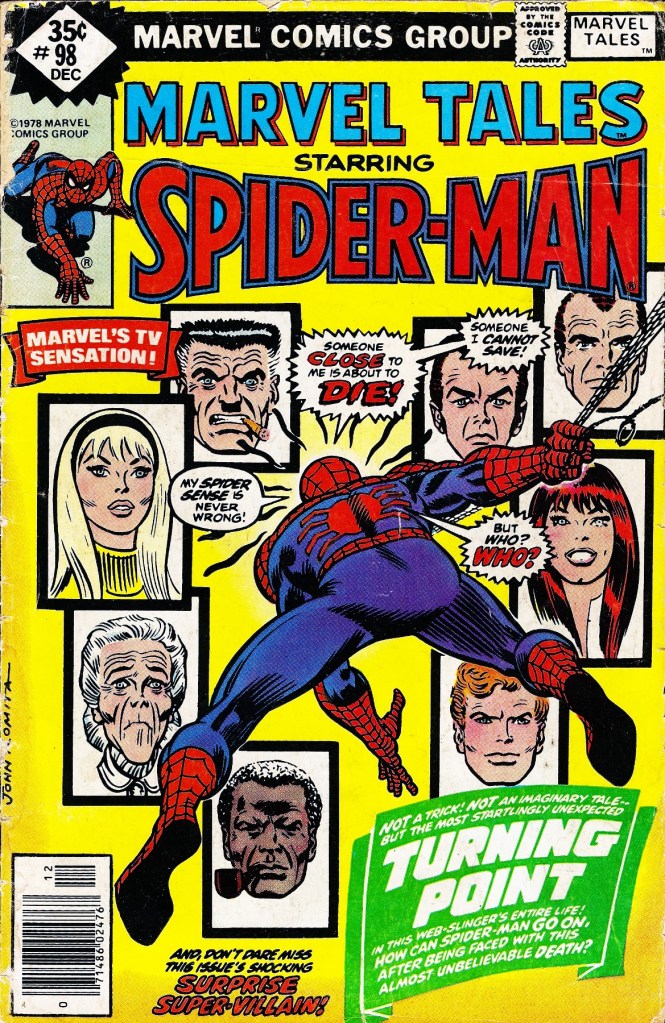
Now this was a comic book that I had been eagerly anticipating for several months once I had realized that its reprinting was approaching in the sequence. By 1978, the demise of Gwen Stacy was established canon–even the original Clone storyline was finished by then–but the story of her death was still referenced and talked about like an acknowledged classic. I had really liked Gwen in the other stories I’d seen her in–liked her more than Mary Jane, certainly, who had taken her position as Peter Parker’s love interest by the time I started following the series. Mary Jane in the early days was flighty, a bit vain, selfish and fun-loving in an almost aggressive fashion. This was not my jam in 1978. So the more sober and supportive Gwen was more my speed–and it’s not like she couldn’t loosen up and dance if the situation called for it. Anyway, while I already knew the outcome of this story, I was very interested to see what all of the shouting was about.

And the book did not disappoint. Even edited for the shorter number of available pages, this comic book still packed an enormous punch. It’s both well-crafted and daring. For those who are unaware, AMAZING SPIDER_MAN #121, from which this story was taken, was released in 1972, and was one of the first issues produced after writer/editor Stan Lee had left the series. Into his shoes had stepped Gerry Conway, who was then about the same age as the wall-crawler and who brought a more youthful sensibility to the series. The notion was that John Romita was going to continue to plot the series and Gerry would simply script the issues, but Conway wasn’t satisfied with that set-up, and so it quickly became a collaboration between the two men. One of the first things they realized is that the romance between Peter Parker and Gwen Stacy had hit something of a dead end. They’d broken up and gotten back together so many times over misunderstandings and tragedies that it was beginning to strain credibility. The only things left to do would be to marry them off. Or…

Actually, the entire series was stagnating a little bit, and so Conway and Romita discussed killing off a main character so as to shake things up a bit. The first potential victim was Aunt May, but Romita correctly realized that removing her from the series would decrease the drama rather than increasing it. Without Aunt May around, Peter would have no good reason to keep his Spider-Man identity a secret from his friends and loved ones. But also, John had been a huge fan of Milton Caniff’s newspaper strip Terry and the Pirates in his youth, and he well-remembered the massive reaction when Caniff killed off the popular girl character in the strip, Raven Sherman. All of the pieces fit together nicely–Conway was much more interested in Mary Jane, he felt that Gwen was too bland. So the two creators took the idea to new Editor in Chief Roy Thomas as well as to Publisher Stan Lee. Stan denied knowing anything about it in later years, but we will charitably refer to that as “an untruth.” Conway and Romita got the green light to proceed from all involved.
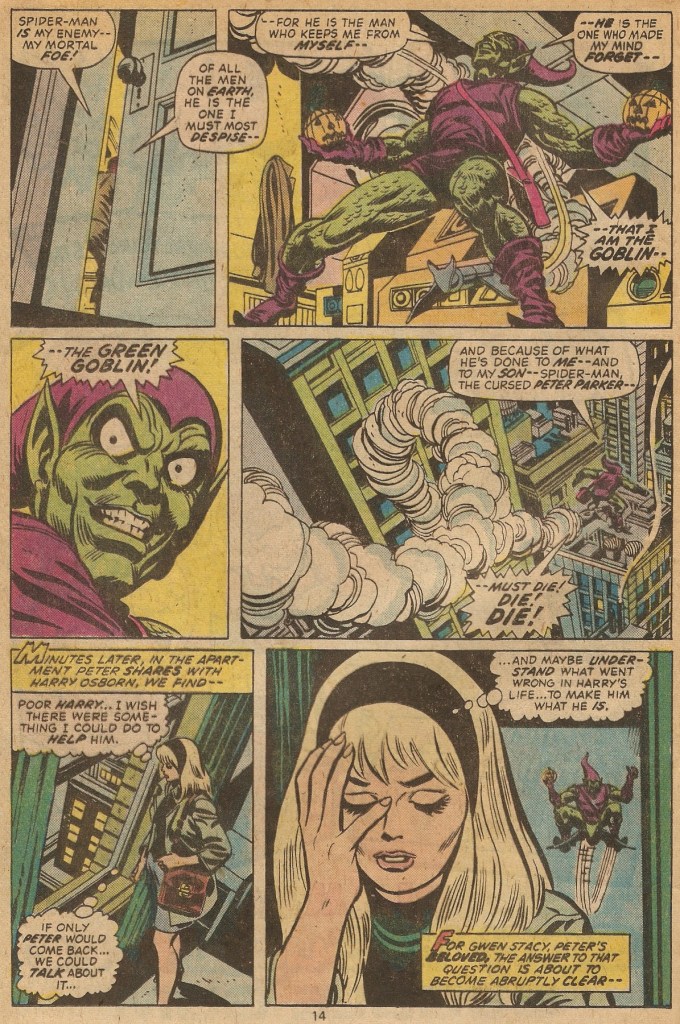
Conway had another problem that he was looking to correct in doing this storyline. The web-slinger’s biggest foe had long been the Green Goblin. That character started out as a mysterious figure whose identity was unrevealed, even to the readership. Eventually, not only was he unmasked as the father of Peter’s college friend Harry Osborn, but the Goblin also managed to unmask Spider-Man in return. Thereafter, each of their encounters had ended with the Goblin sustaining some manner of trauma that caused him to forget both his own persona as the Green Goblin and also Spider-Man’s real identity. This had been done three times already, and Conway thought that it, too, was becoming implausible. Plus, he had the notion that the way to make the Goblin an even better foe for Spidey would be to pass the identity down to Norman’s son Harry, Peter’s friend and roommate.

So this story opens with Peter Parker having raced back to New York from Canada where he was on an assignment. Harry was experiencing a relapse of his drug use and was in the hospital. The stress of the situation and the appearance of Peter sparked Norman’s memory of himself. So, cladding himself in the costume and weapons of the Green Goblin, he goes in search of Peter Parker–but finds Gwen Stacy waiting in his apartment instead. The Goblin carries her off, to the top of the George Washington Bridge (which artist Gil Kane drew as the Brooklyn Bridge, which makes a bit more sense, but Conway made a joke out of being the GWB.) Now there’s a reading of this story where Gwen is already dead at this point, killed by the Goblin off-camera. Later retellings and expansions on these events have put the lie to that, but if you read just the original, that’s a very real possibility here.
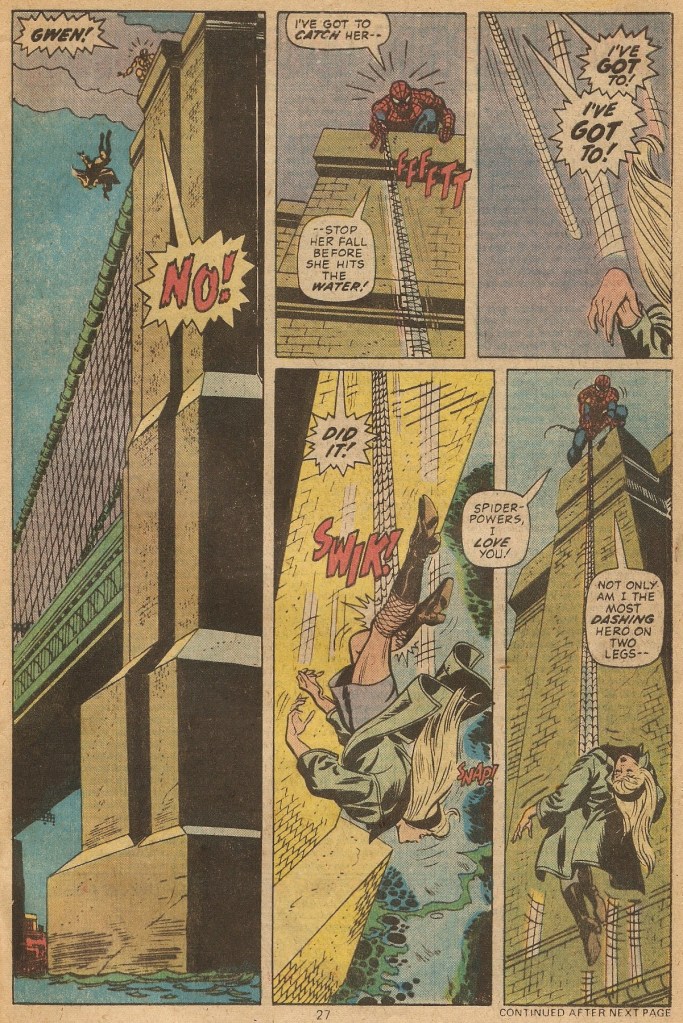
To make matters worse, Spidey caught a cold while he was in Canada, meaning that his spider-powers aren’t at their utmost. Nevertheless, he fights the Goblin in a truly kinetic battle combining the best of Gil Kane’s storytelling and shot selection with Romita’s lush finish. At a key moment, the Goblin knocks Gwen off the bridge, and in attempting to save her, Spider-Man fires his webbing at her to halt her fall–something that he’s done plenty of times in the past. But we see that as the web-line adheres to Gwen and pulls her up short, her head snaps back and there’s a tiny sound effect that indicates that her neck has been broken by the whiplash. A distraught Spider-Man pulls his lady love back up to the top of the bridge, only to discover that she is dead. The manner in which Conway attempt to script this scene tries to somehow make this not Spider-Man’s doing–the Goblin says that “A fall from this height would kill anyone before they struck the ground!”, which seems like diversionary nonsense. Try telling that to skydivers.
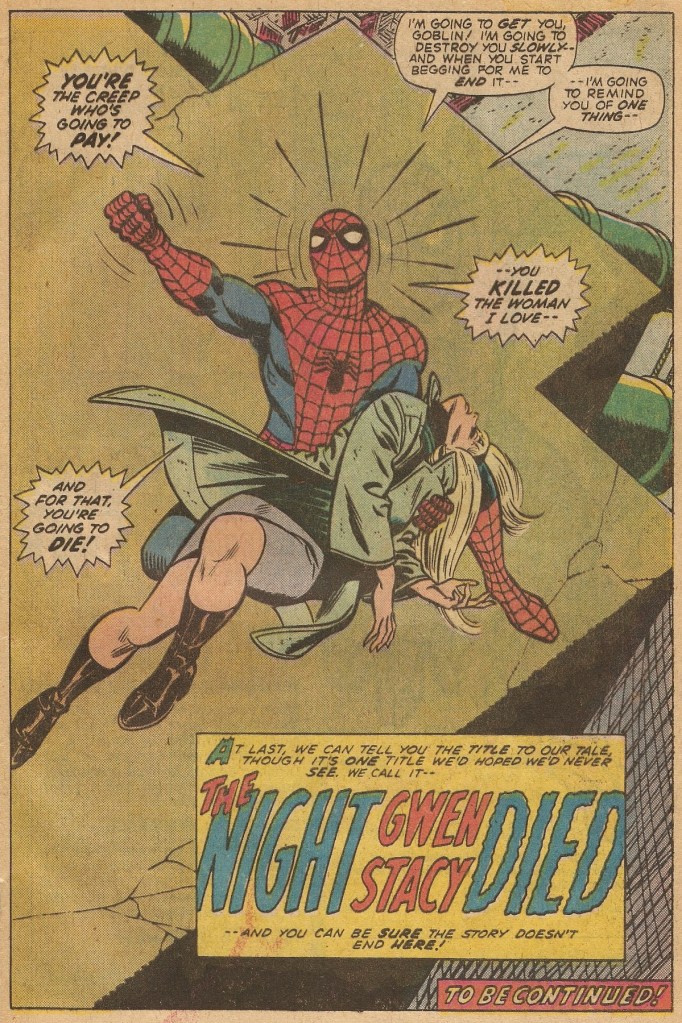
And that’s it! Gwen Stacy is dead, and Spider-Man swears deadly revenge against the Green Goblin! To be continued! Conway does a super-clever thing here where he has the title of the story on the last page so as to not reveal the outcome, which I liked. Speaking to some of the folks who were just readers when this story first saw print, many of them thought that this was all simply a trick, that the figure on the bridge was some dummy or duplicate and that Gwen would be revealed to be alive in a future issue as the story reached its climax. Certainly, there would be Spider-Man stories in years to come that would do just that. But no, these events were real, they actually happened, and they would color the tone and the trajectory of all Spider-Man stories for at least the next two or three years. This was a big deal in comics, something that nobody had ever done before–and it stuck. Even today, while the specter of Gwen has been referenced ad infinitum, and an alternate multiverse version of her has become super-popular as a costumed hero on her own, the mainstream Gwen has been permitted to remain a thing of the past. In a very real way, the death of Gwen replaced the death of Peter’s Uncle Ben as his driving motivation for the next bunch of years.
 The Tom Brevoort Experience
It’s a fascinating experience that’s disappeared: that long-term mystery and mounting anticipation of a clearly important bit of comics lore that was largely inaccessible in the absence of spare money for expensive back issues. It’s a part of being a comics fan that’s disappeared a world of Epic Collections and digital libraries. And while the environment for readers now is almost beyond what I could have imagined at age 11, my nostalgia tells me it’s a bit sad to lose that excitement of getting a long-awaited reprint at last.
LikeLiked by 2 people
It was a shocker. I think I read it in the drugstore before buying it.
The thing Norman said about dying before landing I’d heard but it was about having a fatal heart attack from the shock of hurtling to your death. It wouldn’t have applied with a character unconscious since capture. I’d also like to point out, Gwen finding out Peter was Spider-Man, the man she felt killed her father, and having her leave NYC for good to get away from him would have worked just as well as killing her. Up to this point, I think Iris Allen was the only love interest to ever learn the hero’s secret ID and that was after marriage. Still would have been a shocker and a much lesser one.
(Can you tell I’ve always preferred Gwen to MJ?)
LikeLiked by 2 people
IIRC Carol Ferris and Jane Foster had both learned the truth, but the relationships didn’t last long beyond that.
LikeLike
Hope this doesn’t get me cancelled, but I had come to dislike Gwen, because her part in the stories kept repeating the same thing. I didn’t cotton to MJ at first – too much effort had been spent since HER entrance portraying her as vapid and even a little cruel. I was still rooting for original Betty Brant, though she was neurotic from the start.
LikeLike
This issue of Spider-Man had a major impact on my career as a Friendly Neighborhood Physics Professor.
In the early 1990’s, I was teaching Intro Physics I, and was writing a mid-term exam that involved the concepts of Forces and Momentum. I was trying to come up with a problem that hadn’t been done 100 times before, when it occurred to me that the situation in the page above, detailing Gwen Stacy’s fall, would make a perfect exam problem. Making some assumptions (Gerry Conway rather inconveniently does not specify the time that the webbing takes to stop Gwen’s motion), it turned out to be a perfect exam problem (ignoring air drag, Gwen is falling at a speed of ~ 95 mph when the webbing reaches her, and experiences a force equivalent to 9 – 10g’s, resulting in the tragic neck snap). The students enjoyed applying their physics to situations in fiction, and I started to compile a library of similar examples, particularly where the comics got their science right.
In 2002, when the Sam Raimi Spider-Man film was about to open, I wrote an op-ed for the Minneapolis Star-Tribune describing the physics underlying the death of Spider-Man’s girlfriend, figuring that this was a good opportunity to get some science into the newspaper. My University put out a press release, describing the class I was teaching called EVERYTHING I KNOW ABOUT PHYSICS I LEARNED FROM READING COMIC BOOKS (which, my colleagues would say, explains a great deal). Earlier press releases over the years about my research accomplishments resulted in negligible media responses – – but you write one story about Spider-Man…!
Without ASM # 121, my second career in science outreach and public engagement would not have taken the path it has. Though in the past few years, in my public talks I’ve changed out the death of Gwen Stacy (it was pointed out that the prominent female in my presentation was an innocent bystander pushed off a bridge) for discussions of Doreen Green, who has been known to eat nuts and kick butts.
LikeLiked by 2 people
Hey, my wife bought me a copy of MARVEL TALES #98 for my birthday a few years back! She went digging into significant comic releases from around when I was born, found ASM #121, realized how expensive it would be, and then discovered that there was a reprint that was much more accessible. 🙂
LikeLiked by 2 people
This story shocked me even though I had no emotional investment in Peter/Gwen — I’d just started reading Spider-Man a few issues earlier.
LikeLike
This was essentially my introduction to Spider-Man comics at the tender age of 7 years old and I think this was instrumental in making me a Marvel fan.
I was sampling all kinds of comics at this age. Apart from a Denny O’Neil & Michael Golden story in Batman Family, the DC stuff I was getting was absolutely forgettable compared to this issue, as well as some fairly engaging stories from some other random Marvel stuff I got by happenstance.
It really formed a strong impression that remains to this day.
LikeLike
I’m writing and researching a series of blogposts on Spider-Man comics at the moment, and while I find Gwen is getting referenced after ASM #121 slightly more than I had remembered, it’s still not adding up to all that much. Between 1975 and 1995, Gwen takes up virtually no space in Spidey comics at all. The 90s clone stuff starts referencing her again and then she’s practically reborn in the 2010s with the movies and Spider-Gwen. Such a comeback after the character being literally and figuratively dead for so long is what blows my mind the most about all this.
LikeLiked by 1 person
Maybe it took that long for another generatuon to cycle through that wanted to revisit her. Before Bucky’s return, “dead meant dead”.
LikeLike
And I meant another gen of the people at Marvel, making comics. Newer writers, artists, & editors who remembered her from years before, now in positions to bring her back.
Buck’s return resulted in increased sales, for the series he returned in, & multiple spin-offs. So then Marvel must’ve considered how to repeat that financial success, looking around at other contenders. Gwen was likely an obvious choice.
LikeLike
Plus Spider Gwen really isn’t a revival of the long dead Gwen Stacy. Only the name and hair color got reused.
LikeLiked by 1 person
It still pulls on that history, that legacy. Monetizing that appeal. That’s about all the hairs I have time to split. 😉
LikeLike