

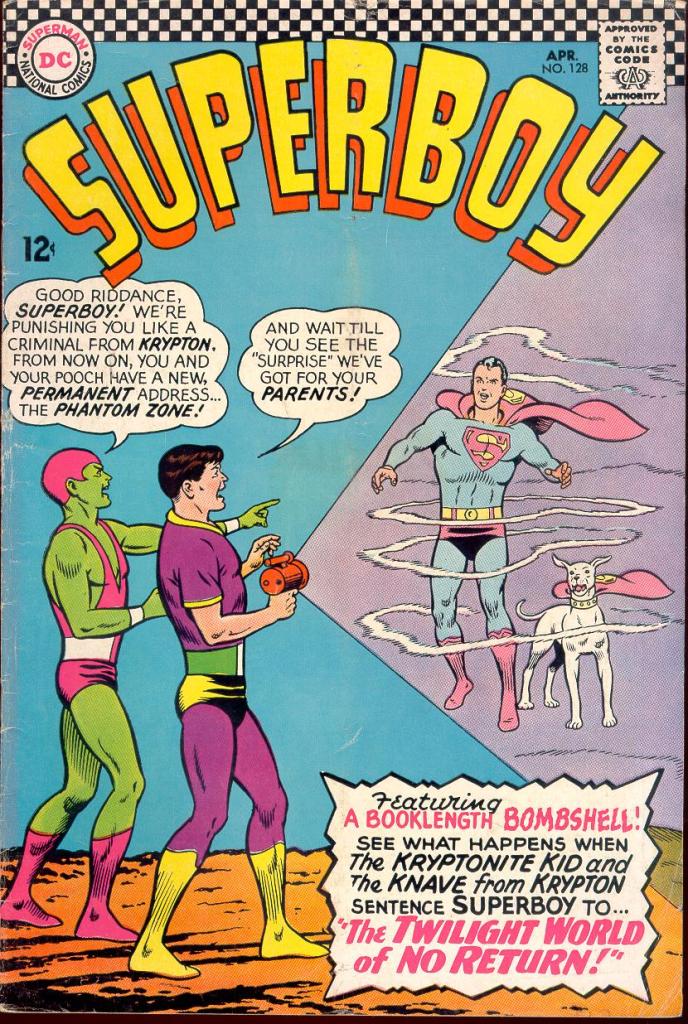
Hey, it’s a comic with Go-Go Checks! Go-Go Checks, for those who aren’t familiar, are that checkerboard pattern at the top of the cover. These ran on all of the DC titles for about a year in the mid-1960s. The intention was to make it easier for prospective buyers to spot the quality DC books on the stands, this being in part a reaction to the growing competition from other publishers, notably Marvel. But they wound up having something of the opposite effect, at least as far as big Marvel fans were concerned. And no dressing up of the covers would change the quality or appeal of what was being printed between the covers. The name was also dated practically from the get-go and sounded exactly like what it was: a bunch of middle aged men trying to connect with a younger generation of readers by speaking in the “lingo” that they didn’t really understand. You see a bunch of this sort of behavior from DC during the mid-late 1960s.

But the Go-Go Checks weren’t the only difference in the books of this era. The side of the original artwork had been reduced as well, resulting in pages that often seemed cramped and awkward as the artists adjusted to the new size and reduction proportion and writers and editors grew more conversant with how much copy could now fit into a given panel. There’s a lot of awkwardness until everybody makes the transition. Editor Mort Weisinger was also starting to mix up the format of his titles, more often employing book-length or even multi-part stories. And in book-lengthers such as this one, rather than being divided into three chapters, reduced page lengths instead culled them down to two chapters.
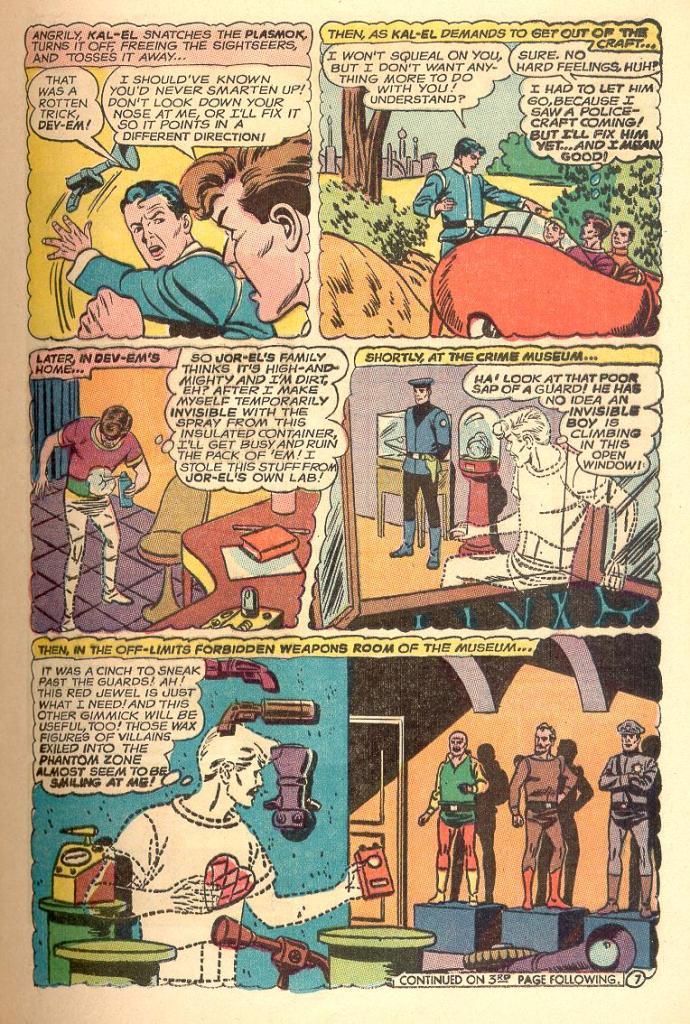
The story in this issue was written by the Boy of Steel’s creator Jerry Siegel and illustrated by George Papp in the first chapter and Al Plastino in the second. This must have been one of the last stories crafted by Siegel for DC/National Comics and editor Mort Weisinger–before too much longer, he’d begin legal proceedings to once again attempt to recapture the rights to his famous creation and be shown the door. Interestingly, despite a contentious relationship. Weisinger privately considered Siegel to be the best emotional Superman writer in his stable. Anyway, most of this story is an extended dream sequence steeped in the byzantine mythology that had been developed over the prior couple of years. It’s still told straightforwardly enough that the story can be followed without any prior knowledge, but most of the big story beats land better if you have some context for them.
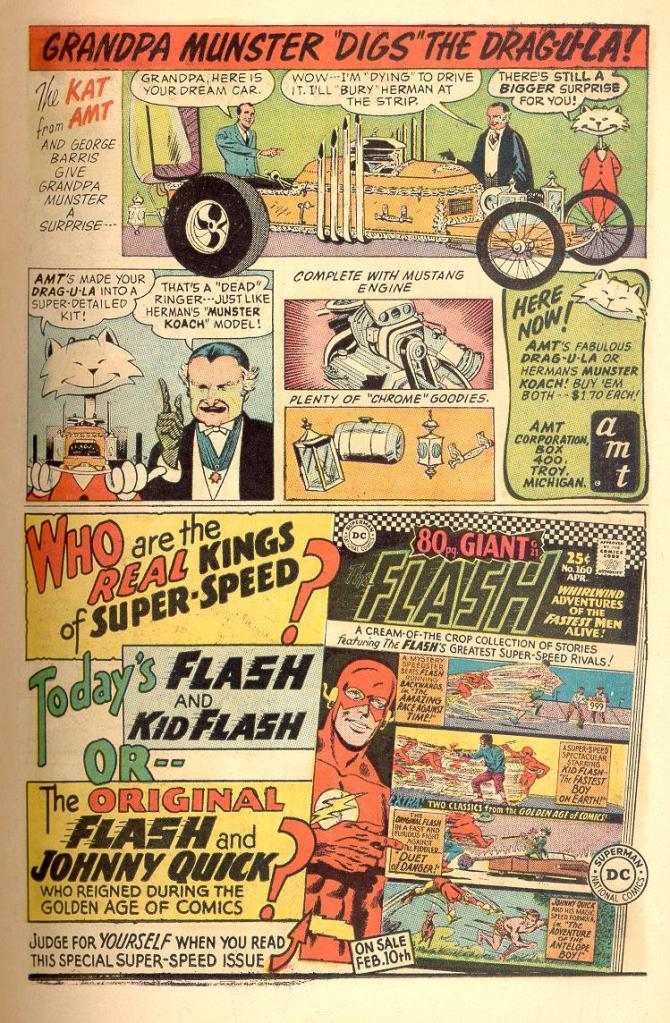
A quick pause here for a half-page house ad for an upcoming 80 Page Giant, this one featuring the Flash. By this point, the 80 Page Giants had stopped being Annuals or stand-alone specials and were instead factored into the ongoing numbering of the core titles they represented. So this particular 80 Page Giant was also THE FLASH #160.
This exciting adventure of Superboy begins with Clark Kent going to sleep. As he rests, he experiences an elaborate dream in which Krypton, his homeworld, never explodes and in which he isn’t rocketed to Earth to become Superboy. In the dream, Kal-El grows up having a regular childhood, including developing a friendship with his somewhat older neighbor Dev-Em, who is considered a bad influence. When Kal-El refuses to go along with his destructive mischief and Jor-El winds up being responsible for Dev-Em being caught in his misdeeds, the boy decides to take his revenge on the family. He does so by using a Forbidden Heart-Gem Weapon to turn Kal-El heartless like himself, and send him off on his own destructive spree. Eventually captured by the authorities, Jor-El has no alternative but to sentence his son to banishment to the ethereal Phantom Zone where all of Krypton’s worst criminals are kept insubstantial.
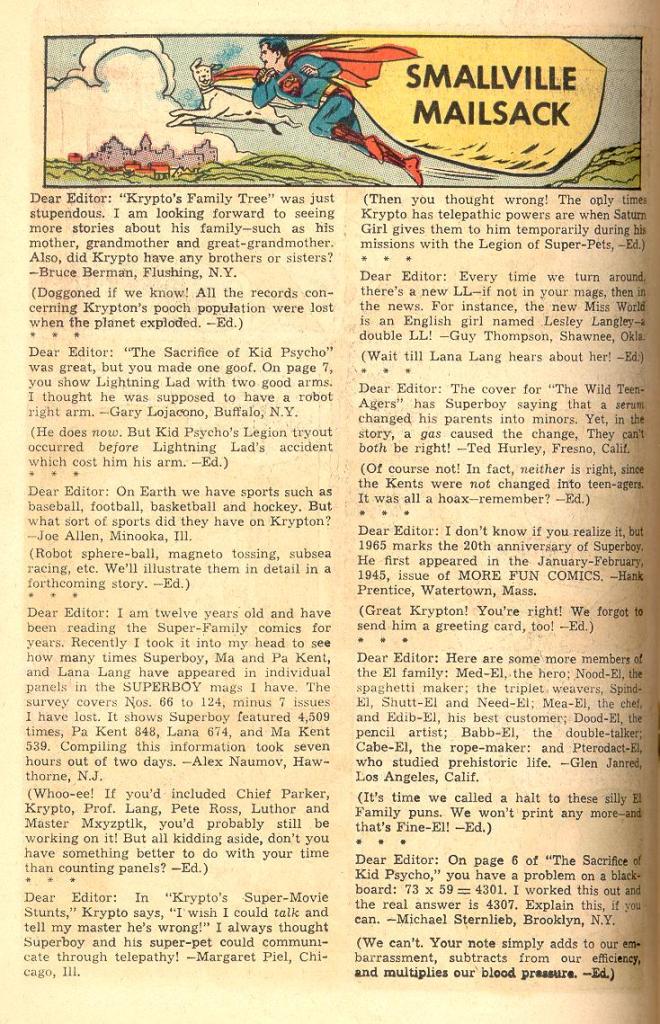
Ana a pause here for the Smallville Mailsack letters page. It may just be me, but by this time Weisinger’s letters pages seemed to be taking on a more aggressive tone. They were more prone to argue with the letter writers or to admonish them publicly. There was just a hint of meanness to them. Now, it’s possible that the page was now being written by Mort’s Assistant Editor E. Nelson Bridwell, but that doesn’t track either, as Nelson was a gentle soul who, despite possessing a biting wit, wouldn’t have been likely to employ it haphazardly against others.
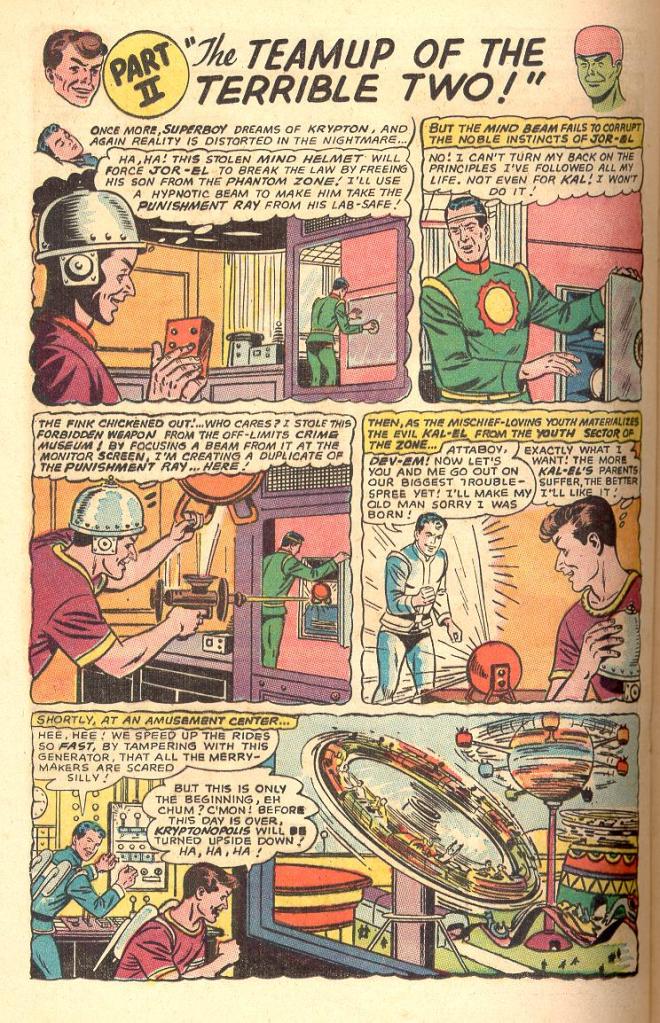
As Part Two of the story opens, bored without his hostile playmate with which to torment the El family, Dev-Em contrives to break Kal-El out of the Phantom Zone so the pair can resume their rampage. And they do, with anti-social results. Then, suddenly, the two juvenile delinquents are confronted by a green, glowing figure. This figure introduces himself as the Kryptonite Kid from teh planet Blor. Having seen their rampage on his telescopes, the kryptonite Kid has journeyed across the stars to put a stop to it. Now, I don’t know how you get a Kryptonite Kid with no planetary detonation to turn the remains into Kryptonite, but this is a dream, so we’ll just roll with it here. Superboy himself wakes up momentarily to ponder this very point, after all.

As though this story wasn’t batshit enough so far, events now kick off into high gear. The Kryptonite Kid chases Dev-Em and Kal-El into an experimental spacemobile, in which they rocket off to teh stars. Eventually, the enter a solar system with a yellow sun, which gives the two Kryptonian youths super-powers. But the kryptonite Kid is able to permanently take those powers away by radiating Gold Kryptonite rays at the pair, and he’s able to take them into custody. But in a last desperate play, Dev-Em uses that same Forbidden Heart-Gem Raygun on the Kryptonite Kid, causing him to go bad as well. Now, though, its time for Dev-Em’s ultimate revenge on the Els. He reverses the Heart-Ray on Kal-El, turning him back into a good kid before projecting him back into the Phantom Zone. Then he turns the ray on Jor-El, making him evil. (Dev-Em repeatedly refers to any good people as “Cubes”, again some slang that was years out of date by the time this story saw print.0 Finally, Dev-Em convinces the wicked Jor-El to destroy Krypton, which Superboy’s father willingly does, perishing in the explosion himself while Kal-El can only watch horrified as a disembodied phantom.
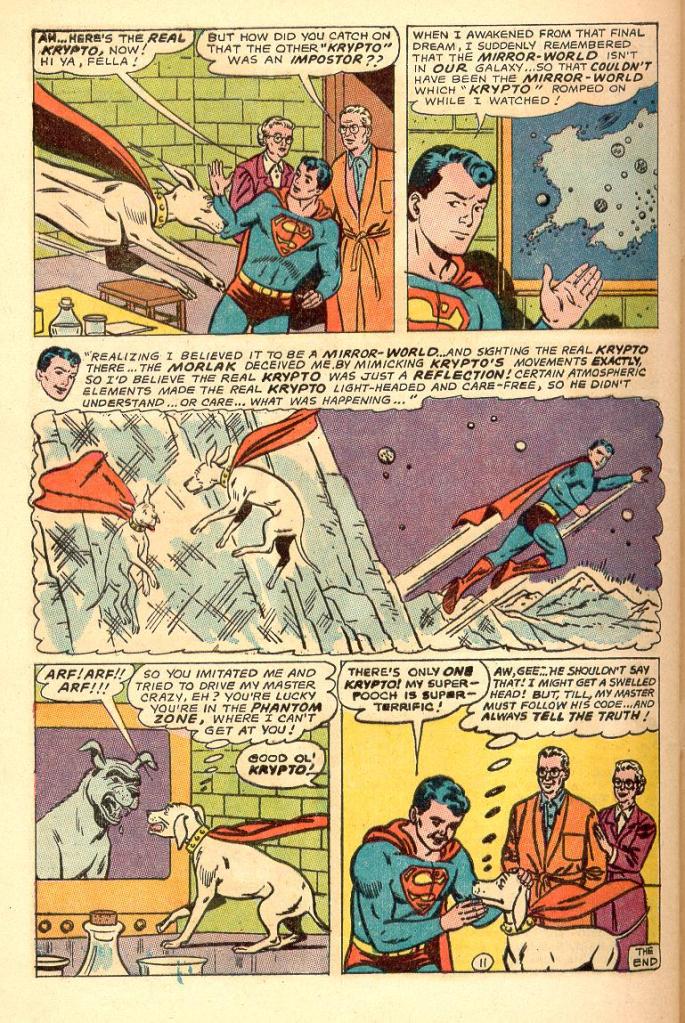
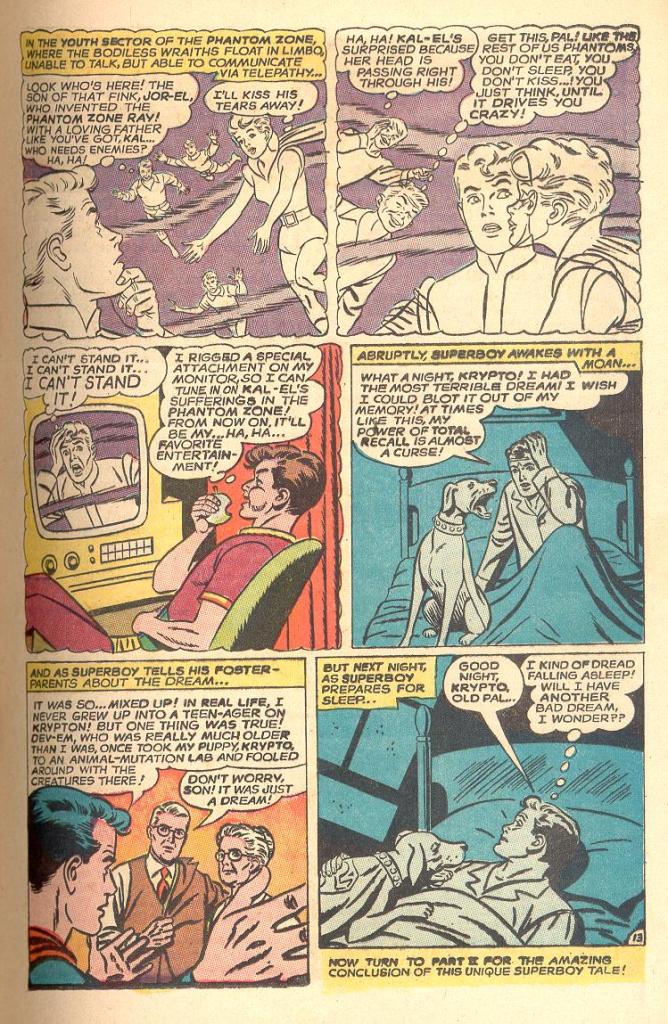
This latest dream causes Superboy to awaken with a starting realization about why he’s been having such bizarre nightmares. He races to get the Phantom Zone projector and projects his faithful dog Krypto into the Phantom Zone. It turns out that this isn’t actually Krypto at all, but rather a Kryptonian Morlak which the real Dev-Em had once altered to resemble Krypto. Having taken the dog’s place, the Morlak had been using its telepathic powers to give Superboy nightmares to drive him insane. It’s a real left-turn wrap-up to what had been a book-length dream sequence, and I can’t say that I found it at all satisfying. But this was the sort of controlled nonsense that Mort’s titles put forward on a regular basis, so you sort of became used to this kind of thinking after a while.
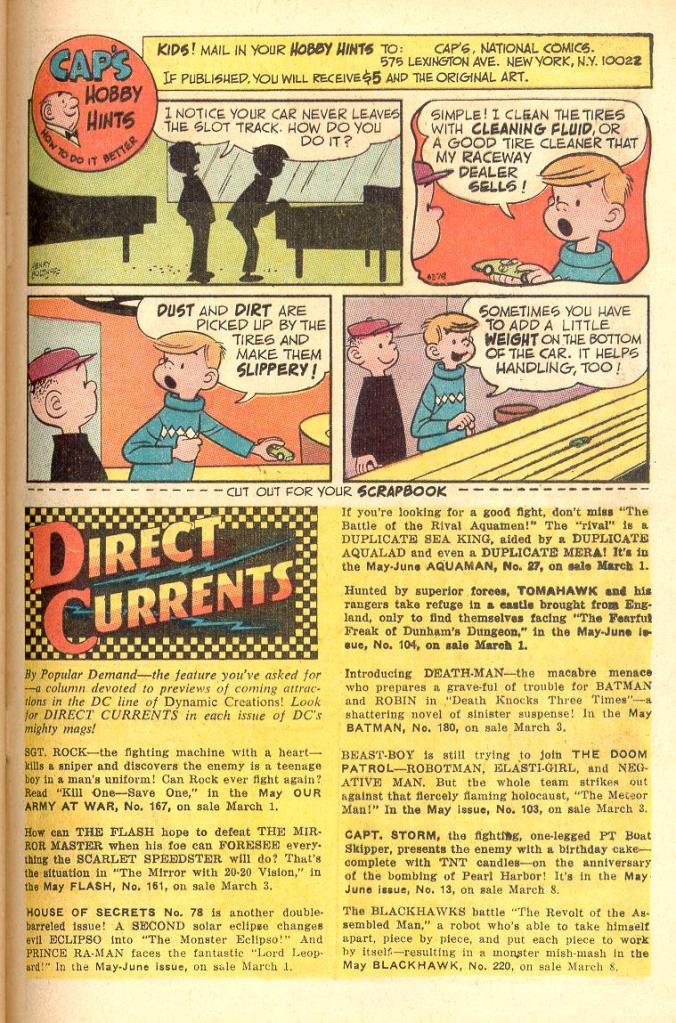
Finally, in emulation of the Mighty Marvel Checklist, the DC books had intermittently begun running Direct Currents, their own upcoming checklist feature. It never quite caught on in the way the Marvel equivalent did, partly because its copy had a bit more artifice to it, and partly because it didn’t run with enough regularity–it would turn up now and then, then vanish for a month or two before returning. So it wasn’t a feature that could be counted on or expected.
 The Tom Brevoort Experience
I’m from a later generation, but I can never read these comics because the emphasis is on the writer’s contribution (the words) and the artist just always to be complying (so the pictures are secondary). They just read like scripts with very little visual punch or panache. Having recently looked at Kuwata Jiro’s Bat-manga — where he actually adapts Batman comics from the same time — it is clear that that the story kernels were good, the villains could be interesting, etc., if the publisher would (like in Japan with Kuwata) just give the artist space to breathe and work. Tom, I’m glad you’re reading these for us — I cannot feel any of what’s cool in these oldies.
LikeLike
Love the mention of “the Krypton Crawl!”
LikeLike
I always associate the DC go-go check era with the “Marvel Pop Art Production” era.
LikeLike