

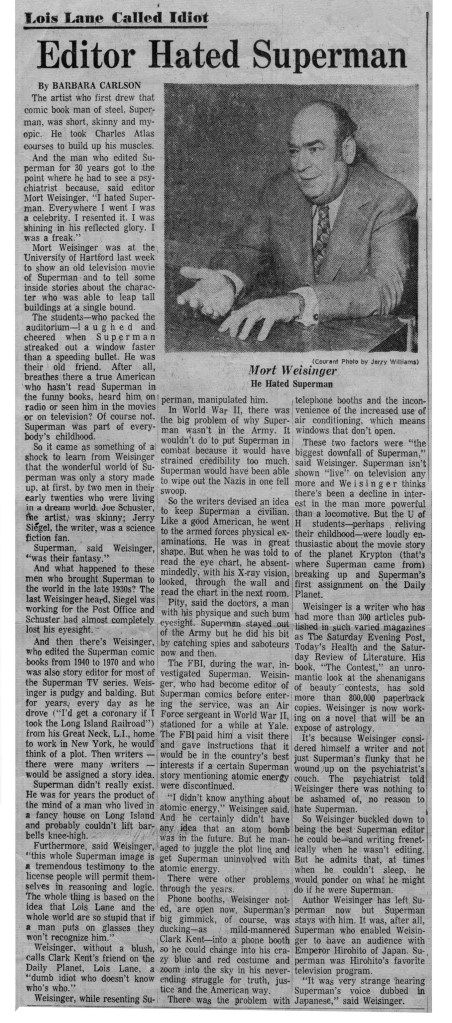
In the 1970s, longtime Superman editor Mort Weisinger took a cue from rival Stan Lee’s playbook and began to tour the college circuit himself, lecturing on the Man of Steel and screening episodes of the 1950s television program THE ADVENTURES OF SUPERMAN. In this, he wasn’t as successful as Lee, even with visual aids. But it did lend him an occasional newspaper write-up in his post-retirement days, such as this one. It’s pretty astonishing that Weisinger is this direct and honest with the interviewer abut his own hang-ups and weaknesses.
 The Tom Brevoort Experience
Very interesting, but I have some difficulty making sense of parts of that article. I find it hard to believe that Weisinger really said that the two factors of “the biggest downfall of Superman” were phone booths are open now and many windows won’t open now. Maybe that was meant as a joke, and the reporter took it seriously. Besides, Superman changing in a phone booth, while there are instances, was actually extremely rare.
More significantly, what comes through is Weisinger’s unhappiness at what he apparently viewed as his job of grinding out popular pap. He may do it well, he may do it profitably, but he’s not writing the Great American Novel. This is something I’ve seen in some of the deeper examinations of Stan Lee, where he was also a frustrated writer, but didn’t tend to mention it except in the lightest of ways. Then again, this is hardly an unknown feeling among writers in general.
LikeLike
Did Weisinger ever write that book about astrology?
LikeLike
Items like this make me realize that Stan Lee was underrated. Yes, I said underrated.
The vast majority of Lee’s contemporaries readily acknowledge that, whatever his specific failings (and yes, he definitely had them), he was a superb editor who possessed a sense of what would sell, who really made almost everyone who worked under him at Marvel Comics feel genuinely enthusiastic about being there, who was incredibly hands-on in an encouraging way that helped the people under him learn the ropes in the biz, who projected a genuine enthusiasm for the material towards the audience, never treating the readers in a condescending fashion and working to broaden his books’ readership both in terms of age range & demographics, and who had an absolutely brilliant rapport with the public. In other words, both inside and outside the offices of Marvel Comics, Lee was the absolute greatest promoter & cheerleader of the company & its products.
In other words, the exact opposite of Mort Weisinger, a man who seemingly oozed contempt for the material he was in charge of producing on a monthly basis, who saw superhero comic books solely as a medium for young kids, who treated his subordinates in a horrifically abusive manner, and who was really poor at promoting DC Comics to the general public.
And the thing is, people like Weisinger are much more common in this world than people like Lee.
LikeLiked by 1 person
In addition to agreeing with everything Ben Herman said about Stan Lee, I would add that Stan had a generally good sense of how to respond creatively to readers’ opinions.
It recently occurred to me to wonder: who was the architect for Sue Storm to get force field powers? Not Kirby. He wouldn’t have been reading the kind of fan mail Stan responded to in FF 8, where Stan tried to defend Sue against dweebs who didn’t think she “did enough.” But Stan probably thought he ought to give Sue more agency, and so it’s most likely (if unprovable) that he would have suggested to Kirby “beef up the girl’s powers.” Now Kirby would probably been the one to come up with force fields. Logical idea, since one of Kirby’s big successes was a guy with a shield, and the group didn’t have anyone who had any kind of shield. So that huge improvement of the character came about IMO because Stan thought the fans had some reason for their complaints.
In comparison, Weisinger is said to have responded to fans’ opinions as well, and sometimes that may have resulted in good stand-alone stories. (I’ll spare you my theories on which ones.) But it’s harder to draw any clear lines, partly because Weisinger had the rep of swiping proposal ideas from writers in his stable and assigning them to other writers. I think that in the late fifties and early sixties, he finally got the chance to soup up the Kryptonian elements of the Superman stories, which had started to get more exposure in the early 50s with Krypto and so on. But at the end of the day, none of the stories he edited belonged to him, it was all DC property. More, his great success, his only claim to any fame, was someone else’s creation, as his lecture briefly referenced. I’m sure he got really tired of doing stories for kids, and maybe Stan got tired of it about the same time. But Stan didn’t get tired of engaging with fandom. For him, it was a challenge, like being a comedian responding to both praise and catcalls from the audience. I don’t know what Weisinger thought he’d get out of dissing the only thing for which anyone in his time validated him, though.
LikeLiked by 1 person
“Superman didn’t really exist.” ? Well there’s a scoop for you. The interviewer seems clueless about his subject.
As a couple of comments above point out, it’s hard to imagine Stan Lee talking this crabbily about his work.
LikeLike