

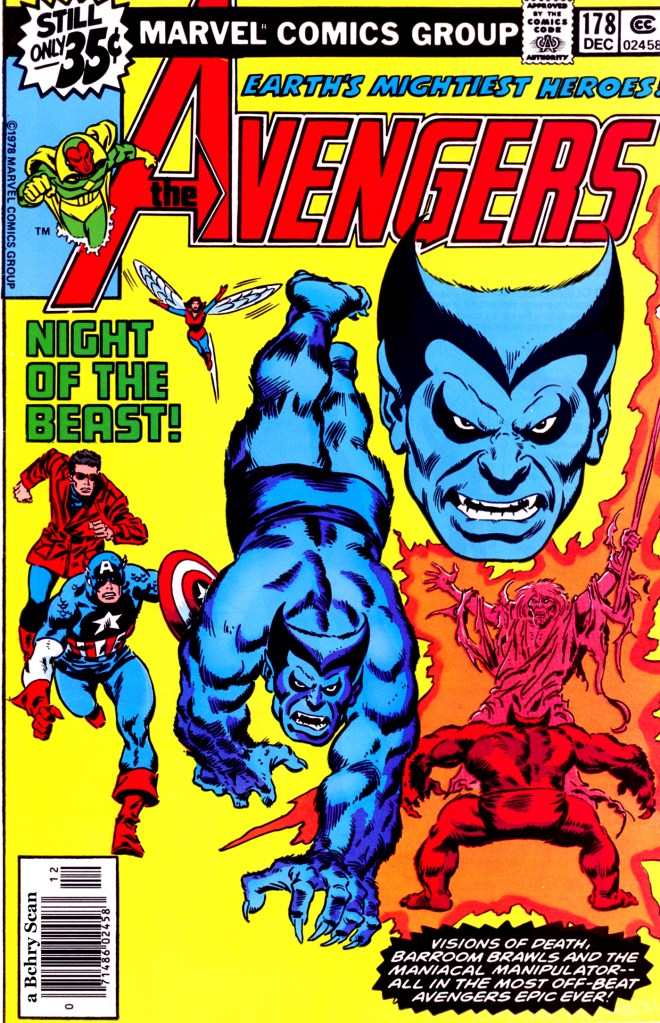
This issue of AVENGERS, frankly, baffled me. We were coming off of the climax of the Korvac Saga the previous month, where the entire Avengers line-up had been killed and only resurrected in the final moments. So my expectation is that we’d see these circumstances followed up on in some way. What I wasn’t anticipating was an unrelated fill-in story, one that looks to me like it may have been intended as an issue of MARVEL PREMIERE or some such. It starred the Beast, which was good–the blue furry version of the character was a real favorite of mine at this time, whether in AVENGERS or X-MEN (where he was making an extended guest appearance). But the story itself was so absurd and crazy that I didn’t like it at all. This wasn’t my first experience with the work of writer Steve Gerber, but it was an early one, and one that put me back on my heels a little bit.
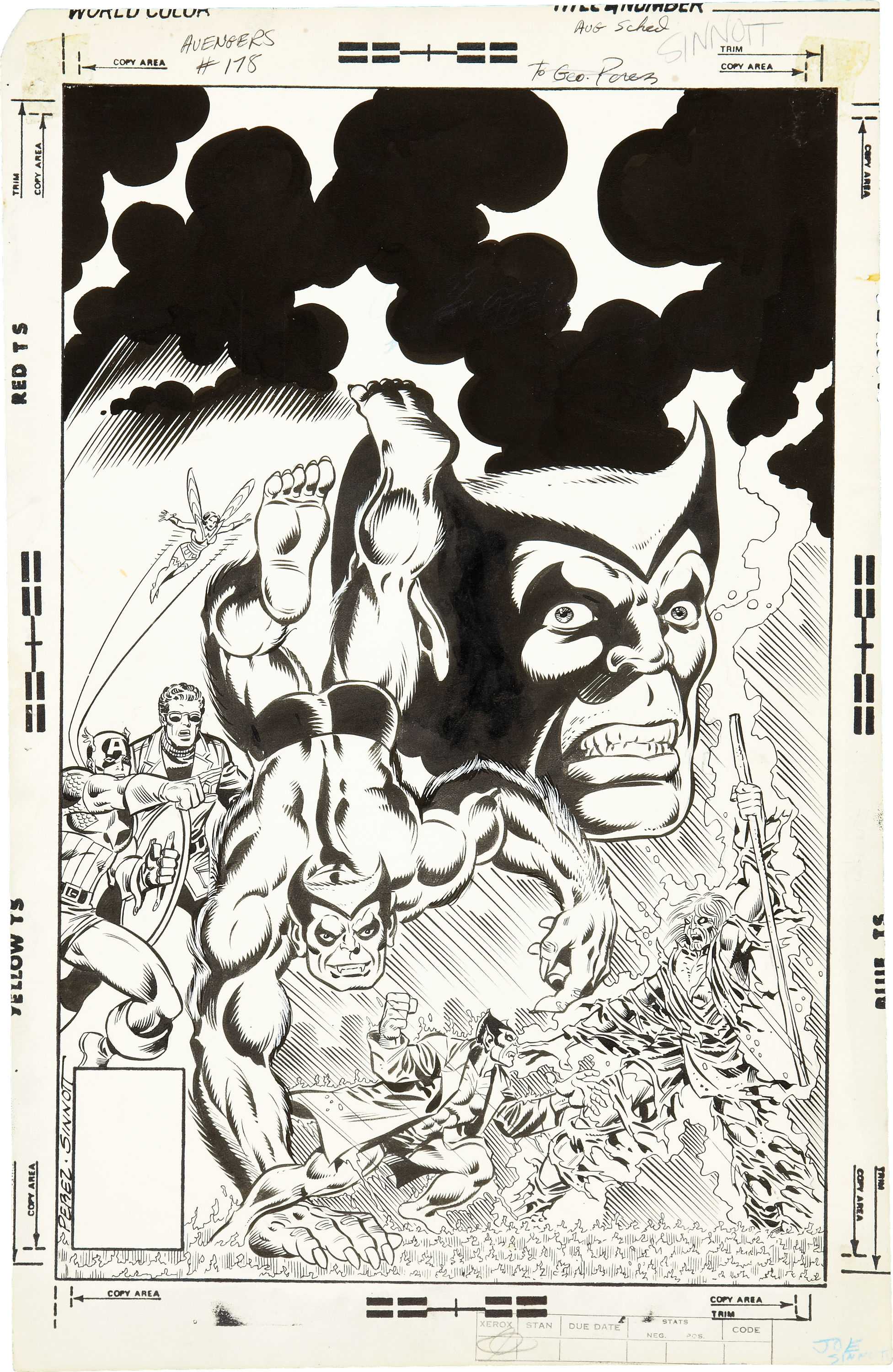
It’s worth noting that the John Buscema cover on this issue was an emergency replacement, jammed out by John after the initial version, which had been penciled by George Perez and inked by Joe Sinnott, vanished in transit from Sinnott’s upstate homestead and the Marvel offices. It’s interesting to compare these two pieces, as they were clearly both working from the same concept (and possibly a sketch by Dave Cockrum or Marie Severin) but the manner in which they approached the image was very different. Both pieces work, though–I have a bit of a preference for the Perez version, though, simply because his interpretation of the Beast was always one of my favorites, In fairness to Buscema, though, he no doubt knocked his version out, pencils and inks, in less than a day.
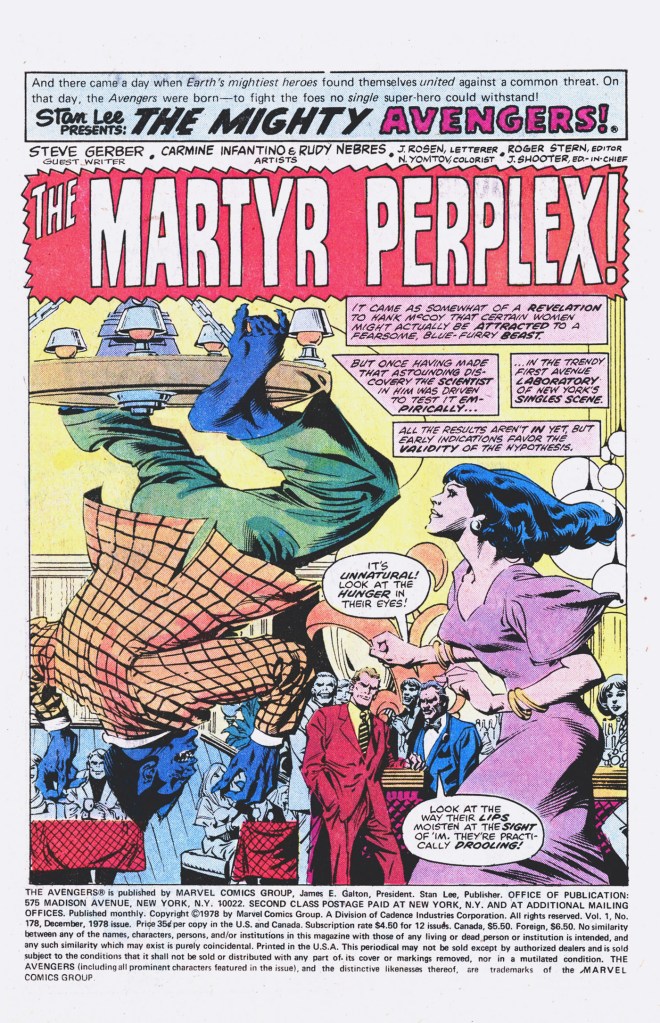
The artwork on this issue was produced by the odd pairing of Carmine Infantino and Rudy Nebres. Carmine was an old pro, the former publisher of rival DC Comics who had been unceremoniously let go and forced to resume his previous career as an artist. His style had grown more stylized and abstracted over the years, making him somewhat of an acquired taste to readers of the Marvel books of the 1970s, whose house style sat comfortably between John Romita and John Buscema. Carmine could tell a story, but his characters often looked weird and sharp, and his shot composition was uniquely his own. Perhaps in an attempt to tone down Carmine’s more pronounced idiosyncrasies, here he was paired with inker Rudy Nebres. Rudy was one of a wave of Filipino artists who came into the industry during the 1970s. He had a lush brush line, but he was enough of an artist on his own that he tended to smother any penciler over whom he worked. consequently, this story looks a bit muddy and uneven, as though Infantino and Nebres are battling it out for dominance in every panel.

As a writer, Steve Gerber was just as individual as Carmine was an artist. Since breaking into the field, he eschewed the Marvel/Stan Lee house style of adventure and soap opera in an attempt to write stories that explored ideas he was personally interested in. As such, he was one of those writers whom older readers really clicked with, as he stood out from the pack. But younger readers–and I include myself among this crown–often found his work frustrating and unengaging. We were there for action and fantasy and fun, not whatever psychological exploration Gerber was putting forth that issue, and so it took a bit of living to get to the point where Gerber’s work might speak to you. This issue of AVENGERS is a good example, in that even today I don’t think it’s successful, but it’s certainly memorable in its failure.
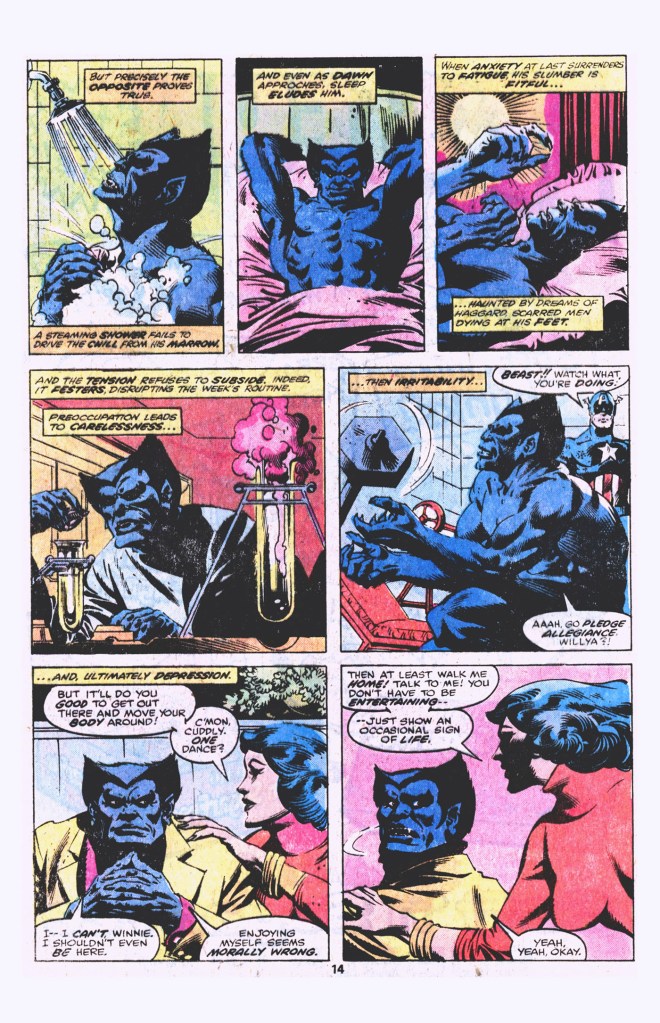
This story isn’t about facing off against some super -villain or menace, but rather about putting Hank McCoy through a voyage of self-discovery. It opens with the Beast partying one evening, earning the appreciative glances of beautiful women and the scorn of men who’d like to be receiving those glances. This quickly turns into a brawl because a Marvel book needed a prerequisite of action. The Beast comes out on top, but knowing that he’s not wanted, he retreats out into the stormy night, depressed. There, he’s confronted by the apparition of a ragged figure who tells Hank that there’s something inside his soul which needs killing–before the figure is struck down by an errant lightning bolt and charred to dust. Returning to Avengers Mansion where he’s been hanging his hat, the Beast doesn’t know what to make of what he’s just experienced.
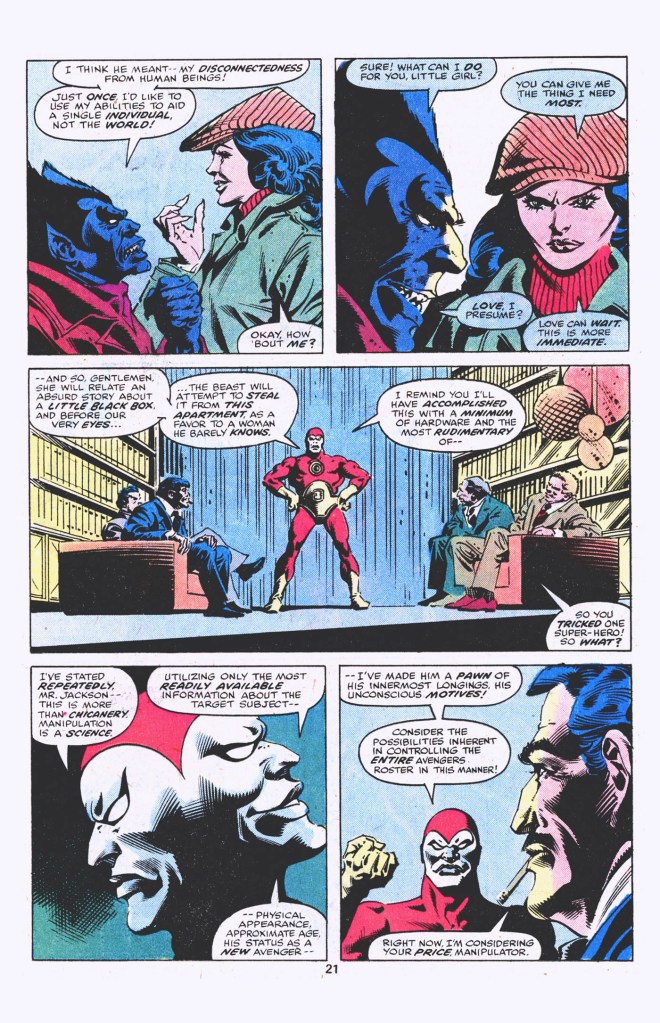
Troubled, and unable to get any good council from his fellow Avengers, the Beast reaches out to a woman he knows from the club scene. The two of them talk about his situation, with the Beast revealing to her that his experience with the ragged figure has forced him to confront his own sense of loneliness and alienation from the world. He feels the need to help a single individual in a personal way–and fortunately, the woman has a job she needs doing. A box that belonged to her father and which contained his life’s work has been stolen and she wants the Beast to get it back. But this entire mission is an artifice, one set up by a new character, a twin-faced figure calling himself the Manipulator. He’s responsible in convincing the Beast to do something that he would ordinarily never do, and he offers his services to an assemblage of underworld figures. Making the Beast come to them will prove his bona fides.
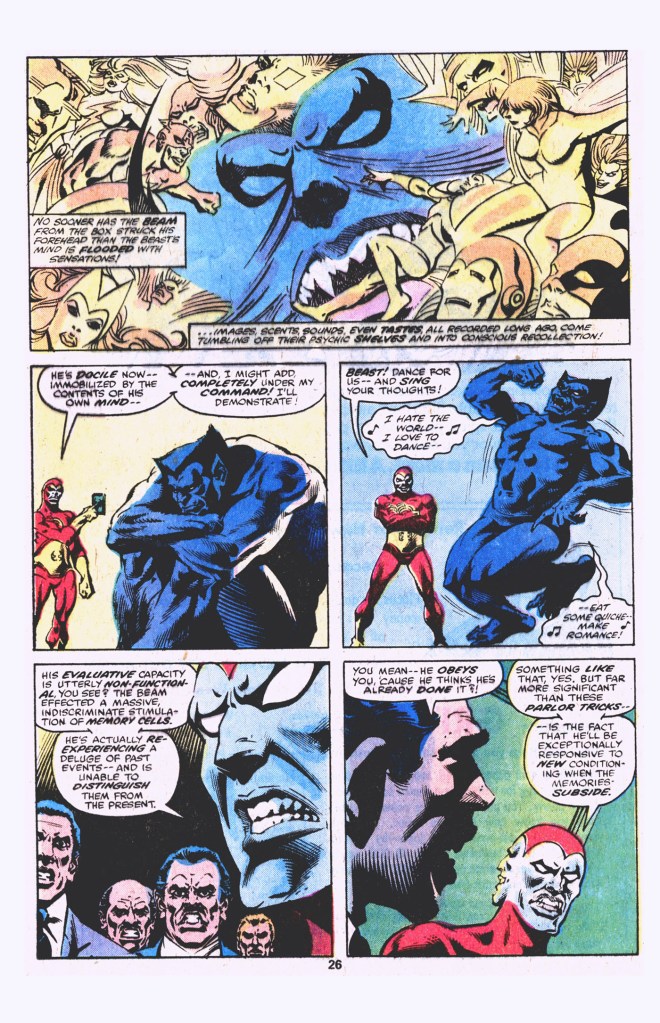
As the Beast attempts to recover the box, he finds himself trapped within an electrified cage and confronted by the manipulator and the criminals. What’s more, what the box actually contains is a device that bombards the Beast’s mind, causing him to become unable to separate memory from reality, fact from fiction. Having proven his power, the crooks are all too happy to meet the Manipulator’s price–but as soon as they hand him a check for his services, he turns and zaps them as well, revealing that he’s actually in the employ of “The Company.” A pair of company agents show up to make sure that the crimelords are carted off by the authorities, and to pay the Manipulator for his services. Apparently, this has all been in the service of creating a failsafe plan should the Avengers or somebody like them ever prove themselves to be a threat to the nation. But it’s a little bit unclear, hidden between the lines of what is said.

Moments after they’ve departed, the Beast himself comes to, feeling very much rejuvenated. He doesn’t think anything of the assorted criminals who are lying scattered around on the floor, nor about what might have happened to him. Happily, he leaps out the window and off into the night. The two Company agents are relieved to see that this experiment hasn’t had any negative effect on the Beast–when suddenly they are attracted by a cry from off-panel. It’s the ragged figure, who appears before them and tells them that something within their souls has to die. But wasn’t he just a manipulation by the Manipulator? Did Hank have a legitimate religious experience? It’s all open to interpretation. But the entire story is weird, and as a reader I found it unsatisfying.
 The Tom Brevoort Experience
I got this off the racks and had pretty much the same reaction. As a solo adventure story it doesn’t give the Beast much to do other than mope…. and the last panel is just a head scratcher all around. He came to die for 2 guys now?
LikeLiked by 1 person
Totally agree. I was flabbergasted just coming off the high I had from #177 Korvac climax. Was disappointed because the story was not really about the Avengers and was missing my favorite character the Vision. Artwise I was expecting Perez to make a comeback or Sal Buscema to fill in. I still have the issue as part of my collection, but read it only once in my lifetime…….
LikeLike
Born in 1961, I’m a slightly older reader who adored Gerber and his runs on Defenders, Omega, and Man-Thing, Stuff like this? Not a fan at all and similar stories like it killed me being on the lookout for new Gerber stories. If he worked on a book I was already getting, fine but that was it.
LikeLike
Sorry to disagree with you but I absolutely loved this story! I did not care for Carmine infantino’s work but I loved seeing Rudy Nebres, who usually only did black and white books for Marvel.
I agree that it was jarring to go from the Korvac saga without any explanation to this, but this book still remains one of my favorites.
LikeLiked by 1 person
As unsatisfyingly odd as this issue is, “I feel like somebody smeared my brain with Vicks Vapo-Rub!” has to be one of the great lines of comicbook dialog.
LikeLiked by 1 person
“I’d love to stay and chat — especially with your choreographer” works for me too.
LikeLiked by 1 person
I bought this as a back issue in the early 1990s. I’m a fan of Rudy Neberes’ work, so I very much enjoyed the art on this issue. But like yourself, I found Steve Gerber’s story nearly incomprehensible. Nebres did inks / finishes over Carmine Infantino on at least one other occasion, Star Wars Annual #2 in 1982, which also looked really good.
I’ve seen the unpublished Perez & Sinnott cover before, and like yourself I prefer it to the published one. I was always curious why it was not used, so thanks for providing the background on it.
LikeLiked by 1 person
this was a mess. Gerber’s weirdness didn’t fit well with a one-shot standalone story such as this. And the Beast is one of the least angsty mutants so making him Scott Summers tormented didn’t improve things.
LikeLiked by 1 person
Totally in agreement. Bad enough that it felt like a fill-in (followed by The Stinger(stinker?) fill-in 2 parter), but I couldn’t make heads or tails of the story.
LikeLiked by 1 person
Count me in with the yay-sayers…I liked this better than the whole Korvac thing before it. The fact that it was somewhat baffling was a plus to me – as that character said “The world is a strange and mysterious place”…and here was proof! And hey, it was one issue, hardly about to break the bank credibility-wise with those who didn’t like it.
LikeLiked by 1 person
Born in 1954, I’m even more slightly older than Steven. I don’t know if total life experiences had anything to do with it, but I liked it too. Seeing Steve Gerber’s name, I knew what I was in for before I entered. And it was good to follow the long long serial with a done in one, introspective story felt to be just right. Helped us catch our breath and remember the story.
LikeLiked by 1 person
I’ve always liked that John Buscema cover. Extra cool he inked it himself. So it was a necessity of time, I’ll take it. I’m more partial to his style than What George & oe produced in the original. Perez’s art work in “New Teen Titans” & especially “Wonder Woman” is pretty much untouchable for me. His best. He did some nice Superman stuff in his brief “Action Comics” run.
But the figures on his & Joe’s Avengers are stiff. The faces oversimplified. It’s “over-inked”. The figures are cluttered. J. Buscema’s figures are more dynamic and more naturalistic here. There’s less ink on the Beast, but everything is there. The lighting, the shaggy fur. George leaves more space between Beast’s nose & mouth, similarly to Jim Starlin’s style. Buscema doesn’t, but it also doesn’t hurt his version of the Beast for me. Everything else about Buscema’s just looks really good to me. Cap & Wonder Man come off better, too (though Wondy should be @ least as well-built as Cap, but again, it’s the time factor, & everything else is so good). The Beast’s form just looks like it’s capable of performing how we expect.
I’ve never been a fan of Carmine Infantino’s drawing. Not the more dainty, reserved Silver Age style, or his angular, abstract approach (except maybe when inked by the great Klaus Janson). I am a fan of Rudy Nebres. His lighting & some of the wispy lines make me wonder if he ever inked Gene Colan, because I think his inks would be complimentary. The lady in the purple dress is a good example of those lush strokes. I’m also reminded of Kevin Nowlan. Lots of similarly dramatic lighting & shadows. And Nowlan can often dominate the drawing by another artists he’s inking. But I don’t recall Nowlan receiving as harsh criticism as Nebres & other strong, distinctive inkers get. Rudy totally upgrades the art in this issue to me. Finesse, elegance, mood, atmosphere, & a dark, naturalism that saves the art. I love that headshot of the Beast in Panel 1, on Page 31.
LikeLike