

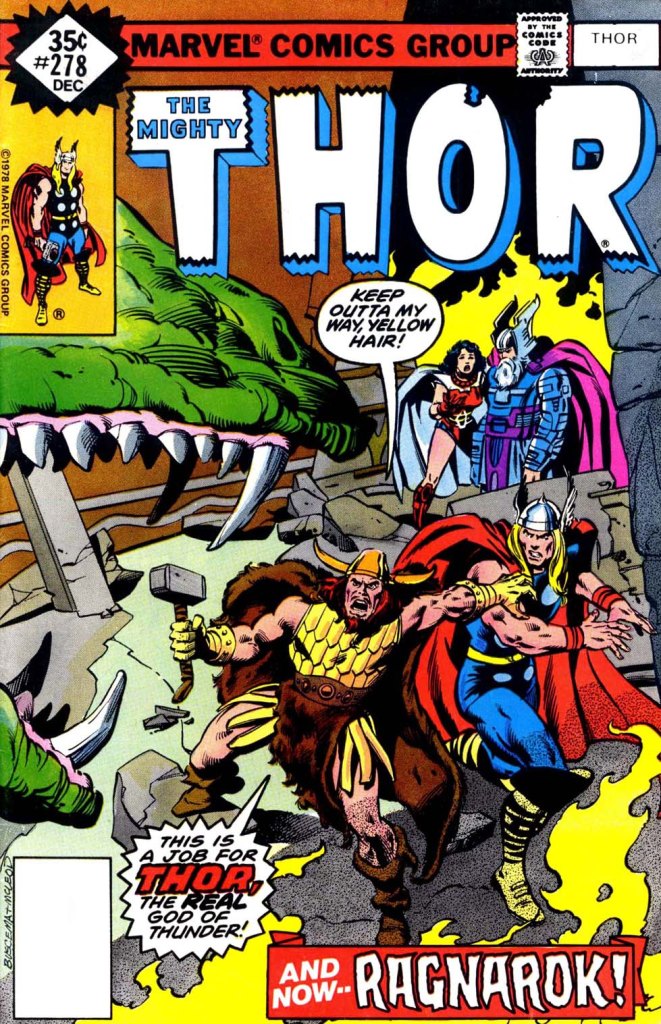
This issue of THOR featured the wrap-up to the long-running Ragnarok sequence begun by writer/editor Roy Thomas, a saga that felt like a saga to me even as it was coming out. Looking back, the story is more of a mixed bag than I had considered at the time, when I was very much into the idea of a second more mythologically-accurate Thor being created as a key plot point. The real shame of the issue is that inker/embellisher Tom Palmer was not in attendance–his strong finishes over John Buscema’s penciled breakdowns had give the title a signature look in my eye, one that substitute finisher Chic Stone couldn’t quite match.
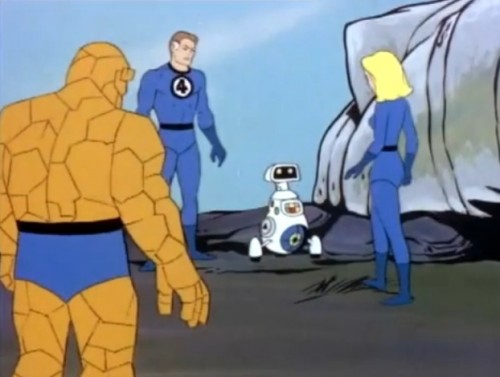
But before we get into the issue itself more deeply, we should talk about a thing that happened the Saturday after this issue of THOR saw print. This was the debut of NBC’s new FANTASTIC FOUR cartoon series, which I was super-primed for (despite the fact that the Human Torch was replaced by the STAR WARS-derived HERBIE the Robot.) Put plainly, the NEW FANTASTIC FOUR cartoon wasn’t any good at all–it stank. But I dutifully watched it each and every week regardless. In a strange bit of poor judgment, the show was produced “Marvel style”–which is to say that most episodes were plotted by Jack Kirby as he did his storyboards for the animation, and then another writer–Stan Lee and Roy Thomas both worked on episodes–would add in the dialogue afterwards. But animation is a different medium than comics, and this approach was impossible to make work well. On top of that, the actual animation itself was crude and penny-pinching, and the show was under strict regulation from the network censors to eliminate pretty well anything that would constitute violence of any kind. Pretty difficult to do a super hero show when none of your characters are permitted to throw a single punch.

Anyway, back in the pages of THOR, Chic Stone was having difficulty filling Tom Palmer’s shoes. Stone had spent a year in the 1960s inking Jack Kirby’s work on pretty much everything the company had published, and his strong linear style elevated the artwork from the haphazard inking it had been getting before. But Stone’s style was very open, he didn’t use many areas of solid black, causing his detractors to often describe his inked pages as looking “like a coloring book.” This issue of THOR suffers from that approach a bit, though it really isn’t a bad job at all. It just isn’t Palmer, whose command of texture and shadow had helped to make Asgard a place that was at once ancient and mysterious but also plausible and lived-in.

So, drawing upon the genuine mythological tales about the coming of Ragnarok, Roy Thomas had been steadily bringing about its approach. Balder the Brave had been felled by an arrow of mistletoe, the only substance to which he was vulnerable, and despite having been placed in a protective healing aura by All-Father Odin, at last his life force seems to have run out, heralding the advent of the final day of the Gods. Meanwhile, Earthly reporter Harris Hobbs and his news crew had conned their way into Asgard, where they find themselves as witless observers to these harrowing events. One of Hobbs’ men, cameraman Red Norvell, had been seduced by Loki into stealing Thor’s belt of strength, iron gauntlets and enchanted hammer, making him the new Thor–but a Thor who wasn’t interested in Ragnarok, and who had instead taken off with Lady Sif in tow. Now, the true Thunder God was forced to face his final moments armed only with a regular old sword.
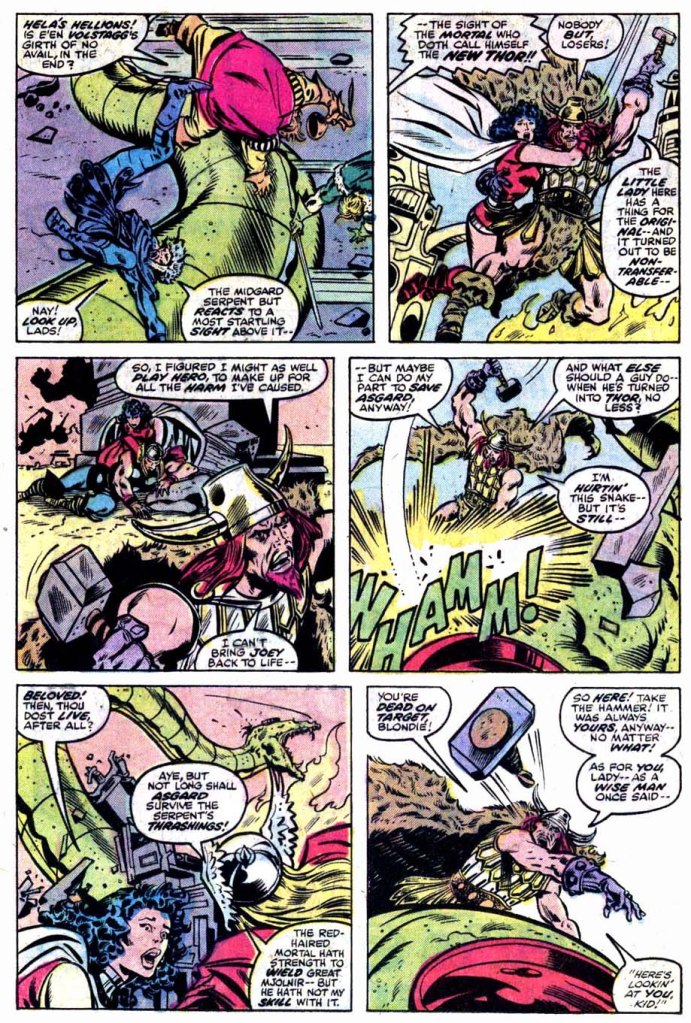
And so, the final day plays out, including Thor’s conflict with his eternal foe Loki. But the God of Thunder is fated to perish in battle with the Midgard Serpent whose coils encircle the entire Earth. Bare-handed, Thor isn’t a match for the Serpent, and so things look dim. But that’s when Norvell and Sif show up–Sif having appealed to Norvell’s better nature and convinced him to return and lend his strength to the fight as well. But even with his newfound power, Norvell isn’t enough to take down the Midgard Serpent, and so he tosses Mjolnir back to its true owner as he awaits his final moment.

Jormungand, the Midgard Serpent, has been injured during the battle, and so it dives deep into the ground, carrying Red Norvell with it–only to re-emerge moments later all on its own, the implication being that Norvell is dead. Enraged at his sacrifice in his place, Thor hurls himself into the fray with renewed abandon. And as the battle rages on, the combatants all begin to realize that they’re not in Asgard at all, but rather some distant field far away from the Golden City. As the Midgard Serpent is vanquished, the assorted army of the enemies of Asgard breaks and flees–and seemingly, the prophesies of Ragnarok have been proven false. Mind you, that’s cold comfort to those who have lost their lives, in particular Red Norvell.

It’s at this point that Odin shows up, to explain what should be obvious: in an attempt to thwart fate and cheat teh prophesies of Volla, Odin himself manipulated many of these events, including the creation of a second Thor to die at the hands of the Midgard Serpent rather than his actual son. Thor’s a bit peeved at this, but the matter is swiftly brushed aside for more plot-based fare. To wit: now that the future of teh Gods is for them to determine, Odin wants Thor to remain at his post and abide permanently within Asgard once again. He forbids the Thunder God from ever returning to Earth. Odin in these days had been largely played as a wise and merciful figure despite his awesome visage, but this was the point where a bit more cynicism was layered into the character, making Thor’s later declarations about the omnipotent perfection of the All-Father ring just a little bit hollow.
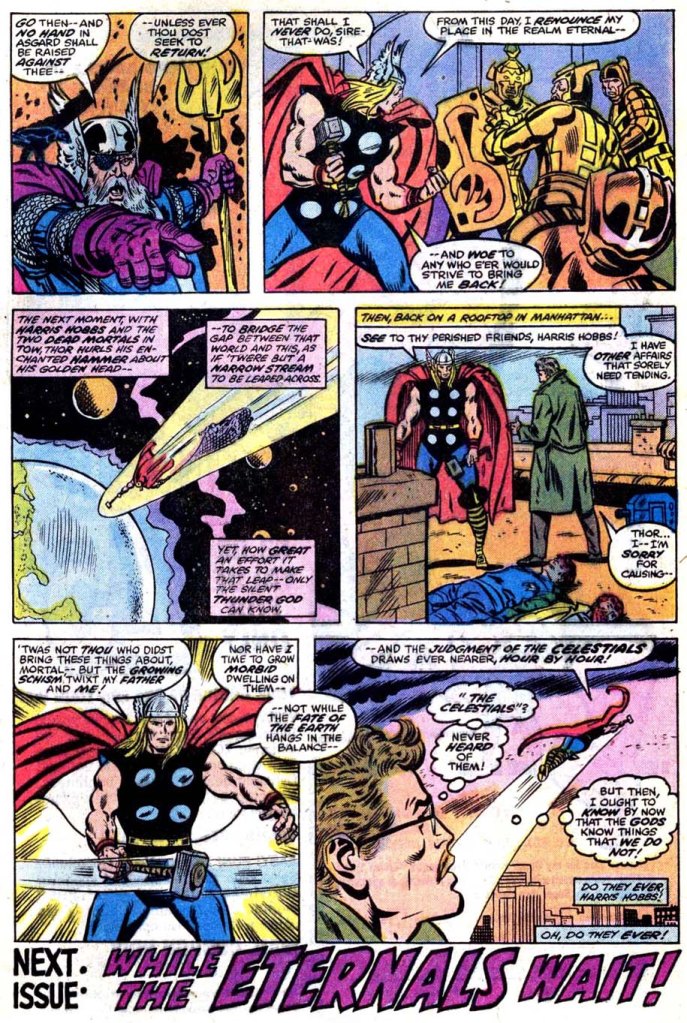
Thor is absolutely not down with Odin’s proclamation and insists that he is going back to Earth–even if he needs to renounce his Asgardian heritage to do it. Odin thus exiles his son, telling Thor that he will no longer be welcome in the land of his birth. Conveying Harris Hobbs back to Manhattan, Thor leaves him with dire tidings of an impending threat by the Celestials. This was, as far as I can recall, the first time the Celestials had been mentioned in THOR, and so where Thor’s concern about them was coming from was a mystery to me. Part of that is that I had missed a THOR ANNUAL (my local 7-11 stopped carrying any oversized comic books for a time, and this Annual was one they never got) that had seen print during this saga. And this was going to be Roy’s next big epic: attempting to reconcile Jack Kirby’s ETERNALS mythology, which had been created as a stand-alone series (despite some reference to SHIELD being added in editorially and an appearance by a Hulk robot) into the Marvel Universe proper. Roy made things even more difficult for himself in doing this by–but that’s a story for the months to come.
 The Tom Brevoort Experience
“Pretty difficult to do a super hero show when none of your characters are permitted to throw a single punch. ” Christy Marx made the same point about the syndicated Conan the Adventurer: it’s hard to write a Conan when he can’t drink, wench or kill people with his sword.
Rereading as an adult, Silver Age Odin often comes off jerkier than he seemed when I was younger.
I really wish they had left the Eternals alone. Or at least challenged Kirby’s assumption that yes, wiping out entire planets that do not meet their standards is justifiable. Instead we ended up with Gruenwald declaring it was OK because Celestials are just that awesome and wise.
LikeLiked by 1 person
I personally liked Stone better than Palmer though that’s not saying I didn’t enjoy Palmer a lot. It’s just that his inking (and Austin and Janson) completely overpowered whomever they’re inking. Buscema was doing layouts, right? Stone maintained the Buscema flavor which I preferred.
I was buying this run and would for a few more years despite any affection for Thor because I had always bought it. It would take the Deodato run to get me to quit eventually and the only run since then I’ve bought more than one or two issues of is the Jane Foster volume. The Ragnorak arc using past lives tied to opera lost me because opera and the way those issues and any like them seemed to derail all momentum for the writer’s pleasure, not ours. The Celestials tanked for me because they really did not (and I’d argue never would) because they were thematically incompatible with the Marvel Universe. It was like watching a square peg hammered into a round hole issue after issue. Thomas also showed none of Englehart’s flair for weaving past continuity together smoothly by tossing a new reason for the Destroyer and Young Gods’ creations
LikeLiked by 1 person
Agreed. The difference between “these are the beings on whom legend, folklore and some religion are based” and “these are a bunch of cosmic people who by amazing coincidence resemble a bunch of gods who are, however, totally real” apparently escaped everyone at Marvel at the time (and since).
LikeLike
I’m definitely a huge fan of Roy Thomas’ work on Avengers in the late 1960s, and his World War II era superhero stories for both Marvel and DC. The Invaders was great and All-Star Squadron was even better. However, I’ve never warmed to Thomas’ work on Thor, either this late 1970s run or his other run in the mid 1990s. It’s funny: Thomas is definitely a great afficionado of Wagner’s The Ring of the Nibelung, and he did a well-regarded adaptation of those operas with Gil Kane in the late 1980s. But somehow Thomas just never seemed like a good fit for the Marvel superhero versions of the Norse myths.
LikeLiked by 1 person
The flimsy hand wave to justify going from “Stop the Celestials” to “let’s retell Wagner!” made it more annoying, like an elaborate bait-and-switch. The reveal that the Asgardians were reincarnations of the authentic mythological Asgardians didn’t work for me either. I stuck to the finish of the Celestials, then bailed until a few issues into Simonson, when I was satisfied this was going to be a good run.
LikeLiked by 1 person
Re-reading this as an oldhead is tedious. The dialog is so overwrought, traying to explain too much, even in one panel. And Norvell’s flip-switch change of heart is too simplistic to believe. But this era’s writing sustained the “comic booky” phrase used to dismiss poor works in other mediums.
I love J. Buscema’s style. And some of his greatness; the figures, their poses, comes through here. But it’s through a dull filter. The facial features are too simplified, The art looks like it’s by some new, developing artists who’s trying to make it look like J. Buscema’s work, without the skillful, naturalistic nuance.
Red Novell was such an Asgardian “Ashole”. Cruel, misogynistic; a bully. I hated him as a kid. The dialog for him this issue and last issue was cringe-worthy. Not just because he’s revealed as an “Ashole”, but the word choices were so juvenile. I guess because that was thought best to reach a younger audience. Because Roy made him so unlikeable when he gained his power, which in itself isn’t “wrong”, he was impossible for me to get behind one issue later. The transition was too rushed. When he tries to do good, I’ve no sympathy for him, and am just glad to see him go. I’d still like to see him as a recurring villain, though. Just to see him beaten.
Superhero comics need good thug villains. The Scorpion, Sabretooth. If they all get “redeemed”, then who do the heroes fight? Especially in creator-owned days when they can save their best characters for series they earn more from and have more control over. Marvel needs its villains. Even in “real life”, there are some people who are just more bad, do more harm, than they do good. So it’s not unrealistic to keep bad guys bad. Some are more sympathetic than others. I need a villain I can root against. I’m tired of heroes fighting each other. “Civil War” fatigue 17 years later, prolonged by the movies, and even DC’s attempts (the wretched “Batman Vs. Superman”). And I’ve never regained whatever good feeling I had for Tony Stark and Carol Danvers ever since. A flawed hero’s one thing. But you guys tainted these two for me, forever.
In a previous article on an earlier issue of “Thor”, Tom described J. Buscema’s version of the Midgard Serpent as a “sock puppet”. Maybe it’s the giant eyes. Definitely more snake than dragon. A missed opportunity that Walt Simonson corrected years later. But for Walt, “Thor” was more than a “job”. He was vested in the material and characters. That said, J. Buscema’s Thor, with a good inker (including himself), looked inherently dignified and powerful. It made me want to read the story (so did Walt’s rendition of Thor- I won’t put one over the other, but Walt’s stories and characterizations were far superior for me).
LikeLiked by 1 person
“Superhero comics need good thug villains. The Scorpion, Sabretooth. If they all get “redeemed”, then who do the heroes fight?” One of the reasons I like Roy Thomas’ Deathstroke from All-Star Squadron is that he’s exactly this. His motivation doesn’t go beyond “I like to kill people. Pay me money, I’ll do it.” and these days that’s refreshingly novel.
LikeLiked by 1 person
Deathbolt. (“Deathstroke” is such a popular, well-known name that I can see why it popped up in your reply.)I was glad to see James Robinson use Deathbolt over 10 years later in his Jack Knight “Starman”. Still with his vintage, Golden Age style look.
LikeLiked by 1 person
Deathbolt, as Tim says.
LikeLiked by 1 person
Wanted to reply to your mist recent repky to my comment, but didnt see a link to do so.
RE: Deathbokt, besides his use in James Robinson’s 90’s Jack Knight “Starman”.
Not to be confused with Deadbolt, an electrically powered hero in the excellent “Casual Heroes”. That series’ 1st issue deserves a “Forgotten Classic” entry.
LikeLike