

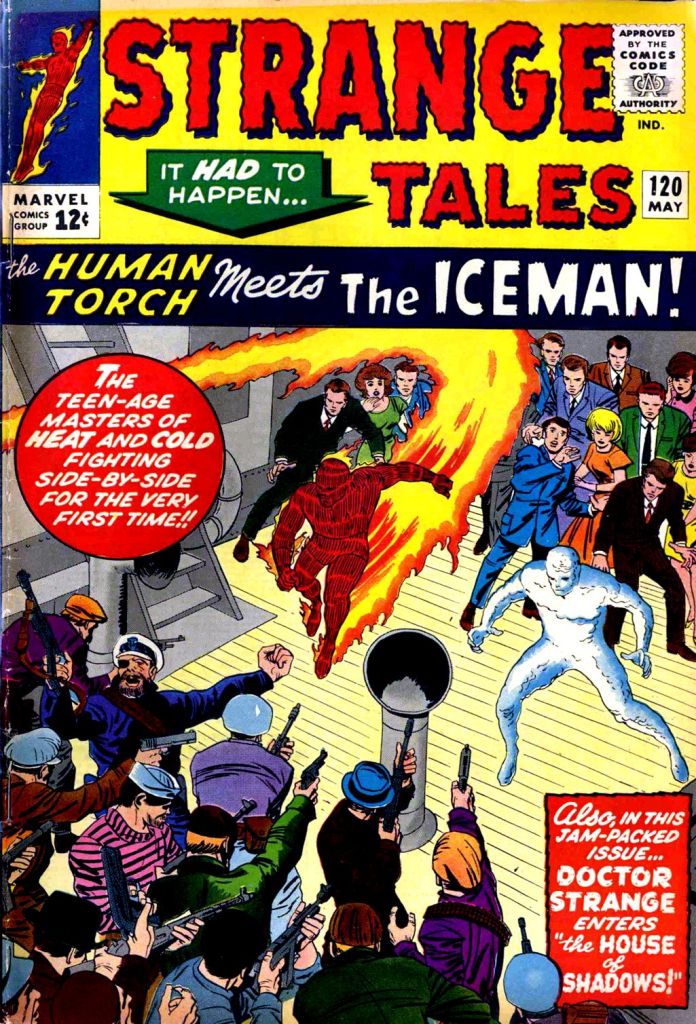
Tis was a slightly more noteworthy issue of STRANGE TALES than many of the other ones that were in the box of comics that I bought as my Windfall. For the most part, any issues that could have been considered “keys” for one reason or another had been extracted. But this one was close, and so I was happy to have it. It was a rare issue where the Human Torch story was drawn (and largely plotted) by Jack Kirby. And the reason for that, of course, was that it was intended as something of a plug for Lee and Kirby’s new series, X-MEN. It was natural that fans would want to see the heroic opposites the Human Torch and Iceman meet, so this story was put into production shortly after X-MEn debuted.

There’s something weirdly fun about how these early team-up stories usually ran a line on the cover or splash page about “Iceman’s guest appearance through courtesy of “X-MEN” magazine–as though both of these weren’t Marvel publications. But if nothing else, it was a way to remind readers where Iceman could be regularly found if they liked him in this adventure. Another somewhat discordant element in hindsight is how much positive newspaper coverage the X-Men were getting in these opening months. Kirby would repeat this bit when the entire team guest-starred in FANTASTIC FOUR #28 a month or two down the line, and it seems weird given the X-Men’s status as feared and hated mutants. But that aspect of the series was still coming into focus in these early days.
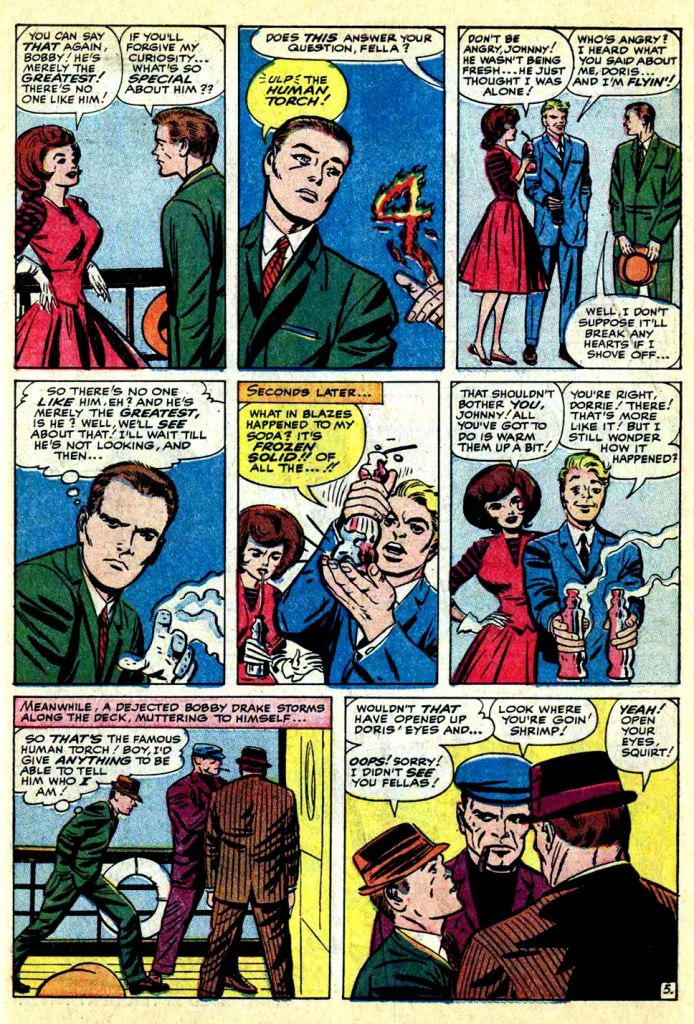
The story’s a bit of a screwball confection, one that also reflects the fact that the X-Men characters were still in a bit of a nascent state. At the opening, Iceman is lamenting that he can never ask Jean Grey for a date, since the other X-Men inevitably beat him to the punch. On the prowl for a girl of his own, he decides to take a daily cruise around Manhattan that’s a regular spot for teens like himself. Once on board, he notices the Torch’s girlfriend Dorrie Evans by herself and attempts to pick her up, not realizing that Johnny is on board as well and just stepped away to get them drinks. Boddy Drake is frustrated that the need to keep his identity concealed prevents him from competing with the Torch openly (though he does surreptitiously freeze Johnny’s drink when the latter isn’t looking.)
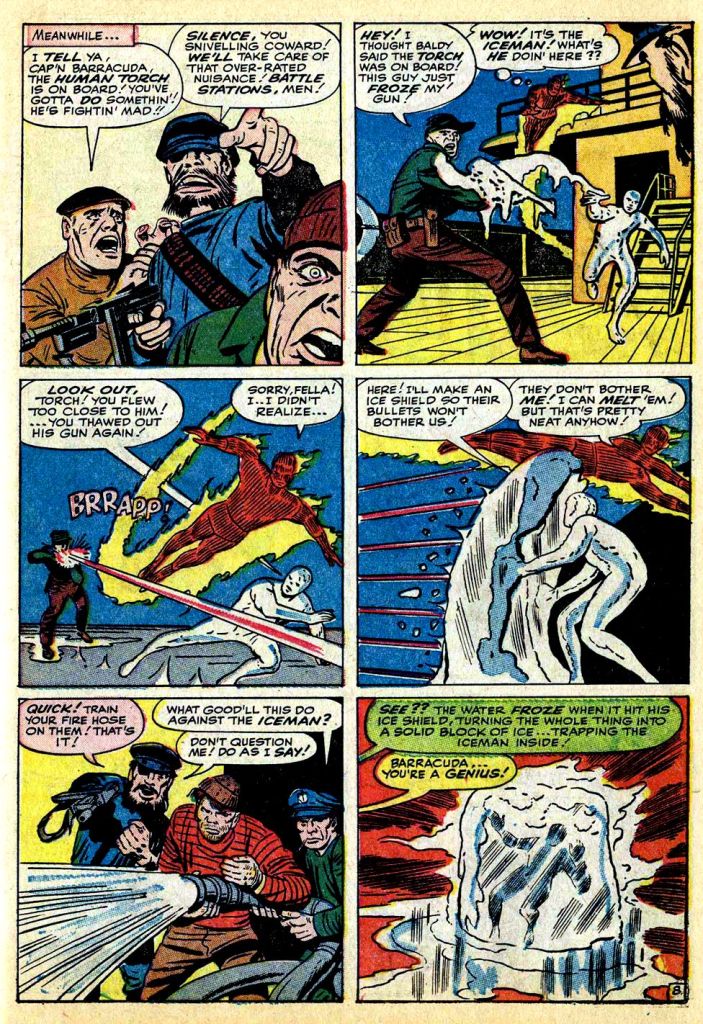
Of course, this would be a pretty dull story if a cruise was all that happened, so it’s a good thing for our two teenaged heroes that Captain Barracuda and his pirates decide to board the ship and rob the passengers. They’ve got no idea that there isn’t one super hero aboard, let alone two, but they’ve at least got the numbers and some relative smarts. Also, it turns out that the Torch and Iceman virtually can’t help but trip each other up, their powers are so wildly in opposition to one another. It’s mostly all just an excuse for Kirby to go wild with the action visuals that he’s so good at. Plot? Who needs plot?

In all honesty, it’s something of a miracle that the story is able to go on for four pages, as the Torch and Iceman really have the upper hand from the moment they show up. With his forces in disarray, Captain Barracuda grabs Dorrie as a hostage and attempts to flee. But Iceman creates an ice tower underneath his boat, giving the Torch the chance to swoop down and rescue Dorrie. And that’s the ballgame. With his romantic prospects thwarted, Iceman makes himself a path back to shore and disappears, with Johnny Storm feeling glum that he didn’t get to know the mysterious X-Man better.
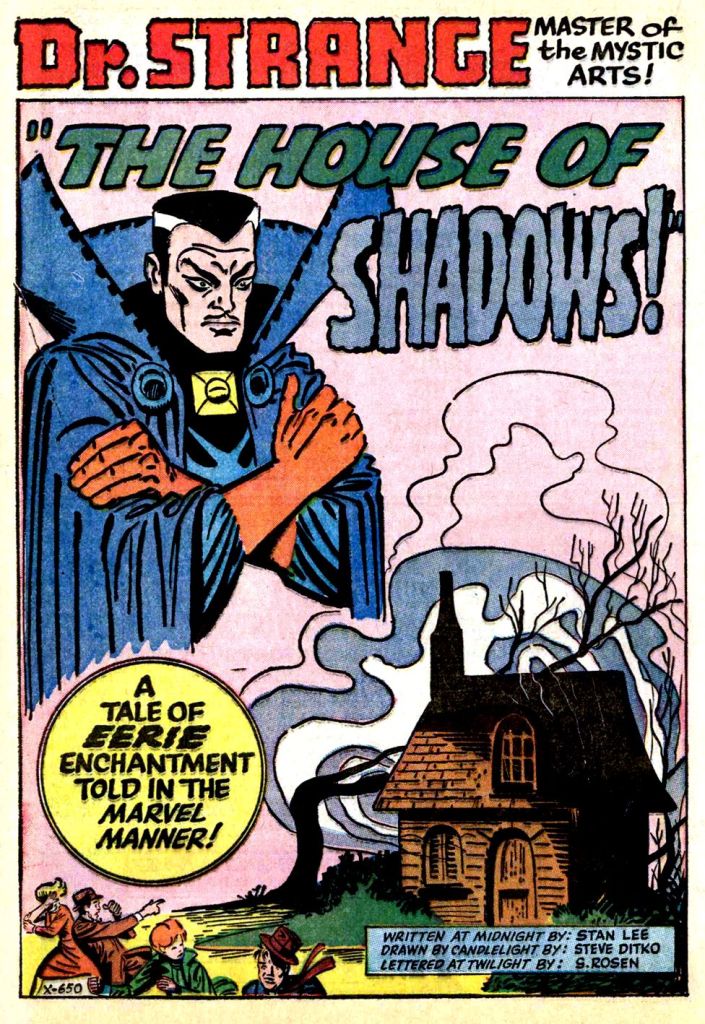
In the rear position was another story starring Doctor Strange, who had begun to be called out on the covers of STRANGE TALES, a sign of his growing popularity. The strip was still mostly doing one-off mystic adventures often inspired by some of the weird suspense stories that Stan Lee and Steve Ditko had produced prior to the rise of super heroes. The biggest appeal of the series was Ditko’s mood-drenched and evocative artwork. There had been plenty of other strips with magician heroes before this, but until Doctor Strange, none of them carried the visual panache that made the otherworldly settings and bizarre incantations seem plausible. Ditko created an entire reality for Doctor Strange.
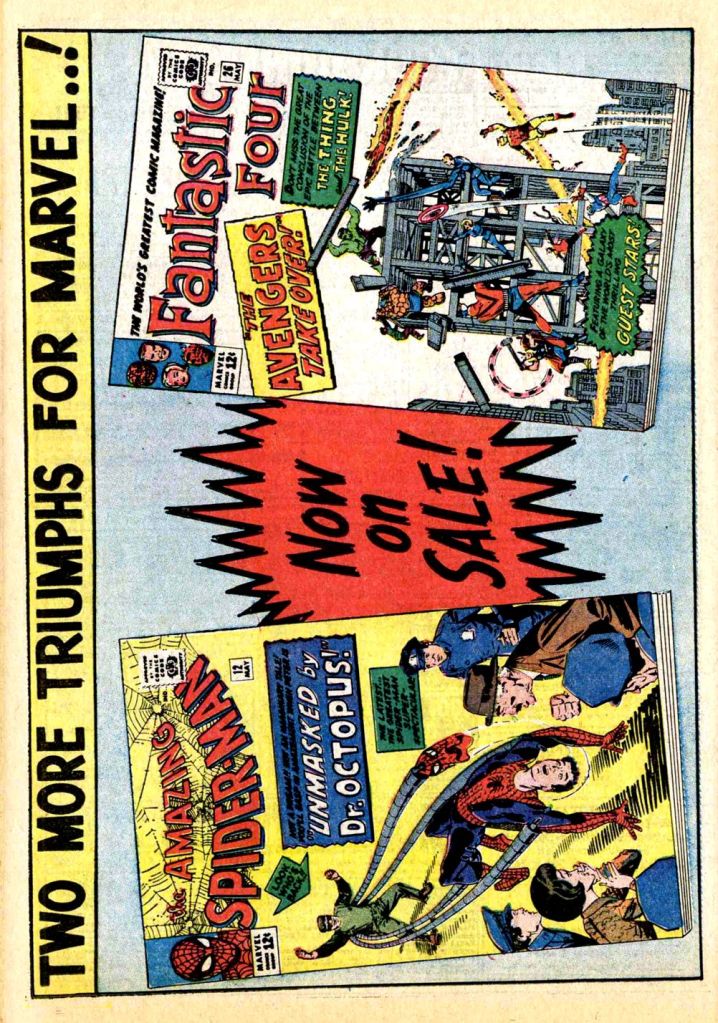
For whatever reason, STRANGE TALES seemed to carry fewer house ads than most of the rest of the Marvel line, and so this was the only such advertisement in this issue. it showcases the two most popular Marvel titles of the era, the two that, more than anything, were driving interest in these strange new super heroes. This is a pair of pretty cool, pretty dramatic covers.

This particular story involves Doctor Strange getting involved with a broadcast in which a reporter is attempting to debunk the idea that a certain house is haunted. Strange suspects that there’s something else at work here, but he’s forces to act as a spectator until he can confirm his suspicions. Once that’s happened, though, he enters the house by force and confronts its secret–the house isn’t haunted, it is itself a malevolent creature from another dimension that intends to continue to prey on human beings. As Strange isn’t down with this behavior, he uses his magic to banish the house–and then departs wordlessly, with nobody in the crowd truly understanding what he has done. In this way, Ditko was already playing with some of the same themes of heroes and truth-tellers being alienated and isolated from society as a whole, their adherence to their beliefs in direct opposition to the moblike “wisdom of crowds.”
 The Tom Brevoort Experience
One of the things I enjoy about Strange in this era is that everyone knows who he is, whether or not they believe what he is.
LikeLiked by 1 person
It’s seems so odd to me that it took three years for Doctor Strange to finally get a cover to Strange Tales all to himself. The character made his debut in #110 cover-dated July 1963 and *finally* got his own cover with #146 in July 1966, the last issue Steve Ditko worked on. Many of the Doctor Strange stories by Ditko & Lee were sooooo much better than either the Human Torch feature or the meandering Nick Fury, Agent of SHIELD tales that fell between the initial SHIELD vs Hydra arc by Kirby & Lee and Steranko’s arrival. Yer for some reason Doctor Strange never got his own cover during either of those periods. Definitely a shame, because Ditko could probably have devised some incredible covers if given the opportunity.
LikeLiked by 2 people
Well, he was the most *prominent* figure on #130, so much so that it was easy to then reuse that image as the full cover for #183. Also, the cover of #146 was a composite of images from the story, so it could be argued that he *never* got a full cover specifically drawn for him during that period. Which is a real shame.
LikeLiked by 1 person
Very enjoyable issue with two great stories. Ditko later wrote that he didn’t like Lee’s plots on Dr Strange – specifically calling out Lee’s use of aliens, haunted houses and guest stars (Thor, Loki). He said he felt Lee didn’t really get the character and found it difficult to write, and that (after bringing in Don Rico to try and help) he was actually considering cancelling the series. This led Ditko to ask if he could he take over storytelling…and thus (as with Spidey) he was given full control of the plots. This is obviously the ‘haunted house’ story Ditko referred to – and I really enjoyed it. Very much like Lee’s plots in Amazing Adult Fantasy.
LikeLiked by 1 person
Is it me or does the Dr. Strange page look as if it has been inked by someone else than Ditko? From the start it has a heaviness I don’t associate with his work. More like the inking of George Roussos.
LikeLike
The House of Shadows has a prototype [ Marvel Tales vol.1#112 ( March 1953 ) first story -“the House that Death Built!” — comes from the Galaxy of Krull-Nrk and flew off with famous architect John Black after eating 2 Plainville leading citizens. It made the daily Globe, Bulletin ( F.B.I. Takes Over Haunted House Mystery! ), News ]. Maybe the yet to be fully told Blonde Phantom story [ Blonde Phantom#14 ( Summer 1947 ) 3rd story ( see Atlastales.com for image of the page ) panel 5 – “…. a House of Horror…” ( It could just be a fake haunted house story or a Bates Motel type story ].
LikeLike
Quogg [ Tales to Astonish#30 ( April 1962 ) 4th story — see profile at marvunapp.com ] is disguised a primitive hut.
LikeLike