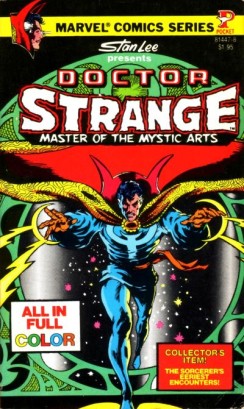


One of the benefits to the Doctor Strange television movie airing was that there was suddenly an interesting in doing a bunch of Doctor Strange-themed ancillary publishing. I hadn’t really connected with the character before this. Especially in the 1970s, his stories tended to be heady and metaphysical in the manner of the time, and less concerned with the sorts of super-conflicts I could easily relate to. Doc also seemed to be able to do anything that he needed to do when the situation called for it, and equally stymied at times for reasons that didn’t appear to possess any real internal consistency. As such, it was tough to connect with the stakes in any story. For all that Doc or the Ancient One or whomever might talk about how grave the danger was, the solution inevitably seemed to be for Doc to “spell harder” and thus make it through.
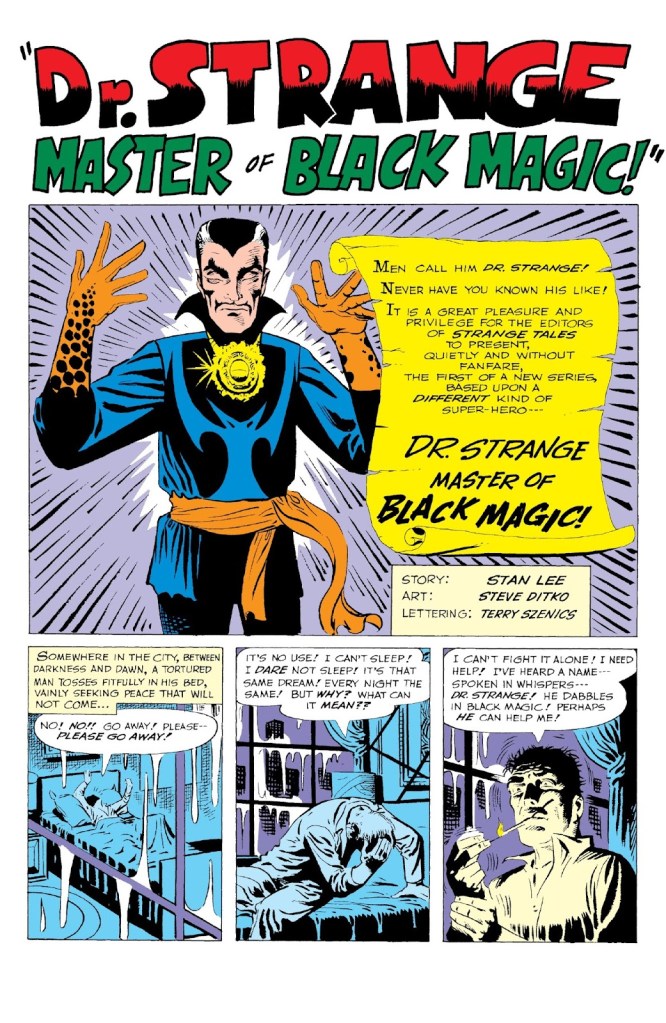
But the stories contained within this little paperback were a bit different. These were the earliest Doctor Strange stories, as produced by his creators Stan Lee and Steve Ditko. They were also short–the first few stories only run for five pages, and they gradually increase in length throughout the volume. But even at their maximum, we were only talking about ten or eleven pages per installment. As a result, these adventures were of necessity more tightly-plotted and the conflicts and set-ups were less abstract, more direct. They also benefitted from Ditko’s wonderfully evocative artwork. Even with the pages reduced to postage stamp size so that they could fit into a paperback book (the lettering as well–which on some of the earliest stories especially made it a challenge for tired eye to read) his approach to mood and atmosphere and the visual language that he established to depict the mystic arts in practice were mesmerizing.

Doctor Strange started out as the brainchild of artist Steve Ditko. He thought there would be something novel about introducing a magic-based character into the nascent Marvel line, so he drew up the first two 5-page stories and brought them in to editor Stan Lee. Had Stan rejected the stories and the characters, Ditko’s next move would have been to peddle them over at Charlton, his other regular account, which published plenty of supernatural mystery titles but which paid worse than Marvel. But Stan didn’t reject the strip, and it ran in a pair of issues of STRANGE TALES, the anthology series where Lee and Ditko had been regularly contributing 5-page twist ending stories. Ditko’s intention was to call the character Mr. Strange, but Stan felt that this was too close to Mr. Fantastic, so he changed it to Dr.–not remembering or more likely not caring that Iron Man had battled a villain called Doctor Strange only a month or two before.
One gets the sense that Lee was never entirely sold on Doctor Strange, not at first anyway. After those two stories had run, he and Ditko went back to one-off weird stories in that STRANGE TALES slot. But the reader response from the growing audience that he was cultivating responded well to that first pair of stories, and so Doctor Strange resumed as a regular back-up feature three issues later. One of the first orders of business was to give the character an origin–he’d simply be a pre-existing entity in his first story. There’s some evidence that Lee and Ditko disagreed with some of the specifics of what they were doing. Early on, and for a decent length of time, Ditko would draw Strange with Asian features, though no mention of this was made in the stories. It’s possibly that Ditko’s intent was that he was not merely the student of the Ancient One, but his actual son. But that all changed once the origin story had been produced–although Ditko continued to give Strange Asiatic features for some time thereafter, as that was the established design. Gradually, over time, he Americanized.

That origin story was a good one, inspired in part by the film Lost Horizon. It revealed that the titular character wasn’t always a student of the mystic arts. Rather, he began life as a gifted but arrogant surgeon, one who put his own selfish desires ahead of the welfare of his patients. Not exactly a typical good guy. But when Strange is in a car accident, his hands are injured–and while they heal over time, he’s lost the delicate motor control necessary to perform surgery. He loses his career, hits rock bottom, and in his search for a sure for his injuries, he hears about a mystic practitioner called the Ancient One who is said to be able to heal such maladies. Journeying across the world, Strange petitions the Ancient One and his pupil Baron Mordo, but the old man refuses to help him. Discovering that Mordo is conspiring to destroy his master, Strange undertakes his first unselfish act, pledging himself to learn the mystic arts so that he can combat Mordo and those like him. He is reborn as Doctor Strange. All of this was communicated in just eight pages.
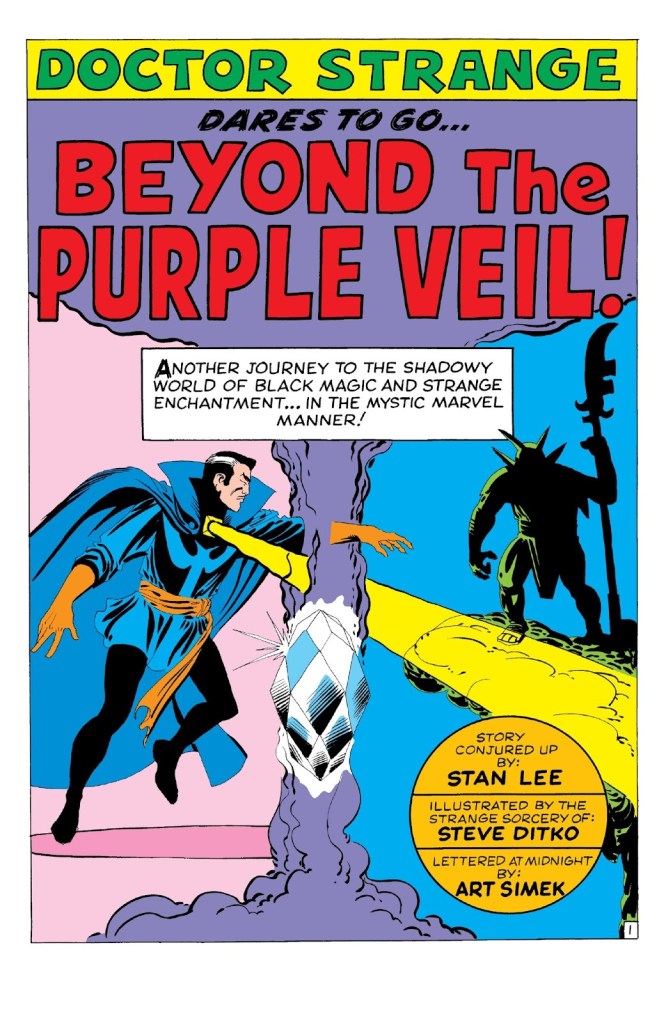
As the length of Doctor Strange’s adventures increased, so too did their complexity, though often they were still riffs on the sorts of bizarre one-off twist ending stories that Lee and Ditko had cut their teeth on. Strange would enter a Haunted House to learn that the structure wasn’t haunted, but was in fact a malevolent creature itself. Strange would go beyond the Purple Veil to rescue two burglars who had attempted to rob him and were swept up into the Veil’s gateway. He’d rescue a town where cases of possession turned out to be an invasion by aliens in a Body Snatchers sort of affair. And so on. And he would battle Baron Mordo relentlessly–the Baron would be the antagonist is seemingly every other Doctor Strange story.
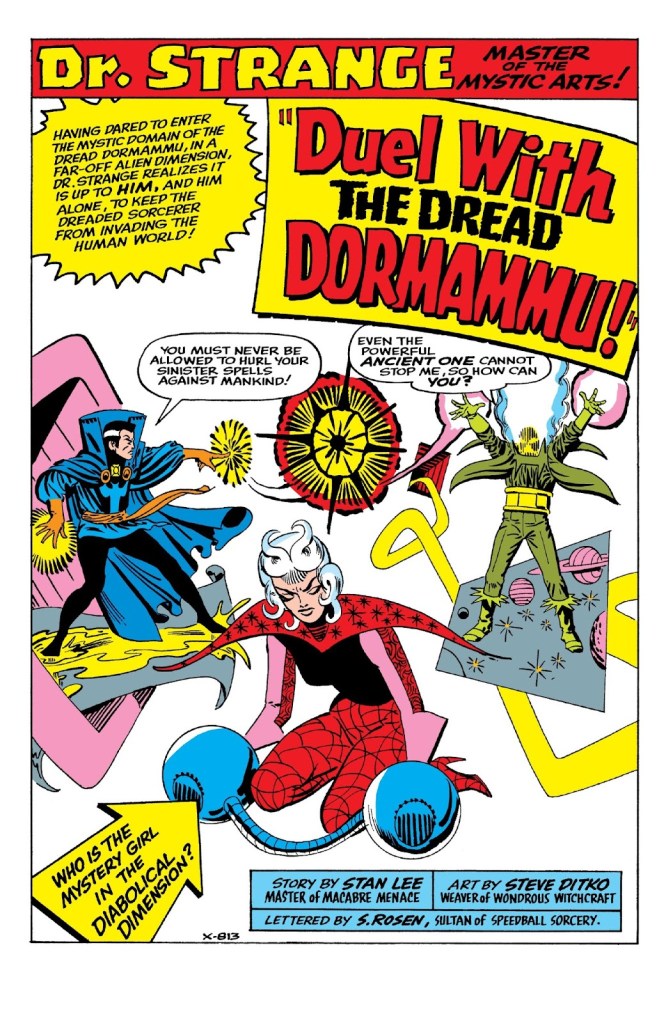
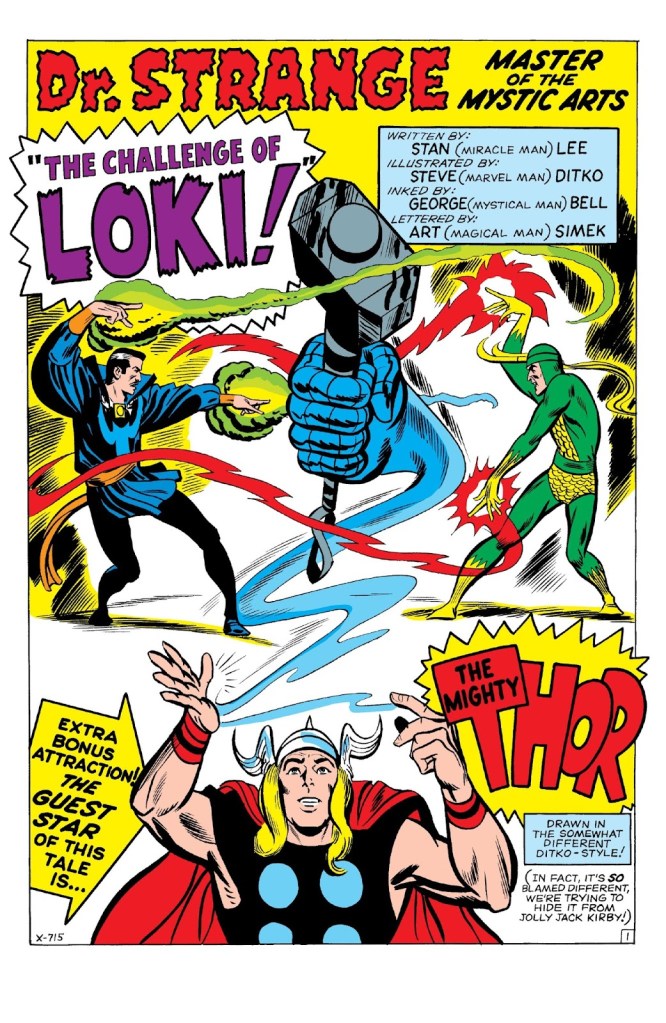
Because they were so short, this Pocket Books compilation reprinted all of the stories from STRANGE TALES #110-111 and #114-129, a much greater swath of time covered than the other Pocket Books volumes which would usually collect six issues. As such, you could more readily see the series develop and change. There started to be a hair more connectivity with the larger Marvel Universe–Strange spends one adventure tangling with Thor’s evil brother Loki. Right at the end, there’s the first two-parter, a story that was intended to kick the series up a notch and reposition Strange as a bit more super-heroic. It involved his conflict with Dormammu, a being whose name had been dropped in spells in issues past and who had been the Ancient One’s sworn foe. Despite being overmatched, Strange descends into teh creatures Dark Dimension to prevent him from invading the material world, and is helped by a mystery woman who would eventually gain the name Clea. Oh, and at the conclusion of the adventure, the Ancient One gives him a new red cloak that makes him look a bit more like a traditional super hero. Lee would constantly make little course-corrections such as this one in an attempt to increase the universal appeal of the characters. Anyway, I really liked these early adventures, but they made me more of a Ditko fan than a Doctor Strange fan, as Doc’s present stories were still pretty hit-or-miss for me.
 The Tom Brevoort Experience
One of the strengths of Ditko’s stories is that Stephen can’t usually “magic” his way out of things. He has to out think or bluff his opponents a lot of the time. His powers might be more consistent than the magic of spider-sense.
LikeLike
Like yourself, Tom, I’m much more a fan of Ditko than of Dr. Strange. Ditko’s moody, evocative art is so wonderful I’ve been tempted a few times to get the DITKO IS… STRANGE book, which I believe reprints— in a larger format— all of Ditko’s Dr. Strange Stories. Is that correct? I assume you’ve seen the book— is it worth it?
LikeLike
These Pocket Book collections were my intro to Cap, Spidey, Hulk and Dr. Strange. For Dr. Strange these 2 Pocket Books were my ONLY experience of him for years. The local drug stores didn’t stock Doc, though they did sell contemporaneous Hulk, Spider-man & Captain America titles. So until the 80s I assumed the Ditko tales were the entire run.
LikeLike
It’s not clear if Dr. Strange was originally intended to be Asian, or if the unusual eyes were just some sort of a Ditko art quirk indicating a sorcerer (i.e. other-worldly gaze or something like that). This article makes a good point that Baron Mordo also at first had similar-appearing eyes:
https://www.cbr.com/comic-legends-revealed-600-was-dr-strange-originally-asian/
Or maybe it was a hold-over from Dr. Droom (wow, that last part of the origin!)
https://www.cbr.com/comic-book-legends-revealed-260/
It’s also a good point that if being Asian was the original intent, it probably would have been stressed in some way (“A mysterious man from the Orient”, or something like that).
I could see someone asking for a change in drawing the eyes as part of just making the design better.
Further, has Ditko ever created a non-Western main character? (i.e. not supporting character like the Ancient One). I can’t think of one offhand.
LikeLike
I can’t remember when we found Pocket Books, but they were a real treasure. I would read the three volumes of Spidey over and over. Plus the first volume of Dr Strange (the only one we had). Fantastic Four was also good, but mainly Ditkos art really hooked me.
LikeLike
I was absolutely in love with these books! Just devoured the Dr. Strange, Conan, and Spidey editions. I still have them to this day…..Sorry, am I nerding out?…..
LikeLike