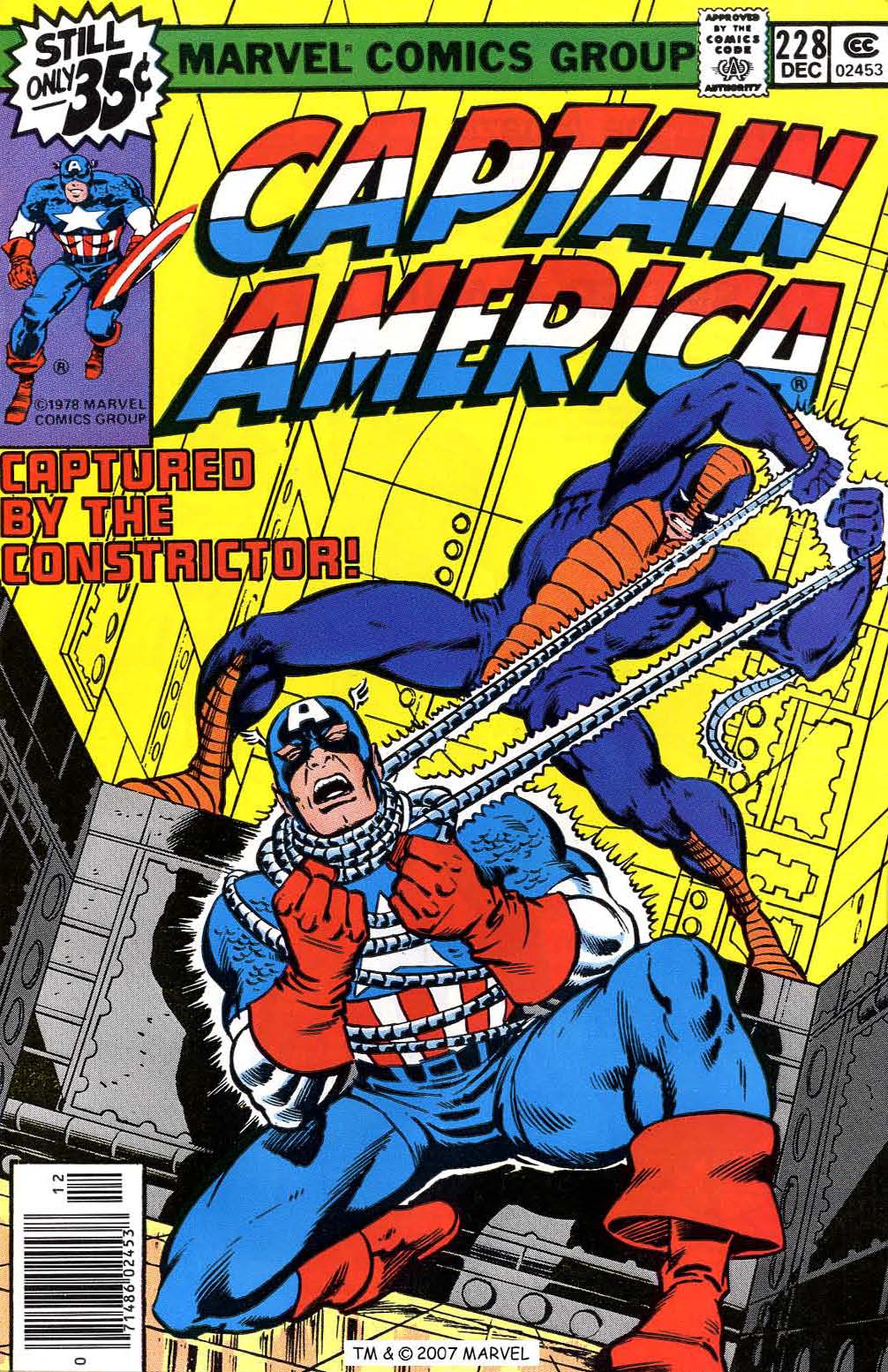


There was a slow but steady transformation of the Marvel titles under editor Jim Shooter. When he was given the job, Shooter realized that no single editor could shepherd the huge number of releases that Marvel was then putting out. So he went about slowly building up a staff of editors, each one of whom would handle a few books, in the manner of the DC editorial system that he was familiar with from his time writing for Mort Weisinger. Shooter’s new innovations rubbed any number of the creators of the period the wrong way, which led to many of them seeking opportunities elsewhere, primarily at rival DC or in the burgeoning independent marketplace. Shooter’s move did institute a greater degree of quality control on the product, though it also had a tendency to also reign in some of the benign chaos that was responsible for Marvel’s better books of years past. The thing it really did, though, was to bring up the quality level of the weakest books and to make them at least readable.
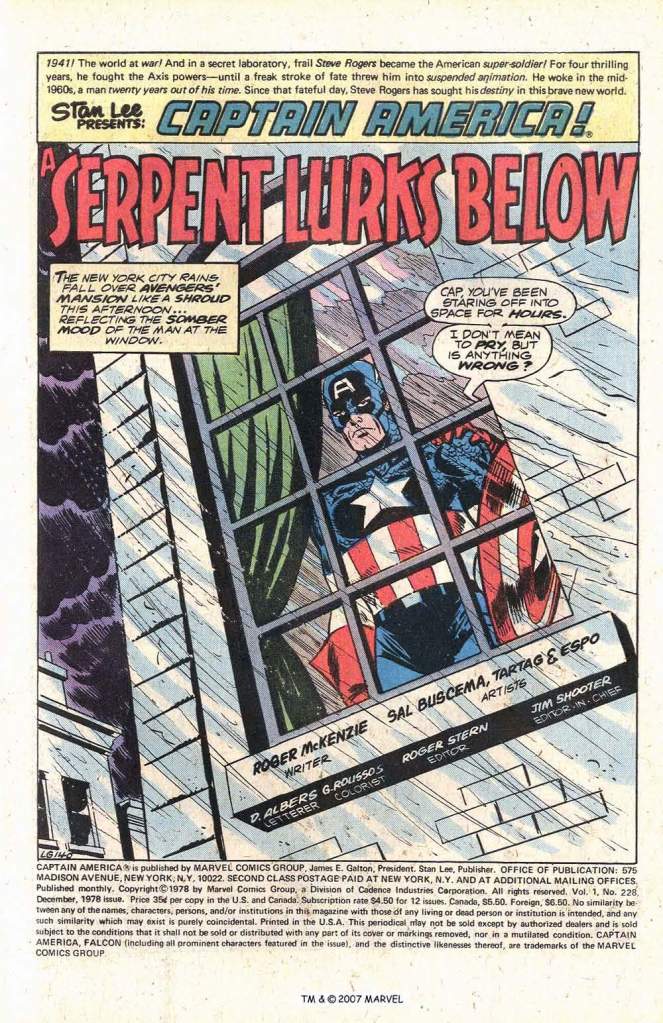
I mention this in the context of this issue of CAPTAIN AMERICA because this was a series that had been in a wild, almost aimless drift since Jack Kirby exited it more than a year earlier. Plagued by creative team changes and fill-ins and unscheduled back-up stories, its ongoing storyline had been disrupted beyond all measure. There were some perfectly all right comics put out during this run, but it wasn’t the book’s finest hour. New editor Roger Stern was given the job of getting the series back on track, a task he managed over several months. The creative team stabilized down to Roger McKenzie writing and Sal Buscema penciling (or, really, doing breakdowns that would be finished by others, in this instance John Tartaglione and Mike Esposito–a sign that schedule delays were still being dealt with.)
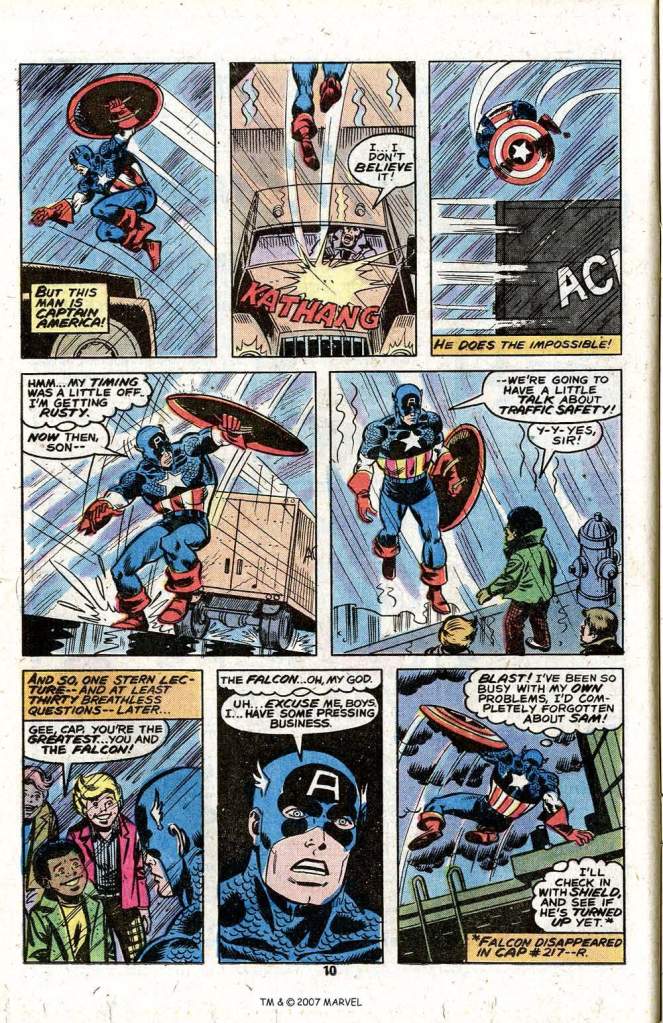
The issue opens with an extensive sequence involving Cap at Avengers Mansion brooding about recent developments in his life. This was a convenient way to recap recent events as well as to get some fun and characterization into the story as Cap interacts with his fellow Avengers. In a conversation with Iron Man about how Cap still feels adrift in this modern era, like he doesn’t have a life for himself outside of being Captain America, Shell-Head takes him up to the roof, and they look out across the cityscape. After Iron Man leaves, Cap spots a young Avengers fan on the road below about to be struck by a vehicle, and he leaps downward acrobatically, knocking the kid to safety ad avoiding the truck himself. It’s a prime bit of expository action that shows the reader exactly what Cap can do even before the story as a whole gets started.
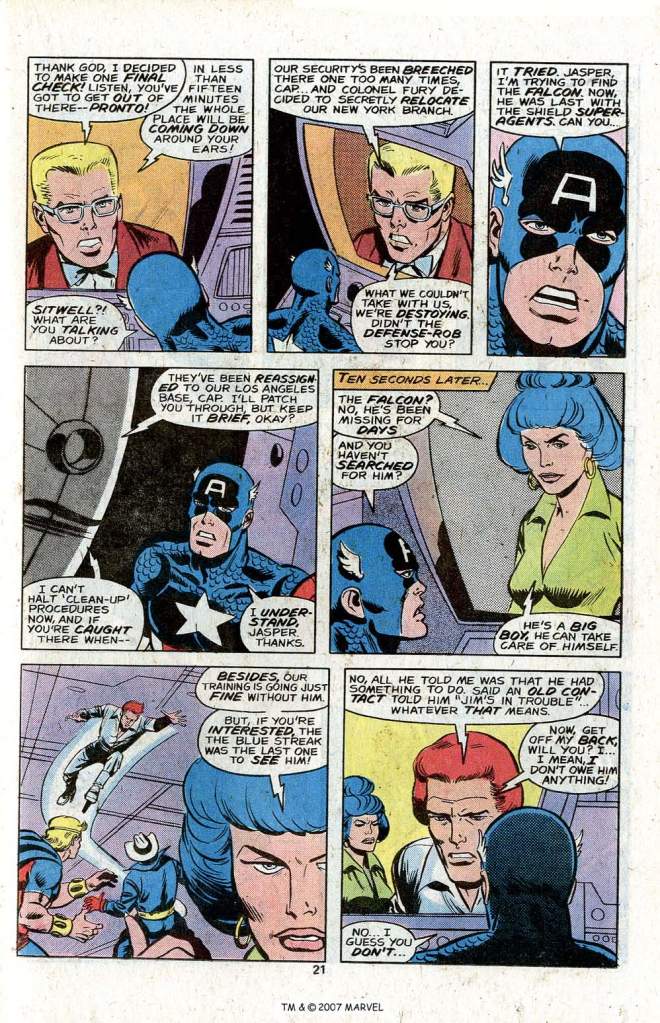
But now it’s time for the story proper to begin. Reminded of the fact that his old partner the Falcon has been missing for several months, Cap heads to SHIELD’s barbershop headquarters, figuring that if anybody can locate Sam Wilson, it’ll be SHIELD, with whom he was last working. But when he gets there, Cap finds the headquarters abandoned, except for a security Defense-Rob that attacks him but that he makes short work of. Cap’s mystified about what is going on until Jasper Sitwell calls in. Sitwell tells Cap that the Barbershop base has been breached too many times, its cover is blown, and so SHIELD has pulled out and is about the destroy the place. This base has been around since the earliest SHIELD stories, so this is a bigger deal than it might seem. Cap takes a moment to confer with the Super-Agents of SHIELD before he leaves, learning from them that the Falcon received a call saying that,”Jim’s in trouble!” and headed out on his own. So that’s at least a clue.

A pause here for this not-terribly-well-drawn advertisement for the upcoming new NBC Saturday Morning cartoon line-up, still a big thing in my household as there were four of us. In particular, I was hugely interested in the new Fantastic Four cartoon that would premiere two days after I bought this issue of CAPTAIN AMERICA–though the inclusion of HERBIE the Robot rather than the Human Torch mystified me to no end. That Saturday Morning Fever slogan was, of course, a take-off on the popular film Saturday Night Fever, and NBC repeated the slogan in promos incessantly. It’s been 45 years, and I can still recall that jingle: “Saturday Morning Fever, it’s on the rise…on NBC!”
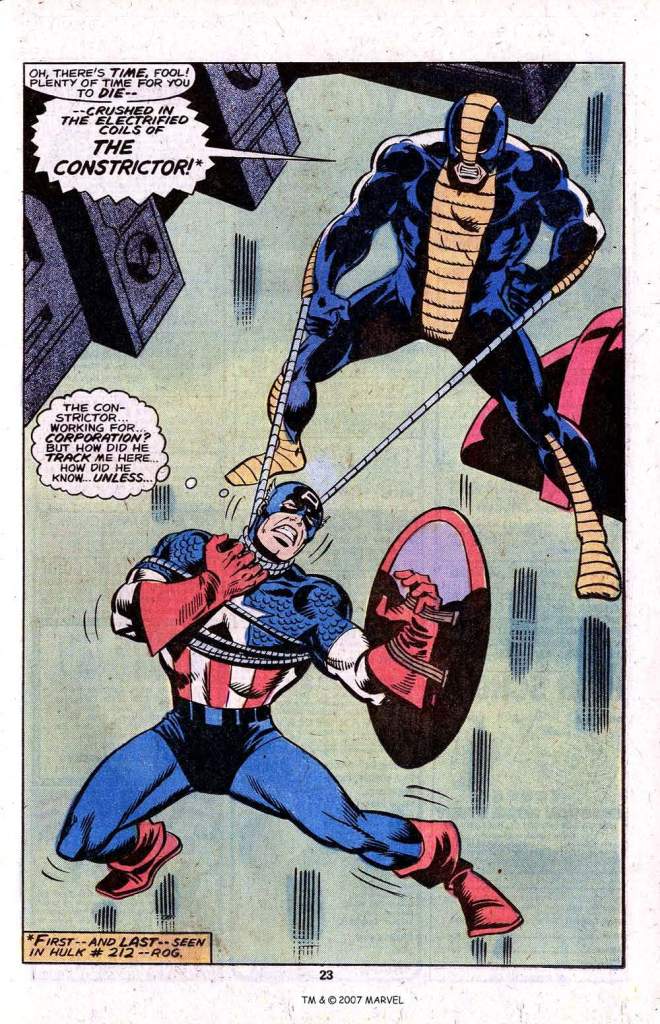
But it’s a clue that Cap’s not going to be able to pursue right away, as he’s immediately attacked again from the shadows. Unbreakable adamantium coils encircle his body and throat. Cap tries to warn his assailant that the base they’re standing in is going to self-destruct any time now, but his opponent has been sent to kill him by the Corporation, the evil organization that has been a presence not only in CAPTAIN AMERICA of late, but also INCCREDIBLE HULK and MACHINE MAN. And as such, the Constrictor isn’t interested in anything Cap might have to say. The Constrictor was a new baddie at this time, having been introduced a few months earlier over in the aforementioned INCREDIBLE HULK #212. I had read that story, so I knew who he was.
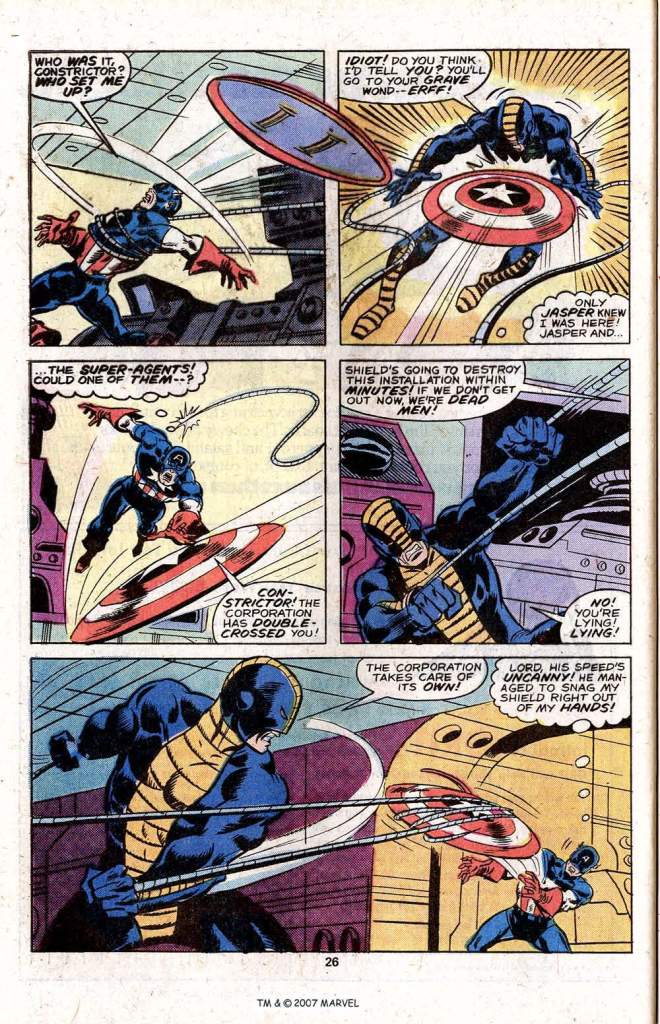
And so now it’s time for the action portion of the issue, as Cap takes on the Constrictor and his unshatterable electrified whip-coils. The villain won’t listen to the Star-Spangled Avenger about the base’s impending destruction, and Cap also realizes that the only people who knew that he was here at this second were jasper Sitwell and the Super-Agents–meaning that one of them might be a double agent. But that’s a problem for another time. As good as the Constrictor is–and for all that he’s in later years been played as just another ridiculous costumed incompetent, in his earliest appearances, the Constrictor was positioned as being legitimately deadly–Cap is still the superior fighter, and is able to outmaneuver him at every turn.
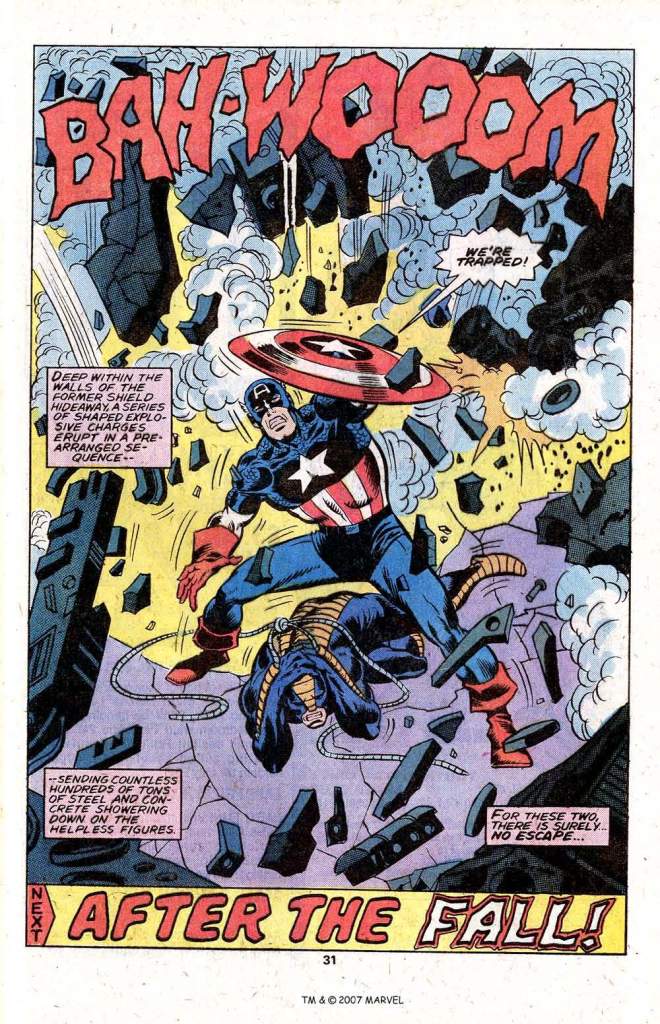
So, yeah, Cap wins the fight, knotting the Constrictor’s whips behind his back and bringing him down. But it all takes too much time. And so, as the issue closes, both Cap and his enemy are trapped in the collapse as the SHIELD base is detonated. To Be Continued! It wasn’t really much of a story per se, but it had a structure and was competently written and drawn to a professional standard. This would tend to become the hallmark of the Marvel books more and more. As a reader during this time, I could tell that the material was gradually starting to become less and less exciting to me, but I couldn’t have said why (apart from the fact that many favorite creators were jumping ship.) But as Shooter applied more efforts to the fundamentals of storytelling across the line, which was great for broadening the appeal of the material, a certain energy was also lost, one that I found appealing as a reader of the time. This also could have simply been me getting older and not being quite so engaged in the same way by stuff that would have wowed me a year or two earlier.


I like the Constrictor, especially as he waffles between criminal and lawful behavior. The Vamp also has potential, more for her power source than her, but for every character who uses a failed character’s power source like Moonstone there’s too many like Nemesis Kid and Vamp whose power sources could have been used by anyone else.
LikeLike
I think of that as the sort of thing I say when I don’t like the character. Lots of villains have tech that could be used by someone else; it doesn’t bother me if the character’s interesting or at least not boring.
LikeLiked by 1 person
I wrote an extended defense of Shooter’s time as Marvel editor-in-chief a few years back. It takes a view of his tenure that runs counter to the one presented above. Among other things, I argue that “the Shooter era at Marvel is easily the most vibrant time in the company’s history apart from the heyday of Stan Lee, Jack Kirby, and Steve Ditko in the 1960s.” Those interested in reading it can click here.
http://rsmwriter.blogspot.com/2016/06/jim-shooter-second-opinion.html
The post repeats the comics lore that many creators jumped ship in response to the changes Shooter instituted. The lore greatly overstates things. The only two people who left because of the editorial restructuring were Roy Thomas and Marv Wolfman, and that was because, when their contracts came up for renewal, Shooter would not allow them to continue as their own editors. The only other high-profile departures because of conflicts with Shooter were Gene Colan in 1981, Doug Moench in 1982, and John Byrne, Mike Carlin, and Denny O’Neil in late 1985. Carlin and O’Neil were fired, and Marvel publisher Michael Hobson supported both decisions. I’m drawing a blank on who left Marvel to work for the independents, but most of the people who left for DC in either the short or long term did so because DC waved money at them.
I should probably note that Shooter’s insistence on emphasizing appeal to new readers was a sound one that saved Marvel from being shuttered by its parent company in the late 1970s. Catering to older readers who’d aged out of the target audience of middle-school-age boys was self-destructive. Although as the direct market grew, and the sales threshold for profitability dropped, Shooter was able to do both. And he did.
The sales were pretty impressive. There was an upward trend throughout his tenure. When Shooter took over Marvel only had two or three ongoing titles that averaged per-issue sales of over 200,000. His last sales year was 1986-1987. That year, Marvel had fourteen ongoing titles that sold over that number. DC’s sales collapsed during that period. 1978-1979 was the last year they reported even one title selling over 200,000 copies an issue. Most of what they published didn’t break 100,000.
LikeLiked by 1 person
“Was Jim Shooter a good witch or a bad witch?” is one of those topics comics fans will be debating until the last of us who remembers the era has died.
I can’t say I found his oversight all that vibrant: back at the time I found most of his creative decisions bad ones. But this is one area where many people’s mileage varies.
LikeLiked by 2 people
Can you be a great EIC without being good with people, ’cause that’s always the impression I’ve gotten reading secondhand accounts. It’s all guesswork and armchair coaching though unless you worked at Marvel then or have direct sources of info.
LikeLiked by 2 people
RS: “The post repeats the comics lore that many creators jumped ship in response to the changes Shooter instituted. The lore greatly overstates things. The only two people who left because of the editorial restructuring were Roy Thomas and Marv Wolfman, and that was because, when their contracts came up for renewal, Shooter would not allow them to continue as their own editors. The only other high-profile departures because of conflicts with Shooter were Gene Colan in 1981, Doug Moench in 1982, and John Byrne, Mike Carlin, and Denny O’Neil…”
That’s right. Only 2 high-profile departures. Or 3. Or 7. 😉 Does Klaus Janson count? George Perez? Archie Goodwin? Ed Hannigan? Or James Owsley/Christopher Priest? Jim Salicrup?
No offense, RS. I don’t know all the behind the scenes stories. Salicrup may have been good with Shooter, & just left to spread his wings elsewhere. Just seems you might be downplaying Jim’s strong personality. His words & actions did have effects, for good or bad, on several accomplished professionals.
LikeLike
Len Wein, too.
LikeLike
It might be a good idea if you would research the situation before throwing names around.
I don’t know of any bad blood between Jim Shooter and Klaus Janson. I know he went to work for DC at a certain point, but that doesn’t mean there was any problem at Marvel. Perhaps you can enlighten everyone?
With George Perez, he didn’t leave Marvel because of any conflict with Shooter. He left because he was overextended with series assignments, and in fact sent Marvel a letter explaining that he had no grievance. He was stepping away because he didn’t have time. Read pages 15 and 16 of the interview published here:
Archie Goodwin went from being editor-in-chief to being writer-editor of the Star Wars title to being the editor of Epic Illustrated, which overlapped with his being the head editor of the Epic imprint. That continued for a couple of years beyond Shooter’s tenure. There was no departure there.
With Hannigan, I gather there was a point where he was working for both companies. It caused some issue with working for Marvel. He ended up working full-time for DC. But I don’t know what the specifics of the situation were, or if those fell outside the norms of client-freelancer dealings.
Priest was let go, per his own account, because of a very messy office-politics situation. He holds no ill will towards Shooter and respects him quite a bit. He in fact holds the hostility towards Shooter on the part of several former colleagues against them. Click here.
https://lamerciepark.com/legacy/comics/spidey.html
My recollection is that Jim Salicrup left Marvel for a while in 1982 because of health concerns. He was back in 1983. At the end of Shooter’s tenure, he was editing the Spider-Man titles. He has personally told me he has “nothing but respect and admiration for” Jim Shooter.
I’ve written about Len Wein’s 1977 departure from Marvel. It had nothing at all to do with Jim Shooter. Click here.
https://rsmwriter.blogspot.com/2017/03/the-jim-shooter-victim-files-len-wein.html
LikeLiked by 1 person
RS Martin. I just saw your reply. I haven’t been getting notifications for this. “It might be a good idea if you would research the situation before throwing names around.” Thanks, buddy.
My memory must fail, but I remember reading Perez saying he wouldn’t work for Shooter again after the JLA/Avengers mess. If he didn’t say it, then it’s just a coincidence he went back to Marvel after Shooter left.
In an “Amazing Heroes” interview, Klaus Janson talked about Shooter giving him an unsolicited & unappreciated lecture about a “bad inking job”. He did take a short break from Marvel, but he was back for the ’87 “Punisher” series, w/ Shooter credited as EIC.
Len Wein helped “lampoon” (one milder way of describing it) Shooter in DC’s “Legends” mini-series. “Sunspot” I think was the character’s name.
Again, thanks for your peerless perspectives, pal.
LikeLike
I would say the two chief indicators of the quality of an editor-in-chief are sales and the quality of the publications. The first is objective, the second is subjective.
It’s an objective fact that Marvel’s sales increased substantially during Shooter’s tenure, while DC’s drastically declined. The information is from the postal-service documents the companies filed with the government. I assume those qualify as “direct sources of info.”
The quality of the publications is in the eye of the beholder. I listed the material from his tenure I consider the stand-out work in the article I linked to. As for the other material, even Shooter detractors such as our host concede the quality floor was higher under Shooter than others.
I should add that the number of people–staffers and freelancers–that worked for Marvel during Shooter’s tenure number in the hundreds. No one gets along with everybody. I grant he became very difficult to deal with during his last year-and-a-half with the company, which was a situation that I believe was largely due to matters that came with the company being for sale. But for the eight years before that, there’s nothing very peculiar. Most people seem to have gotten along with him fine.
LikeLike
Some seminal runs took place while Shooter was Marvel’s EIC. Miller & Janson on DD. Zeck on Cap. Simonson’s Thor. Several stellar Spidey creative teams. As far as “meat & potatoes” superheroes, it was good as it got. Boundaries were eventually pushed farther by others. Epic helped. But DC’s Vertigo would set the standard in many ways.
Hard to think it was coincidence. And unfair to give him credit for the brilliance of others. But the timing of newer, ambitious, enthusiastic creators helped. And maybe so did the conditions Shooter put in place.
As an oldhead now, & reader since 1977 or ’78, I missed out on the 60s material, & only know it for historical reference. I didnt get that rush of experiencing for what it was, in it’s day. How different it was. I became a teenager in the mid 80’s, so my connection to those comics is stronger.
But looking back, I personally think the 1st 6 years of Quesada’s tenure as “EeeC” was @ least as remarkable as any other period, in terms of quality, not sheer originality. Joe had most of the best talent in comics @ Marvel then. And they were working on a higher level, with several notable exceptions, than most of their predecessors.
LikeLike
I’d have to go dig up quotes, but my recollection is that Perez in the years that followed the JLA/Avengers situation acknowledged that his anger with Shooter in that matter was misplaced. And it was misplaced. Shooter had rejected the script DC wanted to use. As our host has noted, the other Marvel editorial staffers who reviewed that script agreed with Shooter’s decision, and some of these were people who were quite critical of him otherwise. DC Editor-in-Chief Dick Giordano, instead of commissioning a new script as requested, responded by having Perez start work on the existing script. It was an obvious (and sleazy) move on Giordano’s part to create a fait accompli situation that would force Shooter and Marvel to accept the rejected script. It didn’t work. Shooter discovered Perez was working on the rejected script, and demanded work be stopped. Perez was understandably furious, given that he was about halfway through the job at that point, but it was Giordano who deserved his anger, not Shooter. Giordano was trying to jerk Shooter around, and he was using Perez to do it. I don’t blame Shooter one bit for not putting up with it. If you think Giordano was in the right to behave like he did, all I can say is you and I have very different views of ethical conduct.
As for Janson, where did I ever claim that Shooter’s Marvel (or anyplace else) was a utopia of good feelings where everybody got along about everything all the time? Professional and personal relationships all have their tempests in a teapot. Janson was unhappy with a reprimand. That doesn’t mean the reprimand was unjustified. Even the best people get justifiable reprimands from their bosses on occasion. Janson’s reaction was to work elsewhere for a while, and as you note, he came back. That Punisher gig was an extremely plum assignment, by the way. The royalty checks were going to be huge. Almost every artist working for Marvel at the time was probably after the job. I can’t imagine Janson would have gotten picked if Shooter wasn’t in favor of hiring him.
My recollection is the resemblance of the Sunspot villain to Shooter was John Byrne’s doing. It doesn’t matter, though. It’s a bit like looking at the first issue of Secret Wars II and coming to the conclusion that Al Milgrom or Steve Leialoha had a problem with Steve Gerber. Unless you can point to a specific complaint, and Wein made it clear he didn’t leave Marvel for DC because of any problem with Shooter, there’s no there there.
LikeLiked by 1 person
And I wasnt there, but I wont take your word for what happened, either. Keep smiling inward, RS. We’re gonna make it! 😉
LikeLike
George Perez, Wizard #34 (July 1994):
“Jim Shooter and I have long [since] buried the hatchet. I’ve told him I would gladly do a cover for Defiant if he needs one. I don’t want people to infer that I am still carrying a grudge.”
LikeLike
Yes. 1994. 11 years afger George stayed exclusive to DC? 7 years after Shooter was fired from Marvel? Im glad George did what he wanted to make peace & move on.
But what happenedin 1994 doesnt erase what happened in 1983. Meaning if he stayed away from Marvel after ’83, until Shooter left, coincidentally or not, that record remains.
I dont live & die by these histories. I know everyone makes mistakes. But I’m also done reading “My Shooter, right or wrong”. 😉 I just don’t care as much.
LikeLike
On page 21, the bottom left panel, Vamp says the word “the” twice in a row.
LikeLike
I don’t think the Cap ship got righted until Stern/Byrne took it over in 247. But between Kirby and McKenzie the only time I can think Cap was interesting was a small handful of Gerber issues.
I think the argument that a certain amount of inventive weirdness might have gotten squashed during Shooter’s tenure as editor in chief is valid… but not from the get-go necessarily. As a loyal reader during this period I didn’t miss the reprints and I think generally… a lot of books got better.
LikeLiked by 1 person