


At about this time, I entered Sixth Grade in Elementary School, which would prove to be a year of some significance in my overall journey. I wound up once again in the same class as my comics-reading pal Donald Sims, the last time we’d share classes together, so already I was on somewhat firm and familiar ground. And I was in general smart enough and well-read enough that typical school subjects were easy for me to coast along on and still do well. My Father put a lot of emphasis on education and being prepared for the future, so the ability to get good grades was a bit of a necessity. But what this all meant is that I never really developed any strong studying habits–I hadn’t needed to–and so when I advanced into Junior High and eventually High School, where more actual work had to be put in, it was uncomfortable and unfamiliar to me.

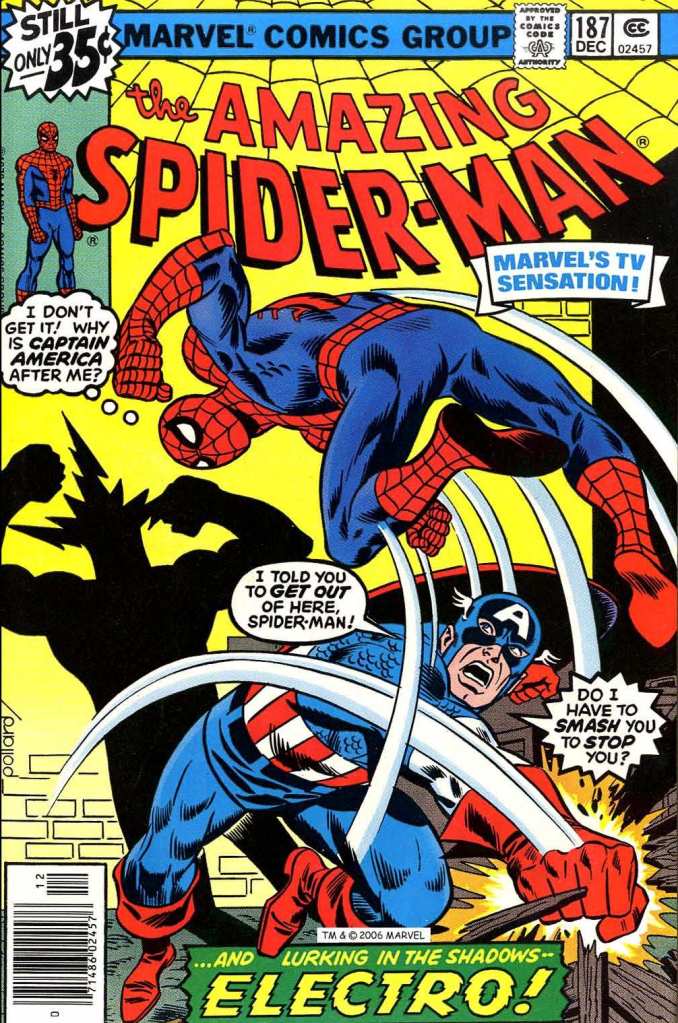
But after those initial school days, once we got to Thursday afternoon, I was able to ride my bike down to the 7-11 and complete my weekly ritual of buying the new comic book releases, which were put out on that day. This issue of AMAZING SPIDER-MAN was one of them. It wasn’t an issue that I especially liked as a kid, and looking at it today, I’m 98% certain that it started out as one of writer/editor Marv Wolfman’s “Marvel Fill-In Comics” stories, inventory jobs designed to be able to be used in multiple different titles as the need arose. This one paired up Spidey and Captain America and seems like it could have fit just as comfortably into CAPTAIN AMERICA or MARVEL TEAM-UP as easily as AMAZING SPIDER-MAN. But ASM was where it ended up.

Marv dialogues the opening so as to reflect recent events in the series, in particular the fact that only last issue, Spidey had been cleared of all of the assorted criminal charges that had been hanging over his head. And the artwork is pretty nice, owing primarily to the finishes by Bob McLeod, I think. Jim Starlin only did breakdowns on this job, so the storytelling is all his. But the relative new McLeod appears t have really worked to make the finished end product sparkle, employing a lot of zip-a-zone and texture effects to give the artwork an appealing lushness. Starlin’s Spider-Man always looked too large to my eye–like John Buscema and a few others, his natural figure sense leaned towards larger, more solid figures. So his Captain America was spot on. But his Spidey, consequently, didn’t have the typical wiryness we associate with the character.
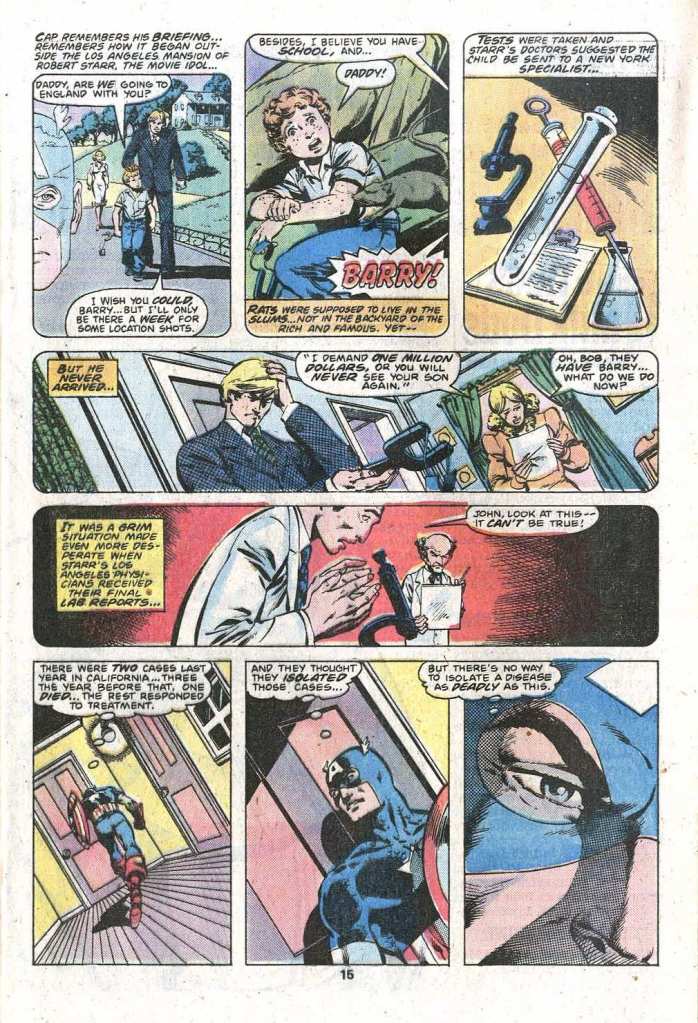
The issue opens with Spider-Man making his way into the cordoned-off town of Indian Point. He’s there on behalf of Jonah Jameson, who dispatched Peter Parker to get some photographs and to try to work out why SHIELD has evacuated and sealed off this small township. Getting inside is no problem for the web-slinger despite the heavily armed SHIELD guards encircling the place. But as Spidey alights to get his bearings, he’s suddenly attacked–by Captain America. The Sentinel of Liberty has his game face on, and he orders Spider-Man to leave the area immediately. After a requisite struggle, the wall-crawler seems to do just that. With Spidey gone, Cap continues his own search and thinks back to the events that led him here.

It all started when the son of megastar film actor Robert Starr was bitten by a rat. The boy was sent to the hospital for testing–but before the results of those tests could come back, the boy was abducted for ransom. Cap and SHIELD have traced the kidnappers to Indian Point. And they’ve evacuated and cordoned off the area due to what the test results showed: the rat Barry Starr was bitten by was carrying the plague, and so now he’ll be contagious. Cap needs to locate him and get him into quarantine before the situation becomes a pandemic. This is why he shooed Spider-Man away, for the web-head’s own safety–Cap is willing to put his own life on the line in this matter, but nobody else’s. Unfortunately, it turns out that the kidnapper is Spidey’s old foe, Max Dillon, Electro, and he takes Cap by surprise, zapping the bejeezus out of him.
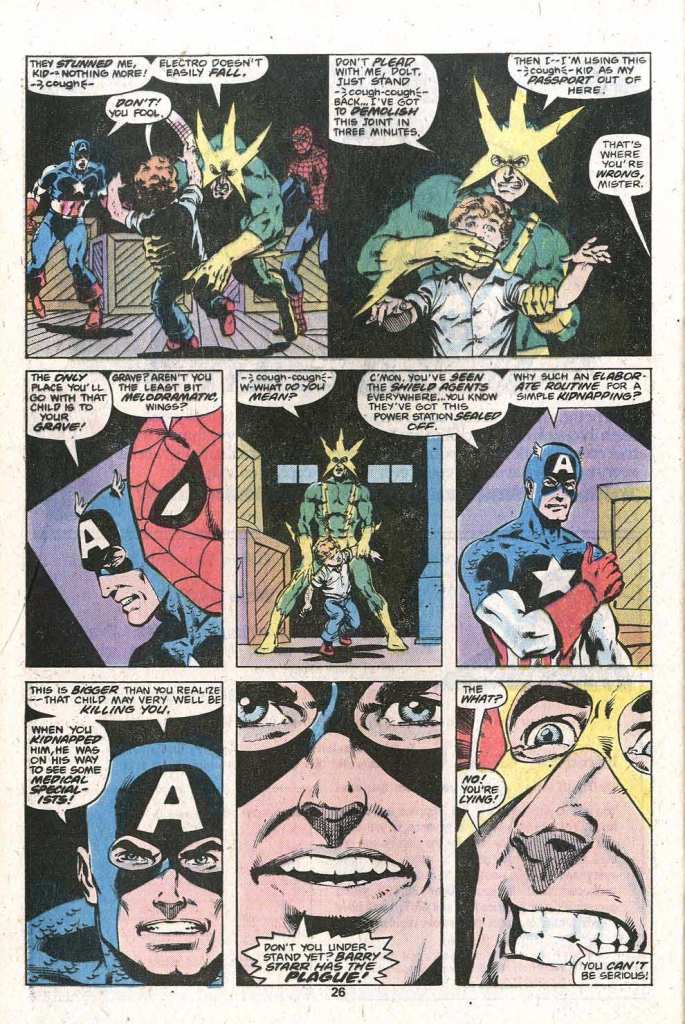
Of course, Spidey didn’t really take off, he just swung away a short distance and has been shadowing Cap ever since, unaware of the danger he’s exposing himself to. But he knows the score with Electro just as soon as he sees him, and he swings down to clobber his old enemy, giving Cap time to recover from his earlier jolt. Together, the two heroes double-team the overwhelmed Electro–who isn’t at his best because he’s unknowingly contracted the plague himself due to his proximity to the kidnapped boy. At this revelation, Electro flips out, plugging himself into the energy grid of the power station he’s been hiding out in. He’d apparently been paid to destroy it, but thought up the kidnapping as a side-hustle that would net him some more cash. Now, he’s hoping that the power he’s drawing from the station will make him strong enough to overcome the effects of the disease he’s been infected with.

Would it have? We’ll never know. Because Electro pulls too much juice into himself, causing him to lose control and for the feedback to cause the entire building to explode in an electrical discharge. Fortunately, Cap, Spidey and Barry Starr are all able to get out beforehand. But Electro doesn’t appear to have been as lucky. (But don’t worry, he’d return many more times over the years–so perhaps his makeshift treatment worked after all.) In the aftermath, the two heroes get inoculated to the disease, Barry is handed off to get medical treatment and everything wraps up nicely. The only thing left is for SHIELD to issue a cover story explaining why there’s been a massive power outage as a result of the detonation of the power station.
 The Tom Brevoort Experience
This cover always irked me: Electro must be standing very close by if that’s his shadow, yet neither hero notices him?! Also it ruins the reveal when you announce him on the cover so dramatically.
LikeLiked by 1 person
A depressingly common problem in comics. Also a number of Doctor Who episodes where the title gives away that it’s the Cybermen or the Daleks who are the mystery villain.
LikeLiked by 1 person
Tom, can you tell us more about Wolfman’s “fill in stories”? Did he do a number of these in advance knowing they could be deployed when schedules went helter skelter? Was it intentional — and how many stories would Wolfman do to be prepared for emergencies?
LikeLiked by 1 person
I can answer that. Before I became Editor-in-Chief Marvel was having major problems with late books –which was called The Dreaded Deadline Doom – and I was told to fix that. I came up with the idea of Marvel Fill-In-Comics. This title would actually be put on the schedule just like any regular book. If it hadn’t been put on the schedule it would. most likely, never get done. The fill-in assignment had to be treated like a real title. Marvel’s previous solution for late books was to put in a reprint. I felt that was cheating the readers who wanted new stories.
Each month Marvel Production head John Verpoorten and I would figure out which books were in danger of shipping late. Let’s say Hulk, Iron Man and Captain America. I’d commission a fill-in book staring those characters, which would also be suitable for The Avengers. If we needed it, one book would cover four titles. We could do even more if needed.
The regular writers of those books hated the idea of a fill-in story interfering with their continuity, and preferred a reprint, which, of course, the readers hated. I guaranteed the writers that if they got their books on schedule those stories would never be used except in one of the regular Marvel team-up titles. So it was up to the writers: get your scripts in on time or we’ll use one of those stories. Your call.
While I was EIC we never shipped a late book or had to use a reprint.
I don’t believe this story was one of those fill-in titles since I was the regular Spider-Man writer and I wrote this story and I wasn’t late. Also, it only featured one other character instead of several. Most likely it was a generic fill-in which would be used whenever Jim had the time to draw it. This was he could take his time and didn’t have to worry about meeting any specific schedule.
LikeLiked by 2 people
A much-appreciated explanation, Mr Wolfman!
LikeLiked by 1 person
Mr. Wolfman, thank you for taking the time to answer this question. I love learning about how things worked behind the scenes. Thanks to Tom, too, for doing the original post.
LikeLike
I can’t see why SHIELD would need a cover story. Electro got busted, the plague got contained, there’s nothing to panic anyone.
LikeLike
Marv, I think Jim Shooter’s said that AVENGERS 163, which guests several CHAMPIONS, was one he wrote for “fill-in comics.” Do you remember any of the others?
LikeLiked by 1 person
Those books were 50 years ago. I don’t remember any of them
LikeLike
Marv, do you recollect the details of Jameson’s thought balloon?: “Who should I send? Conover? No, he’s on the ‘McHedron’ story. Lessman? Blast! He’s covering the pet show!” Conover was an established reporter, but what is McHedron? Was Lessman a reference to Les Nessman?
LikeLike
Marv, do you have any recollection of Jameson’s ballon which reads: “Who should I send? Conover? No, he’s on the ‘McHedron’ story. Lessman? Blast! He’s coving the pet show!”
Conover is an established reporter. What is McHedron? Is Lessman a Les Nessman reference?
LikeLike