

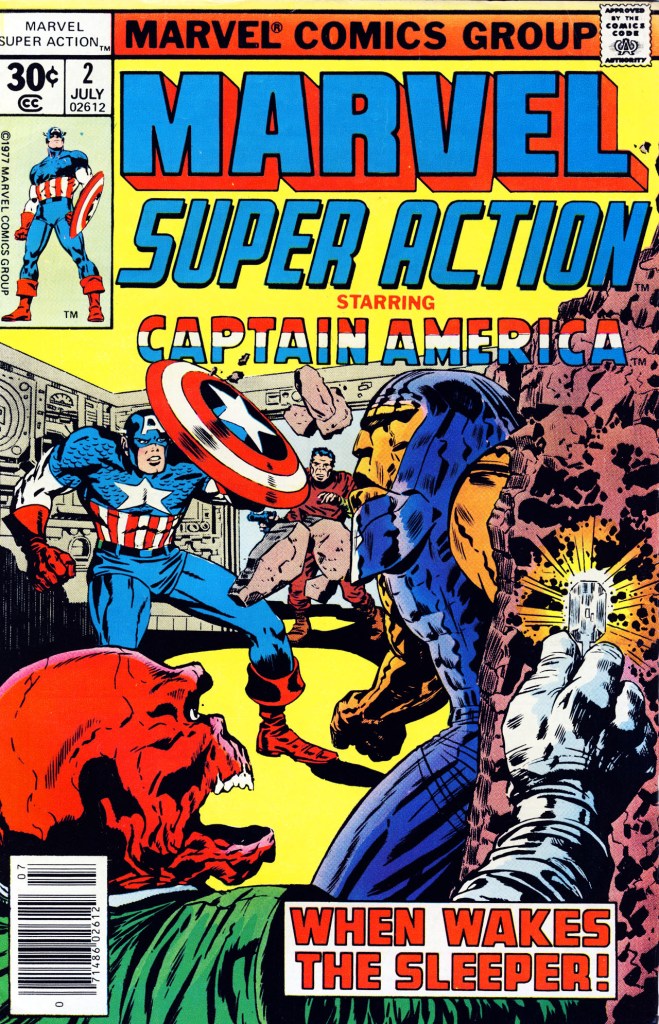
This is one of those comics where I’m not 100% certain where I got it from, or when. But I think it turned up in a 3-Bag at around the same period as IRON MAN #100 and AVENGERS #161–it’s of the same relative vintage anyway. So let’s go with that. During the 1970s, as a way of increasing their rack presence and bringing in some relatively easy additional revenue, Marvel boasted an ongoing line of reprints, showcasing stories that in many cases were less than ten years old. But to me they were new, and it made for an easy way of getting caught up a bit with the intricate history of the Marvel Universe, then only 16 years old in 1978 (which felt like an eternity to my 11 year old self.) As with a number of these reprint books, the cover here is taken from the source material, CAPTAIN AMERICA #101. But in this instance, as would occasionally happen, a stat of the uncorrected cover was used rather than the final version.

Putting aside the portions of the background that were eliminated so as to better silhouette the characters (something that publisher Martin Goodman was a fiend about), the big change was in the visage of the ominous Red Skull. The Comics Code of 1968 thought that Kirby’s initial rendition of the Skull was too horrifying, and so they mandated that it be toned down. This wasn’t a new thing, it had been happening since the character was revived, and even when earlier stories featuring the Skull had been reprinted, his dome was redrawn to make it less scary and, well, skull-like. But by 1977 when this reprint issue came out, the Code had been revised and nobody was particularly concerned about the Skull’s original appearance–which was a lot more dramatic and interesting as rendered by Jack Kirby. The art corrected Skull often looked to me like he was wearing a big meatball on his head.

The story was the first full-length CAP issue to be produced once the Star-Spangled Avenger had been spun off into his own title (the very first issue, #100, had been cobbled together from chapters and bits and pieces initially intended to run as a half-length strip in TALES OF SUSPENSE.) The divisive element of these early CAP issues was the inking by veteran Syd Shores. Shores had been a mainstay in the Marvel bullpen of the 1940s and 1950s, and he had been the principle Captain America artist in the Golden Age after Joe Simon and Jack Kirby parted ways with Martin Goodman and Timely. In bringing him back into the fold, editor Stan Lee was hoping to be able to indoctrinate him into the Marvel approach of doing things (primarily the plot-art-script methodology that saw the artist contributing the lion’s share of the plotting) with the intention of him taking over CAPTAIN AMERICA from Kirby. But things didn’t work out that way. Shores proved to be an uncomfortable fit over Kirby’s pencils–not entirely his fault, as he had been given the impression that what was desired was for him to make the look of the strip his own, and so he used a heavy hand, one whose approach was fundamentally different than Kirby’s. So it wasn’t a great match, and Shores never did wind up inheriting the book.
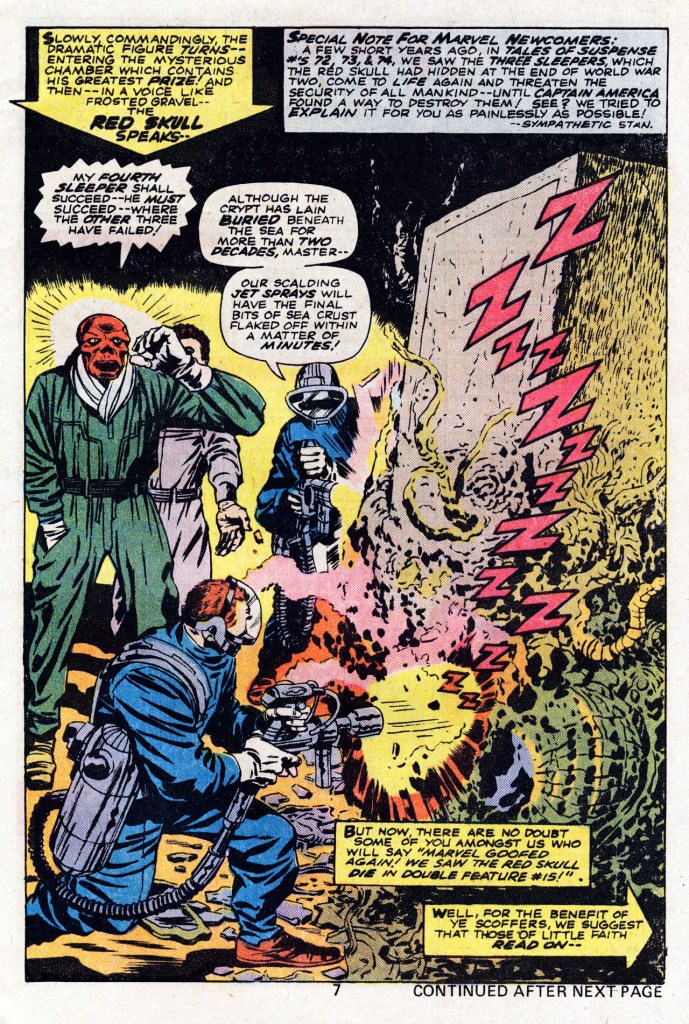
By 1968 as well, Kirby had hit a wall in terms of his own relationship with Marvel, and he’d privately decided as much as possible to stop creating new characters for the company, after having lost control of both the Silver Surfer and Him in rapid succession. This led to his ongoing titles regurgitating villains and situations from the past a bunch–and here, that takes the form of the Red Skull disentombing the Fourth Sleeper. Years earlier, there’d ben a story in which the Nazi villain had set up a trio of killer robots who would destroy the world twenty years later if the Nazis lost the war. Well, it turns out now that they actually had four of the things (and in a couple of years, we’d learn about the fifth.) Which really does raise the question: if you’ve got five unstoppable robots so powerful and sophisticated that they’re still a global threat twenty years later, wouldn’t it be better to put them into battle against your enemies rather than burying them for two decades while your regime crumbles and falls? Nazis are dumb. But hey, that’s the stuff that comic book stories are made of.

So after a preamble with Cap accosting a man he recognizes as an escaped Nazi war criminal–a target that SHIELD’s Nick Fury proceeds to let go, admonishing Cap for his actions. Fury reveals that he only did so in order to plant a tracking device on the guy in the hopes that he would lead SHIELD, and Cap, to bigger game. So even while the Red Skull digs up his fourth Sleeper robot (and reminisces about how he survived certain death in his last encounter with the WWII Living Legend, Cap is in mid-flight to the Skull’s secret island H.Q. His plane is shot down, but fortunately he’s equipped with Tony Stark’s Inflato-Suit, which breaks his fall. I must admit, I can’t read the phrase “Inflato-Suit” without being put in the mind of the Inflato-Coat from the pilot episode of GET SMART, in which Maxwell Smart wears a jacket that conceals twin inflated arms, so as to avoid capture.


So Cap is down and safe, but not for long, as he’s swarmed by stormtroopers in the Red Skull’s service. In typical Kirby fashion, Cap battles his way through a dozen of them–but ultimately, there are too many for him to overcome, and he’s overwhelmed. Meanwhile, the Nazi from the opening has brought the Red Skull what he had asked for: the crystal sonic key that can activate the Fourth Sleeper. And even as Cap is dragged into the room, the Skull begins to do just that. Cap is horrified to learn both that his regular foe the Skull is still alive and that he’s got yet another Sleeper robot to command. But the new Sleeper is far more powerful and uncontrollable than the Skull anticipated, and so he causes chaos and damage as he bursts from his cocoonlike crypt. Cap takes advantage of the situation to wrest himself free of the stormtroopers, but now he’s got to face both the Skull and the Sleeper on his own.

The scene is pandemonium, and the Skull’s henchmen decide that retreat is the better part of valor and begin scrambling for the exits. Never one to miss a beat, the Skull does likewise, closely pursued by Captain America. As they traverse an escape shaft on a cushion of pressurized air, the Skull confides in Cap that the fourth Sleeper was designed with the power and the mandate to destroy the world, just as the first three were. The Skull, though, hopes to yet establish control over the Sleeper and then use him for conquest. But Cap now realizes that either way, he needs to shut the Sleeper down permanently. But it won’t be easy. Because back at the base, the Sleeper unleashes its awesome power, annihilating the complex and indeed most of teh island on which it was built in a single horrifying blast.

Down in the escape shaft, the Skull and Cap wrestle over possession of the Sonic Key, when suddenly the whole place goes up and the two men are separated by the buffeting waters. The Sleeper, meanwhile, has revealed that it is capable of changing its molecular density and so it is unaffected by the detonation, having become phantomlike and slipped into the ground below. Back at SHIELD Base, both Sharon Carter and Nick Fury are horrified by the satellite pictures that they’re seeing, and they fear that Cap is dead. But of course he isn’t–a few seconds later he bobs to the surface, exhausted and out of breath, but in possession of the fateful Sonic Key which he wrested from the Red Skull at the last minute. But can he and SHIELD figure out how to use it to stop the Sleeper in time? To Be Continued!
 The Tom Brevoort Experience
I bought all those reprints in the ’70s. It made me a huge Kirby and Ditko fan.
LikeLike
Reading Cap in Essentials and Epic form it becomes obvious that, as you say, the Skull stowed away more than enough super-weapons to have won the war. Even so, this one’s a dynamic story.
LikeLike
Cool..I
LikeLike
This is the first time that I’ve seen this story in colour. My original exposure to it came when it was republished in black and white (and with smaller panels) in the Marvel UK re-print comic “The Titans” circa 1975.
Thirteen-year-old me actually enjoyed Syd Shores’ inks – perhaps it was the b&w format – and that splash page was my favourite Cap rendition for many years.
LikeLike
I like this Sleeper and I don’t know why Jack Kirby made the First Sleeper [ Tales of Suspense#72 ( December 1965 ) 2nd story — see profile at marvunapp.com ] look so primitive when in 1957 he created robots that look more advanced [ Yellow Claw#3 ( February 1957 ) 3rd story “The Yellow Claw Captured!” — Yellow Claw robot and a non-human looking robot ] & the gigantic human looking Temujai [ Yellow Claw#2 ( December 1956 ) 5th story – Temujai…the Golden Goliath! — I would have used him ( with size changing technology & more durable skin ) instead of the Human Robot in the 1950s Avengers/G-Men — see profile at marvunapp.com ]. ME, I would reveal ALL the Sleepers that came after the Fouth Sleeper were fakes created in modern times and the real missing Sleepers look like the Fourth Sleeper ( some the same height and other taller ) and powerful like the Allies Sleeper — Arsenal [ Iron Man#114 ( September 1978 ) ] and armed with Timely Comics Nazi Technology/Weapons ( Sleep Gas like Countess Mara/Satan in Satin [ Captain America Comics#10 ( January 1942 ) 1st story ], Asphyxiation Gun & Heat Cannon technology of the Scar [ Mystic Comics#6 ( October 1841 ) Destroyer story ) — there is a Destroyer story with a Nazi scientist who creates a force field to protect German cities from allied bombers that works like the Russian mutant hero Vanguard’s force field power ( bombs would hit it and bounce back up exploding allied bombers ).
LikeLike
Add this to Sleeper weapons systems: The Master [ Marvel Mystery Comics#57 ( July 1944 ) Sub-Mariner story ] used chemicals to freeze the English Channel and control the weather. Zomber ( a Nazi ) [ Marvel Mystery Comics#47 ( July 1943 ) Human Torch story ] used electromagnets to bring air crafts to crash from the air & smaller magnets which used in conjunction with his hideout allowed him to raise and lower himself ( see https://marvel.fandom.com/wiki/Zomber_(Earth-616) ).
LikeLike
Seems the Fourth Sleeper was more powerful under Lee-Kirby than under Mark Gruenwald. Cause I wasn’t impressed with its power under Gruenwald. The Allied sleeper Arsenal seemed a hell of a lot more powerful. Considering how powerful the Fourth Sleeper is or was to bad Lee-Kirby never thought to team up Captain America & the Sub-Mariner to fight it ( or that they never channeled DC Comics who weren’t ashamed of their Golden Age past and kept to Original Human Torch around so he could be part of this team-up against the Fourth Sleeper ).
LikeLike
One odd thing about Lee and Kirby looking back at the Golden Age: Captain America is recognized by everyone, a living legend, famous. Johnny Storm remembers him in the comic books. Sub-Mariner? Someone he vaguely remembers from stories Sue told him. Human Torch? When he shows up in FF Annual 4 Reed refers to him as if he were as obscure as the Whizzer or the Blue Diamond. And the end of the Kree-Skrull War shows the rest of Marvel’s GA heroes were so forgotten, Rick can’t even be sure they were real.
LikeLike
Fourth Sleeper: Red Skull says it was created to Erupt, with the Power to Destroy Anything even the Planet ( I assume the slow way cause had Lee-Kirby given it teleportation powers instead of intangibility, I could see it teleporting to the around 20 SUPERVOLCANOES on Earth and erupting all of them. I’m no volcanologist but I assume a new Ice Age and not Earth going like Krypton — with all that volcanic ash in the air. Plus all that lava killing everything it came in contact with ).
LikeLike