

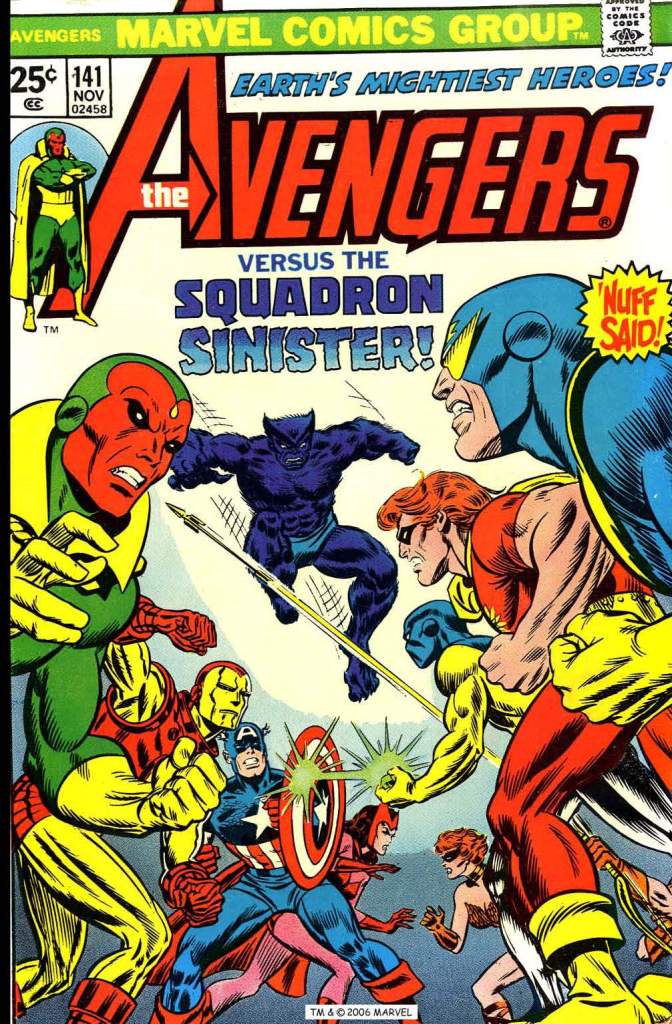
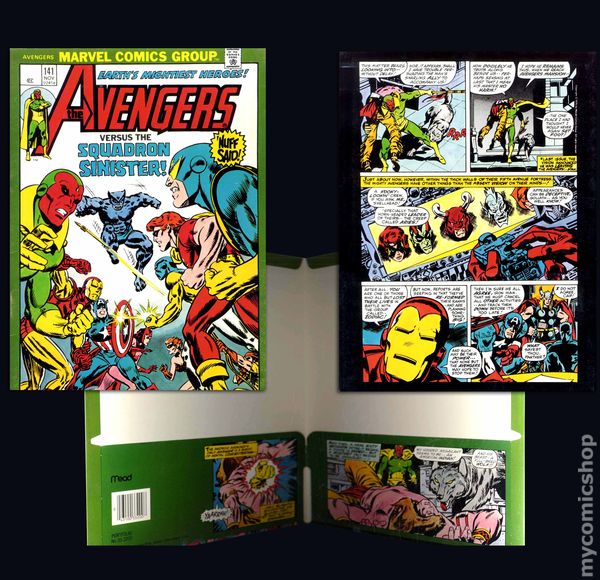
True to form, once I had made the leap to reading AVENGERS on a regular basis, I made may way back to the drug store, to dig through their Big Bin of Slightly Older Comics to see if I could find any other recent issues. I came away with two, this one and issue #152 which we’ll cover tomorrow. Buying this book was a slightly surreal experience, because this cover had already been used on one of the Mead Marvel school supplies book binders, so I had seen it around–in 1978, it was just about the most recognizable AVENGERS cover you could find.
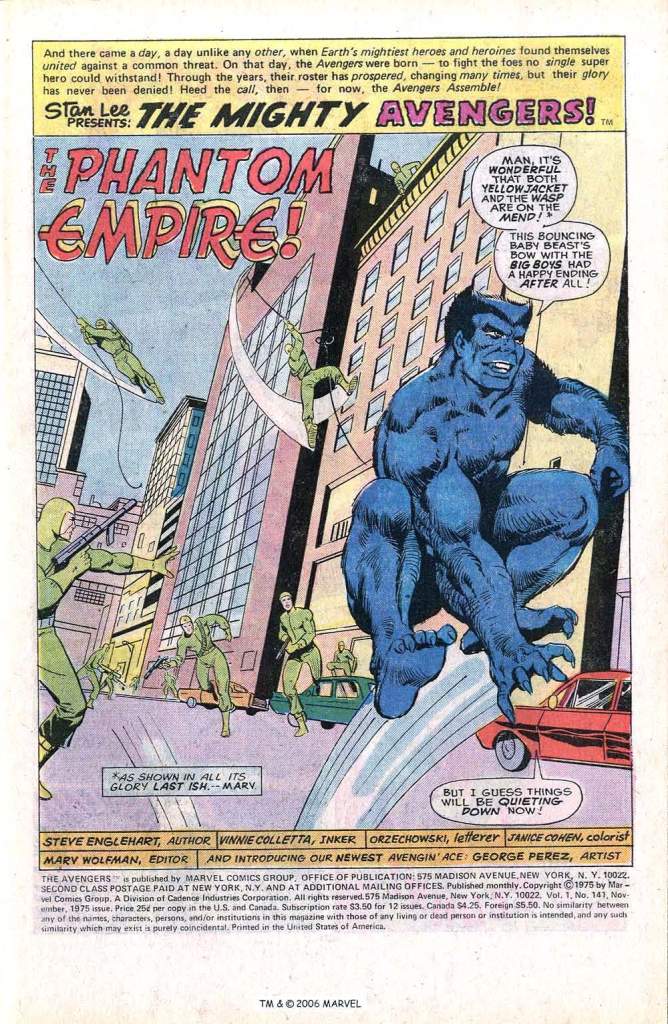
As it turned out, this was the first issue of AVENGERS drawn by my new favorite, George Perez. But this was a much more formative Perez than even what I was used to thirty issues later. George was still embryonic and figuring out his style, so while this issue was perfectly acceptable to my eyes when I read it, it’s also pretty crude and beginner-ish. It probably doesn’t help that Vince Colletta inked this job–George would say in later years that Vinnie really elevated what he gave him, and that may have been true. But I was never a fan of Vinnie’s line, nor the way he would simplify backgrounds and elements to a few open areas, and so this wasn’t a match I loved.
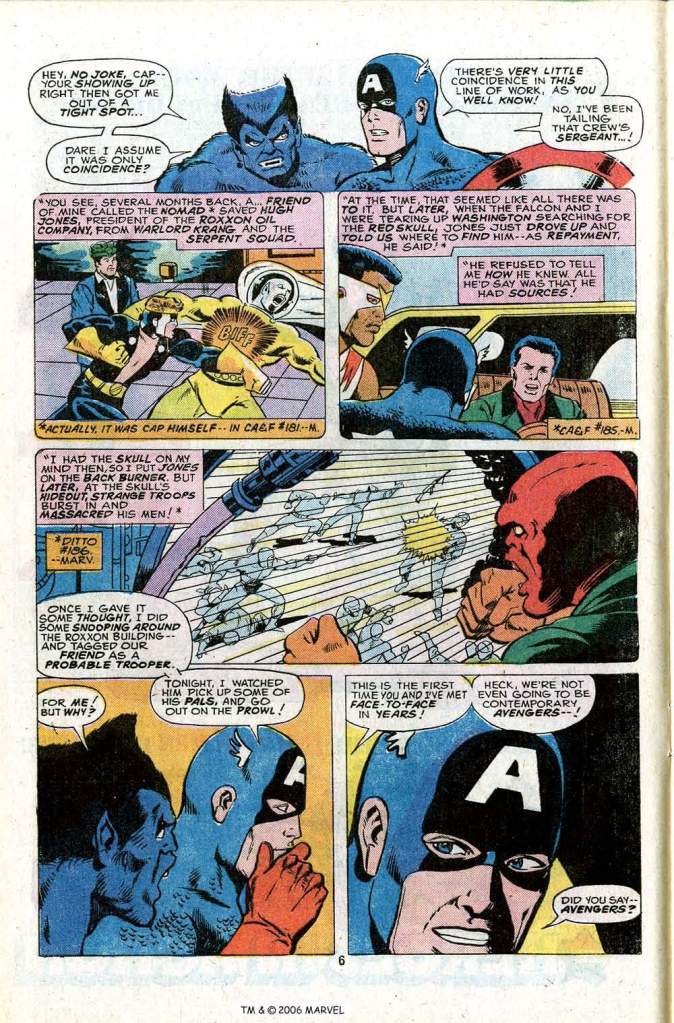
This issue was right during the final period of Steve Englehart’s tenure as the writer of AVENGERS, and he evidenced a very different style from Jim Shooter, who had been doing the new issues I had followed. I knew Englehart’s work a little bit from his run on JUSTICE LEAGUE OF AMERICA. But here, having given up the reins of CAPTAIN AMERICA, Englehart decided to turn his story on wrapping up a dangling plotline from that series, as well as some business left over from the Beast’s short-lived solo run. Consequently, there was a lot of diverse continuity involved in this story, which left me a bit lost. But I wasn’t flummoxed, rather it was all like pieces of an immense jigsaw puzzle where I’d be able to work out the picture if I could just connect all of the elements in the proper arrangement. The story opens with the Beast being attacked by minions of Roxxon Oil, who had been causing trouble for Captain America–and Cap showing up out of nowhere to lend him a hand in defending himself.

The scene then changes to the bedside of Hank Pym and Janet Van Dyne, who were injured on recent missions. Cap and the Beast show up there so that Cap can enlist the aid of the Avengers in investigating Roxxon–he had been apart from the team for several months at this point, a fact I was unaware of, of course. As the Avengers return to their Mansion to work out their next move, a mysterious woman enters Hank and Jan’s room, searching for them. They’ve got some ideas as to who this was, and Englehart provides a clue by way of a footnote–but I didn’t have the background to puzzle this out just yet. There were, it must be said, a lot of footnotes in this comic.

Back at the Mansion, Iron Man and Moondragon have returned from their away mission with a report: their fellow teammate Hawkeye is missing, apparently trapped in the timestream by the team’s old enemy Kang. Again, I had no way of knowing this, but Englehart had been using Kang as a recurring foe for the team, having him show up again and again issue after issue, thanks to the fact that he could recover from a defeat, plan out a new strategy and then return minutes or days later thanks to his mastery of time travel. But this forces the Avengers to split their forces, with Thor and Moondragon heading to the past to search for Hawkeye while the remainder of the team heads out with Cap and the Beast to investigate Roxxon. In the midst of all of this, the mysterious chasing woman finally catches up to the Avengers, and it turns out that she’s Patsy Walker, formerly the star of a million teen humor comics. Englehart had brought her and her husband Buzz Baxter in as supporting characters in the Beast series, and here she’s following up on those appearances. She tries to blackmail the Beast into making her into a super hero by threatening to reveal his true identity. When Hank calls her bluff, the Avengers tell her that they already know that the Beast is Hank McCoy, but the Beast insists on allowing Patsy to accompany them anyway, so that she can see firsthand how dangerous being a super hero really is.
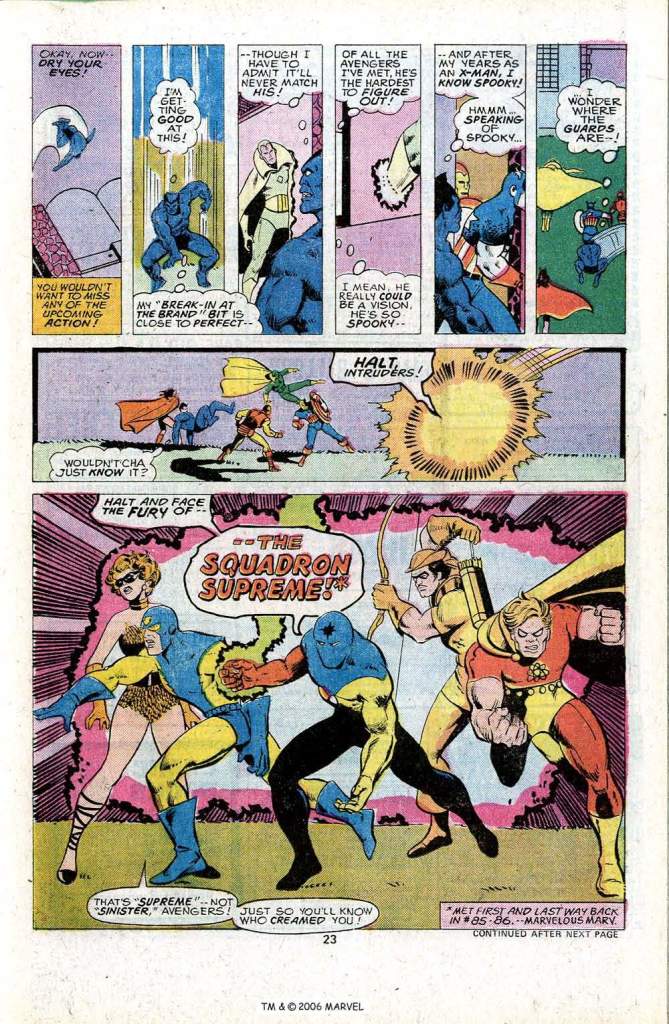
While Thor, Moondragon and their travel guide Immortus get attacked by Kang in the timestream, the remaining Avengers head off for the Brand Corporation, an outfit about which Iron Man has serious misgivings. They attempt to infiltrate the compound, but security has been beefed up thanks to Patsy’s ex-husband Buzz. And so the Avengers find themselves confronted by the Squadron Supreme. Yes, Supreme, not Sinister–despite what the cover says, this is the good guy Squadron team from a parallel Earth not their nefarious Marvel-Earth counterparts. But why are they working for the bad guys? Hell if I knew. But I was informed enough about parallel worlds thanks to my JLA reading so that I could somewhat follow the explanation of which Squadron this happened to be.

It’s a short but colorful fight, and something of a rout as the Avengers have their heads handed to them by the Squadron. (There’s another bit of confusing continuity brought up here, where the Squadron’s Golden Archer explains that, on his world and in his last appearance, he had been known as Hawkeye. But since he was on the Avengers’ Earth now, where Clint Barton lives, he decided to change his name to avoid confusion–and he adopted a costume that Hawkeye had once used to pose as a super-villain. See? There were a lot of footnotes in this comic.) Anyway, the Avengers are all defeated and captured by the Squadron–and meanwhile, back in the timestream, Thor, Moondragon and Immortus emerge in the year 1873, only to come face-to-face with the owner of a threatening and spooky voice. To Be Continued! For those unaware (and because I wouldn’t read the next issue for several years afterwards) that voice came from one of the Marvel western heroes, Ghost Rider (here called Night Rider), who was allied with the Rawhide Kid, Kid Colt and the Two-Gun Kid to oppose Kang’s plans in the old west. So that would be another weird team-up story–Englehart was really drawing ideas from all corners of the Marvel publishing line at this point.
 The Tom Brevoort Experience
Colletta rarely worked for me. He seemed to “dumb down” the pencil art. There were a few Kirby jobs where Vince’s inks added a suitable solid granite finish. But more often his finishes were like a stone grinder. Dulling the details. Eroding the crispness.
Englehart sometimes didn’t know when to quit. Not every single idea is worth chasing down or expanding on. The Hawkeye/Golden Archer idea could have worked if the 2 characters spoke to each other about it. But a footnote is like Steve taking credit for an idea that really adds nothing but trivia. Without the weight of the characters discussing it and rafting, it’s lost.
So the Whizzer can carry Iron-Man? Wow. He’s stronger than either Flash or Quicksilver. 😆
LikeLike
…OTTOMH, the period when Marvel referred to the Western Ghost Rider aroused in me a WTF/” Do you not know the historical context? ” reaction here – a character rides by night in a white costume? Considering that ADMIRERS of the historical My Klux Klan referred to them as ” Night Riders “? I think I did see that this was eventually brought to Marvel’s attention…(I recently read that the historical violent bigoted Klan of the post-Civil War – The 1861-1865 one!!!!!!!!! (Is there anywhere else in the world I would have the chance to add that note? I ask yez. – wore dark, not snow-white outfits, that that was an invention of D.W. Griffin’s THE BIRTH OF A NATION, but anywau.)
LikeLike
…” My Klux Klan “, a mistype got out above. I saw Griffith’s movie decades and we are a ago, but not since, though I once had a VHS of it. I’ve never seen Leni Restifal’s(??) TRIUMPH OF THE WILL or OLYMPIA.
LikeLike
…MISTYPE!!!!!-!!! ” Ku Klux Klan “.
LikeLike
I have fond memories of this Avengers era. I had just started buying the book regularly about six months before with issue #133, and was excited to carry the Mead folder with the cover from #141 to class in 7th grade.Big Mistake. Everybody in 6th grade elementary openly loved comics, but when I got to Junior High, showing you were a superhero fan could get you beaten up as a “sissy”. Ah, the teen years!
LikeLiked by 1 person
First time I’ve ever seen this issue in colour. The last time – the only time – I’ve ever ever read it was as a British (Marvel UK) reprint over forty-plus years ago. Strangely, Colletta’s inking seemed more agreeable in that format.
I had little idea what was going on story-wise and it wouldn’t be until years later that I came to appreciate just who Patsy Baxter (nee Walker) actually was; “her” comics not being British fare.
LikeLike
First I have to say that I originally didn’t know there were 2 teams ( Squadron Sinister & Squadron Supreme — it didn’t help that covers called the Squadron Supreme the Squadron Sinister ). Second it was during Mark Gruenwald’s Squadron Supreme# 1( September 1985 ) – 12 ( August 1986 ) series that it came to me to wonder why Marvel & DC didn’t make the Rival Teams [ The Avengers#85-86 ( February-March 1971 ) & Justice League of America#87 ( February 1971 ) ] into Russian Heroes instead ( U.S. & Russia rivals & Marvel & DC rivals ) — so that both companies could take advantage of your own Super-Villains whose abilities or powers mirrored ( Amazo & Super-Adaptoid, Magneto & Dr. Polaris ) or came close ( in the Leader & Hector Hammond’s case ).
LikeLiked by 1 person
Cadre Cartel ( renamed Serpent Cartel – 8 members ) [ The Avengers#148 ( June 1976 ) page 3 panel 6 from left to right ( my list based on looks ): Sebastian Shaw, Ward Meachum, Harry Leland ( minus the beard ), Darren Cross, Nelson Rockefeller, Drexel Cord, Kyle Richmond ( Nighthawk ) & Norman Osborn ] — of the members seen and named in Web of Spider-Man Annual#5 ( 1989 ) only Sebastian Shaw & Kyle Richmond resemble the members seen in The Avengers#148.
LikeLiked by 1 person
Must admit that this is my favorite Squadron Supreme arc. This is just the first part — and one that I only scanned from the comic book rack at a department store because I had not yet started collecting Marvel titles (was a pure DC fanboy until a few months later). Perez is rough this issue, but still better than a lot of veterans of that time. Colletta’s work here is difficult to judge due to Perez being so raw, but I thought the duo did a fantastic job in issue #147.
I don’t recall who inked Perez on issues #142-143. Issues #145-146 were out of continuity and by Tony Isabella/Rich Buckler and Don Heck. I think, because of the Dreaded Doomline — meaning the regular story wasn’t ready by time of the book had to go to print. I read recently, that the Assassin story in #145-146 was originally intended for a Giant- Size Avengers, but the GS titles were cancelled before it could see print. It’s actually an interesting failed plot on how to murder the Avengers, but is focused on the villain more than the Avenger characters.
The Squadron arc (mostly) ends with the fantastic #148 inked by Sam Grainger who had an ultra clean style compared to Colletta’s more sketchy approach. Issue #144 features Mike Esposito’s inks over Perez’s pencils. I haven’t always enjoyed Esposito’s work, but on Perez’s pencils it worked really well. Issue #144 (The Hellcat Cometh) holds a special place in my heart as being the first regular issue of Avengers I purchased. The Avengers Marvel Treasury Edition was actually my first Marvel purchase (which made me an instant fan).
Issue #148 is noteworthy for Englehart mimicking the Satellite era JLA stories where the group is broken up into smaller groupings with each member’s name/logo heralding each adventure. Very fun stuff, and Englehart would leave the series on a strong note a few issues later.
Finally, I was in junior high when those Mead products came out — and I had the binder, folio/folder and notebook all with that incredible Gil Kane cover. To be honest, I hadn’t recalled it from briefly seeing the issue on the rack a year or so earlier — and didn’t know it was Gil’s work, but it’s probably my favorite Avengers cover produced.
LikeLike