


While I was at Heroes World, I took advantage of the rare opportunity to fill in a couple of the holes in my FANTASTIC FOUR collection, including this issue and the next. This finally bridged the gap between the new off-the-racks issues I had been buying and the older ones that had been showing up at the drugstore and in 3-Bags. I had actually seen this issue a bit earlier–a few months before, I ended up going to the 7-11 with a friend from school, Billy, and he bought himself a copy of this issue, which I thumbed through a little bit. But that was still during the very end of my No-Marvel period, so I didn’t give it a lot of thought. (Billy also told me about his father having a super-old issue of FANTASTIC FOUR that he’d bought as a kid, with a storyline called “The Laughing Dead.” There is no such issue–so I suspect he was making the whole thing up, seeing how interested I was in it. It’s amazing that I remember that 40-plus years later.)
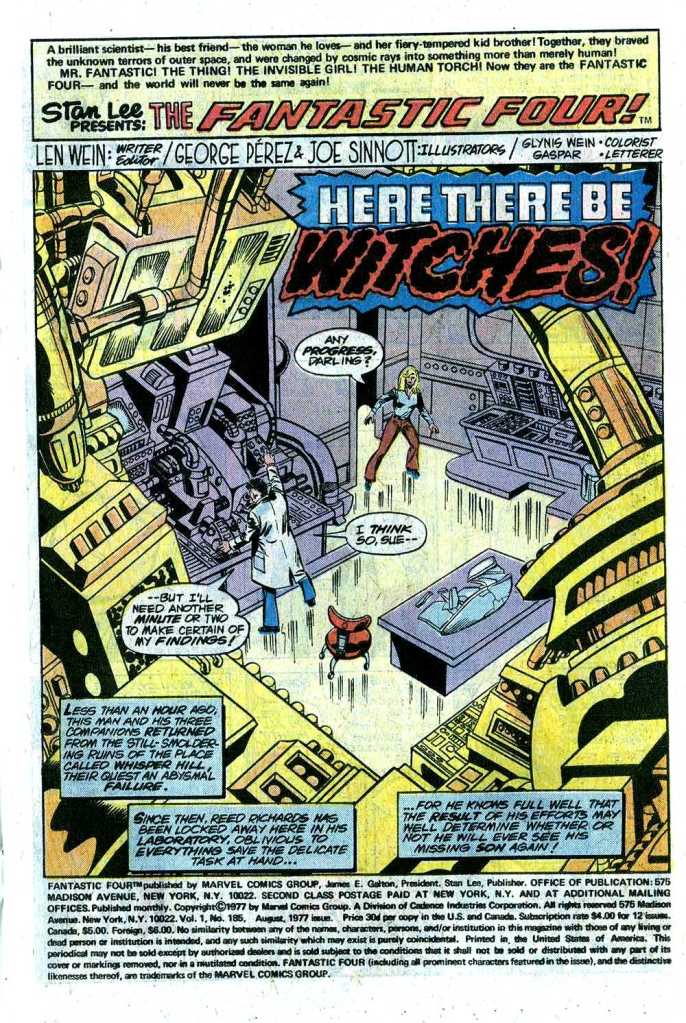
This was another story expertly illustrated by George Perez, who was swiftly becoming my favorite artist in the business. His work was elevated by the always-sharp inking of FF mainstay Joe Sinnott, who was almost as much a part of the series as the Torch or the Thing. After a few months of rotating and haphazard writers in the wake of Roy Thomas’ departure, Len Wein was now at the helm and ready to begin moving forward with his own plotlines while picking up the outstanding business that had been left for him and for the FF by the outgoing creative team. First on the docket: Little Franklin had been abducted by his Nanny, the witch Agatha Harkness–who herself was carried off by mysterious assailants. Time to figure out what that was all about.

Reed’s computers are able to track Agatha’s location to Colorado, so the team gears up to head out and investigate. Reed has lost his elastic abilities, however, which leads to him donning mechanical Auto-Extenders that can replicate the ability of his arms to elongate. He also shows up in a throwback to the FF’s original uniforms, the ones where the chest insignia was a bit three-dimensional. This strikes me as a change that Wein chose to make, and which Perez carried through on. As was typical of him. Perez packs his pages with lots of panels while never seeming crowded, allowing for a great deal of story and characterization moments in every issue. He’d only get better at this.
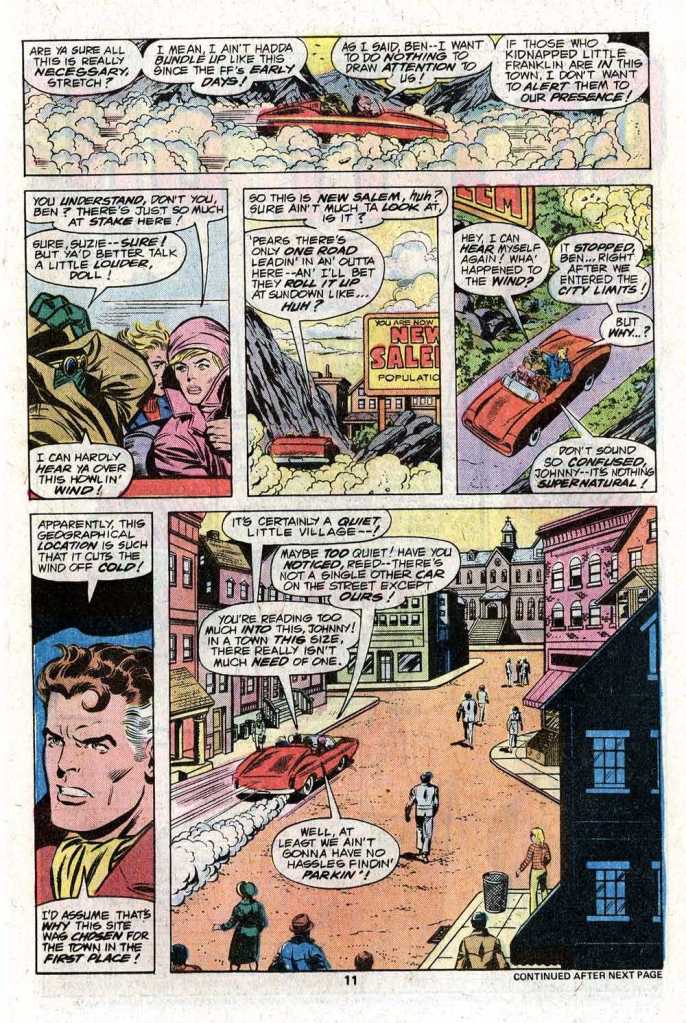
After a short interlude with the Impossible Man just to keep him in the readers’ memories, we find the FF having landed on the outskirts of the tiny remote township of New Salem. Johnny assembles a car for them out of parts stores in their ship, and the team heads into town incognito, where they meet the jovial mayor Nicholas Scratch. But nothing appears to be amiss in New Salem, despite Reed’s computers’ findings, and so having come up empty, the FF load back up in their car and prepare to leave town. But before they can reach the town line, the captive Agatha Harkness uses her own magic abilities to create a wall of flame that shoots up directly in their path, halting their departure. Now the FF know for certain that something is rotten in New Salem.

With their ruse now penetrated, Nicholas Scratch and the citizenry of New Salem drop the spell that is concealing their village, revealing it as a settlement of witches and warlocks, concealed from discovery by the outside world. Nicholas Scratch is the leader of the Coven, and he shows the FF that he’s got Agatha and Franklin in custody. That’s a big mistake on his part, because rather than cowing the FF into acquiescence, it instead drives them into action, and they go on the attack. It’s action time, and so we get a number of pages of combat between the fighting family and their sorcerous opponents.

It’s a fairly well choreographed battle sequence, and it goes on for several pages without the Fantastic Four making any headway. At one point, in a more serious minded version of the childhood taunt, “Why are you punching yourself?”, Scratch and his followers take control of the Thing’s fists, forcing him to pummel himself into oblivion. In a similar fashion, the other members of the FF are confounded by the Coven’s indistinct powers, and despite their own experience, they get taken out of the fight one by one.

And that’s pretty much where the issue wraps up, with the FF all having fallen and at the mercy of Nicholas Scratch and his Coven of Witches–who have made it clear that the four cannot be allowed to leave and spread the knowledge of New Salem’s location to the outside world. To Be Continued! Most readers had to wait a month for the wrap-up, but I had bought issue #186 as well, and so could go straight into it. For you, though, you’ll need to wait until my next entry next week.
 The Tom Brevoort Experience
That is done in depth analysis. Cool beans.
LikeLike
That is awesome in depth analysis. Cool beans.
LikeLike
This issue and the next one were my indoctrination into Fantastic Four. My buddy brought these two issues to read on a trip to Cedar Point and left them in our car, so they were a permanent fixture to backseat reading as a kid. I always confused Agatha Harkness with Aunt May and was wondering why she was being so evil in Fantastic Four when she was so nice in Spider-Man. Of course, back then, in my mind there couldn’t be two old ladies in comics.
LikeLike
FF#185 ( August 1977 ): I wonder if New Salem and the Witches ( not all witches in FF Annual#14 ( December 1979 ) ) influences the creation of the Hidden Ones of the hidden city [ Justice League of America#164-165 ( March-April 1979 ) Hidden Ones name in The Official Justice League of America#5 ( October 1986 ) ].
LikeLike
Timely Comics Prototype to New Salem? The so-called hostile tribe of sorcerers in India that “killed” Monako’s parents and despite the powerful magic they taught Monako ( who they never raised to be evil, so no way they were either ) some how they were all “killed” by British soldiers [ Daring Mystery Comics#5 ( June 1940 ) Monako, Prince of Magic – “the origin of Monako” ]. Monako’s origin gives Marvel a counterpart using one of the tribe to Standard’s Ghost ( George Chance ) [ Thrilling Comics#3 ( April 1940 ) raised in India by a group of yogis who taught the “greatest magic of the ages” ] only as an Indian ( Bhut – ghost in Hindu ) instead of an Caucasian.
LikeLike
In Comedy Comics#14 ( March 1943 ) Widjit Witch story she ran into another witch ( a Nazi spy with a bomb ) and the spy thought Widjit was another Nazi spy and Widjit thought the spy was another witch ( one she thought was ill so she used magic powder to turn an ordinary broom into a sentient flying broom stick to send the “ill witch” back to Witchland to find a doctor ). Widjit has a cameo in the Super Rabbit story: in his dream she gives him the famous Super Ring to turn him into a Super Rabbit )– maybe the ring has a inactive ( needing a spell to activate ) Timely Comics mainstream counterpart.
LikeLike
The panels with the robed witches and glowing eyes ( page 27 panel 5 & page 31 panel 2 ) is reminds me today of the 1967 Spider-Man cartoon villain the Fifth Avenue Phantom ( and MC2 counterpart La Fantome ( Stacy Smythe ) [ Spider-Girl#91 ( October 2005 ) ] )
LikeLike