

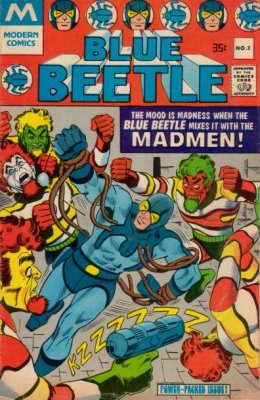

Two-Guys was a low-rent department store chain in the New York area in the 1970s–something of an equivalent to K-Mart years later. Because it was cheaper than most regular department stores in our area, albeit just a bit shabbier, my family shopped there frequently. And tat’s where I first came across Modern Comics. These were three-bag collections of assorted books, very much like the ones DC and Marvel manufactured. But these featured titles I’d never seen before–among them a fair number of super hero books!

I would buy a whole bunch of these 3-bags over the course of the next several months. The prevalent war, mystery and martial arts titles (including former Marvel EIC’s favorite, Yang) would be given to my younger brother or traded away for other things. Modern Comics was actually a reprint program, one struck with the omnipresent Charlton Comics, the perennial bottom-feeder of the industry. Somebody had licensed the rights to reprint a cherry-picked selection of their issues from the past and sell them to the discount department stores and similar outlets as evergreen product.

The first such bag I picked up contained a reprint of BLUE BEETLE #3 from 1967, both plotted and penciled by the great Steve Ditko. This would have been my introduction to Steve’s work in a super hero context, and I flat-out loved it. This was Ditko at his prime, fresh off of his Marvel work and ready to bring the same magic elsewhere, even Charlton, who paid the lowest rates in town. But they also gave the most freedom, which is what Ditko was craving the most. Plus, they’d give a creator as much work as they could handle.

The Blue Beetle had been a long-running character dating back to the Golden Age of Comics. But he was never a huge hit, for all that he’d turn up from time to time. Ditko completely re-imagined the character and made him a legacy hero at that. Something mysterious had happened on Pago Island that had killed the original Blue Beetle and caused scientist Ted Kord to take up his mantle as the non-powered new Blue Beetle. The mystery of Pago Island would be a running subplot through several issues of the series.

And in fact, Dan Garrett mysteriously shows up alive in this issue, a fact that perplexes both Ted Kord and Lieutenant Fisher, the cop who has been dogging Kord, thinking he killed Garrett. It may surprise readers who only know the Blue Beetle from his later DC appearances, or the Legends television show, but he was created as a serious character, a lead hero. In essence, he was a more mature, fully-grown version of Ditko’s Spider-Man. (I myself only knew his name from the comedy skits on the PBS Electric Company show, where he was treated as a buffoon.}

The plot is vintage Ditko, withe the Beetle on the trail of the carnival-like Madmen gang. Complications arise when the Madmen get their hands on the Beetle’s secret weapon, an ominous-looking pistol. They can’t get it to do anything but make a creepy sound, but they’re able to employ psychology to make people think it’s an awesome weapon–and the fickle public turns against the Beetle for carrying it.

The Beetle tries in vain to recover his weapon, along the way having a series of spectacular fights with the Madmen. Captured by the villains, the Beetle can’t be unmasked by them–his metallic hood and costume lock together, a concept I adored. The same fingertip control sensor is used to fire his gun, so when the Beetle gets it back, he’s able to activate it…

..and it turns out to be a light gun! The Beetle would never carry a lethal weapon, the beliefs of the citizenry to the contrary. With the Madmen mostly blinded by the flash (the Beetle’s goggles protect his eyes}, he’s easily able to mop up the threat. But there’s still the mystery of Dan Garrett’s return to deal with–but that wouldn’t happen until the next issue, which Modern didn’t reprint. It would be years before I’d learn the truth.

The back-up story introduced me to Ditko’s other great Charlton creation, the Question. Not quite a super hero per se, more like an investigative crime-buster in the mold of the Spirit, the Question wore a solid full face mask that made him seem faceless. The special gas stored in his belt buckle caused the mask to adhere to his face wile also changing the color of his hair and clothes.

Ditko has described the Question as a tamer version of the ultimate expression of his Ayn Rand ideals, Mr. A. But to be honest, I always preferred the Question. Not only was his look cooler, but he wasn’t proselytizing a set of values, they just came across in the course of the adventure. The one real point of commonality was that the Question, like Mr A., had no sympathy for criminals, The Comics Code softened the Question’s stance some, though– he couldn’t just stand there and watch some no-good get his just deserts, as Mr A. would.
 The Tom Brevoort Experience