

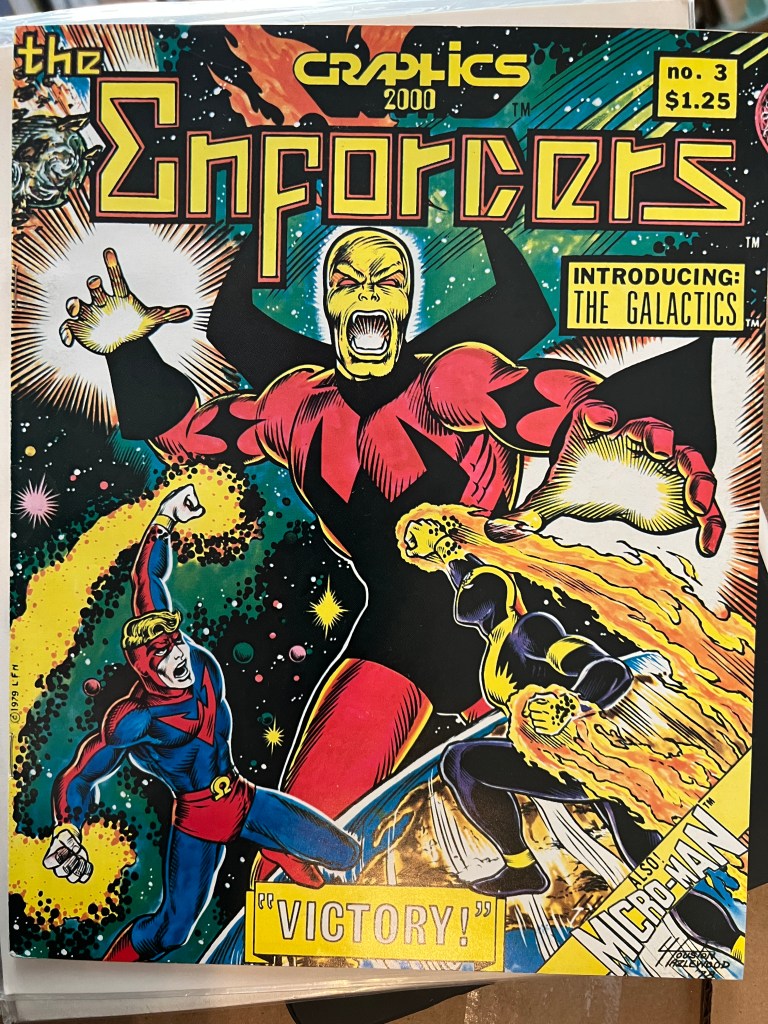
As we covered a bit last week, there were two separate issues of Larry Houston’s fan-published super hero comic magazine THE ENFORCERS that I found on my first trip to Xanadu Comics in Wilmington, Delaware. We covered the first last time:
#3, obviously, was the second. I would spend the next fifteen-plus years vainly trying to track down a copy of #1. Even finding anybody who had ever heard of these publications proved to be difficult. Eventually, at a San Diego Comic Convention in the late 1990s, I struck gold. it was then that I learned that the reason for such difficulty was that the inaugural issue had been released three years earlier, in 1975, and being entirely in black and white, it was much more clearly a fanzine. In any event, my long quest was then finally at an end.
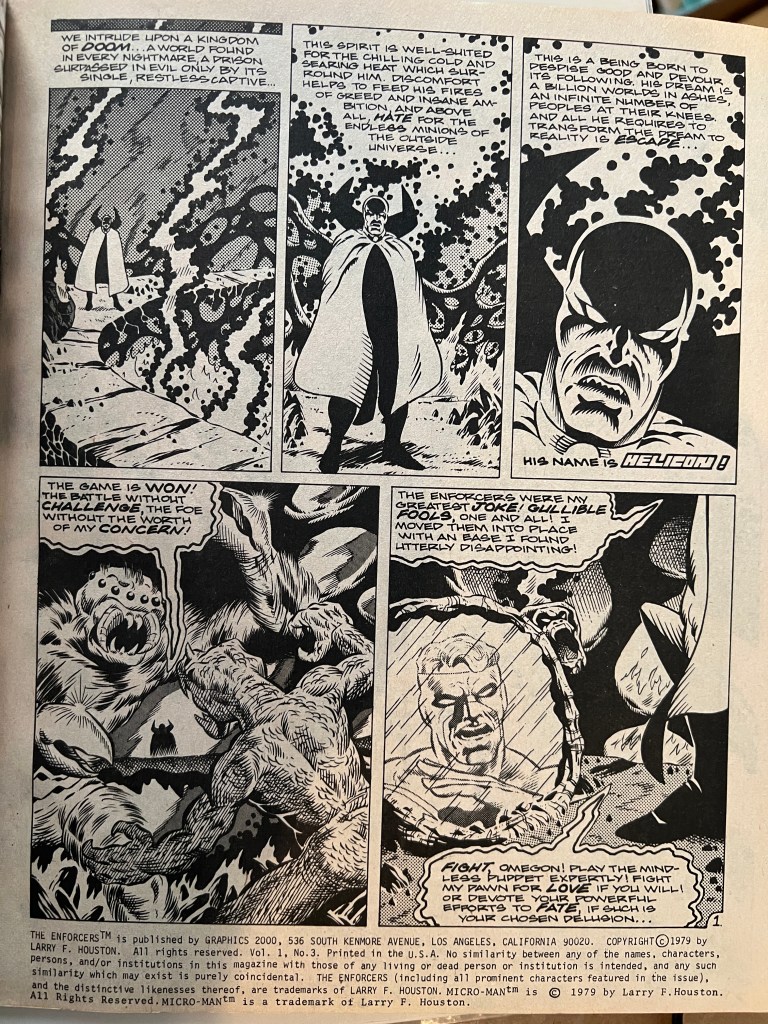
GRAPHICS 2000, Houston and friends’ publishing imprint, talked a good game. Their releases were filled with letters pages and text pieces clearly inspired by the Marvel Bullpen Bulletins of the 1960s. But they showcase a bit more edge than Stan Lee ever did, describing in depth how they had grown up in the 1960s with the best super hero comics ever published, but as they entered the 1970s, the magic seemed to go away from those books and characters in some ineffable way. Nobody among the GRAPHICS 2000 staff ever conjectured that it may have been them who aged and changed rather than the comics. Still, they had put together THE ENFORCERS and the other publications that they intended to release as a cure to this malaise. Inspired by the books they loved, they set about to come up with their own characters and storylines in that spirit. And to a great extend, they succeeded.
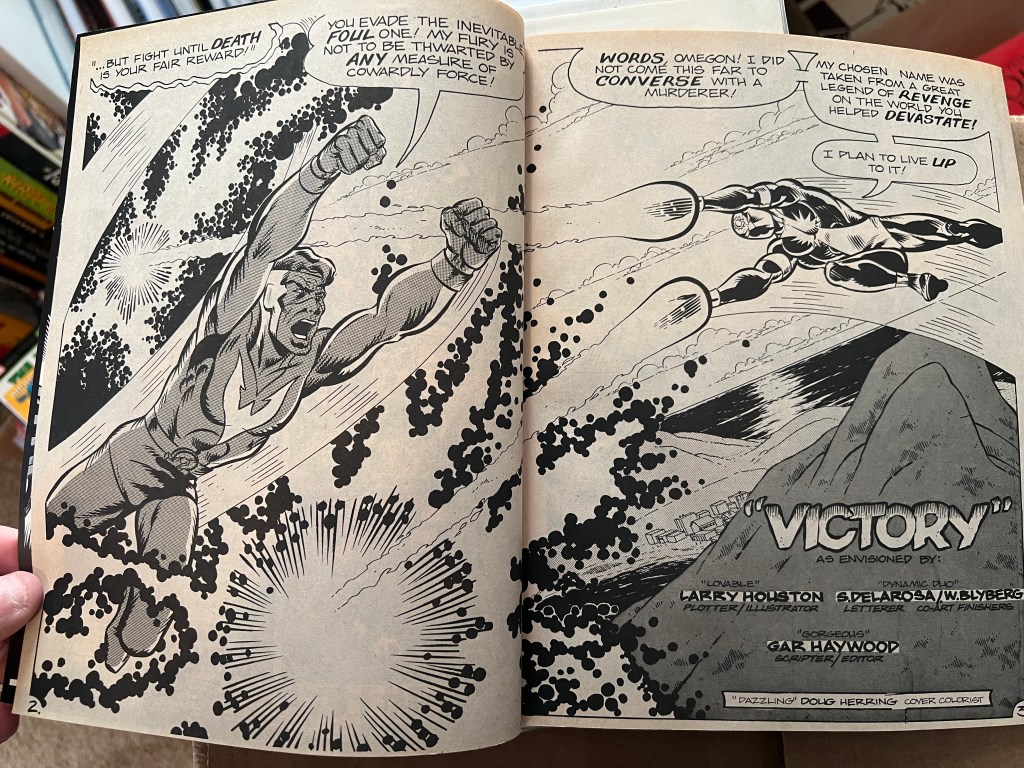
Though it was only released a few months after issue #2, the artwork in this third issue takes a substantial leap forward. Mostly this seems to be down to the inking, which was now being handled tag-team by Sam De la Rosa and Will Blyberg, both of whom would shortly enter the field as respected professionals. Penciler Larry Houston’s storytelling and dynamics were still on point, and he channeled the spirit of Lee and Kirby in his stories. But now the finished product looked a bit sharper and more professional as well. The scripting was now being handled by Gar Haywood, who had previously functioned solely as the strip’s editor (and letterer in issue #2–the lettering was something else that looked a lot stronger this time out.)
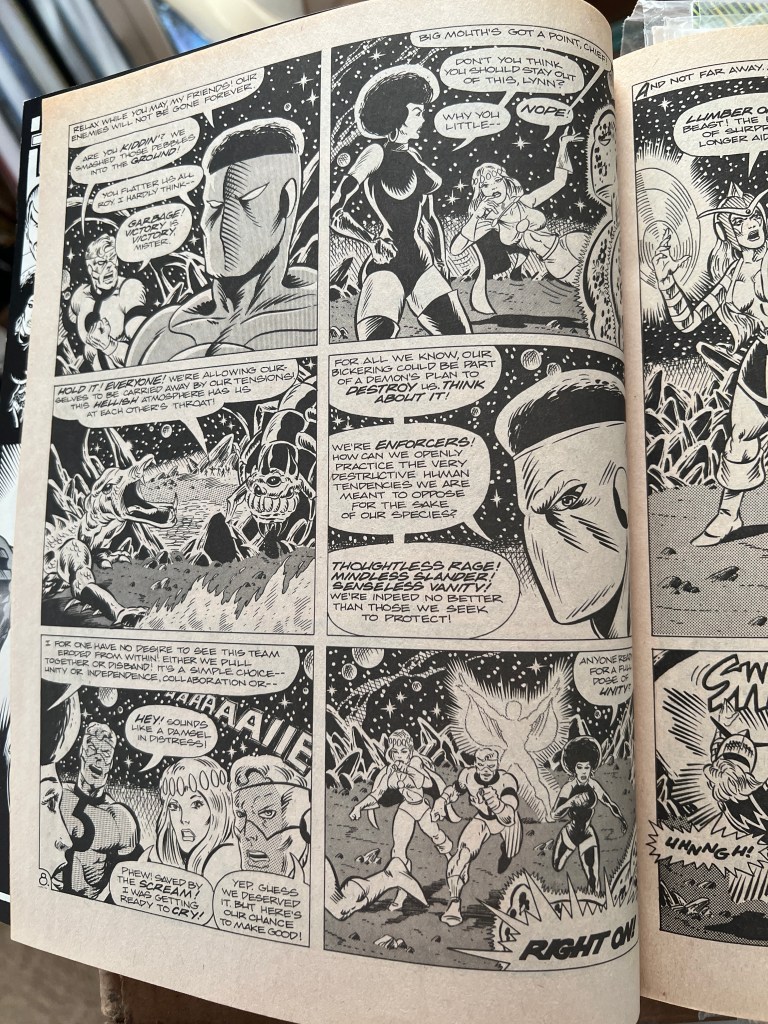
The Enforcers were a super hero team comprised of assorted single heroes in the manner of the Avengers. And like the Avengers, they often took to referring to one another as “Enforcer”. The strip wasn’t really disguising its influences. This issue opens up with Helicon, the team’s secret demonic enemy watching from afar as the conflict that he’d arranged between Omegon, the team’s powerhouse member and Andromedon, the last survivor of a doomed species who sought revenge on Omegon’s people. Helicon reveals through monologuing that the creation of the Enforcers was his doing and a part of his plan to liberate himself from the dimensional prison in which he finds himself. And his daughter Marylyn, known as the Sorceress, is the key.
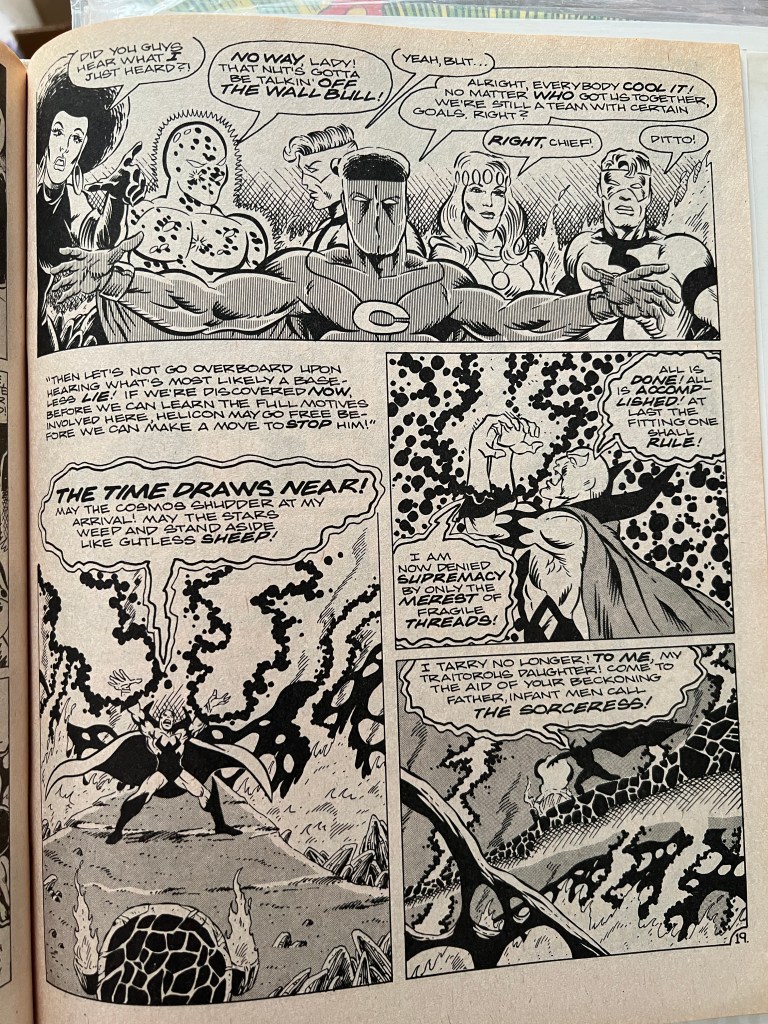
Meanwhile, the other six Enforcers have found themselves drawn into an otherworldly limbo as well, attacked by monstrous creatures and besieged on all sides. being super heroes, this leads to an extended fight sequence that lets them all show off their abilities and personalities, and they succeed in driving off their attackers. But the group squabbles at the drop of a hat, and it’s all that their leader, the Centurion, can do to keep them all on the same page, Fortunately, before the Enforcers can turn on one another, they come across somebody else in peril. This turns out to be Lady Myrannda, the mother of Marylyn, who has also been exiled to this realm. After coming to her aid, Myrannda tells them the backstory of Helicon, how he courted her in order to steal her power for himself.
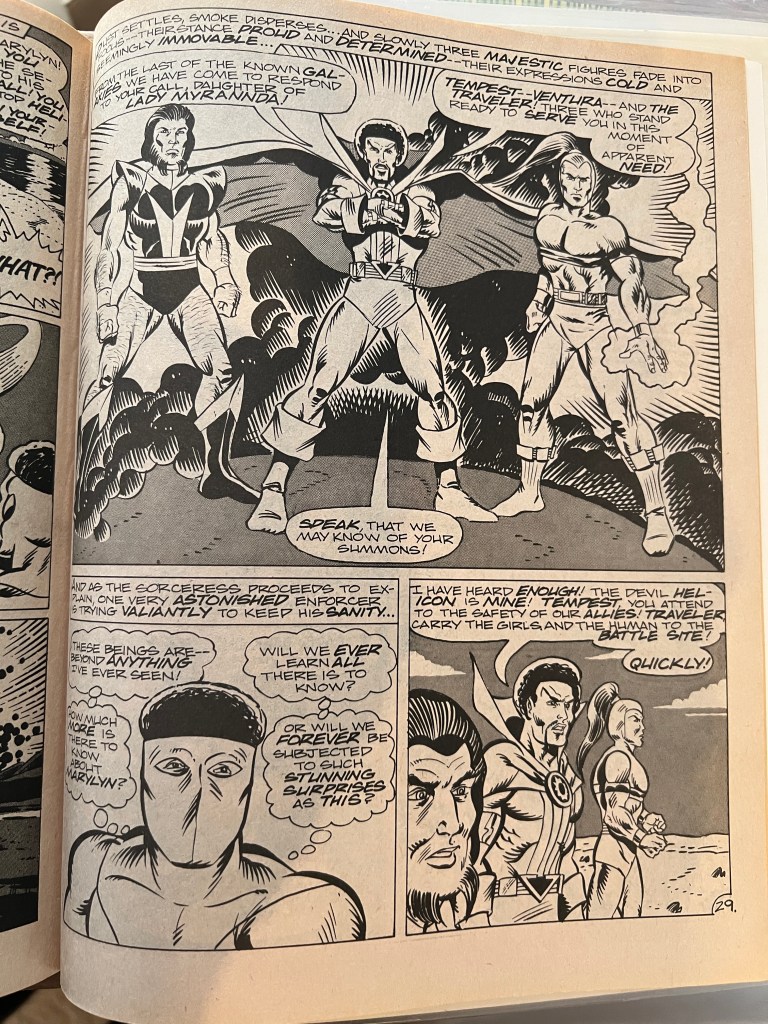
But at this point, Helicon is ready to make his move, and he casts a spell to release himself from his prison, manifesting among Omegon, Andromedon and the Sorceress and breaking up their running battle. Now in the company of Lady Myrranda, the other Enforcers are able to follow, bringing all of the characters to a single location for the first time in these two issues. But Helicon is beaucoup powerful, and he’s able to easily fight back the entire assembled team as well as the hangers on. Things look bad for the good guys at this point. It’s at this moment that the Sorceress acts to bring in a Deus Ex Machina. She casts a summons to one whom she says was once as close to her as the Omegan is today.
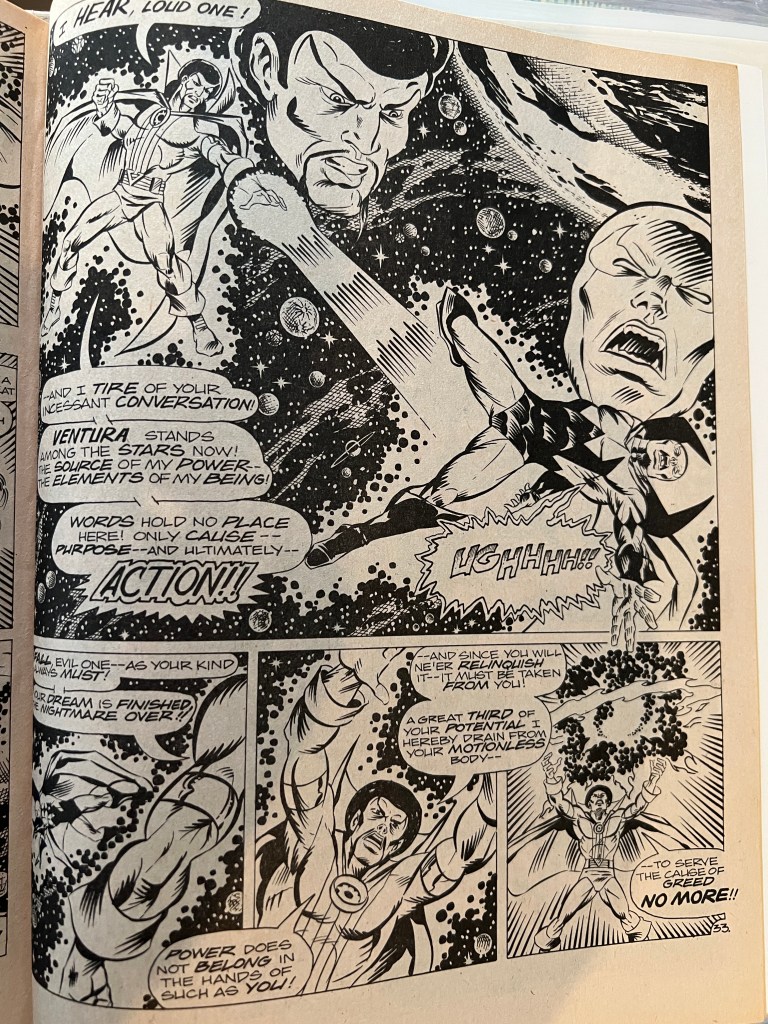
This in turn presages the arrival of three new figures: the Galactics. They’re a team of cosmic-empowered demi-deities: Ventura, Tempest and the Traveler. They seem very much inspired by Jack Kirby’s New Gods by way of Kirby and Lee’s Asgard, but perhaps the most notable thing to my eye at the time was the fact that Ventura, the leader and spotlighted character, was black. There had been black characters among the New Gods, but none that commanded the presence and respect that Ventura does in this story. He’s set up as a very big gun.
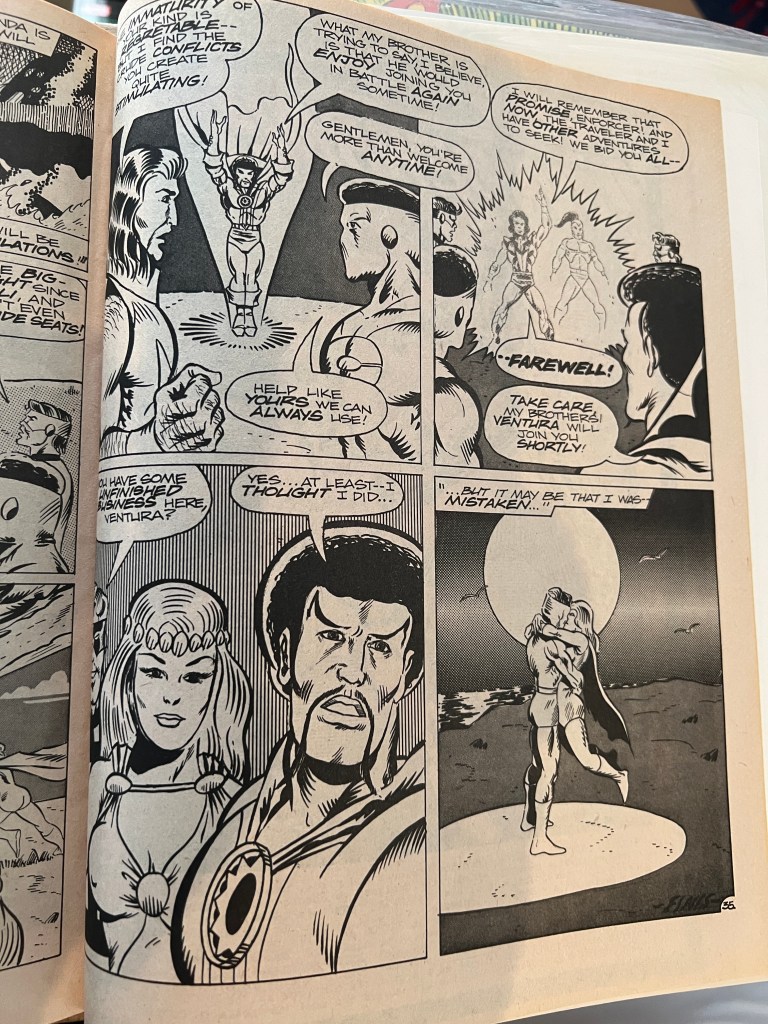
And he doesn’t even need the help of his two cosmic brothers to bring an end to the story that had been running for three issues. The Enforcers themselves stand around and watch in awe, in a manner reminiscent of when the Fantastic Four could do little more than act as observers as the Silver Surfer took on Galactus. The battle is a rout, with Ventura stripping Helicon of his mystic might and exiling him far away once again. But in the final beat, while he and his companions came due to Marylyn’s urgent entreaties, Ventura is saddened to learn that her affections are now for the Omegan alone. And that’s where the story of the Enforcers reaches its conclusion.
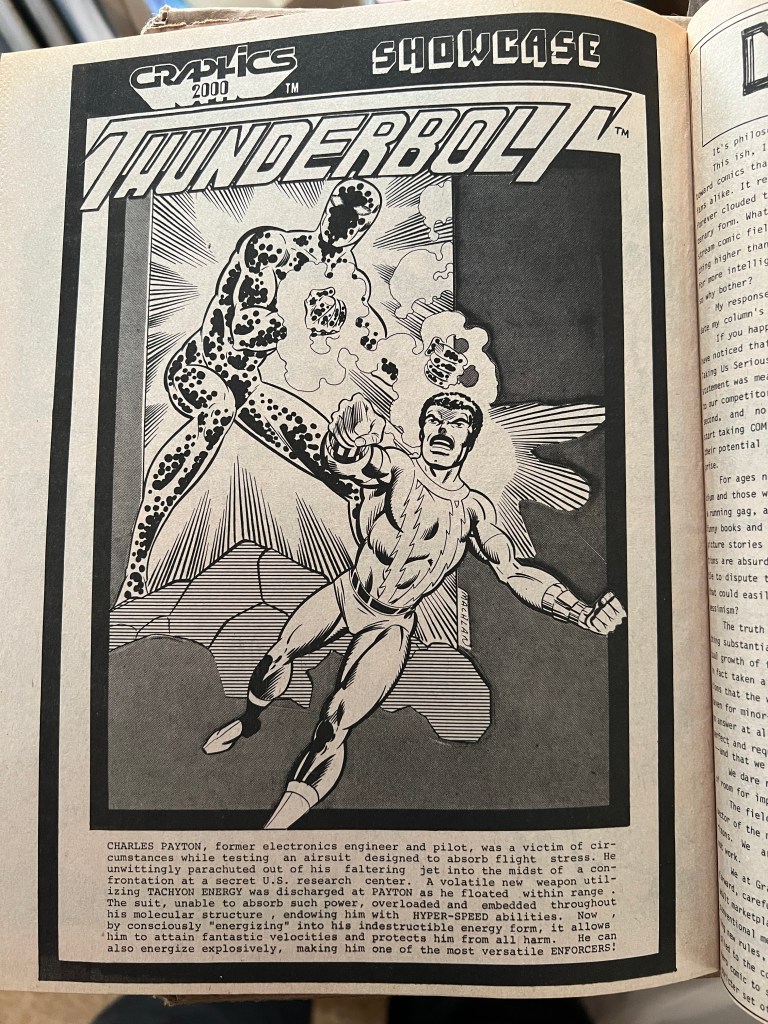
There was a real sense in this issue, as there had been in the previous one, of their being a larger mythos and world behind these characters. This issue included a couple of quasi-pin-up write-ups concerning the individual heroes and their origins and backstories, such as this one by Mike Machlan spotlighting Thunderbolt. This all served to convince me that there must be other releases out there somewhere that I needed to track down. Instead, it was simply the result of the creativity and imagination of Larry Houston and his friends in coming up with these characters.
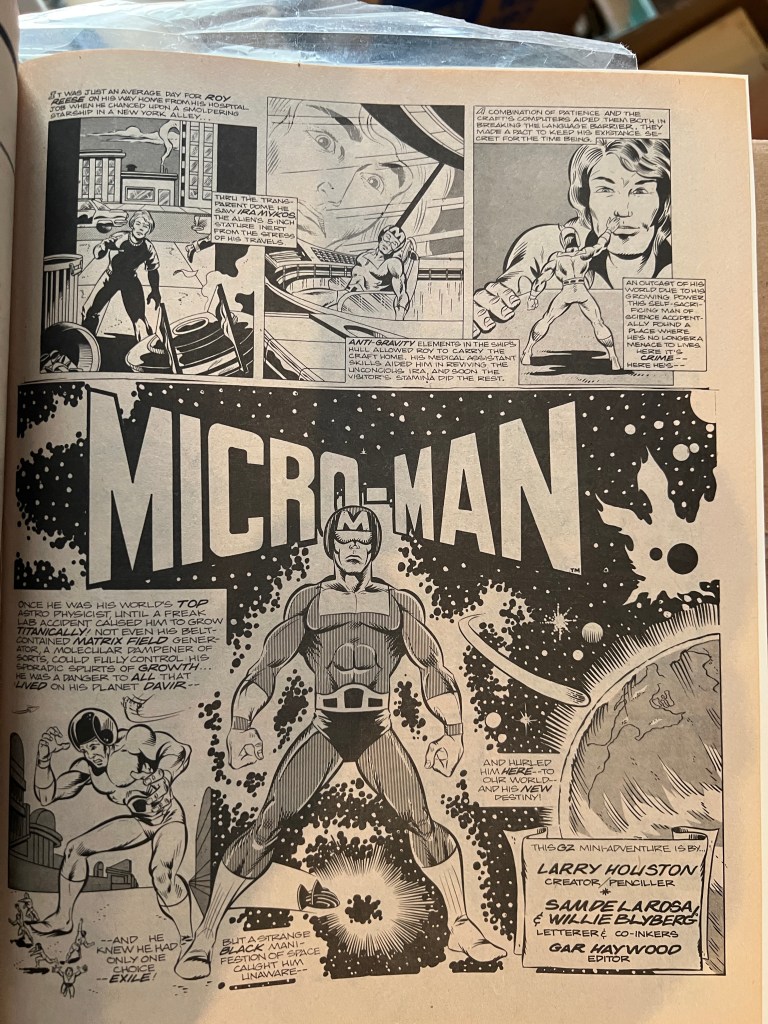
The book also included a four-page back-up feature spotlighting yet another hero, Micro-Man. It had clearly originally been intended for something else, some other fanzine possibly. But the dimensions of the art and the size of the lettering are markedly different from the lead tale. it concerned the adventures of a tiny alien being who had come to our planet inadvertently after posing a threat to his homeworld of Davir. On our world, Ira Mykos was the size of an action figure, but that didn’t stop him from fighting crime and doing typical super hero things, all in the company of his Earthling friend Roy Reese. There wasn’t much more to this short than a proof-of-concept, but it was yet another character who served to help fill out a whole world of new super heroes.
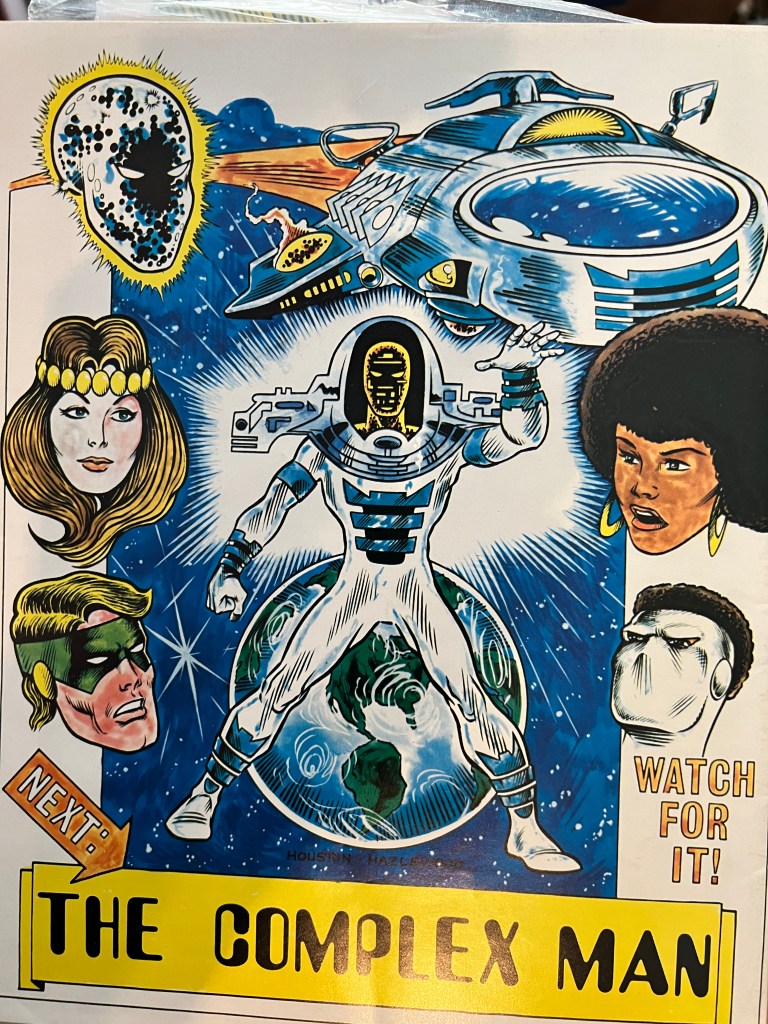
The back cover of the issue functioned as a full page ad for the next issue, THE ENFORCERS #4. Sadly, it would never be published. And so, I have no idea who the Complex Man was, other than that he came from space and was kitted out in some faux-Jack Kirby gear. But I’d have liked to find out! These two books hit me exactly in my sweet spot, especially since at the time I too was making my own comics and heroes and hoped to one day be able to make a profession out of doing so. Larry Houston, on the other hand, followed a different path, one that took him into the world of animation, where he became a leading director and storyboard artist. His personal website is at https://www.larry-houston.com/ and his on-demand collection of the three ENFORCERS issues can be purchased from IndyPlanet here: https://www.indyplanet.com/larry-houstons-the-enforcers
 The Tom Brevoort Experience