

There were some episodes of THE TWILIGHT ZONE that I saw when I was a young boy and which stayed with me, haunted me almost, long after the show had disappeared from the nightly airwaves. But there were others that I only came to later on, once I’d found it in reruns and began to consume the whole of its 156 episodes. Of these, the one that arrests my attention whenever I come across it is this early Season One episode, “The Hitch-Hiker” On the whole, it’s a relatively sedate episode in the series, but between the way it creates, maintains and builds its tension and the manner in which it uses the cinematography of its landscapes–the production wasn’t 100% studio-bound for this one, they went out and filmed on roads and highways–in addition to an absolute bravura jump-scare shot, it remains as a favorite.
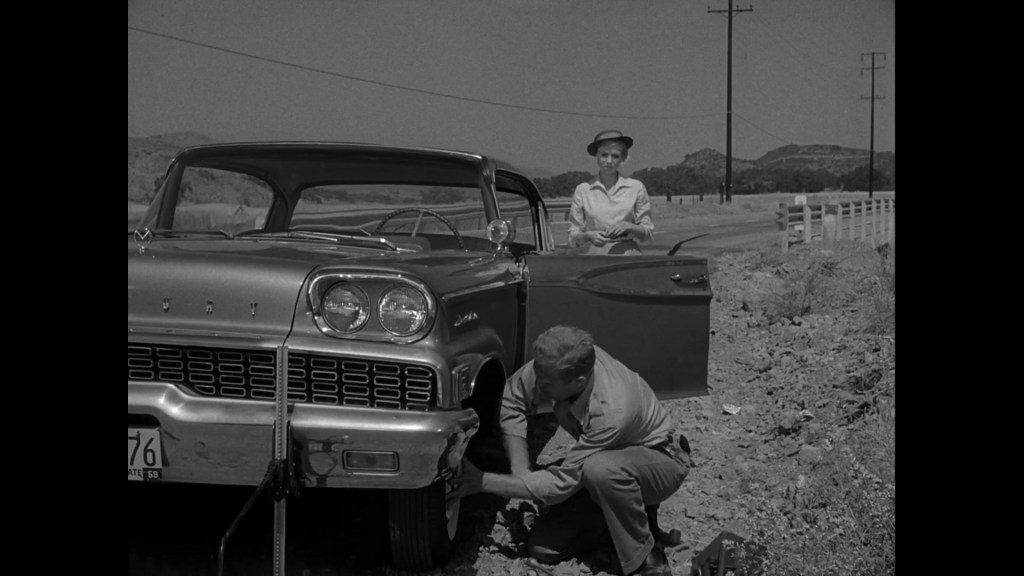
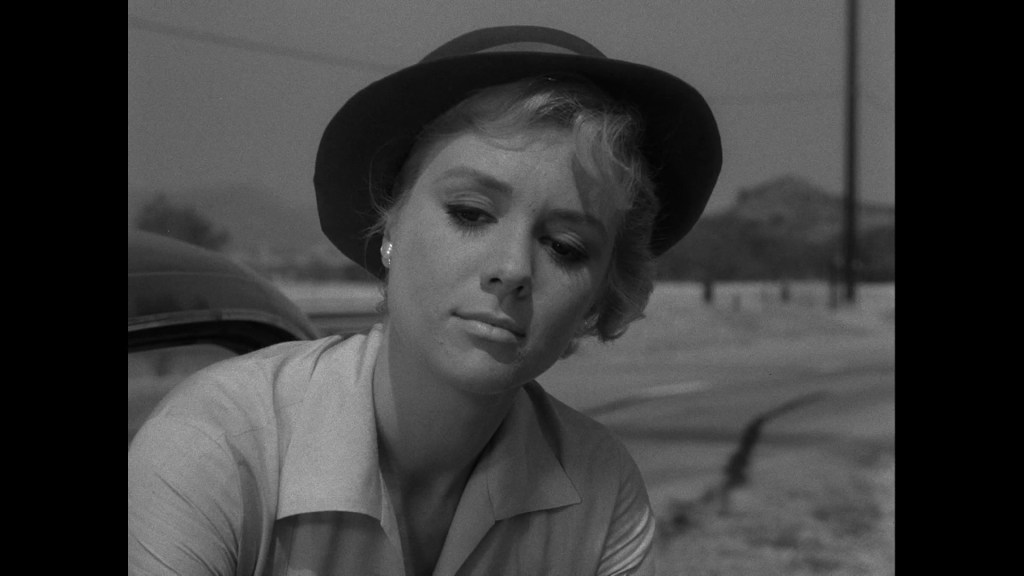
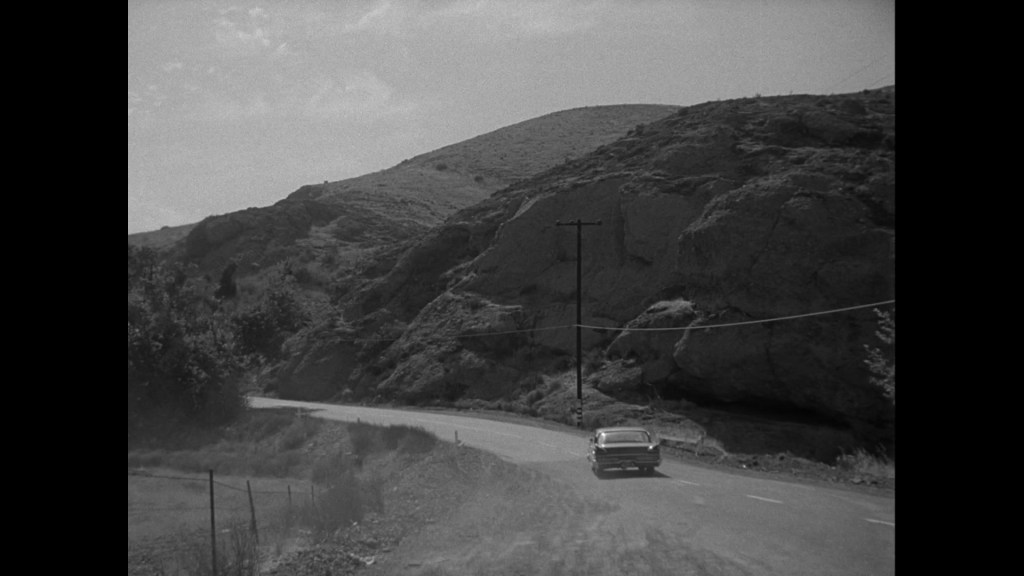
“Her name is Nan Adams. She’s twenty-seven years old. Her occupation: buyer at a New York department store. At present: on vacation, driving cross-country to Los Angeles, California from Manhattan.
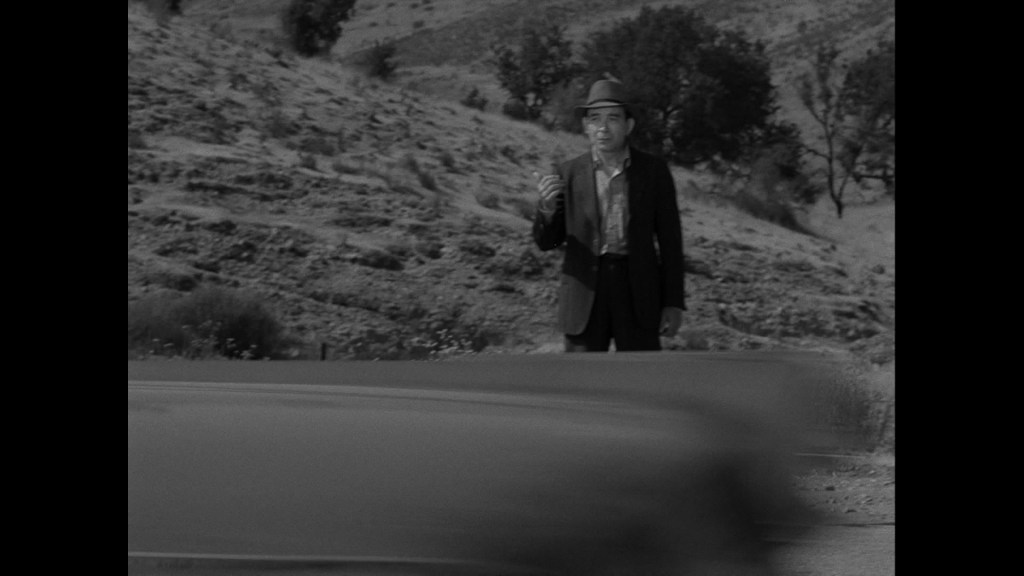
“The Hitch-Hiker” first aired on January 22, 1960 and was the sixteenth episode of the TWILIGHT ZONE to broadcast. Its teleplay was written by Rod Serling, based on a much-adapted short story by writer Lucille Fletcher. Fletcher’s work had been adapted notably to radio, and in fact most of the music cues used in this episode were originally devised for the story’s radio adaptation. Serling made one central but crucial adjustment to Fletcher’s story. In the original prose, and on the radio, the driver of the lonely car making a cross-country journey is a man. Serling intuited that a woman alone on her own against the backdrop of empty, open spaces would increase the audience’s feeling of unease and dread. The episode opens with the inciting incident having already happened. We are introduced to Nan Adams, played by actress Inger Stevens. She’s suffered a blowout on the highway while traveling from New York to the West Coast, one that the helpful repairman who patches her tire tells her might well have been fatal. “You shouldn’t have called for a mechanic. Somebody should’ve called for a hearse.” he says. As Nan pulls away, she spies a shabby figure at the roadside, who holds out his thumb, gesturing for a ride. The man makes her feel uneasy, and so she ignores his silent entreaty, passing him by as she heads towards the repairman’s service station to settle up accounts.
“Minor incident on Highway 11 in Pennsylvania. Perhaps, to be filed away under “accidents you walk away from.” But from this moment on, Nan Adams’ companion on a trip to California will be terror. Her route: fear. Her destination: quite unknown.”
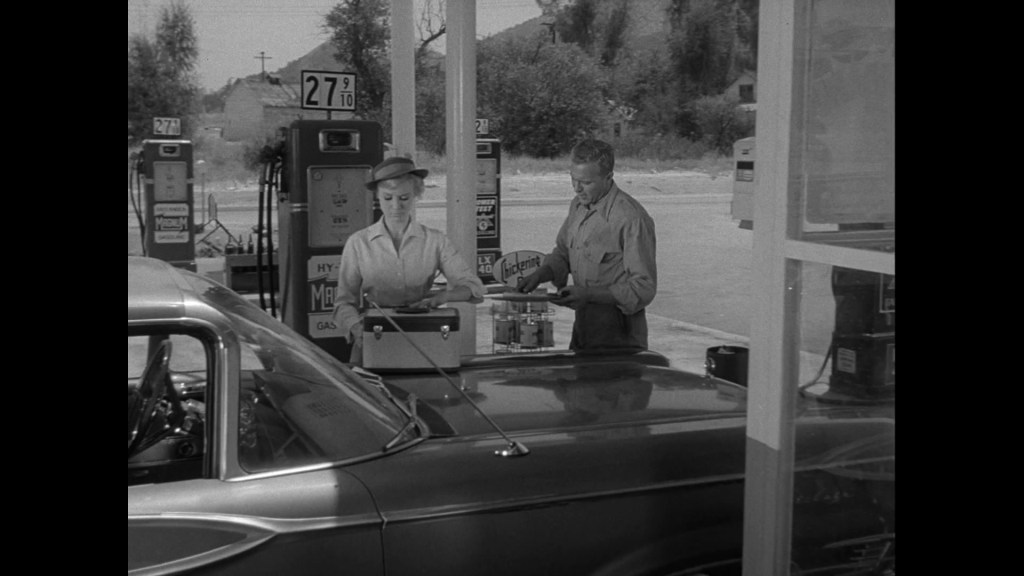
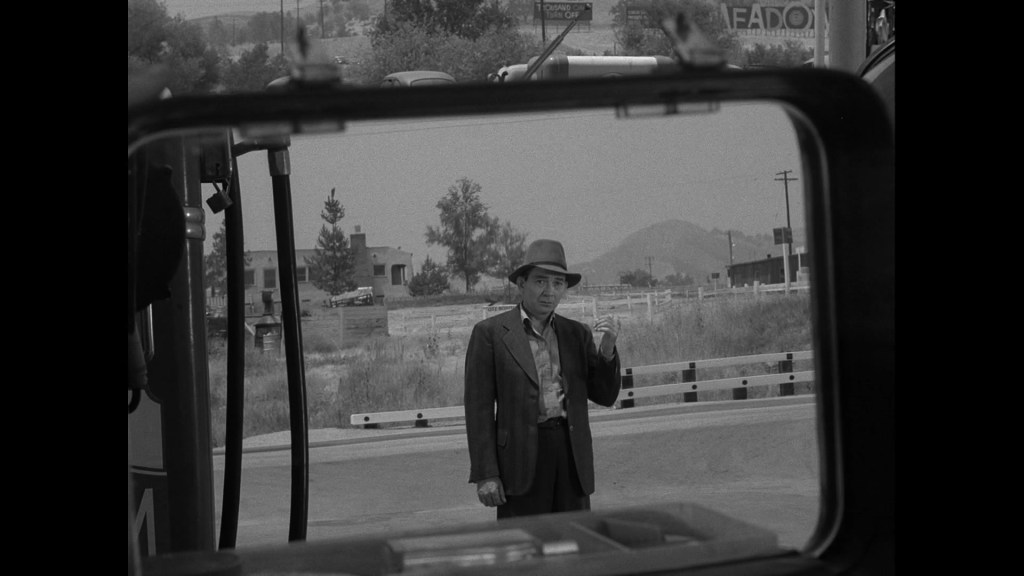
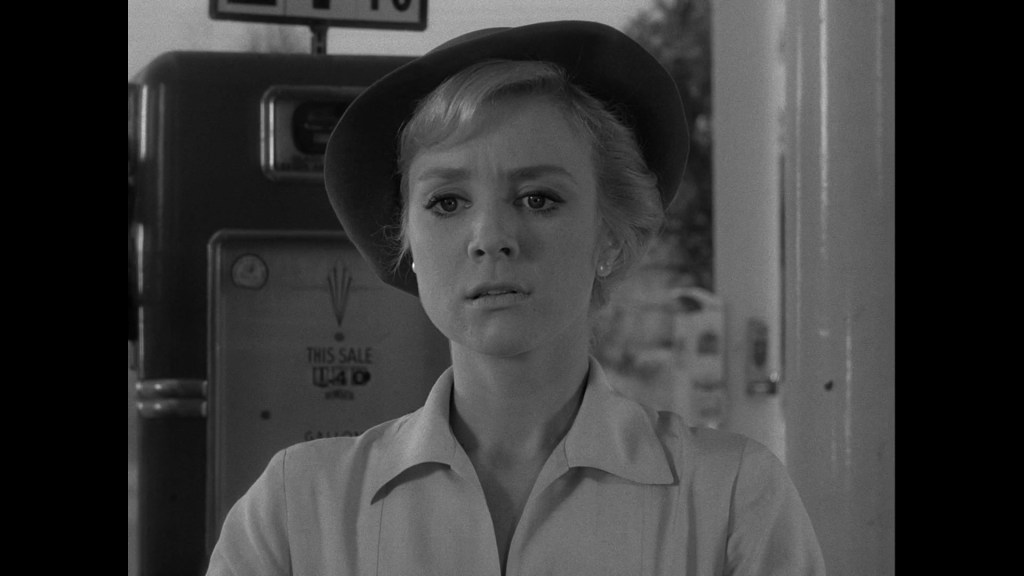
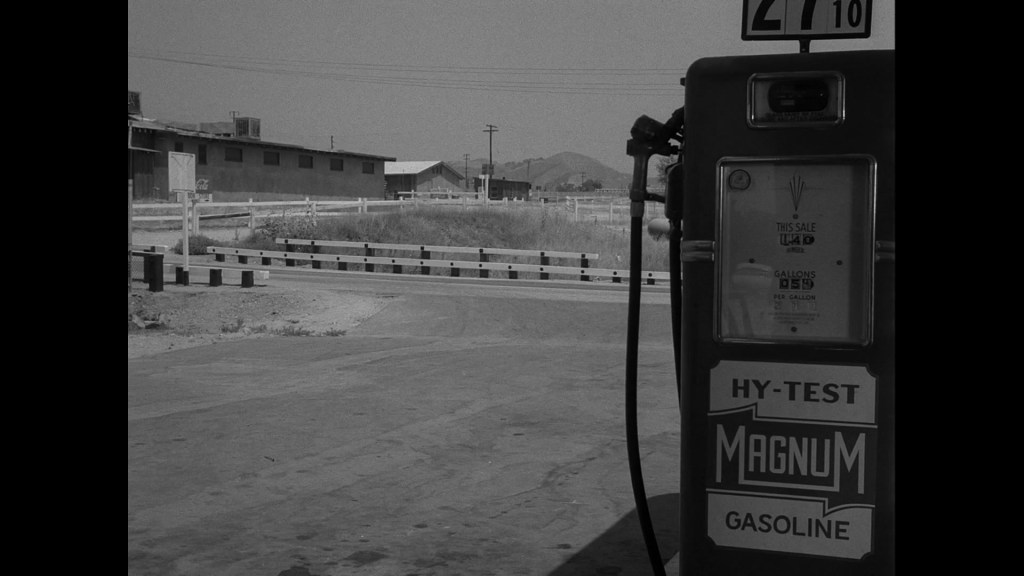
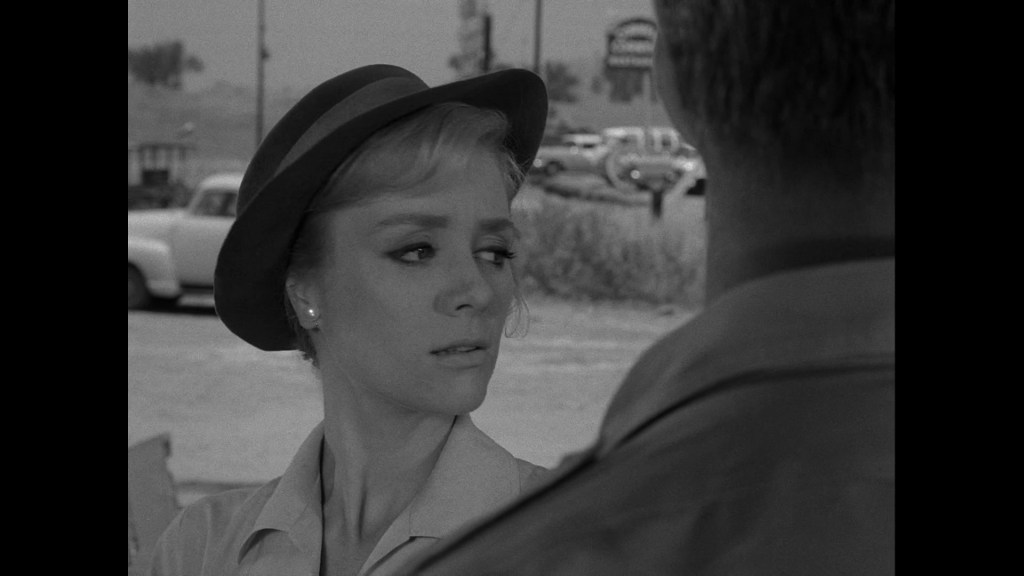
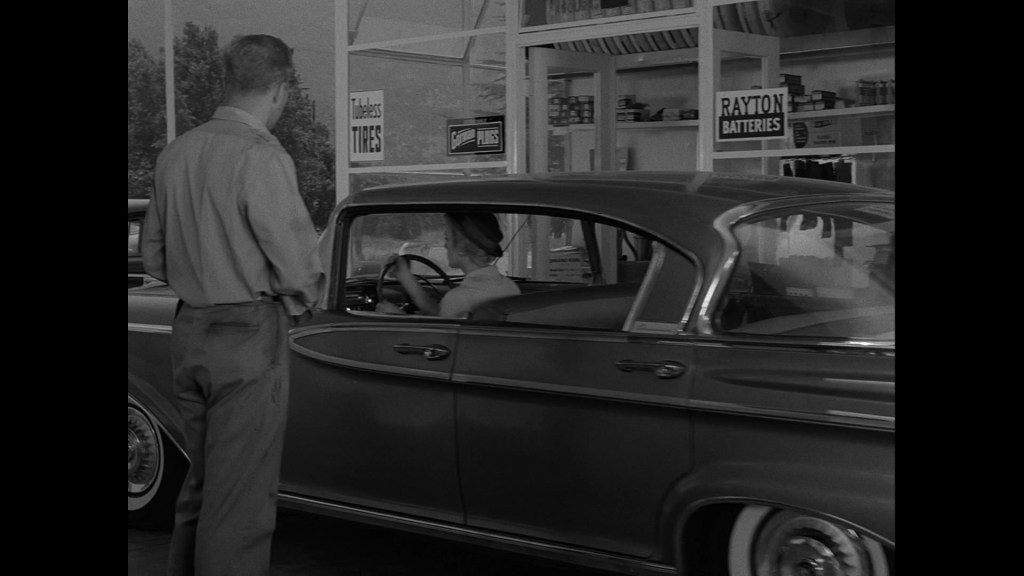
At the station, Nan pays her outstanding bill and composes herself. But when she opens her bag and glances at the mirror positioned in the upper lid, she shockingly sees that same hitch-hiker standing directly behind her, gesturing once more for a lift. Nan knows that it’s unbelievable that the man could have made his way all this distance on foot, but when he returns, not only does the mechanic not see the man–he’s vanished from the spot where he had stood only a moment before, but the man also conjectures that it’s possible that the hitch-hiker was picked up by somebody in a fast car who thereafter went past them before they could get back to the service station. Nan nods in agreement, but she doesn’t really buy into this explanation. The figure, though a bit natty, isn’t in any way overtly hostile or threatening. And yet, his presence provokes a strong reaction from Nan, and she wastes no time in heading out onto the road again.
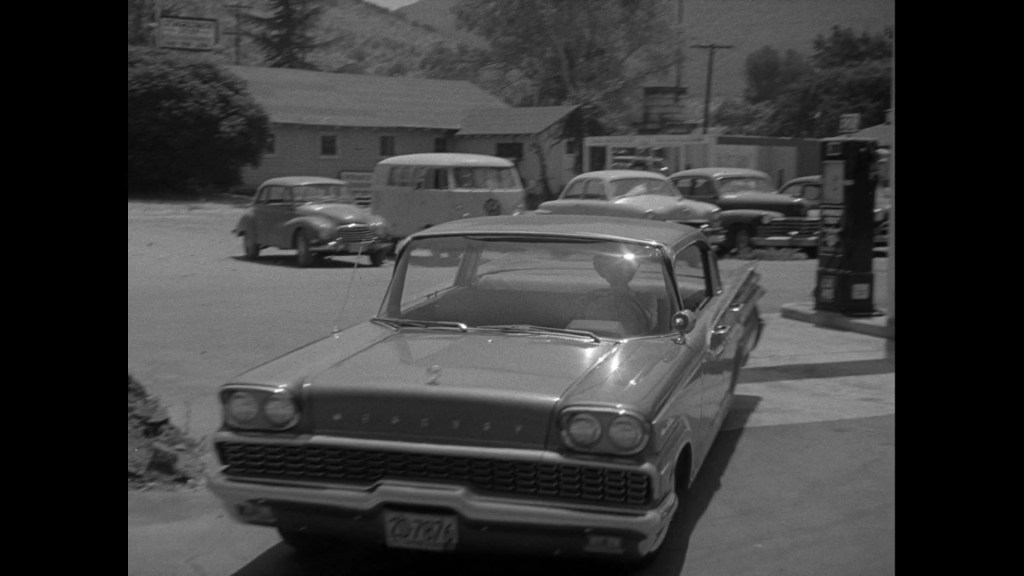
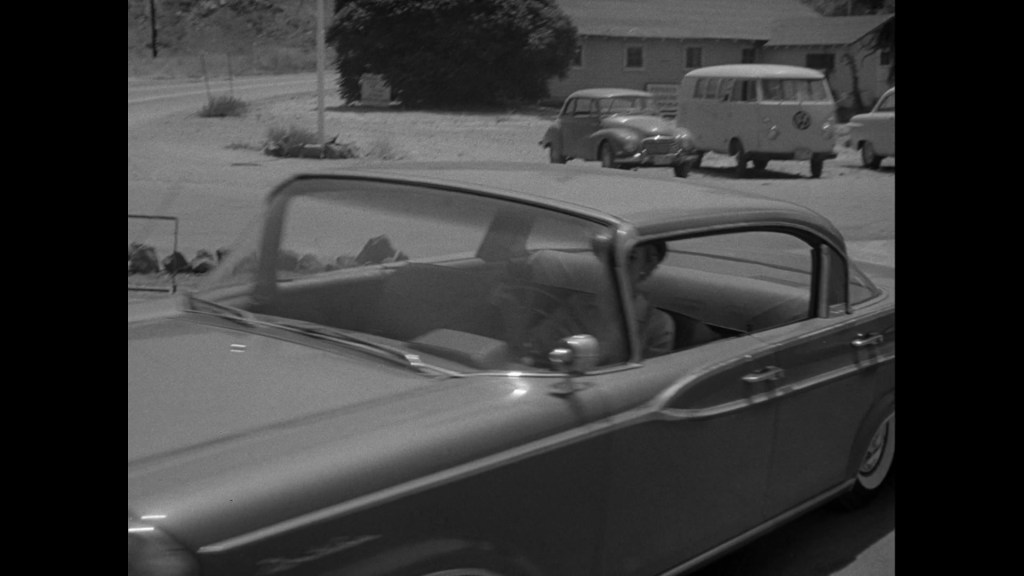
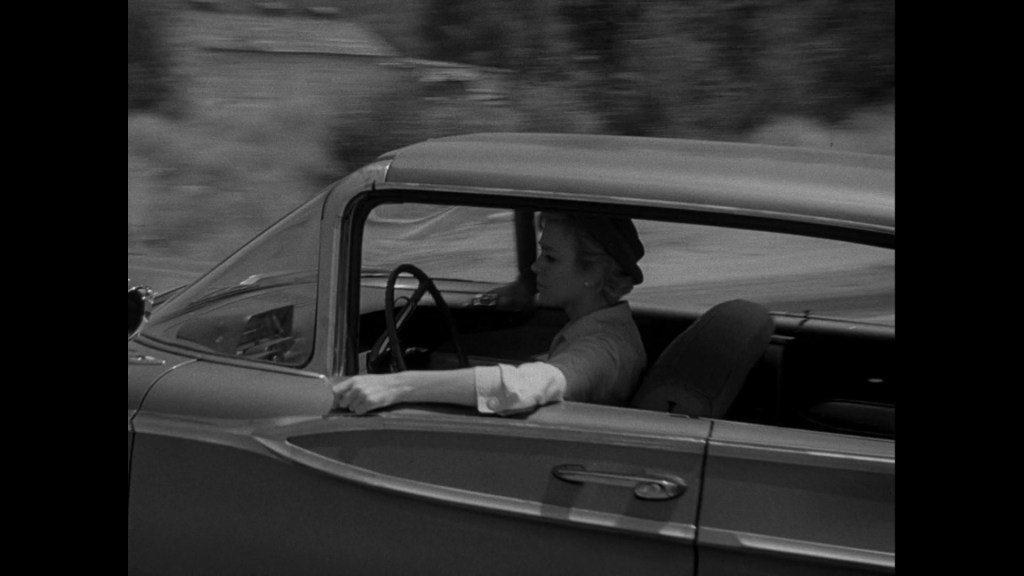
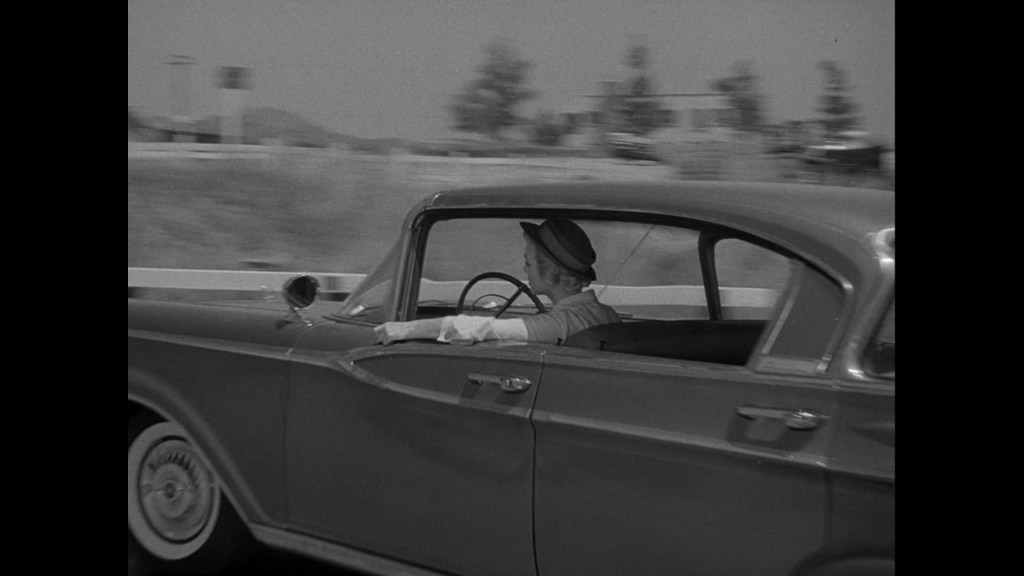
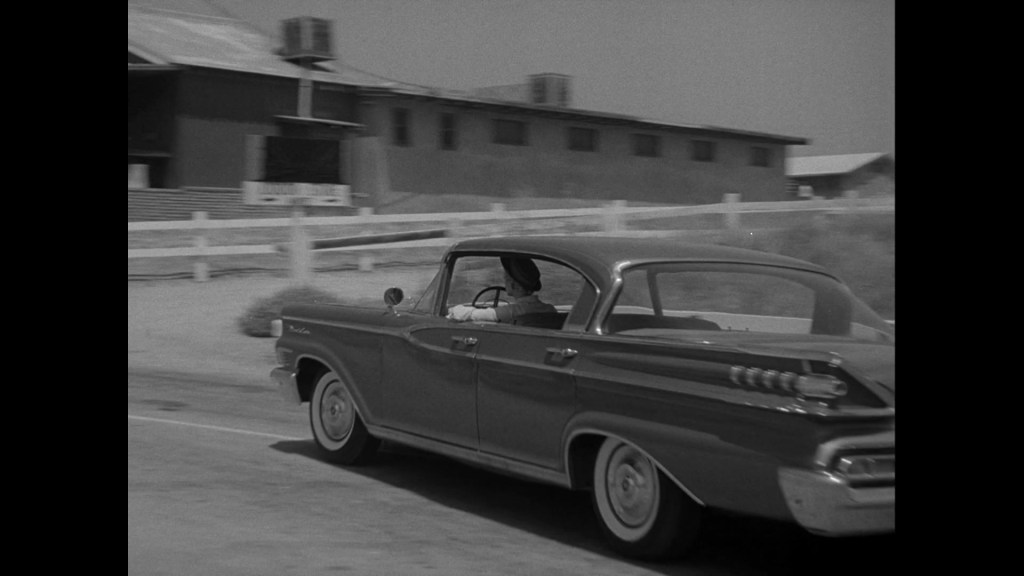
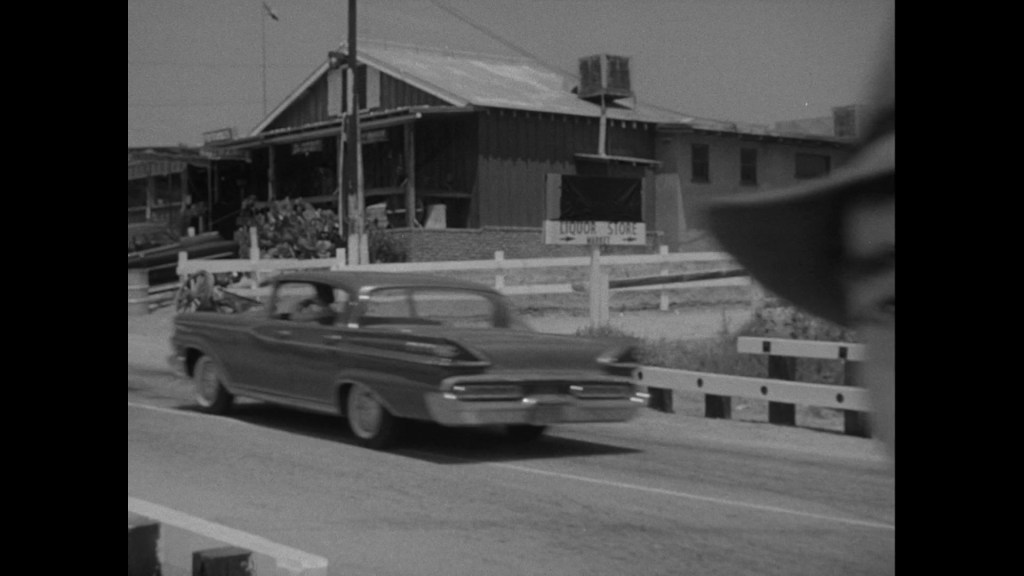
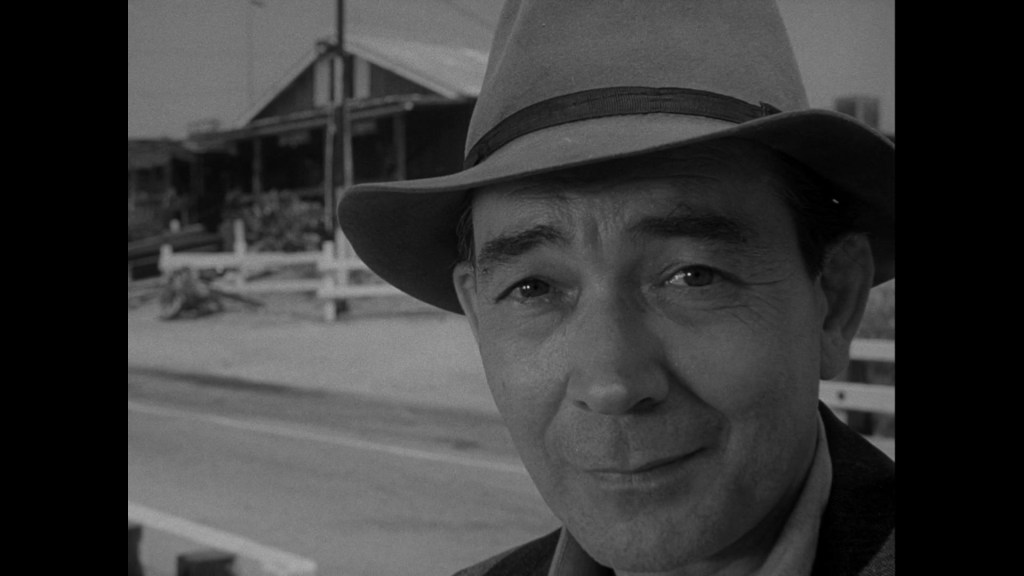
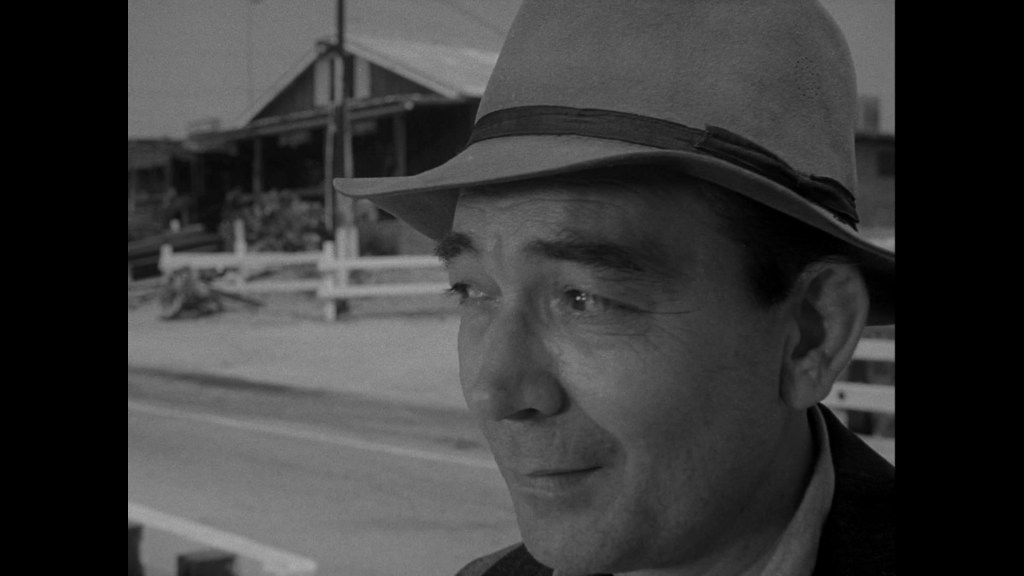
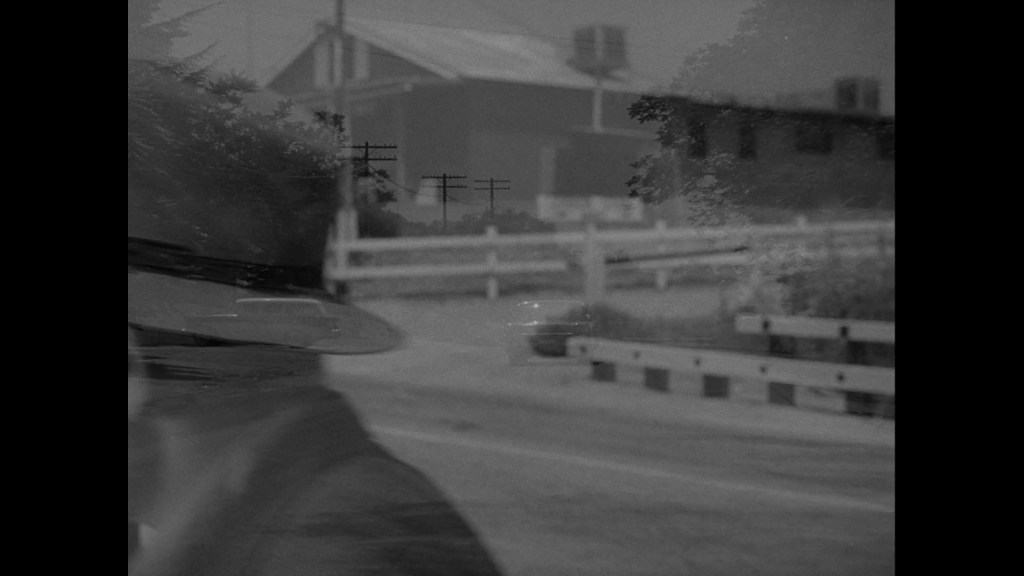
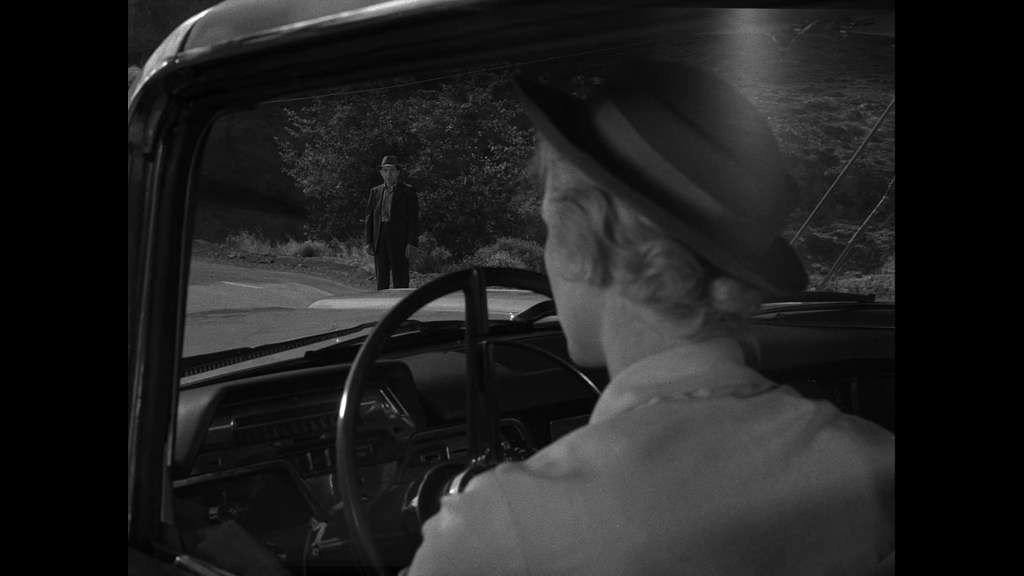
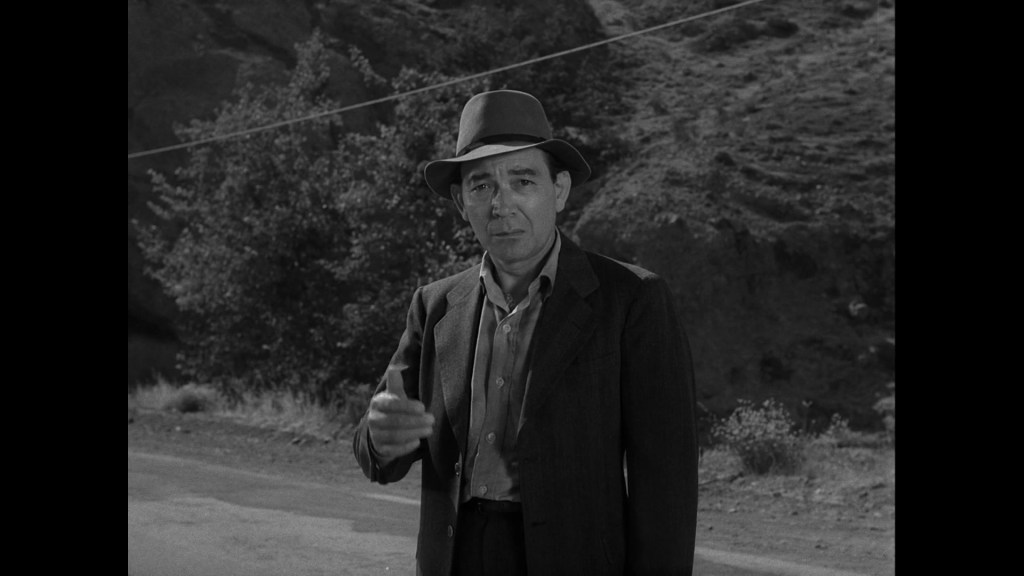
It’s at this early moment that we get what I think is the most masterful shot in the entire production, a jump-scare that works no matter how many times I experience it. And it’s very simple, and all done in the camera. Nan’s car pulls out of the lot, turns onto the road and begins to drive off on the left side. It’s a well-composed middle shot, and your mind tends to focus on that depth. And just as her car pulls away, without warning, the Hitch-Hiker steps directly into camera, staring right down the lens at you. And because he’s so much closer than where your gaze was focused, it feels as though he’s stepped directly into your personal space. as always, he’s completely unthreatening, with his half-smile and sleepy eyes. But this merely adds to his indifferent malevolence. The moment only lasts a second, then he turns in the direction of Nan’s car and walks off left. But the viewer is left with the feeling of being abruptly violated. It’s a great piece of work, a single moment that elevates the entire production. Leonard Strong portrays the hitch-hiker.
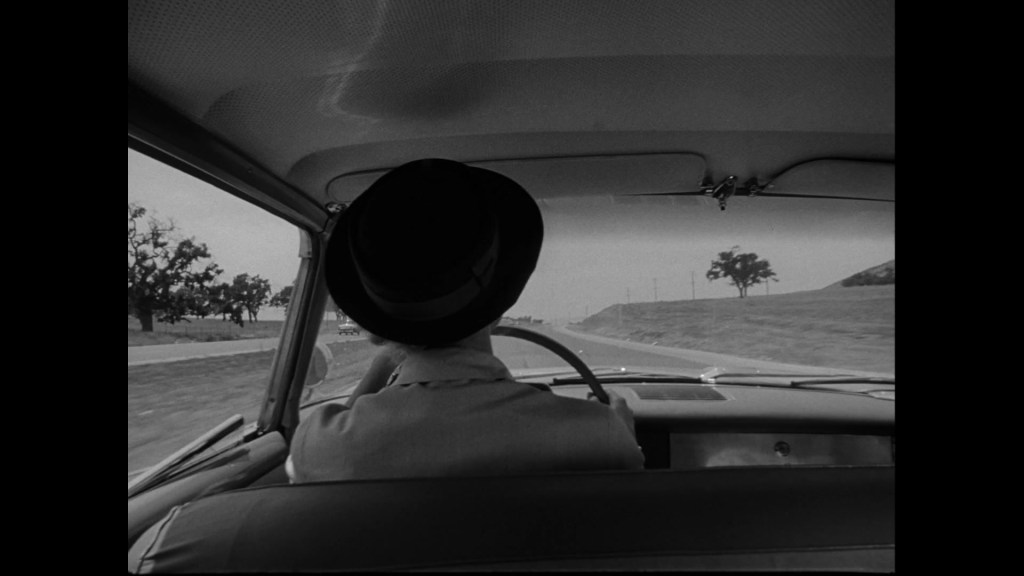
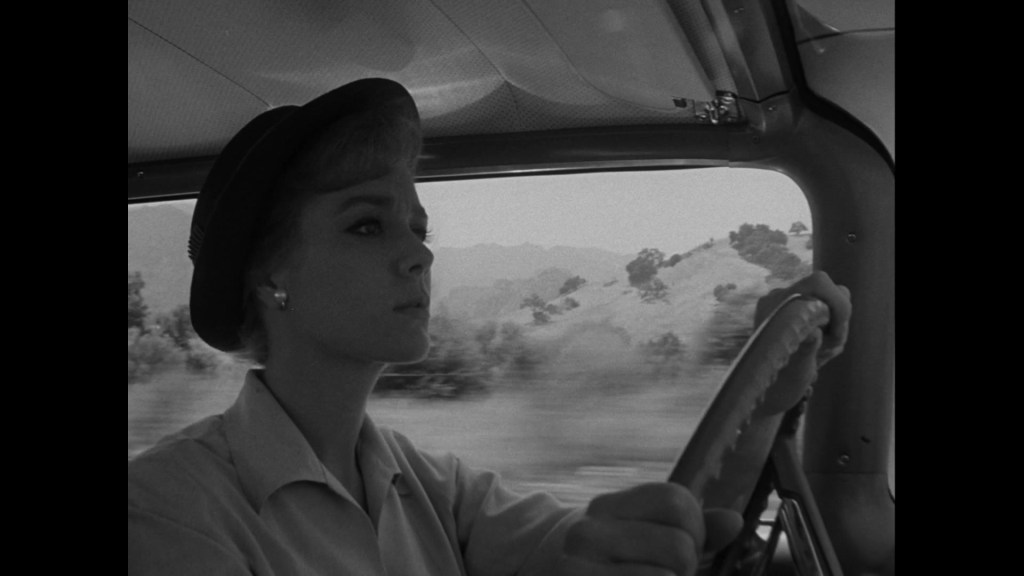
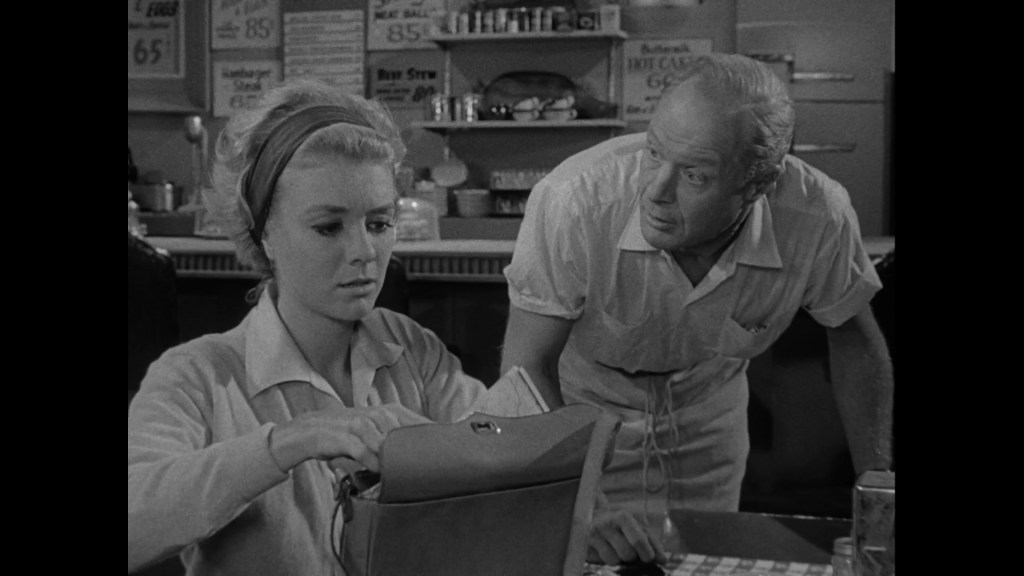
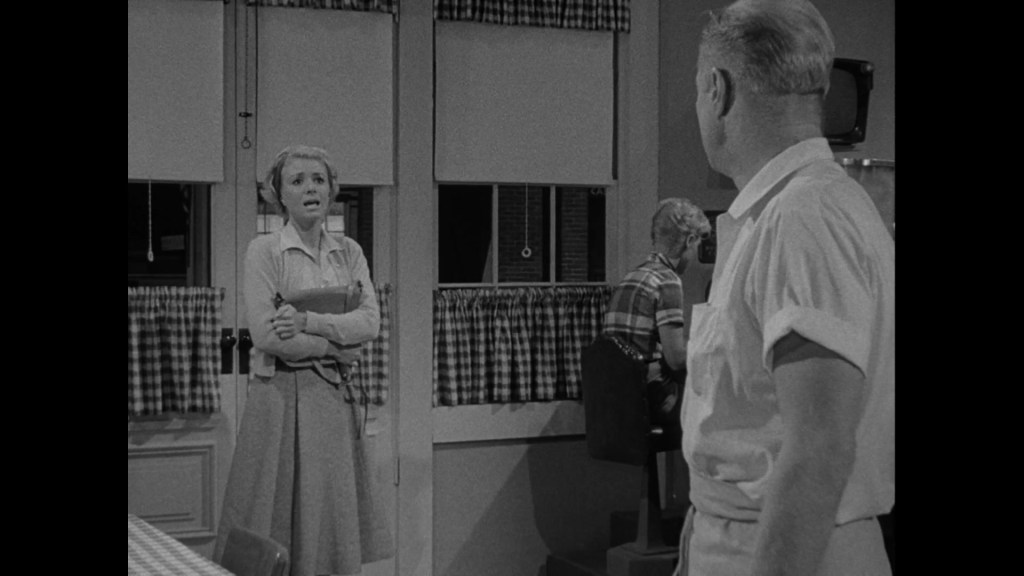
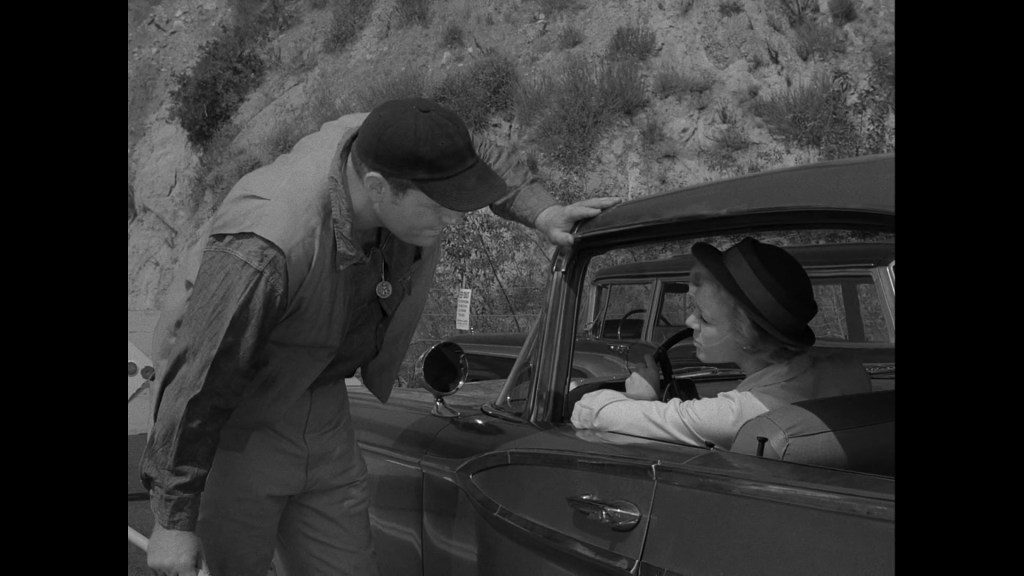
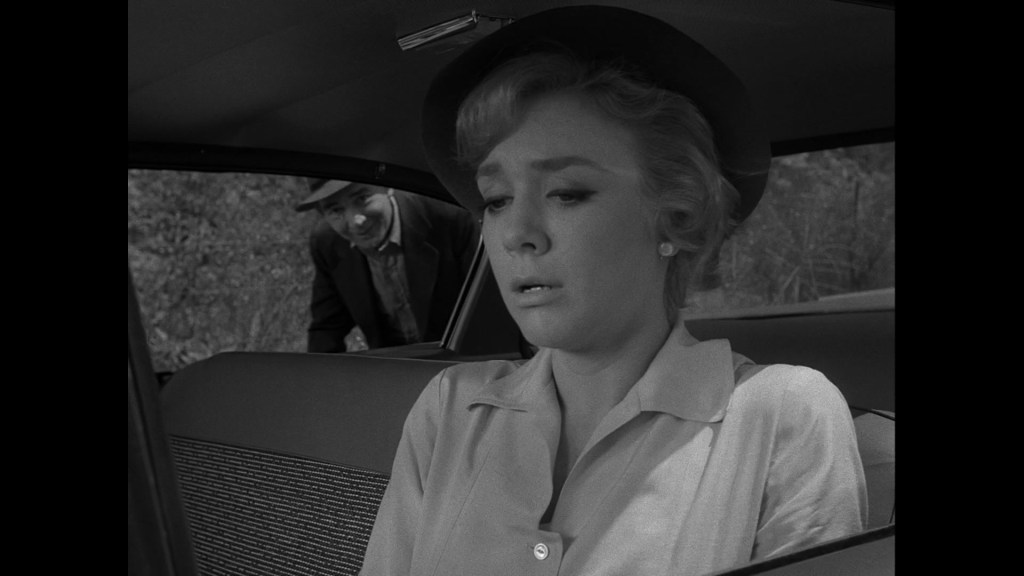
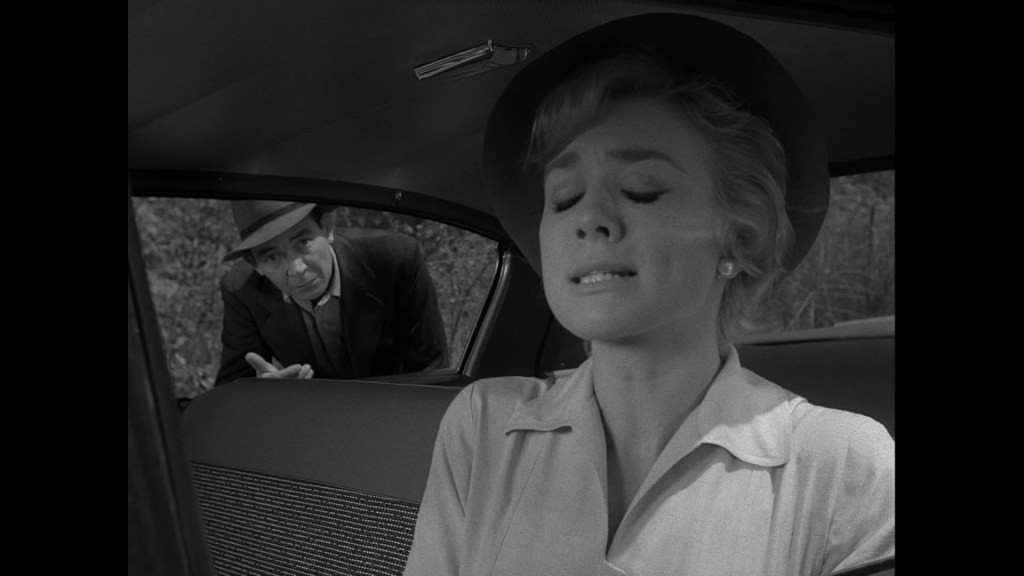
From here, the episode is quite simple: as Nan travels progressively farther and farther west, she finds herself constantly encountering the beckoning hitch-hiker gesturing to be picked up for a ride. Nan drives unrelentingly, night and day. But no matter how many miles she puts behind her, the hatted figure is always there behind her. The few people she meets when she stops for food are incredulous of her entire story, telling her that it would be crazy for anybody to be hitch-hiking across the highways that she is traveling on. But none of that helps, none of that matters–because the figure is always there, always following, always beckoning. When Nan is temporarily delayed by some roadwork ahead, she shudders as the figure draws up behind her and gestures into her open window: “Heading west?” he asks, the only words he delivers in the episode until the very end. Panicked, Nan pulls her car out of line and races off, heedless of the construction. Stevens is really great all throughout this episode, making Nan at once utterly vulnerable but also just this side of crazy. There’s a sense of danger about her performance, a feeling that the character could snap and do just about anything at any particular moment.
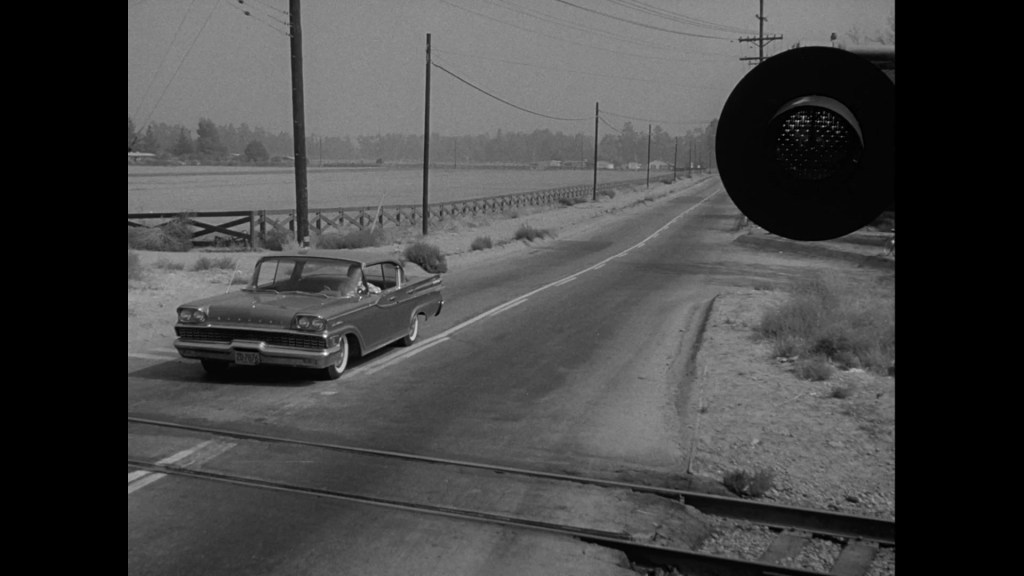
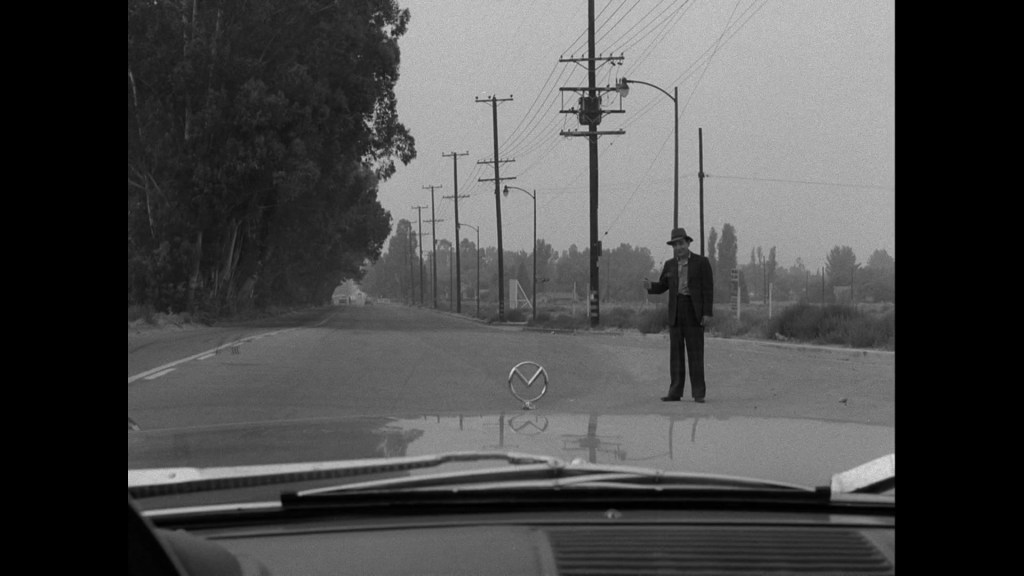
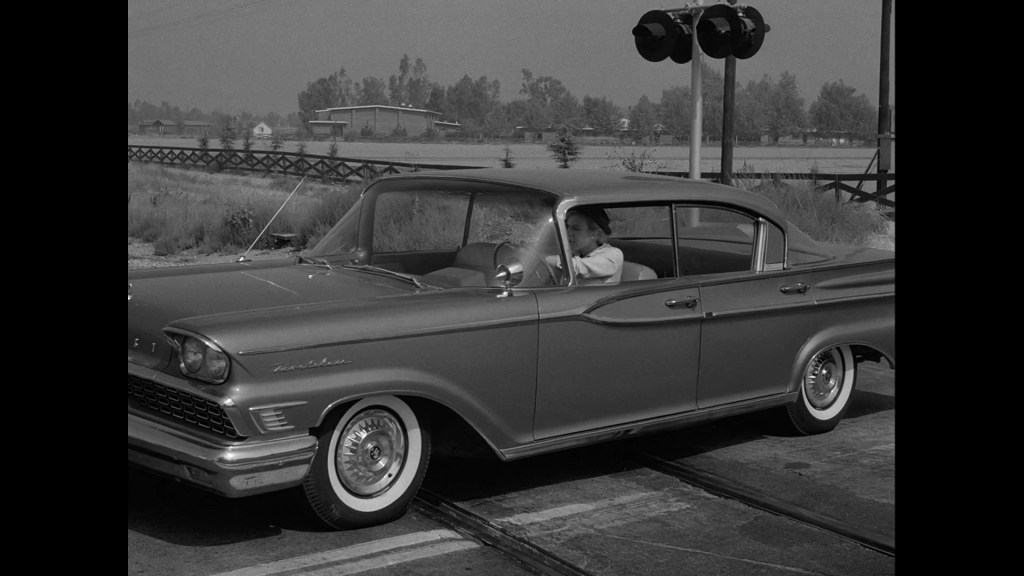
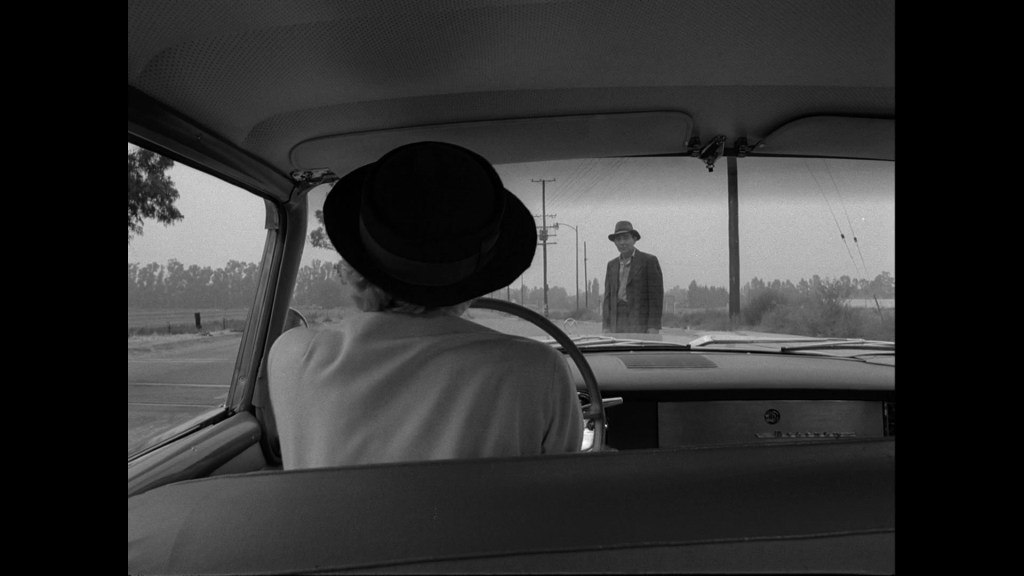
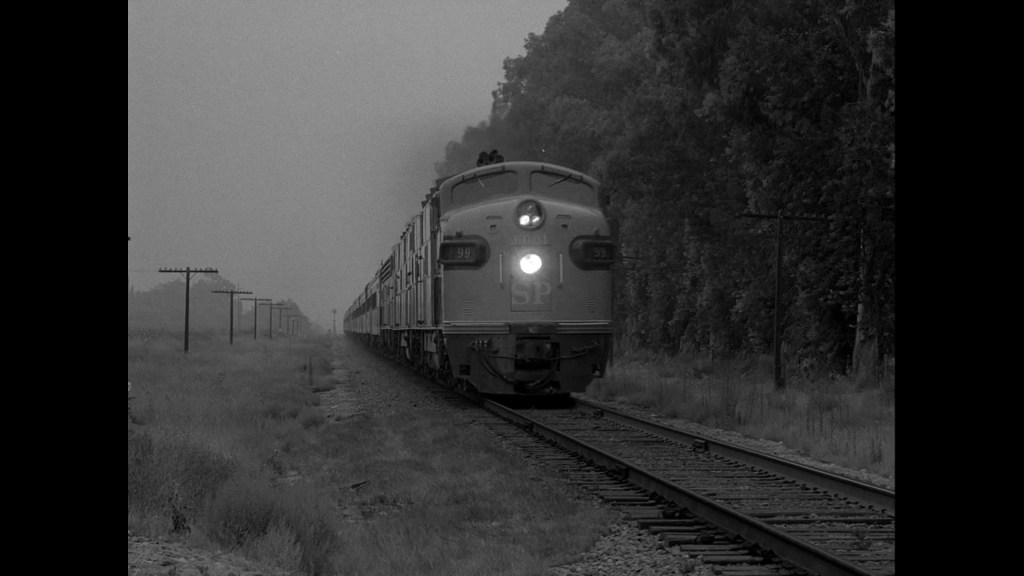
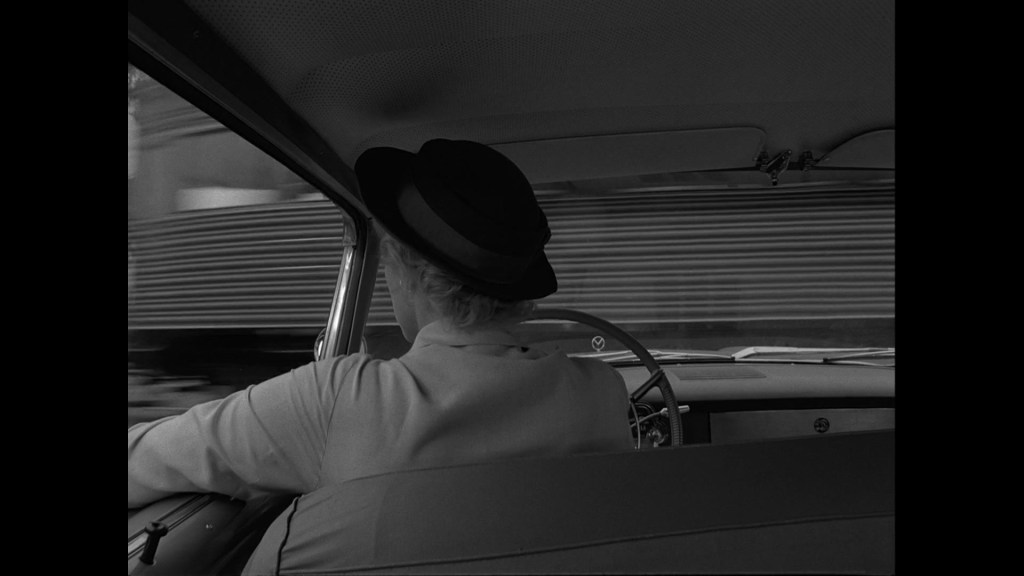
When nan comes to a train crossing, she sees the mysterious figure ahead of her, beckoning her onward. In terror, she attempts to drive her car across the tracks, only for it to seize up and stall right in the middle, with a train approaching. As the figure stands watching, Nan desperately tries to get her engine to catch as the train races ever closer. At the last moment, she’s able to get it to catch and she reverses her way back out of the path of the train just before it would have struck her. When the train passes, the hitch-hiker has vanished. But Nan is now certain that he is trying to kill her.
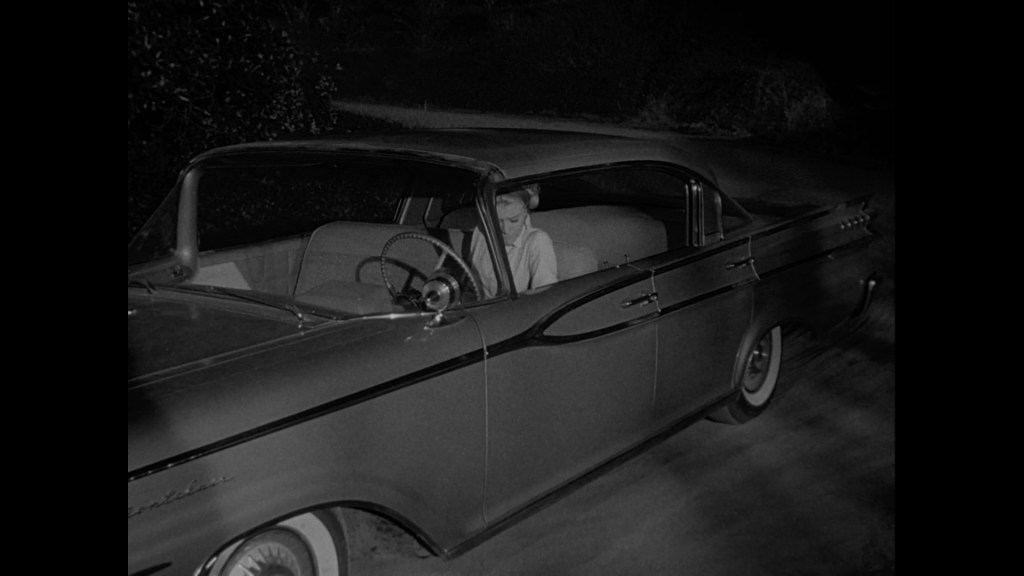
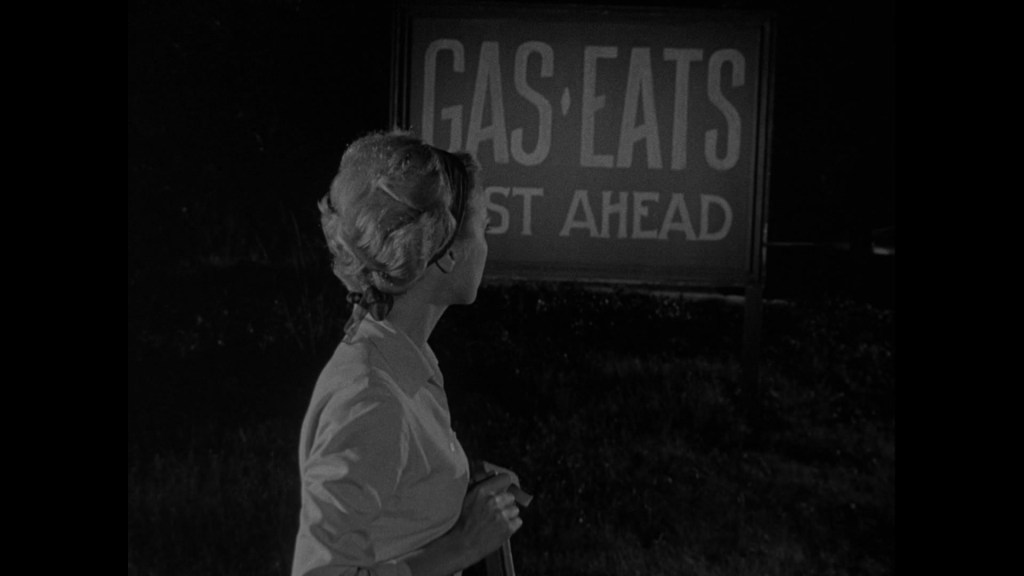
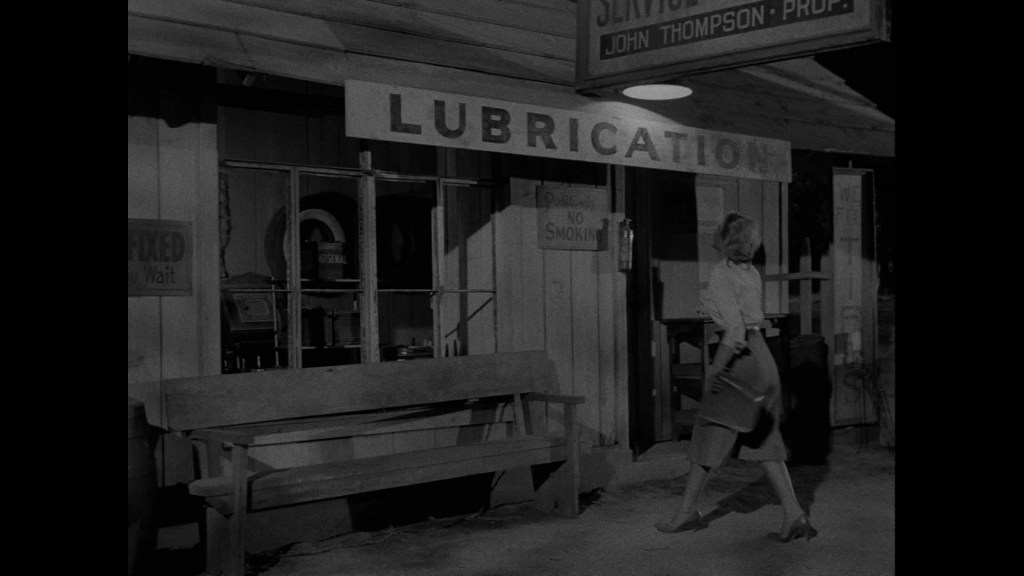
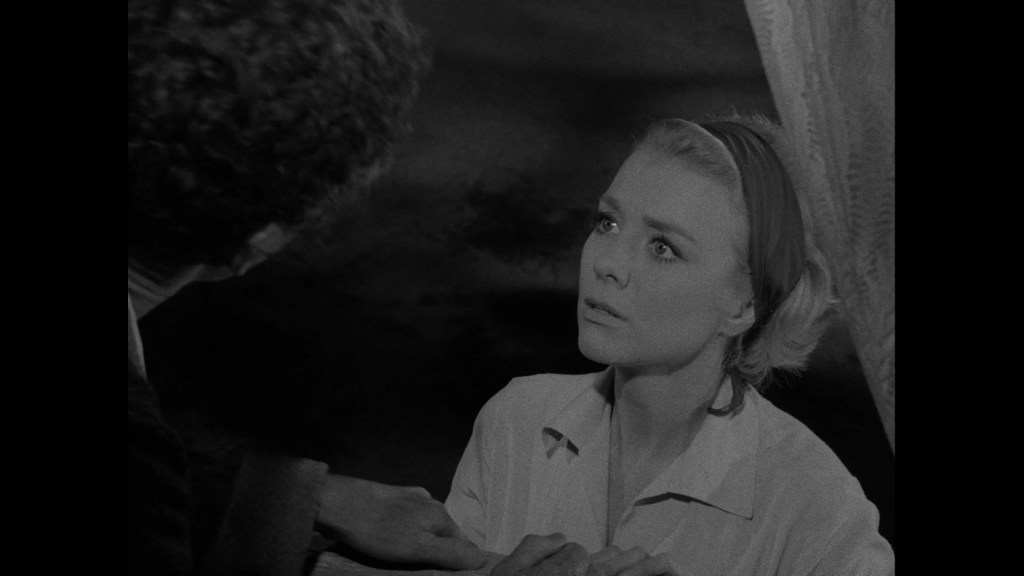
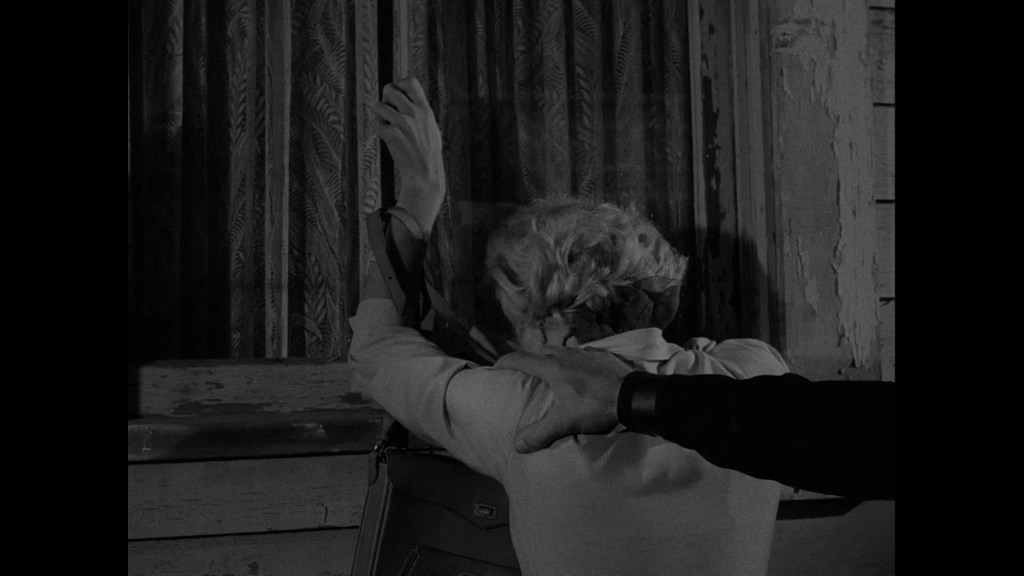
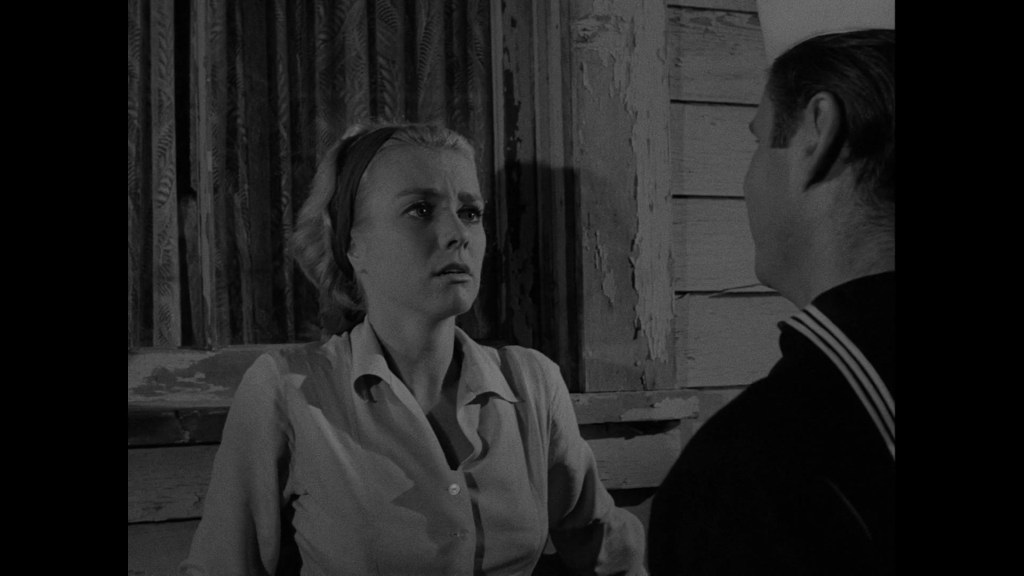
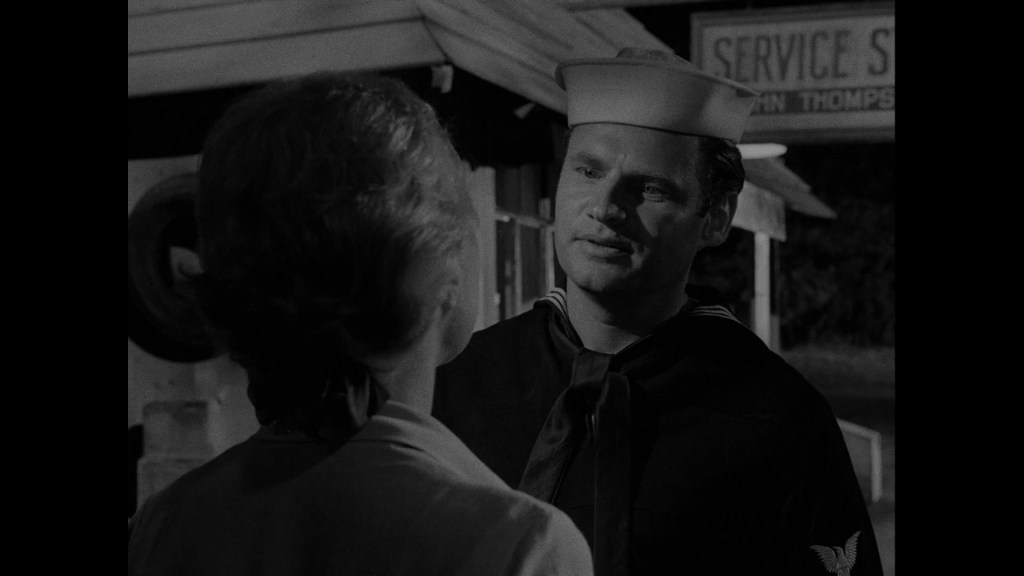
Nan abandons the highways for the back roads, and in the dead of night she finds herself in the middle of nowhere when her car runs out of gas. Venturing out into the night, she succeeds in locating a gas station not far away. But the place is closed, and the proprietor refuses to sell her gas or help her in any way until the morning. Nan just about has a breakdown begging for his assistance. Then, suddenly, her shoulder is gripped by an arm from off-camera and she spins around. But it isn’t the hitch-hiker, but rather a lost and lonely sailor out on leave. This creepy fellow, played by Adam Williams, is trying to get back to his ship on the West coast, and he’s happy to take Nan up on her offer to drive him there. The boisterous sailor is able to roust the gas station attendant, securing for the pair the fuel they need. And so they drive off together down the highway.
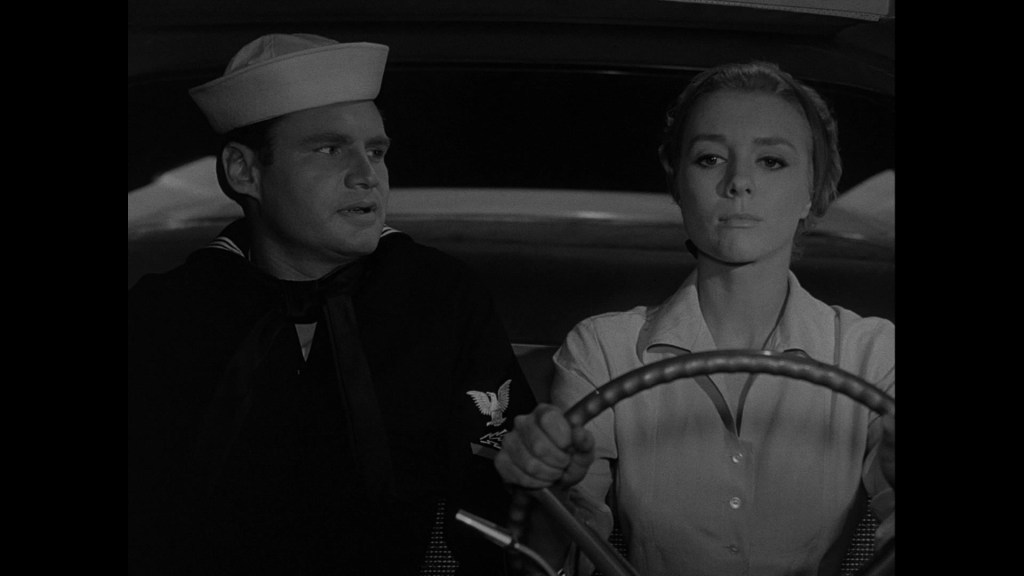
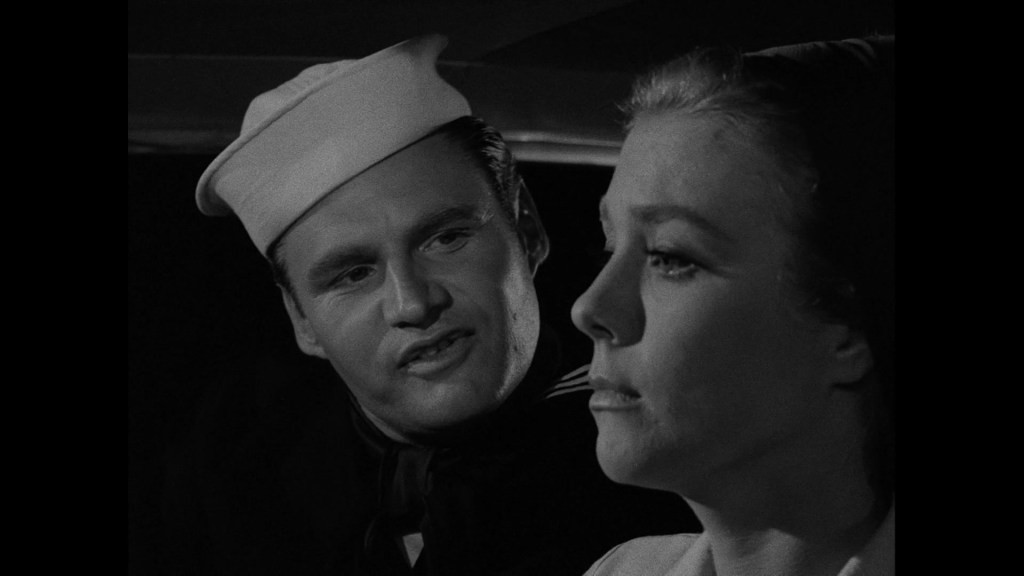
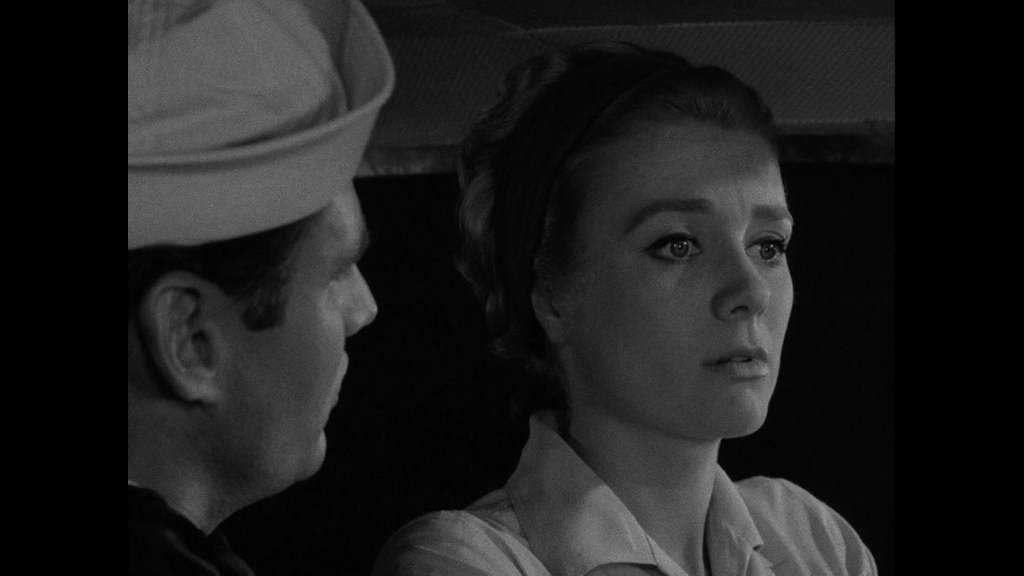
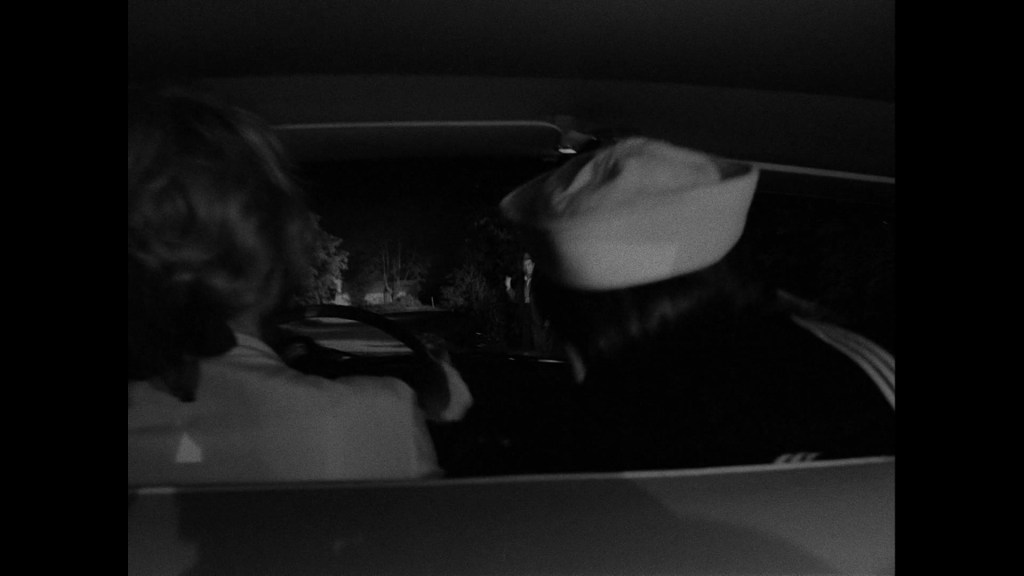
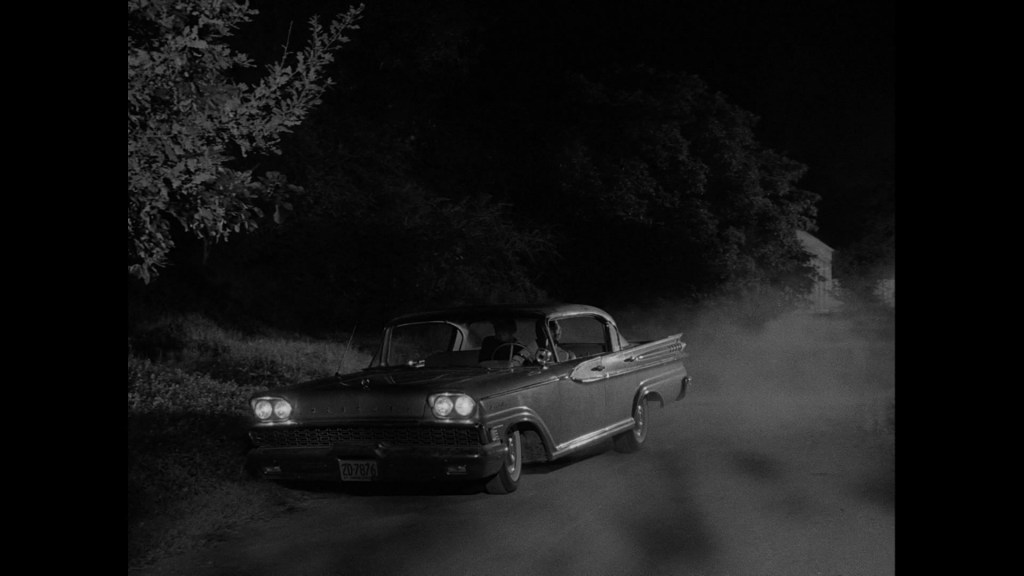
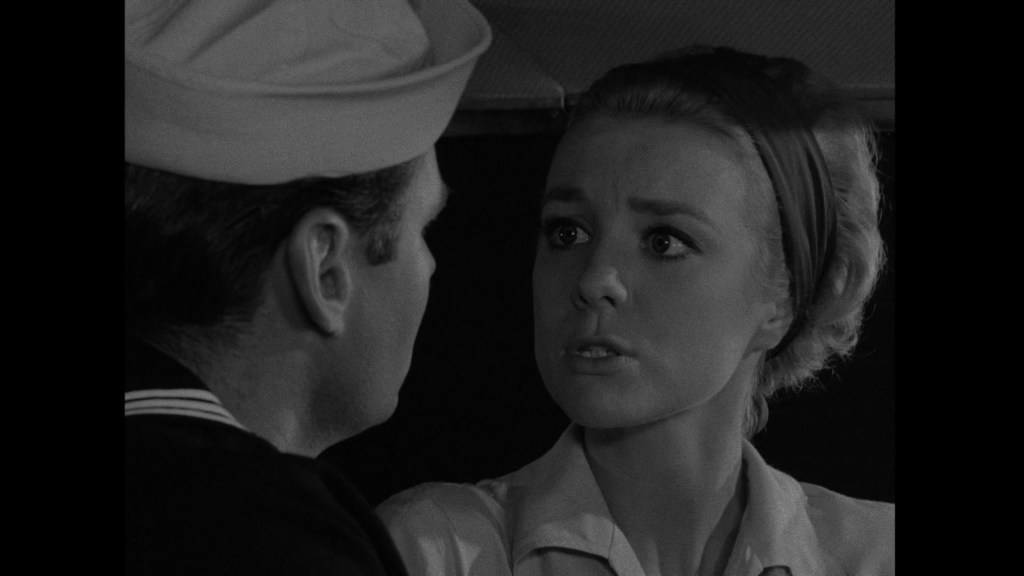
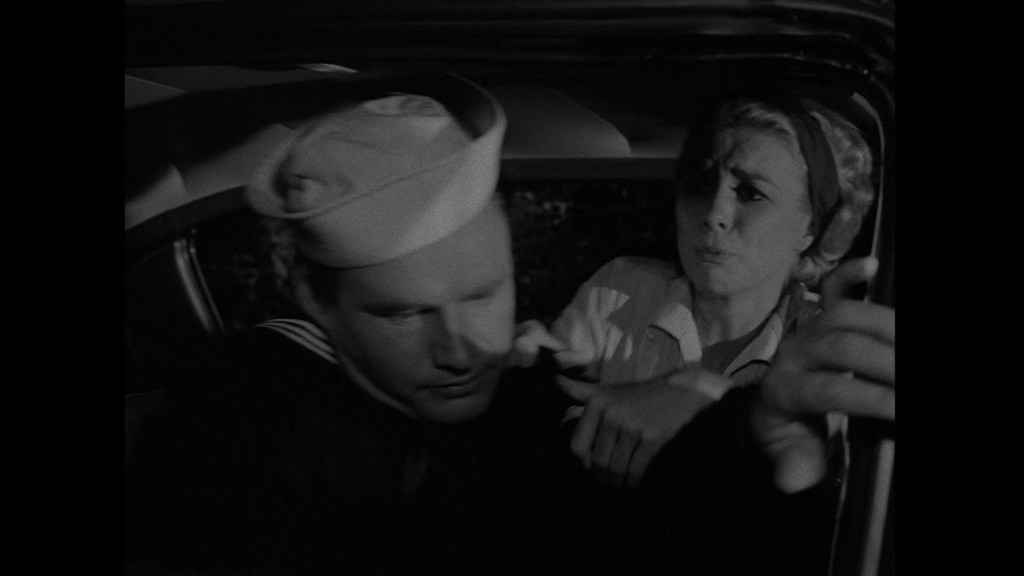
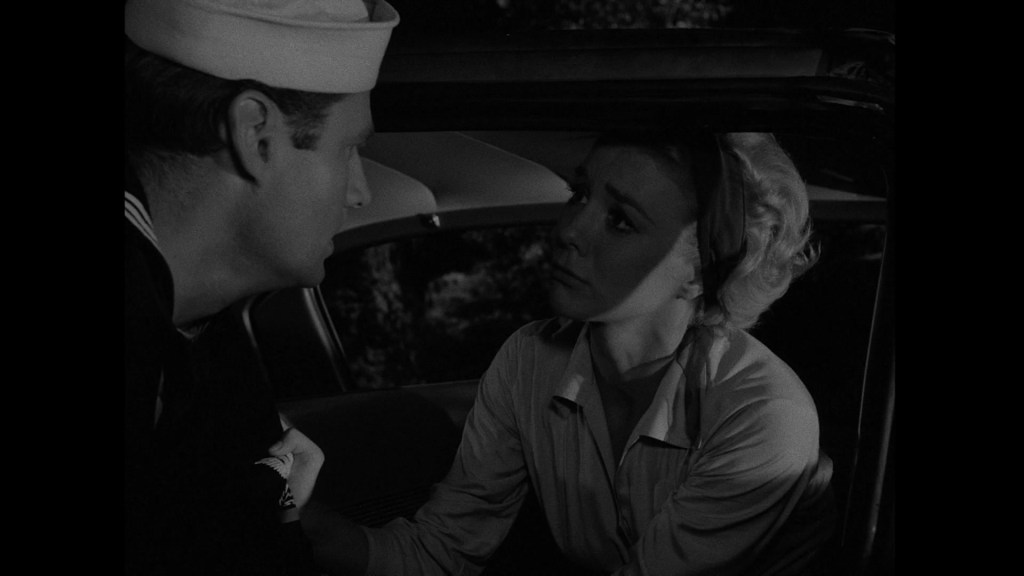
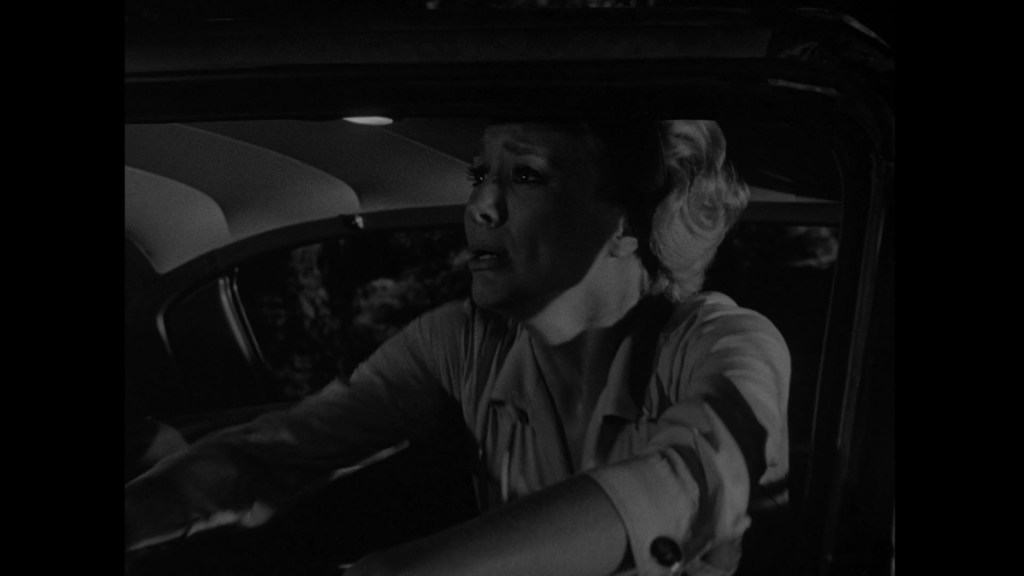
Back in the car, the sailor takes his shoes off. He evidences a lot of what I can only describe as “big rapist energy”, and the way he looks at and speaks to Nan with naked lust is, frankly, incredibly disturbing. Even bound by the limitations of what can be said and shown on television in 1960s, this is disquieting stuff. But the sailor has picked the wrong car. As Nan sees the figure of the hitch-hiker in the road ahead of them, she swerves, intending to try and run him down and kill him. The sailor frantically grabs the wheel and depresses the brake, bringing the car to a stop. And he’s had enough–he moves to exit. But Nan begs him not to go, and even more disquieting, she offers herself to him if he’ll stay with her: “I like you. I really like you very much, as a matter of fact that’s why I picked you up, because I liked you. I thought that we could be friends and I’d kind of like for you to take me out. Really. Please?” But it’s no good. As horny as the sailor is, he realizes that if he stays in this car with nan, he’s never going to reach his ship again. And so he heads away into the darkness, leaving Nan once more on her own.
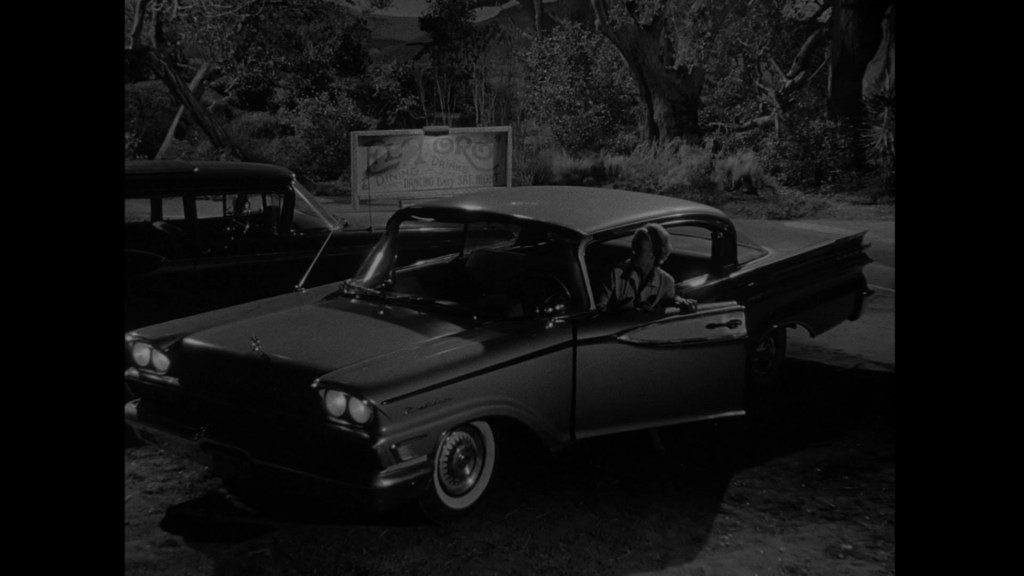
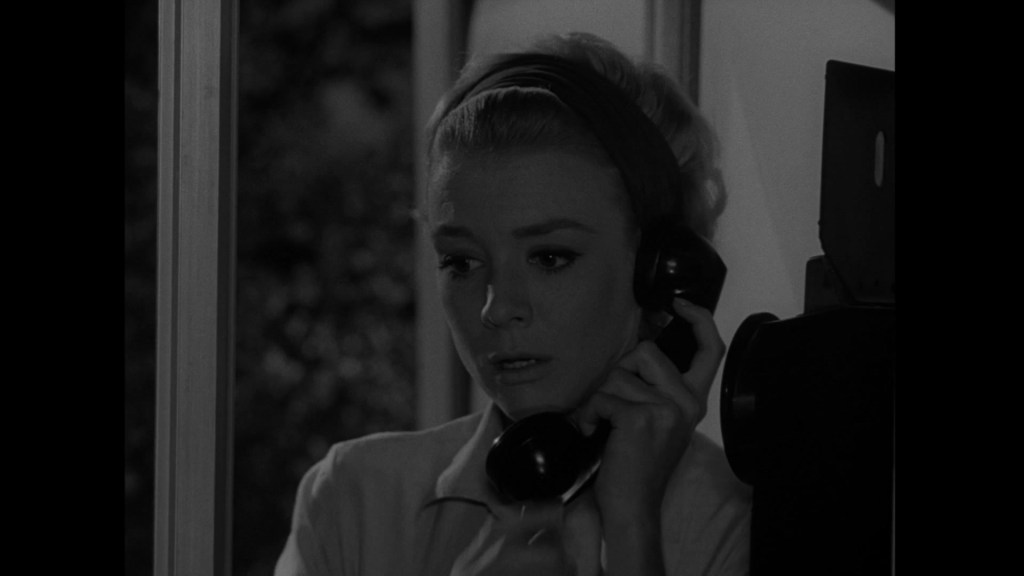
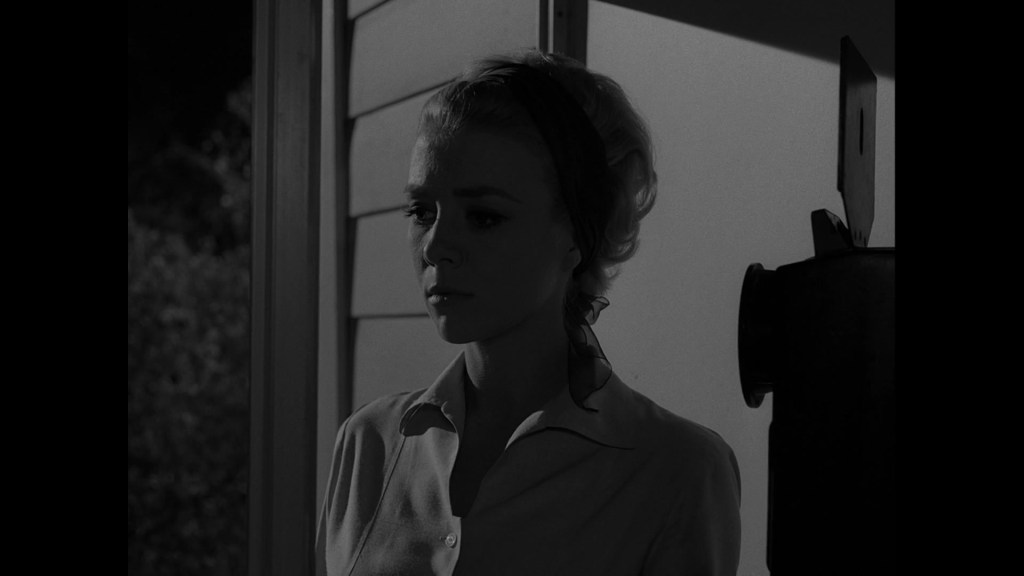
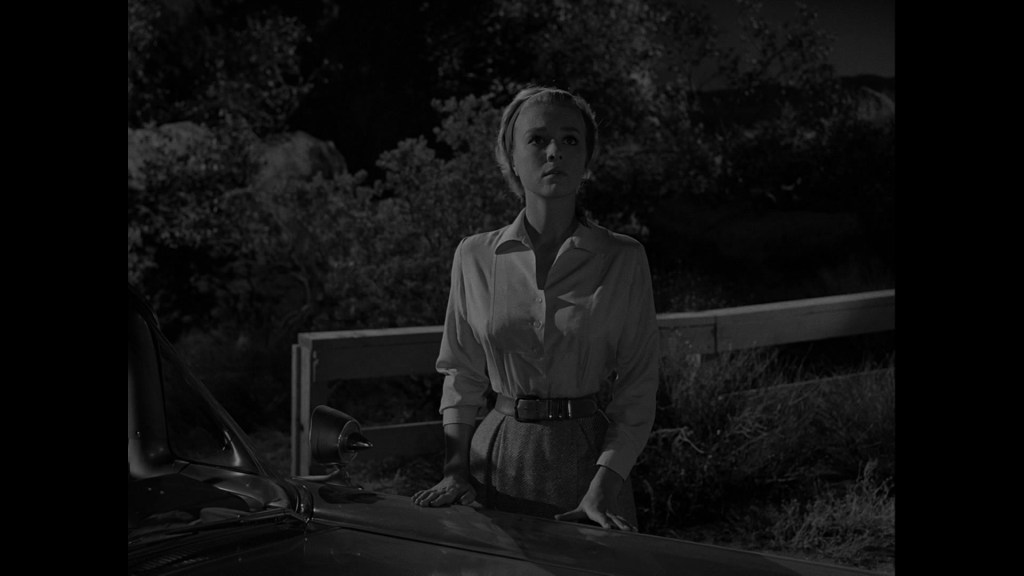
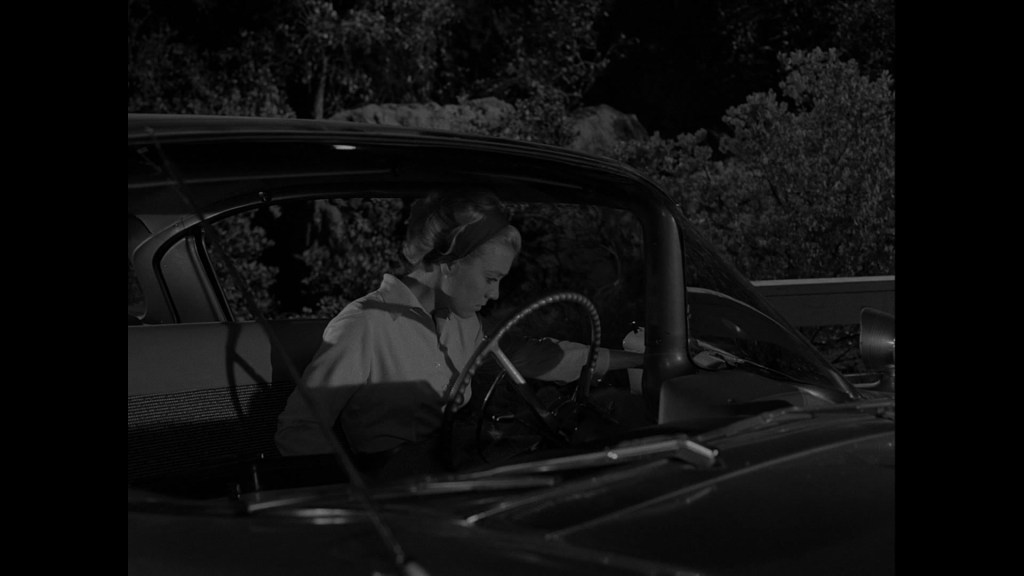
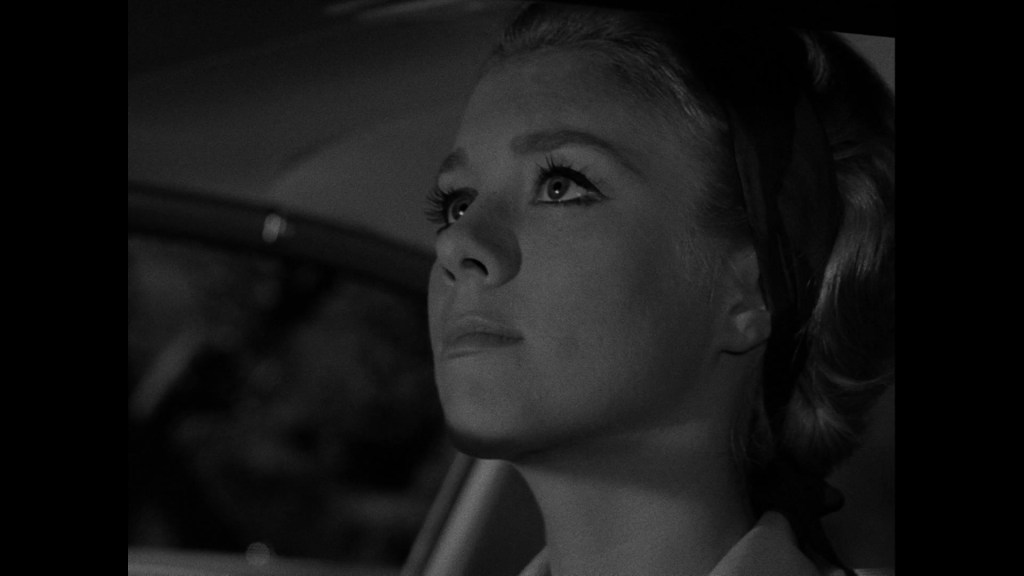
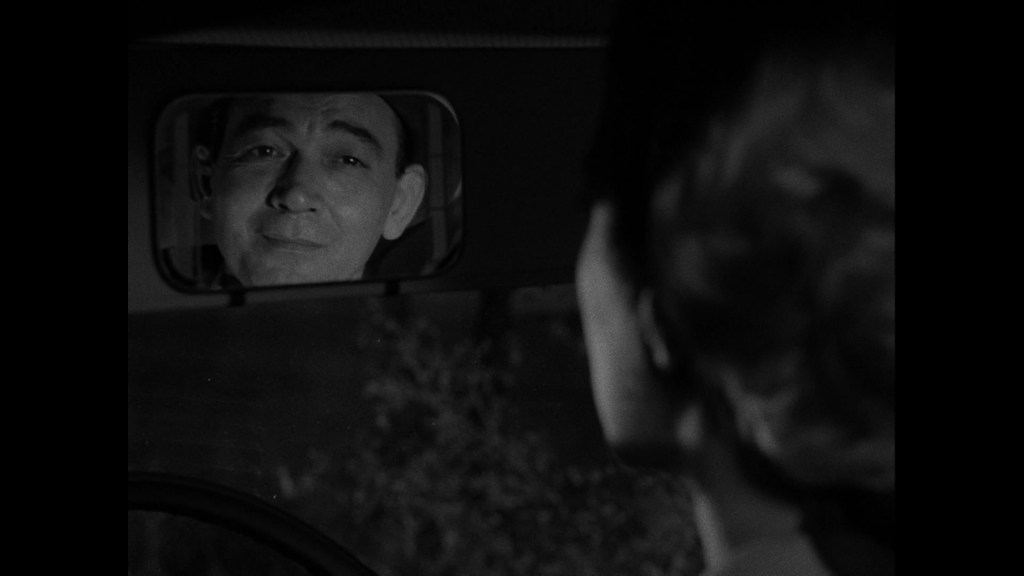
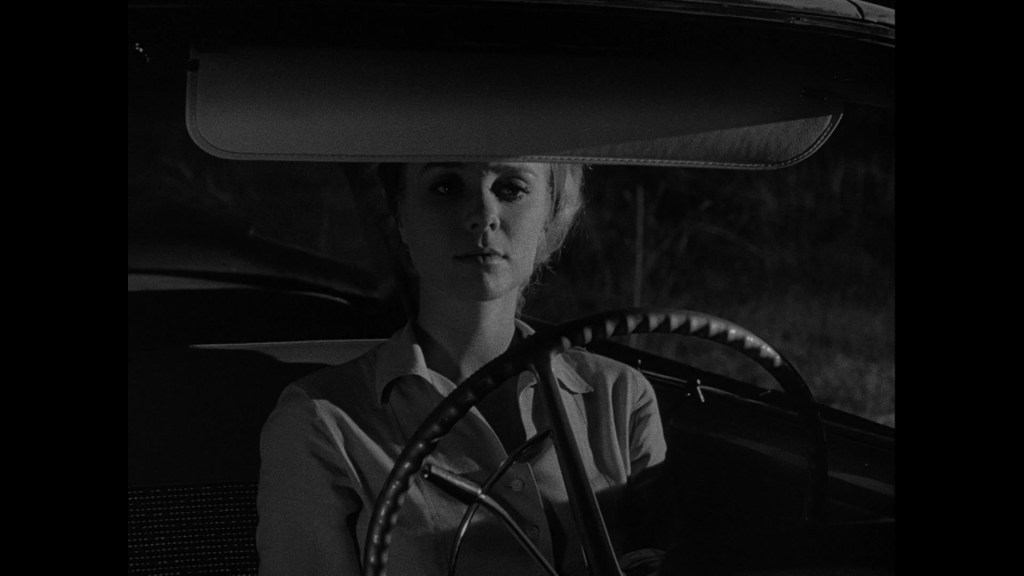
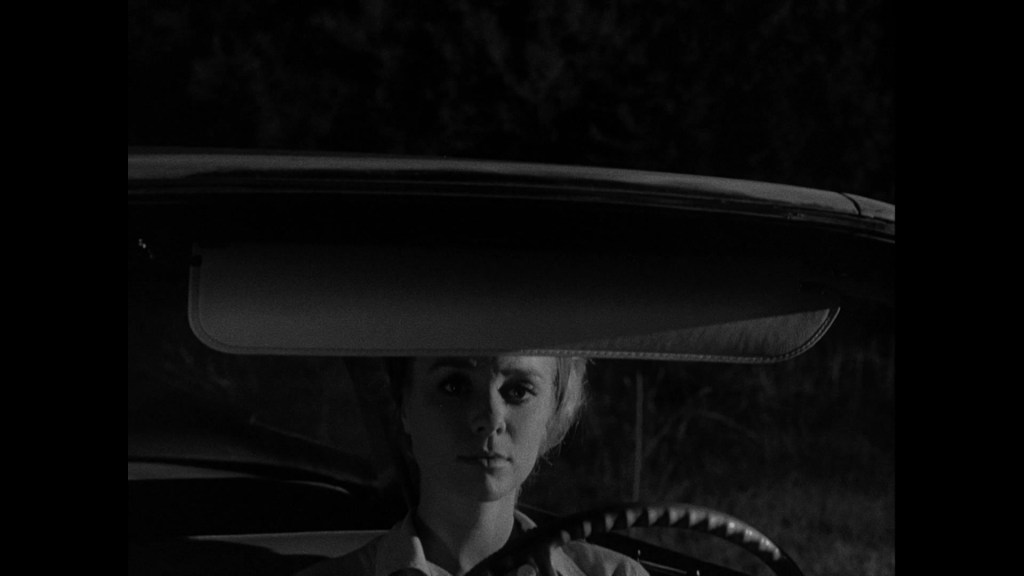
But now it’s time for the punch line to the piece, as obvious as it is. In New Mexico, Nan stops at a payphone intending to call her mother back in New York. She dials the number, but it isn’t her mother who answers but rather a neighbor. The neighbor tells Nan that her mother has been hospitalized for a breakdown she suffered following the death of her daughter a few days earlier. The daughter had suffered a fatal crash after a blowout–the same accident that we didn’t get to experience at the top of the episode. She didn’t survive it, she’s been dead this entire time without realizing it. Her entire body having grown numb, Nan slowly returns to her waiting vehicle ad pulls down the windshield shade, revealing a mirror on the back of it. Reflected in the mirror, as though he is sitting in the back seat, is the hitch-hiker. “I believe you’re going…my way?” he intones, as the camera pans up and away, ending the episode.
“Nan Adams, age twenty-seven. She was driving to California; to Los Angeles. She didn’t make it. There was a detour… through the Twilight Zone.”
Having spent a lot of time in my late teens and early twenties doing long overnight drives up and down the coast, I could relate to the sense of loneliness and isolation this episode evokes–the quiet and the long stretches of open, empty highway. it isn’t as bombastic as some episodes, and its ending is telegraphed relatively transparently from the beginning. But the performances are all chilling, and the way that the episode edges up to some really dark themes is appealing to me in a haunting sort of a fashion. It works because you can feel it right down into your bones. And that early jump-shock shot is incredible.
 The Tom Brevoort Experience
Far & away the single best, most effective episode of Twilight Zone.
LikeLike
I just watched it on Tubi and still don’t remember it even though I know I did. Inger Stevens on the other hand I do remember from Hang ‘Em High & 5 Card Stud. A photo of The Hitch-Hiker is on her wikipedia ( she did a second Twilight Zone — The Lateness of the Hour — season 2 episode 8 ).
LikeLike
Another one of my favorites. I always associate Inger Stevens with her starring role in the 60s sitcom, “The Farmer’s Daughter,” which used to be rerun fairly regularly during my childhood. It’s a shame Stevens met such an untimely end.
LikeLike
One of the things that made Jordan Peele’s TZ revival a fail for me was that he seemed to remember all the TZ episodes that had an underlying message and forget there are lots of episodes like this one, where there’s no hidden meaning, just scary shit happening (or in some episodes, silly but entertaining shit happening).
LikeLike