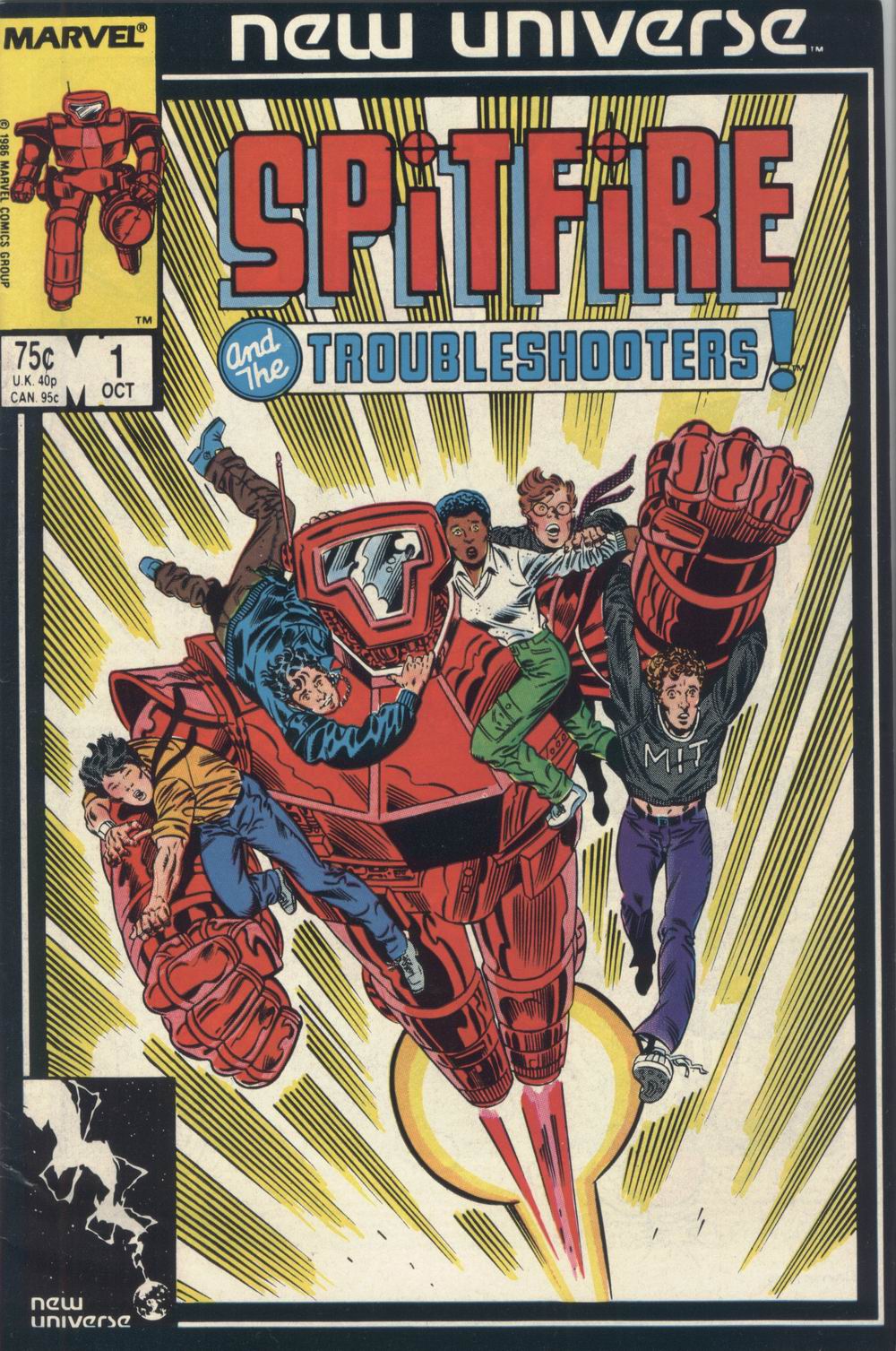


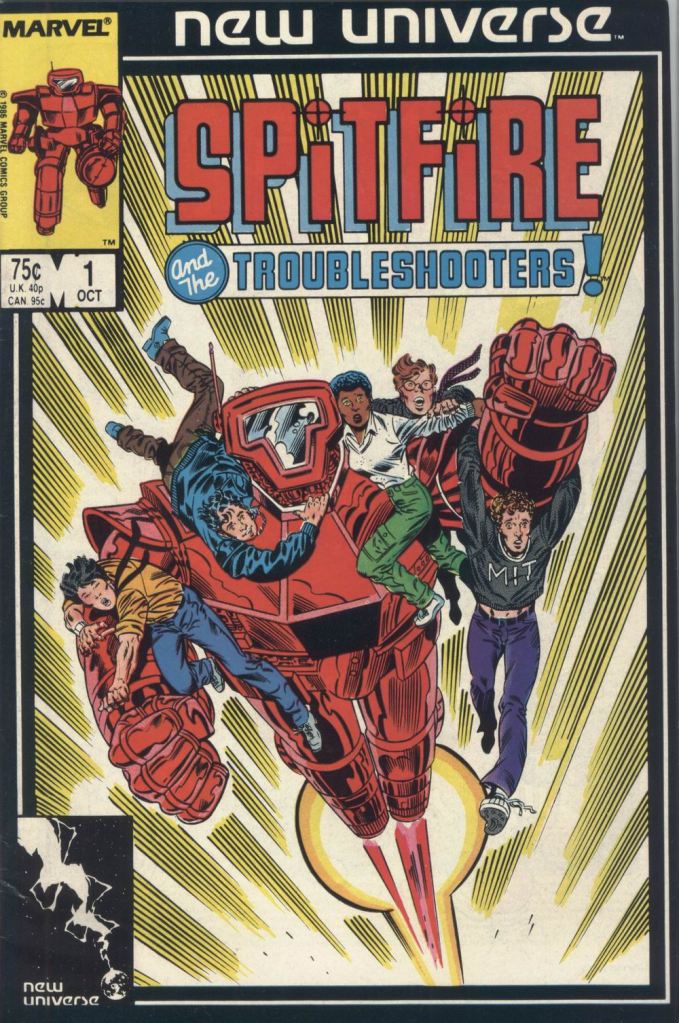
The second of the New Universe titles to make its debut (at the same time as STAR BRAND #1) was ultimately one of the line’s more troubled outings, right from the get-go. It only lasted a little bit over a year, a casualty of the line being contracted and re-envisioned following Editor in Chief Jim Shooter’s departure from Marvel. Even before that, the title of the series would change twice, once eliminating the name of the secondary characters and then in an unsuccessful attempt to re-brand a reconfigured version of the series before it reached cancellation. This was SPITFIRE AND THE TROUBLESHOOTERS.
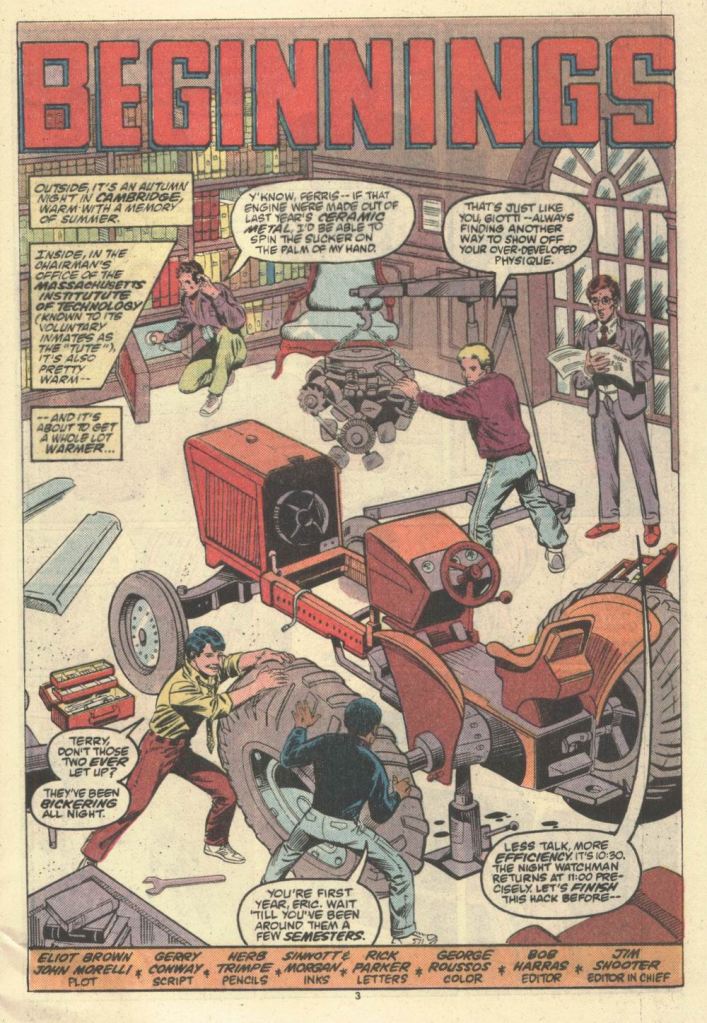
When Jim Shooter had first conceived of his New Universe initiative, he had high hopes for the sorts of creators that Marvel would be able to recruit to populate the line. Legends tell of one early meeting where names such as Isaac Asimov, Arthur C. Clarke, Edgar Rice Burroughs and other similar science fiction authors were considered–never mind that by the time of the meeting, some of them were deceased. But as the clock ticked down and it became more and more difficult to attract even established comic book talent to come up with material for the new line, Shooter was forced to consider the efforts being put forward by more journeyman creators. One such creator was Eliot Brown, who was then an assistant editor and production man at Marvel and who today is probably best remembered for his technical designs featured in the OFFICIAL HANDBOOK OF THE MARVEL UNIVERSE, and online for his many photographs of the period when he was working in comics. Eliot was on the front lines of the struggle to come up with new titles that fit Shooter’s somewhat-restrictive and somewhat fluid parameters, and he had a concept that he thought might fit the bill.
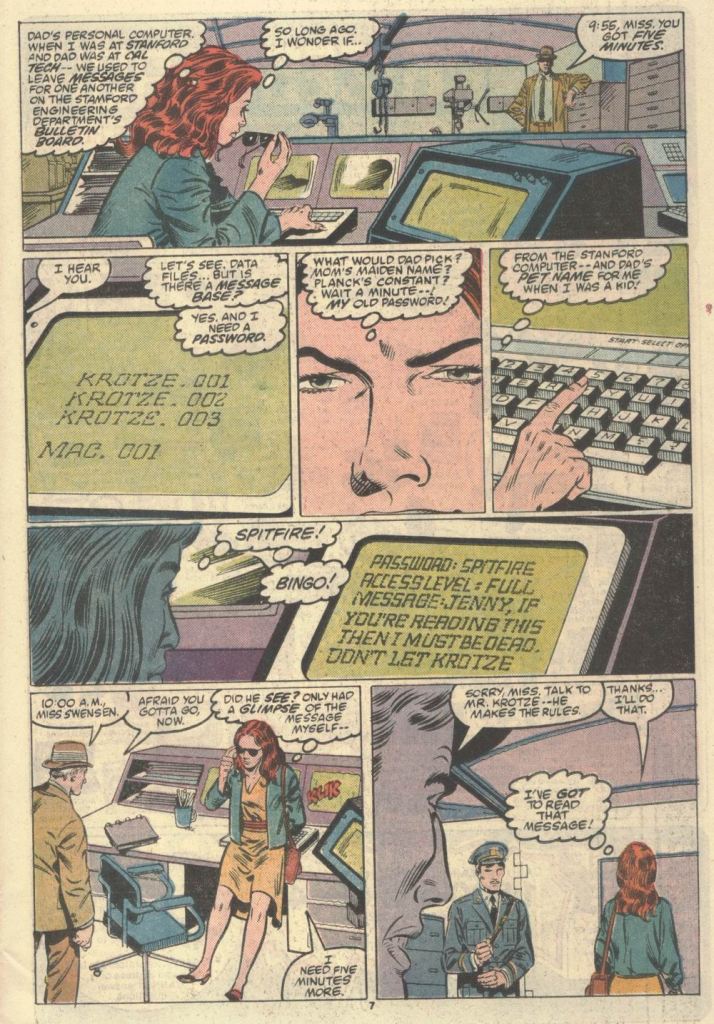
Brown’s idea concerned a professor at M.I.T. whose father was developing an experimental robotics prototype. When Karl Swensen is killed, Jennifer, whom he nicknamed Spitfire due to her red hair and fiery take-no-prisoners attitude, teams up with a quintet of brilliant-but-inexperienced engineering students to liberate his invention before the black-hearted people who killed her father for it can get their hands on it. Brown bounced around his ideas with letterer and fellow production person Jack Morelli, and sold the idea to Shooter for the new line. Unfortunately for both Brown and Morelli, while they were permitted to write up the overview of the series as well as a plot for the first issue, they weren’t seen as having the necessary experience to script the finished comic. That job was farmed out to veteran writer Gerry Conway, who would wind up writing the next bunch of issues solo. (Brown apparently found out about this replacement when he went to drop of the first portion of his and Morelli’s dialogue with editor Bob Harras only to learn that Conway had been hired in their stead. Whether that decision was made by Harras or by Shooter is difficult to say with certainty.)
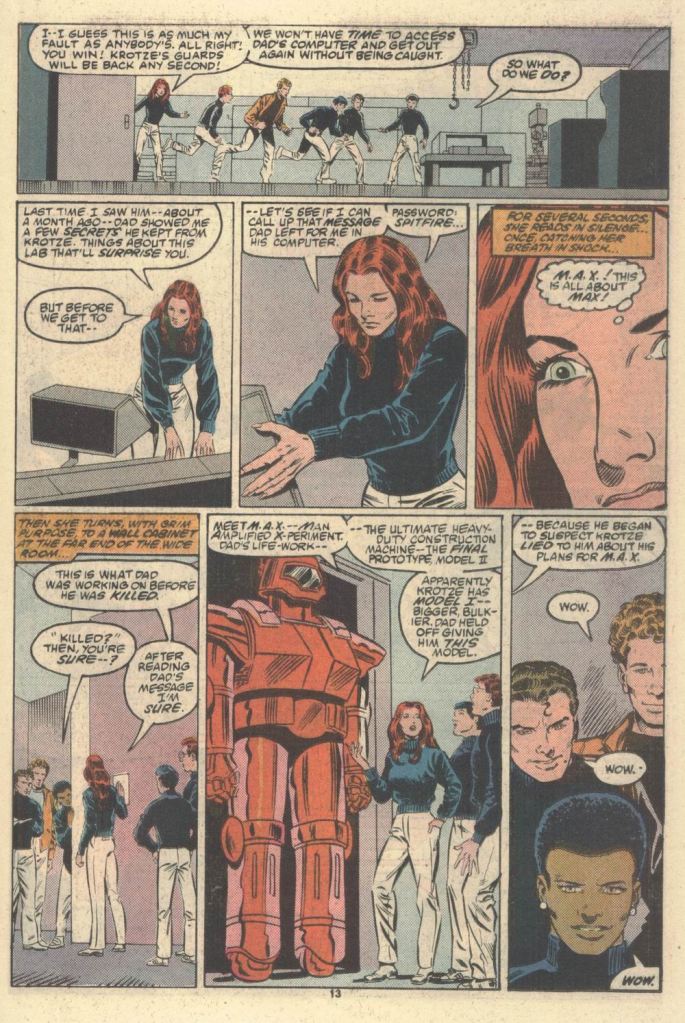
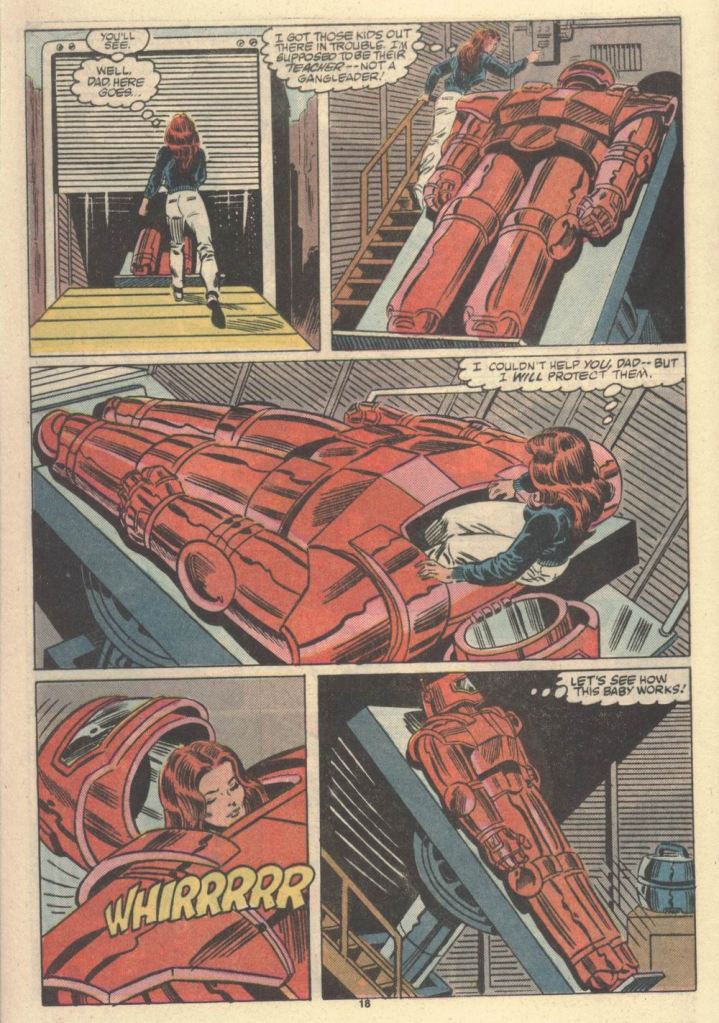
Karl Swensen’s big invention is M.A.X, short for Man Amplified X-Periment. It’s a large armored suit, along the lines of Iron Man’s armor, but bulkier and much less fanciful. The idea here was for it to be a more plausible take on that kind of concept, but in practice, this made it look like a clunky antique when on the stands next to the armored Avenger’s comic. The artwork was provided by Herb Trimpe, who had found a niche for himself working on assorted licensed properties and toy tie-in titles. Consequently, SPITFIRE AND THE TROUBLESHOOTERS looked a bit like one of those, as though the M.A.X. design was a toy that Trimpe was attempting to breathe life into. For this first issue, which was pretty obviously running behind schedule, slick inking was provided by the dependable Joe Sinnott tag-teaming with Romita’s Raider correction man Tom Morgan. Moving ahead, a variety of inkers would be called into service to finish Trimpe’s penciled pages.
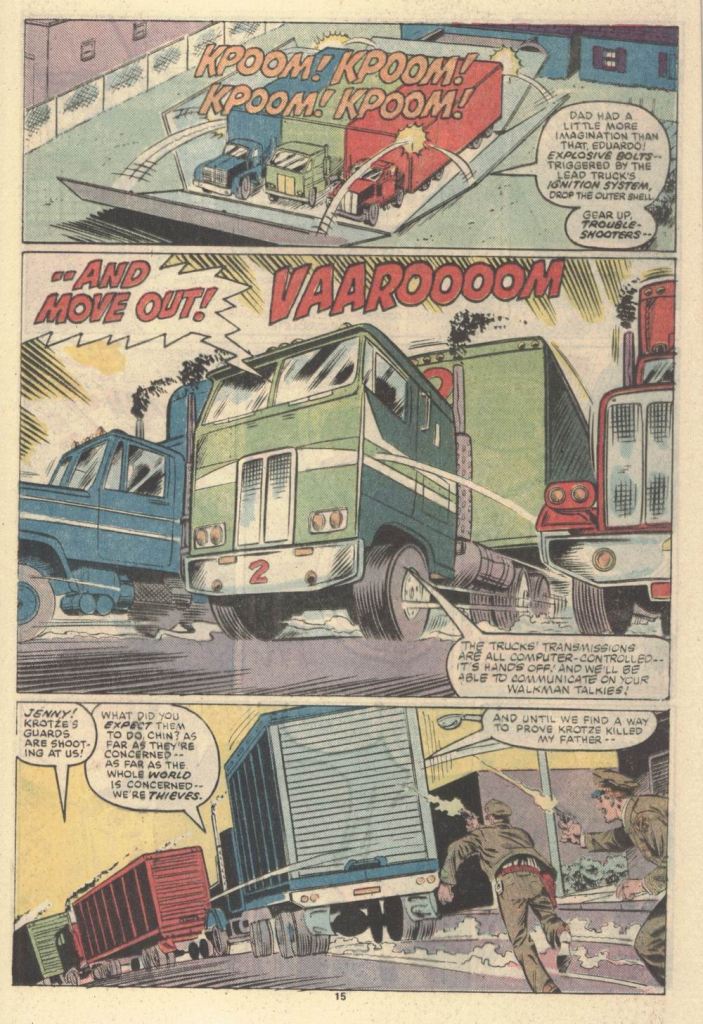
Not only do Spitfire and her five helpers, called collectively the troubleshooters, make off with M.A.X, but also with Karl Swensen’s entire laboratory as well. In a plot contrivance that utterly belies the attempt to make this series a more plausible alternative to Iron Man, Karl Swenson has constructed his lab so that it collapses into a trio of long-haul diesel trucks–Brown and Morelli were no doubt thinking about the toy applications. So the set-up once this first issue is concluded is that Spitfire and the Troubleshooters are on the move in their three big rigs, attempting to remain one step ahead of their government contract pursuers who want to use M.A.X. for military and black ops purposes. The bad guys are able to reverse-engineer their own flying exo-skeletons from Swensen’s designs (which makes one wonder what they truly need M.A.X. for) which gives the team a series of recurring challenges to have to face down.
It’s pretty clear that, for writer Gerry Conway, taking over SPITFIRE AND THR TROUBLESHOOTERS was a hired gun job, nothing more. He’d continue to write the series through issue #6, in a few cases with his friend Roy Thomas co-writing and co-plotting. As with pretty much all of the New Universe titles, a fill-in art job was needed quickly given how late production on the new line got under way, and Trimpe’s last issue at the helm was #5. In #6, changes were clearly in the offing, as that issue was co-written by Conway and not Thomas but rather DC expat Cary Bates. With issue #7, Bates took over the title, and with Alan Kupperberg on the artwork, he began to immediately retool it. Conway had already killed off the main series villain, Fritz Kroetze, and Bates wrote out the Troubleshooters and destroyed M.A.X., transitioning the premise into a more espionage-based book under the new title CODENAME: SPITFIRE. But almost immediately after making that change, Bates was gone, and the series limed to a conclusion in issue #13 with Jenny Swensen getting a new armored suit under a couple of different fill-in writers including Fabian Nicieza, Len Kaminski and Sandy Plunkett.
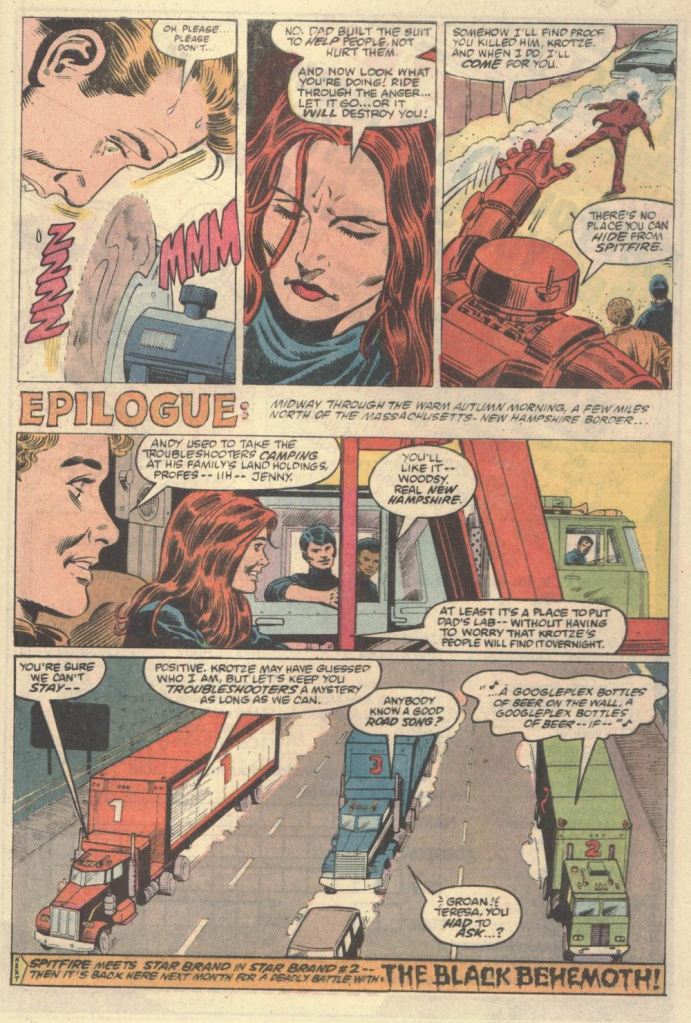
As a reader, this first issue was competent but dull. As was the case with virtually all of the New Universe books, there wasn’t a lot of color or excitement to be found here. It all plays like a tie-in series to a toy line that doesn’t exist–Marvel did a lot of these to great success during this time period, so it wasn’t necessarily a bad instinct to try to build a similar home-grown property. But it was all much less interesting or impressive than the similar fare being put forward in the main Marvel line. And the artwork resolutely reflects EIC Shooter’s preference for mid-shots, grid-based storytelling and almost diagrammatical action sequences. The cast is equally bland, with nobody especially evidencing much in the way of an individual personality. In other words, it’s all a bit lifeless. The two people who might have had some passion for what they were doing, Brown and Morelli, regardless of how green they might have been at that moment, had been left by the wayside. Throughout this short run, one never gets the sense that anybody is trying for anything more interesting or challenging than a piece of competent product.


I’ve only ever read three issues of Spitfire, and I thought they were okay, but nothing especially noteworthy. Definitely a series that needed a solid direction, but which instead lurched from one creative team to the next.
LikeLiked by 1 person
I read this as a ten-year-old in 1986, when it was a backup strip in the UK Transformers comic. It kind of left me cold – boring, without any real action of the kind I liked. A bit too grown-up for me, maybe. But reading it again now, it just never quite clicks. Like you say, it tries to be ‘realistic’, and then the lab folds up into three trucks in exactly the kind of silly ‘science’ the New Universe was meant to be opposed to – the series can’t quite settle down into a consistent tone, one way or another…
LikeLike
I remember reading the first issues of all the New Universe titles. That was enough.
LikeLiked by 2 people
Makes me think of all the bands that put all their effort into coming up with the name of the band and saved none for their songs. Also, why did Marvel need a Iron Man knockoff when they had Iron Man?
LikeLiked by 1 person
Jenny and the Troubleshooters proved to my then 25-year-old self that blind loyalty wasn’t necessarily a good thing. Despite the lessons I should have learned when that same devotion had me ask my comic bookstore to pick up every single Secret War II tie-in issue the previous year, I did likewise with every single New Universe debut issue. As much as Star Brand #1 disappointed me, this one was a struggle to even finish. I had no idea of the backstory with Elliot Brown and Jack Morelli, but at least they seemed to have germ of an idea. This was clearly Gerry Conway going through the motions – a common practice of his that had led me to drop several titles during his previous time at Marvel. As for Herb Trimpe, despite what I know are solid efforts on his part, his art never worked for me outside of those old issues of The Incredible Hulk. I know the guy was as reliable as a clock. But his figures always came across as too stiff and limited. Needless to say, I wasn’t around for #2 or any others.
But if I need to say one positive thing about this issue, I liked it better than Kicker’s Inc.!
LikeLike
I have no memory of this issue so either that pickup truck hit me harder than I thought last year or I decided not to buy it after flipping through it. Weird though since I bought anything by Trimpe back then. From what you describe happened to stave off cancellation maybe it would have been better to cancel rather than retool it so a coherent concept, however dully written as a solo, would exist for future writers to use. I do remember what happened to Jenny when Shooter left and it was just the last bad idea given to Spitfire.
LikeLike
thanks for sharing the behind the scenes story. Replacing Brown withiut bothering to tell his sounds like just really poor management even if it was a correct decision.
the whole “the military will use my invention for war” thing was a very common post Vietnam trope. Even when the invention was funded by the Pentagon and obviously a military project. Makes me want to see a story where an aerospace engineer steals his F16 prototype so the military can’t get it. Fighting Falcon the Fledlings!
LikeLiked by 1 person
Yes, this makes me think of several TV pilot movies where the protagonist cyborg/robot/android goes on the run rather than let the military use them as an assassin.
LikeLiked by 1 person
James MacDonald Hudson’s origin: Hudson expanded his helmet into an exo-suit designed for exploration, granting enhanced strength, tunneling ability and limited flight. Jerome Jaxon ( Am-Can supervisor )betrayed Hudson by selling the suit to the U.S. military. Furious, Hudson destroyed the blueprints, abandoned the exo-suit, and reclaimed his helmet, the armour was inert [ Alpha Flight#2 ( September 1983 ) marvel.fandom.com ] and 1985 science fiction film D.A.R.Y.L. features a young boy who is actually a military experiment with a computer for a brain, who escapes his creators with the help of one of the scientists who dies.
LikeLike
There was a point where it was shared around the office that the New Universe was looking for fill-ins. I wasn’t working up at Marvel, but I was doing stuff for MARVEL AGE, I think, and was up at the offices often enough.
So I pitched a SPITFIRE fill-in. I’m sure it wasn’t wonderful, but I tried to incorporate all of what I’d heard about what Jim wanted in New Universe stories.
During the editorial meeting where it was explained to me all the ways in which my pitch didn’t work for the New Universe, one of the editors (not Bob) told me the basic problem was that I wasn’t a very good writer and shouldn’t do any writing for Marvel.
So…I didn’t pitch any more New Universe fill-ins.
I did do more writing for Marvel later, though.
LikeLiked by 2 people
I recall reading maybe a book or two with your name on it. 😊Glad your didn’t let that editor stop you or I’d never have had my favorite Avenger’s run.
LikeLike
To be fair, writing a pitch for a book I didn’t much care for, while trying to obey rules I didn’t think made much sense, wasn’t the way to put my best foot forward anyway, and I didn’t yet know how to find an angle I liked in a book I wasn’t positive about. And I got quite a bit better only a few years later.
And on the other hand, while Marvel wasn’t giving me any love, I was writing my first creator-owned book for Eclipse (for practically no money, but still), and DC was having my writing drawn by José Luis García-López. So I had that going for me.
LikeLike
What sort of idiot unprofessional behavior is that anyway?!? An editor telling a writer that they aren’t good enough to work there.
I am also glad you ignored his advise, as your Thunderbolts is one of my favorite comics runs ever.
LikeLike
While Silver Age Marvel did a lot of stuff that was relatively realistic and grounded for a superhero story they never forgot that realism wasn’t an end in itself. The mobile lab here didn’t bother me at all but the total lack of anything interesting or different did.
Someone at the time complained that the creators had no sense of how engineers think or how distinctive their sense of humor is. I don’t know enough engineers to judge but it sounds plausible.
LikeLiked by 1 person
Edgar Rice Burroughs????
LikeLike
I’d guess optioning some of his undeveloped projects from ERB, Inc.?
LikeLiked by 1 person
Sometimes “the world outside your window” is just not so blamed interesting . . . . .
LikeLike