

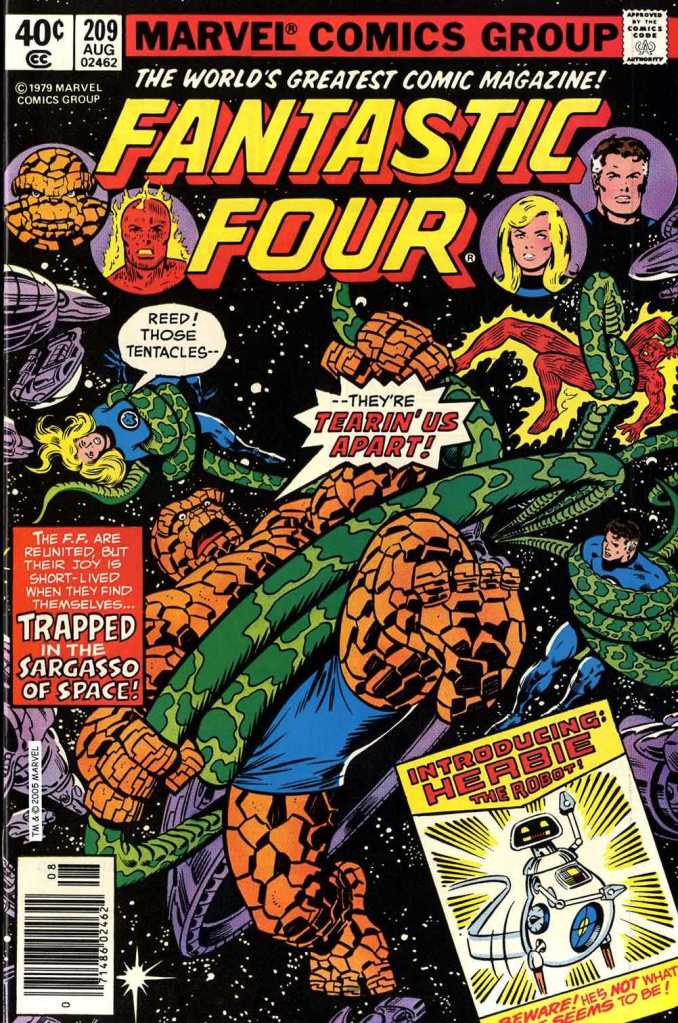
Even at the time, we all knew in my circle of friends that the New Fantastic Four cartoon that was then airing on NBC on Saturday mornings wasn’t very good. This despite the involvement of the comic’s co-creator Jack Kirby as a designer and storyboard artist and dialogue written by Marvel figures such as Stan Lee and Roy Thomas. All of the stories were watered down versions of actual early FF tales, with the action minimized due to the strong restrictions placed upon children’s programming at that time. That didn’t stop me from recording a few episodes on audio cassette tape–I was a collector, after all, and a Marvel fan. But it wasn’t really very good. At this time, I hadn’t yet seen the earlier 1967 Fantastic Four cartoon, which was markedly better. So as this was the only way I could experience my new favorite heroes on television, I sucked it up and went along with it, squeezing out such enjoyment as I could. But there was one element of the show in particular that rankled each and every episode.
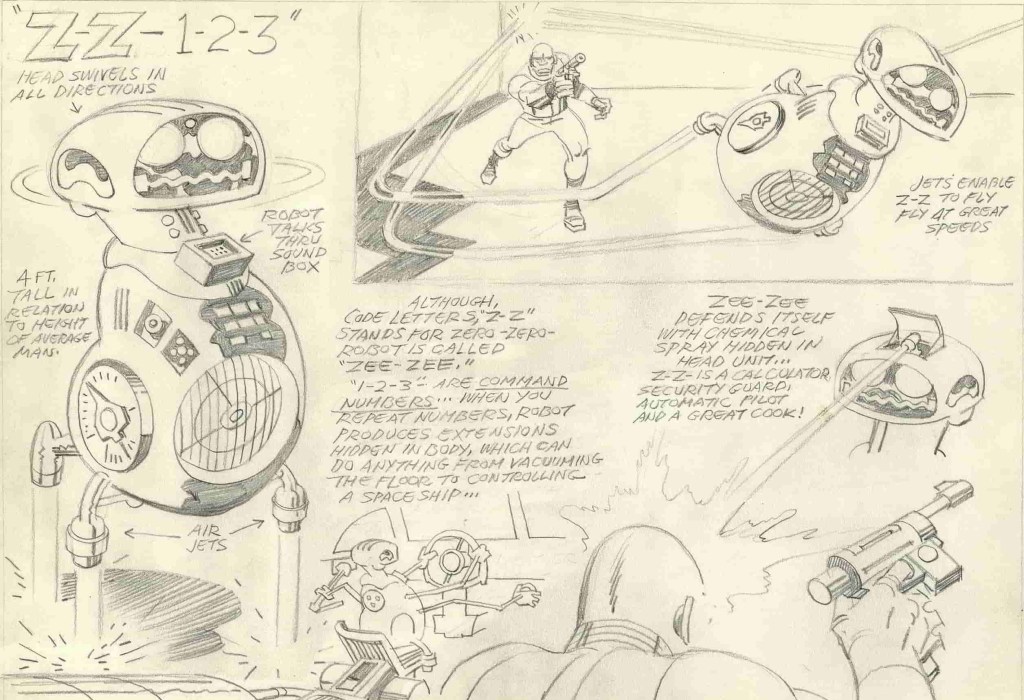
That element, of course, was HERBIE the Robot, a new character introduced into the cartoon series when it turned out that the television rights to the Human Torch were unavailable for animation (they had been licensed for a live action television production that never happened.) Consequently, a new character needed to be devised to take the Torch’s place and fulfill the promise of the premise. And this was 1978, in the immediate wake of STAR WARS, so the shape of that character was obvious to everybody involved: the Fantastic four were about to count among their number a cute R2D2-style robot. It was Jack Kirby who designed the new character–Jack named his creation Z-Z-1-2-3, but that didn’t have the necessary pizzazz for marketing. So he became HERBIE, short for Humanoid Experimental Robot with B-Type Integrated Electronics. No, I don’t know what B-Type Electronics are either, nor how you could take one look at HERBIE and describe him as humanoid. But he got to spar and argue with the Thing, which was his primary story function.
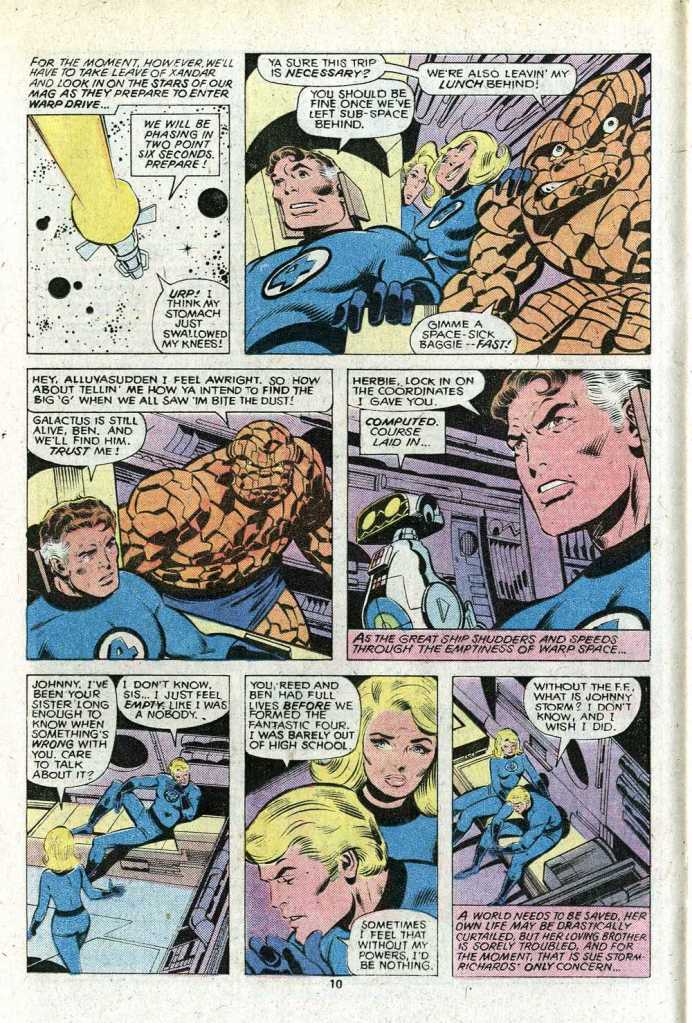
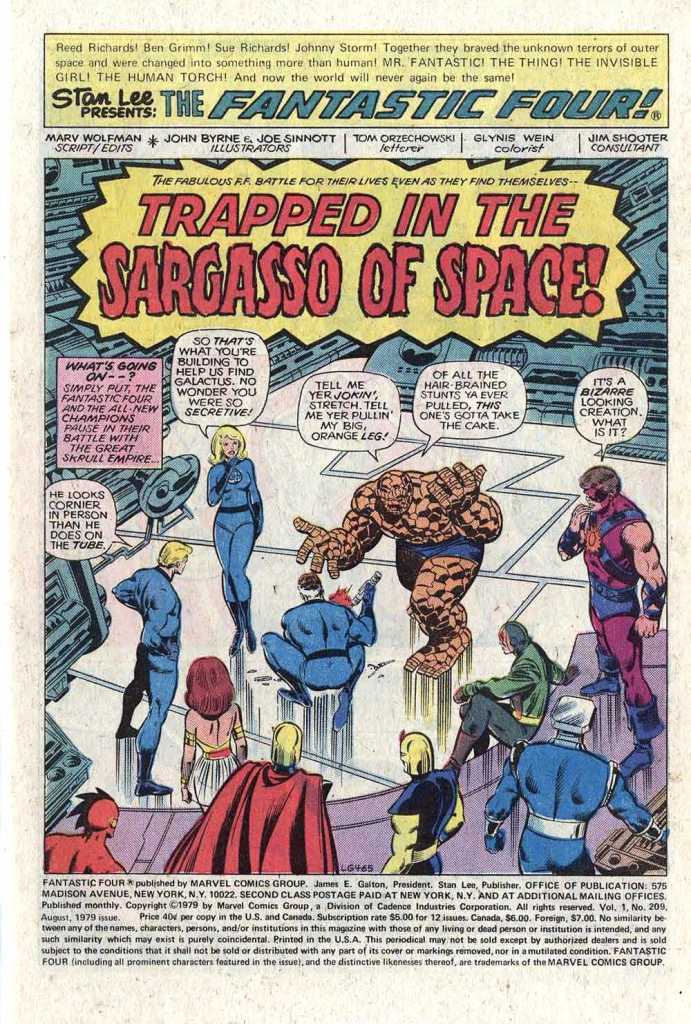
This being Marvel, it wasn’t enough to simply create HERBIE, he needed to be integrated into the comics as well. So in the next issue that I received as part of my subscription, writer/editor Marv Wolfman did just that. The pretext for Reed creating HERBIE is relatively thin–he’s a remote computer terminal that can provide the team with the calculations that they’ll need to navigate across the stars and locate Galactus, their only hope for waylaying the now cosmic-powered Sphinx, who is headed back to Earth to lay waste to it. Marv also includes the in-world explanation that Johnny Storm was out of town the day the contracts for the cartoon series had to be signed, explaining why he was replaced by the little robot. Three of the four members of the FF–everybody except the Human Torch, who arrived later, have been struck by a Skrull aging ray, which has increased their metabolisms, causing them to age at a rapid pace. They’ve only got about three days in which to accomplish their mission before they all perish of old age. So it’s goodbye to Xandar, Nova, the New Champions and that entire wing of this crossover story, as the FF borrow Nova’s starship and head off to locate the world-devourer.
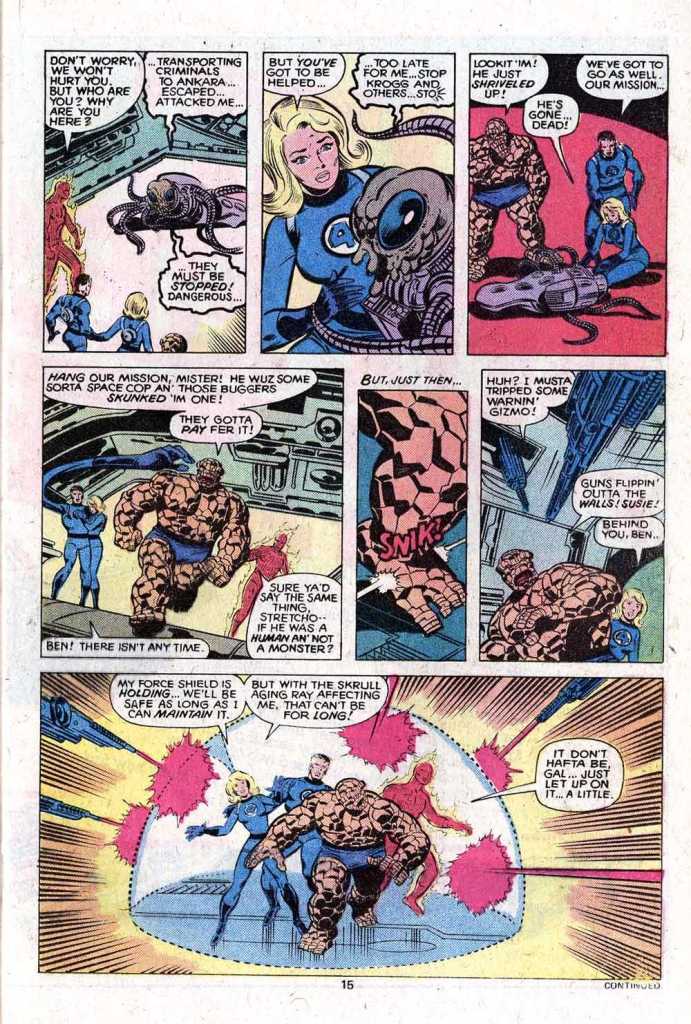
But the truly big news in this issue of FANTASTIC FOUR was the arrival of new artist John Byrne. I was a big fan of John’s work at the time, and had in particular loved his one-off Thing vs Thing story in MARVEL TWO-IN-ONE #50, so i welcomed his arrival.
With powerhouse inker/finisher Joe Sinnott remaining in residence to continue to give the series its typical polished look, all of the elements were in place for a stellar run. It looks to my eye as though Byrne was only doing breakdowns on this FF run, since Sinnott was more than capable of providing a strong, almost overwhelming finish to them. And this run looks…all right. But it never quite rises above mediocrity. In later years, Byrne revealed that he had strong feelings about the FF–feelings that he’d be able to put into practice in a couple years when he’d go on to both write and illustrate the series. But this first time out, he wasn’t vibing with the stories, and his more fluid approach to the artwork had a lot of its character submerged by Sinnott’s finishes. None of it looked bad, but overall it’s a bit of an uninspired mix.
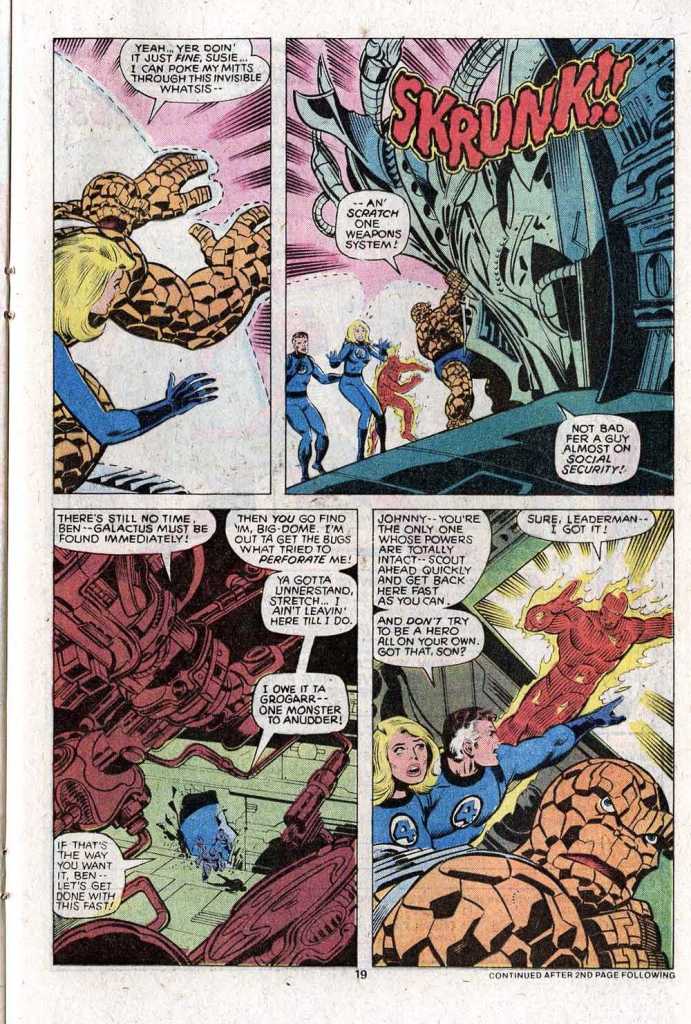
Anyway, getting back to this issue, it needed a story and some action as well as the set-up to cartoon synergy and dispatching the myriad of guest-stars, so very quickly in their space voyage, the Nova ship finds itself drawn into a Sargasso of Space, the final resting place of lost ships. The team determines that there are life forms on one of them, and despite the fact that they’re racing the clock in more ways than one, they decide to head over and investigate. There, they encounter a suitably buglike alien called Grogarr, who tells the humans that he had been transporting dangerous criminals across space when they were drawn to the Sargasso, and that his fellows must be prevented from escaping. Consequently, the FF head deeper into the ship in an attempt to recapture the now-demised Grogarr’s charges.
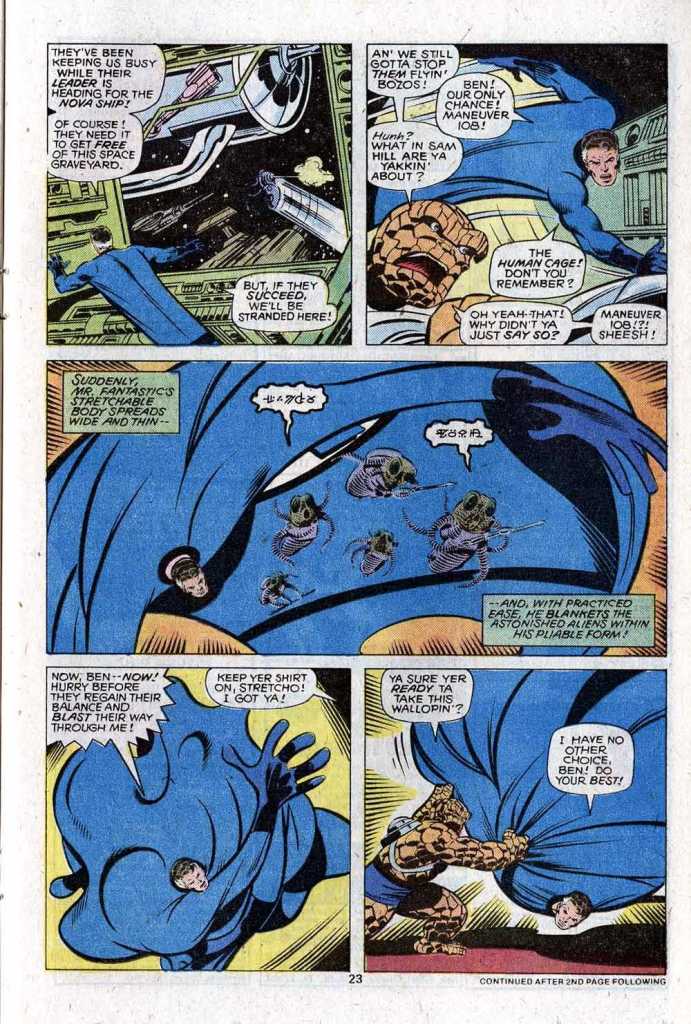
What follows is kind of a blah action sequence, far from one of Byrne’s finest. He was typically truly adept at coming up with interesting action beats, but here, with the FF facing a dozen flying bugs in armored carapaces, it feels like he’s a bit uninspired. Anyway, the FF get jumped by the aliens, and while they fight back, the alien leader Krogg attempts to zip over to the Nova ship and claim it for himself and his men–they need it in order to escape the Sargasso. The team, though, puts a quick kibosh on most of the aliens, with Reed enveloping them within his own expanded body and then Ben smacking Reed against the bulkheads again and again until the bugs are all stunned. With that, the Thing punches a hole in the skin of the ship and Reed attempts to stretch over to their own craft before Krogg can get away with it.
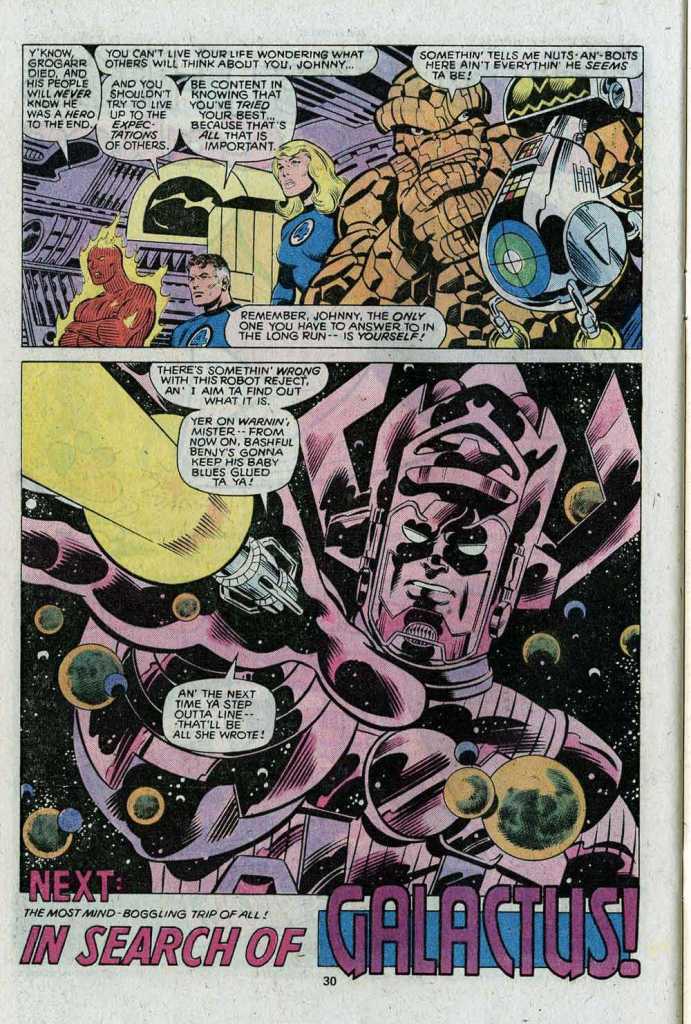
But when he gets there, Krogg is suspiciously dead, and the only one around who might have done the deed is HERBIE. But the robot insists that the termination of life functions isn’t permitted in his programming. This doesn’t prevent the Thing from side-eyeing him, though. Anyway, leaving the rest of the aliens in suspended animation with a rescue beacon set up to alert others of their kind to their whereabouts, the FF zip off in the Nova ship in pursuit of Galactus. To Be continued. It’s a meh issue, to be honest, and I felt that way about it at the time. Especially with the addition of Byrne to the creative team, this felt as though it should have been a home run. But the creators weren’t yet pulling in the same direction.
 The Tom Brevoort Experience
Z-Z-1-2-3, had Jack Kirby gone with ZZ-123 he would have beaten Star Wars: The Force Awakens ( 2015 ) to a similar named BB-8.
LikeLike
Humanoid Experimental Robot B-Type Integrated Electronics ( H.E.R.B.I.E. ) : What other H word could take the place of Humanoid? How about Heuristic ( 1. involving or enabling discovery or problem-solving through methods such as experimentation, evaluation, and trial and error. ), sure HERBIE experimental in his name but you could take a page from HAL 9000’s name ( Heuristically programmed ALgorithmic computer ) and HERBIE’s name becomes HEuristic Robot B-Type Integrated Electronics ). I’m glad we got HERBIE( or HERBIES) back, in a role any scientist would build any for. I like receptionist Roberta too.
LikeLike
I realized this morning that I could keep Experimental in HERBIE’s name since experimental was in reference to the robot while Experimentation in Heuristic is in reference to function, so Heuristic Experimental Robot B-Type Integrated Electronics ( H.E.R.B.I.E. ).
LikeLike
Reed built a slightly different robot in to monitor Franklin Richard’s mutant powers [ Fantastic Four#244 ( July 1982 ) Prolog Two ] and H.U.B.E.R.T. [ Fantastic Four#257 ( August 1983) ].
LikeLike
There were plenty of things I didn’t care for in the all Byrne F4 (Sue being a minor when she and Reed first developed feelings for each other, for example) but this run was definitely meh. Byrne did better with austin’s overwhelming inks than fared with Sinnott, whose inking made everything look the same, just with different layouts. Hunt was my favorite Byrne inker by far. I also don’t think Wolfman ever really clicked with this book. There’s no genius inspiration like with New Teen Titans and even Spider-Woman was electric and fun unlike his F4. Wolfman never fell below a high level of quality but F4 was the bottom of his successes.
LikeLiked by 1 person
Oh, and the eventual HERBIE reveal was just downright painful.
LikeLiked by 1 person
You misread it, then. Sue developed an innocent crush on Reed while she was
minor, but Reed in no way had similar feelings at that time.
LikeLike
With what seems a consensus “meh” rating for this issue, Tom’s review sparked several key memories. Hanna-Barbera’s 1967 Fantastic Four cartoon led me to purchasing Marvel Collector Items Classic #22 – my very first comic book as a 7-year-old – although I didn’t start collecting until my grandmother bought me Iron Man #45 four years later. (This is expanded on a bit more detail in my blog About | Iron Man). As a result, I was certainly intrigued about the new FF cartoon in the fall of 1978. Although nervous since it wasn’t a Hanna-Barbera production, I really wanted to like it. After all, it had two of my absolute favorite voice talents with Mike Road and Ted Cassidy. Add in Jack Kirby and Stan Lee and how bad could it be?
Actually, thanks to the addition of HERBIE as well as stories wrung out drops of drama and action due to the network restrictions, bad was an understatement. “Woof” was more like it! I didn’t stick around long. If it helps, I felt really guilty abandoning Marvel for DC’s “Legion of Doom” on the Superfriends.
Jump ahead just over a year and nearly three years since I’d quit reading comics and I decided to buy a couple comics at a store so that I could skip doing my homework. One was X-Men #129 and the other the FF #213. I bought both because of John Byrne. Tom called it in saying Byrne’s art just didn’t mesh as well with Joe Sinnott’s overpowering inks. But his work with Austin as well as Chris Claremont’s writing on the X-Men sealed the deal, keeping me a collector until about five years ago.
Reading all of Marv Wolfman’s run a few years ago, my assessment echoes Tom’s. Nothing overly impressive with a storyline that went way too long. But circling back, for a “blah” issue, have to say this review did rekindle some fun memories.
LikeLiked by 1 person
This was a pretty ho-hum era for the FF in general, and I drifted in and out of following the series. Things didn’t really get back on track until Byrne came back as writer/artist. In retrospect, I think his run is a little over-rated, but at least he seemed to be genuinely excited about working on the series, and that enthusiasm was contagious.
LikeLike
I liked Wolfman’s FF run well enough and I liked the Byrne/Sinnott team quite a bit. Some bigger things were still to come… Terrax, Galactus. Galactus vs Sphinx.
Herbie was a deal killer on that FF cartoon… what a way to sack a project.It seems somewhat unbelievable that circa 1978 The Human Torch was in development for some other project. It seems more likely that saturday morning cartoons didn’t want to show a guy go up in flames since it was potentially dangerous mimical behavior.
LikeLike
It may seem more likely, but it wasn’t true.
The Torch was licensed to Universal, along with the Hulk, Doctor Strange, Captain America and one or two others. I want to say the Sub-Mariner, but I’m not sure.
We got a Hulk TV series out of that deal, a Dr. Strange pilot and a Captain America pilot, but Johnny didn’t make it that far.
LikeLiked by 1 person
Thanks. Just to be clear… I wasn’t making an accusation that it was an untruthful claim… just that I don’t think the special effects existed at the time to pull off a live action Human Torch on a tv budget.
LikeLike
That may be why not even a pilot movie materialized. They thought they could do it, realized they couldn’t while in development, and abandoned the idea.
LikeLike
I can see plausible reasoning for licensing the Human Torch separate from the FF. The Golden Age character was extremely popular. There was a Silver Age solo series for the FF’s Torch. And there’s an easy concept explanation, if Spider-Man is an “unhappy” young hero, the Torch can be pitched as a “happy” young hero. I can’t say any of this was actually their thinking, but it’s something which seems sensible. At times people have thought the Torch could be a breakout character, but he’s just never caught fire.
LikeLike
Yeah, HERBIE was widely disliked, though it seems a little odd decades later, when he’s become an occasionally-seen robot helper, something Reed would logically have, and was a welcome sight in the recent FF movie. I guess he makes a better supporting character than Torch-replacement.
A little baffling, though, that in the wake of STAR WARS, which had “Artoo” and “Threepio,” they gave the robot the same name as Herbie the Love Bug instead of something with a number in it.
LikeLike
Down with the robot.
While it may not be the best Byrne outgoing, it was an improvement over a lot of prior FF art. I’m happy that Sue has her hair though she does look a lot like the other John.
We learned that a Saturday morning cartoon could crush your dreams.
LikeLike
Stopping while on your way to save Earth is not limited to the Fantastic Four: While on their way to track down and stop the Xindi from destroying the Earth, Captain Archer and his crew stopped off at planet that had Humans on it ( Star Trek: Enterprise – “North Star” –season 3 episode 9 — space cowboys whose ancestors were taken from Earth to be slaves but they rebelled ). I wonder if Reed would have violated his ethics to save Earth like Captain Archer did in “Damage” ( season 3 episode 19 — stole the sole warp coil from a damaged Illryian spacecraft. I was disappointed they never circled back to that after Archer got the Xindi scientist Degra on his side and asked him to return or give a new warp coil to the Illryian ship ).
LikeLiked by 1 person
I greatly prefer Sinnott inking Byrne over Byrne inking Byrne but not as much as I like Austin or Day inking Byrne.
I’m not alone in feeling that way.
Of course state or merely even allude to that at the Byrne robotics forum and those vile cultists will encircle and flame you
LikeLike
The idea of a “Sargasso Sea of Space” was already something of a trope:
https://mavericuniverse.fandom.com/wiki/Sargasso_Sea_of_Space
LikeLike