

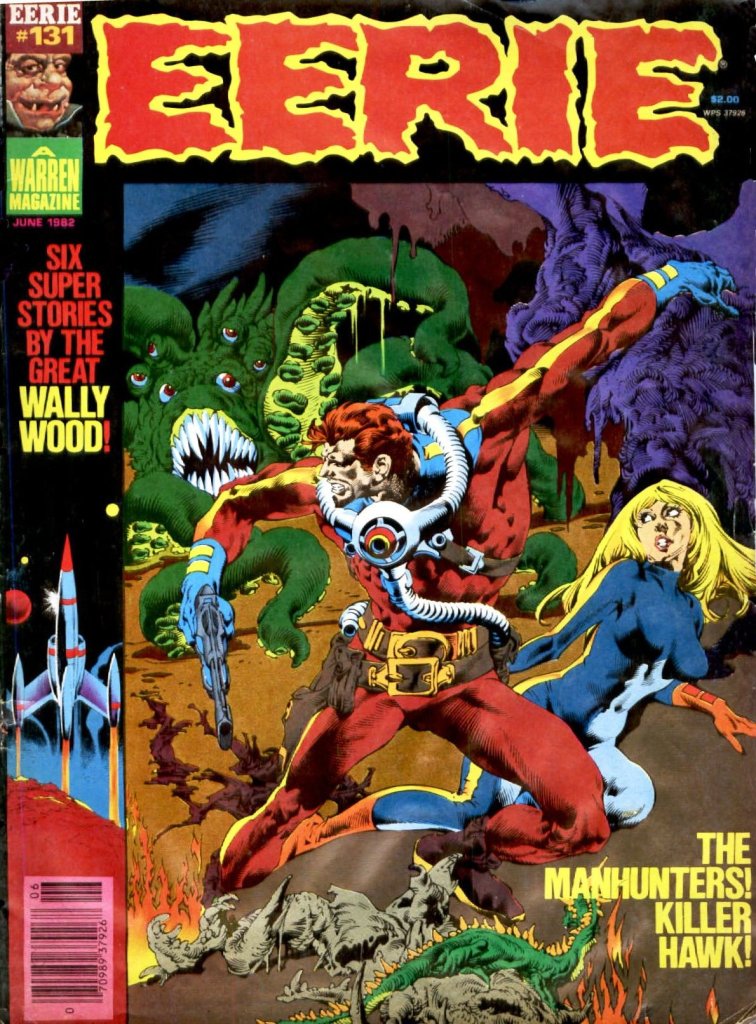
I wasn’t ever really a fan of the line of black and white comic magazines published by Jim Warren. I sampled them from time to time, but I always came away feeling a bit unsatisfied. The stories were often lackluster, and the artwork wasn’t of a consistent enough quality to pull my attention. So in general, I tended to avoid them. And yet, there was some little part of myself that whispered that I ought to be paying more attention to them, that they represented something important in the comic book field. I never did take the full plunge, but from time to time whenever the company would devote an issue to a specific artist, I would indulge myself. So it was with this memorial issue to the great Wally Wood. and yes, I don’t know what sense it makes to feature a Rudy Nebres cover on a called-out collection of Wally Wood stories either. It’s likely that Warren simply figures that Nebres’ work would bring in more contemporary sales, or else it was a piece that he had paid for and was going to use.
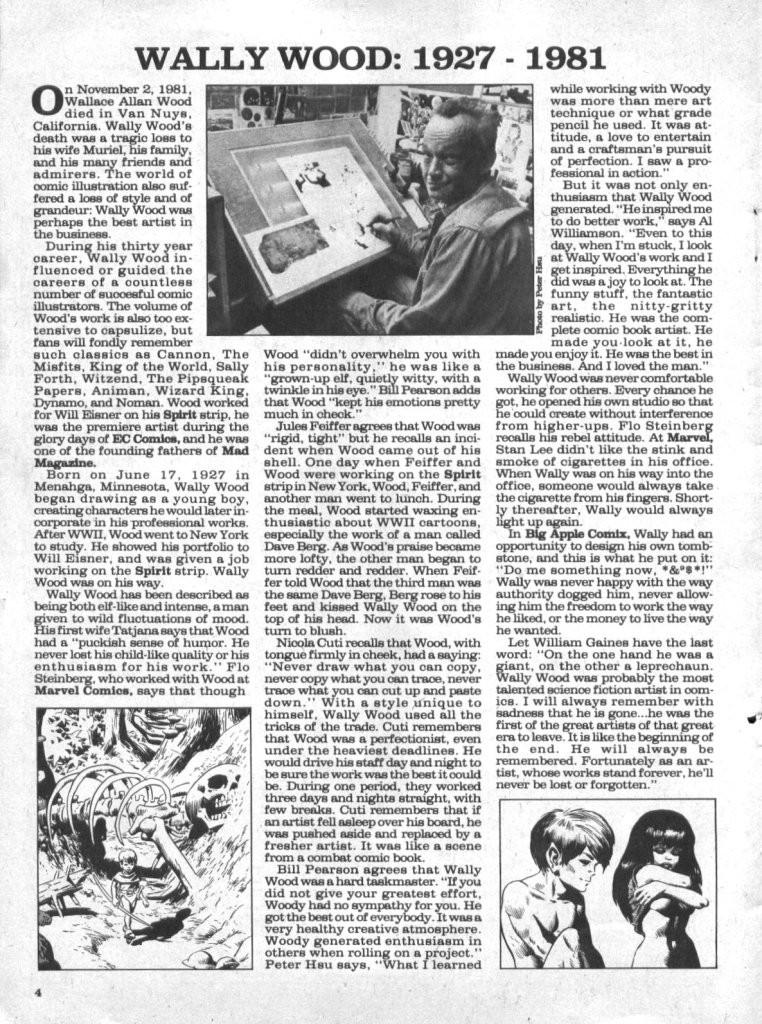
Wally Wood had been in ill health for a while, the sad end result of a life spent at a drawing table with a steady diet of booze and cigarettes that took a toll on him. He suffered kidney failure, and rather than face a future of dialysis treatments and diminished quality of life, Wood took his own life. It was a shocking moment for comic book readers, who had known Wood as a steady presence back into the 1950s. As Wood has done a bunch of work for Warren over the years, this commemorative issue of EERIE was assembled. it opened with a very understated obituary, reproduced above.
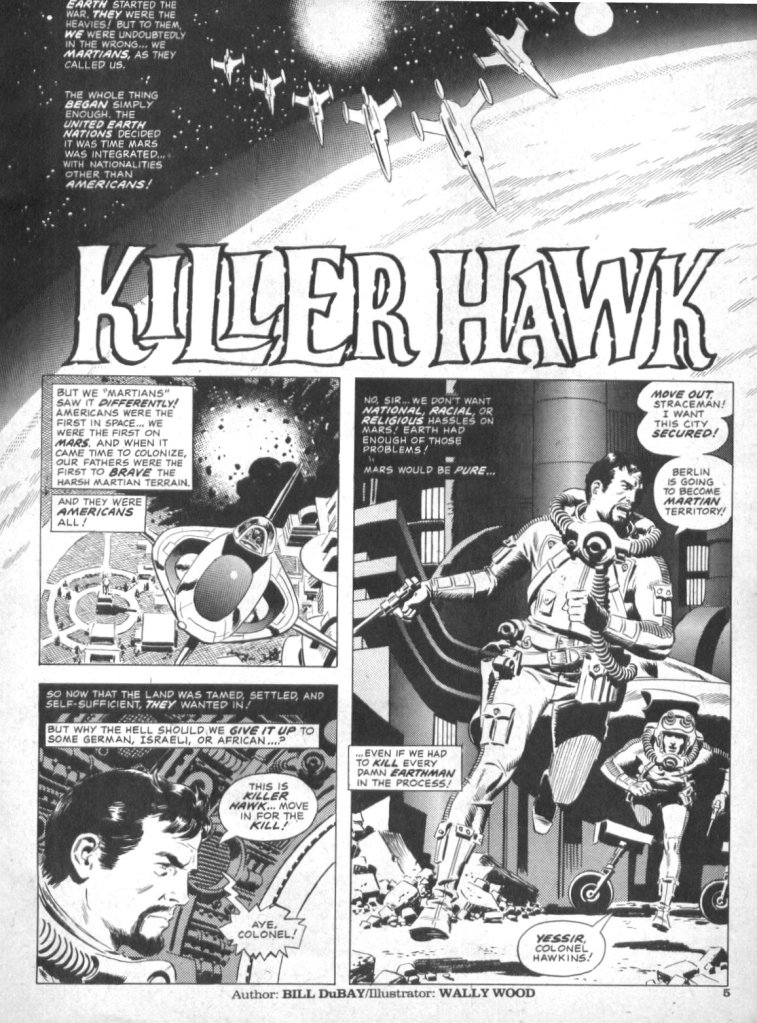
The stories in the issue were all reprints pulled from earlier Warren publications. The opener came from an issue of EERIE from 1974 and was written by Bill Dubay. It concerned a cyborg exterminator from Earth who infiltrated the military of an independent colony on Mars in order to assassinate its President and take his place, delivering it into the hands of the Earth government. This he does–only to find himself being destroyed by his creators upon the completion of his mission, as they fear that he’s learned ambition from posing as the Martian President. The artwork by Wood is the best thing about this tale, as was the case more often than not in this book. The story was overwrought and lurched from incident to incident almost haphazardly.
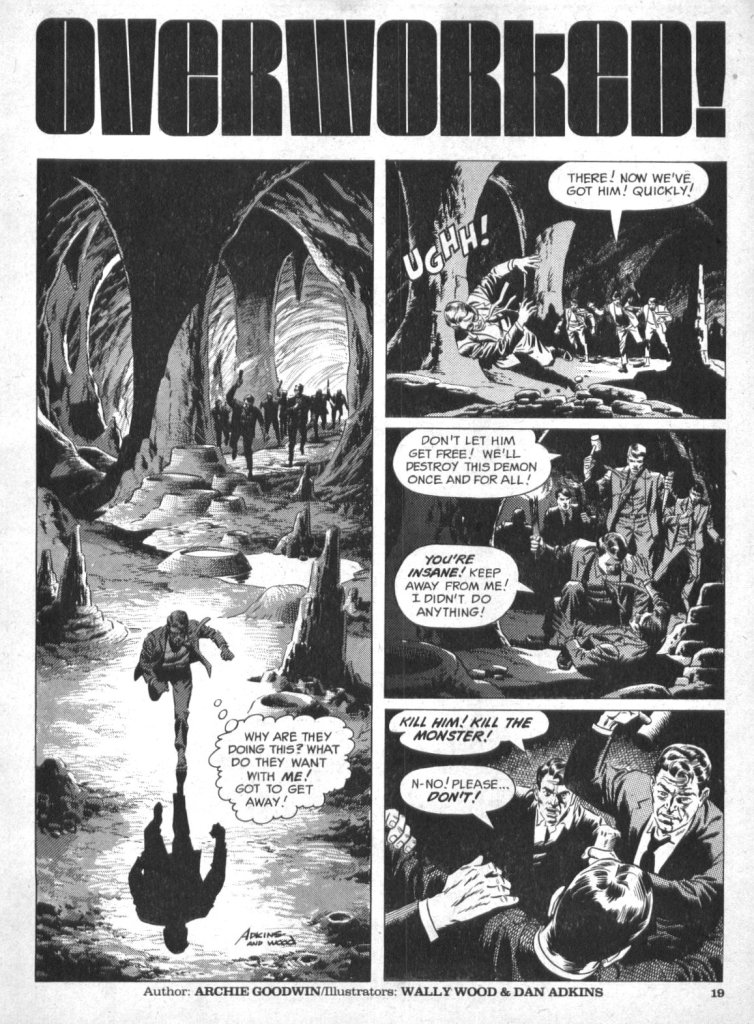
The next story was better, and no wonder: it was written by Archie Goodwin, one of the most accomplished writers and editors in the business. It had originally been prepared for an issue of CREEPY in 1966, and it concerns an overworked comic book artist who specializes in weird horror stories who begins to develop a psychotic breakdown, imagining that his stories are coming to life to hunt him. At the tale’s end, his editors find him trapped within the final page of artwork that he had been drawing. The whole thing has a bit of an EC flair to it, which isn’t surprising given how big a fan of those books Goodwin had been.
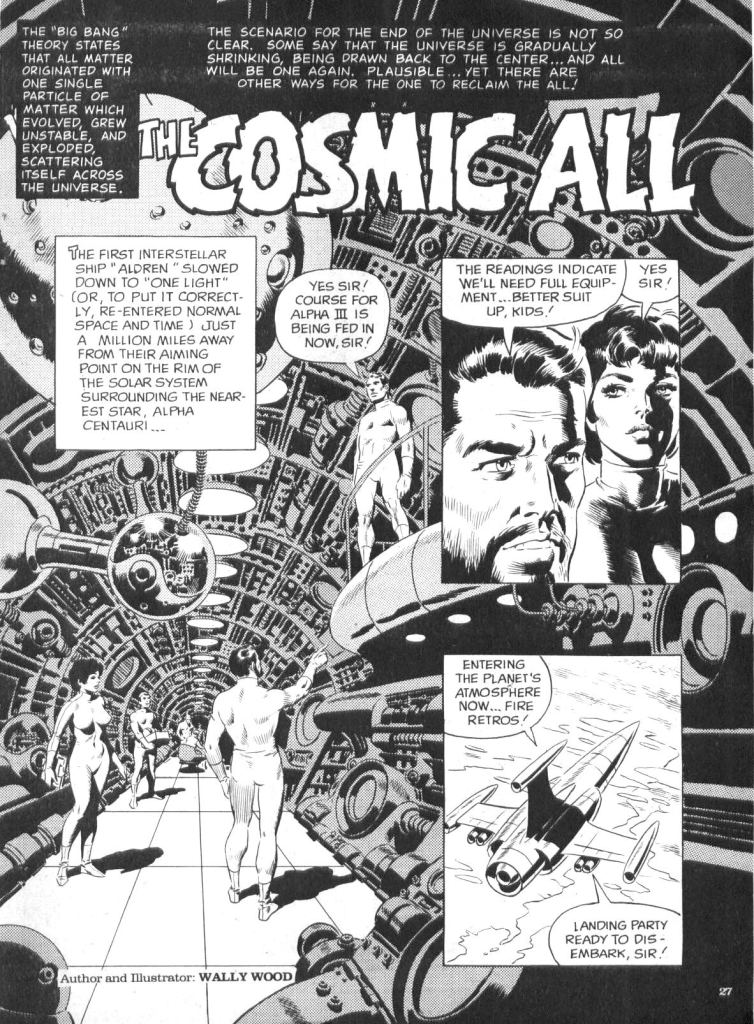
The next story came from a later issue of CREEPY from 1971 and was written by Wood himself. It’s about a team of interstellar explorers who reach a far-off solar system, only to discover that all life on its various planets has been consumed by a shapeless goo. They do manage to find one enclave of remaining humanlike life, but that outpost is wiped out and they’re forced to flee for their lives. They escape and head back towards Earth–only to realize that tis was exactly what the goo wanted, to be able to spread to another solar system. In the final panels, the two remaining astronauts melt away, leaving only their skeletons behind. But it’s all parsed as a good thing, the goo wanting to eliminate strife and disharmony and to bring peace and unity to the universe–which is was now ready to continue to do.
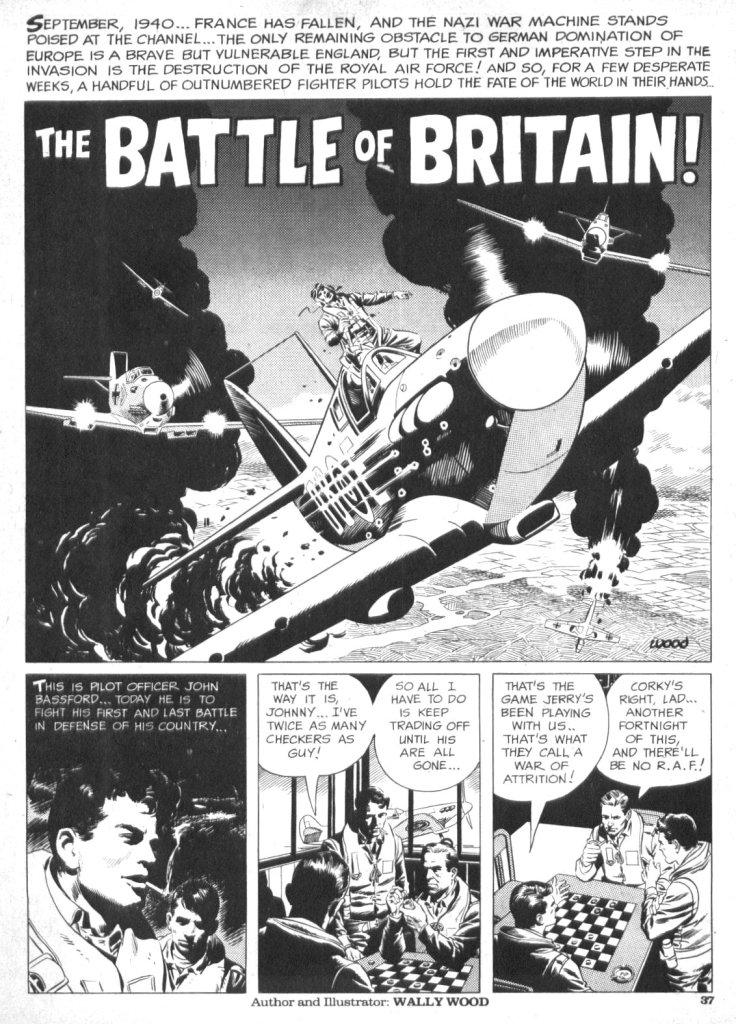
The next story was also written by Wood, but it wasn’t a horror or science fiction story at all. Rather, it was culled from the short-lived BLAZING COMBAT, a very fine war magazine that was put out of business when it dared to tell antiwar stories during the Vietnam conflict. It’s a very Harvey Kurtzman-style war story of seven pages in length, about aviators during the Battle of Britain, and how the rules of engagement in a checkers match don’t equate to the realities of wartime. Dan Adkins apparently ghost-penciled this story, uncredited, though once Wood was done with it, it all looked like his work regardless. It first saw print in 1966.
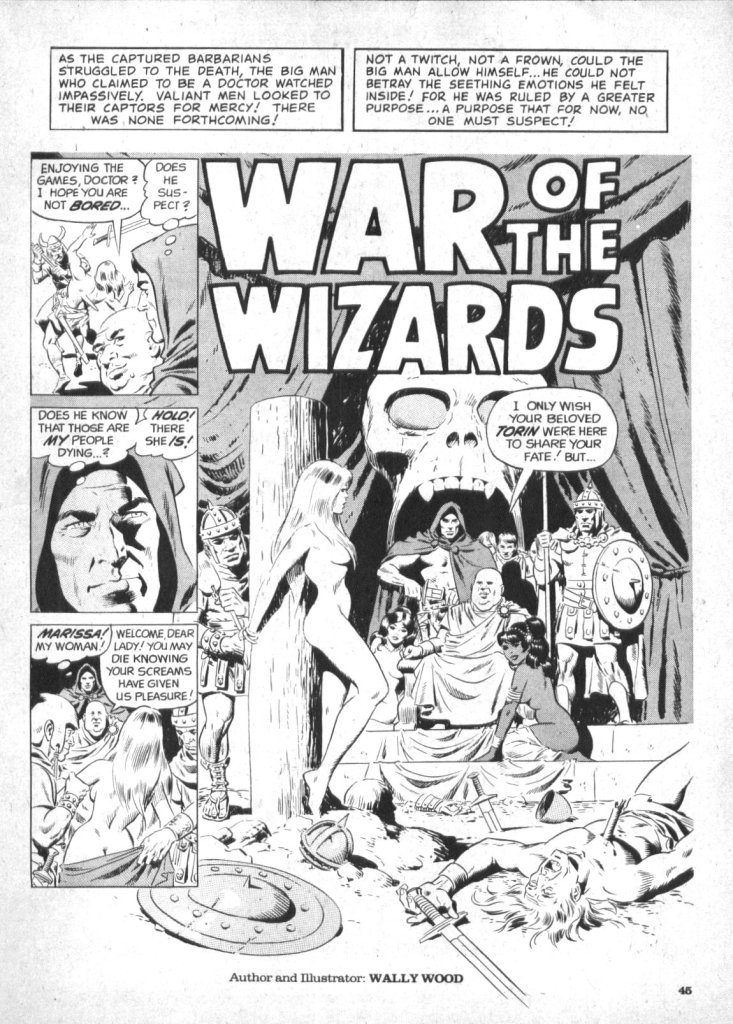
The next story up came from the pages of VAMPIRELLA in 1971 and was a sword-and-sorcery fantasy affair, a genre that Wood always seemed interested in. After escaping from certain death, the barbarian Torin and his lady Marissa are recruited by the wizard Thanos to eliminate his rival Aros. (Wally apparently took the same psychology courses as Jim Starlin.) Thanos arms them with a gem that will neutralize Aros’ magic, but it turns out that Aros has a similar lodestone that could be used to destroy Thanos’s floating citadel if it could be conveyed there. Torin catapults the lodestone into the citadel, bringing it to ground, then turns and slays Aros. It turns out that far from just being a barbarian, he’s also a wizard himself, one in service to the gods of chaos. The point here seems to be that there isn’t any difference between white magic and black magic, but it feels a bit like a reveal for the sake of a reveal. Wood wrote this one himself as well.
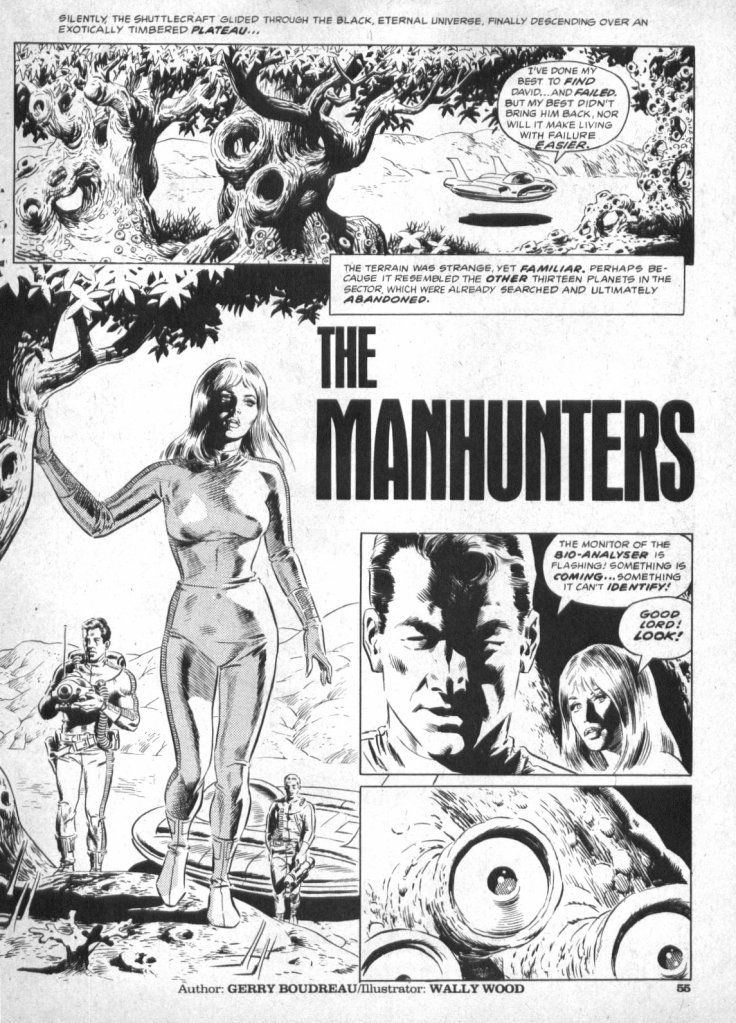
The last story in the issue was also from EERIE and published in 1974. it was written in an overwrought fashion by Gerry Bordreau, and it concerned a woman who traveled the stars looking for her missing husband. She and her party land on an unassuming planetoid, only to be picked off one by one by a horrible, monstrous bloblike creature. Turns out, though, that this creature is actually the woman’s husband, his brain having been transplanted into an alien body after his own form was horribly shattered in a crash-landing. Ultimately, the woman finds that she still has feelings for her husband despite his unlikely metamorphosis, and so the two head off together, arm-in-tentacle.
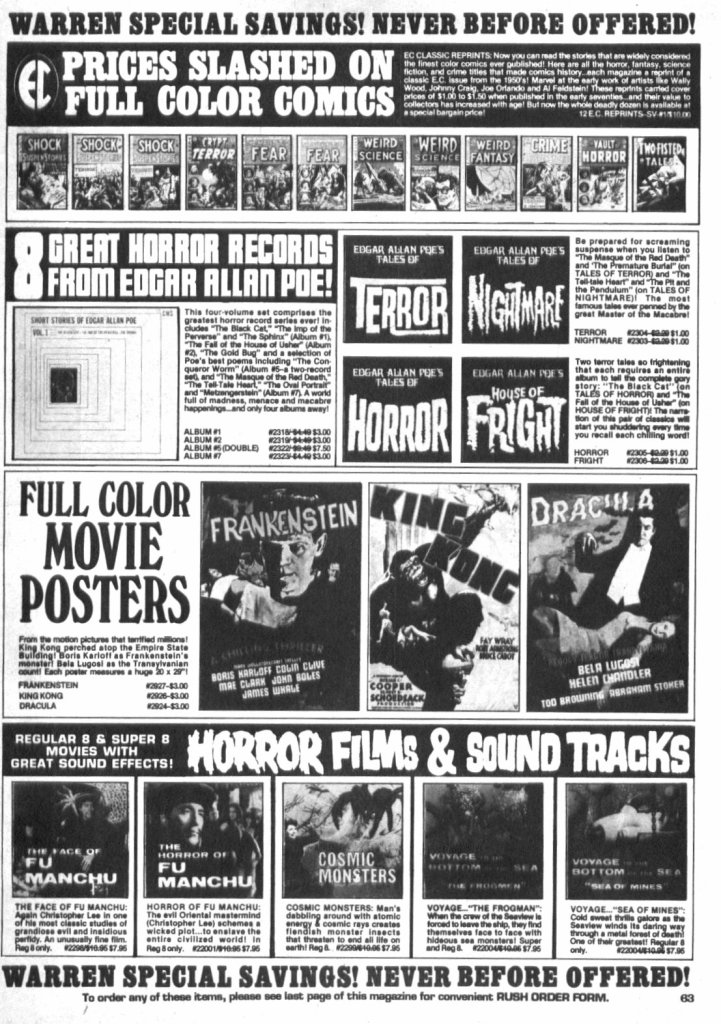
Warren’s magazines were also full of lurid advertisements for a wide spectrum of genre merchandise available for mail order from his Captain Company subsidiary. This included a full slate of back issues as well as film clips, models, records, toys and pretty much everything under the sun. In a period when this stuff was still relatively difficult to find, it must have been a godsend to monster-minded kids to be able to have access to it all. I never took the plunge and ordered anything from Captain Company, though. My supplier of choice for this sort of thing had been Superhero Merchandise, the outfit that became Heroes World.
 The Tom Brevoort Experience
Like you I was never a fan of Warren’s black and white titles or anybody else’s. Why buy a black and white book when I could get one in color and usually cheaper? But I did dip my toe in the Warren pool from time to time. Did buy a few Vampirella books but looking at a half-naked woman in boring stories didn’t interest me. Also all of Warren’s books seemed to be almost half advertisements and the other half stories and such.
However, I did start reading their reprint of the Spirit stories, my first real exposure to the character. And I became a Rook fan.
But yeah, all that wasted space on ads instead of stories really bugged me.
LikeLike
Only so many “legendary artists” in comics, especially the US market. Wally Wood more than qualifies, anywhere. That stark and sometimes subtle light and shadow.. Emoting faces abd figures. Fantastic yet believable and naturalistic backgrounds.
Sad end. But who’s isn’t? Just varying degrees, like shades of gray. In my mind I hope he was friends with Al Williamson. I admire similar visual greatness in their work.
LikeLike
Nice write-up on the individual stories.
I’m not sure Jim Warren himself was involved with putting together this issue and others from his company at this point in time. He’d stepped away from the day-to-day operations by the 1980s, and left staffers to handle things. They ran the company into the ground.
And there’s this bit of fan lore:
“BLAZING COMBAT, a very fine war magazine that was put out of business when it dared to tell antiwar stories during the Vietnam conflict.”
There is no evidence of this. While many retailers refused to rack the second issue, no one has ever gone on the record as to why, and Warren has admitted his distributors never told him anything. There was a jumping to conclusions that a story sympathetic to a Vietnamese character was the reason, but Warren admitted no one ever told him this. The most likely reason was the Frank Frazetta cover image, which was particularly gruesome. The central action showed a man being impaled on a rifle bayonet, and the foreground featured a soldier bleeding out from a gunshot wound to the head. It’s not the kind of thing most retailers would be happy about displaying even now.
LikeLiked by 1 person
Since that Nebres cover features the lead character from that first story, it seems that it must have been commissioned specifically for this issue. I guess they didn’t have anyone on speed-dial who could do an effective Wood pastiche (not that there were many), or they didn’t have the time to get someone more appropriate.
LikeLiked by 2 people
Woody feels like the ultimate cautionary tale in an industry that has tragically seen too many great, talented freelancers struggle financially & die too young. As much as I, as a reader, love the medium of comic books, I greatly dislike the industry for having done a disservice to so many of the people who have worked within it. I guess that the lesson one can find in Woody’s death is that, if you are going to be a freelancer in American comic books, then it’s best to try to develop a healthy work-life balance.
Too bad Warren could not find a piece by Woody to use as the cover. Still, I’ve always found Rudy Nebres to be a really great, underrated artist, and he does a nice job here.
LikeLike