

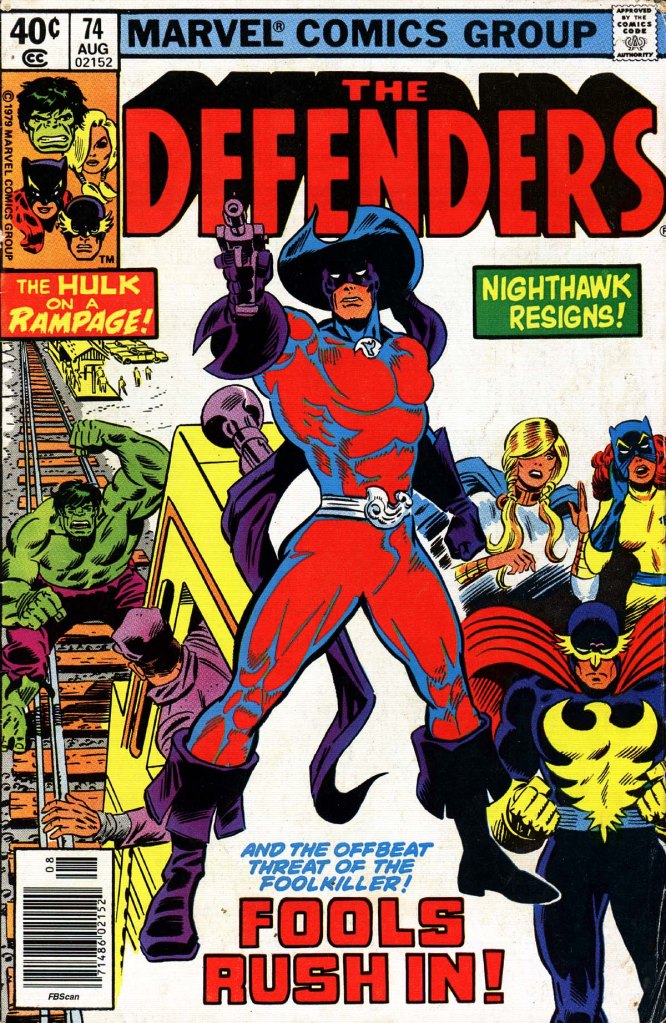
Another issue of DEFENDERS came out, and this one was a bit more to my liking. It was Earthbound, for one, and it introduced me to Steve Gerber’s creation the Foolkiller. I wasn’t familiar with the character prior to this–I hadn’t much read MAN-THING or similar monster/horror titles. But I immediately understood his shtick, and he looked like a costumed super-villain, which was all i asked for. I don’t know why the decision was made to color hold portions of his figure in blue on this cover, but it certainly did make it stand out, even though it looks to my eye to be a misprint. That red color of his bodysuit doesn’t match his established attire either, nor what he wears in the book, so I assume that somebody figured that he’d stand out better here in primary colors. It grabbed my attention, so it worked.
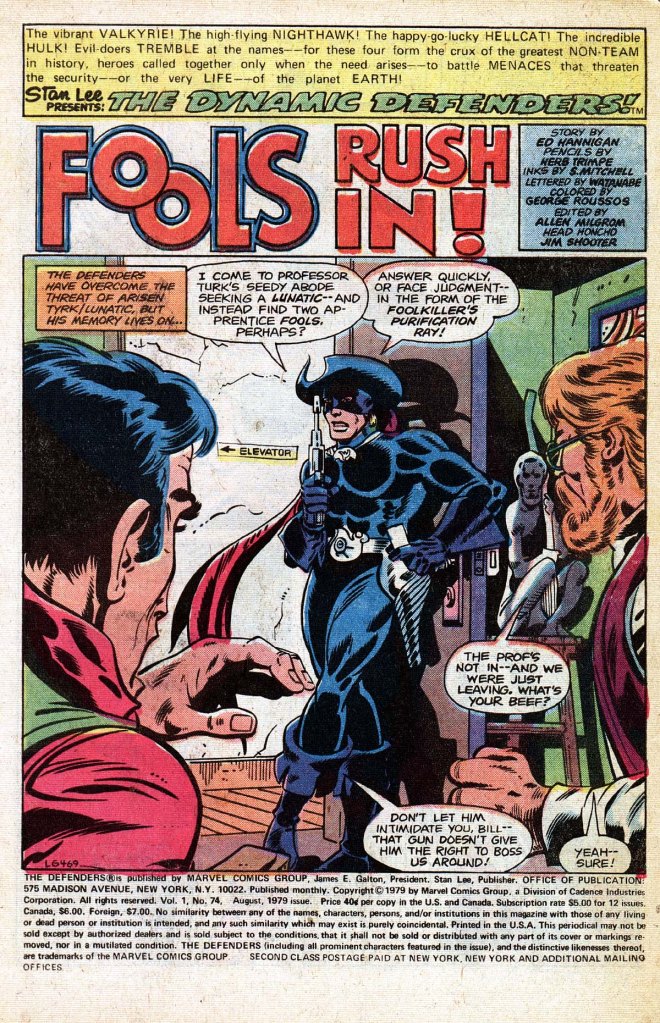
Ever since Steve Gerber had taken over DEFENDERS a few years earlier, his trademark zaniness and bizarro approach had become the default setting for DEFENDERS. As opposed to the first year or so of the title’s existence, when it was just a typical Marvel super-team title with an eclectic cast, under Gerber the stories got aggressively weird. They were at once more unlikely and absurd and yet also had more direct meaning than the typical adventures then being published. So it’s no surprise that those that followed after him tried to continue things on in his spirit. The flaw in this approach was that nobody else was Steve Gerber. Nobody else had his cracked viewpoint on the world or his particular finesse for satire and commentary. As a result, DEFENDERS became a title that was simply weird for the sake of being weird. This was one of the factors, I think, which kept me from embracing it, though I continued to purchase the book month after month regardless. I was that kind of stupid comic book reader.
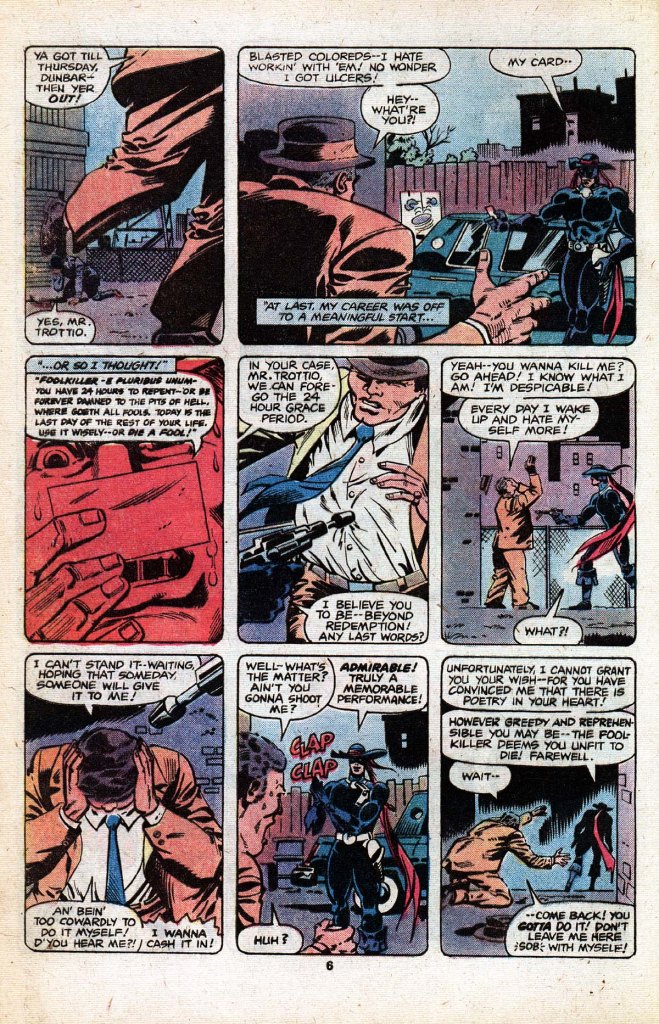
New DEFENDERS scribe Ed Hannigan was no exception to the Gerber influence, and so he proceeded to bring in Gerber characters one after another in an attempt to tap into that author’s personal zeitgeist, to diminishing returns. All of which brings us around to the Foolkiller, a vigilante killer dedicated to wiping out those who do not live an artistic or poetic life. He was a bit of a strange concept, one that Gerber revisited twice with two separate individuals behind the mask, altering and widening the parameters of the second’s crusade to avoid the limitations of the first’s. On the surface, he’s a decent sort of a foe for the Defenders. However, Hannigan doesn’t really have a whole lot to say about society through the mouthpiece of the Foolkiller–he’s just a weird fanatic creating a problem for the Defenders to cope with. Accordingly, this two-parter is a bit flat and stale.
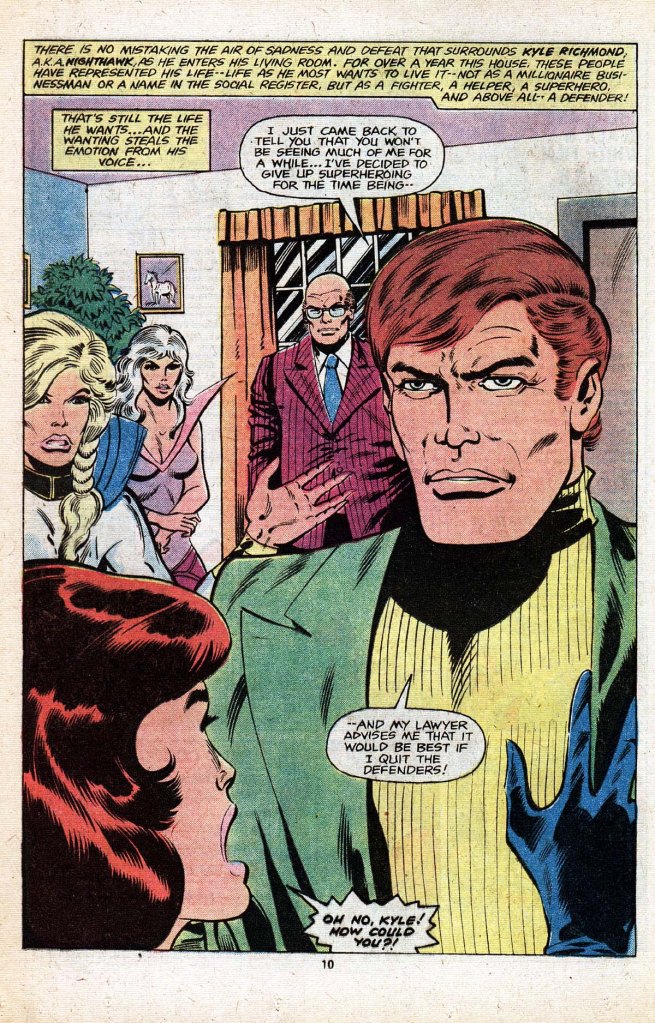
The issue opens with the Foolkiller appearing in the doorway of Professor Turk’s college office, seeking his alter ego Lunatik. Instead, he finds Dollar Bill, a recurring cast member, who hears out Foolkiller’s story and suggests that maybe what he ought to do is to join the Non-Team. And there’s about to be a vacancy. Cutting over to the Long Island Riding Academy that serves as the non-team’s headquarters, we and they are startled to learn that Kyle Richmond, formerly Nighthawk, is giving up his wings. He’s under investigation for his business dealings and given the scrutiny, his lawyers have advised him that he ought to give up his vigilante activities. But he tells his friends that they can keep using the Riding Academy as their hangout if they want to. I don’t know that Kyle’s pronouncement merited a splash page as seen above, though–it’s a pretty dull image to devote an entire page to. Jack Kirby could have made this sort of portrait shot work, but artist Herb Trimpe simply isn’t in his league in this arena.
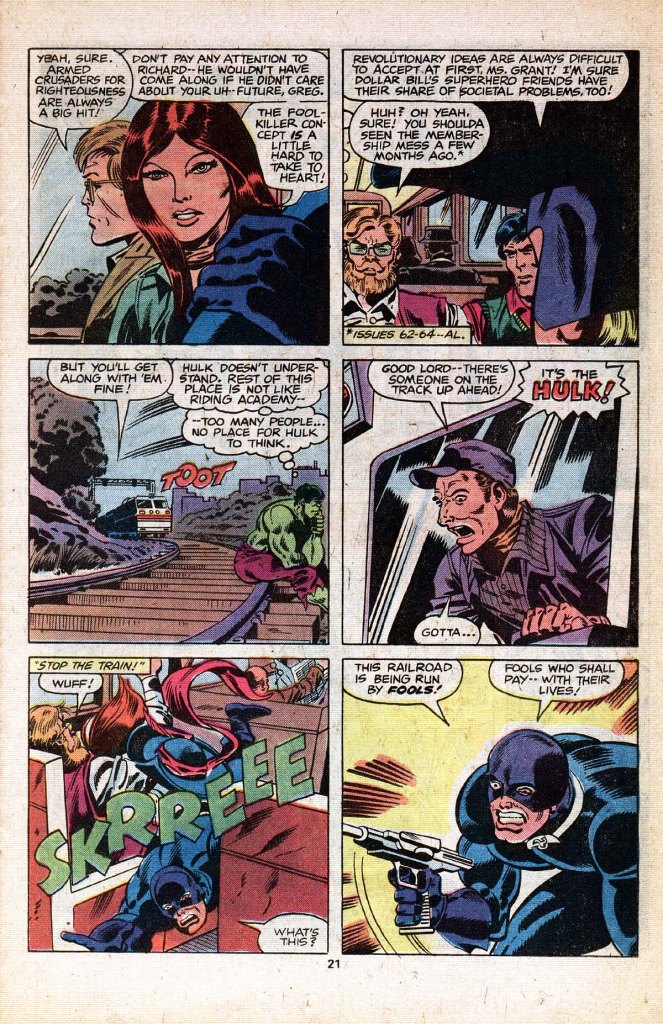
But this is a Marvel super hero comic book, and that means that some action is required before too long. And it takes an unlikely and coincidental form. As Dollar Bill and the Foolkiller–accompanied by Gerber’s other creation Richard Rory for no particular reason–take the train out towards the Riding Academy so Bill can introduce Foolkiller to the Defenders, the train comes to an abrupt stop–it turns out that the Hulk just happens to be sitting on the tracks brooding. The sudden stop jostles Foolkiller’s hat from his head, causing him to get uptight and want to kill the fool responsible. But drawing down on the Hulk would be a suicidal idea, and so Bill is able to calm him down and get him to take his seat once more.
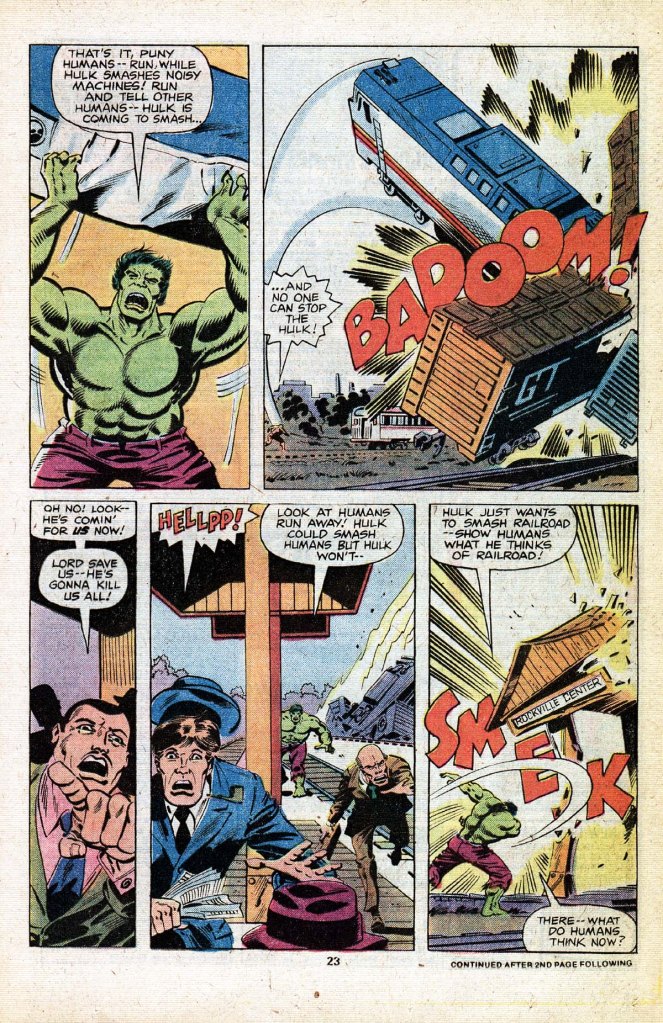
The problem is that the Hulk’s reverie has been interrupted by the arrival and sudden stop of the train, and he’s not happy about it. He picks up a nearby boxcar to throw at the train before thinking the better of it. But he does show off his anger by demolishing the other track and a nearby train station–all to applause of the passengers on the train, who have all had horror stories about commuting on the line. Confused and unsatisfied at the response to his actions, the Hulk decides that this is a good time to exit this particular comic book, and he leaps away. But this whole bit of nonsense adequately checks off the action box for the issue, and so now the story can proceed.
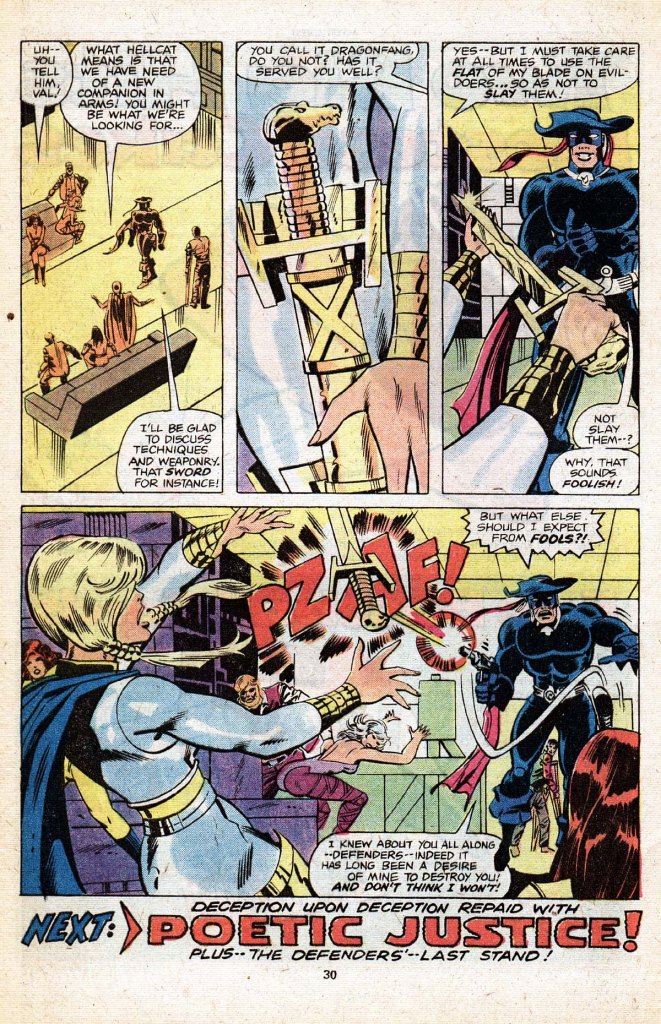
Eventually, the travelers reach the Riding Academy, where Bill hopes that the Defenders will be able to disarm and neutralize the crazy person in his midst, Foolkiller. But it turns out that Dollar Bill has outsmarted himself. See, Foolkiller is familiar with the Defenders–possibly from the very documentary that Bill himself had filmed and edited–and he considers them all fools that need to be put down. So drawing his disintegrator pistol, he fires off a first shot at Valkyrie that seems certain to set off a pitched battle. But any fighting will go down next time, because this is where this issue is To Be Continued. I can’t say that I found this issue especially satisfying, for all that it was more engaging than the previous Tunnelworld epic. Not a whole lot happens, and a bunch of the page count is devoted to a diversion. The whole thing is kind of simple-minded and childish somehow, difficult to take seriously. It’s Gerber absurdity without the intelligence behind it, which made it a vapid package.
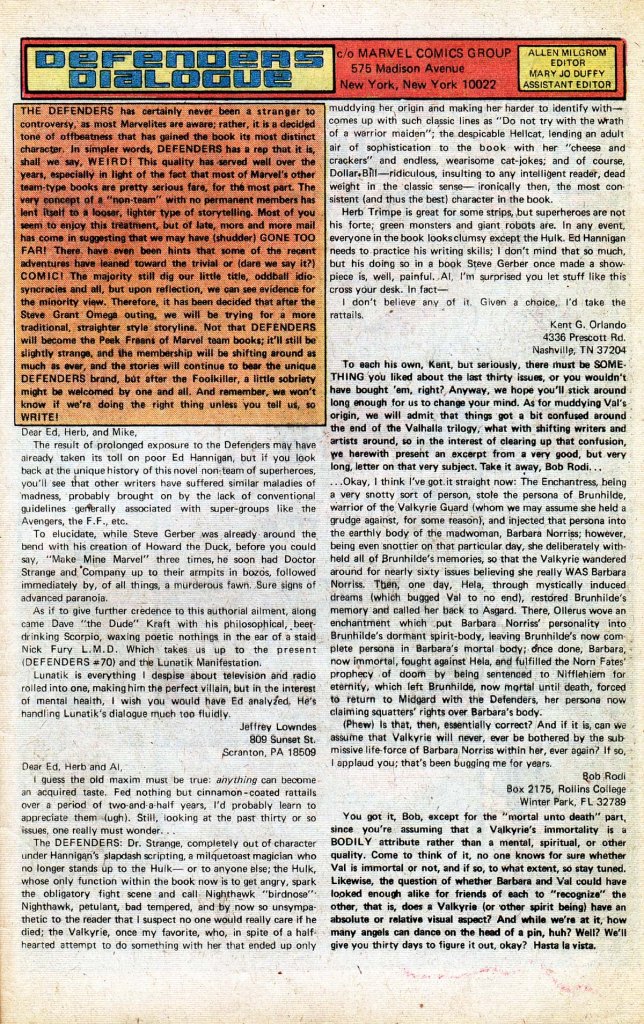
Apparently, enough readers had been writing in about the strangeness of the series (and, I suspect, new Editor in Chief Jim Shooter may have expressed some discontent with the direction of the book) that editors Al Milgrom and Jo Duffy felt compelled to print a message on the letters page guaranteeing that all of this craziness will come to an end in a few short issues’ time, and we’ll be back to having regulation Marvel stories from there on in. They made this attempt, but it didn’t really pan out that way. While the Gerber influence would recede, DEFENDERS remained an off-kilter series all the way to the end of its run some seventy-plus issues down the line. This Defenders Dialogue letters page also included a note from future writer Bob Rodi, a regular contributor especially to DC editor Julie Schwartz’s letter pages. Here, he breaks down what he thinks the deal is with Valkyrie following recent revelations and adjustments made to the character.
 The Tom Brevoort Experience
Just knee deep in the big muddy of what I like to call the Kyle’s Kooky Quartet era of Defenders, with the book just staggering on the minimal power of being a second Hulk title during the TV show. That the title survived this to go another 78 issues remains astounding. Aside: The title might still be going if it hadn’t been cancelled to clear room for the New Universe titles.
LikeLike
Tha splash page with what appears to be robot Kyle quitting is sure something. I agree that Kirby did this sort of “still figure delivering a pronouncement” splash not infrequently… and pulled it off….though A) the scenery wouldn’t have been so ordinary/dull and B) someone would be wearing a really ornate hat.
I have a fondness for a lot of Trimpe’s work but I don’t think he was a great fit for The Defenders even though the Hulk was a member. His forte was giant monsters and wild machinery and not interpersonal team dynamics… I don’t think it helped that by the late 70’s his work had become very mannered compared to his work just 5 years previous. The stories weren’t great during this period to boot so I’m not sure how much the art is really to blame.
I wouldn’t have minded seeing somone like Tom Sutton or Frank Robbins. They were never fan favorites but they were really good at being weird and were never stiff.
LikeLike
You’re too kind to that splash page. Trimpe draws Kyle like Lurch.
LikeLiked by 3 people
TRIVIA( Wikipedia ): FOOLKILLER 1 — His real name was not given until a later flashback in The Amazing Spider-Man#225, which stated that it was Ross G. Everbest ( a variant of Gerber’s Reg Everbest pseudonym with his middle name attached to it ). The original Foolkiller was more of a reactionary crusader than subsequent versions of the character. Upset by anti-Vietnam War protests and counterculture movements, he decided that sinners, dissidents, and criminals alike were “fools” who must be eliminated, and that he had been chosen by God to do so. Gerber, Mary Skrenes and Jim Mooney created Greg Salinger, the second Foolkiller [ Omega the Unknown#9 ( plus a one-panel cameo in #8, which was written by Roger Stern and drawn by Lee Elias ). Salinger defined “fools” as those guilty of materialism and mediocrity, or anyone who lacked “a poetic nature”. Kurt Gerhardt the third Foolkiller initially directed his vigilante campaign at violent criminals, garnering some praise from the public, but his anger at abuse and neglect in general led him to kill drug-addicted negligent mothers and even their ( albeit violent ) children in a series of escalating massacres. His ever-broader definition of “fools” who deserved death broadened to include those guilty of what Gerhardt believed to be rank hypocrisy or stupidity.
LikeLiked by 1 person
I began collecting the Defenders regularly with issue 4 and loved both Englehart’s run, but, really, it was Gerber’s run that really grabbed me. His writing really stood out to my adolescent self and made me think about the world and real life absurdities as reflected in his stories, even if set in fictional world full of bizarre characters. Conway’s brief run seemed a retrenchment to standard super-team fare but I did like Kraft’s Scorpio epic, After that, however, the mag floundered. I kept collecting it but it became much less of a must-read for me. Both the writing and art became ever less appealing to me and I was reading the stories without really absorbing them, more out of habit than genuine enjoyment. I know I read this particular story but no memory of the contents. I think I finally quit collecting a bit after the 100th issue so I missed the switch to a quasi original X-Men reunion (well at least 3/5th of them). Yeah, Gerber was one of a kind, standing out because, as far as I could tell, he really couldn’t help but allow his at once outraged and bemused vision of the world permeate his work and although I couldn’t really have articulated why 50 years ago, that really resonated with me.
Ed Hannigan, on the other hand … well, he may have tried his best but it just didn’t rise to the same level. As to Trimpe’s art … I got used to it on the Hulk –hey, he was the Hulk artist when I started collecting regularly, just as George Tuska was the Iron Man artist, etc. I got his work on that other big, green monster — Godzilla – while that lasted. But on regular super-hero titles, Trimpe’s art most often struck me as jarringly out of place, somehow wrong, and this issue was no exception. And his style seemed to get worse in the latter part of the 1970s. To be honest, admittedly, until reading this, I had long forgotten that Trimpe had drawn any issues of the Defenders. And reading this posting not only reminded me that he had also reminded me of why I had largely forgotten it – well, aside from that cover, which was rather striking for that weirdly colored version of the Foolkiller.
LikeLike
That cover is a mess of elements that don’t hold together. If I had to bet… the Foolkiller figure looks like Bob Hall’s work. The background stuff by Trimpe is just plain awkward… funny that the train whistle would come out of FK’s bum if continued inside his sash.
LikeLiked by 1 person
I think it’s all Trimpe pencils, but Al Milgrom, editor/inker, has tweaked it some in the inks.
It’s also probably from someone’s cover rough, not Trimpe on his own, and looking at it I’d guess the cover rough was Al again.
LikeLiked by 1 person
Considering that inside, the Foolkiller’s bodysuit is black with blue highlands, and on the cover it’s red with light-blue highlights, I wouldn’t be surprised if it had been intended to be a dark blue with light blue highlights, and something just went awry.
On the other hand, I also wouldn’t be surprised if it was an experiment, hoping to make the cover zingier. With the red logo above and the red caption below, it does pull that figure forward. But I think it’d be just as strong in dark blue or black…
LikeLike
I had a soft spot for the Defenders so I stuck with it through Hannigan’s unintentional attempt to get it canceled.
LikeLike
The Hulk is 100% correct regarding the Long Island Failroad. They (MTA) have one job to do and they fail spectacularly at it daily. The taxpayers of course take the brunt of their criminal misdeeds while their Exec’s receive 7 and 8 figure annual bonus’s and the whiny do nothing conductors receive per year retirement packages that are nearly 3x the USA median income.
LikeLike