

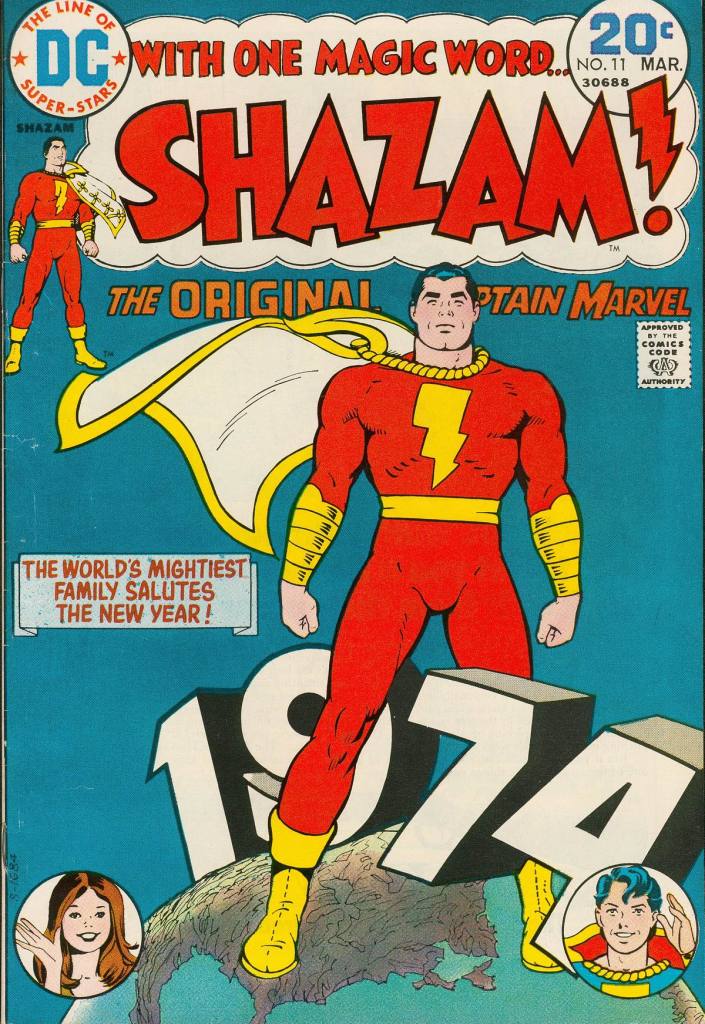
I’m pretty certain that I had owned a copy of SHAZAM #11 at some point. I believe I got it in one of those 3-Bags that could be found in supermarkets, toy stores and department stores, with three comics of recent vintage for a barely-discounted price. I’m also sure that I traded this comic away for something i wanted more, likely with my next door neighbor Johnny Rantinella, who would sometimes get comic books as well. Either way, I came back across it in my read-through of the entire run of SHAZAM courtesy of my friend from school Donald Sims, who loaned me the entire thing one day.
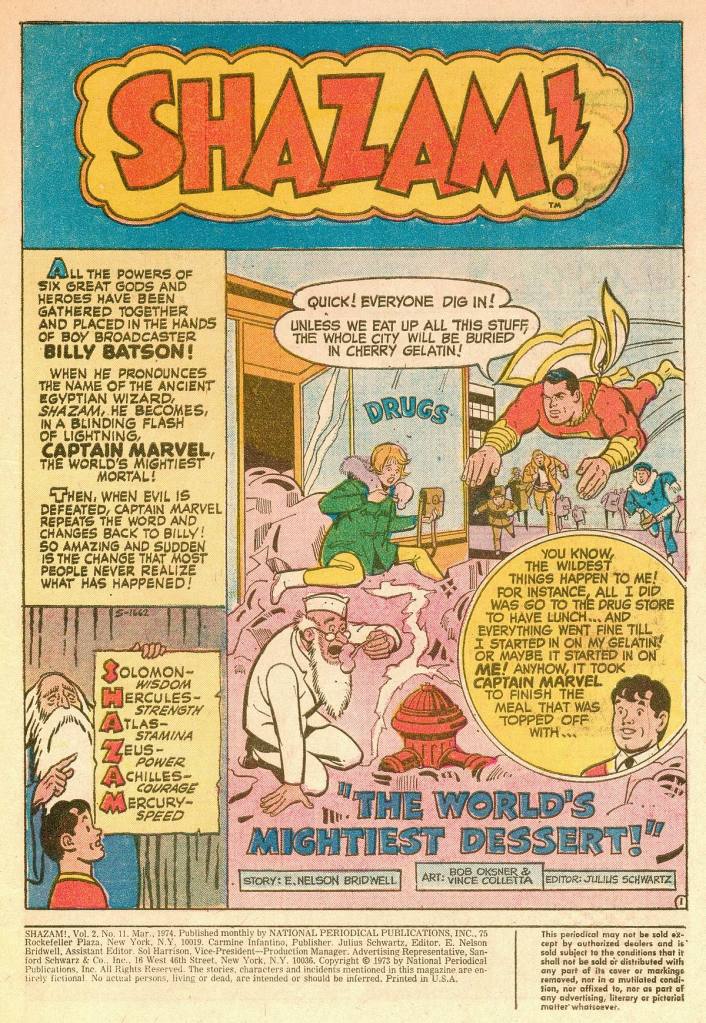
This was the first issue to be produced without any artwork or input from the character’s co-creator C.C. Beck. Beck had grown increasingly unhappy with DC’s handling of Captain Marvel and what he saw as the stupid stories that were being given to him to draw. The stories in this issue were among those he turned back to editor Julie Schwartz, which wrote an end to his involvement with the feature. Beck did attempt to write and pitch a script of his own, but in typical form, Julie edited it severely, and Beck wanted nothing to do with the rewrite. So this is the first issue in the run that’s 100% the DC vision for what Captain Marvel and his world ought to be about. And it isn’t a bad issue, for all that the stories are both all a bit silly and underdeveloped given their short page lengths.
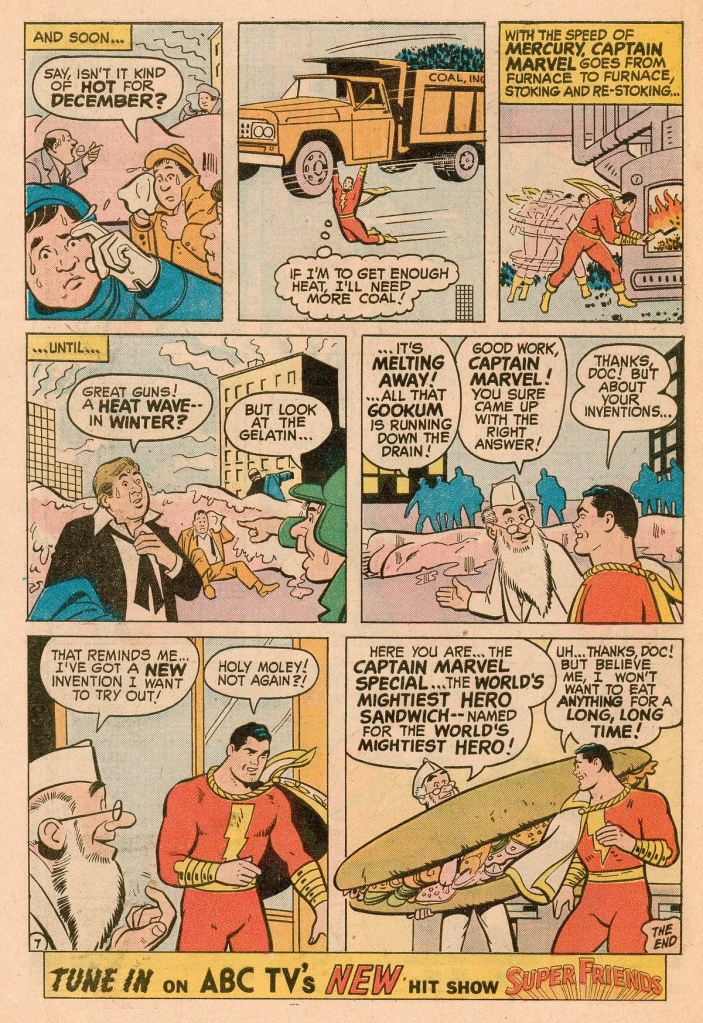
The opener is by E. Nelson Bridwell, who was a fan of the Captain from back in the day, and who over time would come to closest to capturing his essence from those days. it involves counterman Doc Quartz accidentally inventing a gelatin desert that grows uncontrollably, threatening to engulf the entire city. Even the World’s Mightiest Mortal doesn’t possess an appetite large enough to consume all of it, and while he brings in every passerby he can find to help, including some criminals, it just isn’t enough. In the end, though, Marvel realizes that he can melt the gelatin if he can increase the ambient temperature sufficiently, and he does so, eliminating the problem. Nelson drops in an oblique reference on this final page to the Gookum story from MAD #1 from the 1950s–he was a fan with a fiend’s recall for such details.
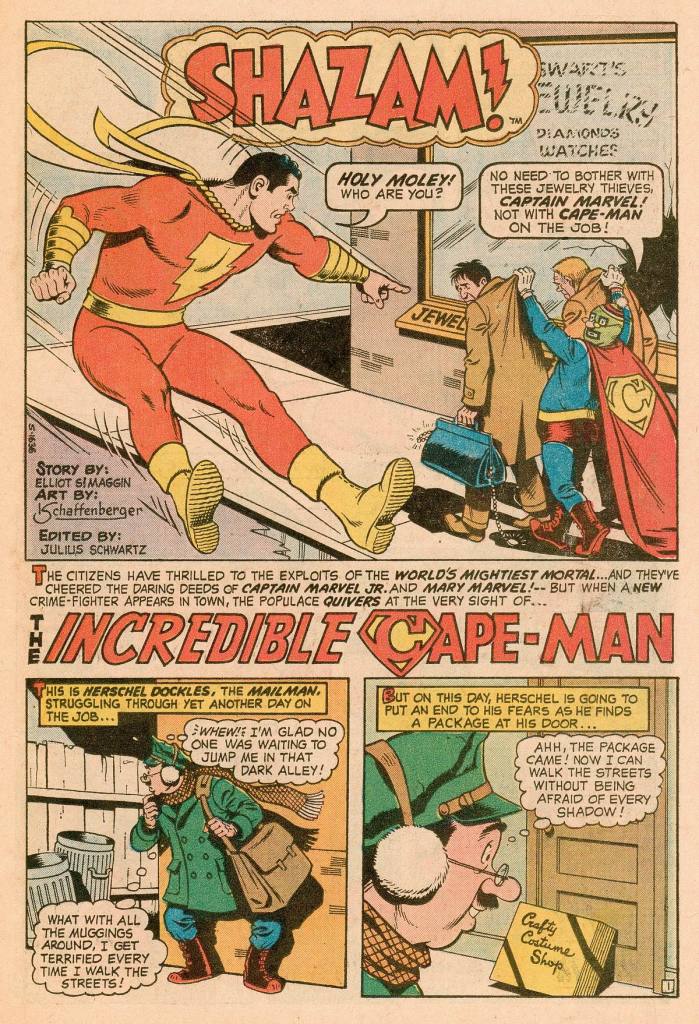
The second story in the issue was written by Elliot S! Maggin, a writer who was still in his early days with the company, for all that he was and would continue to be a favorite of editor Schwartz. But the real get here was that, after Beck turned this script down, it was handed off to artist Kurt Schaffenberger to illustrate. Schaffenberger had worked on Captain Marvel back in the very early 1950s, so he was at home with the character, and his charming, open style really suited the strip and its material. His pages somehow felt a bit more complete and lived in than most of the other work being done on the series up to this point.
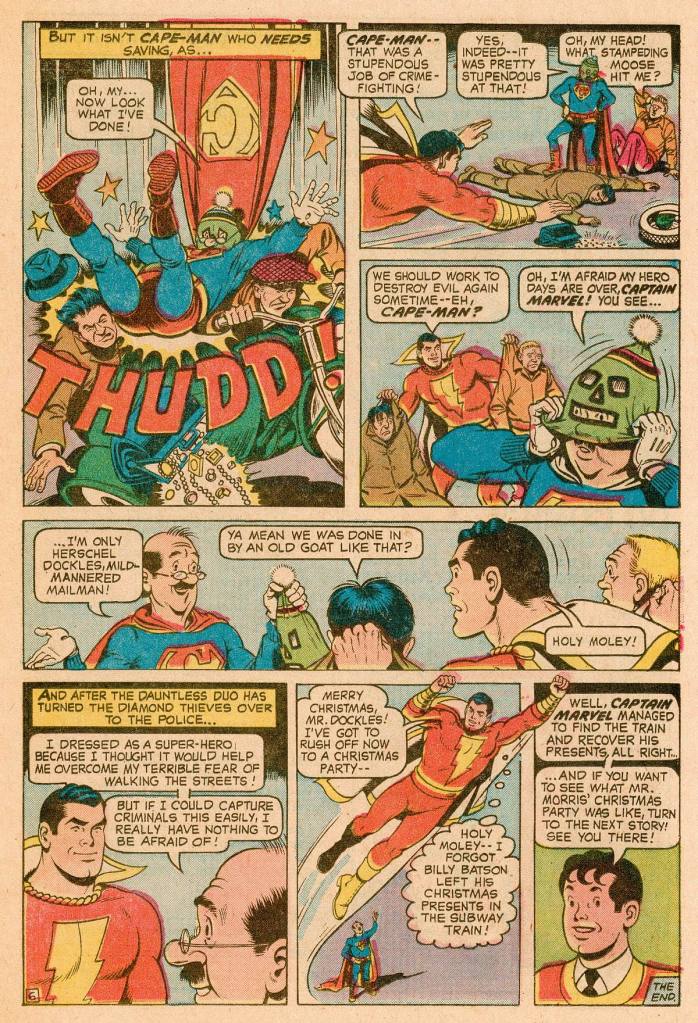
But it’s pretty difficult to argue with Beck’s assessment of the story, as it really is pretty stupid. It’s about a fearful mailman named Herschel Dockles who dons a ersatz Superman costume and a ski mask to feel more courageous as he makes his rounds, and who gets dragged into a situation with some jewel thieves and Captain Marvel, of course. By the end, despite the fact that he’s cowardly and hapless, Dockles does manage to be instrumental in capturing the crooks, and this gives him the courage to go back about his duties sans costume. It’s all wonderfully drawn, but really dumb stuff, and it has an undercurrent of dismissiveness towards the audience somehow. It feels like the writers aren’t really trying too hard because this sort of material is aimed at really young children. It’s written down.
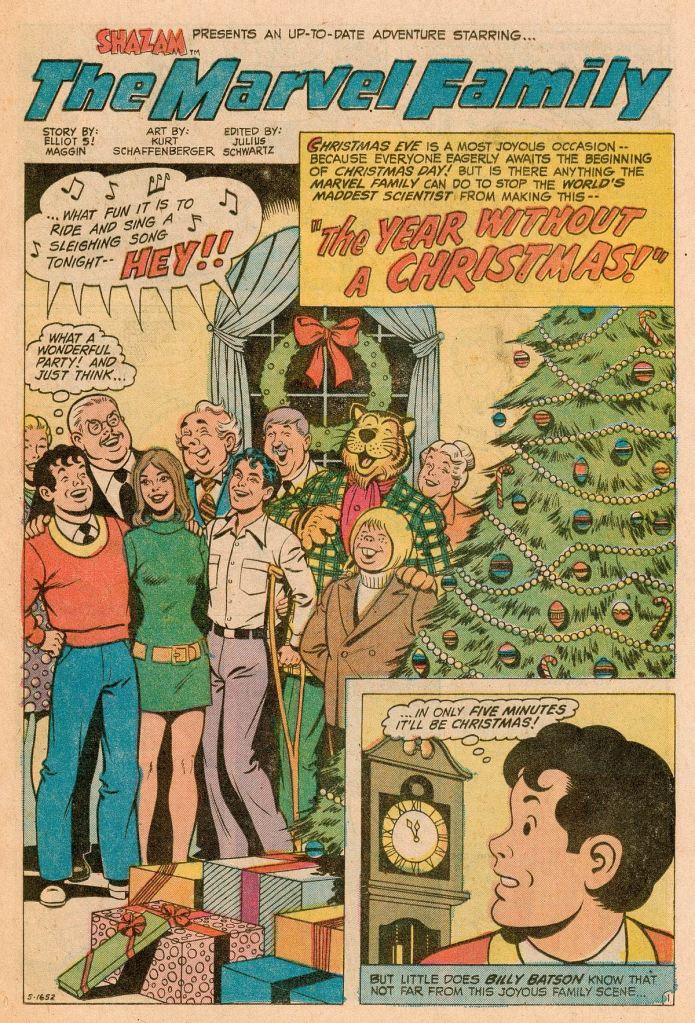
The last story in the issue puts Elliot together with Schaffenberger for a wrap-up to the year of Captain Marvel’s return, 1973. It’s the first all-new story to utilize the entire Marvel Family since the very first issue. But it, too, is pretty silly and underdeveloped. The story takes place on Christmas, with all of the strip’s characters having gathered to celebrate the holidays. But the Sivana Family hates Christmas, and so Dr. Sivana has developed a device that will speed time up, making Christmas pass in about ten minutes. The Marvel’s need to intercede to prevent everybody from losing their holiday.
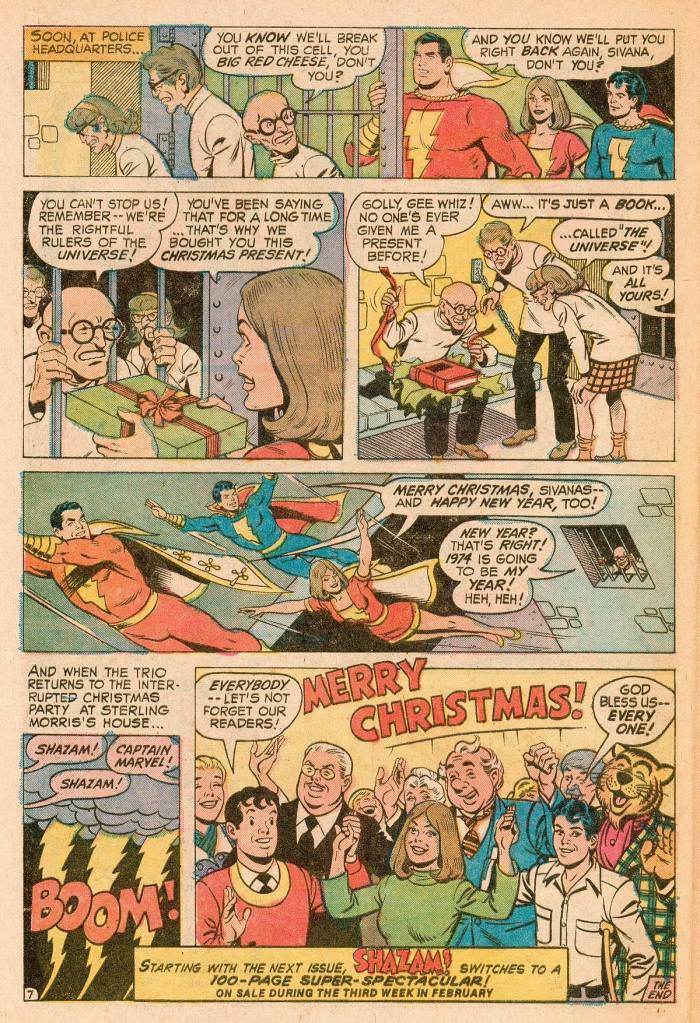
The Marvels take a moment out to rescue Santa Claus, who’s discombobulated in that he now has to make all of his deliveries in a scant ten minutes. But the heroes are able to track down the Sivanas, and even though the Cosmic clock they’ve built is meant to be Marvel-Proof, by combining their strength, Cap, Mary and Junior are able to pull the hands of time backwards, turning everything back to Christmas morning and restoring the holiday. And that’s about it! The final caption indicated that the next issue was going to be another 100-Page Super-Spectacular, which is news that would have thrilled me at the time of publication. But I already had that issue next up in my stack of borrowed books, so it was hardly news to me.
 The Tom Brevoort Experience
Bad guy invention or no… I’ll bet there’s a strong market for a Christmas time shortening machine.
LikeLike
Bobby the Ox! Unfortunately inked by Colletta again.
Still, it’s great cartooning under the inks, and then two Schaffenberger stories makes a nice art package, at least.
LikeLike
Good to see Kurt Schaffenberger inking his own pencils here. I always felt he was his own best inker, and it’s a bit unfortunate that during the Bronze Age he was paired up with other artists who were not necessarily a good match for him.
LikeLike