

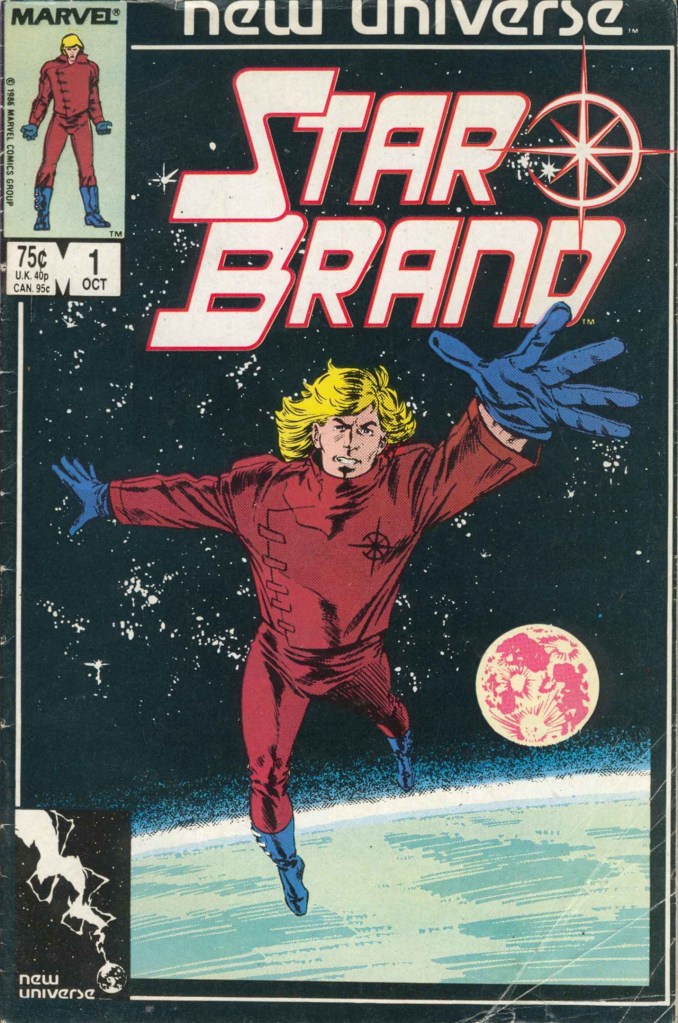
The eight New Universe titles rolled out two-a-week across a month’s worth of time, and I sampled all of them. The promotion around this initiative made it feel like a seminal event, and so I was determined not to miss the moment. Ultimately, I found myself disappointed with pretty much all of the launch titles, and there was only one series that I stuck with, though even that only lasted about five issues or so. STAR BRAND was clearly the flagship of the line and so was the first book out of the gate. And in retrospect, it was perhaps the strongest series launched as a part of the New Universe. But for all that, it wasn’t the book that I wound up following. I’d only gain a greater appreciation for STAR BRAND long after the fact, when I got to read the run as back issues during the time of my internship at Marvel. It’s a flawed venture, but a profoundly fascinating one, in that it drew so heavily from the life experiences of writer and Editor in Chief Jim Shooter that he and the main character, Ken Connell, seems somehow of a piece.
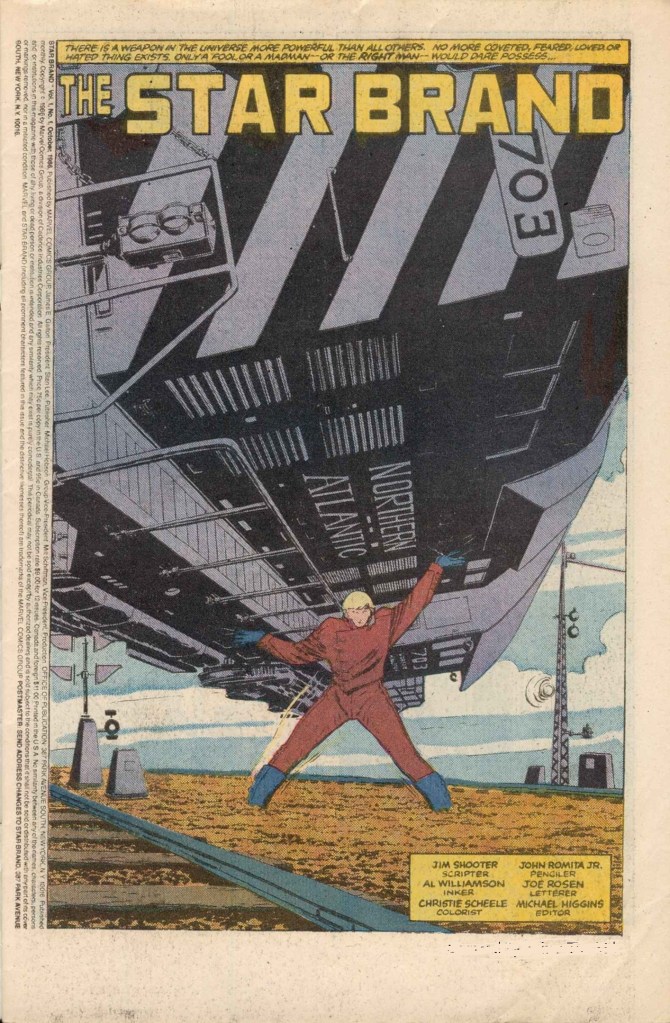
STAR BRAND was illustrated by John Romita Jr. and Al Williamson, and in later years Shooter would tell stories about how the two of them stepped up and volunteered to help him out by drawing his series, the budget for creators and promotional efforts for the line having been dramatically slashed. It’s a nice story, well-polished in how often it was retold, but my insider understanding from speaking to both artists was that the circumstances weren’t entirely that simple. John had been penciling UNCANNY X-MEN at the time, and was prevailed upon by Shooter to do STAR BRAND, which was described to him as being akin to “Marvel’s Superman.” Al Williamson, same thing. Shooter’s prediction was that the New Universe books were going to sell so well that they’d make thousands in sales incentives and live like kings. The fact that it was the company’s EIC telling them that was a powerful motivator for them to both get on board.
What makes STAR BRAND so fascinating is just how much of it draws from Shooter’s own life and background (Jim grew up in a poor family in a depressed steel town in Pennsylvania) and how unlikable the story makes its lead character Ken Connell. Ken is a self-interested mechanic from a blue collar world who’s good-hearted but selfish, prone to anger when under pressure and a bit limited in his dealings with other people, but ultimately trying to do the right thing, whatever that may be. The parallels between Connell and Shooter aren’t even hidden, they’re right out in the open. It’s another example of Jim’s attraction towards stories about ordinary people from humble backgrounds who gain enormous power and who want to use it for the common good but who are misunderstood and hounded and ultimately undone by those who don’t understand them. It’s a theme that Shooter would return to time and time again, and it clearly spoke to him on some primal level. But oddly, there doesn’t seem to be a lot of self-awareness in STAR BRAND. It’s as if Shooter is writing a version of his own life without actually being aware of it. It’s so weird, but completely mesmerizing as a result.
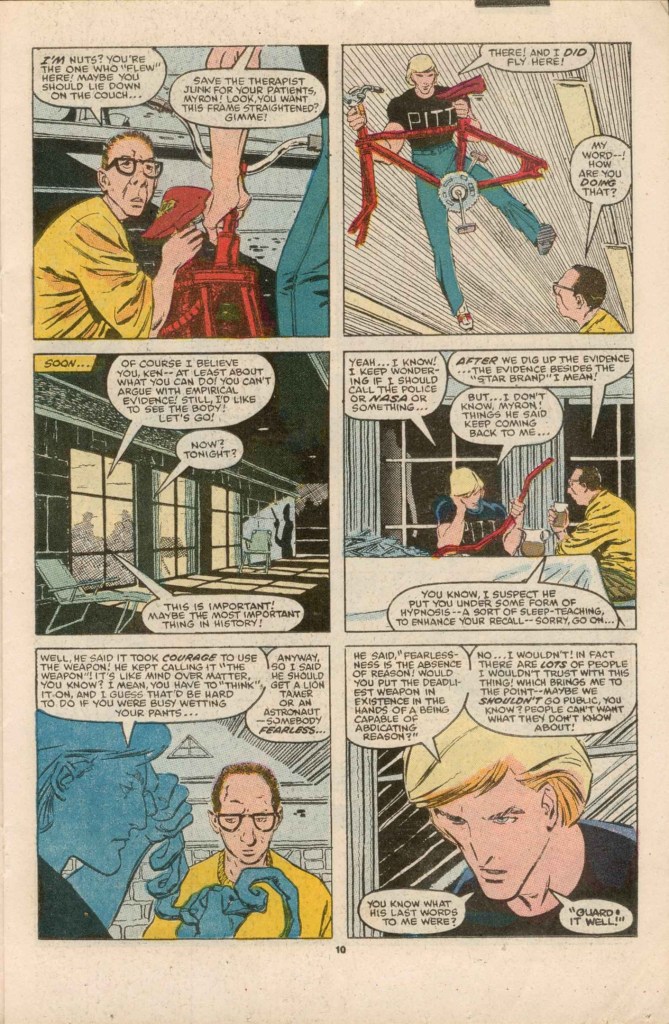
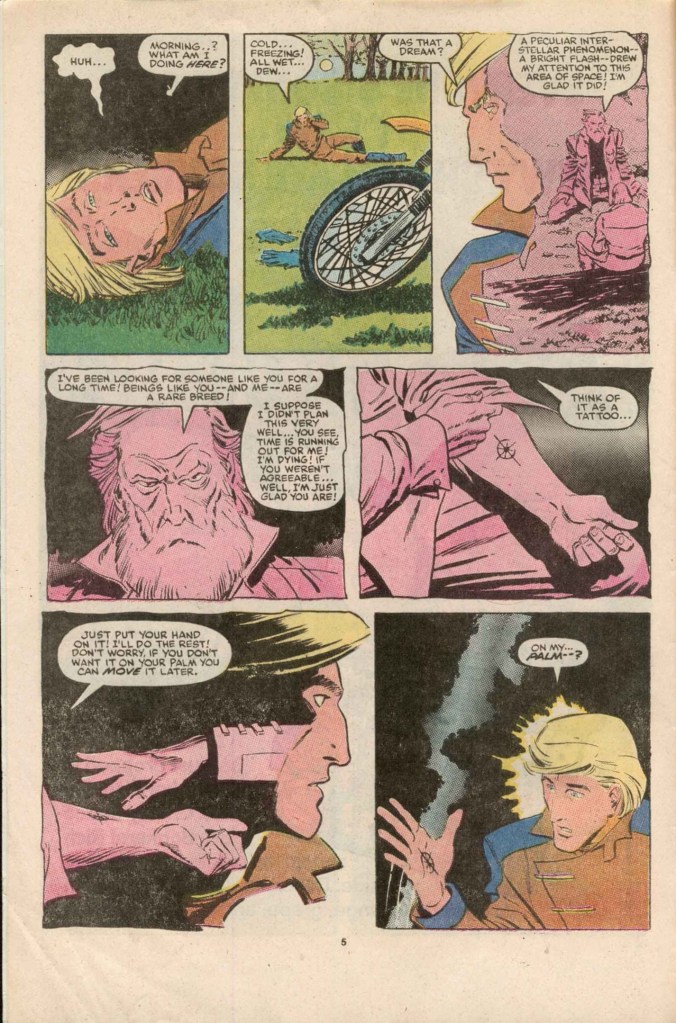
It’s also interesting to see just how quickly Shooter abandons the ground rules that he himself had set up for this line. The New Universe was supposed to be “The World Outside Your Window”, indistinguishable from the real world at least up to the point where the White Event that unleashes super-powers across humanity happens. But Shooter’s premise involves Connell encountering an Old Man in the remote Pennsylvania woods who claims to be an alien from another world and who passes the titular Star Brand to Connell, which makes him super-strong and indestructible and able to fly, at least while he is concentrating on being so. Connell, though, isn’t really the sharpest tool in the shed, so upon realizing what he’s gained possession of, he swiftly seeks out the advice of his friend Myron for what he ought to do with it. Romita isn’t yet quite the artist that he would become–that wouldn’t happen until he took over DAREDEVIL–but he’s already good enough to give Connell and Myron and really all of the characters in this series distinctive appearances. Especially in a line that’s going to largely eschew costumes, such a capability is going to be especially important to differentiate one person from another.
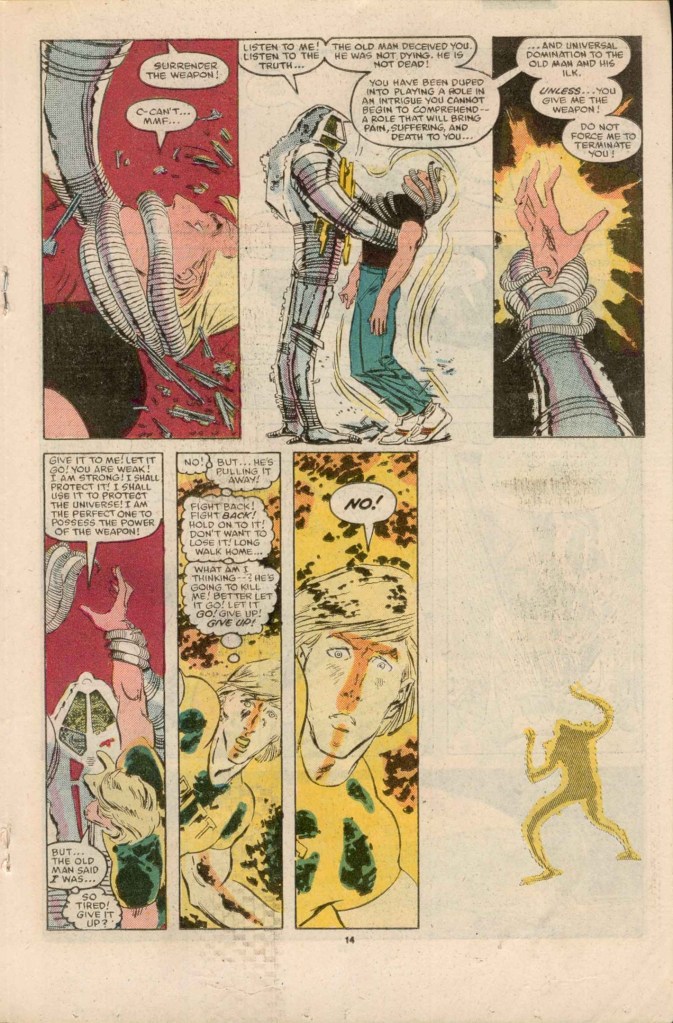
But as soon as Connell and Myron lay out the basics of what they know about the Brand and the power it conveys, they’re attacked by an armored alien who covets the Brand for himself. This alien claims that the Old Man who passed the power on to Connell was lying about everything he said, and that the only way to prevent an impending holocaust would be to hand over the power to the alien. Connell buckles at first, then doubles down on keeping his power, using it instead to obliterate his attacker. But it’s impossible to tell what is true at this point in a way that’s really interesting. Is Connell guarding a power that can’t be permitted to fall into the wrong hands or is he a pawn in some larger intergalactic conspiracy about which we know nothing? Sadly, Shooter won’t remain on the series long enough to provide us with definitive answers, but the ambiguity is pretty delicious.
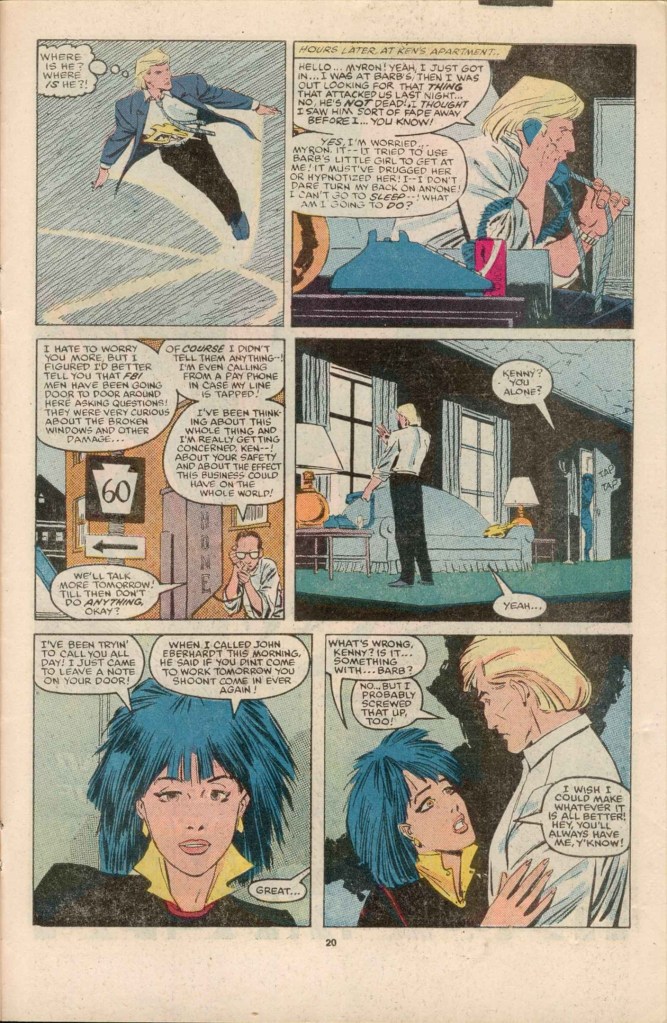
Ken Connell, it turns out, is also a bit of a creep when it comes to women. We’re hereafter introduced to both Barbara Petrovic, a middle-class single mother of two whom Connell is in a relationship with despite her being a bit out of his league, and Debbie “the Duck”, a less educated blue collar girl who co-dependently dotes on Ken, even though he treats her shabbily. She’s ready to given Ken money and clothes and make excuses with his bosses all in the hopes that he’ll look at her twice, and he takes advantage of her for his own needs while being oblivious to hers. The sexual politics of the entire series are really weird (and only get stranger when you realize that Shooter named Debbie after his own longtime friend Debbie Fix.) To Shooter’s credit, he really doesn’t shy away from the fact that Ken isn’t a good guy here, but it’s a really odd choice given that we’re meant to sympathize with Connell and bond with him as the star of the book.
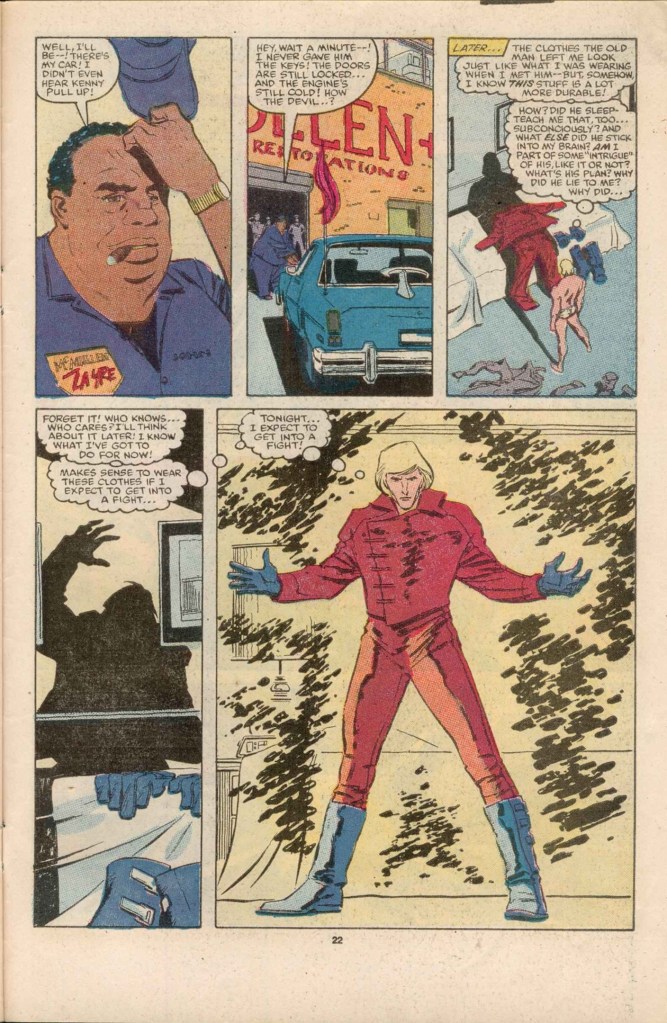
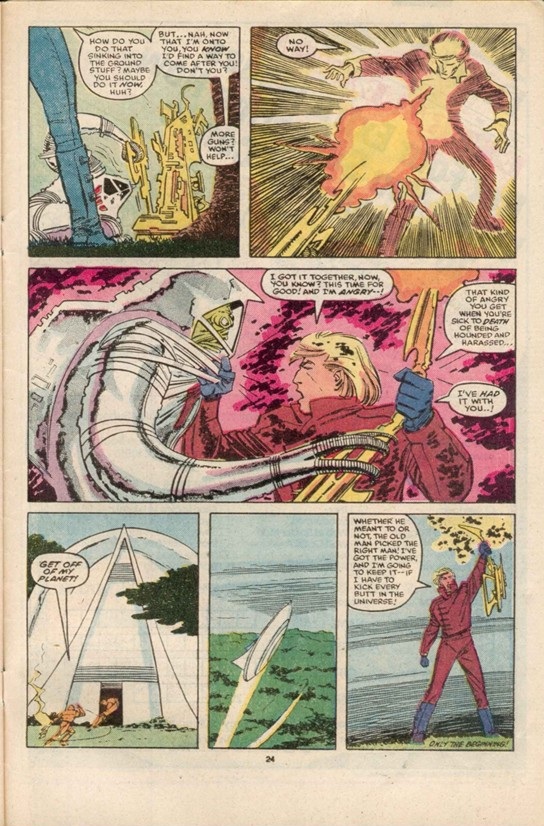
Throughout the rest of the issue Connell is stalked by the alien’s partner, a second identical alien who is a bit more circumspect in how it tries to get Connell to hand over the Star Brand to him. Eventually, Connell reaches his limit after the alien tries to use Barbara’s kids as hypnotized pawns. He suits up in the outfit he was wearing when he first got the Brand, which will now function as his costume, and seeks out the remaining alien and his ship. He swiftly kicks the alien’s ass, causing him to retreat back to space in his ship. Connell has decided that, whatever the truth may be, the Star Brand is his and he’s keeping it. And that’s the set-up for Marvel’s Superman figure. Readers at the time thought the set-up owed a bit too much to Green Lantern, and they have a point there–but no more so that Nova does, for example. Shooter, though, had become a divisive figure, and so judging the book became more about judging its creator that simply the work itself.
STAR BRAND was among the more consistent of the New Universe titles. While the late start that the creators got meant that Alex Saviuk had to step in along with Vince Colletta to produce the art on issue #3, Shooter and Romita Jr stayed together as the creative team through issue #7. That last issue wound up being scripted by Roy Thomas from a plot by Shooter, and thereafter Cary Bates and George Carragone did a bunch of fill-in work for the rest of Shooter’s tenure at Marvel. In those final months, it became clear that Shooter’s mind was on other things, and given that his dismissal was imminent, it’s not hard to see how that would be the case. Following Shooter’s departure, STAR BRAND was reorganized and relaunched mid-run under the oversight of Mark Gruenwald. Mark recruited John Byrne to take over the series, though to do so he had to agree to make it a bimonthly. Even with that, Byrne only did scripts and layouts on it, with Tom Palmer brought in to provide finished artwork. Byrne didn’t waste much time in throwing out most of Shooter’s concepts and he seemed to delight in torturing Ken Connell, killing him off repeatedly, whom he seemed to see as a Shooter stand-in (Byrne’s relationship with Shooter had deteriorated during the final years of Jim’s time as EIC. Byrne would also memorably plot a sequence into an issue of DC’s LEGENDS event in which Guy Gardner humiliates a barely-disguised version of Shooter in the guise of “Sunspot”, a Star Brand doppelganger. ) While the Shooter STAR BRAND issues are intriguing, the Byrne run largely comes off as half-assed and ill-motivated.
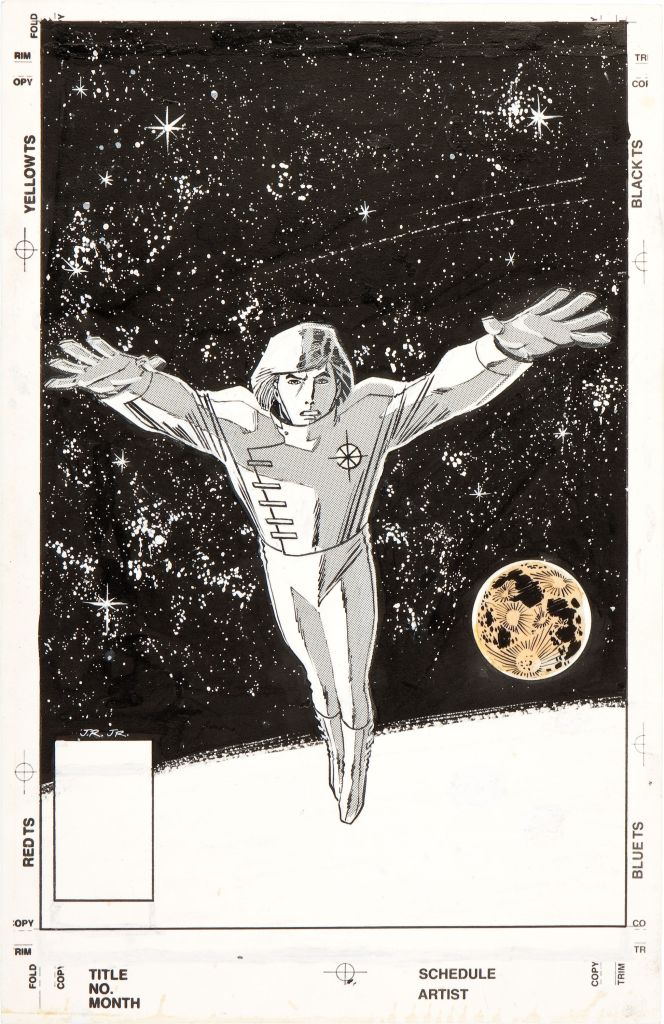
As with most of the other New Universe titles, the cover of STAR BRAND #1 was drawn a couple of times before Shooter was happy with it. What we see above is one of those unused earlier attempts, which isn’t all that much different from what eventually saw print. But Jim had a very specific vision in his mind–though it was one that he struggled to get across to the editors and other creators who were meant to be working on the line. Accordingly, working on the New Universe titles wasn’t a happy time for most of the principles involved.
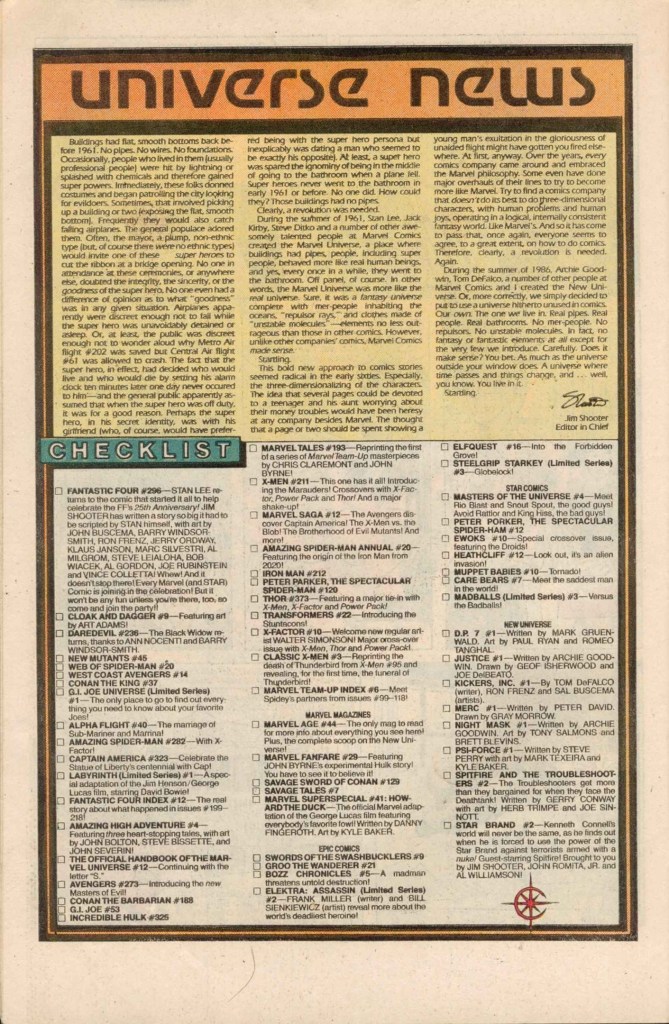
In the first Universe News Bullpen-style page, Jim outlines his vision for the new line in an introductory column.
 The Tom Brevoort Experience
Nice to hear you talk nice about JRJR’s DD run. Seems like most people dismiss it.
LikeLiked by 1 person
I feel as though Star Brand #1 merits two reviews. How I responded to it back in the summer of 1986 when it was first released and how I feel about it now. Unfortunately, those responses, despite a wealth of backstory I didn’t know or realize, don’t change much. Even being in my mid-20’s when this one hit the comic book store, I still wanted to at least like my superheroes. On that count, Ken Connell fell far short for all the reasons cited in Tom’s review. Even with more knowledge of the background of this title and the New Universe in general, the needle doesn’t move on that initial assessment.
Although I collected this one longer than any other NU titles, I believe I was gone after #3. While I returned for John Byrne’s “vengeance run”, I didn’t last long for that one either. Tom hits the mark on that run. It was also the first time I’d ever dropped a comic book produced by John Byrne.
On a side note, I always kind of resented this title as I blamed it for taking JR JR off the X-Men, setting up about a year where that book lacked artistic continuity until Mark Silvestri arrived.
Lastly, as I believe I said last week, has it really been nearly 40 years since the New Universe launched? I suppose that explains the grey hair.
LikeLiked by 2 people
My rule with Shooter’s recollections is that they’re about two-thirds accurate. While I believe budgetary reasons were the reason the creative teams on the New Universe books were office staff and second-tier freelancers, I’ve never accepted that extended to STAR BRAND.
John Romita, Jr. and Al Williamson were hardly begging for work, and both saw the point of just about any assignment as a paycheck. Shooter had an overweening view of his popularity as a creator among the readership. (He stated in sworn court testimony around this time that he believed he was a fan-favorite talent along with Byrne, Claremont, Miller, Moore, and Walt Simonson.) I have no doubt he expected STAR BRAND, which was his baby, to be a big hit. I would think he’d have sold the assignment as such to prospective collaborators.
LikeLiked by 1 person
I’ve been meaning to give Star Brand a read for some time now, in that it was clearly (from what I’ve heard) a very personal work for Jim Shooter and it seems to be something of a protype / false start for what Shooter and his collaborators much more successfully pulled off in the pages of the early Valiant Comics titles. I think I’ll head over to ebay and see if I can find an affordable copy of the trade paperback.
LikeLike
I can’t be sure if I’m being honest if I stayed on Star Brand until Byrne’s nasty revamp or came back for the beginning of my disappointment in Byrne’s public persona. It certainly wasn’t for Romita’s art. I’ve skipped runs by writers I like on characters I like because he’s been the artist. Asshole Ken didn’t bother me one bit. Men and women being paragons of virtue when out of the blue gain massive super-powers needed people like Ken to balance them and I didn’t realize that until Star Brand. He wasn’t well educated, self-absorbed, and a bit petty but his attempts to do the right thing felt more real than other characters who were cookie cutter do gooders from the beginning. Was he among the group when Kayla was gifted the brand in Quasar? I wouldn’t mind seeing him revisited with today’s viewpoints and decades of new types of stories becoming more commonplace every year in comics.
LikeLiked by 1 person
“Readers at the time thought the set-up owed a bit too much to Green Lantern, and they have a point there–but no more so that Nova does” Yes, but I liked Nova.
I wasn’t a fan of Shooter’s tenure as EIC but if I was biased when I looked at this, it was his writing, not his editing. Much as I loved his Silver and Bronze Age work, his return to Avengers and Secret Wars had none of that talent. My reaction to Star-Brand was that “the world outside your window” was too dull to set comic-books in. Nothing about Ken’s adventures interested me.
Like That Steve, Romita’s art was a factor. I can’t say exactly what it is I don’t like about it but his work always feels jarringly wrong to me.
LikeLiked by 1 person
I definitely thought STAR BRAND owed a lot to GREEN LANTERN, and while I agree that so do NOVA, NOVA wasn’t promising to be a big step forward, a new revolution in how comics were done. It was just aspiring to be a fun superhero comic with a young protagonist, and if it felt like Green Lantern mixed up with Spider-Man, well…so what?
STAR BRAND seemed to promise more, so it felt to me like it should have worked harder to be more, at the beginning. Guy given powers by alien, fights other aliens…c’mon. I liked the way Ken didn’t fit the hero mold and didn’t fall into the usual tropes (or at least not quickly), but the setup was pretty basic.
And I was baffled by that Jim’s Soapbox column, which correctly (I think) identifies the Marvel Silver Age revolution as “fantasy with added realism and melodrama,” and then suggests that the New Universe with be the next step by being “that, but with less fantasy.” Mer-people? Repulsors? Unstable molecules? What on Earth would make anyone think readers didn’t like these things? It’s easy to point at the bits of DC Silver Age stuff that seemed stilted, undramatic or formulaic, but it wasn’t the mer-people, or fictional science that were the problem.
STAR BRAND seemed to offer a conventional superhero setup that would simply develop slowly and with more introspection and character incident, a focus on figuring things out in a more realistic manner than rushing through them — an idea Marvel would make big money off of years later in ULTIMATE SPIDER-MAN — which I thought was interesting, but if you were going to do that sort of thing I’d have rather seen it done by someone more inclined to maximalist texture, like 70s Englehart or contemporary Claremont, than Jim. And the same on the art — if you’re going to dwell on real-world aspects, get art by someone who revels in that stuff, rather than JRJr, who was decent at it but clearly itching to get the characters into costume and into action, rather than hang around in garages or apartments. Weird to say considering how they didn’t get along creatively, but I think Gene Colan would have been a better artist for this approach; he’d have leaned into the cinematic pleasures of setting, mood and emotion.
But Gene wasn’t an option, even if Jim would have thought he’d be a good choice (and he wouldn’t have).
LikeLiked by 2 people
I’m befuddled how Shooter could think that the Star Brand (unlimited powers granted by an alien) was somehow more “realistic” than repulsor rays (charged particles shot from a suit a guy made… eventually runs out of power). It’s like arguing that Doctor Stange is more realistic than Batman.
The Ironman suit as it operates in the MU breaks a number of real world laws like the conservation of energy… but the general concept is way more grounded than aliens giving some human the power of the force.
If aliens showed up wouldn’t they more likely give us technology if they share anything at all? …and it would probably be something like a food replicator or water purifier if we’re lucky.
LikeLike
Have you read EM Foner’s books that start with the EarthCent Ambassador series? Benevolent AI makes Earth a probationary method and a ward of theirs to prevent the apocalypse. They treat Earthlings a lot like your what if and I love his connected series based off of it,
LikeLike
TRIVIA ( Wikipedia ): WILL POWER was the original title according to Mark Gruenwald’s notes from the meeting, and “STAR BRAND” was taken from an unused concept by Archie Goodwin ( Will Power ( a hero ) – Marvel Mystery Comics#34 ( August 1942 ) Jimmy Jupiter story — vs. Satan, Werjil, Matilda & Temptation ) — I wouldn’t mind knowing more about Archie Goodwin’s unused concept Star Brand ( Cause if his/her powers are different than the New Universe’s Star Brand then perhaps since as seen in the Ad in Captain America Comics#1 ( March 1941 ) just before the Hurricane story it could be given to Timely’s Star another unused concept ).
LikeLiked by 1 person
TRIVIA( As I pointed out before, he had the Silver Age GREEN LANTERN’S ORIGIN FIRST ): ACE OF SPACE — “Young millionaire sportsman” Ace Egan discovers a crashed alien spaceship.. The dying alien inside gives Ace a power belt and warns him of the imminent invasion of the Slogons. Ace uses his new powers and his space ship to defeat the Slogons [ Feature Comics#38 ( November 1940 ) 4 appearances ] — The Encyclopedia of Golden Age Superheroes — Jess Nevins. Marvel’s first use of that origin was the third TORPEDO ( Brock Jones ) [ Daredevil#126 ( October 1975 ) ] – Brock Jones witnesses the battle between Daredevil and Torpedo and frees the dying Michael Stivak. He explains the history of the battlesuit, and entrusts the completion of his mission to jones ( Torpedo Trivia — Marv Wolfman says King of the Rocket Men/Commando Cody inspired Torpedo ). Then the POWER PACK kids and the new ( Hopefully ignored ) origin for Timely Comics FIERY MASK in The Twelve.
LikeLiked by 1 person
STAR BRAND ( Object — https://marvel.fandom.com/wiki/Star_Brand_(Object): gave its bearer GOD-LIKE POWERS, limited only by the wielder’s imagination. The most easily attainable powers of the Star Brand are FLIGHT, INCREDIBLE STRENGTH, INVULNERABILITY and the ABILITY TO UNLEASH BLASTS OF DESTRUCTIVE ENERGY. The Brand makes the bearer IMMORTAL( preserving him from aging and reviving and regenerating his body upon its violent death ). With time, IMAGINATION and WILL, the bearer of the Star Brand can EXPAND ITS ABILITIES INTO ANYTHING HE(SHE) CAN CONCEIVE OF. Early examples are learning to DIRECT ITS DESTRUCTIVE ENERGY into CONTROLLED BOLTS and HEALING WOUNDS OF THE BEARER or OTHERS AT WILL. Expanded powers have included the ability to “BURN-OUT” the POWERS OF OTHER PARANORMALS, CREATING OBJECTS FROM NOTHING ( Up to entire cities )., RECONSTRUCTING and REDESIGNING THE BODIES OF LIVING BEINGS, RENDERING INERT ALL NUCLEAR WARHEADS ON THE PLANET and EVEN TIME TRAVEL. It is the IMAGINATION and WILL that made me think the STAR BRAND should be able to MIMIC an NUMBER of ETERNAL ABILITIES or CREATE FORCE FIELDS or MOVING/RUNNING/SWIMMING AT SUPER SPEED or LEAPING ABILITY IF HE/SHE WANTED.
LikeLike
Making the hero kind of an un-heroic jerk is a good idea – the series needs to be something different from the established patterns of superhero comics when you’re launching a whole new universe, especially when his origin story is just Green Lantern. But the story just isn’t compelling to read, somehow, and it just seems to sum up the whole New Universe. A lot of ideas and rules about what would make good comics, but what actually appeared in them just isn’t very good…
LikeLike
I’m not gonna read the stories of a lead fictional character I don’t like. It’s necessary to follow the news about, and history of, consequential real-life people. Many of whom are reprehensible, disgusting, or even just annoying. Why the eff would I bother following regularly published “imaginary stories” of people who could be described just as badly? Unless their inclusion is as a foil, or adversary of the protagonist.
A superhero comic book about an unlikeable person is a non-starter for me. “Oh, but it’s SUCH a DIFFERENT approach!” It sets it APART!” That doesn’t mean it’s good. There’s a reason vehicles that travel on the ground ALL have ROUND friggin’ wheels. 😉
Only a fool would design a vehicle, expecting it to successfully compete with tried-and-true others, and give it square “wheels”. (OK, sticklers, a “wheel” by definition is round, and I admit I’m not as blessed in my vocabulary as you.)
“Unlikeable” is open to interpretation. Namor can be a pain in the @SS, but I often find him likeable for different reasons. Courage. Honor. Loyalty.
Superman, that paragon of “Truth, Justice”, Hope, yadda-yadda-yadda, has too often been written, to me, as unlikeable. Whiny and petty (he learns better, but he really ought’ve already known by this point). I’ve dropped those runs pretty quickly, and avoided subsequent work by the same writers involved. They weren’t a good fit for showing what’s est about that great character.
I won’t disparage pro’s by name here, but I will give appropriate credit. Grant Morrisson’s probably written my fave characterization of Superman. And for thinking of very interesting things to do with, or to, Superman. Bendis did a decent job with Supes’ personality and dialog; I just didn’t always like the paces he chose to put Superman through. And just because I’m not taking the time to name other takes by writers I have liked doesn’t mean there aren’t any others.
But the lead superhero in a solo series must be likeable for me to keep coming back. Same for the real people I choose to associate in my own time. Team books can be more varied- the characters can play off each other. But even still, Wolverine in the X-Men books I liked never rubbed me as badly as Guy Garnder. And I get that was the POINT of Gardner in “JL”, but there only so much I can take.
Grant’s “JLA” did a great job of showing different characters working off each other. Aquaman could get cranky. Kyle’s overt, youthful “bro-isms” (again, open to interpretation) could be annoying. But there was shared respect shared between members. And they were all there for the right (altruistic) reasons. I wanted to spend time reading about what they were doing. Otherwise, it doesn’t work for me.
The path can get bumpy. The road narrow, or curvy, or so wide or obstructed it’s hard to see all incoming threats from all sides. It’s gotta be interesting. The wheels may need repair, or get stuck, for a variety of hopefully compelling reasons. But they gotta eventually start turning again. Or I start looking for a different ride.
LikeLike
If you want to draw the Shooter/Connell parallels even closer, Jim also called Debbie Fix “Debbie the Duck,” well before Star Brand was a twinkle in anyone’s eyes…
LikeLike
If anyone actually read Shooter’s run on Star Brand, Byrne’s run is the pay off. Byrne kept the format, origin flashback every issue. He kept Ken Connell’s personality, smartest dumb guy and a douche to his girl friends… But… Instead of getting by on luck, he made another stupid mistake.
This mistake fueled the whole relaunch of the New U. Something finally happened in the New U.
Shooter’s run is like Shooter doing Vertigo, but he ruined it by having the Old Man return, which Byrne cleared up. Shooter return of the Old Man was like Abin Sur came back to life and tried to kill the Green Lantern. Otherwise John Romita Jr was pretty much carrying Shooter, but Starbrand almost led Romita Jr to quit comics.
LikeLiked by 1 person
I didn’t have interest in this title because I didn’t like Shooter’s writing on previous books (Avengers and Secret Wars). I did read one or two of the Byrne issues, but don’t remember them at all. I know Byrne says he tried to take it seriously instead of making it the attack on Shooter everyone was expecting. I can’t judge the accuracy of this, of course, because I didn’t read the rest of the books. It seems to me if you wanted a “more serious” comic line it should have started with cold-war era spies and such topical stories, since it was set firmly in the 1980s.
LikeLike
re your comment, Tom, that the origin “owed a lot to Green Lantern,” I remember the comics shop owner I worked for at the time described the character as “Superman, with Green Lantern’s origin.”
LikeLike
The Silver Age Green Lantern borrows from E,E, “Doc” Smith’s Lensman novels.
“The thing that hath been, it is that which shall be; and that which is done is that which shall be done: and there is no new thing under the sun.” Ecclesiastes 1:9.
However, it is harder to sell a derivative concept with an abrasive main character, unless you subtly signal that the character has room for growth (see, e. g., Larry Underwood in King’s The Stand). That did not happen here.
LikeLike