

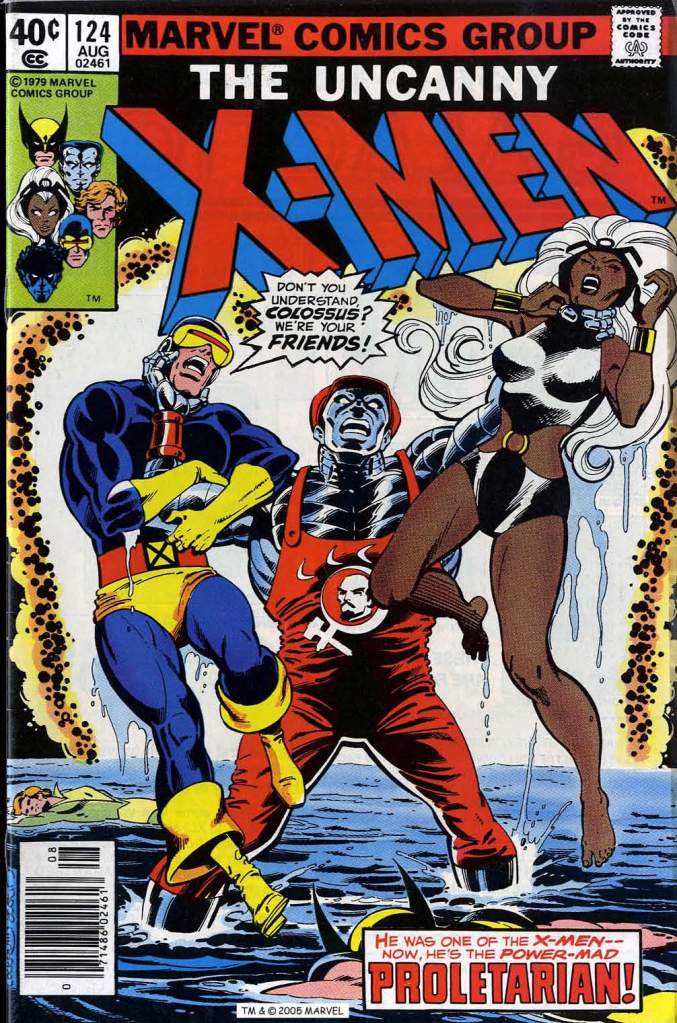
By the time of UNCANNY X-MEN #124, I had been buying the book for about a year and a half, and I enjoyed it every month. It wasn’t my favorite title, didn’t differentiate itself from the rest of the pack in that manner at the time. But it was a book that could be relied upon to deliver the goods. In wider fan circles at the time, the appeal of UNCANNY X-MEN was growing, and this sent the prices of back issues skyrocketing, at least in relation to everything else of that period. It was unthinkable in 1979 that a comic book published just four years earlier would command $25.00 on the back issue market, but that’s exactly what was happening with GIANT-SIZE X-MEN #1 and especially UNCANNY X-MEN #94. Because the book had been a reprint series for so long, the print run on #94 was a lot smaller than the typical Marvel super hero book of that period, which meant that copies were a bit more scarce in the wild. As fans wanted to catch up on these strange new characters that had caught their fancy, dealers found that they could charge greater and greater sums for the earlier issues and there’d be people who would pay them.
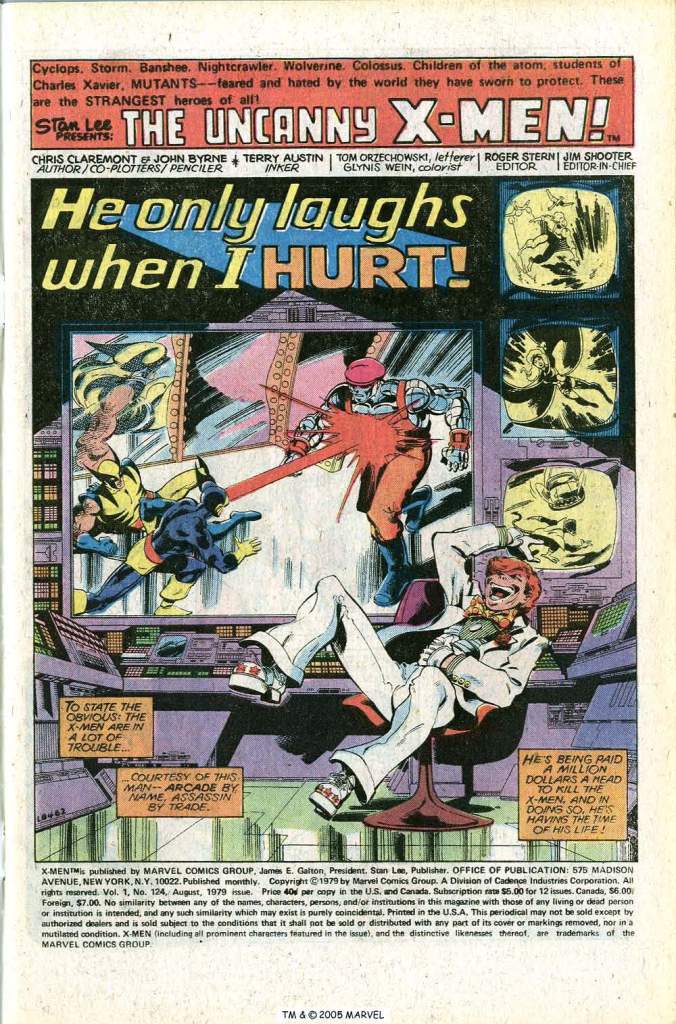
The consistency of delivery on UNCANNY X-MEN comes down in large part to the consistency of creative team. While they were far from a simpatico partnership, the trio of Chris Claremont, John Byrne and Terry Austin produced issue after issue with one another, with only an occasional absence by Austin. Additionally, letterer Tom Orzechowski and colorist Glynis Wein also remained on the series in seeming perpetuity. And editor Roger Stern provided a necessary fulcrum to balance the needs and desires of both Chris and John, keeping them in balance through much of this run. Of the material that Marvel was producing in 1979, UNCANNY X-MEN was pretty much the pinnacle, with only the work being done on DAREDEVIL by newcomer Frank Miller beginning to catch the same sort of fire.
The story in this issue is about as close to plotless as the series would come. In short: the killer-for-hire Arcade has been retained to assassinate the X-Men by their old foes Juggernaut and Black Tom Cassidy. Arcade’s minions abduct the X-Men as well as supporting cast members Colleen Wing, Amanda Sefton and Betsy Wilford and spirited them away to Murderworld, his killer amusement park, where he intends to put the team through its paces and eliminate them in style. I hadn’t seen the earlier story that Claremont and Byrne did in MARVEL TEAM-UP where Arcade did the same thing to Spider-Man and Captain Britain yet, so I didn’t realize that they’d had that heroic pair face pretty much all of the same gags and deathtraps that endanger the X-Men in this story. But it means that there was even less innovation going on here than I knew of in 1979. Anyway, the plot of the issue is pretty much the separated X-Men fighting their way through one situation after another, trying to get free and get to Arcade.
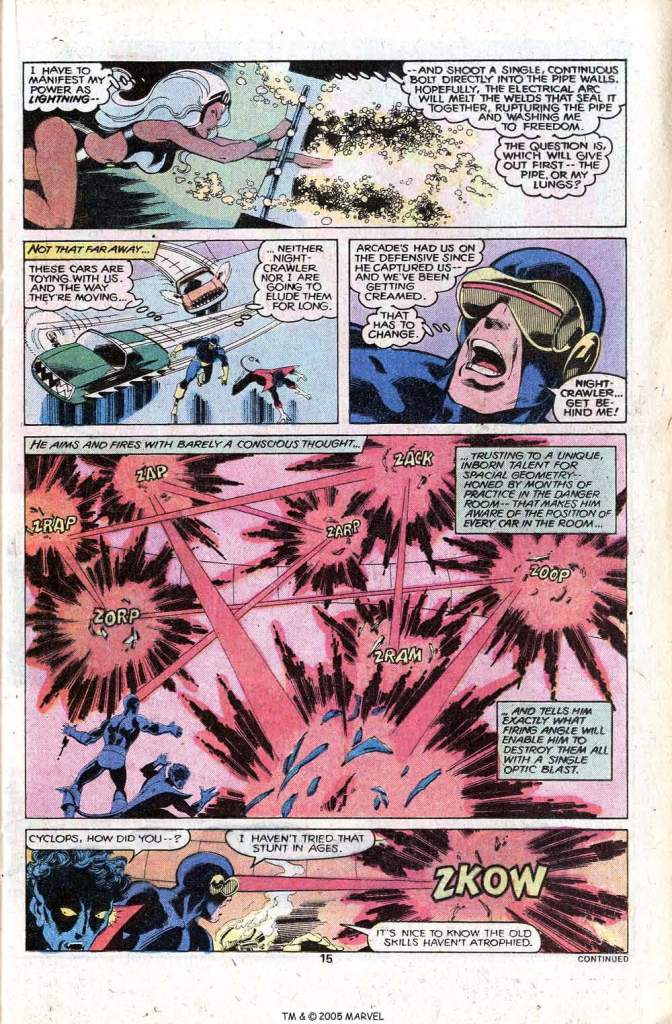
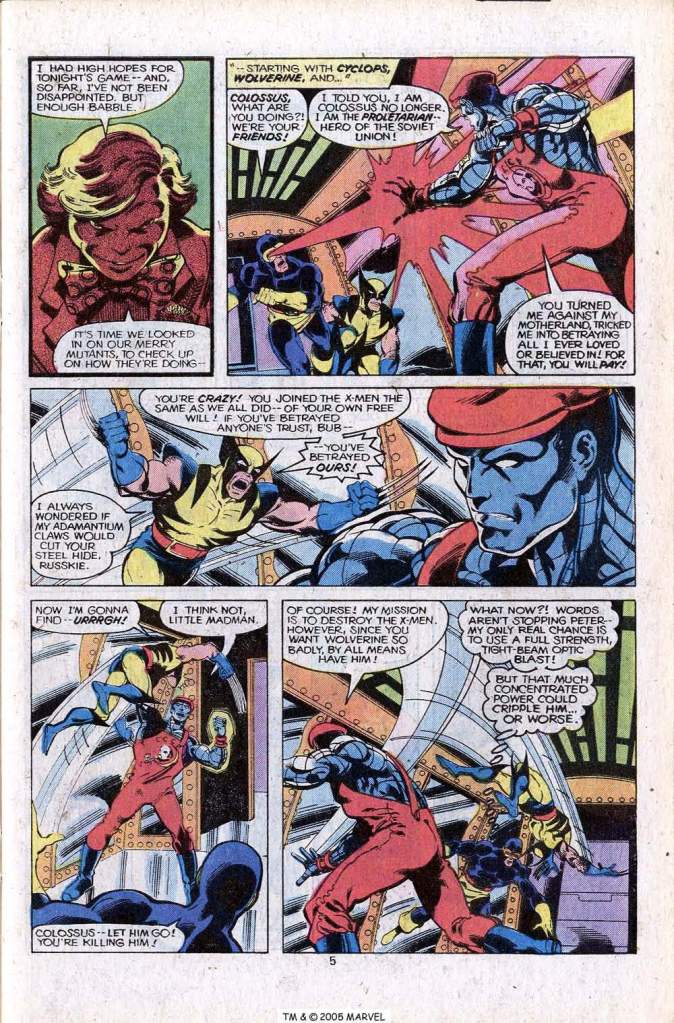
As a part of his efforts, Arcade brainwashes Colossus, the Russian X-Man who recently has been feeling uncertain about his place in the group as well as having left his homeland and family behind to join it. He’s consequently recast as the Proletarian, hero of the Soviet Union, and he attempts to annihilate his fellow X-Men even though he inwardly feels guilty about doing so. He initially mixes it up with Wolverine and Cyclops, and while the battle is uncertain, the two wind up being sent through different passages into different death traps elsewhere in Murderworld. Meanwhile, the other X-Men are also attempting to survive their own life-threatening situations–Storm enclosed in a space rapidly filling with water that also triggers her claustrophobia, Nightcrawler trapped in a spherical room throughout which buzzsaw-mounted cars race, and the powerless Banshee in the midst of what seems to be attacking spacecraft right out of STAR WARS. Wolverine winds up with Banshee while Cyclops finds himself alongside Nightcrawler.
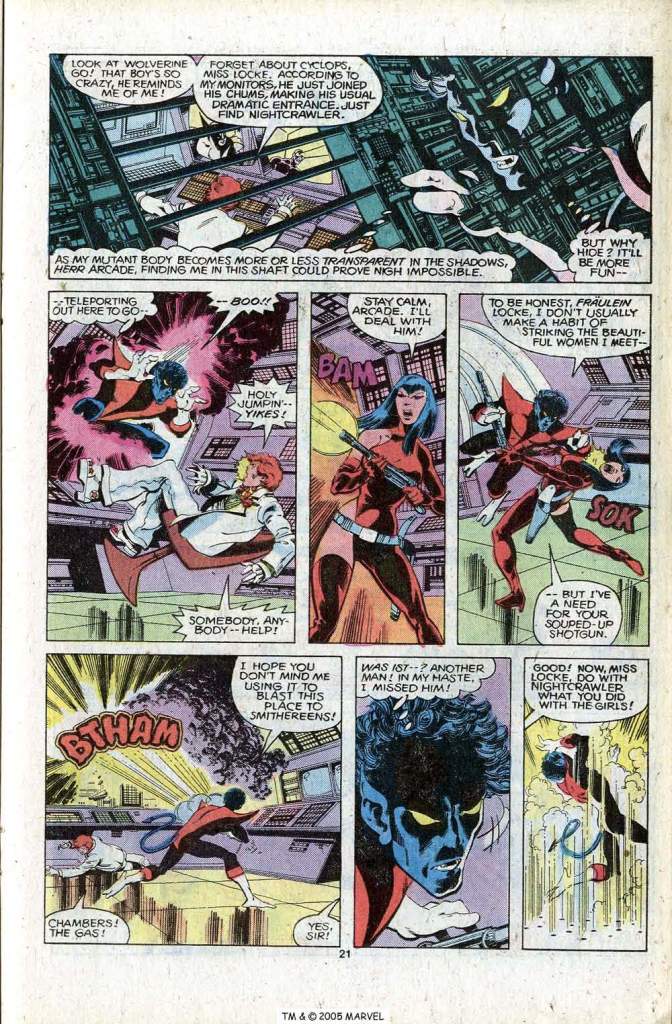
Plotless doesn’t mean without incident, however, and the structure for this story allows artist John Byrne to go wild with his flair for action sequences. He gives all of the X-Men good business that shows off their abilities, whether it’s Cyclops taking out the roomful of buzzsaw cars with a single ricocheting Optic Blast or Nightcrawler sneaking through the ductwork of Murderworld to find the control room, becoming semi-invisible in the shadows as he did in those days. It’s fast-paced and fun, and keeps the tale rocketing forward smoothly in a very satisfying manner.
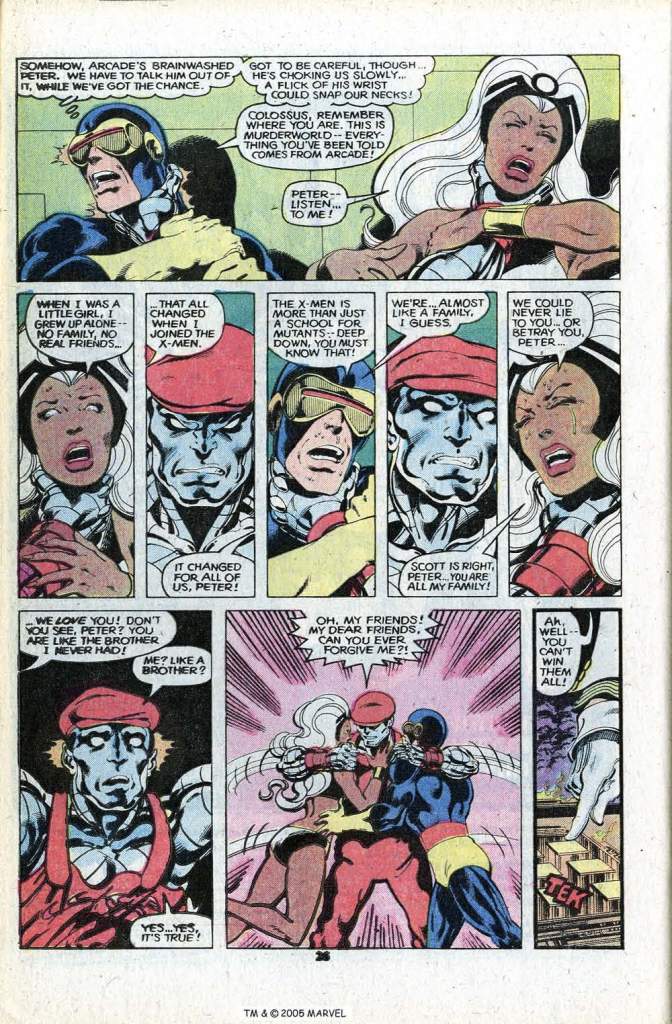
But the big emotional payoff comes with the exhausted team is set upon by their old friend Colossus once more. The brainwashed mutant swiftly incapacitates both Banshee and Wolverine, and then moves to choke the life out of Storm and Cyclops. They attempt to break through Arcade’s brainwashing by appealing to their shared experiences as members of the X-Men and how they’ve all become a found family. It’s ultimately Storm telling Colossus that she regards him as a a brother that ultimately does the trick. With his park in ruins and his controls mangled as a result of Nightcrawler’s attack earlier, Arcade decides that it’s time to walk away, and he has the X-Men ejected from Murderworld.
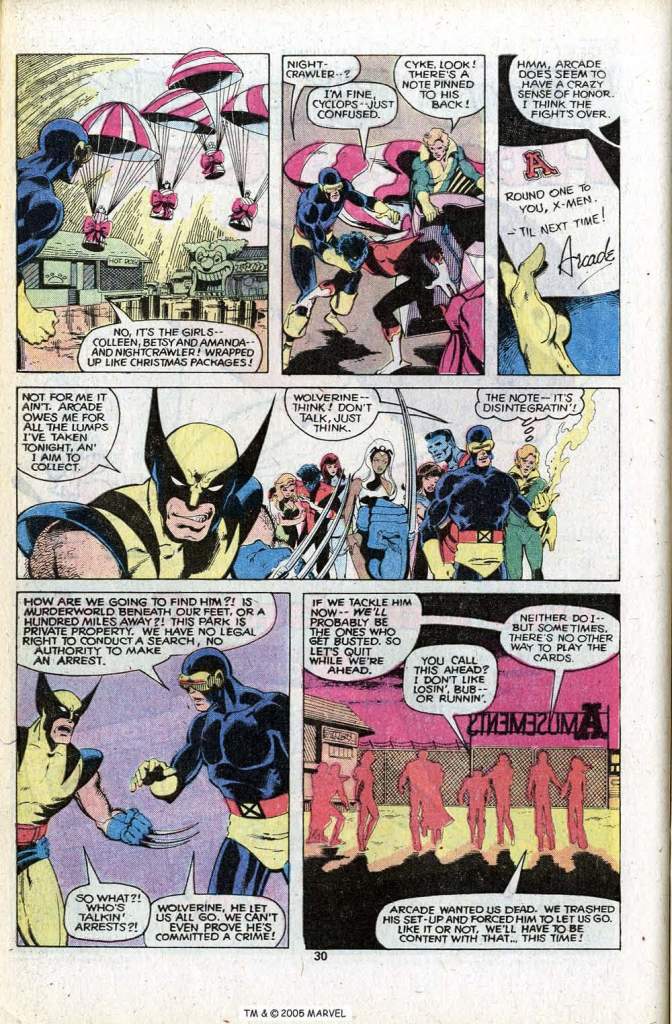
As the X-Men regroup, Arcade even sends Nightcrawler and the three ladies out to them, with a note indicating that this round goes to them. Wolverine has no intention of letting this go that easily, but the issue is out of pages, so Cyclops is able to make him see reason–they’ve escaped with their lives and Arcade’s set-up is in ruins, that’s all the win they’re going to get today. All in all, this was a fun escapade that was well-drawn and well-delivered. And “He Only Laughs When I Hurt” is a very clever little title.
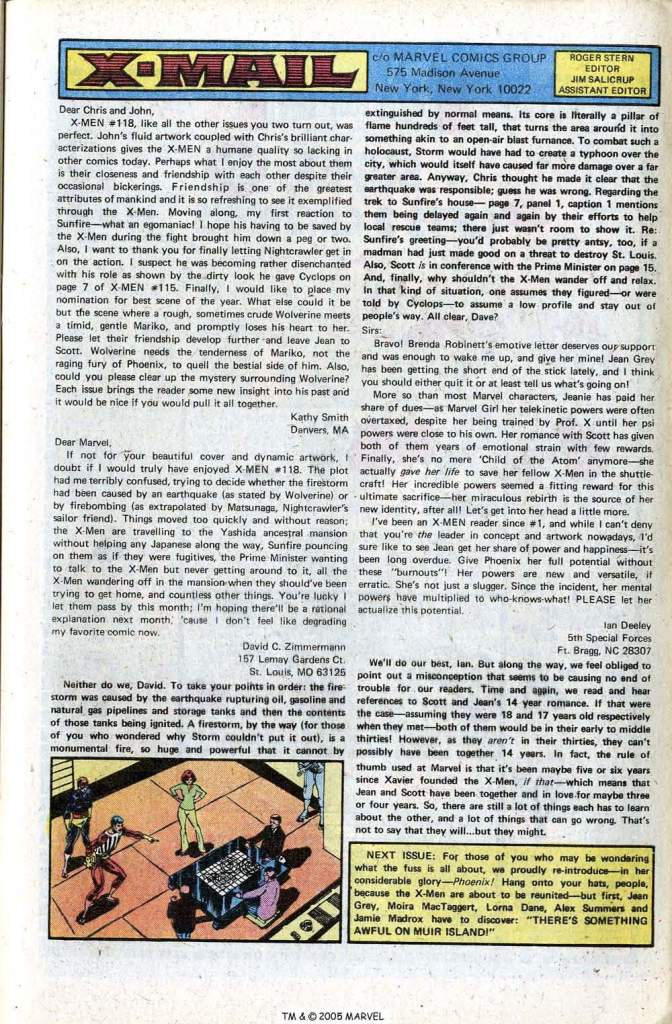
I’m also including the X-Mail letters page from this issue as it features in its response to the last letter the first in-print explanation that I can recall of how the passage of time works in the Marvel Universe. The unnamed writer, possibly either editor Roger Stern or assistant editor Jim Salicrup indicate that at this point the working theory is that it’s only been maybe 5 or 6 years since the X-Men first formed in-world, even though 16 years have passed since the publication of X-MEN #1. This is one of those ideas that makes certain readers’ heads ache, but took this revelation completely in stride. I hadn’t been bothered by the passage of time in my comics either way, so this explanation worked for me. But some didn’t like it, just as some don’t like it to this day.
 The Tom Brevoort Experience
I recently reread X-Men from #1 to 176 and one of things that struck me was how few original villains Claremont created for that part of the run. They were either preexisting Marvel U or X-Villains or ones he had created in other titles, Arcade being one of the latter.
LikeLiked by 1 person
This issue absolutely underscores the excellence of the Claremont-Byrne-Austin team. I say that because, as Tom points out, X-Men #124 is hardly “Days of Future Past.” It’s essentially the second part of a story that killed time in order for the “band” to reunite in the next issue. That said, it seems that all creators involved brought their “A game” to both issues, making it every bit another solid contribution to a groundbreaking run. Kudos as well for the impressive Dave Cockrum-Terry Austin cover!
LikeLiked by 1 person
I bought nearly all of DC & Marvel’s super-hero books back then and while I’d read Arcade’s debut but did many others? Even if MTU wasn’t on the downswing yet, Arcade’s schtick was still novel. I was bored with it by the time he teamed with Doom and roll my eyes whenever he’s trotted out now (except when he was used to kill off teenage characters. That time I was disgusted by his use).
BTW, was Betsy ever given a send off or did she just stop appearing anywhere? I know she was spared idiocy like Amanda has been through but Google couldn’t give me a definitive final appearance of her.
LikeLike
Well marvel.fandom.com/wiki/Elisabeth_Wilford_(Earth-616) suggests that this was her last appearance and also her Arcade encounter might have led to her breakup with Piotr Rasputin. Also in a case of no one checking before they printed it, in Colossus#1 Miss Locke claimed that there was never a Betsy Wilford, that it had always been her in disguise as a prelude to Arcade’s kidnapping of the X-Men in this issue ( This of course ignores Miss Locke meeting Colossus, Betsy, Nightcrawler and Amanda face-to-face in that issue, and is clearly false ).
LikeLike
While I was getting more annoyed with the X-MEN book around this period, I really enjoyed this two-parter. I didn’t think it was plotless so much as that it was largely self-contained — it didn’t have much of an effect on the overall series direction. But it put the characters into a crucible and showed how they reacted — exploring their powers, personalities and interpersonal bonds — in way that I generally thought enriched the book.
It wasn’t a building block in a larger structure (or, if it was, it was barely one), but it was a story, in the tradition of fight-for-survival stories like “The Most Dangerous Game.”
I could see it, though, arising from a “We’re running late; we need a plot in a hurry” situation (going by the credits, this could be one of the issues plotted in a phone call, with Byrne doing most of the fleshing-out), though it could also be a “Let’s do an action story before we plunge into the character-heavy stuff coming up.” Or even “We just got them back to the US; we’d better have a New York adventure before we head out to furrin’ parts again.”
LikeLiked by 2 people
The Most Dangerous Game ( I believe it was in Middle School that my class had to read that ) : Storm had to survive it [ Uncanny X-Men#215-216 ( March-April 1987 ) vs. Crimson Commando, Super Sabre & Stonewall ]. Major Liberty foe Reynolds ( an English traitor ) loves to play sportsman…using his shipwrecked victims as prey for the kill! [ USA Comics#2 ( November 1941 ) “The Island Menace” — Headhunters Inn ( eerie castle ) ].
LikeLike
You could run out of pixels before you exhausted all the stories inspired by Most Dangerous Game.
LikeLike
I vaguely remember Stan Lee saying that the way the Marvel Universe works, somewhere in the late 60s to late 70s, was that one year passed in the Marvel Universe for every 5-6 years in our time. So 50 years after the first Spider-Man story, Peter would be in his late 20s. And then once he stopped being the main man for Marvel, all bets were off as to how fast time past in the Marvel Universe.
LikeLike
That seems like another thing that, if Stan said it, he’d decided he’d said after the fact, because Marvel never really worked that way.
Early on, it seemed to progress in real time — we saw Peter Parker finish up high school and go to college after three years of high school (with summer vacations, even); we saw Sue Storm have a pregnancy that lasted more or less the time a pregnancy lasts, not 5-6 times as long; we saw juvenile Bobby Drake celebrate his 18th birthday after a few years. Time just passed like normal.
In the early 70s, though, Stan realized these books were going to last a long time, and told the staff that instead of ongoing change, what they needed from then on was “the illusion of change.” No real progress, just things that felt like it for a while.
It wasn’t until Stan was largely out of the picture that people started the 5-year-rule or the 7-year-rule, and so on. But even then, that wasn’t an orderly progression measured out in proportion to real time. It was just Marvel editors deciding after a while that 5 years was too short, so we’ll say it’s been 7. And then later changing that to 10. And later changing it again.
But none of it’s a regular progression of time, just slower than in the real world. It’s fits and starts and editorial fiats. No rules, no steady change.
LikeLiked by 1 person
Thanks. I think that’s the nature of pretty much every comic book line. I remember reading that Julius Schwartz saying, in the 60s, that Superman is 29 and he will always be 29.
But now he has kids, so he can’t be 29 anymore.
Aging out your heroes so the younger generation can take on the mantle is great story-wise, if done well. But the public sees the heroes as they were and it can be a financial disaster to age out someone like Clark Kent, Bruce Wayne, Peter Parker, and Bruce Banner and try to replace them with younger folks, perhaps their sons.
LikeLike
Aging a character and having another generation take over can be a great series direction.
Unfortunately, if you want to do that in the Marvel or DC Universe, you either have to step outside normal continuity, or you have to do it to the whole shared universe. And that is both financially risky, since it involves making big changes in all your books, and kinda repetitive, having all (or most) of the series dealing with the same damn thing.
You can mess with it a little — maybe Batman’s aging and Dick’s going to step up, but Superman’s long-lived so he stays in his prime — but then what about Lois and Jimmy? Are they going to age while Superman doesn’t? Are they going to get magic no-aging rings and become eternally young, which is weird in itself?
Whatever you do, you’re going to be tossing a grenade into your whole line.
So it’s maybe better to do real-world aging in single series, like SAVAGE DRAGON and ASTRO CITY or GASOLINE ALLEY and STEVE CANYON. If Skeezix grows up in GASOLINE ALLEY, he’s not going to force Charlie Brown to do it too.
LikeLiked by 2 people
I agree.
Gasoline Alley, since it was a comic strip, got away with slowly aging out the characters and having the kids and then grandkids take center stage. Other comic strips, like Blondie did the same thing nearly, even though they have grown kids, Blondie and Dagwood still seem to be in their early 40s.
Milton Caniff had an interesting way of aging. The men slowly got older but the women didn’t until the men were past them in age and then aged very slowly, compare to the men. Terry and the Pirates is a prime example of this. When the Dragon Lady was introduced, Terry Lee was just a kid, so Pat Ryan wooed her. Sometime in WW2 when Terry was fighting Japan as a pilot, the Dragon Lady shows up as a Freedom Fighter and hadn’t aged a bit so Terry was now able to sort of woo her. Once he got into his late 20s, he was able to freely woo her and when he hit his 30s, she slowly started aging but was now younger than he was.
Doing limited series is probably the best way to use aging with characters, letting you play with the idea of passing on the torch.
LikeLike
I don’t think the Dragon Lady was ever younger than Terry in Caniff’s run.
But the kids did age up to be at least near-contemporaries with the adults, and Terry did romance Burma a bit. I think the general operating theory there was that the kids aged visibly and the adults remained adults, their actual age never really coming up.
In STEVE CANYON, the aging was much closer to real-world aging, as the kids grew up and the adults grew older. This seemed to happen (though maybe not at a steady state) in the Nick Dallis-written JUDGE PARKER as well, where the kids grew up and the judge eventually retired. Not so much in Dallas’s other strips, REX MORGAN and APARTMENT 3-G, through that may be due to a lack of children as recurring characters.
LikeLike
I still miss Apartment 30G. It’s an unjust world where it’s gone and Mary Worth got a better artist and worse stories.
LikeLike
I know there’s been discussion of retooling and bringing back 3-G, up at the syndicate. But the editor who was discussing it is no longer with them, so I’m not sure anyone’s thinking about it any more.
If I was healthier and on top of my deadlines, I’d be interested in taking a shot at it. But I don’t think that’s likely any time soon.
LikeLiked by 1 person
I think Murray Boltinoff originated “Superman is 29 forever” Can’t swear to it. I suspect it tied in with the whole “never trust anyone over 30” meme of the sixties.
Boltinoff definitely established that Superboy stories under his tenure all took place 15 years earlier than whenever the book was coming out — a 1973 story would take place in the late 1950s, for instance. Commander Benson lays it out: https://captaincomics.ning.com/forum/topics/deck-log-entry-176-superboy-the-time-of-his-life
LikeLike
I think it was likelier Weisinger than Boltinoff. Boltinoff didn’t start editing adult Superman until 1970, and I think it was a thing before then. If it was after Weisinger left, then Boltinoff or Schwartz would be the likeliest suspects.
And it was definitely because of “Don’t trust anyone over 30.” DC wanted the characters to appeal to kids, but they thought saying Superman was 29 and Batman was 28 was enough, even if they still wrote them like Superman was 42 and Batman was 36.
LikeLike
According to Commander Benson at the link, Weisinger put Superman in his 30s (this fits vaguely with what I remember).
LikeLike
Mort edited Superman for a long time, so he was editing him before “Don’t trust anyone over 30” became a thing, starting in 1964 and spreading until at some point it alarmed someone at DC.
So he might have said Superman was in his 30s at some point, and then changed his mind.
I don’t know who decided Superman was 29. If that Boltinoff feature was the first to mention it, it’s from a period that Murray and Julie had just recently started editing the adult Superman books…but for all we know, when they wanted to know how old Superman was, they asked the guy who knew all the details of the Superman legend backward and forward…Mark Waid.
Er, I mean E. Nelson Bridwell.
And if they asked Nelson, he could have decided it himself, or he could have told them what Mort decided. Or Carmine could have decreed it.
So I’m not ruling anyone out.
LikeLike
As you brought it up, has anyone ever seen Bridwell and Waid together in the same room?
LikeLiked by 1 person
My two cents… one aspect that allowed the sliding time scale to fit in pretty smoothly was the relatively long length of key real world events that influenced a number of 60’s Marvel stories: namely the cold war and the Vietnam war.
The commies still haven’t made it to the stars yet even if the reference sounds dated.
LikeLike
One of the things I noticed about the original X-Men was how weak the team was. And I started reading the X-Men during it’s re-run era. Marvel Girl could barely lift a cake to the table with her TK. Iceman could throw snowballs but nothing stronger. Angel could fly and his job was to distract foes. Beast and Cyclops were the two strongest members of the team, though Cyclops ran out of energy fast if he used his force beams too often or at close to full power. And they fought Magneto in their first adventure! How did they survive? Magneto must have gotten bored or thought it would be a bad image if he killed some 16-17 year old kids.
————————————————————
Iceman in the next issue or the one after that, could harden the snow around his body into ice armor that also helped make it harder to see him, something that gets forgotten a lot. He could shoot or throw icicles now, so he was getting better but also the youngest on the team, I think 16 in the opening stories.
Marvel Girl slowly increases the weight she can lift, though it drains her quickly if it is near her max capacity. She got to the point that when an X-Man was falling or being thrown a distance that could really hurt them when they crashed, she could catch them but be exhausted and out of the fight.
Angel could fly and his job was to distract foes.
Beast’s powers remained fairly steady though they didn’t seem to know how strong that they wanted him to be.
Cyclops’ force beams got stronger and he could use them longer.
————————————————————–
Then Iceman could create an ice sled to travel on and shoot ice a distance at his foes.
Marvel Girl could now telekinetically fly herself or the others a short distance.
Angel could fly and his job was to distract foes.
This was about the time that the writers decided that Beast was about as strong and agile as Spider-Man.
Cyclops’ force beams got more powerful and he didn’t get as tired anymore, making him the most powerful X-Men, something even in the New X-Men series, he could still claim to be one of the most powerful.
————————————
A number of issues later, everyone’s powers pretty much maxed out except Angel’s. Angel could fly and his job was to distract foes.
Flight was a pretty amazing power in the 40s for heroes to have. Though most but not all flying heroes had some other kind of power or used weapons. By the 60s though, flight was just a travel power. You needed some kind of offensive and/or defensive power as well. Hawkman would kick Angel’s butt since he used weaponry to fight, just as the GA Hawkman did.
I think this is one of the biggest reasons it was one of the weakest selling team books during the 60s and 70s, they were so weak compared to the Avenger or the Fantastic Four. Even the age of Cap and his Kookie Quartet were more powerful than the X-Men at that time.
So Angel had to lose his wings and become Archangel in order to power up and be useful. I think Jubilee was more useful when she first showed up.
LikeLike
On the cover of X-Men#1 ( September 1963 ) the Angel had that metal rod as a weapon, don’t know why no one back then thought to make it his weapon in the series ( especially one that could fire energy blasts and maybe other abilities too ). Wasn’t a fan of Angel’s Apocalypse makeover. Decades later they would give Cable and Bishop big guns when they first appeared despite being mutants ( having powers ). In the 1960s Thor had his hammer and Doctor Strange had his amulet and cloak of levitation. With or without weapons the Angel as he was could be just as effective as the Falcon ( Sam Wilson ) once he got his Wakandan wings.
LikeLike
Imagine if Jack Kirby had given the Angel the Baton the elder Manhunter used in 1st Issue Special#5 ( August 1975 ) or Big Barda’s Mega-Rod.
LikeLike
An extendable rod would have been cool, turning it into a long staff, he could barrel into a mob, using his flight speed to send them all …flying!
LikeLike
I remember Marvel got complaints that Arcade wasn’t a complex character, just a psycho who loves killing people. That’s part of why I enjoyed his stories — it’s a refreshing break from villains who are (or are supposed to be) deep, complex or tormented.
LikeLike
Arcade is fun, in that having elaborate-death-trap as his entire gimmick, gets around the problem of why the killer villain doesn’t just shoot the hero. Someone who loves putting together these destructive big props and wild gadgets for the sheer joy of it, as part of their character, is kind of a reflection of many readers.
I think he could be made a somewhat more complex character by leaning into that as a motivation. Say he has the world’s largest collection of “Most Dangerous Game” stories and memorabilia. He’s a pretty good strategist because he thinks through what people might do, and tries to counter them (not perfect, of course). He’s a villain who gets other villains to fund his own live-gaming obsessions, which is actually rather clever when you think about it.
LikeLike
Good point on Arcade getting paid to do what he loves. Having him use Murderworld as a danger-room-for-hire was an inspired later idea too.
LikeLike
There was one bit in the story that I thought was going to plant a seed for future issues, but didn’t: Arcade, surprised by how little time it took to brainwash Colossus, says “he must have some real, fundamental doubts about being an X-Man”. I seem to remember reading an interview with Chris Claremont shortly afterward where he said that he was planning for Peter to leave the team. I guess he changed his mind! If my memory is correct, he also said that he wanted the two-parter to be a “basic but interesting, punch-and-hit” story before the heavier plots that would be coming up (Proteus, the Hellfire Club and Dark Phoenix).
LikeLike
David Plunkett: “My two cents… one aspect that allowed the sliding time scale to fit in pretty smoothly was the relatively long length of key real world events that influenced a number of 60’s Marvel stories: namely the cold war and the Vietnam war.”
Sort of related, several of the series novels I read as a kid existed in a kind of timeless phase — stuff set in the 1950s or late 1940s didn’t seem jarringly old when I read them in the 1960s. A lot of them at the end of the 1960s made (usually awkward) efforts to suddenly acknowledge the world was changing (atomicjunkshop.com/timelessness-and-relevance/)
LikeLike
In the day I disliked how this script tossed out a crisis of confidence for Colossus, one barely thought out, and then papered over that crisis so that it was never (as I recall) referenced again.
LikeLike