

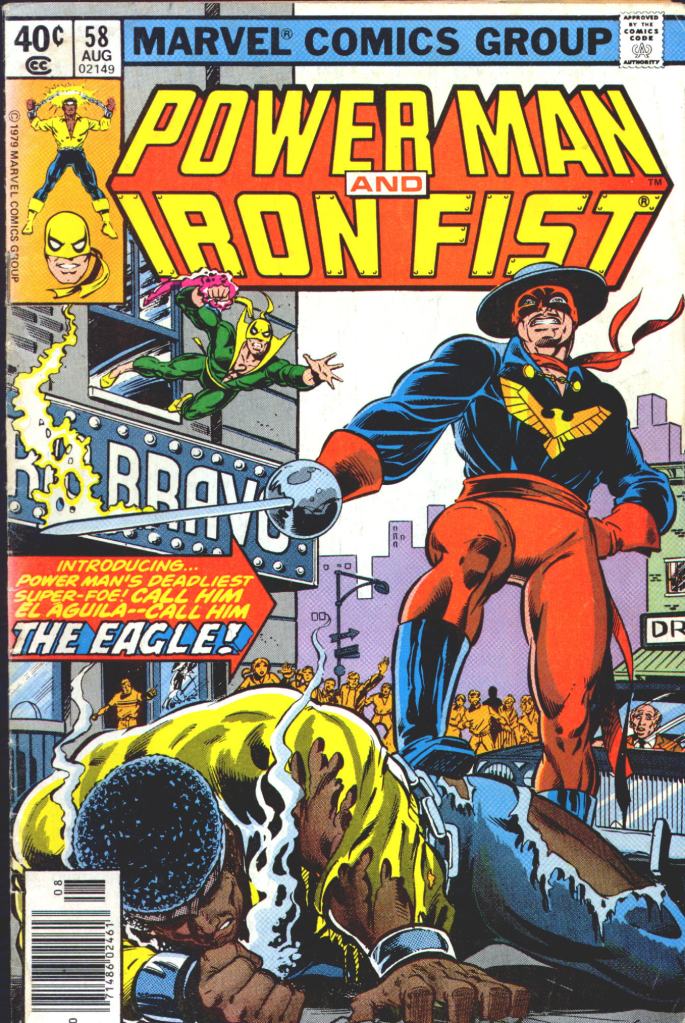
I had picked up POWER MAN AND IRON FIST #57 thanks to the guest appearance of the X-Men in that issue. But having cracked the seal, that meant that I almost automatically began buying the book regularly, even though I was only lukewarm on that prior issue. I had sampled an issue or two of both POWER MAN and IRON FIST in the past and found neither of them especially compelling. But I was getting to the point where I had more disposable income to play with and so it didn’t take much to get me to start following one more comic book series. As it happened, this infatuation with POWER MAN AND IRON FIST only lasted for a little over half a year, and I would wind up kicking it to the curb again, only checking it out occasionally when something of note was on its cover or filled its pages.
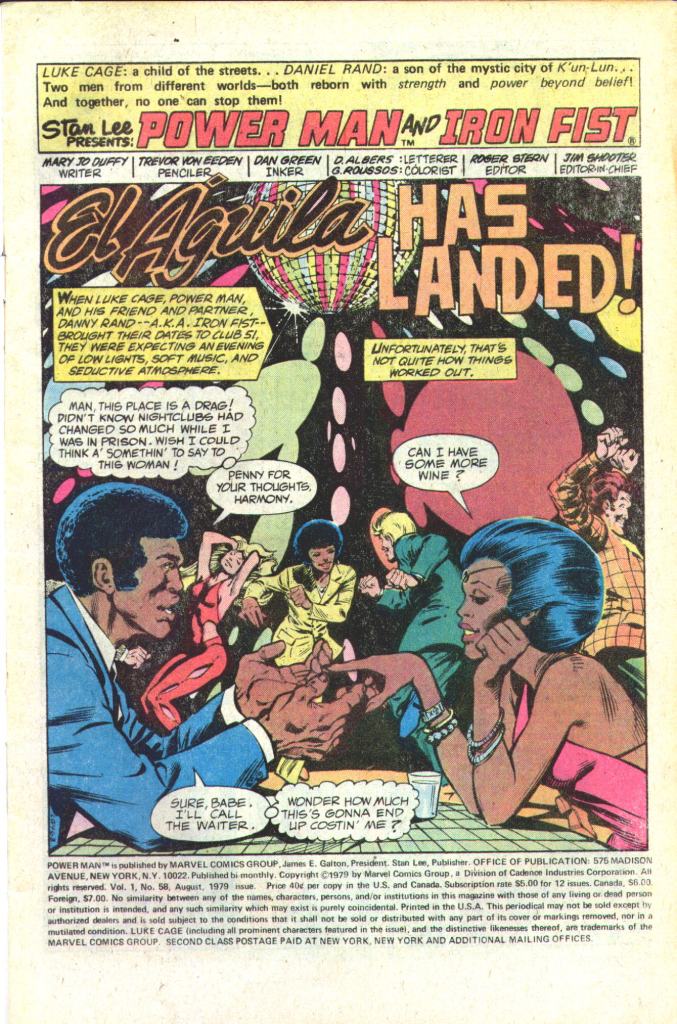
POWER MAN AND IRON FIST was at this point being written by Jo Duffy, who had succeeded Chris Claremont after he and John Byrne left the series to focus on their other assignments, principally X-MEN. She was a good fit for the book and brought an easygoing charm to Luke Cage and Danny Rand and their shared cast and world. And under her, the title began to perform better, with sales picking up. The artwork in this issue was done by Trevor Von Eeden, but it isn’t really a true accounting of his capabilities. In just a few years, he’d develop his style in wild graphic directions that made a bit of a small splash. But at this moment, and working for Jim Shooter’s Marvel that stressed six-panel pages and medium shot storytelling, his work was competent but undistinguished. Inker Dan Green gave it all a lovely polish.
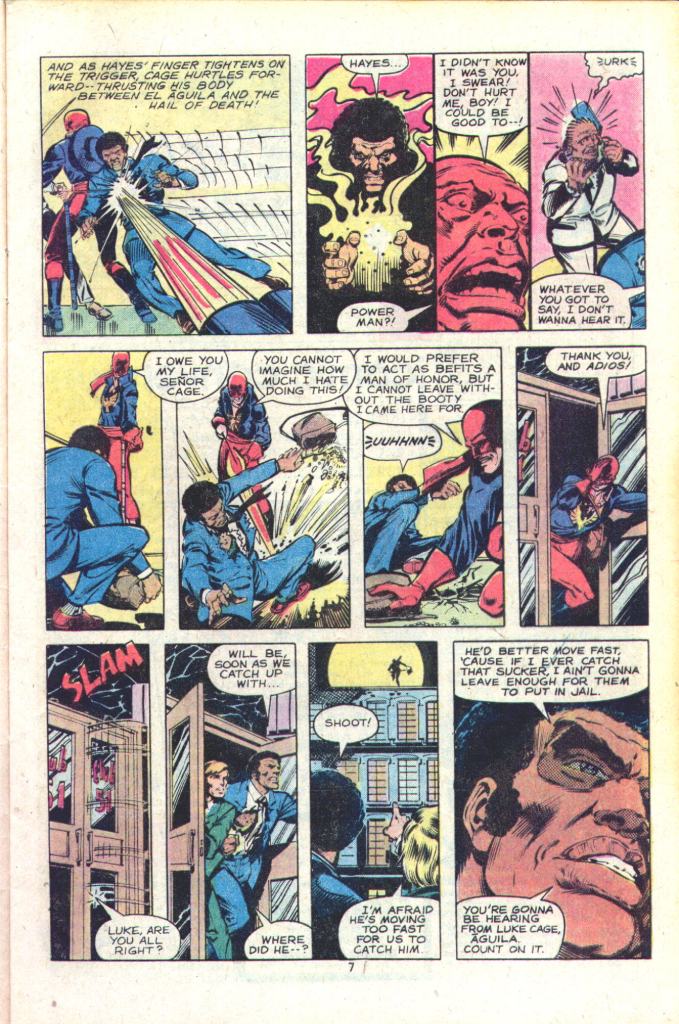
Von Eeden did tend to break his pages in this issue down into a far greater number of panels than six, whether in emulation of the kind of storytelling that Bernie Krigstein practiced or simply because he felt like Duffy’s plot had so much going on that he needed the extra space is tough to tell. But it meant that this issue was full of a lot of tiny panels conveying the action. The story opens with Luke and Danny enjoying a night out at a local disco. But their night, and those of the patrons, is interrupted by the arrival of a costumed vigilante, El Aguila. His target is a drug kingpin, Hayes, who is also at the disco. El Aguila is a Zorro-like crusader for justice, and he robs the druglord of his money and possessions but leaves everybody else untroubled. When Hayes’ men bring out artillery, Luke winds up saving El Aguila’s life–only for the masked man to strike him down with a zap-blast so that he can make his escape.
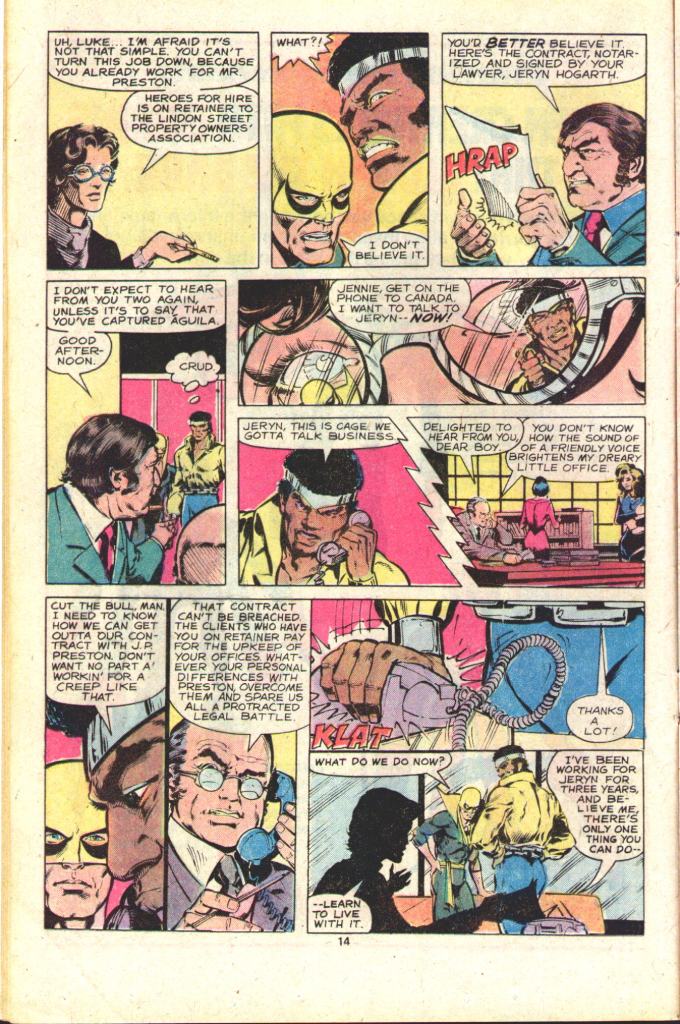
Over the course of the next few weeks, El Aguila makes his presence known in the neighborhood, striking out against slum lords and drug dealers and their ilk. Luke and Danny have an interest in taking him down due to their altercation at the club, but that interest steadily diminishes as they begin to learn of the scope of his activities. Unfortunately, it turns out that Heroes for Hire has been put on retainer by the local Property Owners’ Association in an ironclad and unbreakable contract. The Association members want to see El Aguila brought to justice, which means that Cage and the Fist have no choice but to try and bring him in.
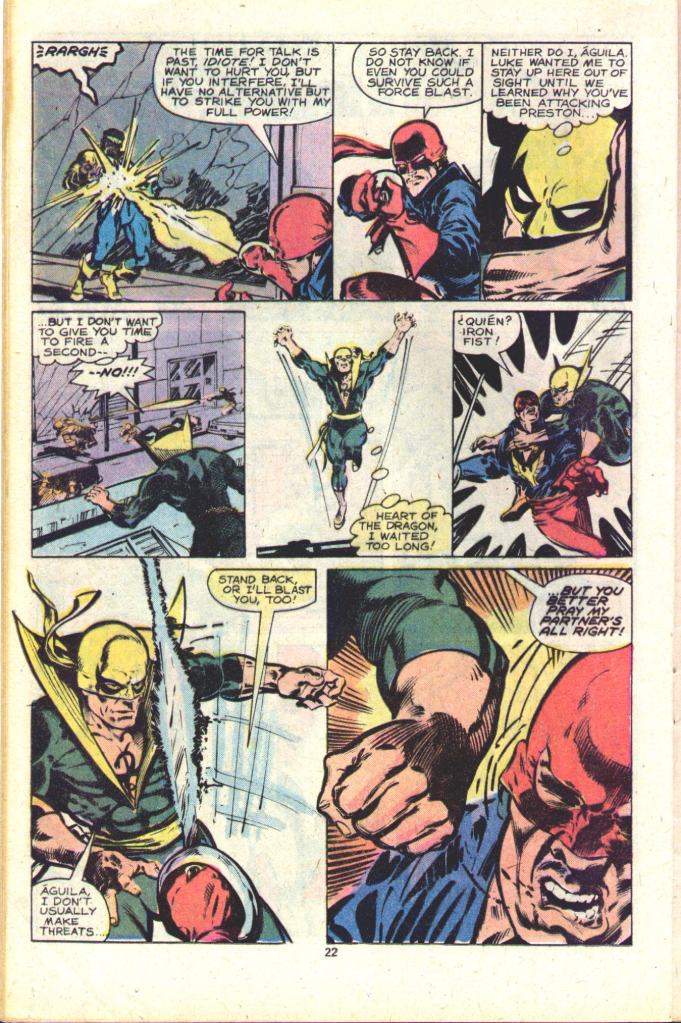
But despite their best efforts, Luke and Danny have little luck in tracking down El Aguila–he strikes and then disappears, and there doesn’t seem to be enough of a pattern to his activities to predict. Left with little other recourse, the team stakes out J.P. Preston, the head of the Property Association that hired them, figuring that it’s only a matter of time before El Aguila takes a shot at him. And eventually, they’re correct–El Aguila accosts Preston as he’s leaving his office, and attempts to relieve him of his valuables. Luke steps in at this point, but El Aguila drops him with a blast from his sword.
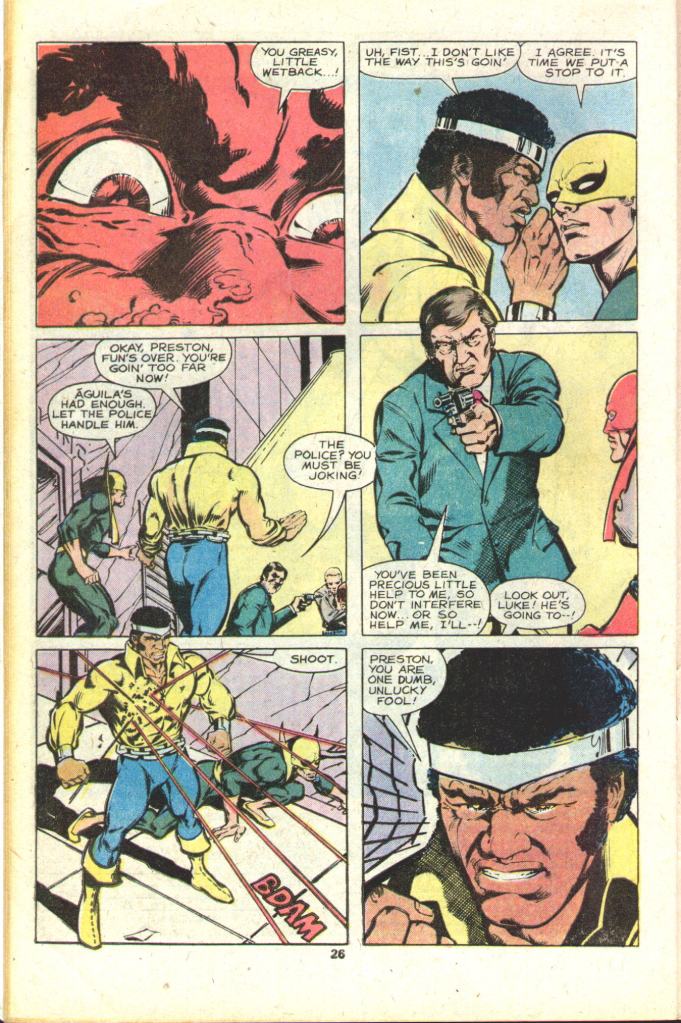
Leaping from cover, Iron Fist takes El Aguila down with a single well-placed strike, then moves to check on his partner. While he does so, Preston’s security detail of goons shows up, and at his direction, they begin to beat the hell out of the defeated El Aguila. A recovered Luke and Fist approach, telling Preston to back off and leave El Aguila to the cops, but the slumlord isn’t down with that kind of justice, and he pulls a pistol, shooting at Luke. Dumb move against a guy with bulletproof skin, as this only makes him mad. What’s more, El Aguila reveals that the electrical power he directs through his sword isn’t some mechanism but rather his own innate power, and in the confusion, he’s able to zap the thugs holding him.
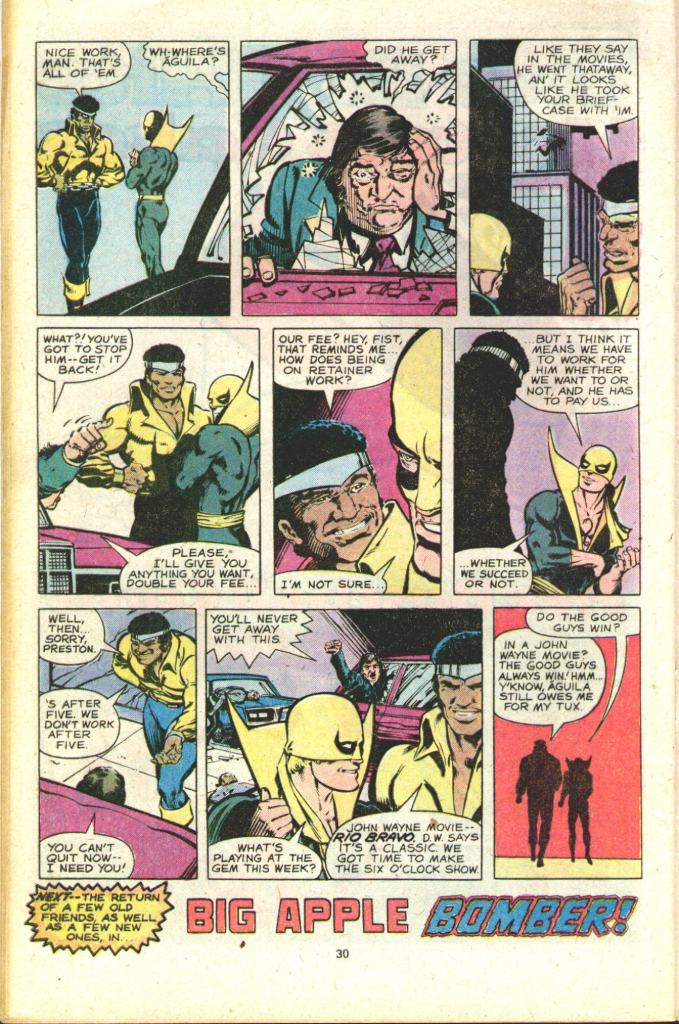
So El Aguila makes his escape–and he gets away with Preston’s briefcase and valuables in the bargain. Heroes for Hire is still under retainer from Preston, but Luke tells the man that it’s after five o’clock, so it’s officially quitting time, and he and Iron Fist let the vigilante go on his way unmolested. Given that Preston tried to shoot Cage just a moment ago, he gets off pretty easily here. But that’s the issue. It’s a nice, grounded story with relatively low stakes but an interesting moral conflict for our two heroes. But it wasn’t quite the sort of thing that I was into as a comic book reader of the time, so I can’t say it made a huge impact on me. I’d keep following the title for the next few months, but as nicely as it was being done, it wasn’t really for me.
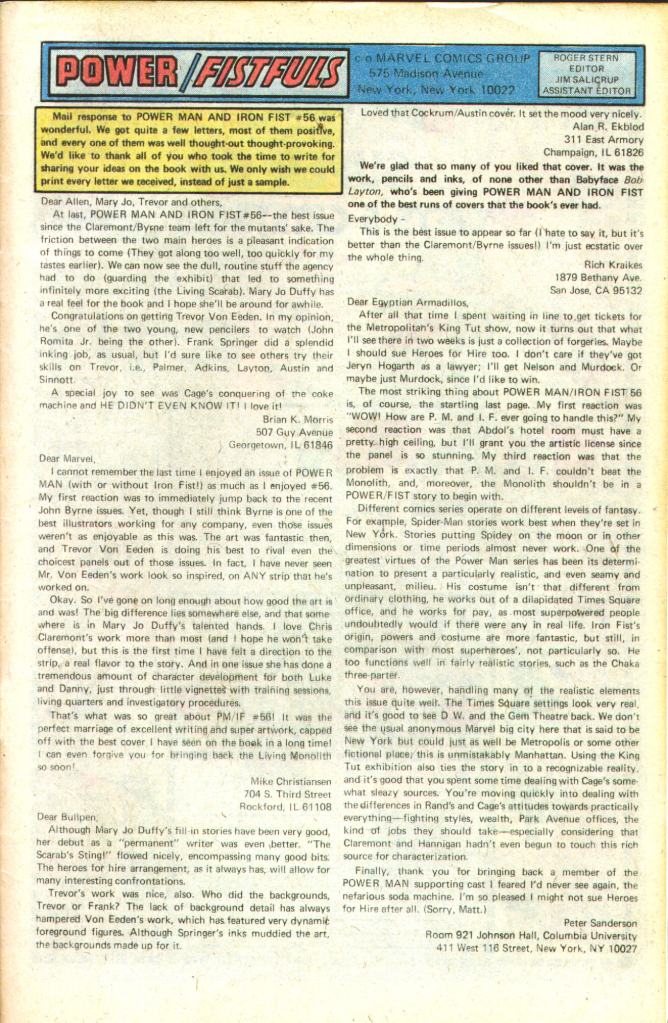
The Power/Fistfuls letters page this month included a correspondence from Peter Sanderson, future comic book historian and librarian for Marvel. Peter was a regular letter-writer during this period, and his missives were always long, well-written and thoughtful. You can see why the various creators and editors began to become familiar with who he was.
 The Tom Brevoort Experience
As a guy who grew up loving Zorro ( Hell I watched the female Zorro, the Queen of Swords TV series – 2000-2001 ), I was 100% for El Aguila. Hated that they dressed him like a Matador in the Disney Plus She-Hulk series and made him a buffoon like The Twelve did the Blue Blade. I looked forward to his appearances in the series like I would have Thunderbolt ( Bill Carver )’s had he not been killed off.
LikeLiked by 1 person
I think 6 panels on every Page is boring. I like these pages a lot. There are 1 or 2 of Trevor’s PM&IF that I wasn’t as into. But the story layout here is dynamic to me. Strong stuff. I especially like the figures & faces. IF’s mask is well drawn.
Trevor would leave the series after a handful if issues, correct? His subsequent work at DC would continue to get more experimental. His layouts bolder. So much that the great artist David Mazzucchelli would compliment him in an interview.
Trevor’s “Thriller” was an artistic breakthrough for him. Then his “World’s Finest” issues. Batman Annual # 8.
I was lucky enough to work with him during the 20-teens. And I wouldn’t have, obviously if he declined, but also if I hadn’t wanted to. I’d been a fan of his work since first seeing it in “Batman & the Outsiders” on a few fill-ins. Then I tried to find more of his work, wherever I could.
I like Dan Green’s inks here, too. Thick, smooth, & well lit, as usual. I wish they’d had more chances to work together. Larry Mahlstedt’s (apologies if I misspelled his last name) inks worked well over Trevor’s drawing, too. A little cleaner, sharper, & sometimes with that “ziptone” effect. I liked Bob Smith’s inks for fir Trevor, too.
And of course Trevor’s own inks. I’d’ve liked to’ve seen Bill Sienkewicz & Klaus Janson each get the chance to have inked Trevor’s drawings, too.
LikeLiked by 2 people
I was neither a Power Man nor an Iron Fist fan. Both were poor rip-offs of Blaxploitation and martial arts crazes, to me at least. But when they combined into working together, for some reason, that caught my interest. I guess it was because the racially stereotypical black foes Power Man faced and the martial arts foes Iron Fist faced … diminished? softened? allowed for other kinds of foes for them to face. Broadening their appeal.
I mean, what if Spider-Man only fought insect themed foes? That’s what Power Man and Iron Fist were doing prior to this, fighting one-themed foes. Gets boring fast. So I remember picking up a half dozen issues or so.
I may not be able to say this well but Power Man was nothing more than another racially stereotyped character, no different from black characters from the golden age with watermelon lips and getting scared white, in the fact that it is a racial stereotype.
Outside of Black Panther, who many make a fairly valid case, is nothing more than a black Phantom. Outside of him, almost every black hero is racially stereotyped.
Stereotype – Poor Angry Black Man from the Ghetto/Poor crime ridden side of town.
Either stays in the ghetto to fight crime like Power Man or returns to it, like Black Lightning [a character I liked more than Power Man], or becomes rich, like Steel, leaves the ghetto and only occasionally fights crime in the ghetto because his grandma still lives there and he wants her safe.
Heroes of this stereotype:
Power Man
Black Lightning
Steel
Cyborg – breaks the mold to an extent as he had a middle class/upper middle class upbringing but his dad, if memory serves, clawed his was out of the ghetto.
Falcon – angry black protestor from the ghetto, who was trained by Captain America while he was trapped in the Red Skull’s body, later becomes a social worker in the Ghetto.
Black Goliath – born in Watts, created at a time when the Watts Riots were fresh in everyone’s mind.
Tyroc —[[OH GAWWDD!!]] – a hero from an island of black racists humans, who migrated there centuries before, to escape the racism of the galaxy. The island usually is in a different dimension but sometimes appears on Earth. He applies for Legion membership and berates them for being a racist organization for whites only. Brainiac Five, Shadow Lass, Chameleon Boy are pointed out but he says that they are aliens so that doesn’t count, since the legion is made up of mostly white humans. Again, only a few members are human, the rest are from other planets that weren’t settled by humans or have evolve far enough away that they couldn’t really be considered human but their own individual race.
Only 7 Pre-Crisis LSH members were actually from Earth/Human. Saturn Girl from the Moon of Titan, shouldn’t be considered human as her people there lived long enough to mutate into people who all have mental powers.
Static Shock
Icon – doesn’t really count, once you find out his origin that he is a space alien who life support capsule crashes on Earth and part of its system is to make whoever is in it similar to the intelligent lifeforms near it. So out pops Icon as a black baby, in Pre-Civil War South, because he is surrounded by slaves picking cotton, now a slave baby.
His sidekick – Rocket
John Stewart, Green Lantern – first appearance, angry black teen protesting in the Ghetto.
Any others I missed? Any others that actually break this continual racial/social stereotype?
LikeLike
The Legion was not white, like Superman is not white. Yes, he’s not human. But if you look at him, he’s white. Same thing with much of the Legion, and almost all the ones with nonhuman skin tone (Brainaic 5, Shadow Lass) look like white people wearing makeup. Chameleon Boy being the only even debatable exception (token Asian?). Karate Kid was half-Japanese, but that tended not be visible.
Icon is a Black Conservative. They do exist. Dwayne McDuffie talked about it.
https://web.archive.org/web/20010527032512/http://www.psycomic.com/columns/2000/dmcduffie/20001206dmcduffie.shtml
LikeLike
I guess Dwayne McDuffie shared your opinion of Luke Cage when he co-created Buck Wild ( Luke Cage blaxploitation parody — comics.org words ) in Icon#13 ( May 1994 ).
LikeLike
I liked Static Shock and Icon when they first came out. I was not at all thrilled with Rocket and never warmed up to her. Big fan of the Static Shock cartoon as well. Liked that Icon was a conservative black man, until I find out he’s not human but an alien from another planet, shapeshifted into a black baby but still conservative. So he basically lived two lives. One growing and maturing as the alien Arnus, the other growing and maturing as Augustus Freeman. Isekai!
The official poverty rate of the U.S. Black population reached a historic low of 17.1% in 2022, according to U.S. Census Bureau data released. Estimates from the Current Population Survey Annual Social and Economic Supplement (CPS ASEC) show the Black population was one of the only major demographic groups to experience a significant change in poverty between 2021 and 2022. 19.5% in 2021. The official poverty rate for the nation was 11.5%, unchanged from 2021.
So over 80% of Black Americans live ABOVE the poverty line.
Here’s an idea to check if you have unaware racism. Take the original Wildcat from DC comics. Ted Grant. Heavyweight Boxing Champion of the World. College Graduate, who couldn’t find work after graduating. Gets a break when helping current Heavyweight champ when the Champ and his fiance are being mugged. Helps to fight the crooks off. Given a job as the Champ’s sparring partner and then starts getting his own fights and works his way up the ranks until he is ready to face the Champ, his friend, for the title. The crooked managers for the two of them place a drugged hyperdermic needle into Ted’s glove after a certain number of rounds, so that they can make a killing on illegal bets against the Champ. The drug kills the Champ, Ted is the prime suspect when the needle is found. He runs and becomes Wildcat to prove his innocence.
That’s his origin in Sensation Comics 1.
Now, make him black, then yellow, then brown and then red.
What do you think has to be changed because of the change in skin color? Is he going to talk differenly. Is he going to dress differently? Why? Why does making him a different color mean he has to be rewritten? It shouldn’t. Not one bit. Lots of Americans of all colors, dress and talk the same. Have the same beliefs. Have the same love for their country.
Sorry, I really didn’t mean to make this a social studies on racism thing.
When will people stop making Black Heroes and will instead make heroes who just happen to be black and its never brought up because it is acceptable.?
Hey Tom! Why don’t you talk about one of the great super-heroes of the 1960s soon? I am referring to Fatman, the Human Flying Saucer! Once upon a time, I had all three issues.
and again, sorry to Soapbox here.
LikeLike
Dmcmahon:
“What do you think has to be changed because of the change in skin color? Is he going to talk differenly. Is he going to dress differently? Why? Why does making him a different color mean he has to be rewritten? It shouldn’t. Not one bit.”
Sure, it should, though not necessarily in the ways you imagine.
Ted Grant, in 1942, as a white man born in, let’s say 1918, would have had a very different childhood from a Black man born in 1918, in terms of the people around him, their life experiences — and his life experiences, from educational opportunities to public acceptance and more. A Black man dressing up as a jungle cat and beating people up is going to get a different response from the police and from onlookers. He’ll have had a different life, which will make him a different person; Black characters aren’t simply white characters painted brown.
The same for Asian Americans, Hispanics and Native Americans. Who they are will depend of where they came from, how they were raised, and how the world treats them. That’s how people get formed.
They won’t all have the same precise experience, any more than white people all have the same experience. But their experience will be formed by how the world around them views them.
“When will people stop making Black Heroes and will instead make heroes who just happen to be black and its never brought up because it is acceptable.?”
Because race, like class, gender, religion, area of childhood and more, aren’t just things that “happen to be” and have no effect on people. Black kids grow up with a different awareness of the world than white kids, just as women grow up with a different awareness from men.
Look at how Black kids with toy guns are treated versus white kids with real guns.
Comic book characters should be written like people. People are individuals. They’ll be shaped by many things, including race and racism. Lots of Black characters have been written as stereotypes in the past, and that shouldn’t happen — but at the same time, they shouldn’t be written as if they’re white and just got colored funny.
They should be written with an awareness of how they grew up, how they were treated and how they react to it. Which is also how white characters should be written, but their life experiences will have been shaped by different factors.
LikeLiked by 2 people
@Kurt Busiek. Great points. Well-said. If there was an applause emoji, I’d’ve used it.
LikeLike
What are your thoughts on Bloodwynd [ Justice League America#61 ( April 1992 ) ]? I remember thinking when I read this issue that I wished Icon had his costume, cause then I would have bought Icon ( Hated his costume ). Wikipedia said fans panned his named as well as his reduced roles ( “underdeveloped” and fade into obscurity ).
LikeLike
I would wager that letter column lalso has Brian K Morris that does writing for Twomorrows magazine and occasional comic stories and articles. I used to hang out with Brian when I was doing a lot of Illinois comic shows selling comics and the like in the 90’s. Awesome to see him still in the industry!
LikeLike
A fair criticism by and large. However:
“Falcon – angry black protestor from the ghetto” Um, since when? The Falcon wasn’t at all angry and not a protester. Just a social worker trying to help out.
I’d argue John Stewart starts out looking like angry black man but he proves himself level-headed — and ultimately he’s right about the case they’re working on where Hal is wrong across the board (stands out from the usual efforts to both-sides social protest). I’m not a fan of the O’Neil/Adams GL run but that issue stood out.
IIRC Night Thrasher came from money (I can’t swear to it). The black executive in Damage Control was pointedly shown to be upper middle-class and very, very pissed when Damage Control the Movie portrayed him as a street-smart ghetto type (damn, I miss Dwayne McDuffie).
LikeLiked by 1 person
Night Thrasher did come from money. He’s essentially Batman with a skateboard but somehow Fabian Nicieza made it work.
LikeLike
Remarkably he did. Thanks for confirming my memory.
LikeLike
I followed Iron Fist and Power Man here from their solo titles and I have to say, Duffy left me cold. I remembered El Aguila when I read this post but hadn’t thought of him in years. I also can’t name one plot or antagonists from this era. I think this title was one of the first that broke my completism.
LikeLike
I don’t think Von Eeden is using lots of panels here because Jo’s plot is dense — Kerry Gammill had no problem doing more open pages from Jo’s plots, after all, and Von Eeden clearly liked doing many-paneled pages, given that he’d break up Mike Barr’s very straightforward Green Arrow scripts into many moment-to-moment panels, and THRILLER was an absolute showcase of that kind of storytelling.
I expect Jim Shooter was trying to get him to tell the story more conventionally, but Von Eeden couldn’t hold off completely from doing it his way.
I enjoyed this book — and when Kerry arrived, it rapidly became my favorite Marvel book of the era. I even wrote a review for…COMICS FEATURE, I think, raving about it in detail, and wrapping up by saying that someday, Jo would leave the book and I couldn’t imagine who they’d get to take over who could do as good a job; I’d certainly have no idea what to do.
I think that review came out shortly after I wound up writing the book, having no idea what to do and not doing nearly as good a job as Jo.
So I was right!
LikeLiked by 2 people
PM/IF is one of three long running Marvel books that never grabbed me, the others being Master Of Kung Fu and Daredevil (Miller having come and gone before I ever noticed the book.) I’m guessing because all three seemed to have limited interaction with the rest of the MU, especially MOKF. Miller’s DD back issues were prohibitively expensive in those days before trades and the couple issues around his that I picked up were nothing to write home about.
LikeLike
As I understand it, there were 3 different people that were Bloodwynd, including the Martian Manhunter. So while the costume looked fairly interesting, the character was complete confusion. Was he some kind of Master of Magic? Did he use his superpowers and pretend that they were magical? Or something else?
But at least he didn’t have the big armored shoulders pad that were the craze of 90s heroes!
LikeLike
Never read MOKF, though I saw the comics in the stores. I did pick up some back issues cheap years later thought it was kind of interesting he was fighting Fu Manchu, who I had become aware of around the same time.
I was a DC kid, didn’t like that soap opera stuff Marvel was shoving out. But as my income increased, going from being a paperboy to fast food employee, I started looking over Marvel Comics.
I remember picking up Daredevil’s title when it was Daredevil and The Black Widow. I remember Angar the Screamer. So around issue 100 or so when I started reading it more or less faithfully. Knew nothing about either character until then.
I picked up Spider-Man after the death of Gwen Stacy, so had no idea who she was so around issue 125 plus or minus.
I started reading the Avengers with issue 102. I was really drawn by the art.
I picked up X-Men when it was in reprint mode, so around issue 78.
I don’t really remember much about the Fantastic Four’s book. Though I do remember Reed shooting his son, Franklin, with a huge energy gun so his powers wouldn’t go out of control and destroy the world and maybe the galaxy. For some reason, Sue was really upset about that and left Reed for awhile. And they had Agatha Harkness as their governess to watch over Franklin.
I remember buying the original Guardians of the Galaxy’s books, with Vance Astro and gang, and liking them but not so much that I would check a dozen 7-11s or liquor stores to find the next issue. Yeah I had a weekly route riding my 10-speed to every 7-11 and liquor store in about a 5 mile radius of my house.
It’s amazing what we will still remember or misremember of comics that impacted us, 4-5 decades later!
LikeLiked by 1 person
Liquor stores sold comic books in the 1970s-80s? Either I never noticed this somehow or that wasn’t happening here in Columbus, Georgia.
LikeLike
For any speakers of Espanol out there, I was always thrown by the name, “El Aguila”, “the Eagle”. Wouldn’t a male eagle would be El Aguilo, or maybe El Aguile? And a female eagle would be La Aguila?
LikeLike
Google: COLLINS DICTIONARY — El Aguila. Although it’s a feminine noun, remember that you use el and un with aguila. SPANISHDICTIONARY.COM — Eagle (animal ) -1.a. El Aguila (F). I guess for some reason feminine words are used, Die Grosshorn Eule ( Great Horned Owl — mistranslated by Tarantula as The Horned Owl ( Der Uhu — Google says this should be Die Uhu ) –dc.fandom.com )[ Young All-Stars#1 ( June 1987 ) Nazi Batman ] –die is the feminine for The and Der is masculine for The in German
LikeLiked by 1 person
Muchas gracias, John!
I happened to get a call from a coworker originally from Puerto Rico, who speaks Spanish, English, & Portuguese. His wife is from Brazil (she speaks all three languages, too).
And he told me the same as you. It’s “El Aguila” en Espanol. But he put the pronunciation emphasis on the first syllable. “AHguila”. I was wrongly saying “Ah-GUEE-la”.
I remember the Great Horned Owl &, I think, his sidekick, der Flautermouse. I probably misspelled that. But I think it’s “bat” (“flying mouse”). Father & son Nazis in Axis America, in Roy Thomas’s “Young All-Stars”.
Along with a bald (scarred?) Ubermensch, a Valkyrie, der Seawolf, der Zyklon (“cyclone”, super speedster), and Usil (Italian “sun” archer).
“Super fiends”, since they’re derived from the fab 5 who made up the core of the Super Friends TV cartoon line-up.
This was after “Crisis” (CoIE) reduced the DCU to one Earth. (Or just no more “multiverse”.) The JSA & All-Star Squadron came before the JLA in the new shared timeline.
So Superman, Batman & Robin weren’t around during WW2. Jay Garrick was Flash & Alan Scott was Green Lantern in the JSA.
*whew*
LikeLike
It’s worth pointing out that El Aguila was created by Dave Cockrum because he was a huge fan of Zorro. Jo Duffy saw his presentation piece, liked it, asked if she could use the character in PM/IF, and he said sure. Trevor Von Eeden then drew the issue. Pretty sure she added the electrical power, which was then later explained by him being a mutant, which is fitting, given he’s really a Dave Cockrum creation.
LikeLiked by 2 people