

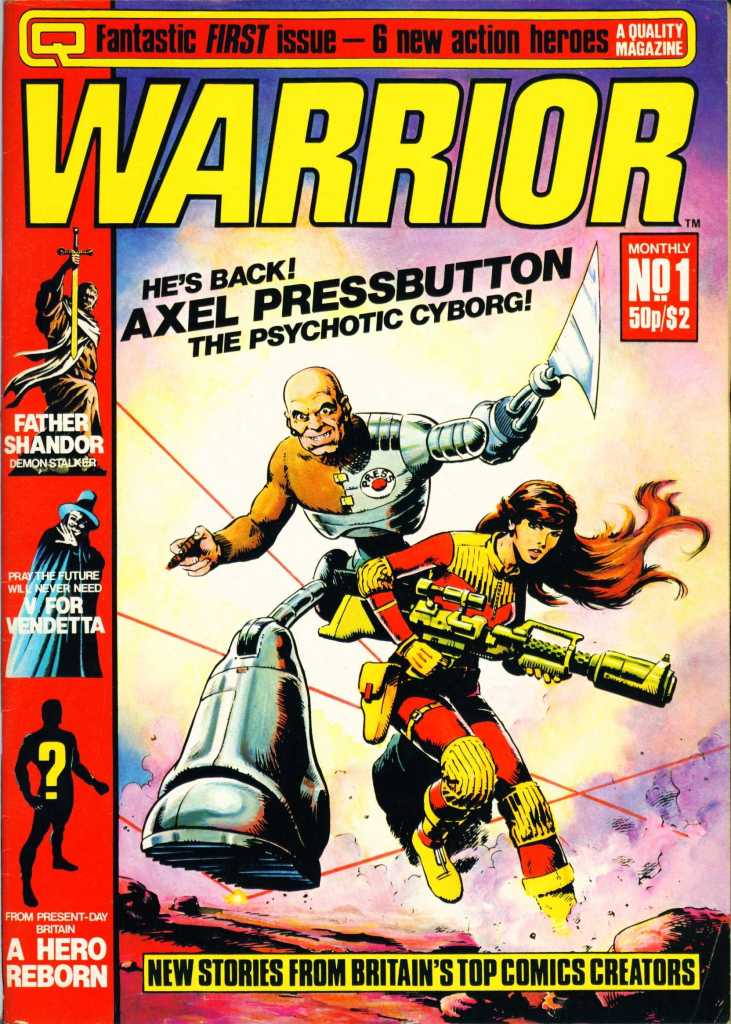
I don’t remember why or what for at this late date, but at some point in early 1982 my family had cause to go back out to Long Island, New York where we had once lived for some bit of business–maybe it had something to do with the sale of our old house to its new owners. For whatever reason, this gave me the opportunity to pop into Port Comics in the Suffolk collectibles building in Medford. Port Comics had been my home comic book store for the past couple of years, so I was happy to be able to visit the place once again. As had been the case in the past, in addition to the typical Marvel and DC offerings of the day, Port also stocked a comic that I had never seen before. It was magazine-sized and clearly from the United Kingdom. I didn’t know who Axel Pressbutton was or where he was returning from, but I paid my two bucks to find out. This turned out, in retrospect, to be a very important purchase in my comic book reading career, as it represents the first time that I encountered the work of writer Alan Moore, who would change the game for me and so many others.
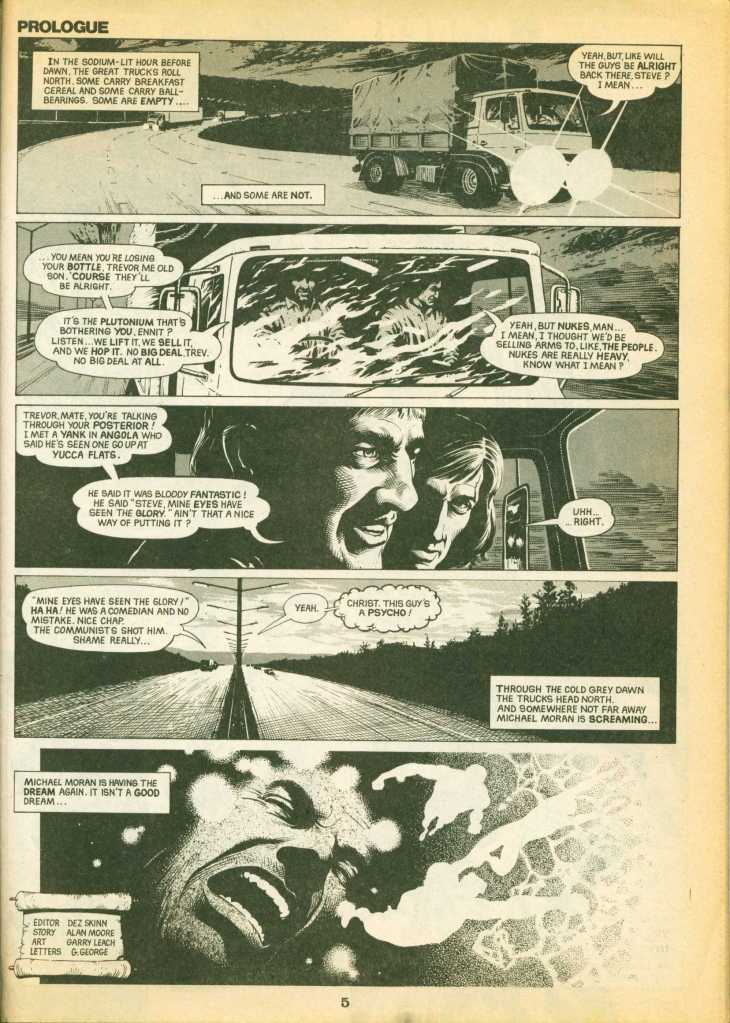
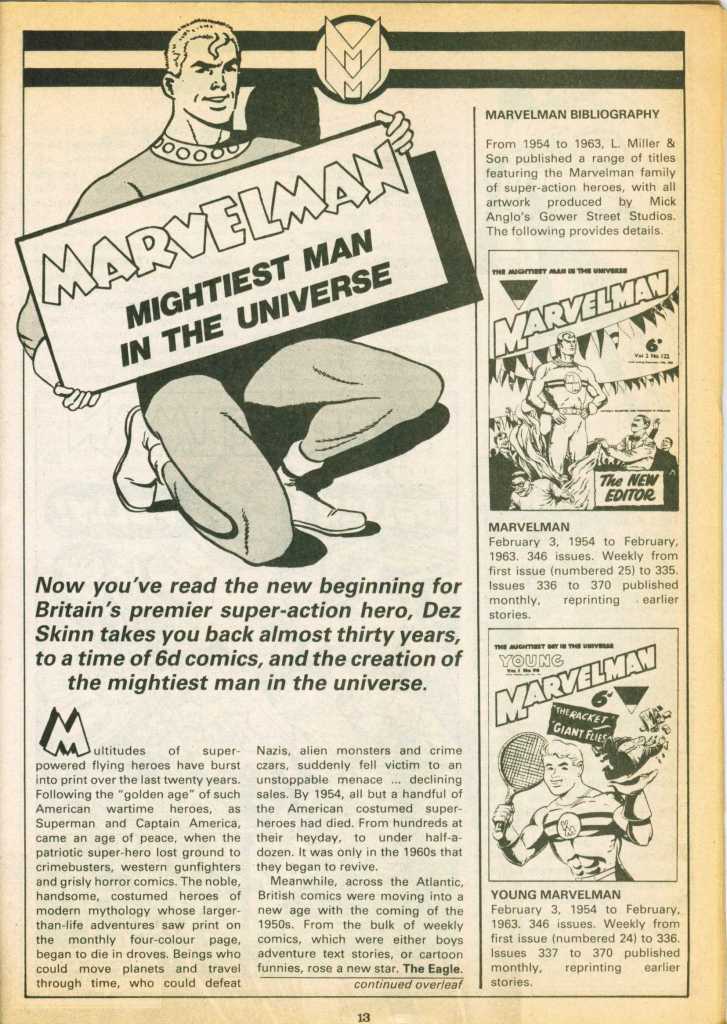
Launched by the somewhat-controversial Dez Skinn, WARRIOR was an attempt to produce a more upscale and adult-oriented comic magazine than the weekly papers that still made up most of the scene in the UK. It was an anthology of very fine work, not all of which I appreciated entirely at the time. But it was the Alan Moore stories that really stuck with me. I didn’t know anything about Marvelman before I opened up this debut issue, but in eight pages, Moore and collaborator Garry Leach made him seem incredibly interesting. The artwork was sharp and the approach grounded and modern–though not yet quite what the strip would eventually become. It was the revival of a character who had been conceived as a replacement for the Fawcett Captain Marvel when the latter was sued out of existence in the early 1950s by DC Comics. Helpfully, this firs issue of WARRIOR included a history of the character that ran right after his debut resurrection story, which helped to give me some context.
For all that, it still read like any number of super hero revivals that I’d seen in the past, most notably the return of Captain America in AVENGERS #4. And while the strip was treated with verisimilitude, there wasn’t yet enough to differentiate it from the rank-and-file super hero comics that I was then following to truly make it stand out. So I liked it, but not enough to relentlessly track down additional issues of WARRIOR until some time later.
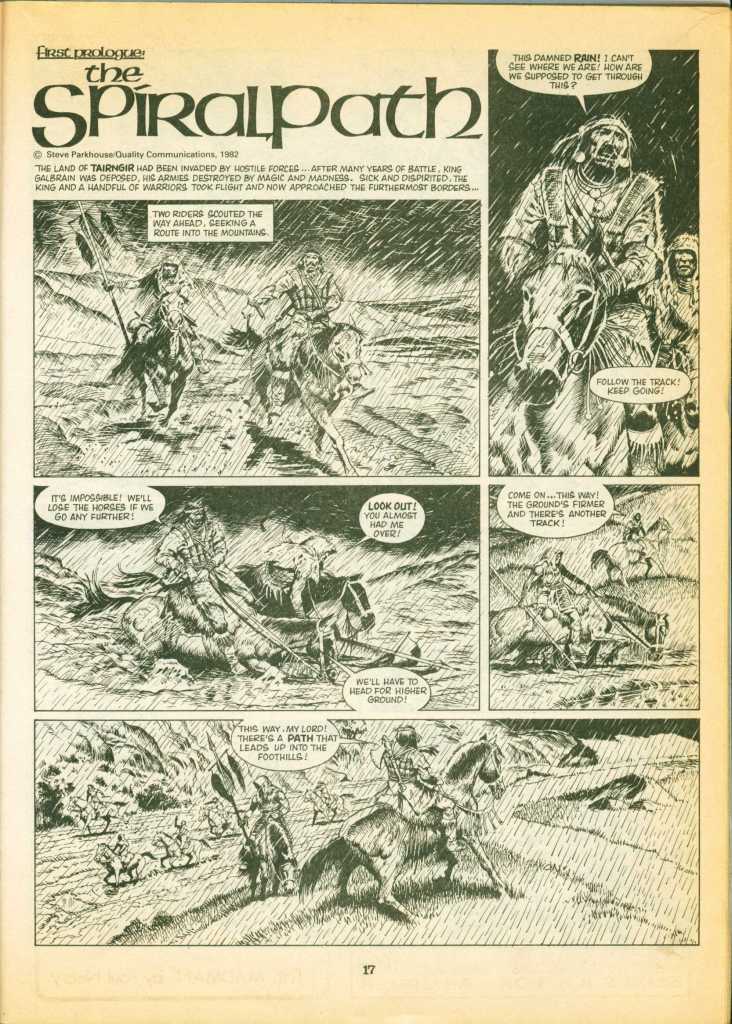
The remainder of WARRIOR #1’s stories were of varying degrees of interest to my still mostly super hero-loving self. Next up was Steve Parkhouse’s The Spiral Path, a sword-and-sorcery epic with some lovely black and white art. But I had never been a devotee of that genre, and so while I read the story, I didn’t have any strong opinion on it. It certainly didn’t grab me enough to want to seek out more.
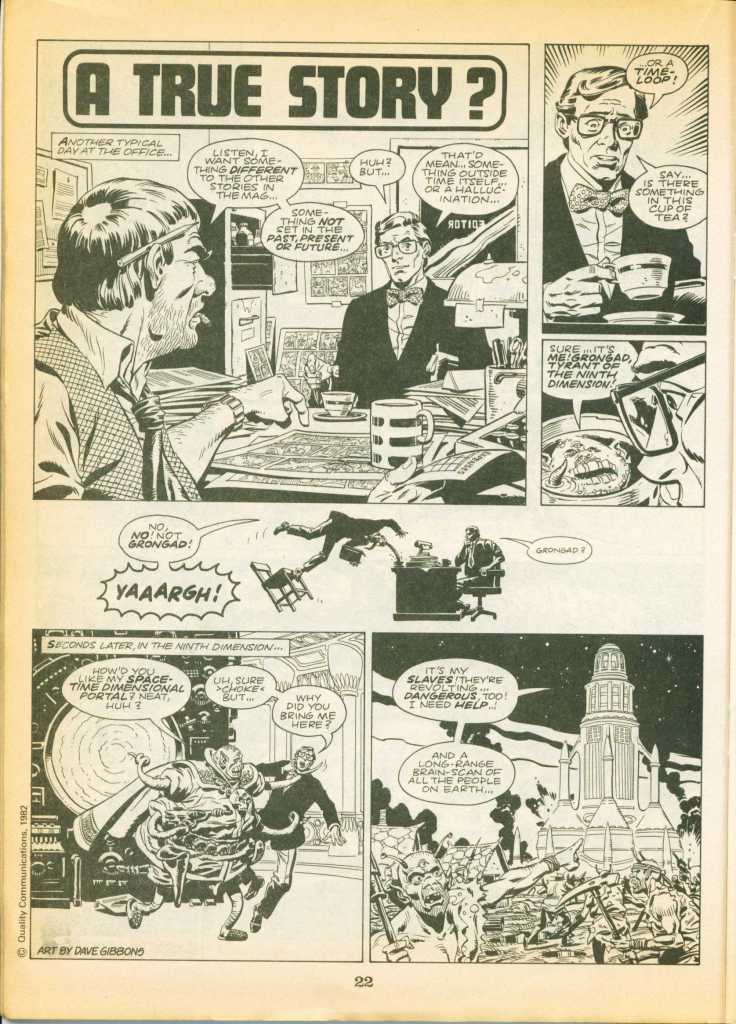
Next came a two-page one-off filler strip by Steve Moore and Dave Gibbons, one that had some of the flavor of Tharg’s future Shocks over in 2000 AD (not that I was familiar with 2000 AD at the time I first read this.) It’s an absurdist circuitous tale that ends up being a time loop that never ends, and it’s quite attractively illustrated by Gibbons. So it was fun, and I liked it.
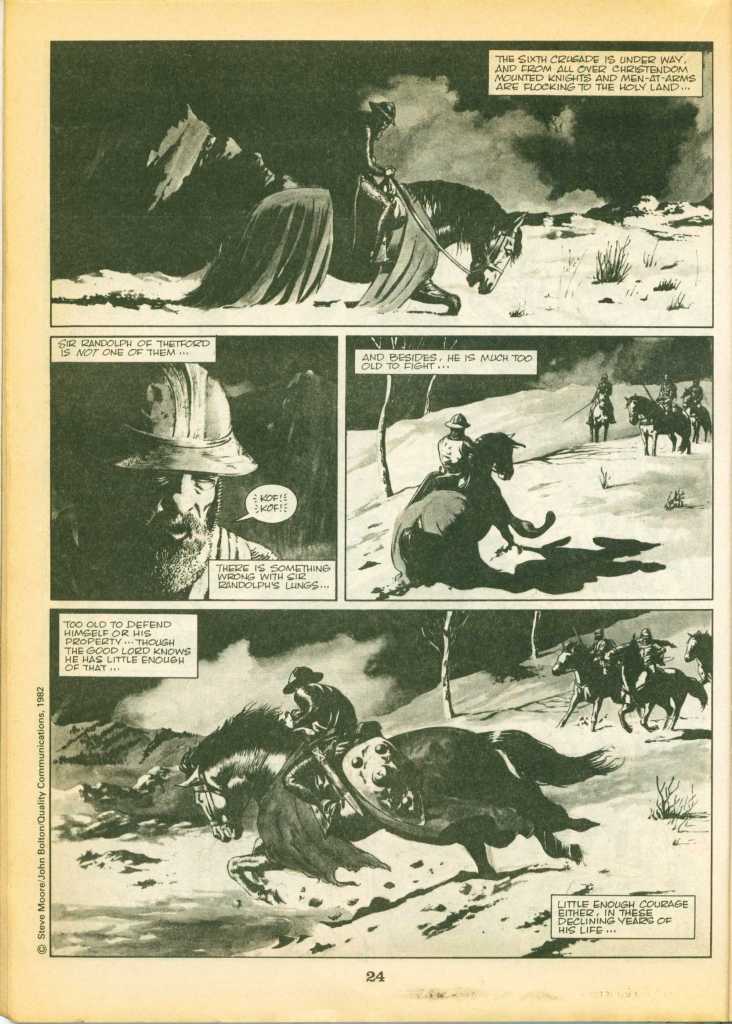
Next came The Legend of Prester John, a historical adventure strip of the sort that once littered the landscape of UK boys’ comics. It was done by Steve Moore and John Bolton, and it was exquisitely drawn. But just as I never clicked with sword and sorcery stories, so too did historicals feel like more of the same, just with the interesting bits shaved off. So I could, and did, appreciate the craft on display in this work, but it left me cold and uninvolved. I looked at the pictures more than I took in the story, if you see what I mean. But it’s really lovely black and white work.
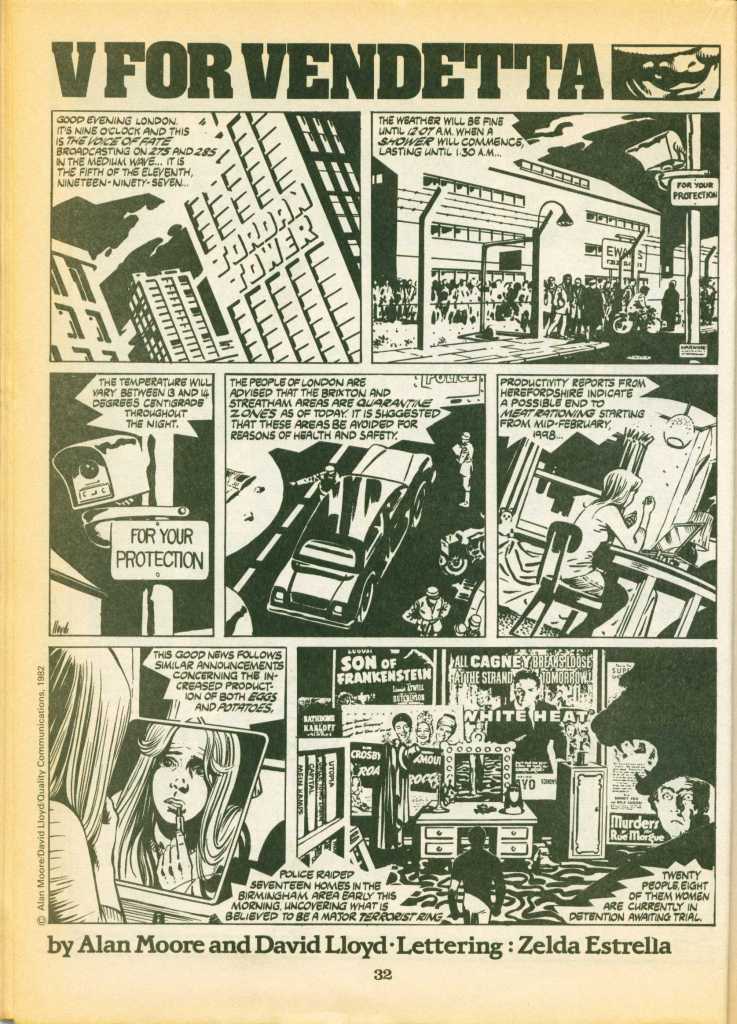
Of greater interest to me was V for Vendetta, also by Alan Moore in conjunction with illustrator David Lloyd. It told of a futuristic dystopia, but in the person of the Guy Fawkes mask-wearing V, it came with a heroic lead that I could connect with in the manner of a super hero strip. Also attractive was Lloyd’s sharp use of black and white without any shades of gray in-between them. I still find the color editions of V FOR VENDETTA to feel just a bit wrong to me; it was a strip designed for black and white. The strip had a nasty edge to it, one that I didn’t entirely get at the time when I first read this initial installment. But I enjoyed it.
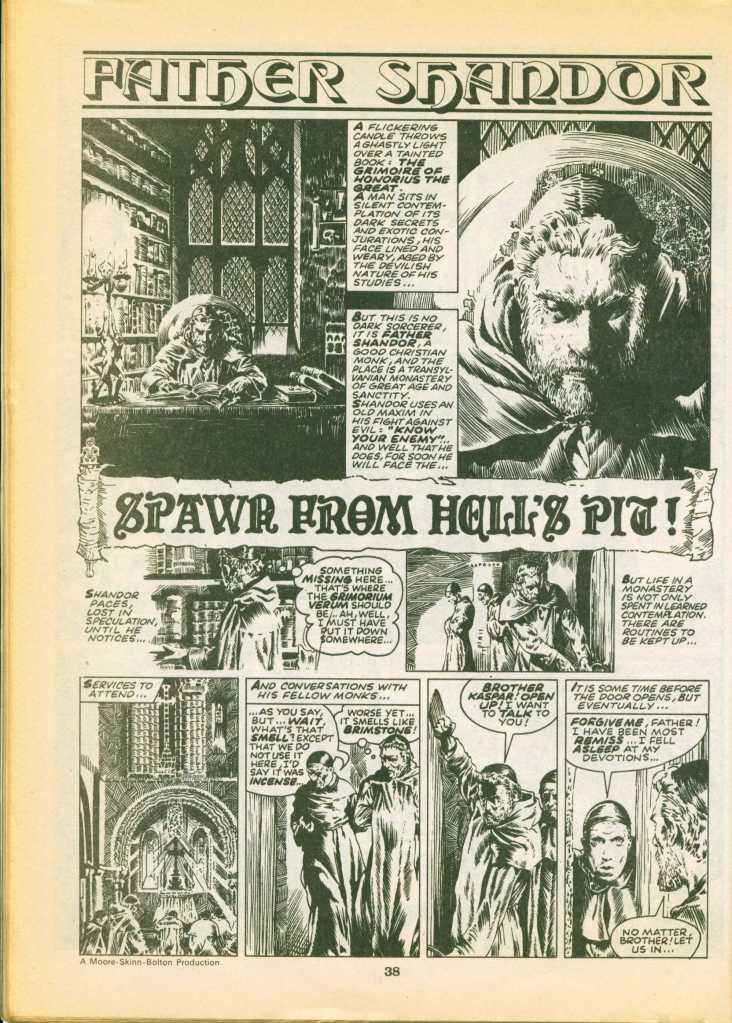
Thererafter, another Steve Moore and John Bolton historical series, Father Shandor. It too was of limited interest to me despite the fact that it concerned a priest battling demons and the like. What was interesting to me is that Bolton illustrated Father Shandor in a much more linear fashion than the wash-heavy Prestor John, which gave each one a distinct flavor despite coming from the same hand. That said, it didn’t do anything for me.
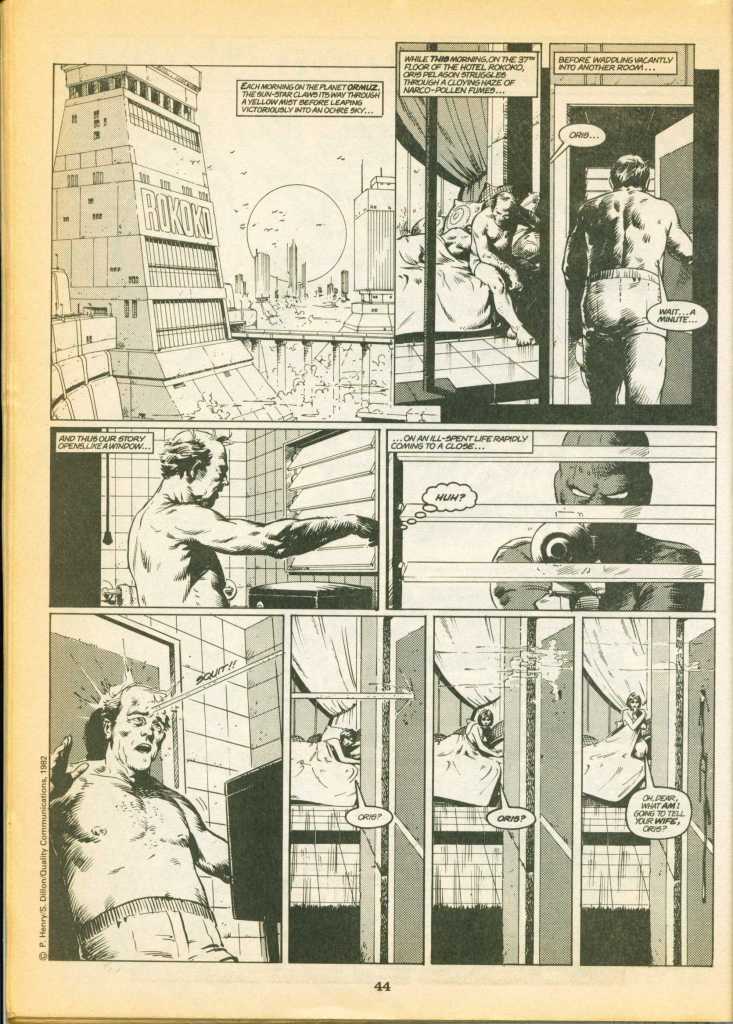
But I did like the final strip in WARRIOR #1, the much more conventional Laser Eraser and Pressbutton by Pedro Henry and a young Steve Dillon. It was about a pair of hitmen for hire in the world of tomorrow. Dillon drew it in his typical clean fashion, and its storytelling was on point, so I enjoyed it. And for its reputation, it wasn’t really all that graphic or violent a strip at all, not in this initial outing. I didn’t know that Pressbutton, the psychotic cyborg, had originated in a strip that Alan Moore both wrote and drew for a music magazine under the pen name Curt Vile. But Moore was the link between the three series that had made an impact on me.
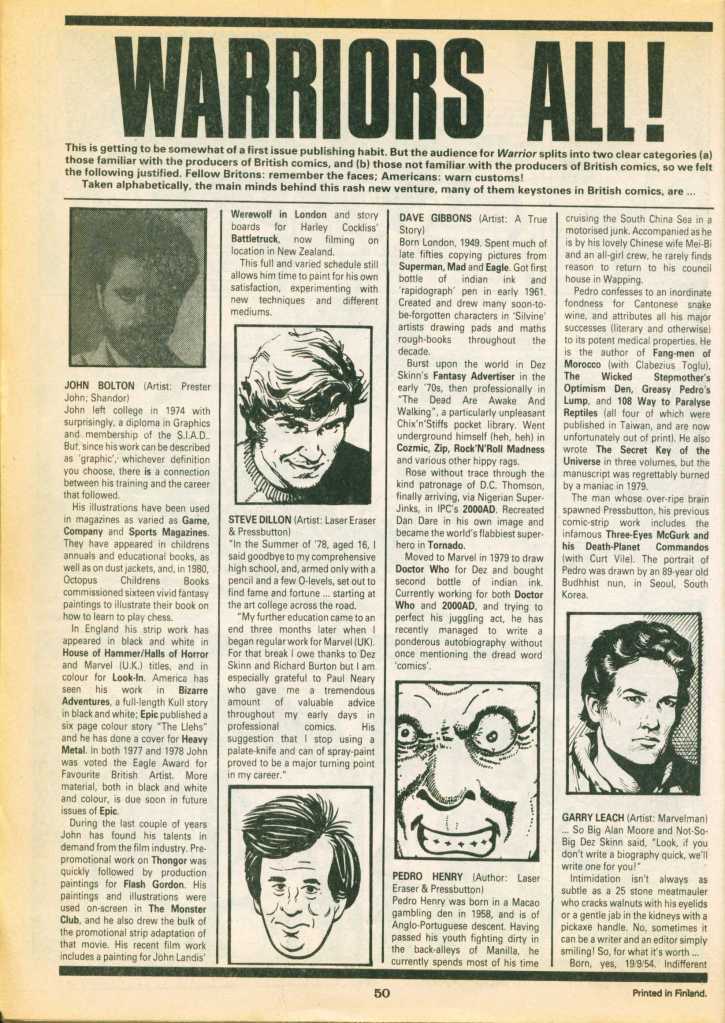
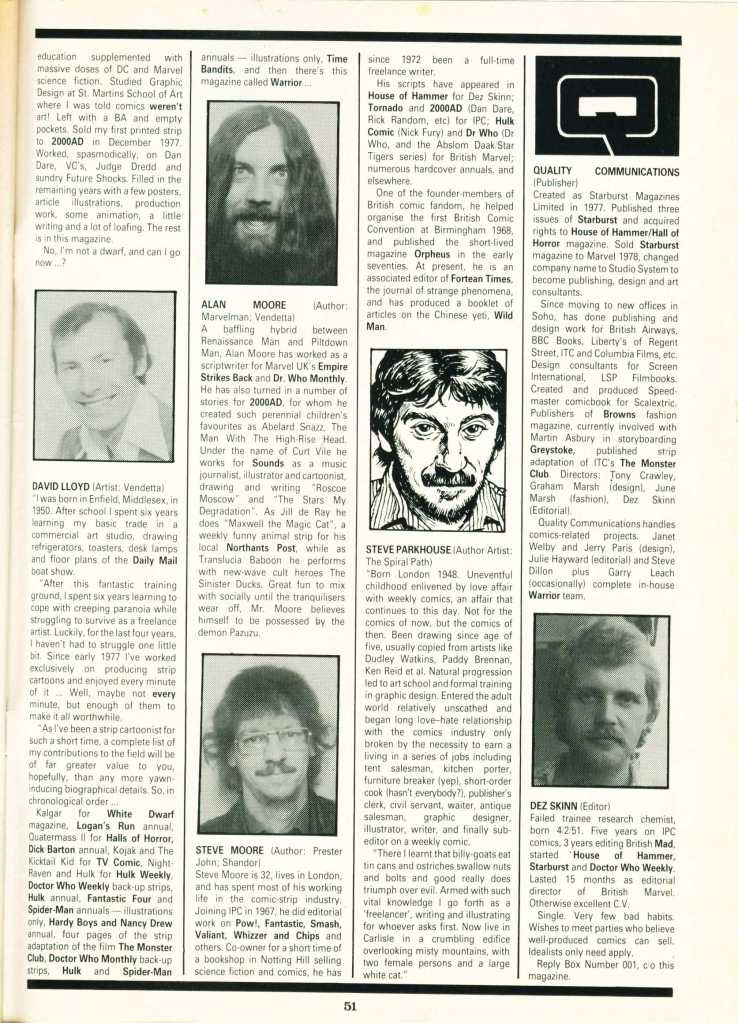
I wouldn’t see another issue of WARRIOR for some time, as I was still at a remote distance from even the closest comic shop in Delaware. But I’d eventually go all-in on tracking down the entirety of the run, even before much of it came over to the U.S. in reprinted form (mostly through Eclipse Comics)
 The Tom Brevoort Experience
Milestone. Writers & artists who’d change the industry, and even lead to a big budget movie. Alan Moore, for sure, would change how comic books would be written, and raise the expectations for many readers forever. I also read Steve Moore stories almost up until his sad death almost 12 years ago. As well as Steve Parkhouse, Dave Gibbons, and Garry Leach (until almost 20 years ago, and he passed away in 2022). The series would go on to introduce several other comic book biz luminaries.
LikeLike
Back when Moore was first making a name for himself in America with SWAMP THING, I was discussing his work with a local comic shop owner, and wondering where the heck this guy had come from. The owner mentioned he had some copies of WARRIOR, and offered to sell them to me for cover price. I’m still kicking myself for not taking him up on that one!
LikeLiked by 1 person
I didn’t see an issue of WARRIOR until later on, so I was coming into the stories midway, and couldn’t make head or tail of most of them — especially not V For Vendetta. But I liked Marvelman, and bought a couple more issues, I think. Not sequential, though, so I didn’t get any less lost.
I didn’t really catch up until they started getting reprinted in the US.
LikeLike
WARRIOR was the first of three new titles around this time that completely altered my idea of what could be done in comics – the other two being ESCAPE MAGAZINE and LOVE AND ROCKETS.
This first issue included more filler than I remembered, but that’s more than made up for by Alan Moore’s two contributions. Marvelman is the work of a promising beginner, though it would improve very quickly. (Garry Leach’s art was outstanding from the very first page, of course.)
V For Vendetta, though, hit the spot right from the start. Its then-futuristic ‘90s dystopian setting, portrayed with a mixture of ‘50s noir and ‘60s kitchen sink drama, was the perfect vehicle for an allegory for ‘80s Britain. Much of Moore’s work, while brilliant, is self-consciously playing with the paradigm of whatever genre he’s dipping into at that moment. V stands up as his sincerest, most heartfelt work. And David Lloyd was the perfect collaborator – as you say, Tom, it looks far better in black and white.
WARRIOR went on to be a bumpy but exhilarating ride, one I wouldn’t have missed for the world.
LikeLiked by 1 person
Something about the general feel of British comics turned me off and the fact I have never liked black and white comics didn’t help. I did enjoy the colored reprints of Marvelman, even though I may be the one person who doesn’t care very much for Alan Moore’s work. I don’t think I’ve read anything else not published by DC.
LikeLike
A very early edition of myself wrote a LOC to the Comic Reader extolling the virtues of V for Vendetta and Marvelman…but not sure it was ever published.
Warrior introduced me to Alan Moore, to Gary Leach, to David Lloyd, to Alan Davis and to John Bolton, and there was the odd Bolland feature ( Zirk I recall). but overall I found it erratic ( publishing timelines and features…Big Ben…no time for crime was amateur) and then DC finding out about it and then hiring the British talent away killed it. But let’s face it, with Marvelman and V it was at the time miles ahead of anything being done on the other side of the pond (IMHO).
ps the Daredevils comic/ magazine put out by Marvel UK at the time was an extremely nice package with Moore and Davis on Captain Britain, Frank Miller DD and Lee/Romita Spidey reprints! I assume that did not hit the US shelves at all. It’s all such a long time ago…with Alan Moore giving a very very laudatory write-up of Stan the Man vs his ‘collaborators’ in Dardevils #3 & 4. How times change!!
LikeLike
One of the most impressive and epochal British comics ever.
LikeLike
I think SPIRAL PATH was collected in two color reprint mags. It read like its creators made it up as they went along.
I never got much out of V FOR VENDETTA and don’t consider it one of Moore’s better works. Good on those who got a bang out of it.
LikeLike
I first saw this cover in the Bud Plant catalog and it immediately turned me off! The big guy with the blade hand didn’t look like my sort of thing, and the “He’s back!” line made me feel like I’d be coming into the middle of an ongoing storyline.
Then on a trip to L.A. I was at a newsstand (!) which had issues 2 and 3. I read Marvelman and V for Vendetta (as well as the other material) and was hooked for life.
LikeLike