

As we talked about last week, Jerry Siegel’s creation Robotman, while not being a trend-setter, grew into a reliable back-page feature over the course of his career. And in fact, the strip was popular enough to survive its home, STAR-SPANGLED COMICS, being rebranded as a western title. When that happened, the strip migrated to the pages of DETECTIVE COMICS for some reason–there wasn’t anything particularly detectivish about Robotman–he might have fit in better with ACTION COMICS, say, or one of editor Julie Schwartz’s science fiction titles such as MYSTERY IN SPACE. But presumably, DETECTIVE COMICS was where there was a space, and it was in those pages that Robotman finished out his golden age run.
He was done in by the same circumstance that brought an end to the career of others such as Johnny Quick and Zatara, and which forced Superman and Batman to start sharing a locker in the pages of WORLD’S FINEST COMICS: shrinking page counts. While comic books had started out at 64 pages in an issue, plenty of space to build a compelling anthology of features, as he economics of publishing changed and costs rose, rather than increasing their dime cover price, DC instead decided to shrink the size of their books. They first went down to a 48 page package (often blurbed as 52 pages, as DC liked to cheat and count the covers), and then at the end of 1953, to 32 pages (or 36 pages with covers.)
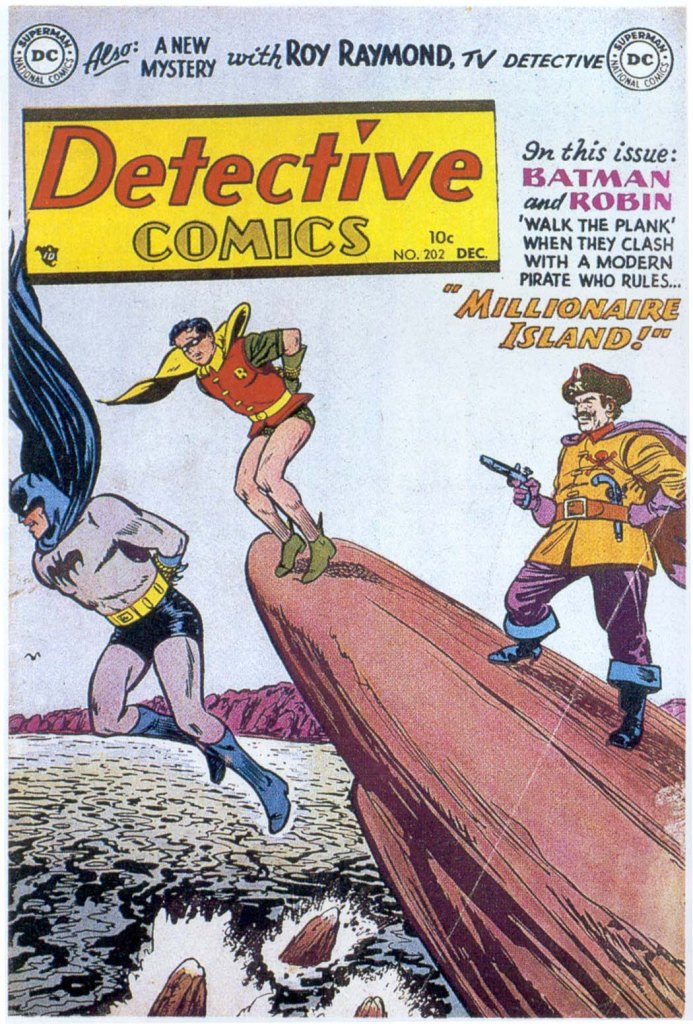
What this reduction meant in practical terms was that every anthology series needed to shed at least one feature. In the case of DETECTIVE COMICS, this meant that Robotman’s time was finally up. His final golden age story appeared in this issue, DETECTIVE COMICS #202, towards the end of 1953.
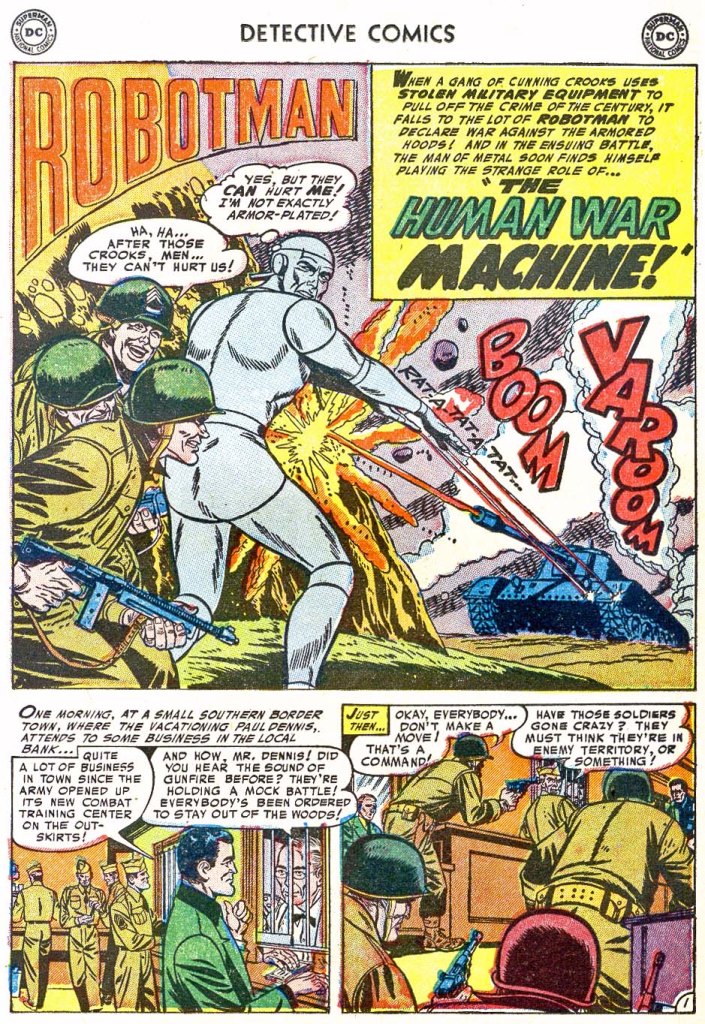
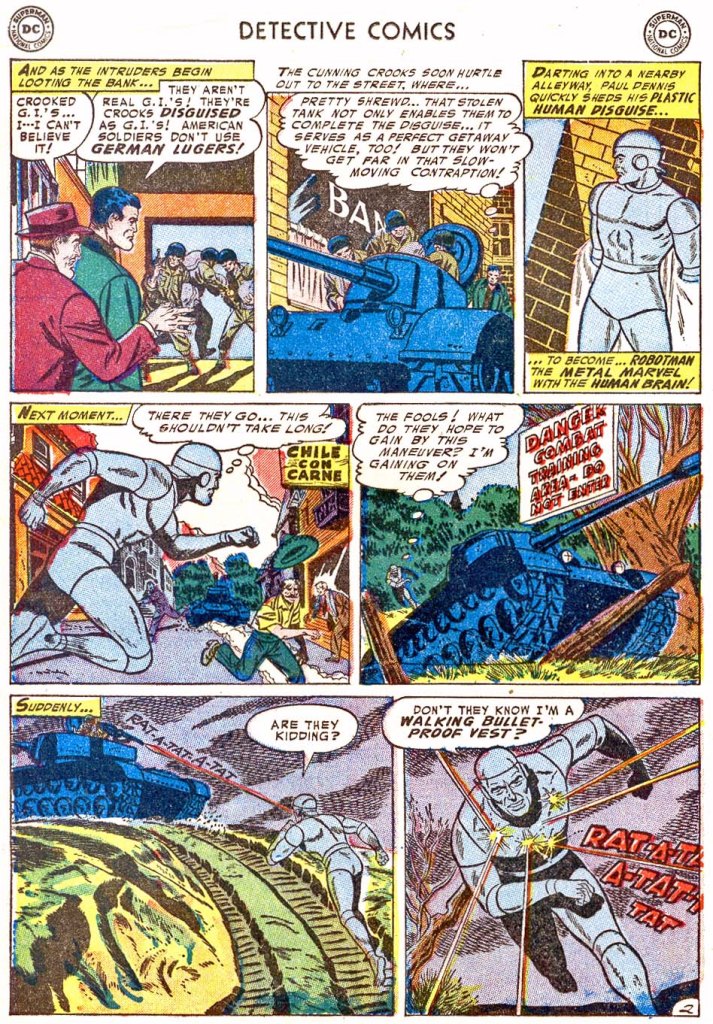
The writer of this final Robotman story is unknown, but the artwork was by Joe Certa, who is best remembered today as the artist who co-created John Jones, the Manhunter from Mars.
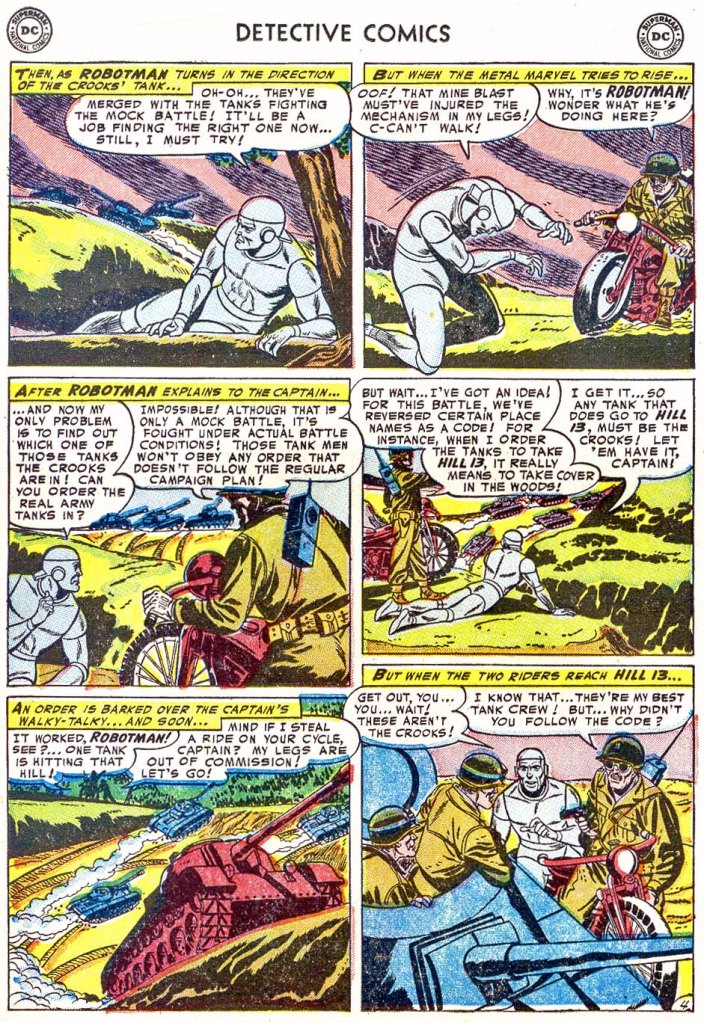
A decade later, writers Arnold Drake and Bob Haney would resurrect the premise of the Robotman strip for one of the characters in their new feature for MY GREATEST ADVENTURE; the Doom Patrol. This later Robotman (who was initially referred to as Automaton) didn’t bear any connection to his golden age forebearer apart from his heroic codename.
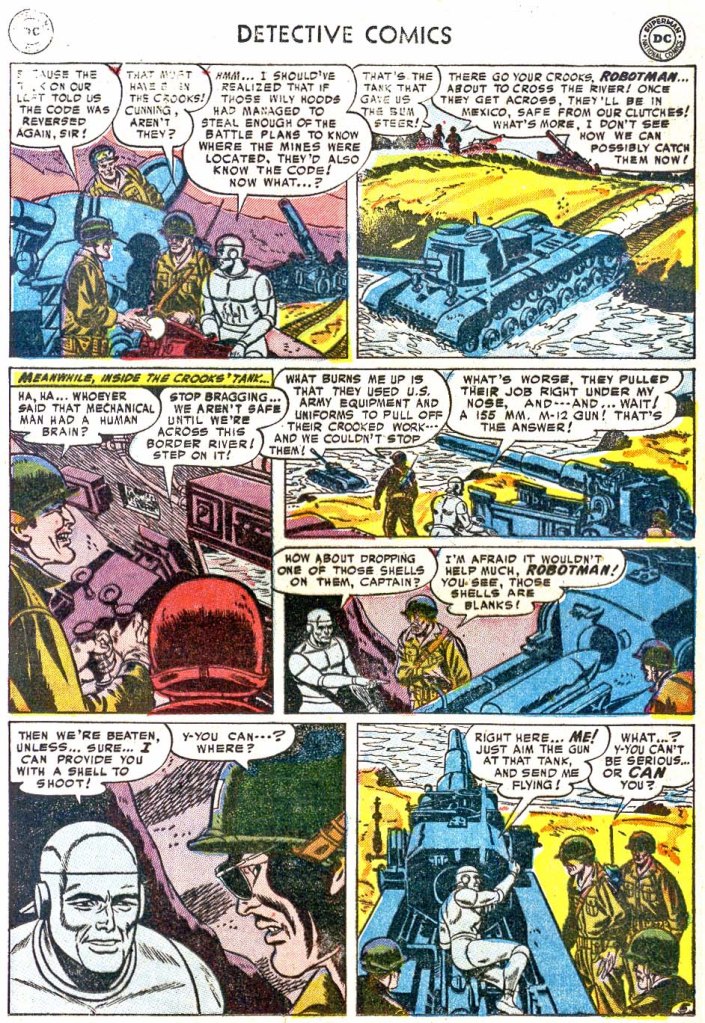
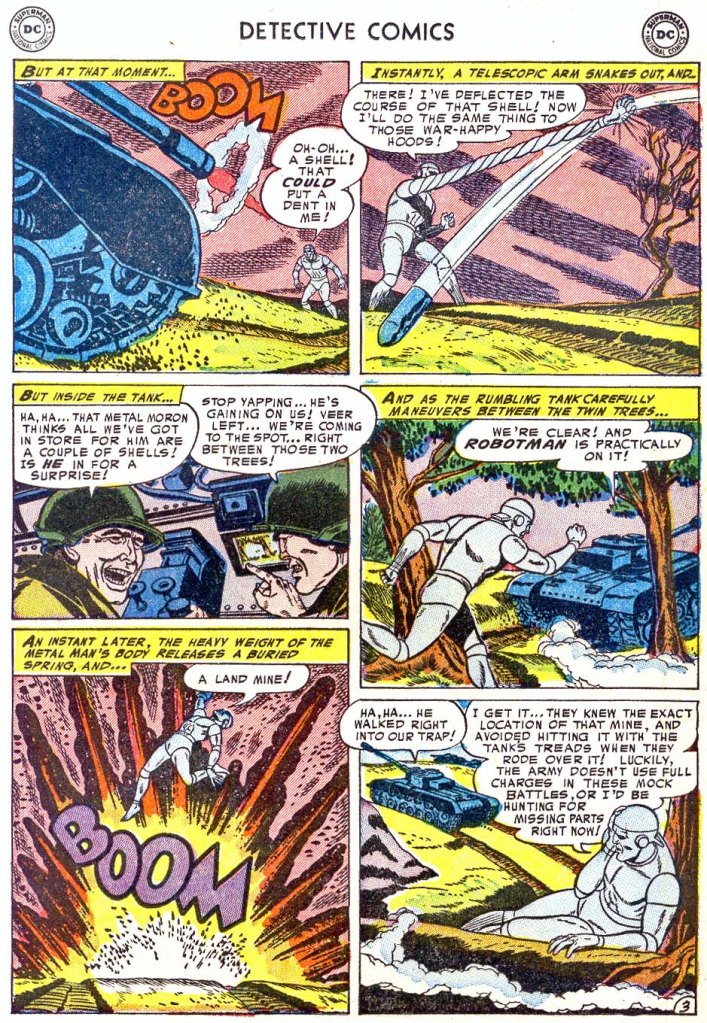
The climax of this story, in which the army fires Robotman at the criminal tank, shows a profound lack of understanding as to how such firearms work. But for the young audience of the period, it worked as well as anything else.
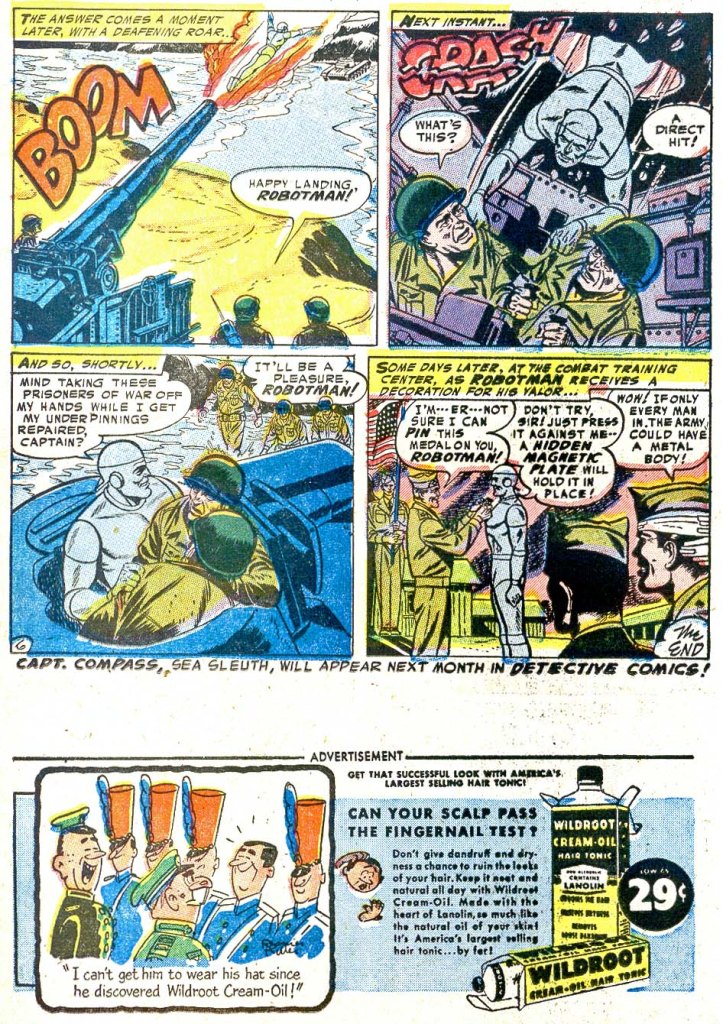
As this final blurb indicates, Robotman’s place in DETECTIVE COMICS was taken up by Captain Compass, who was a maritime detective and so fit in better with the theme of the magazine.
 The Tom Brevoort Experience
Gotta quibble with some of this. The Robotman series didn’t leave STAR SPANGLED when it became a Western book, and it didn’t get booted out of ‘TEC because the book was cut to 32 pages.
STAR SPANGLED didn’t really ever become a Western book — the closest I think we could say it came to that was that Tomahawk took over the cover spot, but that didn’t happen until 14 issues after Robotman had departed. Tomahawk’s not quite a Western (though it has a lot of similarities, I’ll admit), and the other series in the book were even less Western. STAR SPANGLED eventually did convert into a focused genre series — and at that point, it’d affect Robotman again.
And when the Robotman series left DETECTIVE, ‘TEC was still a 40-page book, and didn’t get cut down to 32 pages for another 10 issues. The series that got dropped because of the cut was “Mysto, Magician Detective.”
It looks like what happened on the leading edge of all that was that editor Jack Schiff decided to end the Air Wave series that had been running in ‘TEC, and at the same time he launched the Captain Compass series. I don’t know why Air Wave ended — his last story seems to have been artist Lee Harris’s last comics work, so maybe he got a better gig and left, or couldn’t find one after Schiff dropped him — but whatever the case, Schiff chose to move Robotman to ‘TEC rather than just give Captain Compass Air Wave’s slot. Though as you note, Compass got it eventually.
So that was just Schiff moving stuff around inside his own books. Weisinger probably wouldn’t have wanted Robotman even if he had room, and Julie Schwartz wouldn’t have an SF book to put the series in for another three years, even if he’d wanted it.
And why did Robotman get scrapped in ‘TEC? Mostly because STAR SPANGLED got handed off to Murray Boltinoff and turned into STAR SPANGLED WAR STORIES. Of the four series then running in STAR SPANGLED, Tomahawk had his own book by then, so he was okay; Robin’s solo feature ended but he was appearing in several other books regularly; Doctor 13 vanished for 16 years; and, well, Captain Compass got moved over to ‘TEC to take poor Robotman’s slot.
At the same time, Pow-Wow Smith also got kicked out of ‘TEC, but he found safe haven over in WESTERN COMICS. His slot got taken up by the ill-fated Mysto, who lasted only 10 issues and then was never seen again until ‘TEC 500. This must have been somewhat distressing for Leonard Starr, who was drawing both Pow-Wow Smith (which got given to Carmine Infantino by the new editor of WESTERN, Julie Schwartz) and Doctor 13, which, well, Starr got given Mysto as a replacement. Sorry, Mr. Starr, but good things will come your way in time.
And that, I think, is the song of Robotman, and his STAR SPANGLED/DETECTIVE shuffle.
LikeLiked by 3 people
The Splash panel depicts an event that clearly takes place before Robotman loses the use of his legs but there are no soldiers near him when that happens. Plus dc.fandom.com ( Robert Crane New Earth ) does not mention him firing bullets from his fingers: Superhuman Strength, Superhuman Speed, Elasticity ( arms and legs only ), Enhanced Vision ( photoelectric eyes ), Enhanced Hearing, Radar Sense, Super-Leaping and Thermal-Blast ( acetylene torches in his fingers ).
LikeLike
They must have has a circus Human Cannonball in mind for that Robotman stunt. HUMAN CANNONBALL ( https://en.wikipedia.org/wiki/Human_cannonball ): The impetus in the cannon is provided either by a SPRING or JET OF COMPRESSED AIR. This makes the device work more like a CATAPULT, where the cylinder propelling the human stops at the mouth of the cannon. Some cannons utilize nitrocellulose, specifically the dinitrate ester, cellulose dinitrate ( pyroxlin ). In a circus performance, GUNPOWDER may be used to PROVIDE VISUAL and AUDITORY EFFECTS unrelated to the launching mechanism. FIREWORKS and SMOKE may also be used to INCREASE the VISUAL EFFECT.
LikeLike
I’m sorry to see that Robotman’s robot dog companion was apparently out of the strip by the time the hero took his final bow.
LikeLiked by 1 person
To be fair, Robotman wasn’t any less detectivish than The Boy Commandos, which was still running in Detective when Robotman started. Hi
LikeLike
All Robotman needed was a hat shaped like a funnel and an axe, and he’d have a Halloween costume as the Tin-Man.
This definitely looked more ’50’s than ’40’s Golden Age to me. Especially the faces. It’s interesting to see the differences. Even for greats who were developing over the 5+ years their careers may have spanned from one decade to the next. Early 40’s Joe Kubert (was he still a teenager?) was striking, but not as refined as it’d get, 10 years later. Same for Alex Toth’s ’40’s Green Lantern vs. his refined ’50’s western stuff.
LikeLike
Gil Kane’s growth was amazing as well.
LikeLiked by 1 person
Robotman got a new lease on life with Roy Thomas made him one of the main characters in All Star Squadron.
LikeLike