

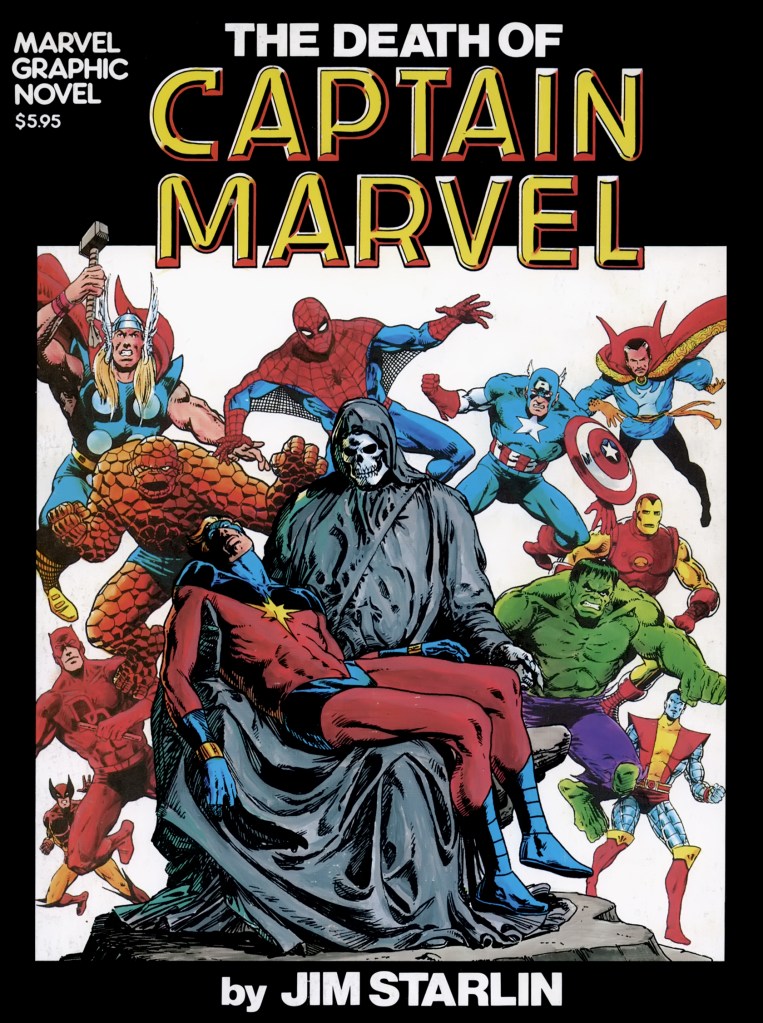
First of all, it’s got to be said: at a time when a regular issue of a new comic book cost 60 cents, the fact that this first MARVEL GRAPHIC NOVEL was priced at $5.95 was almost intolerable. Yes, it was 64 pages long by a top creator, yes it was on far better paper and was larger overall–the dimensions of a European color album, which is what had inspired the format in the first place. But regardless, this was a lot of moolah to be spending on a single comic book purchase in 1982.The actual bite of the cover price was concealed for me a little bit, in that I got my copy during the brief period of time when I was having my comic books shipped to me every month C.O.D. from Geppi’s Comic World. So I wound up paying for the entire shipment at once and wasn’t innately aware of just how much of that cost went to this one item.
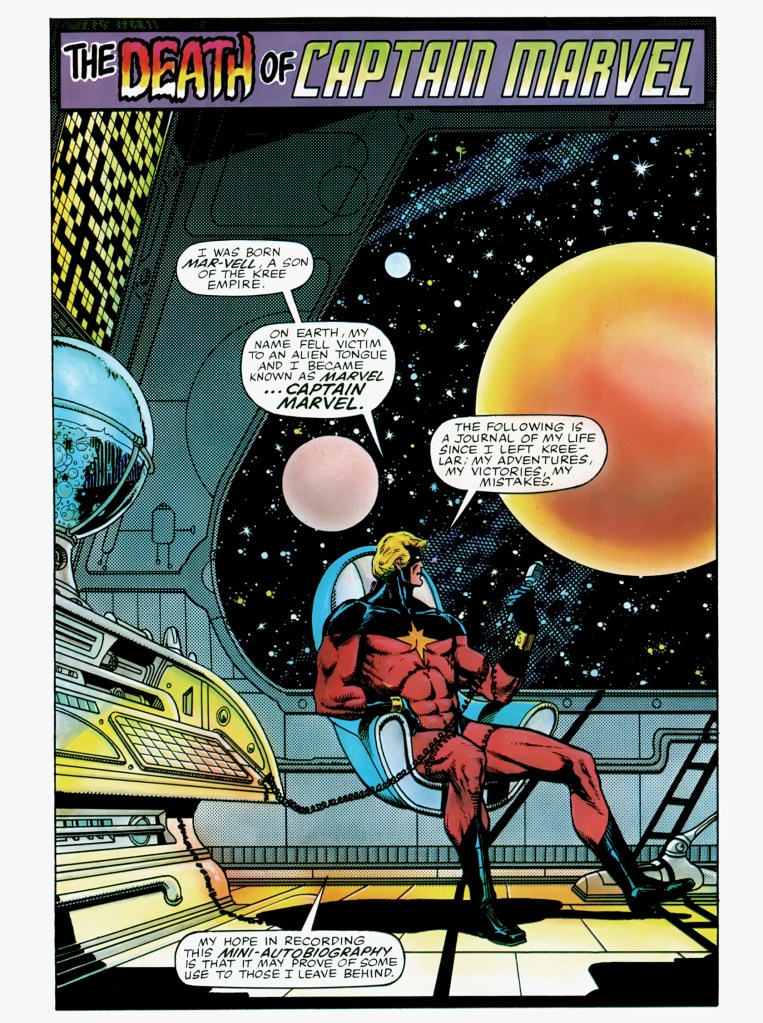
Putting the cost aside, this really is a very strong story and a very nice package. The assorted reprints over the years haven’t ever quite captured the feel of the original, in its larger dimensions and slick colors and paper. It represented, in my opinion, the capstone to creator Jim Starlin’s first period at Marvel. It’s a book in which he wraps up all outstanding business and story threads that were still lingering from his initial decade at the publisher. While he’d return in later years, by that point his experience and perspective had changed somewhat, and his work hereafter felt often like remixes of ideas he’s already explored in earlier stories. Reportedly, this story was particularly meaningful to Starlin, as his own father had died a short time before.
The titular Captain Marvel was, to put it kindly, a bit of a dog of a character. He’s originally been created in a rush so that Marvel’s owner Martin Goodman could secure a trademark on the name Captain Marvel. There was apparently some interest in an animated cartoon series featuring that name, so the Marvel incarnation became a warrior from an alien planet sent to spy on Earth. It wasn’t a great strip, and it was cancelled pretty quickly despite attempts to revise it to make it more appealing–new costume, new powers, new supporting cast, etc. But the thing that brought it back wasn’t anything that Marvel did. Rather, it was DC licensing the original 1940s Captain Marvel from Fawcett. To prevent them from reviving the character under the Captain Marvel name, Mar-Vell was brought back and given his own series once again. But it was still a lower-tier title, with only one true bright spot in its long run: when Jim Starlin was briefly writing and drawing it.
Eventually, the need to keep the series going had passed, and Captain Marvel was cancelled. At around this time, Roger Stern put forward a new idea: why don’t we create a new character using that name? After all, that’s the part that we need in order to hold onto the trademark. Roger planned to do such a thing in the pages of AMAZING SPIDER-MAN and AVENGERS which he was writing. But before that could happen, something had to be done about the existing Captain, Mar-Vell. As the creator most associated with the character, Jim Starlin was given the opportunity to bring his story to an end. it was quickly decided that this tale would be told as the first of Marvel’s new line of Graphic Novels–in this format, Starlin would get a greater slice of the pie than he would have had this been produced as a standard comic. Rather than having the hero expire in some life-and-death battle, Starlin took a much more human approach and instead had him contract terminal cancer.
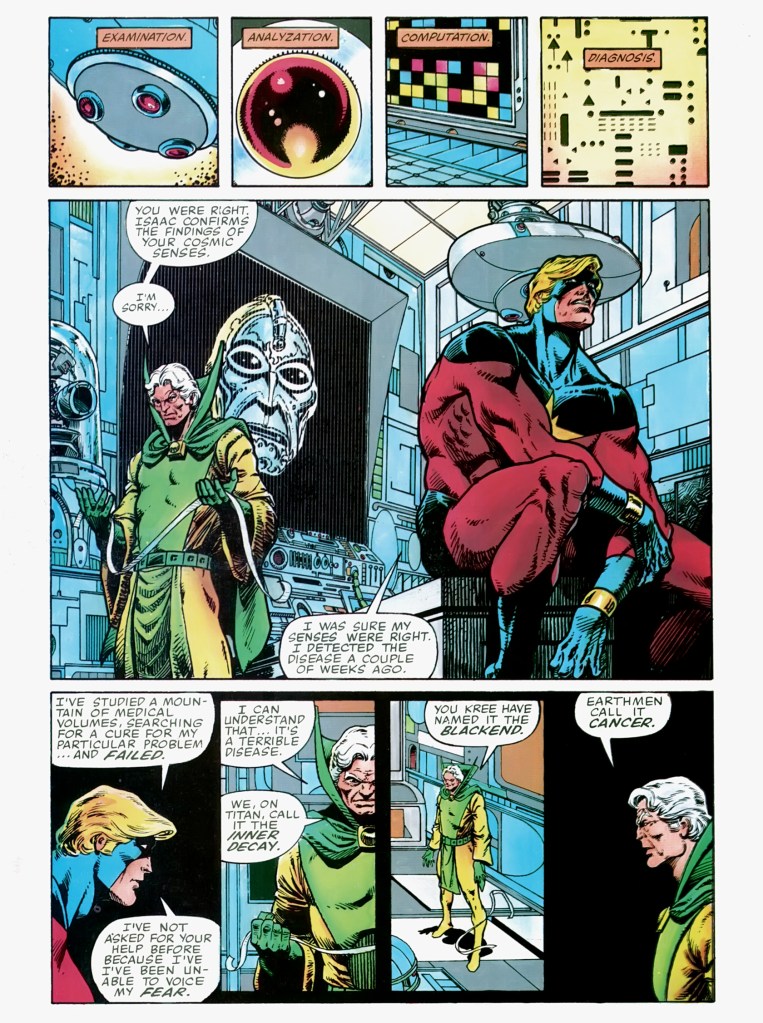
So this book opens with the semi-retired Captain Marvel living on Titan among the relatives of his old and now demised foe Thanos. He’s fallen in love with a woman, Elysius, and settled down to live out the rest of his days. But when he, Mentor and Eros are ambushed by a coterie of Thanos-Thralls who are still marauding despite the extinction of their leader, Mar-Vell finds himself more exhausted by the effort than usual. Mentor offers to run medical tests upon Mar-Vell, but through his Cosmic Awareness, the hero already knows what the problem is: he’s got cancer. years ago, in Starlin’s last adventure featuring the character, he had been forced to seal off a deadly canister of nerve gas that threatened to poison the area. Turns out that while he survived that exposure, it had the long-term effect of giving Mar-Vell cancer.
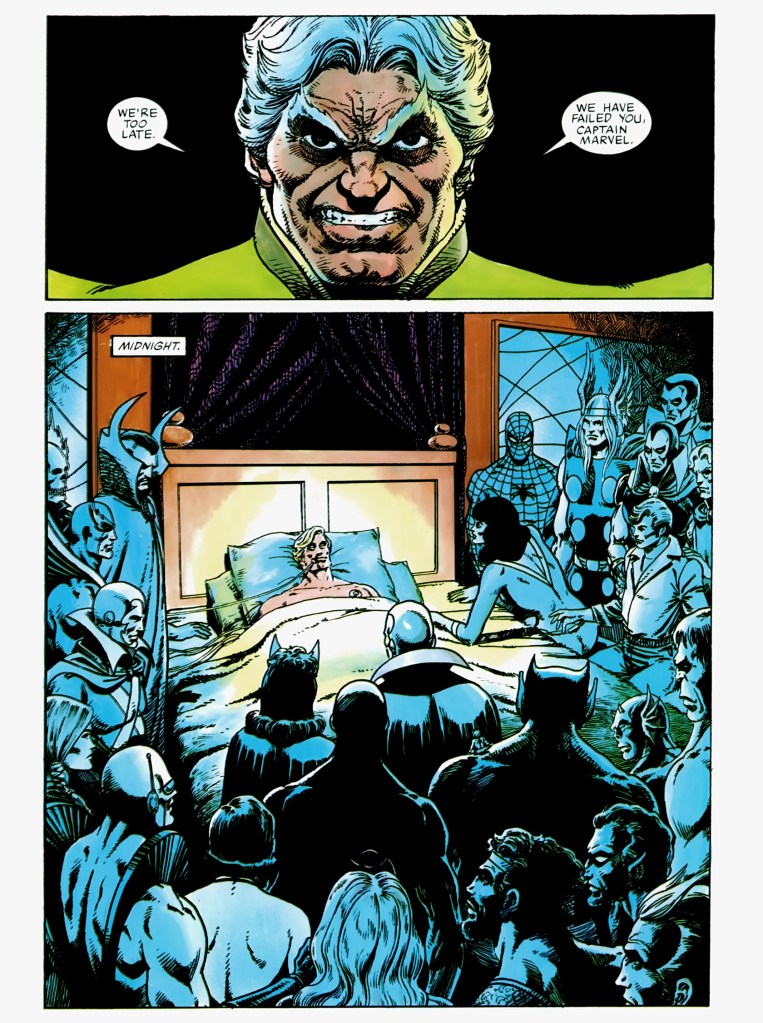
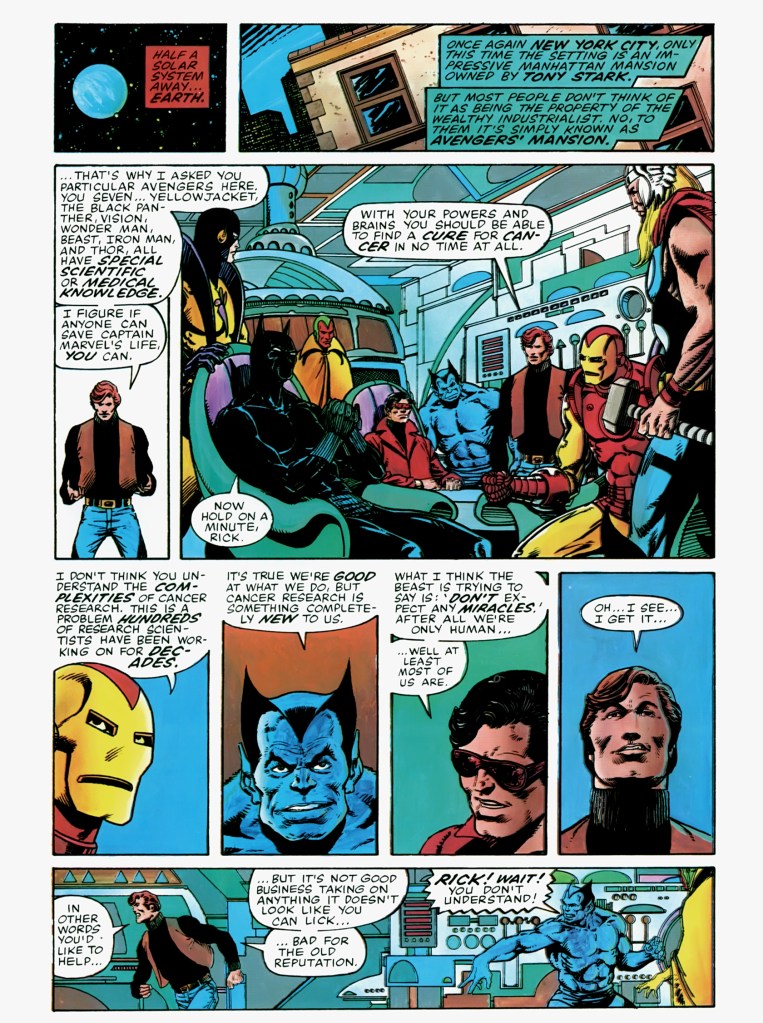
For the most part, there isn’t any overt action or fighting. Instead, the heroes of the Marvel Universe join forces in an attempt to cur cancer and save Mar-Vell’s life. All the while, the hero’s condition worsens and he works to get his affairs in order. When word of Mar-Vell’s impending demise gets out, in a memorable scene a military envoy from the Skrull Empire arrives to present him with an award for valor as their Empire’s greatest enemy. It’s all very sad and affecting, and very nicely realized by Starlin. In the end, of course, the heroes come to the limits of their abilities, and unable to defeat the foe that is this unrelenting disease, they settle in for the inevitable end.
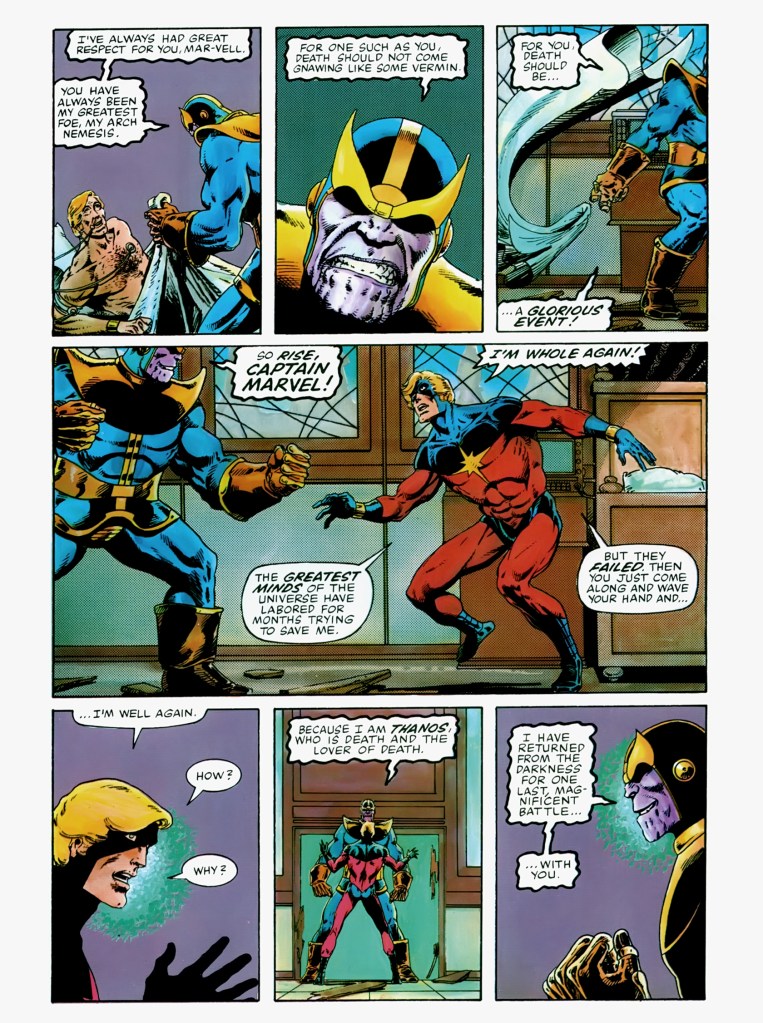
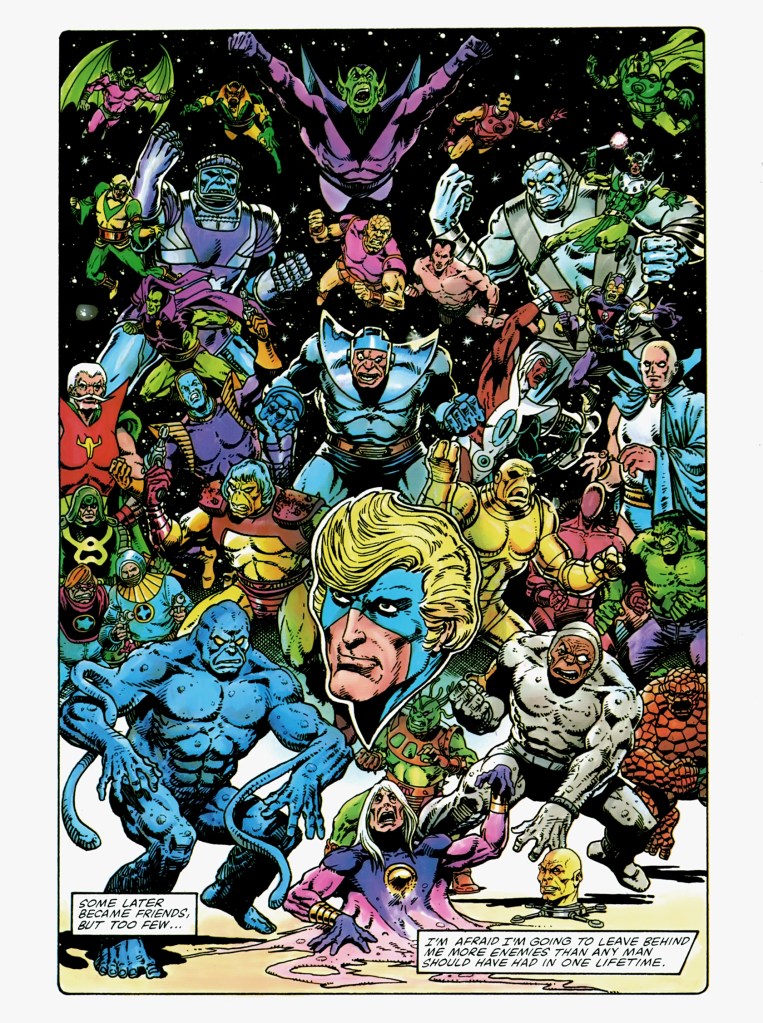
As Mar-Vell’s time grows short, the petrified form of Thanos stirs from where it has stood since the Mad Titan perished and makes its way to Mar-Vell’s side. He restors Mar-Vell’s vigor and tells him that, as his greatest foe, Mar-Vell’s death should be a thing of glory. So he stages one final climactic battle with Captain Marvel, with the fate of the universe apparently at stake and all of Mar-Vell’s deceased enemies joining in the fight. It’s a fitting last struggle, for all that it is all just for show. Because in the end, all men are finite, even men such as Mar-Vell and Thanos, and death comes to them all in the end. Ready to pass on to whatever comes next, Mar-Vell embraces the personification of death, and his life ends.

It is quite possibly the best single story that Jim Starlin has ever produced, at once cosmic and resolutely human, with an undercurrent of sadness and finality and a genuine empathy for both the character and anybody who has faced actual death at some point in their lives. What’s more, despite some abortive attempts to bring the character back over the years, it’s a story that’s been permitted to stand. And that’s proper, I think, in that it isn’t about the sort of death that super hero comic books are often full of, operatic bombast. it’s quieter, more contemplative, more realistic, and so it feels more genuine, especially to any readers who have had encounters with the same terrible disease that ends Mar-Vell.

For all that I liked it at the time, I didn’t yet have enough life experience to truly appreciate just how good a story this was when it first came out. It justifies its ridiculous price tag.
 The Tom Brevoort Experience
if nothing else, I makes me nostalgic for a time when a death in popular culture has gravitas and was thought to be relatively permanent.
LikeLiked by 4 people
I didn’t acquire a copy until years later. Discovered it lived up to its press clippings. I imagine the transfer of the name to multiple legacy heroes has helped Mar-Vell stay dead (and the number of people who want to bring him back probably isn’t large) but I’m glad it took.
For me this was the last great or even good Starlin story. But lots of people spend their careers without writing anything this good.
LikeLiked by 2 people
As someone who liked Mar-Vell I did not enjoy The Death Of Captain Marvel at all. Mentor, “We’re to late. We have failed you Captain Marvel” — that’s cause you didn’t have me there to tell you to use the FF’s Time Machine to go back and get cells ( maybe when someone knocked him out ) from Mar-Vell before his first encounter with Nitro and clone him a new healthy body and use the Telepaths on Titan to transfer his mind. Mar-Vell’s death didn’t affect me the way Sarek’s death in “Unification, Part 1 ( Season 5, Episode 24 ) did and that was before my own father died, or Elizabeth Keen’s fake death in the last episode of season 3 of The Blacklist “Alexander Kirk: Conclusion” — Raymond Reddington said words identical to and some similar to what I said to my then newly dead mother in that hospital room.
LikeLiked by 2 people
In Silver Surfer#13-14 ( July-August 1988 ) Steve Englehart cleaned up Jim Starlin’s mistake in The Death of Captain Marvel of having the Silver Surfer on Titan for Mar-Vell’s death ( Galactus’ barrier was still up around the Earth ). In Silver Surfer#14 you would think the Surfer would be more adept at his power than Bartak ( a Skrull disguised as the Silver Surfer ), but Bartak beats him and then is killed by Ronan.
LikeLiked by 1 person
I first encountered this version of Captain Marvel in my younger years, around the same time that I also discovered Starlins version of Warlock…loved them both, and the masterful artwork is what drew me in; the heavy narratives went over my head when I was that young, but I’ve come to deeply appreciate them in my later years. Starlin’s a craftsman.
LikeLiked by 2 people
I thought it too expensive for my budget, so I didn’t buy it. Then it got rave reviews, and I was very interested. Finally spotted a used copy at a comic book swap show for a bargain price, and I was surprised because it seemed to be in a smaller format… one that might fit in my comic long boxes. So I snagged it, and looked at the inside copyright. To my surprise, it was in its 10th printing, and various sized reprintings had occurred over the years. Glad I got one .
LikeLiked by 1 person
Mar-vell being a “dog of a character” makes Ms. Marvel’s creation and solo book a bit of a head scratcher unless it was also a trademark thing. If this guy in the cool Kane suit didn’t sell well why would a gal in the same clothes succeed? It’s because his belly button and legs weren’t showing apparently.
The powers that be (or at least Gruenwald) sure seemed to turn against Stern’s Captain Marvel despite the initial build up and subsequent position in the Avengers.
LikeLiked by 2 people
One of Gruenwald’s rare missteps as Avengers editor was ordering Monica Rambeau to be sidelines & depowered, which of course led to Roger Stern leaving the title, cutting short a really strong, creative run.
LikeLiked by 3 people
Looking back at Gruenwald’s career, causing Stern to leave Avengers will always stand out as huge blunder to me, and will always color my opinion on his work.
LikeLiked by 3 people
Mark wasn’t “against” Monica, per se — he’d edited almost all the stories she’d appeared in, after all — he just wanted to give the CAPTAIN AMERICA book (which he was writing) some extra cross-promotional value by making him the leader of the Avengers again, and it was just Roger and Monica’s bad luck that this happened right when Roger had made her (with Mark’s approval, and after a long buildup Mark hd also approved) the leader herself.
I think it was a conflict of interest on his part, and he made a bad decision besides. But sometimes that’s how the cookie crumbles, and Marvel’s loss was Superman’s gain.
LikeLiked by 4 people
I suspect her powers as originally defined made her a tough character to write. I liked the character well enough but thought her powers tended to remove just about any stake.
LikeLiked by 1 person
Not in the circumstances we’re talking about, because Roger Stern, her co-creator, was writing her and was perfectly comfortable doing so, in part because his wife is a trained scientist and consulted on the plotting.
After Mark fired Roger, other writers had problems writing her, and her powers got modified now and then to try to make her easier to write. I tended to fake my way through Monica appearances.
But while Roger was writing her, he wasn’t having any difficulties.
LikeLiked by 3 people
I dropped Cap’s book later in that run. Bad artists (or bad for Cap. Could be either because, you know, decades) were part of it but the series felt pretty lame overall. Maybe that should have been addressed rather than ruining Avengers.
LikeLiked by 1 person
Most of Gruenwald’s missteps involved Captain America.
LikeLiked by 1 person
I never thought Monica R was meant to be anything but a placeholder. Aside from that one special devoted to her, is there any evidence that Marvel ever considered giving her a series of her own?
LikeLiked by 1 person
I really liked her in “The Avengers” in the 1980’s. Having 2 “Captains” on 1 team seamed weird to me, but writer Roger Stern deftly had her friendlier ‘mates call her “C.M.”. “Cap” was reserved for Steve.
Years & even decades later, Marvel tried at least 2 other names for her. Photon doesn’t do her wide range of powers justice . I preferred “Spectrum”.
i dont care that “Dr. Spectrum” is also used, for another set of heroes. It still could’ve worked.
She’s still one of my fave Avengers. And one of the most capable & powerful
LikeLiked by 2 people
It seemed Monica always needed a new name because Genis-Vell had stolen hers.
LikeLiked by 2 people
I really liked her in Nextwave: Agents of H.A.T.E. but it’s possible that she was out of character there.
LikeLiked by 2 people
I’ll admit, I resented Monica at first. I’d been fond of Mar-Vell, and the fact that he was never considered for Avengers membership, while Monica strolled right in, irked me little. But Stern gradually won me over to her, and I was disappointed by her treatment after he left. If Stern had arguably been a little over-zealous in promoting his “baby”, the backlash against her seemed disproportionately mean-spirited.
On the other hand, I thought Monica was hilarious as the “has-been who peaked too early” in NEXTWAVE, although I’m sure that’s an extreme minority opinion…
LikeLiked by 2 people
As I posted on my blog a while back, I was just starting to get into comic books in a major way in 1985. I forget what exactly had prompted my nine-year-old self to purchase a copy of The Death of Captain Marvel, but I did. Even though I was totally unfamiliar with the Kree warrior turned cosmic protector Mar-Vell, Jim Starlin had done a superb job of summarizing his life before bringing it to a moving, tragic end in the graphic novel.
I was left with the impression that Mar-Vell must have been an incredibly important figure… although I now realize that if that had been the case, Marvel Comics would never have killed him off permanently in the first place. But in the mid-1980s, with no awareness of the chaotic publishing history of the Captain Marvel series, I really was convinced that his death was a huge deal.
And, no, all these years later I can’t remember how I afforded a copy of The Death of Captain Marvel! Six bucks was a lot of money for a nine-year-old kid to be spending in 1985.
LikeLiked by 3 people
Good story, especially for its time. The art looks off. I think I liked Starlin’s work more from a few years before this, maybe it was when inked by Milgrom. Here, and over the next few years, the eyes were drawn close together. The body part proportions were often mismatched with the torso. But Starlin went on to write some big stories the next 2 decades. “Batman” (including “10 Nights of the Beast”), “Batman: The Cult”, and several other. Then in the 90’s he and the great George Perez did their cosmic epic, “The Infinity Gauntlet”.
Marv-Vell’s red & blue suit was a big improvement over his original white & green Kree military uniform. And the change from white hair to blonde made for a nice visual balance with his star chest emblem and gold Nega-bands. Though I think another improvement was made for Kurt & Carlos Pacheco’s Genis-Vell; namely exchanging the red tights/”leggings” for dark blue.” And I think his hair was only white during use of his powers.
LikeLiked by 2 people
A few fears ago I had a commission drawn if an alternate roster of the Champions, using other characters that existed at the time editor Len Wein and writer Tony Isabella organized the book. The artist used the same poses as Gil Kane drew for the actual line-up.
We had Mar-Vell where Angel was, with some energy crackling in between his Nega-bands. The others were Tigra, Red Wolf, Power Man (Luke Cage), and Shang-Chi as Iron Fist (red outfit, dragon chest tattoo visible under the “v-cur” shirt, and yellow mask.
LikeLiked by 1 person
I agree with this generally … though Mar-vell looked pretty spectacular rendered by Kane/Adkins in the new suit with the white hair.
I generally liked The Death of Captain Marvel though it rubs up against the limits of what the characters are suited for… namely trying to solve an enduring real world problem for a single story and never trying again.
Starlin’s work is full of idiosyncrasies but it’s so distinctive and his storytelling is solid enough that they don’t detract. There’s an obsessiveness to his work that makes it really compelling to me. He knows how to bring the energy. I think it’s possible that the slickness of the printed product heightened the awkwardness a bit… where his work on newsprint appeared softer.
I never liked the cover concept though… why is Cap like Christ and Death like Mary?
LikeLiked by 2 people
It was a conscious homage to Michelangelo’s Pieta.
LikeLiked by 1 person
“It was a conscious homage to Michelangelo’s Pieta”
Yeah… I knew that since I referenced Christ and Mary. Regardless, the homage makes little sense in the context of Captain Marvel or Death unless Starlin is likening them to Christ and Mary. He’s not just referencing it.. the figures are traced in position so it’s meant to be symbolic, and the symbolism fails.
LikeLiked by 1 person
While it’s impossible to know what Starlin had in mind unless he’s said something on the subject, it’s worth remembering that in the Starlinverse Death is Female– or at least, she seems to be female most of the time. I don’t know of any orthodox Christian belief that would align the Virgin Mother with Death. I did see a brief remark by Camille Paglia to that effect, but I don’t know if she really believed there was a valid artistic comparison or if she was just being provocative.
LikeLiked by 2 people
I was 20 years old when this was first published and I got it brand new. Aside from losing a few pets during my childhood, I hadn’t yet experienced the death of any human I was very close to. But I thought this was a very moving story. As a young adult, I appreciated that Starlin was permitted to do something as unusual as having even a C level super-hero die of a disease that could not be magically cured and that even fit within prior events depicted years before in an issue I had — Starlin’s last page in Captain Marvel left him in rather dire circumstances, seemingly killed by that nerve gas. It almost seemed too perfect that although Mar-Vell was shown to survive that exposure in the short term, in the long term it proved fatal to him. I doubt Starlin really planned on that as an in-story means to later genuinely kill off Mar-Vell, but still it seems to fit. I’m also glad that the death was allowed to stand. I actually did like the character, admittedly more so when chronicled by Jim Starlin. The first comic I got to feature the Kree captain was C.M. #22, his 2nd revival, which was, well, not all that good. I think I was 9 at the time. I missed the next several issues but then got C.M. # 27, by which time I was 10. Now that issue, in my estimation, was magnificent. I loved the story and art. One of my favorite comics ever. I kept collecting the mag even after Starlin left. Sure, Milgrom’s art was middling compared to prime Starlin, but still reasonably good and I mostly liked Englehart’s writing. Even Conway’s brief run didn’t put me off and I continued until the mag finally did get its final cancellation. As well as the short run in Marvel Spotlight or whichever mag it was. Then Starlin returns for this final farewell.
Decades later, on February 28, 2014, I was with my mother, aged 70, as she died in a hospital bed, just before midnight. I was holding one of her hands as my stepfather, to whom she had been married for nearly 30 years, held her other hand. I had gotten the call that her heart had stopped at about 6:15 p.m., as I was about to relax after getting home from work. I raced to the hospital in Green Cove Springs, Florida, which was about 31 miles from my house — the traffic was just light enough that I managed to get there within 45 minutes – without going over the speed limit too much! The doctors had brought her back, and she was conscious but had an oxygen mask and couldn’t speak. Her heart stopped again and the medical team brought her back again. But her doctor told my stepfather and me that her death was inevitable and she only had hours left to go. Her heart was going to stop again and starting it up again was just prolonging her suffering. We were asked if we were willing to let her go more easily. My stepfather and I agreed it was better to let her go. I was able to call my younger brothers, one in Texas, the other in California) and enable them to say their good byes to her even if she couldn’t speak back to them. I’m fairly sure she could hear them but can never know for sure. I was gently holding her hand and watching the heart monitor as it zigzagged, spiking wildly, then coming down and finally flattening out as she died. At about 11:59 p.m. I don’t know the details of the death of Starlin’s father, but I could imagine it wasn’t all that different from what I went through and that translating that event into the last Captain Mar-Vell story had deep meaning for him. Which is the main reason I’m glad no one has undone that particular death story and hopefully never will.
LikeLiked by 4 people
Beautifully said. Tragic. 2014 isnt that long ago. I hope you and your family can find comfort in your favorite memories of her. I’m glad you were able to be there for her and your step-dad. Achingly tough situation.
LikeLiked by 2 people
I’m one of the minority that really like Mar-Vell but they did give him one hell of a sendoff. I still wouldn’t mind his coming back though, even if he can’t be Captain Marvel anymore. If Doran and Gaiman’s epic end of the Element Woman can be retconned away, anything’s possible.
LikeLiked by 2 people
As a kid getting into comics in the late ’60s and early ’70s, even before I turned 10 years old, among the reasons I came to prefer Marvel over DC was that despite all the outlandish fantasy elements, the Marvel characters were typically written more like actual people as far as their emotions, fears, failings, etc., than was the case in the contemporaneous DC comics I read at the time. I could relate to the Marvel characters more. And in that era of the Silver & Bronze ages, when a character was clearly shown to have died, they usually stayed dead, with such rare exceptions as Charles Xavier (although Thomas had at least provided a quasi clue that maybe it wasn’t really Professor X after all), Super Skrull (who I think should have been left dead) and Mandarin (the explanation for his resurrection struck me as ludicrous, but, hey, comics!). Most baddies, especially top-tier ones like Dr. Doom and Red Skull (but not the original Baron/Dr. Zemo) survived one seemingly certain death over and over again and in later decades even A list level super-heroes have been killed off or seriously injured but magically returned to life. But I mostly quit reading comics long before that became routine. When the outlandish fantasy elements seemed to overwhelm the more realistic qualities of the stories, I gradually lost interest. I’d occasionally find out about some runs that I found appealing enough for whatever reason to get the TPB or even hardbound collections. But when even death becomes a minor inconvenience for most characters, things have gone a bit too out of whack for me to remain interested anymore.
LikeLiked by 2 people
I really liked this story as well. I wasn’t aware of the first run of him. I picked him up when Rick Jones joined the cast and used the Nega-Bands to summon him. Marvel’s version of Billy Batson and Captain Marvel.
Also the Kirby’s use of the Forever People to summon the hero that was much more powerful than they were, when things got really rough. At the time, I had no knowledge of Ultraman in Japan and their use of a “normal” hero who could swap out with Ultraman to solve the big problems. So it was a well-used format. Later learned of Red Rube, who was also a summoned hero. There were probably more heroes like that.
I was not a fan of Starlin’s Warlock. Honestly, it seemed too “cosmic”, too “philosophical”. Captain Marvel had some of that too but was a bit more grounded, to me at least.
LikeLiked by 2 people
Darkhawk [ Darkhawk#1 ( March 1991 ) ] did the body swap thanks to a mysterious amulet – wikipedia ) that Mar-Vell/Genis-Vell and Rick Jones did. Not a body swap but when Rick Sheridan sleeps Sleepwalker [ Sleepwalker#1 ( June 1981 ) – wikipedia ] can materialize in reality or remain in Rick’s mind and converse with him via his dreams. Roko the Amazing ( Lon Crag ) [ USA Comics#5 ( Summer 1942 ) ] thanks to Menelaos ( Timely’s young Shazam ) transforms by saying Ilium. Etrigan the Demon ( Jason Blood ) is a transformation and not a body swap. Captain Triumph ( Lance and Michael (ghost ) Gallant ) [ Crack Comics#27 ( January 1943 ) Quality ] merge when Lance rubs the T-shaped birthmark on his right wrist. Then there is Erik Larsen’s answer to Billy Batson/Captain Marvel, Mighty Man ( originally Robert Berman and later nurse Ann Samantha Stevens ) [ Megaton#2 ( October 1985 )/ The Savage Dragon#3 ( October 1982 ) ] who transforms by taping wrists together ( Rick & Mar-Vell hitting Nega_Bands together ) — Mighty Man takes Thor’s place in the Liberty League ( The Avengers ) – Mr. Big ( Giant-Man ), Hornet ( Wasp ), Battle Tank ( Iron Man ) & Super Patriot ( Captain America ).
LikeLiked by 1 person
Just realized that way Rick Sheridan & Sleepwalker work is similar to the original 3-D Man ( Chuck Chandler ) [ Marvel Premiere#35 ( April 1977 ) ] that when Hal Chandler wore the glasses ( that Chuck’s image had been imprinted on the lenses ) and concentrated, he could trigger a dimensional shift that caused Chuck to materialize into a three-dimensional existence ( Thou the process is different, both Rick & Hal are responsible for the 2 heroes manifesting in Earth’s dimension ). Is Thor/Donald Blake a transformation or body swap?
LikeLiked by 1 person
I would say originally it was body swap, then it became Don Blake was actually Thor but made human by his father, so then it was transformation.
LikeLiked by 1 person
Black Racer, forgot about him, from the New Gods. He used the body of a totally paralyzed Vietnam Vet to house his body, then would exit it to go do his Death God schtick.
Sort of a mash between Kirby’s Silver Surfer and Hel, Asgardian Goddess of death, flying around on his skis and ski poles.
LikeLiked by 1 person
*snicker*
LikeLiked by 1 person
Then there is Marvel’s Perun who for unknown reasons was stripped of his godhood and bound to an amulet that was later found by Russian agent Valeri Soyloyev who used it to share his body with the headstrong deity, much to his distaste ( marvel.fandom.com ).
LikeLiked by 1 person
John Holstein: The initial version of Thor was clearly a simple transformation, of the type I think of as “magic skinsuit”. It’s like Iron Man, but a magic-based skinsuit instead of technology-based armor. This is evident because Thor talks and thinks as if he were Blake on steroids. Later on, they made the transformation more complicated, with mental aspects, to do the retcon that Blake was literally Thor the person. I call this “positive Hulk” – the character gets both stronger and mentally different in a desirable way. The modern DC Captain Marvel/Shazam is “magic skinsuit”, while I’d argue the Fawcett Captain Marvel is “positive Hulk”. Actual body-swap like Mar-Vell/Rick Jones has a big downside, since it’s necessary to explain why the powerful hero is trapped in limbo/Negative Zone/Pocket Dimension/whatever most the time, and they are going to want out. Which was indeed an element there. It’s not that good stories can’t be done with that premise, as with Etrigan The Demon/Jason Blood. But it’s really different from the common “magic talisman, power up!”.
LikeLiked by 1 person
As a child, in the seventies, I´ve read some Marvel comics but not regularly – mainly sixties stories, since they were published wth a large delay here in Brazil. In 1980 I saw the linked cover in the newstand and had my father buy it. It included the start (not really since they skipped some issues and started it with CM #29) of the original Thanos arc and I was so taken by the art and story that I started to collect comics. So Marvel´s death, published here in 1988, really impacted me.
http://www.guiadosquadrinhos.com/edicao/ShowImage.aspx?id=6284&path=abril/h/htv0302011.jpg&w=400&h=575
LikeLiked by 4 people
Look at all the responses to this post — that should be enough evidence that Death of Captain Marvel was a powerful work. We’re still talking about it. And it’s a quiet work — a very sober work. With people in spandex. Starlin could really tell great stories and work magic. He really should be considered up there with Kirby, Ditko, etc. A very special talent.
LikeLiked by 2 people
I bought this from my LCS when it first came out as I’d loved Starlin’s Captain Marvel–it was a breath of fresh air when it first arrived. It’s amazing to think how much the MCU came from Starlin. I had problems with his figure work–the head always seemed too small on his heroes–but on such a grand scale it was forgiven. Heck, even Superman showed up for the funeral (far right on that last page) so you know it was a landmark event.
LikeLiked by 2 people
Is he the one in the back, holding up Wolverine? 😉
LikeLiked by 1 person
It was an expensive purchase at the time but a really powerful story, almost as powerful as the death of Gwen Stacy. One more reason to bring the ReMasterworks back to recapture these CM issues.
LikeLiked by 1 person